
The Cost of Connectivity in West Virginia
West Virginia is one of the least broadband-connected states in the country. Many residents live in areas not covered by any internet service provider, and those with options often pay high rates for slow service. Our analysis of internet service options in 13 communities across the state shows that residents of rural communities have slower, more expensive options for internet service than West Virginians living in more populous urban areas. This data provides more evidence that rural communities in West Virginia remain inadequately connected to broadband service, and that both state and federal policies need to better support the buildout of better broadband infrastructure to previously underserved and unserved areas.
Affordable and reliable broadband service could help many West Virginians gain better access to employment, healthcare, education, government services, and federal benefits. County officials have said that the lack of broadband access narrows opportunities for economic growth in their communities. The state’s own broadband council has written about how a lack of broadband access disadvantages job seekers who cannot go online to look for jobs, fill out applications, and schedule or conduct virtual interviews. The COVID-19 pandemic is also exposing the depths of the digital divide and its adverse impact on rural areas like West Virginia, where many do not have access to affordable, quality internet service that would allow them to virtually meet with a doctor, apply for unemployment benefits, access online learning resources, or even stay informed on the public health crisis.
OTI began reviewing West Virginia’s internet access as part of our research for the next iteration of our Cost of Connectivity report. We published previous versions of this report in 2012, 2013, and 2014 to highlight the disparity between what consumers pay for broadband service in the United States versus consumers in peer cities abroad, as measured by retail prices advertised by internet service providers. We recently published our first set of findings detailing the benefits of a municipally-run fiber optic network in Ammon, Idaho. Here, we examine West Virginia, a state that has received federal attention for its rural connectivity challenges.
Our Methodology
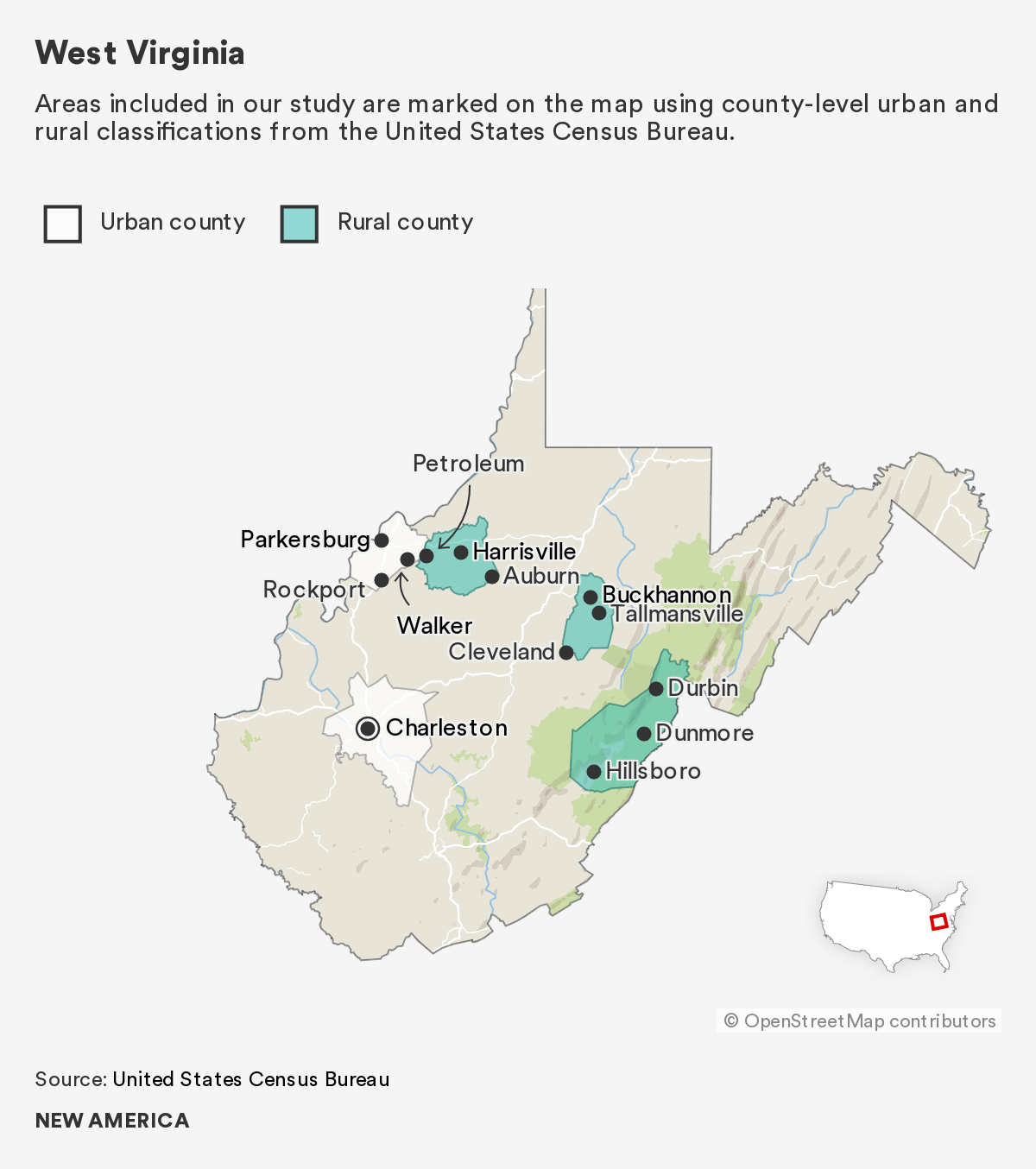
To conduct this research on the internet market in West Virginia, we chose four counties throughout the state—Pocahontas, Ritchie, Upshur, and Wood—and then selected three communities spread out within each county. We also collected data on service options within Charleston, the state capital. In total, we looked at 13 communities: Auburn, Buckhannon, Charleston, Cleveland, Dunmore, Durbin, Harrisville, Hillsboro, Parkersburg, Petroleum, Rockport, Tallmansville, and Walker.
We relied on a variety of publicly available sources—including broadband maps from the state and the Federal Communications Commission (FCC)—to gather and verify data on all available standalone broadband plans that we could locate across each community from November 2019 to January 2020.[1] To collect this information, we navigated the internet service providers’ websites and, if prompted, manually entered addresses and zip codes corresponding to real homes in the community. We selected these addresses by cross-checking the FCC’s Broadband Deployment Map with publicly available addresses in Google Maps.
Across all of the providers’ websites, we gathered data on download and upload speeds, monthly promotional and non-promotional pricing, contract termination fees, data caps, technology used, equipment costs and/or rental fees, activation fees, and installation fees, where applicable. Providers often list either a promotional price or non-promotional price on a monthly basis—where just one price is listed, we cite that number in our analysis. If providers list both a promotional and non-promotional price, we adopt the promotional price.
The data we compiled on broadband service in West Virginia is a near-comprehensive effort to include all available broadband plans that were listed publicly on the internet service providers’ websites at the time of collection. Other internet plans may be available, but all analysis in this blog post is limited to the 123 plans included in our dataset and the information that was available at the time of data collection (see Appendix). Our dataset does not necessarily represent the available plans for each community as a whole, as certain plans may not be available in all locations. Because our methodology is limited to collecting data on only those providers that list the relevant information online, our dataset excludes at least one provider: Armstrong Telephone Company, which services some of the areas examined in this study according to the FCC's Broadband Deployment Map.[2]
To conduct our analysis, we distinguished communities as rural or urban using county-level classifications from the United States Census Bureau, which is reflected in the following map.
Note: Not every broadband plan listed information on each aspect on which we were gathering data; the lack of data is signified by “no data” or a “—” in our data visualization. Some providers stated that certain aspects were not applicable to their offerings, which is noted in our dataset. As in previous years’ studies, all data collected reflects advertised costs that a new customer would pay and advertised speeds from internet service providers, which does not necessarily reflect actual costs a customer would pay or speeds they would actually receive. The price as advertised may in some cases include taxes, but providers did not always disclose this information.
Our Findings
Our research demonstrates that internet service in West Virginia is slower and more expensive compared to plans advertised across the country. This situation is particularly problematic in rural areas, where the offered plans are slower and more expensive than those offered in urban areas. This gap can be attributed to the differences in technologies available in rural versus urban areas. Those living in more populated, urban areas have faster, modern cable broadband options, whereas residents in more rural communities are more often limited to slower, outdated satellite technology.
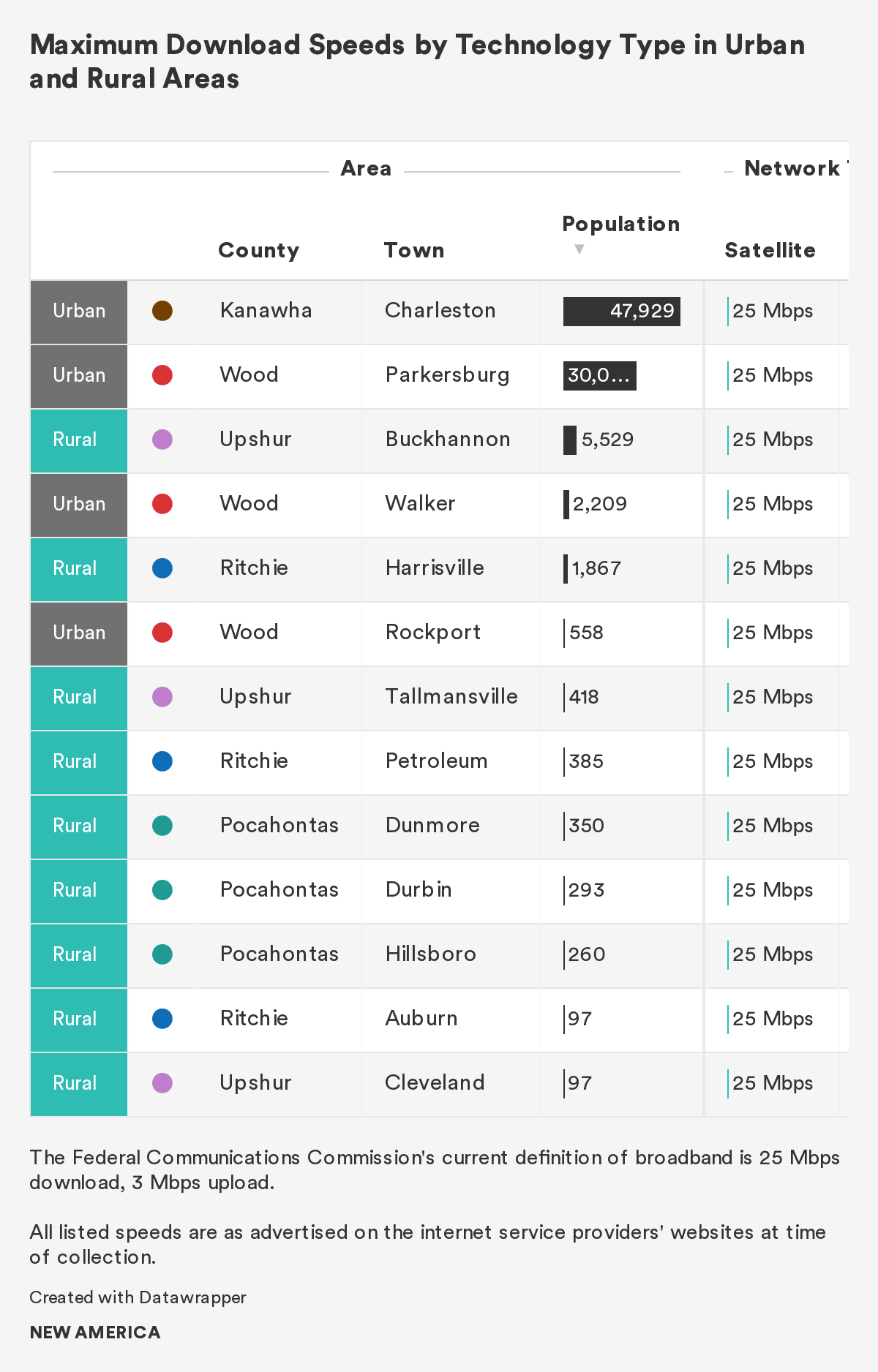
The only technology available across all 13 of the communities is satellite, which is also the sole option available in four of the less populated, rural communities: Auburn, Harrisville, Petroleum, and Rockport. Just five of the 13 communities examined have access to cable broadband, one of the fastest available technologies: Buckhannon, Charleston, Hillsboro, Parkersburg, and Walker. Apart from Hillsboro, these communities are also the four most populous among those surveyed. This trend is troubling, as satellite is one of the slowest and most expensive options for internet service. It suffers from high latency that causes delays in transmitting data between residences and satellites, can be subject to disruptions caused by weather and trees, and is often more costly than other options (as detailed below). It is also worth noting that even the urban areas we surveyed in West Virginia lack access to fiber technology, the “gold standard” for residential broadband.
When it comes to speed and cost, advertised plans in West Virginia are slower and more expensive relative to the median broadband costs and speeds for the United States identified in similar studies. The median advertised download and upload speed of the plans we surveyed is 25/3 Mbps, and the median monthly cost (looking at non-promotional prices where promotional prices were unavailable) across all plans is $84.99.
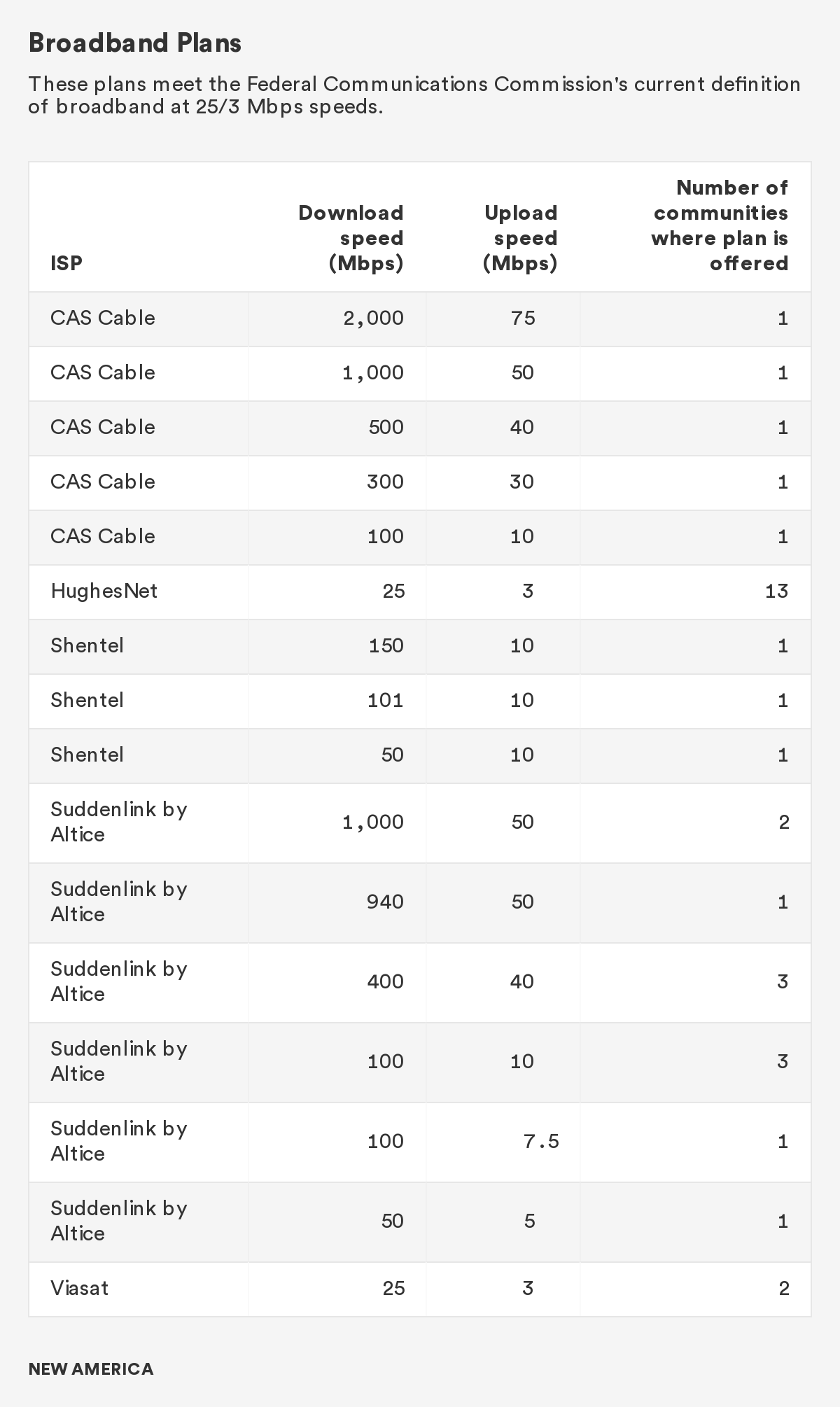
This median is notably higher than the $66 median price for all U.S. households found in a recent Wall Street Journal study. It’s worth noting that the Journal’s study combined monthly plan costs with equipment rental, speed surcharge, modem, and data-usage fees, whereas ours does not.[3] Therefore, we anticipate that the difference between the median monthly broadband costs would be even greater than $18.99 if we were to compare true equivalents.
Communities in West Virginia also have slower internet options. The Journal additionally found that the median download speed for broadband service in the United States is 100 Mbps, whereas the median download speed across plans in our West Virginia study is advertised at 25 Mbps. Although 25/3 Mbps is the minimum threshold for the FCC's current definition of broadband, such a speed is too slow for multi-person households looking to surf the internet, email, stream video, and share files, which could make it hard for people to apply for jobs, or stream online classes; FCC Commissioner Jessica Rosenworcel has called for a new, higher standard.
We found additional evidence of a rural/urban digital divide in advertised pricing and speeds. Average advertised download and upload speeds are consistently faster in urban areas than rural areas. The average download speed for plans advertised in rural communities within West Virginia is 25.65 Mbps, compared to 186.58 Mbps for those advertised in urban areas. The average upload speed offered, meanwhile, was 3.39 Mbps in rural areas, while it was over four times that, at 14.02 Mbps, in urban areas. Over half the plans offered in urban areas surveyed that have data on download speeds advertise higher download speeds for lower prices than plans offered in rural areas.
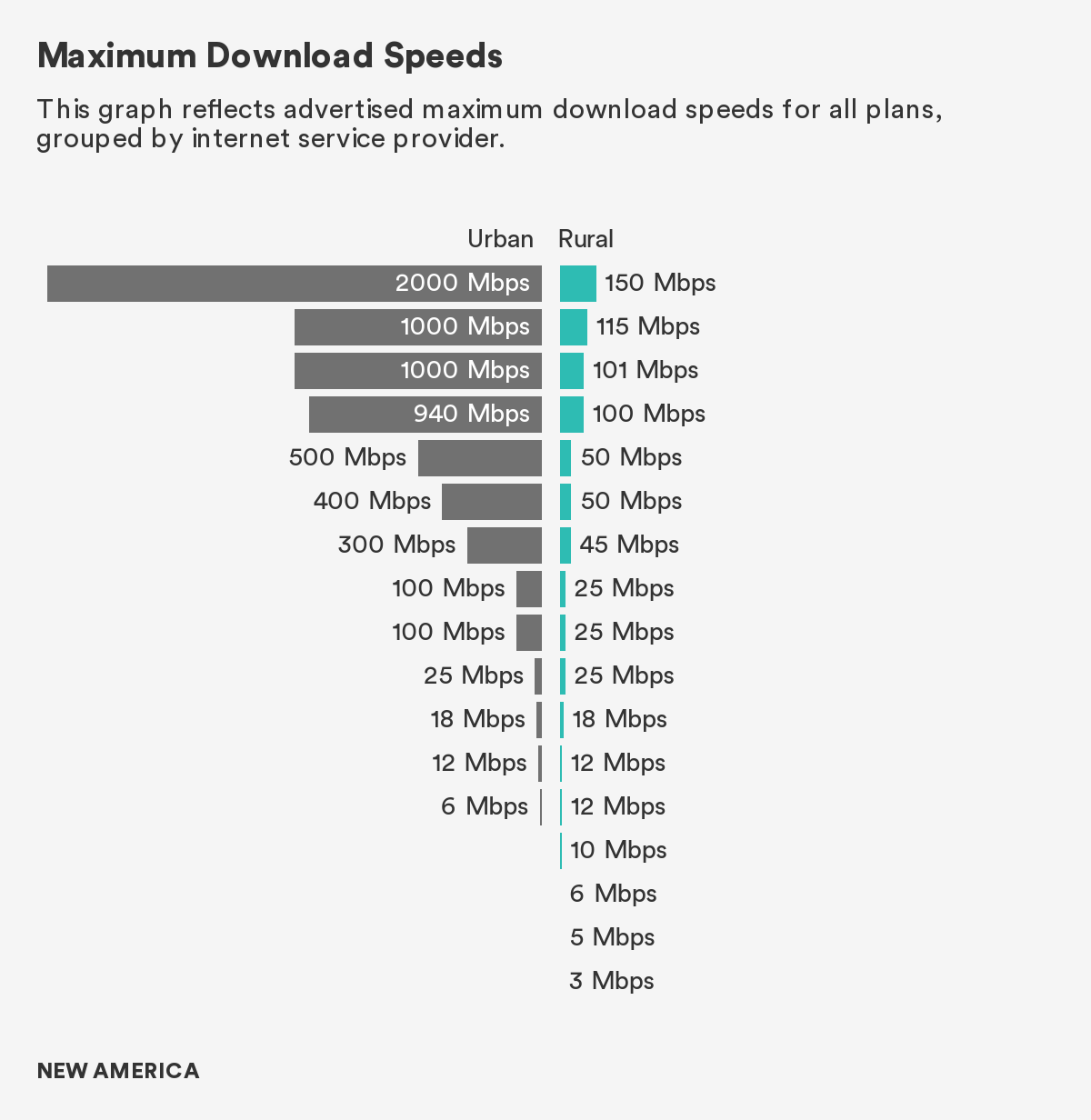
The bar graph above shows that whereas the fastest plan available in an urban West Virginia community advertises download speeds of 2000 Mbps, the fastest plan for a rural area advertises a maximum download speed of 150 Mbps. Additionally, while this plan in Hillsboro is the fastest for a rural area within West Virginia, it is also the most expensive plan, offered at $199.95 a month by Shentel. For comparison, CAS Cable advertises a 2000 Mbps download speed plan for $50 less in more populous Parkersburg.
Where a person lives can also dictate pricing. Suddenlink, for example, advertises that it charges $54.99 a month for its 100 Mbps download speed plan in rural Buckhannon, but the company offers the same speed plan for only $34.99 in the urban areas of Charleston, Parkersburg, and Walker.
Only one provider covered in our study, HughesNet, offers the same plans at the same prices in all the communities we surveyed. For all other providers, plans advertised in rural areas reach lower maximum download speeds than plans available in urban areas.
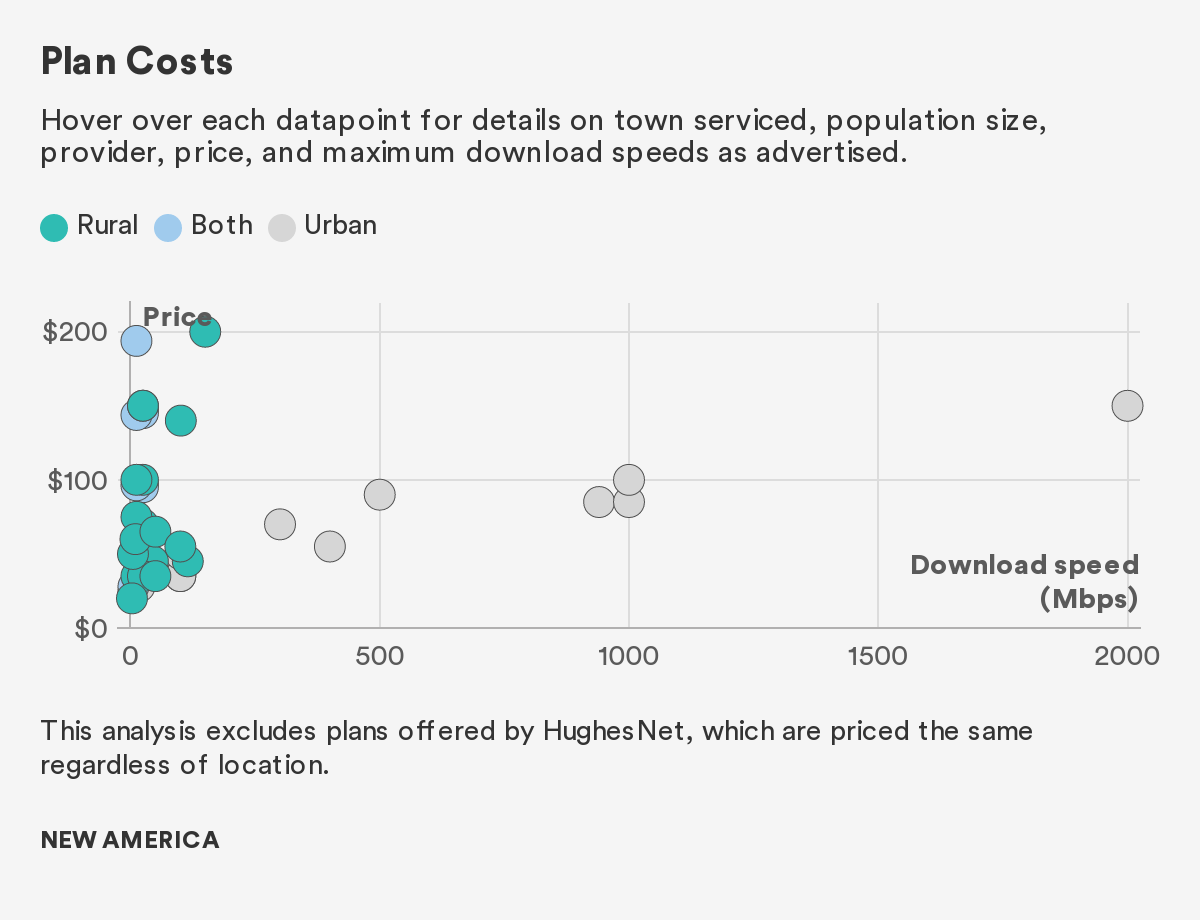
This scatterplot shows that internet options for those living in rural communities are slower and more expensive than plans advertised for those living in urban areas. For instance, we can compare Frontier’s 45 Mbps download speed plan offered in rural Tallmansville to Suddenlink’s 400 Mbps download speed plan offered in urban Walker. While Frontier’s 40 Mbps advertised download speed plan is the fastest plan offered in rural Tallmansville, it is also advertised for $44.99 a month. For ten dollars more, a resident of Walker has access to broadband service at four times faster with the 400 Mbps download speed plan advertised by Suddenlink.
Policy Implications
Our research indicates that further work remains to improve broadband access and affordability throughout West Virginia. A necessary first step is collecting better data to inform policymakers, as OTI has long advocated for. Current federal maps of broadband availability are flawed, as the FCC relies on internet service providers to self-report what speeds they offer, which can inflate numbers. It’s worth noting that these self-reported numbers rely predominantly on advertised metrics, which do not always match up with the speeds users actually experience. OTI has additionally urged the government to collect broadband pricing data—something no government agency currently does. Pricing data is critical to understanding the state of broadband access, as cost is one of the biggest barriers to adoption. The stakes are particularly high, as FCC Commissioner Geoffrey Starks has argued, because flawed data and mapping can cut out communities from critical funding opportunities that would expand access.
Federal subsidies for building out broadband can also help. Internet service providers can be discouraged from investing in rural communities by the risk of low returns stemming from a lack of potential customers. The FCC has historically tried to incentivize providers by subsidizing broadband build-out to rural communities through its Connect America Fund. The FCC also recently approved a new Rural Digital Opportunity Fund, which initially funds census blocks without 25/3 Mbps fixed broadband service. There are concerns, however, that funding rules as currently drafted could preclude many communities—including West Virginia’s Upshur County—from receiving assistance because it has already received federal or state subsidies. Underserved and unserved communities still need support to build out faster networks and better infrastructure, and such a restriction on additional federal funding could severely limit the ability of rural communities—like those in West Virginia—to improve broadband access.
States should also take steps to improve broadband access in underserved and unserved communities. West Virginia’s state legislature recently adopted a plan designed to improve broadband infrastructure throughout the state, and the governor has also approved multiple grants for broadband planning and infrastructure build-outs through the United States Department of Housing and Urban Development’s Community Development Block Grant program. Pocahontas County, for example, received $75,000 from the program to identify a strategy for building out broadband infrastructure in 2019.
However, the digital divide could widen if these subsidies are distributed predominantly to incumbent companies that use outdated, slow technology, like satellite and dial-up. In 2018, for example, the FCC granted money to satellite provider Viasat to improve its services in West Virginia through a reverse auction, a system in which participants bid for the least amount of support they believe they need to serve an area, with the lowest bid winning the auction. This system preferences incumbent providers that can offer low cost proposals that only involve slight upgrades to existing infrastructure. The reverse auction doesn’t incentivize adoption of newer and faster technologies, since maintaining older technology like satellite and DSL is less expensive—and would therefore win a reverse auction—than building out faster technologies like fiber.
OTI’s study of internet plans in West Virginia demonstrates that we should not underestimate the challenges that remain in improving access to broadband internet. Recent natural and public health disasters highlight how many still lack internet access and reiterate the importance of getting everyone connected. Policymakers need accurate pricing information for broadband plans alongside comprehensive information on availability and speeds. Our forthcoming Cost of Connectivity report will provide more information on the scope and nature of this problem, motivating discussions around policies that will make broadband access more affordable and accessible.
Appendix
Plans available in West Virginia
[1] We included satellite plans in our West Virginia dataset as satellite technology is most readily available in rural communities. Some of these communities are not serviced by any providers when satellite plans are omitted.
[2] Armstrong Telephone Company’s website directed us to call their customer service line to check if service was available: “Armstrong services may not be available at the address provided. Please call us at 1-877-645-1586 to speak with a customer service representative if you feel this is incorrect.”
[3] The Wall Street Journal study also relied on data from broadband bills from real customers, and included bundle options, wherein customers received not only internet, but also television or telephone services. More details on the Wall Street Journal study’s methodology can be found here.
Acknowledgments
The author would like to thank Becky Chao, Sharon Bradford Franklin, Amir Nasr, and Josh Stager for their contributions; Naomi Morduch Toubman for the data visualization designs; and Lisa Johnson and Austin Adams for their communications support.
Downloads
More About the Author