

Haley Swenson
Senior Writer and Researcher, Better Life Lab
The COVID-19 pandemic put the spotlight on child care as a necessary public good for U.S. children and critical for the workforce to function, as well as the country's broken system. It has also generated renewed interest in innovations within the child care field to better serve children, parents, and providers.
Using a solutions journalism approach, the Better Life Lab conducted interviews with providers, parents, innovators, advocates, and experts to better understand the innovation opportunities and successes within the child care field. A clear policy goal emerged across five main areas of innovation: offer child care as a public good, with strong federal investment to shore up a national child care system. Without the political will to do so, child care innovations may remain limited, local, and unsustainable in a fractured system. The overall well-being of our country’s workforce and its children will largely depend on the creation of a sustainable and fully funded federal program.
The Better Life Lab’s reporting and research for this project were supported by Pivotal Ventures, a Melinda French Gates company. The authors wish to thank the innovators, entrepreneurs, experts, policymakers, and teachers in the field for sharing their time and stories for this report. We also thank Linda Shockley and the team at Early Learning Nation for publishing excerpts of this report ahead of publication.
Thanks also to Elliot Haspel, Julie Kashen, and Cara Sklar who took time out of their schedules to share insights and expertise and to review and comment on earlier drafts of this report. Thanks to the Better Life Lab team for their support: director Brigid Schulte, senior fellow Vicki Shabo, operations associate Keisha Dixon, and former colleagues Sade Bruce and Stavroula Pabst. Thanks, too, to Jodi Narde and the New America Communications team, and Angela Spidalette and the New America Events team for their work in publicizing this report and event.
In the United States, child care has historically received far less public investment than K–12 education and less private investment than areas like education and health care. U.S. investment in early care and education (ECE) for children aged zero to five is among the lowest of all Organization for Economic Cooperation and Development (OECD) countries. Market solutions, like relying on individual proprietors to meet the growing needs for care out of self-interest, have utterly failed. Even public efforts designed to help qualifying parents pay for the cost of child care—the Child and Dependent Care Credit for instance—haven’t kept up with the soaring costs of child care, have failed to keep thousands of providers open, and aren’t designed to help those least able to pay. As a result, innovation has lagged—impeding efforts to create an accessible, high-quality universal system with a variety of choices that meet family needs and offer widespread benefits to children, families, communities, society, and the economy.
The COVID-19 pandemic put a spotlight on child care as a necessary public good for U.S. children and critical for a functional workforce. Though some relief came to the child care sector through the American Rescue Plan, Congress has failed to expand the current funding mechanisms, shore up the early education workforce, and propose infrastructure for a fairer and more accessible system. As a result of the unmet needs on display during the pandemic, private for-profit and philanthropic investment in child care innovations has increased—without centralized policy or infrastructure meant to ensure these investments will benefit families most in need.
In dozens of interviews conducted for this report with providers, parents, innovators, advocates, and experts, a clear policy goal emerged: offer child care as a public good, and commit to investing public funds to improve quality for children, provide reliable coverage that meets families’ needs, and offer living wages, benefits, training, and support to educators and providers. We cannot rely on the private sector alone to be the solution, as market incentives from either the supply or demand side cannot fully cover the cost and complexity of universal care. However, some innovations from both the private and public sectors—or in some cases, a collaborative effort—show the potential for particular interventions to improve the current state of and increase general access to child care in the absence of major federal policy change, particularly if given the resources and attention they need to thrive and scale.
Individual families and providers cannot be expected to shoulder the responsibility of the child care system alone. We found some small pilots and individual innovations in the field that helped certain groups, which could be a part of a well-functioning system. But taken on their own, they’re not enough to build a universal system. For instance, new apps to help parents find nearby child care options may be valuable, but they don’t help increase the supply of child care on offer, especially after pandemic-era closures. Building an infrastructure that meets families’ needs, particularly in child care deserts, will require robust federal and state investment and inclusive design to transform the fragile, unsustainable economics of the existing child care system.
Questions raised for discussion:
The Better Life Lab and its partners embarked on a year-long solutions reporting project to find out the best answers to these questions, based on the experience and wisdom of child care providers, advocates, researchers, and parents today. We have identified five important areas of innovation and noted 25 innovations across these areas, both to emphasize the promise of thinkers and builders already engaged in these discussions and to highlight the need for even further attention and investment in these spaces.
For the purposes of this report, innovation is defined as a group, entity, idea, movement, or organization that seeks to improve access to high-quality early care and education, with the potential to scale or be applied elsewhere, in pursuit of just, equitable, and truly universal child care.
Our deep dive into child care innovations found several areas of notable progress. These included efforts to:
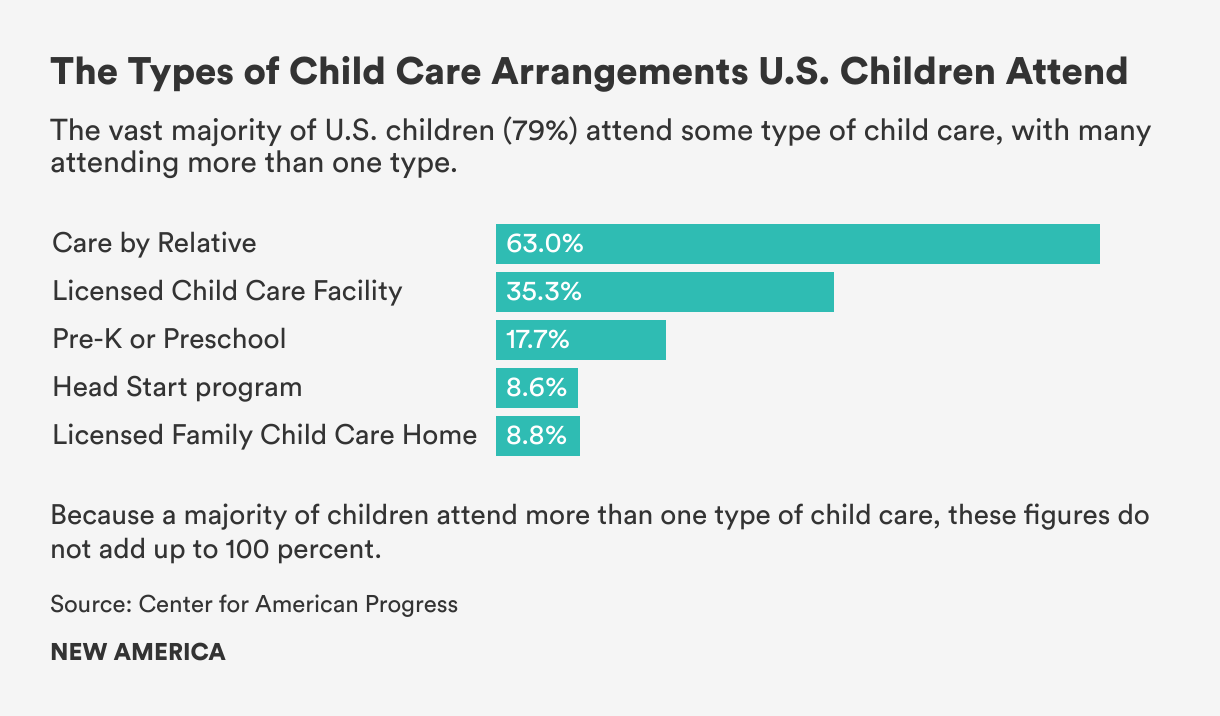
Receiving care and education from someone who isn’t a parent is an increasingly common part of life for the majority of children in the United States. According to the most recent available census data, analyzed by the Center for American Progress, the majority of children aged zero to five in the United States spend time each week in nonparental care. Of children who receive care from a nonparent, more than half receive care from more than one provider. Of those children who spend time in nonparental child care on a weekly basis, the majority (63 percent) are cared for by a relative, like a grandparent or sibling; 36.9 percent spend time in a licensed care setting; and 19 percent receive care from an unlicensed nonrelative, such as a home-based care provider, a friend, or a neighbor.
Beginning in March 2020, the lockdown phase of the COVID-19 pandemic shifted child care burdens back home and forced families to rely on unstable or untenable arrangements. Parents juggled caring for their young children out of their normal child care settings while working from home, in some cases also while helping older children with their remote schooling. Many parents of color, who are disproportionately represented in occupations that do not allow telework and therefore could not work from home, were forced to leave their jobs or scramble to find new child care arrangements, including arrangements they did not prefer, like having older children watch younger children.
The COVID-19 pandemic has had profound detrimental effects on marginalized children. More than 75 percent of children dying from COVID-19 are minorities, mirroring the disproportionate death rates of adults. The disproportionate representation of minority deaths may result from, among other things, mistrust of and lack of access to health services. Additionally, child poverty rose between 2018 and 2020 for Black and Latinx children. Analysis of data from the National Survey of Children’s Health reveals that before the pandemic, Black and multiracial parents experienced child care–related job disruptions—such as quitting a job, not taking a job, or changing their job—due to problems with child care at nearly twice the rate of white parents.
In many immigrant families (like those with green cards or whose children are U.S. citizens), adults who lost their jobs or had their hours reduced during the pandemic did not qualify for most forms of federal aid, such as unemployment insurance or recovery rebates. Because of their immigration status, many also fear applying or don’t qualify for federal public benefit programs like Supplemental Nutrition Assistance Program (SNAP), Medicaid, Supplemental Security Income, or Temporary Assistance for Needy Families.
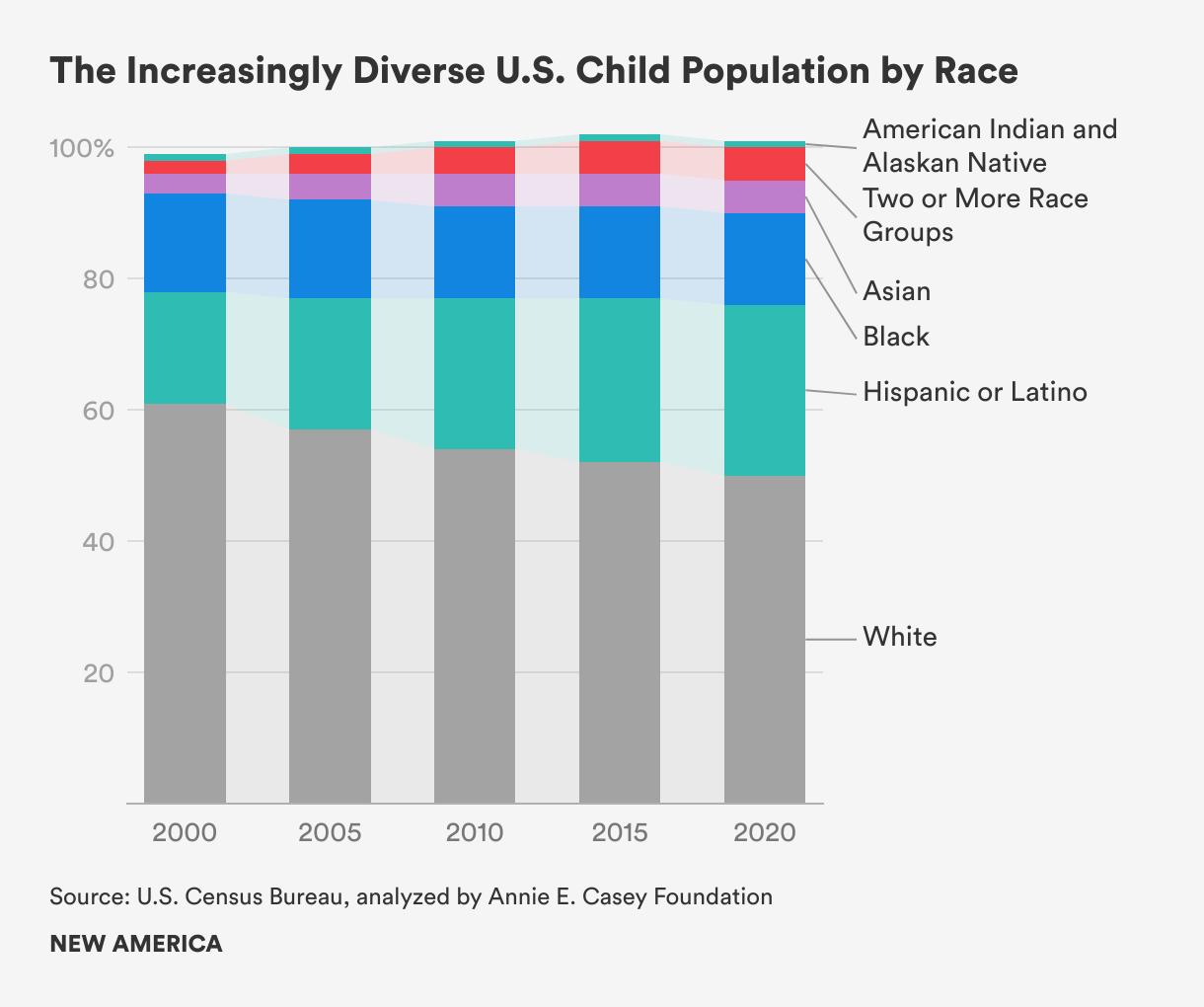
The U.S. child population has become increasingly diverse in recent decades; children of immigrants make up the fastest-growing population of children. Each area of inequality for children and families of color has a pronounced impact on the overall well-being of children.
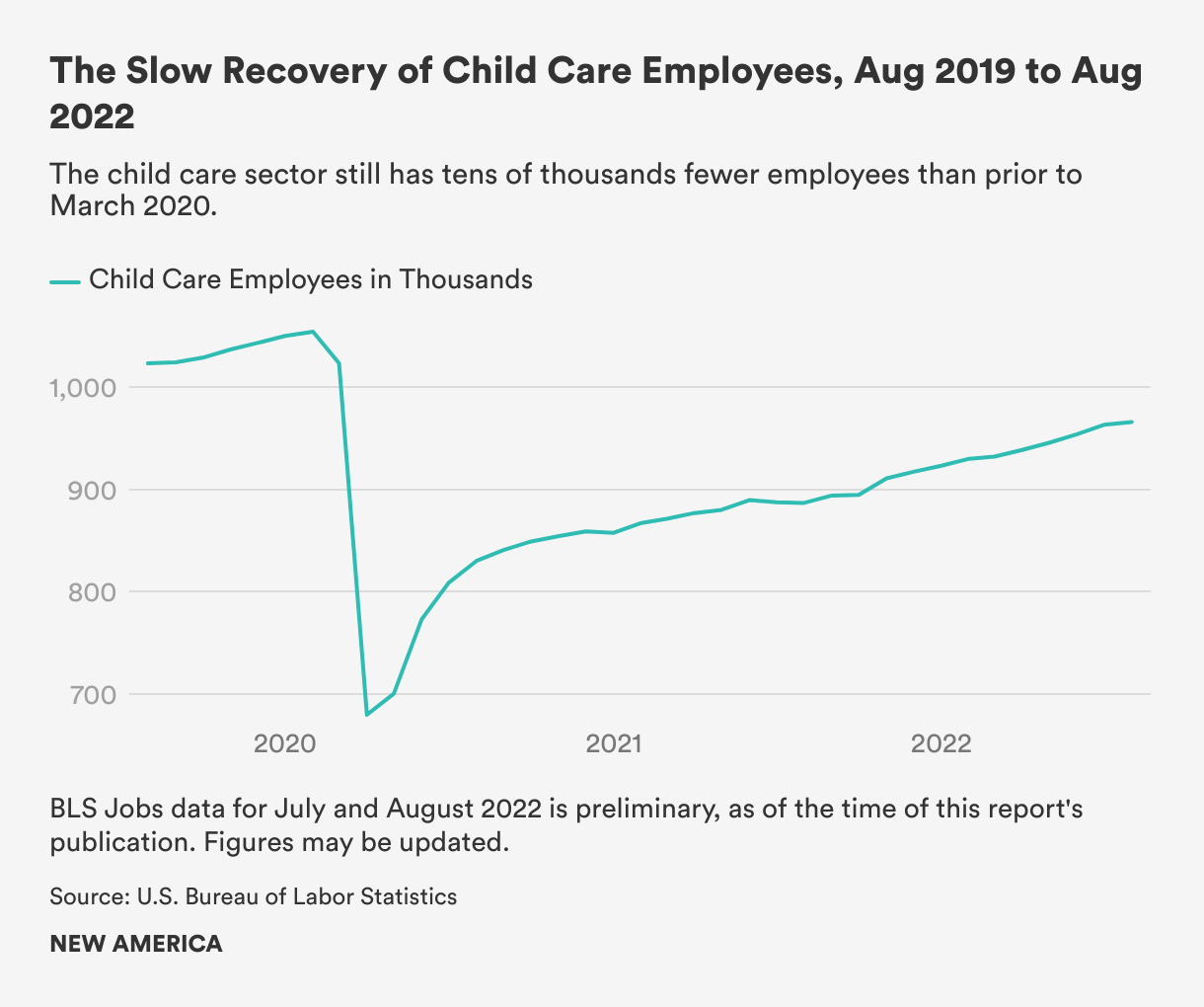
Between 2019 and 2021, 8,899 child care centers and 6,957 family child care providers closed, according to Child Care Aware. Because women continue to perform the majority of housework and caregiving, managing these gaps in child care has often fallen to them. More than two years after the pandemic began, an estimated 1 million fewer women are in the workforce, and many cite the need to care for children as a reason why. Furthermore, the child care workforce also shrunk, dropping from 1,054,200 workers in pre-lockdown February 2020 to just under 680,000 by April 2020, according to data from the U.S. Bureau of Labor Statistics (BLS). By August 2022, the most up-to-date (but preliminary) BLS data available at the time of publication, many of those workers had returned to the child care sector, but still 88,000 fewer than prior to the pandemic.
The child care workforce also represents a site of ongoing racial inequality. Although virtually all child care workers are women, women of color and immigrant women disproportionately do not enjoy adequate wages or benefits. More than one in five (22 percent) child care workers is foreign born, 15 percent of child care workers are Black, and 21 percent are Latinx. Data from the National Survey of Early Care and Education in 2019 show that wages for early childhood teachers differ by race: Black women earned 76.3 percent and Latinx earned 85.2 percent of what white teachers were earning. Perhaps even more troubling is that the wage disparities worsened for both Black and Latinx teachers between 2012 and 2019. While inflation-unadjusted hourly wages for white women increased 92 cents, they decreased for Black and Latinx women by 40 cents and $1.05, respectively. The low wages child care workers earn has undoubtedly slowed the sector’s employment recovery, as some experienced teachers seek higher wages and more stable employment in other sectors.
As a result of pandemic-related closures and the decline in staffing, millions of children, including millions with disabilities, were cut off from critical resources. According to data from ChildTrends, approximately 7 million infants, toddlers, and children with disabilities struggled with the sudden absence of health services and learning accommodations as providers closed and schools grappled with providing remote instruction.
Devastating outcomes like these made child care a subject of national debate for the first time in decades. Despite years of public underinvestment in early care, recent studies suggest the U.S. public is, by and large, open to a much more assertive public role in the sector. A 2022 poll by Morning Consult showed overwhelming bipartisan support for child care investments, including 72 percent of all adults and a majority (60 percent) of Republicans favoring expanding subsidies to make child care more affordable for parents. Yet efforts by U.S. President Joe Biden’s administration to champion child care and prekindergarten investments in 2020 through its Build Back Better framework were met with staunch opposition, despite several members of Congress championing the early care and education portions of the legislation.
We know from other peer-competitive economies, as well as experiments with public child care in the United States like the Lanham Act during World War II, that a high-quality, accessible, affordable universal early care and education system—with a well-compensated, well-trained workforce—helps everyone thrive. Until more robust federal investment plays a role in our nation’s child care infrastructure, it is up to private innovators, nonprofits, and forward-thinking state and local governments to deliver this public good. This report discusses such innovations in more detail.
In 2021, the Better Life Lab team at New America set out to better understand the most critical pain points in U.S. child care and realistic solutions that could pave the way for a universal and equitable child care system in the United States. Over the last year, we have interviewed dozens of parents of young children and more than fifty experts and innovators in the child care space. Along the way, we have asked interviewees to tell us about the problems they’ve identified in the child care space, how they came to identify certain innovations as promising, the details of the changes they are trying to make, and their success or any barriers encountered thus far.
Our reporting and our findings are by no means comprehensive or exhaustive. However, our findings are supported by numerous experts and evaluated based on the experiences and insights of multiple sources. As the United States reimagines how to design and build an equitable, universal early care and learning system that works for children, for families who rely on stable child care in order to work, and for child care educators and providers who need and deserve to earn living wages for such valuable work, we believe all of these stakeholders in the child care system will find this report useful as a starting roadmap for next steps and questions.
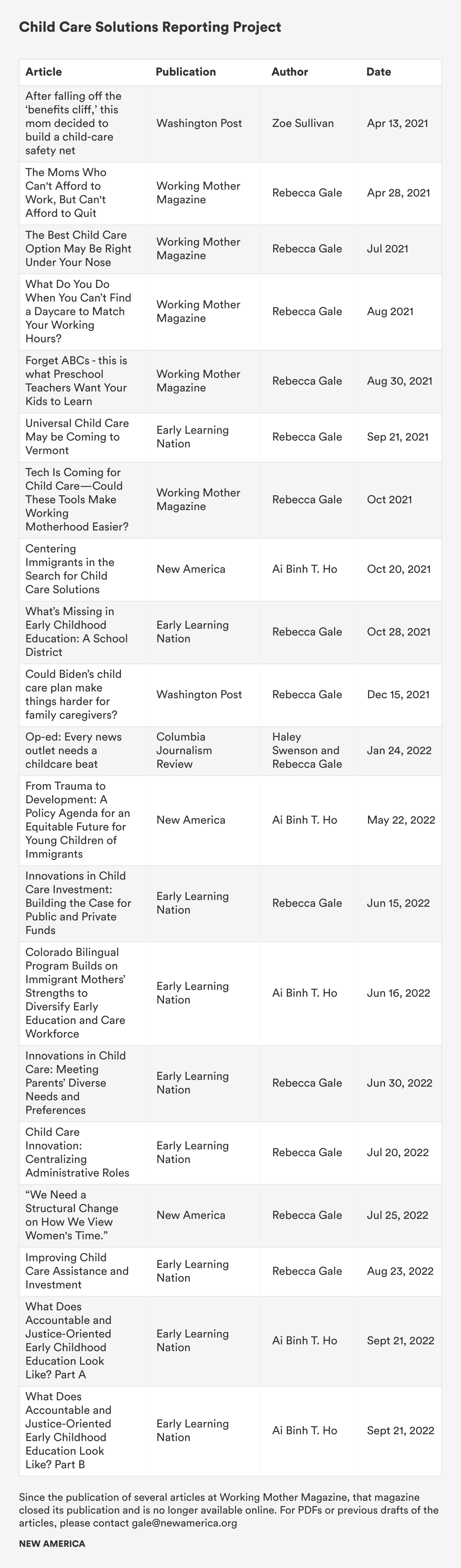
Along the way, we surfaced several key themes about innovations and impact. We published standalone articles on the topic of child care in the Washington Post, the Columbia Journalism Review, Working Mother magazine, and Early Learning Nation, among others. In each case, we used a solutions journalism framework to articulate bright spots and explain which innovations could work in multiple instances and be scaled for wider adoption.
A complete list of the articles is below:
The solutions journalism framework has become one route for journalists to pivot from reporting on seemingly intractable problems to seeking out and focusing on available solutions. The Solutions Journalism Network (SJN), founded in 2013, has sought to formalize and promote solutions-oriented reporting by “leading a global shift in journalism, focused on what the news misses most often: how people are trying to solve problems and what we can learn from their successes or failures.”
The SJN has conducted research using case studies and experimental A/B testing to show that engaging with solutions-oriented reporting versus traditional reporting impacts individuals by increasing their emotional connection to the issues described, their belief that they can play a role in developing and implementing solutions, and their intent to learn more about the issue.
Our own organization, New America, has invested in solutions journalism in various ways in the last decade. Our RiseLocal pilot for reporting grants supported journalists exploring policy solutions underway in states, cities, or even organizations in the United States that might—when scaled, resourced, or translated—promise solutions to major problems outside their current context. Our solutions reporting, including some by authors of this report, has shone a spotlight on promising attempts at eradicating homelessness, supporting immigrants in attaining health care and other services despite the chilling effects of the so-called public charge rule, and a social entrepreneurship model where women in poverty are offered jobs and job training at the same time.
There are challenges to applying the solutions journalism lens to one-off stories about child care however. As two of the report authors, Haley Swenson and Rebecca Gale, argued in a 2022 Columbia Journalism Review op-ed, there may be no other complex public policy topic that affects so many people that is still not covered with dedicated journalists who understand the intricacies and fragilities of the U.S. child care system. There are coverage verticals of nearly every stripe and size, but child care is still too often considered an add-on to parenting and, more recently, to political or economics coverage. In reality, its complicated nature requires a dedicated reporter to understand both the intersecting circumstances causing the child care crisis and the ways that it might be solved. Our goal in bringing multiple authors from different backgrounds together for over a year of reporting on this subject has been to provide a deep, contextualized narrative about what is currently underway to improve child care across the country and what major barriers still stand in the way of progress.
Additionally, our reporting has been influenced greatly by the insights of the fields of early childhood education policy and research, which have grown and deepened their influence over the last few decades. Unlike a traditional newsroom, this report’s authors have been reporting from within a nonpartisan think tank. When we began our exploration of key areas of innovation for universal child care, we consulted with experts in the Early and Elementary Education Policy program at New America and came up with an initial list of known problems in the existing child care system to explore. Those included the following problems:
In this report and our reporting elsewhere, we have sought to highlight what we see as promising solutions—what we have called innovations—for pushing the child care system toward a better future.
Note: For the purposes of this report, innovation is defined as a group, entity, idea, movement, or organization that improves access to high-quality early care and learning, with the potential to scale or be applied elsewhere, in pursuit of just, equitable, and truly universal child care.
Our approach to child care innovation in this report meant looking for and reporting promising solutions to the United States’s child care crisis that are possible even without major federal intervention. We interviewed stakeholders about and explored the real limitations of those solutions, especially absent robust federal investment or other modes of scaling these solutions or transferring them to different locations. We have therefore provided critical historical and demographic context, not only in this introduction but in each of our stories, which our reporting suggests is critical to understanding the child care system as it is today and the real steps our communities, states, and federal government must take to ensure high-quality child care is available and affordable for all children in the United States.
According to our review of the latest research among early childhood experts, high-quality early childhood education—or ECE, which we use interchangeably with the phrase “child care” in this report—promotes children's physical, mental, and emotional well-being and development through a consistent, positive, caring relationship between child and caregiver. The economic evidence of early education’s benefits on the economy and the workplace are clear, but that should not overshadow the potential of early education to create a better and more just society.
Early education should be more than an early version of K–12 schooling, in which children learn new academic information and develop skills. Many young children, especially children of refugees and immigrants, have experienced trauma that has been associated with reduced size of the brain cortex, which is responsible for many complex functions including memory, attention, perceptual awareness, thinking, language, and consciousness. Young children enter child care with a variety of needs and a range of experiences and capabilities. The best child care makes space to recognize those differences and to provide or connect families with whatever type of support will best benefit those children and ensure them healthy, happy futures. Holistic and accountable approaches may need to fall outside of the classroom, such as connecting families with pediatricians and health services, mental health care, parenting groups, and home visiting services. Families are best supported in facilitating their children’s development and mental health when services are available in their native languages.
This report highlights innovations that promote more universal access to care that acknowledges the structural injustice toward marginalized families and the richness of their cultures and traditions, as well as their preferences and the types of care they feel most comfortable receiving. In this report, we explore a variety of types of child care providers and settings, and focus on building systems that can translate across locales to train and prepare educators as the latest research on quality develops. The context in which we have been searching for and reporting on child care solutions, one with both great public interest but a seemingly uphill struggle to pass those policies at a federal level, has shaped the focus of the reporting on particular areas of intervention. They range from the types of campaigns we think show the most promise in widening the current policy “Overton window” to make space for more ambitious policy changes, to smaller, more incremental changes (such as changes in the subsidy model or local plans for centralizing administrative tasks), to changes made by state policymakers and administrators, child care providers, and even technologists and philanthropists absent shifts in the policy landscape.
For decades, the United States has taken a largely individualist, market-based approach to the care and education of its youngest citizens. While a national public education system for K–12 students has served families and youth since 1918 (with some states, notably Massachusetts, offering public education since the 1850s), there has never been a federally funded and publicly available system for the care of all children who need it from birth to age five.
Public schools continue to be subsidized and offered as a public good (though experts note that the K–12 system also needs bolstered investment and infrastructure, and that it contributes to inequality across race and class). Child care has been relegated to the highly individualistic, fragmented system we have today. A small portion of U.S. children benefit from the Early Head Start and Head Start programs, but the vast majority of families find child care independent of the state.
In 1971, the United States was on the precipice of change when Congress passed bipartisan legislation establishing a federally funded child care system. At the time, there were more women in the workforce, ample evidence of successful child care programs in other countries, and the political climate had supported reforms such as the 1965 creation of Medicare and Medicaid under president Lyndon B. Johnson. The Comprehensive Child Development Act would have made child care universal for all three- and four-year-old children with a sliding scale of costs based on income (and free to poor families).
The legislation was vetoed by Johnson’s successor, president Richard Nixon, who had touted the need for child care support in his campaign. Nixon, influenced by Cold War ideological battles, wrote in his veto statement that child care had “family-weakening implications.”
Nixon’s veto would set the tone of public child care debate and policy for decades to come. The entire child care industry has struggled since to provide affordable, quality care for children with livable wages for staff. Since 1971, demand for child care has skyrocketed. In 1975, when the U.S. Census Bureau first began reporting the number of women with children under age six in the labor force, the labor force participation rate for mothers with young children was just 39 percent. In 2020, 65.8 percent, nearly two-thirds of women with children under age six, were in the labor force. As of 2016, 60 percent of children too young to attend kindergarten spent at least one day a week in the care of a nonparent.
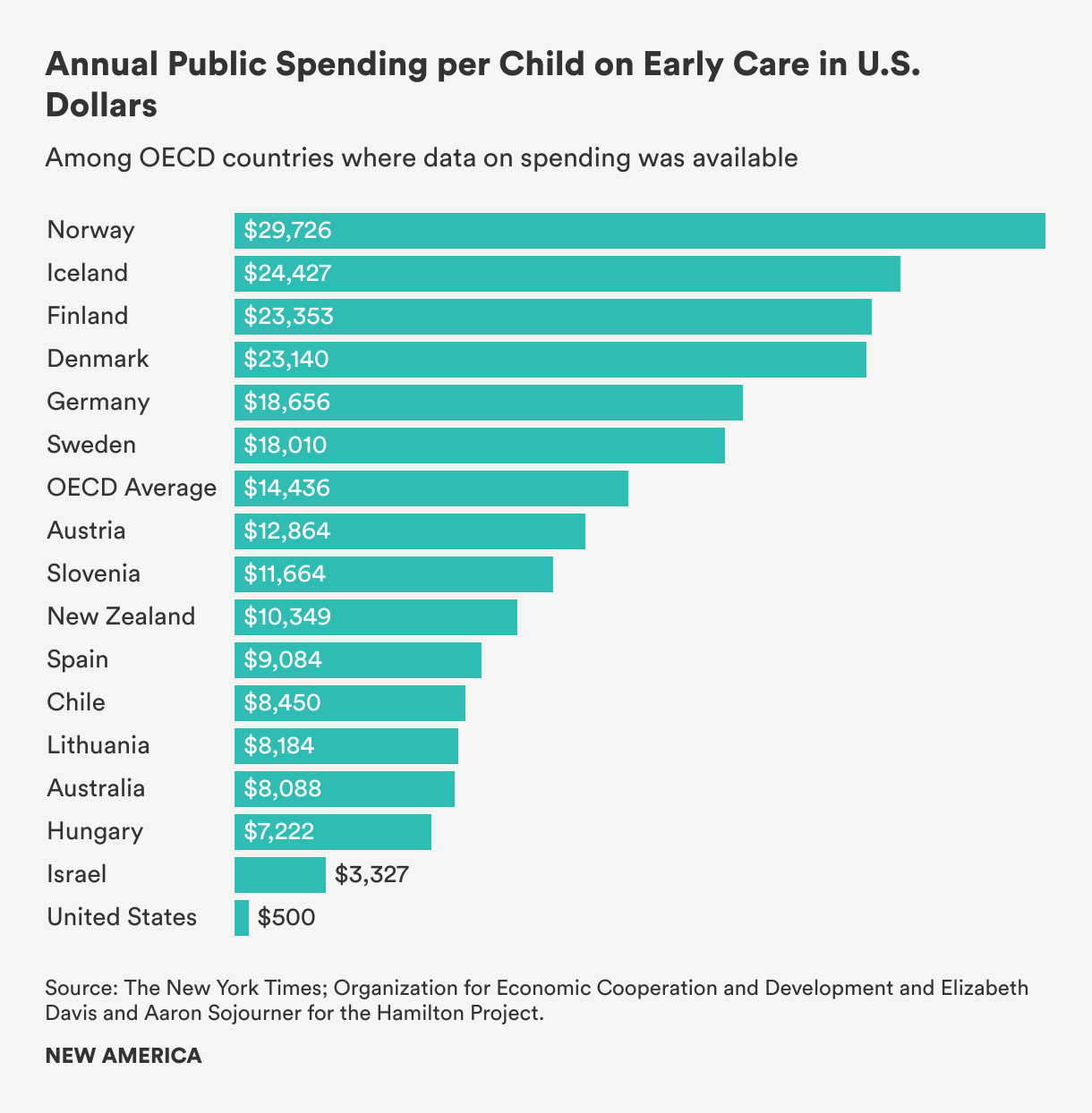
As New America’s Early Education team has reported, the United States continues to lag shockingly far behind its peer countries in the Organization for Economic Cooperation and Development (OECD) when it comes to investing in the care and education of young children. While the median spending per young child in other OECD countries averages $14,000, the United States spends just $500, most of it in the form of the aforementioned subsidies.
The federal government has played a limited role in improving access and affordability in more recent years. Beginning in 1990 with the passage of the Child Care and Development Block Grant (CCDBG) Act, the federal government has provided states flexibility in how they develop their child care programs and policies. These block grants subsidize child care for families with incomes up to 85 percent of state median income, and also provide funds for activities to improve the overall quality and supply of child care. Today, according to analysis by the Center for American Progress, just one in nine eligible children receives a child care subsidy.
Despite the fact that the Supreme Court has long held that undocumented children are owed unfettered access to public education, in practice, this protection has not been extended to young children prior to their entrance into K–12 schooling. Regulations under the CCDBG make it clear that child care subsidies serve children, therefore their parents’ immigration status cannot be considered a factor in qualifying. Yet the National Research Center on Hispanic Children and Families found that of the 13 states that contain 80 percent of the Latinx population, 12 states requested Social Security numbers for household members and seven of these states did not indicate that offering the information was optional. The percentage of Latinx children eligible for the Child Care and Development Fund is larger than the share of Hispanic children served by the program in 12 states.
Further limiting children’s access to these subsidies, some states require minimum weekly work requirements that must be formally documented. Families who work nonstandard hours and frequently only have short notification of their work schedules struggle to document their work hours from week to week.
The child care system in the United States would be even less robust than it is today if it weren’t for the child care workers who essentially subsidize it with their low wages. Yet the destruction wrought by the COVID-19 pandemic showed that a critical sector cannot continue to function on the backs of underpaid and underappreciated workers indefinitely. If early childhood education is a priority for the nation, then compensating and valuing the educators and other workers who make it possible must go hand in hand with efforts to expand access and opportunities for children.
Though millions of loving and dedicated child care providers make an undeniable impact on the children and families they support on a daily basis, the child care system—insofar as the network of decentralized, underfunded-yet-expensive, scarce, poverty-wage-paying providers that families rely on can really be called a system—is failing. Our own organization found as much in its 2016 Care Report and Index, which found that when it comes to cost, quality, and availability of child care, no single state was performing well across all three metrics.
In the following sections of this report, we shift our focus from the many problems with the child care system to bright spots and reasons for hope emerging even amid the crisis of the last few years. Many of the problems described above could be solved with bold legislative action. Unfortunately, the critical child care provisions in the Build Back Better budget reconciliation package first proposed by the Biden administration were reduced when it was ultimately passed as the climate and tax-focused Inflation Reduction Act in the summer of 2022.
This report serves as both evidence-based inspiration and a reality check on what can be done by dedicated practitioners, investors, and educators in the meantime, and what future state and federal action should consider and include.
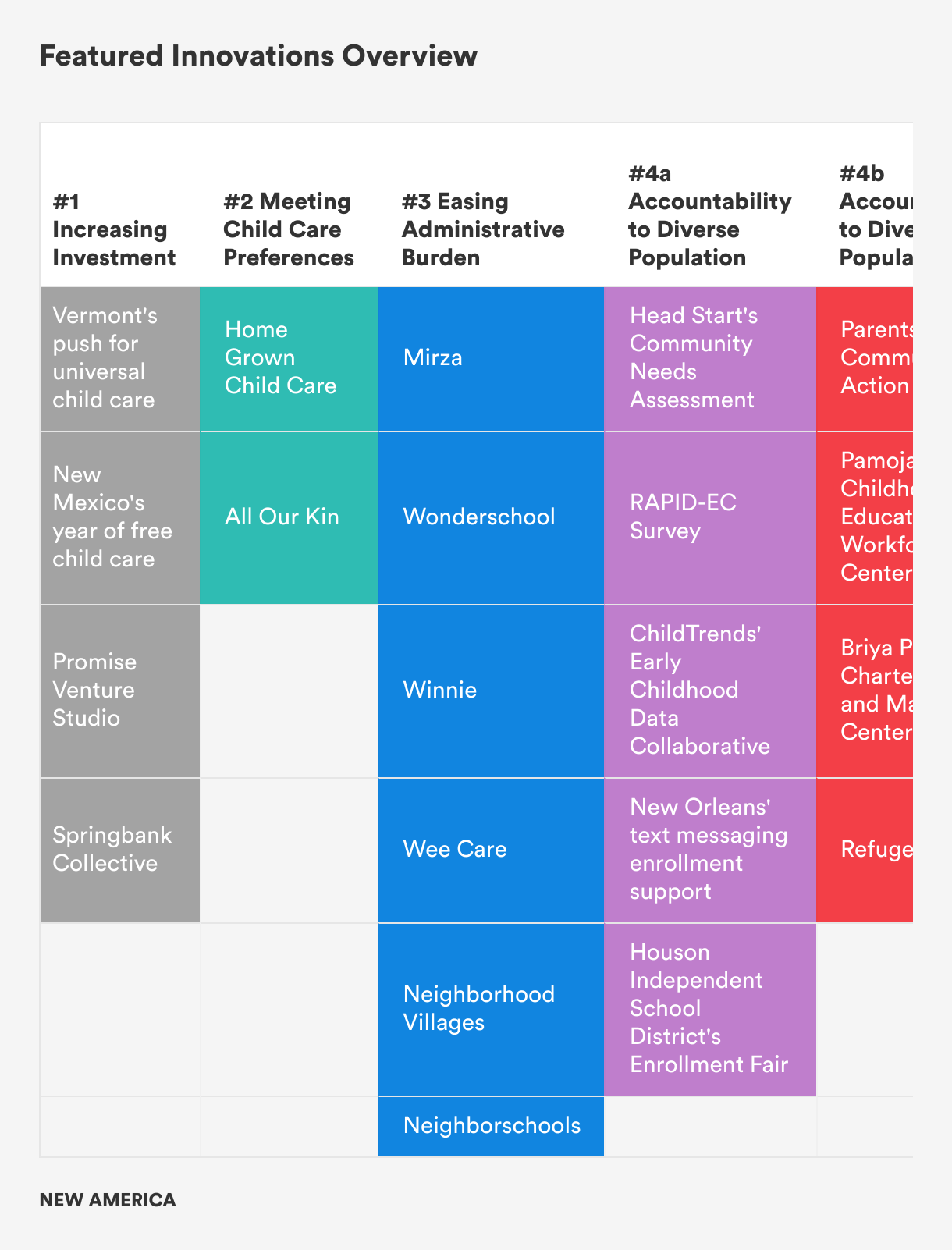
Disclaimer: This is not an exhaustive list of notable innovations in the U.S. child care system. This report is meant to describe innovative solutions to various pain points in the child care delivery system, and promising efforts to improve it, absent the serious federal investment in care infrastructure advocates have called for. Nor is New America attempting to rank such innovations based on merit, scalability, or worthiness of investment. These innovations are just examples of the creativity and level of change required to move the current system toward universal care.
Read the full piece at Early Learning Nation here.
Becca Balint remembers arriving at the Vermont State Senate in 2014 and looking around the room at her middle-aged colleagues, many of whom were well into their 60s. “Child care wasn’t even on their minds,” she said. When the topic of increasing access to affordable child care came up, it was met with shrugs. “It was considered a women’s issue, a private issue, a ‘stay-at-home until they’re older’ issue,” recalled Balint, now the State Senate Leader, in an earlier conversation with Early Learning Nation.
But in the past decade, demographics in the state house and attitudes around child care have drastically shifted, and Vermont is one of the first states to seize on that opportunity to push for universal child care. There are now state laws codifying a study on implementation and financing (likely paid for by an income tax for the workforce). Innovators in the child care space are watching Vermont closely because their efforts have gotten so far in codifying universal child care into law through the state legislature. New Mexico, by comparison, is using executive action and giving voters a chance to vote on an amendment to accomplish something similar.
Research shows that treating early care and education as a public good will benefit families, children, democracy and society. According to UNESCO, the United Nations Educational, Scientific, and Cultural Organization, early childhood education also plays a role in combating structural inequalities in family and education that may already be impacting a child’s well-being before they enter K–12 schooling.
Vermont’s promising goals notwithstanding, our current national patchwork system still relies on an individualistic approach, where families are left to fend for themselves in finding and paying for expensive child care, early educators earn poverty wages, providers are underpaid and operate on razor-thin margins, and the quality of care suffers for young children at a time when research shows their developing brains need it most.
While we have a way to go for the kind of public investment and public-private partnerships to make quality early care and education truly affordable and workable for all families, there is ample innovation in the field that stands to improve different facets of our child care delivery system. It’s a complicated problem with neither substantive federal investment nor a robust care infrastructure, building a high quality, universal early care and education system will require innovative and creative solutions. Right now, states are lone actors in making sweeping changes with little federal support or public investment. While private sector solutions are useful, they are not sufficient for widespread change.
The following is not an exhaustive list of innovations underway across the country, nor does it capture all of the many barriers that stand between our current reality and a future in which all children have access to high-quality care and learning It is meant to illustrate select innovations for various pain points in the child care delivery system, absent further federal investment, and to inspire more action.
In the absence of substantial public investment—including the pandemic spending aimed at keeping the broken system somewhat afloat—child care innovations are filling the void and taking place in the public and private sector. State and private sector solutions are useful but not sufficient for widespread change.
In May 2021, after years of coalition-building, Vermont passed H.171 legislation to lay the blueprint for universal child care. Vermont still faces a major hurdle in funding the universal child care program. H.171 puts in place two studies: the first on how to make the program accountable and efficient, and to decide which agency will regulate it and how. The second is a revenue study, designed to map out the costs and payments. Yet this is the furthest a state has come to adopting universal child care into law. For states looking for an innovative way forward on child care, Vermont can serve as a blueprint.
Read more about Vermont’s Push for Universal Child Care in this ELN feature.
In April 2022, New Mexico Gov. Michelle Lujan Grisham announced that the state will cover the costs of child care for the majority of its residents, up to 400 percent of the federal poverty level, through June 2023. According to estimates from the Washington Post, this new benefit will make child care free for 30,000 families. This makes New Mexico the first state to offer no-cost care over such a broad range of incomes. New Mexico has also expanded their subsidy program in innovative ways, to be discussed more in Part 5 of this series. Until then, read Bryce Covert’s ELN article: “New Mexico Just Became the First State to Make Child Care Free for Nearly All Families.”
Build Up San Mateo in the San Francisco Bay Area is a multi-stakeholder public and private partnership led by San Mateo County’s Child Care Partnership Council and Office of Education, as well as philanthropic partners like the Silicon Valley Community and Heising-Simons Foundations. The goal of this initiative is to solve the county’s child care shortage by prioritizing evaluation of the community’s unmet child care needs, the barriers to increasing the supply of care, and working with business leaders and developers to make planning for and realization of an improved child care supply a deliberate part of the county’s development moving forward. In one example of Build Up’s success thus far, the county tapped the private development firm Greystar to engage the community and study best practices for building sustainable and affordable onsite child care into a mixed-use project on Redwood City’s South Main, currently under construction.
Promise Venture Studio serves as a nonprofit accelerator for entrepreneurs in the early childhood space. It has created a Venture Index to showcase these innovations with the hope of drawing investment and attracting attention from policymakers, funders and journalists. The group also can collaborate and work with one another via a Slack channel. The goal is to get the early education and child care field to look like most other ones in terms of private investment, explained founder Matt Glickman.
Springbank Collective is a private investment company that provides early investment to companies that fit within one of the three themes to support women and working families: career, care and consumer. Two examples of this are Little Otter Health, which supports whole family mental health, and Wellthy, which offers care coordination for caregivers provided through employers for managing child care and complex illness needs.
These innovations can help spur funding and they can help individual states improve their child care options. But the national child care crisis is too large for a silver bullet solution, even one that has passed state legislatures or received generous Series A funding. (Series A financing refers to an investment in a company after it has shown progress in building its business model and demonstrates the potential to grow and generate revenue. It is considered seed capital since it’s designed to help new companies grow.)
“We cannot out-innovate our way out of paying workers $12 an hour,” said Elana Berkowitz, a founding partner of Springbank Collective. “We need every kind of investment and we need more of it: private investment, government investment, employer benefits. No one should have to shoulder the entire burden of this sector, which is utterly strapped.”
Investment helps. Even as fields such as health care and education have seen a thriving market for private funds for innovation, early child care has lagged behind. Groups like Promise Venture Studio and Springbank Collective, among others, aim to close that gap, create a thriving ecosystem for innovators, spur investment and use the accelerator process to make it happen quickly.
Private sector solutions require less political will and can be scaled to encourage more change nationwide. But private innovation cannot be the only answer. Research by Better Life Lab found that child care is too fragmented and complicated to be solved by a single innovation, no matter how well funded. Reliable, stable funding is crucial to keep child care operations open. This is true of both center-based and home-based care. The margins within the child care market are too thin for most providers to offer basic benefits, including paid family leave and paid sick days. For the majority of Americans who live in states that do not provide such benefits, the burden falls to the families who pay tuition and the care workers who go without.
Absent federal investment for universal child care, it will be up to states to lead the way, like Vermont and New Mexico, which have already acknowledged that quality, affordable and accessible child care is essential for their workforce and economy. Other states such as New York, have drastically increased their budgetary spending on child care, and Connecticut lawmakers have advanced a state budget to include a one-time rebate of $250 per child, up to $750 per household. States that can demonstrate an effective universal child care system may become the blueprints for future state efforts, similar to the paid family leave model which started in a handful of states and has since grown to 11 states plus D.C.
But states can struggle to maintain funding streams to allow for universal child care, as states are required to balance their budgets and not take on a deficit, unlike the federal government. One of the first steps in creating a state-supported child care system is identifying the sustainable funding streams, said Elliot Haspel, author of Crawling Behind, and a top voice in child care and early education. “The states can’t just rely on American Rescue Plan Act money or the state having ‘a good budget year.’”
Haspel added, “States have traditionally been these laboratories of democracy, they serve that role well. With the political realities at the federal level, states have more of the burden to bear.”
Read the full piece at Early Learning Nation here.
Joan Morgan had developed an unusual morning routine. With her two kids, ages 4 and 6, buckled in the car, she leaves her house in the Portland, Oregon area around 6:40 a.m. to drive to her child care center, where she arrives promptly at 7:00 a.m. All three of them wait in the car while Morgan dials into her first conference call of the day.
“I bribe them within an inch of their life in order for them to keep quiet,” Morgan says. Morgan is a bone marrow transplant coordinator, her husband also works in health care, and she has the later workday start at 7:00 am. The daycare, however, doesn’t open for another half hour. And this is the earliest option available anywhere close to where they work and live.
Tari Brodsky, a nurse practitioner in Long Island, New York, said that every mom she knows who works at the hospital has had this same struggle. Daycares tend to run between 7:00 a.m. to 6:00 p.m., but Brodsky, who works 12 hour shifts, has to be at work at 7:00 a.m. and isn’t finished until 7:00 p.m. When her twins were young, she worked the overnight shift, hiring a babysitter to come in the afternoon for four hours while she slept. Now, she works on Sundays, so that her husband can be home with the kids and she doesn’t have to struggle to find coverage.
Morgan and Brodsky both recounted these stories in an interview with Better Life Lab. But they aren’t alone in having this predicament. Traditional child care hours don’t work for all families, including families who have sporadic or inconsistent work. Nationally, only 8 percent of child care centers are open during nontraditional hours, which can mean anything from starting early, long shifts, overnights or weekends.
Families are different. They work different schedules. They need and want different things. And that changes over time as jobs change, life circumstances change or children grow up. In researching child care innovations on the state and local level, and echoed by a report from the Urban Institute, we found there is not a one-size-fits-all or “silver bullet” solution for how child care delivery should operate. But we do know that innovation surrounding nontraditional schedules and child care deserts are needed to increase supply and meet demand.
To improve supply, meet demand, and provide support for a wider variety of families, innovators in the child care space are doing more to support home-based, family-based or Family, Friend and Neighbor care (FFN child care). Currently, informal care settings serve more families than center-based care, can be more easily set up and can be a better match for families who work non-traditional schedules or who are seeking a specific cultural match. Some studies also suggest that families of color may prefer these arrangements to center-based care, including Black and Latinx families and those living in homes with low incomes. It remains to be seen, though, whether that preference would hold if the child care system included culturally responsive, affordable, and accessible center-based care close to their homes. A 2016 report by Child Care Aware of America found that “both African American and Hispanic children are more likely to be in cared for by a relative in the home, while white and Asian children are more likely to be cared for in a home by a non-relative.”
Additionally, as one author of this report demonstrated in a prior publication, many immigrant parents believe that FFN care provides more personal attention for their children. Indeed, research shows that FNN providers often have low adult-to-child ratios, suggesting that these providers are able to spend more individual, quality time with each child.
Families’ child care needs vary widely and are largely specific to the family unit. Families want different kinds of child care arrangements, which change as children age. There is no one-size-fits-all solution to child care needs. Innovation surrounding nontraditional schedules and child care deserts—as well as ensuring access and quality in a variety of settings, from small family home settings to child development centers—are needed to increase supply and meet demand.
These “informal care providers” as many are referred to, can be licensed or unregulated, depending on state and local business regulations. Many have not received formal business and marketing training, yet are tasked with running a business as part of their child care. They may lack splashy marketing materials and brand-name recognition of center-based care. And several innovators spoke of a bias in home-based care, that it is perceived as less worthy or less valuable than center-based care. Innovators in this space are working to change that perception and show that home-based care plays a crucial role in child care delivery.
Other benefits to the family child care centers include:
“There is a bias around home-based child care,” explains Natalie Renew, director of Home Grown Child Care, which connects funders with child care providers, provides resources to home-based child care, and advocates for providers to policy makers. Home-based child cares are typically less resourced and less visible than center-based child care centers, especially those centers connected to existing institutions, like a school system. They also receive fewer funds under the state subsidy systems, even for doing the same work as child care centers.
The current child care system uses quality metrics as part of a process to calculate reimbursement rates for providers who accept subsidies. These systems, too, disadvantage family child cares. “The typical framework for quality is based on teacher qualifications, room arrangement and indoor environments,” said Renew. “When we talk to families who use home-based care, we learn that they are defining quality differently: intergenerational relationships between parents and families; flexibility; small groups; consistent routines; feeling of safety. These perceptions of qualities—while valued in the literature—are not present in the quality metrics.”
Research, too, supports what Renew says regarding families’ preference for unregulated home-based care. “A lot of prior thinking is that this was a second choice, but it’s not what families want. But now families are saying we want unregulated home-based care,” said Renew. They want kids to sleep in their own beds and eat meals with people in their immediate community.
“Because our framework is so oriented around the activities, and the way we define quality in the context of centers, a narrative has developed that this is a lower quality of care,” said Renew. “The standards as written are modeled on school and center-based operations. It looks different in home-based care. There is a routine: the natural routine of the family. And that is what builds stability for learning and curiosity. The desire to superimpose that center-based model creates unfair and unjustified burdens on the providers, and they don’t get appreciated for the incredible assets that exist in home-based care.”
Another problem with the existing subsidy system is the paperwork required for providers to accept funds. For a small child care provider, the administrative burden can be too great. Ashli Carlock, a home-based provider in Nebraska wrote about the process in a Home Grown blog post: “It’s nerve wracking. You know you’re going to get paid something, but you don’t know what that will be exactly… You’re trying to calculate in your mind paying bills, keeping food stocked for kids, meeting your own personal needs, and paying a part-time employee.”
Another group working to expand the role of family child educators is the Connecticut-based All Our Kin, a nonprofit that trains, supports and sustains family child care providers. “We built this organization to recognize that family child cares are left out of conversations and devalued,” said Jessica Sager, founder of All Our Kin.
Because family child care centers tend to be used by families of color, and are often run by women of color, Sanger believes they have been devalued by systemic racism, which has rendered family child labor as worthless. “Children can succeed in any setting with stable, nurturing care,” said Sanger. That stable, nurturing environment isn’t restricted to the domain of child care centers, which can benefit from having more resources for reaching families.
Because family child care centers tend to be used by families of color, and are often run by women of color, Sager believes they have been devalued by systemic racism, which has rendered family child labor as worthless. “Children can succeed in any setting with stable, nurturing care,” said Sanger. That stable, nurturing environment isn’t restricted to the domain of child care centers, which can benefit from having more resources for reaching families.
Note: This section appeared in the May 2022 report by Ai Binh Ho, From Trauma to Development.
Half of all immigrant caregivers in the early education workforce are providing home or family-based care. A quarter of family-based providers in the United States identify as Latinx.
The Child Care and Development Block Grant biennial state plans found that only three states report that they have policies in place to make their child care licensing regulations more accessible to providers from language minority or immigrant communities. Moreover, many immigrant FFN do not know that these subsidies are available. Spanish-speaking FFN care workers were half as likely to access subsidies as their English-speaking peers. Some states, including Florida and North Carolina, prohibit unauthorized immigrants from collecting any subsidies. Unsurprisingly, only 38 percent indicated that they received subsidies or other financial support other than payments from parents, compared to 74 percent of English-speaking FFN providers.
Most states require household-wide background checks to receive payments, which experts say can make it less likely that undocumented providers or providers in mixed-status households will apply for assistance. Immigrant providers, specifically, are often discouraged from becoming licensed due to costs, language barriers, and real or perceived barriers related to their immigration status.
We need better reimbursement rates, quality metrics, and availability. Improving the current child care delivery system to meet the needs of more families and in more places will require improving the current reimbursement rates and availability of all child cares – including family, home-based and informal child care. Currently, informal care can vary widely from state to state with myriad licensing standards and subsidy reimbursement rates. For example, in Massachusetts, anyone watching a single, non-relative child in their own home requires a child-care license. In South Dakota, a caregiver can watch up to 12 children without requiring a license.
Additionally, both the quality metrics and subsidy reimbursements among states and informal care can vary widely. Renew has been outspoken for efforts to encourage decision-makers and others to recognize the value that home-based child care brings to children’s development, families and communities overall. A key way to support that care, she says, is to improve compensation for it.
There has been an influx of venture capital funding for innovations that make child care delivery more manageable and affordable, such as Wonderschool, Wee Care and Winnie, which connect families looking for child care with a provider. But while some may take into account licensed family-care providers, most are still concentrated on traditional child care delivery systems, particularly child care centers. While child care centers are an effective child care option for many families, they do not work for all families, especially those in child care deserts or those who work nontraditional hours. In addition, daycare centers often charge a set rate regardless of the number of hours used. For families that require only part- time or sporadic child care (such as those working unpredictable hours), the center-based care is not an ideal fit and often more than they can afford.
But please note: even an influx of home-based child care providers will not be enough without the shift in perceptions, quality standards and subsidy reimbursements that put such providers at a disadvantage. Expanding the role of subsidies is explained more in this report in section 5. Elevating home-based providers requires a change in our country’s way of thinking about child-care delivery, and one that is immediately needed to support a growing workforce.
Read the full piece at Early Learning Nation here.
Tiffany Gale has a fervent wish – to offer paid leave to her employees. But Gale (no relation to the author) runs a home-based child care center out of her home in Weirton, West Virginia, and doesn’t have the profit margins to pay for an employee to take a paid leave and hire a temporary replacement. Nearly all the money she makes, she explains, goes back into the business: for supplies, playground equipment, toys and staff. After expenses, she estimates she took home $30,000 last year. “Not much for a small business owner,” she said. One of her two employees is her sister-in-law, who has spina bifida and limited feeling in her lower limbs, which makes her prone to infections and occasional hospitalization. When she is out, Gale can’t afford to pay her, nor does she have the staff and paperwork capabilities to apply for disability or job assistance. “I care about her, and she genuinely cares about the children,” Gale said. [link to story here]
What Gale faces, like so many other child care providers, are the demands of running a small business with high labor costs, strapped tuition-paying parents, slim profit margins and many moving pieces. Roughly 30 percent of infants and toddlers go to a home-based program, and estimates from Home Grown show that 1.2 million paid carers work inside their home, like Gale. And research shows that the childcare industry is highly fragmented, with nearly 90 percent of the establishments being single proprietorship child care providers and educational professionals – like Gale herself. Unlike other peer competitive countries, most of this country’s child care is unsubsidized, so it’s up to parents to pay the full cost while transferring some of the high-cost burden to the employees, many of whom make poverty wages. On top of that, the owner of the child care center is expected to manage the staffing, payroll, marketing, communication and benefits on top of everything else.
One of the most promising innovation areas we found in our on-going child care research is the growing number of technological and financial tools available to help the business side of the child care industry run more smoothly and efficiently – which can ease the time burden on owner/providers and potentially lower costs for parents and providers. While such innovative efficiency fixes can be very useful to individual child care centers, they are not a substitute for substantial public investment. Full enrollment, better marketing or payroll assistance can boost market efficiencies, but it will take real federal investment, year over year, to help families cover costs and boost child care educator wages, or robust family-supportive and safety net policies that would allow home-based providers like Gale to have her employees take paid sick leave without hurting her bottom line.
Some of the most promising, scalable innovations are those that seek to centralize administrative roles and allow child care centers to focus on providing quality care, not back office functions. This can help lower costs for parents and overhead, keep family homes and small child care centers sustainable, and raise the low wages of child care workers.
Mirza is a fintech company that works with employers to subsidize the cost of child care so their employees aren’t forced to drop out of the workforce. The employers give a zero-interest loan, between $5,000-$7,000 per year, that an employee puts toward child care and can repay over three years, or get chunks of it forgiven with retention and attendance incentives. This program allows parents to afford quality child care without taking income away from the providers. Mirza integrates with an employee’s payroll provider so that monthly loan payouts and repayments happen automatically.
“It’s actually a care subsidy disguised as a loan,” said Siran Cao, the company co-founder. Since many parents are having children during some of the peak career-building years, stepping away from work comes at a much higher cost. “That is a period where the opportunity cost of leaving the workforce is missing some of that career acceleration.”
Mirza is in the process of launching with U.S. companies and Cao expects to do so in the summer and fall of 2022.
Probably one of the most talked about solutions for making child care more accessible and affordable without the addition of a significant federal or state investment are those that work with existing child care centers to centralize administrative costs, and take on some of the administrative burdens, including personnel, placement, covid-19 mitigation, and external communications and marketing.
Winnie, Wee Care and Wonderschool offer such administrative support. All three conduct an online marketplace for child cares—connecting families with open spots—with the goal of allowing providers to operate at peak capacity and spend less time on administrative tasks. The low-margin industry of child care operates most effectively when all spots are filled, so these companies are doing a service to improve access and lower operating costs for the providers.
Wonderschool is a two-sided marketplace meant to help parents find child care options and offers a child care management system (CCMS) for day-to-day operations. This CCMS provides online enrollment and enrollment management, tuition processing, financial recordkeeping tools, a CACFP (food program) solution, daily attendance tracking, a parent communication and engagement tool, and an online community for providers.
The child care providers—80 percent of which run home-based child cares—can self-select which level of Wonderschool access they want and need, with prices ranging from $2 a month per child to access the Wonderschool child care management system, to up to a 10 percent revenue share for opting into a higher tier of service with marketing and enrollment support. In some cases, a sponsoring agency like a government agency or child care network will purchase Wonderschool access and make it available to the child care providers within their communities. Two examples include the Elevate New Mexico Child Care program and the Maryland Child Care Boost program. Wonderschool also offers a New Supply solution, in which new child care programs are supported in setting up, getting licensed and onward into operations.
“Technology solutions provided by the Wonderschool platform help keep administrative costs low, efficiency high, and programs fully enrolled and profitable; these are all key components of running a sustainable child care business,” said Mia Pritts, Wonderschool’s VP of Strategic Partnerships.
Winnie matches families looking for child care spots with licensed providers using publicly-available state data. While Winnie is free for any provider to use (the founder Sara Mauskopf gives the analogy of Yelp, where anyone can claim a page), subscribers of Winnie Pro pay $199 per month and receive prominent placement, lead generation and a better web presence with more customizable features.
By keeping the centers at capacity, or close to capacity, they are helping to increase the profit margins. Mauskopf’s own research estimates that if the average cost of child care is $844 per month (with some locations being much higher) Winnie Pro subscribers net a return on their investment by keeping spaces filled just two weeks faster.
“With this audience, we are able to help child care businesses fill their open spaces on average 2 weeks faster than if they did not use Winnie to list their open spaces,” said Mauskopf. “Given the average cost of [child care] in the U.S. is $10,174 per year, or $844 per month, when Winnie helps a center fill a space 2 weeks faster that’s $424 they’ve made, or $225 after the cost of the subscription.”
WeeCare also serves as a marketplace for parents and child care centers – both home-based and childcare centers. Participating providers are considered “Wee Care Directors” and by participating, are better able to fill their child care centers to capacity.
Similar to Wonderschool, WeeCare offers back-end support, including accounting, marketing and a web presence. WeeCare estimates that such administrative tasks being outsourced saves 20 hours per week for the child care provider. The company collects a percentage of the enrollment feeds from any leads generated, though a spokesperson for the company said they’ve been reducing that fee as the majority of their growth revenue comes from creating an employee child care benefits program.
Neighborhood Villages serves as a de-facto school district for five child care centers in the Boston area. This nonprofit operates as the back-end support for the centers, providing a family coordinator on the ground to help with wrap-around services, such as housing or food support for a family in crisis, and a central office function to assist with personnel, administrative functions and issues as they arise, such as creating a comprehensive Covid testing system. (Read more about Neighborhood Villages in Early Learning Nation.)
Questions of licensing currently vary widely across states. The process can be onerous, though it can matter a great deal when it comes to the quality metrics and subsidy reimbursement rates. Licensing too, gives a record of the child care space, which can in turn make it easier for families to find available care options. But for many families who rely on non-traditional child care—particularly home-based child care or Family, Friend and Neighbor care—the licensing process can be too much of an administrative hassle without enough upside.
Groups like Neighborschools, based in Massachusetts—a state with strict licensing requirements for child care—will help a child care provider navigate the licensing process free of charge for two years, then collect a referral fee for any placements made after those two years are up.
Innovations in this area focus on using the same forces that make private companies and services profitable and efficient—technology, data management, systems design—to improve affordability of child care. Each of these innovations is designed to improve upon the existing system, in which each child care provider is going it alone, and represent an infrastructure improvement rather than a total overhaul. There is a logic to this: substantial change is far more difficult and requires a great deal of political will and public investment.
It’s important to be cautious about developing or perpetuating false optimism that if only a child care center had a better website, or backend payroll system or full enrollment, the child care crisis would be over, that child care would be a more equitable and affordable good.
These innovations help, and they should be applauded in their efforts for making improvements, but by no means should they be considered a substitute for robust public investment and child care infrastructure, the same way our country’s policies and tax dollars support K-12 education. Until the day comes when early care and education receives the investment and support as a public good like K-12 education, these new technologies are making providers’ jobs easier, one improvement at a time.
Read the full piece at Early Learning Nation here.
Justine Barawigira, 26, does not want to send her children to a child care center: “My bus can be late and [the center] can call [the] police and take my child. Yeah, I cannot agree with that.” While public transportation can be unreliable and her job can let her out late, Barawigira’s decision to not use center-based care reflects cultural preference (many refugees are unfamiliar with the U.S. early education system) and a deep need for her children to be with someone she trusts. At the root of her fear is mistrust of the U.S. care system to sympathize with her as a Black refugee mother and protect her children.
Among young children with immigrant parents without a high school diploma, like Barawigira’s children, only 5 percent use center-based care. Lower levels of parental education are associated with lower income and with less full-time work. Parents’ immigration and education status is strongly associated with the use of center-based care: the higher the education status, the higher the likelihood parents will send their children to the often more formal center-based care.
Many immigrant parents express fear around Early Childhood Education (ECE) centers. They worry that their child rearing practices, which may be historically rooted and culturally normative, may be viewed as abuse in the U.S. They also fear being tracked, monitored, or reported. As an example cited in Helping in Child Protective Services, a Diné family was distraught and invested significant effort to find advocates when a health inspector cited a child care center and named their child’s use of a cradleboard, a traditional sleeping and carrying apparatus, as “child abuse” during a visit to a ECE center.
Barawigira and her children are a part of the fast changing Black population: one-in-10, approximately 4.6 million Black people living in the U.S., were immigrants as of 2019. And Black children are far overrepresented in Child Protective Services cases, in which the state attempts or completes exactly what Barawigira fears—the removal of one’s children from one’s care. Black children also face the most difficulties in accessing high quality early education and have the highest likelihood of losing their access due to expulsion and suspensions, wrote W. Steven Barnett, co-director and founder of the National Institute for Early Education Research, and his colleagues.
Barawigira’s story reflects the U.S. history of exclusion and discrimination that weigh heavily on marginalizedd parents’ minds as they consider ECE options. In its 2020 Early Learning Needs Assessment, Washington State found that some marginalized parents chose not to access ECE because of fear or distrust of the system or concerns that their children may be unfairly treated or inaccurately assessed because of their race or cultural differences.
Despite growing findings on the importance of early childhood education, access has been slow and inequitable, with vulnerable populations often the last to benefit. The Urban Institute found that early childhood programs are among the most racially and ethnically segregated educational spaces in our country. Some state policies promote segregation. For example, Park Slope North–Helen Owen Carey, a community-based universal pre-K providers that offers universal pre-K seats open to any child as well as seats specifically reserved for low-income children whose families qualify for additional services, was financially punished when it refused to follow New York City’s policy of keeping the income-qualifying children and the general universal pre-K children in separate classrooms.
Young children of immigrants, the fastest growing population of young children in the U.S. is not being reached by the existing publicly subsidized system ostensibly designed to help them. The child care system in the U.S is a woefully inadequate and inequitable patchwork built around a private market of those parents who can pay and public programs for those financially struggling parents who meet income thresholds and other eligibility criteria. So creating an inclusive and equitable child care system will demand deliberate design and policy considerations.
For easier reading, this innovation area is broken into two parts: the first focuses on the reaching and promoting access to drastically underserved communities, and the second, on program design that centers marginalized students and their families across the country.
The first step of accountability is access through:
The first step to mitigating these inequities is reaching all populations of young children and building trust with their families in order to understand their wants and needs for a future child care program, and then to enroll them in the programs that meet those needs. Some promising programs show how early education can simplify enrollment, initiate culturally competent outreach, advance staff recruitment and ongoing training, and develop trusting relationships with parents.
You can’t solve a problem if you don’t know how big a problem it is. Yet, many states cannot answer questions on the quality of ECE programs, which children have access to ECE services, how effectively these services promote school readiness and positive health outcomes, or if the workforce is adequately trained to meet the needs of diverse children.
Data on young children are too often siloed, disconnected, and uncoordinated, preventing policymakers from understanding and responding efficiently and reliably to families’ needs, observed ChildTrends. For decades, more than half of the states have lacked comprehensive data needed to assess early childhood policies and outcomes, according to a 2018 ChildTrends survey. Adequate data collection would support rapid response planning to vulnerable populations during crises, such as the COVID-19 pandemic, as well as improve accessibility to ECE.
Effective data collection depends on partnership with families, early learning professionals, and community leaders, and local organizations–without these connections, the data risks excluding marginalized populations, and thus, fails to address discrimination and systemic barriers. These partners should be included at every step of data collection, from the creation of the survey to the analysis of data. This type of community-centered data collection builds trust within a community, and as a result, increases new enrollments of vulnerable young children to ECE programs. Building positive parents-teacher partnerships will enhance children’s development and even recruit diverse teachers.
The first step toward increasing the accessibility of ECE is to learn who the families are, where they are, the extent to which they enroll in early education programs, and the issues they face that affect their willingness to access these programs.
Head Start, a 1965 federally funded program that offers comprehensive ECE, health, nutrition, and parent involvement services to low-income families, provides a model of data gathering the nation, states, and ECE programs need. All Head Start grantees are required to conduct community needs assessments every five years to determine the number of eligible infants, toddlers, preschool age children, and expectant mothers, including their geographic location, race, ethnicity, and languages they speak.
All data collection should document eligible children to reach families like Barawigira's, who did not apply with a statewide provider. Programs are also required to track children’s experiences with homelessness, foster care, and disabilities; their education, health, nutrition and social service needs; the typical work, school, and training schedules of parents; other child development, child care centers, and family child care programs that serve eligible children; resources that are available in the community to address the needs of eligible children and their families; and, the strengths of the community. These assessments paint a picture of the community, capturing the historical, economic, and political scene in order to maximize benefits for even the most underserved and hardest to reach families, such as mixed-citizenship status families who have low education attainment and limited English proficiency.
Each program must annually review and update the community assessment to reflect any significant changes, such as rates of family and child homelessness and shifts in community demographics. As a result, the program can quickly meet the needs of a new population, such as the 2021 influx of Afghan families. Preferring to speak over the phone rather than in email's written form, a Head Start program in Minnesota, which asked not to be named due to fear of anti-immigration and anti-Muslim acts that have been occuring in the state, reached a large number of Afghan families within weeks of their arrival. The program’s deep community engagement through strong relationships with parents and partnerships with local organizations means that families’ trust in the local organizations gets extended to the ECE program, effectively mitigating the mentioned anxieties around ECE.
While data collection may not sound like an innovation, adopting Head Start’s guidelines and focus areas could be the most critical step towards equity and accountability in ECE. The shift intentionally centers marginalized young children and begins to account for the U.S. history of ableism, white supremacy, anti-immgiration, anti-LGBTQ+, and other systemic violence because the data helps capture the effects of this violence and helps make visible barriers to ECE , and thus, enables ECE providers and programs to more directly respond to and meet families’ needs.
Adopting a Head Start-style community assessment is also an opportunity to be more inclusive. For example, new assessments can also ask about different family structures and a child’s gender identity.
Despite Head Start’s successes, it serves less than 40 percent of the 3- and 4-year-olds in poverty and less than 5 percent of the children living in poverty under age 3, according to State(s) of Head Start, the first report to comprehensively analyze Head Start’s enrollment, funding, quality, and duration by individual states. The report shows that Head Start is under-funded and is administered so differently from state to state that children do not benefit equally. For example, at age 4, enrollment by state varies from 17 percent (Nevada) to 100 percent (North Dakota) of eligible children.
Other non-Head Start programs also collect meaningful data that serves as a model for further efforts. Some school districts in New Jersey are likewise required to conduct community needs assessments. In other states, regional governing bodies determine the characteristics and needs of children in their service area. North Carolina's Statewide Birth-5 Needs Assessment collects data on a range of issues, including infant mortality, food and housing security, emergency room visits, child health, foster care, early learning and early literacy for all 100 counties as a part of its Early Childhood Action Plan. Additionally, it recently reestablished the Early Childhood Data Advisory Council to focus on improving the quality and scope of early childhood data collection.
In times of crisis, such as the COVID-19 pandemic, data collection needs to be fast and adaptable to guide advocates, policymakers, and other stakeholders. The RAPID-EC project, based in Stanford University Graduate School of Education, collected information on early childhood and family well-being in response to the pandemic through a survey in April 2020 and March 2021 in order to provide actionable data, particularly to legislators, as it provided regular reports and policy briefs.
While RAPID-EC recruited participants through Facebook advertising, its success comes from its partnership with parent- and child care provider-facing organizations, including ParentsTogether, HomeGrown, Child Care Aware of America, Abriendo Puertas/Opening Doors, and the Center for the Study of Child Care Employment.
Additionally, it employed data from the U.S. Census, Pew Research Center, Urban Institute, National Survey of Early Care and Education, National Health Interview Survey, among others to create its own integrated data system. The surveys are offered in English and Spanish. According to program manager, Cristi Carman, RAPID-EC has a large pool of participants, and invites potential respondents, whose “race/ethnicity, income, and geographic location . . . are proportional to the population of households with children under age 6 in the US.”
While Head Start’s data collection ensures it will reach vulnerable populations, its programs are least likely to be linked to other databases on children and families compared to other ECE programs, such as subsidized child care or state pre-kindergarten (33 percent versus 71-81 percent). The lack of data sharing between ECE programs requires unnecessary re-assessment when a child moves from one program to another and creates a significant knowledge gap in ECE programs within a state or nation.
In response to the lack of data sharing and integration, ChildTrends established the Early Childhood Data Collaborative to help state policymakers’ development and use of coordinated state ECE data systems to make policy decisions. The collaborative encourages data sharing and integration from two or more sources to answer policy, program, and research questions about children and families and the services they receive. For example, linking data between licensed child care facilities and children receiving subsidized child care helps providers identify supply and demand of child care. It can also help providers determine which services reach the greatest number of (or most vulnerable) children and families to create coordinated and rapid outreach strategies when needed during the pandemic.
Enrollment remains an obstacle for many families despite the growing public investments in ECE over the past two decades. Enrolling in publicly funded early childhood education involves many time-consuming steps: the search for programs; applying to express interest in these programs; supplying documentation to verify family eligibility, and registering to confirm enrollment. With so many hurdles, many low-income families particularly struggle to navigate the existing options, which is further elaborated in Ai Binh T. Ho’s From Trauma to Development, and identity and income verification. Documents required for verification can include birth certificate, parent ID, proof of guardianship (if not parent), two proofs of residency, four current and consecutive pay stubs for each parent, W-2 forms, income tax forms, and an official letter from the employer. Parents must include a recent unemployment compensation statement if they do not work. Head Start also requires in-person interviews with each family.
The most frequently mentioned barrier to verification is confusion over the steps required to verify family income; about 20 percent of parents indicated some logistical barrier to completing the process; approximately 15 percent expressed difficulty finding or accessing at least one of the required documents; and 9 percent expressed that work schedule conflicts prevented them from verifying during the available hours.
Starting in 2012, New Orleans began using a common application, OneApp, to simplify the ECE application process and encourage families to consider multiple programs, allowing the vast majority (86 percent) of 2017–2018 ECE applicants to choose more than one program. The OneAPP is available in English, Spanish, and Vietnamese. Still, only about 65 percent of families in 2016–2017 completed the verification step after applying.
In an experiment to increase verification rates through text messages that permit two-way communication to remind parents and answer questions about verification, researchers Lindsay Weizler et. al found that the intervention increased verification rates by 13 to 15 percentage points and the speed with which applicants verified. Researchers concluded that barriers rather than a lack of motivation prevented families from completing verification since nearly 90 percent of parents, who received a personalized message, replied at least once with follow-up questions.
Two-way communication of texting cannot eliminate structural barriers to verification, such as inflexible work schedules, lack of transportation options (which prevents families from taking their children for up-to-date vaccinations and in-person interview required by Head Start), or difficulty in accessing required documents. Combining the low-cost texting intervention with innovations adopted by other cities could reduce application confusion and structural barriers that ultimately bar children from publicly funded ECE.
Expanding Preschool Access for Children of Immigrants, an Urban Institute study by Erica Greenberg et. al in 2018, synthesizes the strategies of four communities with unusually high rates of enrollment among low-income immigrant families and negligible (or nonexistent) gaps in enrollment between children of immigrants and children of U.S.-born parents. The report found that these locations in Dearborn, MI; Atlanta, GA; King County, WA; and Houston, TX offer simplified application, enrollment assistance, and flexible times and locations for enrollment. Additionally, they facilitated immigrant inclusion by not asking for parents’ or children’s Social Security numbers; by translating forms, related websites, and informational materials into popular languages; allowing flexibility in the types of proof of residence and other documentations; and by not requiring proof of income unless necessary.
The rise in children’s uninsured rates and widened racial disparities during the COVID-19 pandemic makes it urgent for programs to help families with health screenings and immunizations requirements by connecting families to partners who provide low-cost or free healthcare to young children. Millions–one out of three–of children fell behind on their vaccinations in 2021. Parents In Community Action, Inc. (PICA), a federally designated grantee that operates Head Start programs in Hennepin County in Minnesota partnered with Hennepin Health Mobile Clinic to offer vaccinations at one of its centers, where parents are already doing drop-offs and pick-ups. Siblings can get vaccinated together so families do not need to make multiple doctor visits. Sheyanga Beecher, Hennepin Healthcare nurse practitioner, explains that parents extend their trust in the teachers and school nurses to the vaccination pop-up since it's promoted by ECE programs.
Expanding Preschool Access shows the effectiveness of a centralized registration that includes interpreters, health providers who can complete required health screenings, and representatives from social service agencies who can respond to any broader family issues to simplify enrollment. The Houston Independent School District, for example, hosts a district-wide application fair to assist families with the ECE application process. They provide help, in English and Spanish, to families who cannot attend the event by connecting with them virtually or over the phone.
Flexibility is the answer that stakeholders found after years of different innovations, emphasizes Expanding Preschool Access. Pre-school administrators in these locations constantly adapt to family needs. The report offers quotations from these administrators, showing the approaches they take:
The emphasis here is to get every child in a program by meeting parents' needs. This level of flexibility that prioritizes young children enrollment over rules and procedures requires resources, cultural competency training, and time in order to trial and error different techniques and shifting family needs.
Researchers at Education for Research Alliance recommend removing the barrier of the enrollment process altogether. Policymakers, for example, could align ECE income eligibility requirements with requirements for other social services to pre-approve ECE applicants who qualify for these services.
By understanding that immigrants, like Barawigira, who fear ECE, and thus, cannot reap its benefits of reducing educational inequalities and improving the overall health for children, programs can focus on targeted outreach in order to mitigate fear and highlight benefits. These children, like every young child, offer their personality, intelligence, compassion, and experiences to their teachers and peers as they learn and play together. These rich daily interactions are the very best part of education and make up the foundation of our nation. That is, the absence of Barawigira’s children in ECE programs not only disadvantages them, but deprives all children by taking away opportunities for children to interact with a truer representation of the U.S. population.
For the majority of her motherhood, Zahra Hasmi’s biggest concern has been whether her children will return home each day: “When they went to the school, I was thinking, like, I don't know [if] my son or my daughter come alive in the house or no.” Before moving to Tucson, Arizona three years ago, Hasmi, who is originally from Afghanistan, witnessed multiple family members murdered. She mourns others she left behind. After her father and uncle were burned alive in front of her, she married a man who worked at the U.S. embassy. Now 41, she doesn't know how old she was when she got married; she only knows that marriage might have helped her stay alive. Four of her cousins were also burned alive in their house. Her mother still carries a bullet left by a member of the Taliban.
Now she is in the U.S., far from that violence, but ever-connected to her original home. Her first priority is to help the family members she has left behind, rather than focus on her daughter’s education, which might look like a luxury in a life and death context.
Though she speaks some English, Hasmi is illiterate in all languages. Her daughter recently started school when Hasmi learned about the school from a friend. She does not know the name of the school nor if it’s kindergarten or preschool. She is also unsure of her daughter’s age, and assumed that the school placed her daughter in an appropriate class when she presented her daughter’s green card.
Hasmi’s story reflects a common reality in a nation as diverse as the U.S., particularly among the youngest population: young children do not arrive at early education and care (ECE) programs equally ready to absorb knowledge. Research finds that parents’ economic hardship and psychological distress, such as feelings of depression, anxiety, and worry, lower children’s cognitive skills at as early as twenty-four months. Hasmi’s uncertainty, feelings of helplessness, witnessing of atrocities against her family members, and prolonged sadness have a cumulative effect on the family and the parent-child relationship.
Her family is not alone as 34.8 million children (ages 0-17)—nearly half of American children—are exposed to adverse childhood experiences. Trauma is rooted in geopolitics, race, gender, and economic disparity. Young children who live in poverty are more vulnerable to the negative effects of trauma than are children living in higher-income families.
Centering equity in ECE requires programs to intentionally mitigate the effects of trauma. Young children are the most vulnerable to long-term negative effects of trauma. Trauma during the early years can damage the cortex, the hippocampus, and the amygdala of the brain and can disrupt healthy development by interfering with a child’s ability to develop positive relationships with adults and peers, to learn and play, and to self-regulate their emotions, attention, and behavior. There is significant evidence on the importance of demographic similarities between teachers and caregivers in ECE settings and young children. The state and federal government must intentionally recruit and train more teachers who look like their students and direct resources to existing informal caregivers like the Family, Friend and Neighbor (FFN) providers many families prefer for various reasons.
The University of the District of Columbia Community College designed and implemented a Spanish-English bilingual associate degree program after Washington, D.C. passed regulations that sought to increase the education and credentials of the early educator workforce in 2016. This program aimed to address academic, bureaucratic, linguistic, and other barriers to obtaining degrees by providing early childhood educators with the opportunity to take courses in Spanish at close to no cost to participants. Colorado’s Pamoja Early Childhood Education Workforce Program offers free college-accredited courses in four languages, Swahili, Arabic, Farsi, and Karen, and connects providers and teachers with mentors to help with homework and technology skills—all of which helps increase the likelihood that each woman completes her certificate.
Programs need to intervene in the discrimination experienced by marginalized teachers. National Survey of Early Care and Education from 2019 data shows that wages for early childhood teachers differ by race: Black women earned 76.3 percent and Latinx 85.2 earned percent of what white teachers were earning. Perhaps even more troubling is that the wage disparities worsened for both blacks and Latinx teachers from 2012 and 2019. While inflation-unadjusted hourly wages for white women increased 92 cents, they decreased for Black and Latinx women by 40 cents and $1.05, respectively.
Soad Altaai, a Muslim teacher assistant and translator for Pamoja, says “The discrimination . . . was normal.” As an example, she recalls being blamed when a non-verbal child began acting aggressive. The mother told the ECE director that the aggressive behavior began when Soad was hired. Lauren Dorn, Pamoja program director, explains it is not enough for the program to build a diverse workforce. Pamoja had to offer implicit bias training to an ECE center when Pamoja recognized that the center repeatedly rejected Pamoja’s Muslims teachers.
Programs can create a sustainable and diverse early education workforce by establishing relationships with parents. Parents In Community Action, Inc. (PICA), a federally designated grantee that operates Head Start programs in Hennepin County in Minnesota, has staff members who have been there for decades. As a part of its efforts to improve families’ economic trajectories, PICA trains and hires staff directly from the families they serve. In fact, PICA is the number one trainer of teachers of color in the state of Minnesota. According to PICA’s director Monshari Chandler, over 70 percent of its staff are parents whose children are in the program or have graduated from the program. It is because of their deep engagement with parents that PICA knew and quickly responded to parents’ struggle to vaccinate their children during the COVID-19 pandemic.
In addition to a diverse staff, ECE programs need to provide comprehensive training for all staff members–including bus drivers and janitors– to create safe and supportive early learning environments. Adopting a trauma-informed philosophy requires a paradigm shift that begins with understanding that challenging behaviors are normal reactions to trauma and not intentional misbehavior. Programs such as Early Head Start and Head Start with access to infant/early childhood mental health consultation report less expulsion. These professionalization and additional aids require substantial government funding and initiatives.
Families (including chosen families) are young children’s first and most important teachers. Developmentally appropriate practices for young children should be informed by knowledge of young children’s social and cultural contexts, according to the National Association for the Education of Young Children. Strong partnership between parents and providers enhance children’s social, emotional, and cognitive development. All solutions need meaningful community outreach and make a real commitment to language access that includes investments in translation of informational materials and bilingual staff and interpreters.
The best growing conditions for young children depend on comprehensive support services for families because the stresses, work conditions, and overall wellbeing of caregivers profoundly impact young children's cognitive and emotional development.
Despite knowing this, the U.S. engages with the family in fragmented ways, according to Deborah Young, founder of Empowering Communities Globally: For the Care of Children and a Pamoja organizer. Young explains, as an example, Pamoja’s Early Childhood Education and Workforce Pathway Program, FFN Family Home Training Program, and Fatherhood Program come from disparate grants. In the Fatherhood program, the grant stipulated a focus on a single ethnicity.
As a result, teaching and caring for young children include investments and work towards a range of social and political changes. As examples, these changes can be pathway towards permanent residency and citizenship, which reduces the chronic stress on the entire family, and work authorization and labor protection to prevent exploitation of undocumented and documented immigrants, allowing them to earn more wages and more time with their children.
Briya Public Charter School in Washington, D.C., as an example, provides a whole-family approach by offering free high-quality early education to children as well as a tuition-free high school diploma program, Medical Assistant program, Child Development Associate program, and English as a second language program to immigrant parents, all at the same location. Additionally, three of the four locations also offer health services through Mary’s Center, a community health center. Recognizing the trauma experienced by many immigrants and refugees, Christie McKay, Briya’s executive director, explains that Briya has mental health and behavioral health counselors within their schools, allowing any adult and child student access to counseling, which is often inaccessible for financial reasons and its foreignness for many immigrants. In order to reduce stigma and unfamiliarity, counselors join classes and lunch to normalize talking about trauma and allow students to request individual sessions when they’re ready.
Home visiting has been shown to benefit the whole family, strengthening children’s linguistic and cognitive development and their school readiness, increasing parents income, employment rates, and school enrollment. However, home visiting is incredibly underfunded. A North Carolina 2020 statewide report found that home visiting programs serve fewer than 1 percent of eligible children, and 72 percent of home visiting programs maintain a waitlist. The nation’s data reflects similar information: home visiting serves 1.6 percent of the 18 million pregnant women and parenting families who could benefit from home visiting, according to a 2019 Home Visiting Yearbook. Aimee Hilado, academic researcher, clinician, and Program Senior Manager of RefugeeOne, calls for leveraging early childhood education systems, particularly home visiting to mitigate trauma and promote developmental and healthy outcomes for the entire family. She explains that home visiting can build trust and remove several access barriers, such as transportation and reduce the anxiety of encountering federal agents at a public service venue. Staff can better see the family’s needs since members are more comfortable at home and can target their specific needs through providing information, training, screenings, and connections and referrals to services for parents expecting or caring for young children.
As mentioned above, because these visits happen in individual families, they can be an opportunity to address trauma in a way that does not feel foreign or stigmatizing for immigrant families. RefugeeOne Wellness Program, a mental health program in Illinois that started in 2016, integrates a home visiting program for trauma-exposed pregnant mothers and families with children under age three of refugee/immigrant status. The program sends a team of clinicians, psychiatrists, and interpreters to immigrant homes, regarding the parent as an expert in their own right, through a partnership to support both child and parent goals.
In addition to strengthening the parent-child relationship and promoting child development, staff can introduce immigrant families to additional support programs. Hilado and her team found that children receiving these home visits showed gains in social emotional and language development. Parents expressed fewer stress symptoms, were more likely to identify needs and navigate community resources, and also were more likely to be employed with either part time or full time employment.
Race, immigration status, parental language, parental education, and income are predictors of children's participation in ECE. The current market-based system, in which only families who can afford the care they prefer have the flexibility to procure it, leaves children of color and children from low-income families at a profound disadvantage. Professor Mariana Souto-Manning argues that early childhood education “centers white interest, promotes white supremacy, upholds inferiority and deficit beliefs pertaining to children and communities of colors, and sees the language practices of communities of color as needing remedy. As such, early childhood education in the U.S. systematically and continuously inflicts harm on children, families, and communities of color."
On the contrary, culturally inclusive programs, such as those described above, respond to systematic disenfranchisement, and benefit all students, who learn by interacting with their peers. Children in diverse preschool settings show increased learning outcomes and learn to empathize and coexist with people from other races and classes.
However, it is clear that the best models of inclusive early education today are far too limited, confined to highly motivated organizations and programs that receive federal funding and have a mandate to serve all children equally. Future child care policy at the federal and state levels must make cultural responsiveness on an ongoing basis a requirement for increased funding to child care providers.
Read the full piece at Early Learning Nation here.
Zonia Sanchez works a long day. She begins at 6 a.m. and remains on the clock until 5 p.m., taking care of her four grandchildren, aged 2 months, 3, 5 and 11 years old. She logs her hours into a notebook, and submits the total each month to the Child Care Resource Center (CCRC) in Palmdale, California, where she lives. She’s paid different hourly rates for each child – $3.61 per hour for the 3 year old, $3.34 for the 5 year old, and $2.63 for the 11 year old. For the infant, she receives nothing; his paperwork has not yet been processed into the CCRC system.
“These are my grandkids and my daughter has to work,” she explained in an interview with Better Life Lab, published in the Washington Post. “If it wasn’t for me, who would take care of my [grand]baby for no pay?”
The complicated, bureaucratic process around child care subsidies and payments is something many child care experts believe must be addressed for the system to work for more families. In better news, innovations surrounding the subsidy model are showing great promise for correcting some of these problems – including changing the way rates are set.
“For years, subsidies were set by a market rate,” explained Simon Workman, principal of Prenatal – Five Fiscal Strategies, a consulting group focused on early education. States determine the “market rate” via a survey of what parents are willing to pay for care.
But in 2016, federal regulations changed and states were allowed to explore alternative models for setting subsidy rates. Instead of looking at market rates (what families are willing to pay), innovative states began to look at true cost (how much actual care costs to deliver). What followed was a burst of innovations across the states focused on the way subsidies are determined, delivered and at what amount to a variety of providers.
Currently, only a small fraction of families that qualify for child care subsidies actually receive them, and the vast majority of children receiving subsidized care (75 percent) attend licensed child care centers. Only two percent of federal subsidies go to families who use informal, Family, Friend and Neighbor (FFN) caregivers like Sanchez in the child’s own home.
Much of the funding for child care assistance comes from the federal Child Care and Development Block Grant (CCDBG), established by Congress in 1990. The CCDBG gives states flexibility in how they develop their child care programs and policies, and distribute funds given to them annually by the federal government. Under federal regulations, the block grants subsidize child care for families with incomes up to 75 percent of state median income (and some proposals would limit child care costs to no more than seven percent of income) and also provide funds for activities to improve the overall quality and supply of child care, including quality programs in subsidized care, and creating health and safety standards.
Today, approximately 1.8 million children receive CCDBG-funded child care in an average month, but that includes just one in nine eligible children. It is through these funds that a provider like Sanchez can get paid, in a state like California which allows FFN providers, who are unlicensed, to receive child care subsidies. (Eight states and D.C. require providers to be licensed to receive subsidies). FFN care is especially crucial for marginalized communities, who may seek a cultural connection or relation for their preferred caregiver, as in Sanchez’s case where the preference is for a grandmother to care for her grandchildren.
In addition to subsidies going to too few children, another major flaw is the way subsidies are calculated that makes quality care out of reach for families. Until recently, the subsidy reimbursement amount set forth in the rules of the CCDBG was pegged to the 75th percentile of that market rate. That means if a state finds the market rate for child care is $419 per week (as it is in D.C. – the most expensive in the country), then families who qualify for child care subsidies will receive three-fourths of that price to send their child to a qualifying provider. In most instances, it is up to families to pay the differences or for providers to absorb the cost difference.
But this model often doesn’t work well, explains Workman. In practice, most states can’t afford to set the subsidy rate at the 85th percentile. Even with the federal block grants and any additional state revenue earmarked for child care (only some states contribute; others rely solely on federal funds), there often isn’t enough.
Further, in rural areas, the subsidy rate is even lower. The market rate of child care established in surveys could be very low, and yet the cost of providing care still remains high. For example, rural providers must still pay for educators, facilities, supplies, equipment, food and all other expenses, even if their clientele are more dispersed and live farther from the provider. Finally, the low rates from subsidies mean providers take in less money per child, and then are forced to cut costs even further. “What it really means is that providers who cannot get much money from parents get very little from the government. Inequities from the market continue into the subsidy system,” said Workman.
In 2016, the Office of the State Superintendent (OSSE) developed and conducted a cost-estimation model methodology to further understand the actual costs of care. This model, which was later revised in 2018 and 2021, took into account different types of child care, at different ages, in both home-based and center-based offerings.
This was the first locality to set rates based on true cost, not market rates. True cost is defined as how much care costs to provide; market rate is the sticker price a family is willing to pay.
According to Workman, this cost modeling has helped inform other improvements surrounding child care: reforming licensing rules, improving ratio and group size requirement, updated quality rating and improvement systems, and including additional support staff (coaches, health consultant etc.) in calculating the base rate of what constitutes quality care.
As reported earlier in this child care innovation series, New Mexico’s governor, Michelle Lujan Grisham, made creating a universal early childhood education system a big part of her platform. The state built a cost model, similar to that done in D.C., to find the true cost of quality care, and then set reimbursement rates based on costs, not market rate. Under this new approach, centers are incentivized to accept the subsidies and better compensation to provide high-quality care.
New Mexico also drastically increased the income level of families who qualify for subsidies, raising it to 300 percent of the poverty line. As of May 1, 2022, New Mexico has since waived all co-payments, the only place in the country to do so.
Traditionally, non-center-based care models—including home-based or family-care, or Family, Friend and Neighbor Care—are paid less money per subsidy for the same work. And in eight states and D.C., unlicensed providers, like FFN, are not eligible for subsidies at all.
California is an example of a state that provides subsidy reimbursement for unlicensed Family, Friend and Neighbor Care providers like Sanchez, and California recently negotiated an increase for those providers’ pay.
Some of this support can be attributed to the new union: California’s Child Care Providers United (CCPU). The union has successfully negotiated better reimbursement rates both for FFN and family-care providers. Licensed family caregivers who accept families on child care subsidies receive up to 75 percentile of the regional market rate (RMR) survey (from 2018), and FFN caregivers get 70 percent of the licensed caregiver rates – a 40 percent increase in their previous pay.
The CCPU also negotiated with the state to provide one-time supplemental payments to family child care providers as a bonus during Covid. For one time payments in spring and summer 2022, large family child care providers (over 6 children) received $10,000, and small family child care providers (under 6 children, though with certain requirements, can be under 8 children) received $8000. And FFN providers each received $1500. Additional payments will be forthcoming in FY 22-23.
“What we hear from our members is that this [stipend] allowed them to pay off credit cards and expenses from COVID,” said Dion Aroner, a consultant with the union who was involved in its formation. “It was these providers that carried the ball during the pandemic. They were the ones that stayed open and put themselves at risk.” And if the money runs out? Nationally this continues to be a problem, as sixteen thousand child care providers closed during the pandemic, due in large part to operating costs.
To address the shortage of licensed high-quality infant and toddler care, Georgia’s Department of Early Care and Learning (DECAL) began its Quality Rated Subsidy Grant program in 2015 to change the way providers and families interacted with child care subsidies. Rather than using a traditional child care voucher, in which a voucher is paid to a child care center when an eligible child enrolls and attends, Georgia’s new program relied on grants to pay providers directly and to contract a select number of slots. Using this “contracted spots” modeling, the state guaranteed the providers a level of income that allowed them to pay staff and stay open, even as a child’s circumstances changed and enrollment dipped.
Participating centers received reimbursement that was 50 percent higher than the base subsidy rates, a strong incentive to participate in the program. The providers were trained by DECAL staff in how to recruit families, and verify and recertify family eligibility. Families in the program did not owe copayments, unlike in Georgia’s traditional subsidy program.
This process achieved several goals.
Katrina Coburn, Senior Manager of State Policy at Zero to Three, who provides technical assistance to state advocates and policy makers, says that more states are beginning to explore this model as a way to stabilize child care programs and to increase access to high quality programs. The infusion of funds through ARPA has given some states the means to pilot this approach.
Unfortunately, Georgia cut funding for the program in 2020, which Coburn attributed to the political landscape. Mindy Binderman, the executive director of the nonprofit Georgia Early Education Alliance for Ready Students (GEEARS), and child care advocate, explained that each state department was directed by the governor to come up with a 4 percent across-the-board cut. “In the context of the budget cuts mandated by the Governor, it was the least worst option,” said Binderman in an email.
Georgia’s break with a successful program exposes the limits of state innovations, even successful ones. Coburn says that the contracted spots model of Georgia is “starting to be recognized as the norm,” with the funding for ARPA being used for similar programs underway in Pennsylvania and Illinois.
“The issue is that subsidies can only do so much,” explained Workman, the early education consultant. Unless a program runs on 100 percent subsidies, there isn’t going to be a guarantee that the teachers and staff can get a salary. Even improvements in the level and availability of subsidies will not fully solve the fragmentation as only dedicated funding streams create stable jobs at affordable salaries. Under our current system, subsidies reach only one in seven eligible children, and many more families who are not eligible for subsidies still struggle to afford quality care.
Even the states that have worked to institute such significant public investment — like Vermont and New Mexico, discussed in part 1 of this series, will face other limitations.
“The problem with relying on states for child care innovations is that at some point, states will run out of money,” explains Elliot Haspel, author of Crawling Behind, and a top voice in child care and early education.
“States have traditionally been these laboratories of democracy, they serve that role well. With the political realities at the federal level, states have more of the burden to bear. States can help lead the way, to help inform and have a two way dialogue. There is no way we are going to get a fair system until we get federal funding flowing.”
Our reporting on nascent and ongoing innovations in the child care sector is just the beginning. There is much to explore to better understand both the challenges and opportunities for improvement that exist in the U.S. child care system, and the great distance between our current infrastructure and a system designed to be equitable, just, and universal. We have identified the following key areas for future innovation in the child care system and reported on some examples of innovations already underway.
1 – Increase both public and private investment into early childhood education. In the absence of substantial public investment – including the temporary pandemic-era spending aimed at keeping the broken system somewhat afload – child care innovations are stepping into the void and taking place in the public and private sector. States like Vermont and New Mexico are currently lone actors in making sweeping changes with little federal support. Private sector solutions, such as Promise Venture Solutions and Springbank Collective are useful and can be built upon, but, alone, are not sufficient for widespread change.
2 – Incentivize and support a wide variety of settings for early learning and care that meet families’ needs and preferences, including that given by family, friend, and neighbor caregivers. Families’ child care needs and preferences vary widely and are largely specific to the family unit. Families want different kinds of child care arrangements, and they change as children age. There is no one-size-fits-all solution to child care needs. Innovation surrounding family child care, unlicensed child care can better meet the needs of families with nontraditional schedules and who live in and child care deserts—as well as ensuring access and quality in a variety of settings, from small family home settings—are needed to increase supply and meet demand. Groups like Home Grown Child Care and All Our Kin work to increase supply and success of family child care providers.
3 – Centralize and subsidize administration and program management of diverse child care providers in order to ease the burden on providers, both large and small. Some of the most promising, scalable innovations, like Winnie, Wonderschool and Wee Care, seek to centralize administrative roles and allow child care centers to focus on providing quality care, not back office functions. This can help lower costs for parents and overhead, keep centers sustainable, and raise the low wages of child care workers. Others, like Neighborhood Villages, work as a nonprofit entity to provide those support services. Groups like Neighborschools aim to make the licensing process less burdensome for child care providers. Mirza is a startup that works with employers to subsidize the cost of child care, providing limited relief for some parents.
4a – Rethink and restructure all early education settings to be accountable to the needs of an increasingly diverse U.S. child care population and their families. The first step of accountability and equity is offering seats to marginalized children through:
4b – Provide holistic care that centers both academic and social-emotional needs. In order to create positive learning environment for all students, ECE stakeholders must:
5 – Expand, reform, and increase public subsidies as well as reform the subsidy model to make quality early education more accessible and affordable to families across income and citizenship and work status. While this paper supports a universal framework for child care, such targeted approaches have value and can be more easily implemented in many cases. Innovations are still needed around subsidies and making the process more accessible and understandable for families, including making more subsidies available at higher dollar amounts, like New Mexico, regardless of parents’ work or citizenship status, , and for different types of care, like California, including home-based and Family, Friend, and Neighbor care (FFN).
We hope this report, as well as the series of articles we published leading up to it, will inspire other reporters and researchers to continue the work of not only detailing the system’s failures but also highlighting the work being done to improve it.
Some of our questions for future child care reporting include:
This solutions reporting project highlights both the promise and glaring needs of the struggling child care sector. In each story included here, we provide real, tangible examples of emerging campaigns, organizations, technologies, platforms, programs, and policies that demonstrate a realistic and achievable path toward a better system for U.S. children and their families. Though each one has specific limitations, all these innovations as a whole are limited by the lack of public investment to implement them at scale and build the high-quality, accessible, and affordable care infrastructure that children, families, businesses, and society requires. The vast majority of child care innovators interviewed for this report recognize they cannot succeed without public support, and that no single solution will be able to overcome the many barriers to universal child care in a society that has long been indifferent to the value of early childhood education and the struggles of families with young children to combine work and care responsibilities in order to survive.
The central challenge that emerged again and again in our reporting: How do we overcome that apathy and transform U.S. culture and politics so that early childhood is a public priority? Journalists play a role in shaping the national narrative and determining the limits of public discussion and debate, as they choose which stories to focus on and how to frame the stakes, causes, and consequences of each challenge.
The pandemic has created a hunger for child care coverage unlike any other time in U.S. history. This report represents just the start of what could be a golden age in early childhood reporting. By telling stories to the general public about the full scope of the problems that exist in the current child care system and the efforts underway to solve those problems, we hope this report might pave the way for a nationwide mindset and behavior shift. Universal child care is not just a goal that every country should seek to achieve and be willing to invest in, but one that is highly achievable here and now in the United States.
2018. State of Early Childhood Data Systems Interactive Map. (2018). Child Trends. Retrieved September 19, 2022, https://www.childtrends.org/publications/2018-state-of-early-childhood-data-systems-interactive-map.
2019 Yearbook. National Home Visiting Resource Center. Retrieved September 19, 2022, https://nhvrc.org/yearbook/2019-yearbook/.
"About the early childhood data collaborative." Child Trends, Febcruary 7, 2022. https://www.childtrends.org/about-ecdc.
"About Us." Home Grown Childcare. (n.d.). Retrieved September 6, 2022, https://homegrownchildcare.org/about-us/
Adams, G., Willenborg, P., Lou, C.; Schilder, D. (2021, January 14). To make the child care system more equitable, expand options for parents working nontraditional hours. Urban Institute. Retrieved September 6, 2022, from https://www.urban.org/urban-wire/make-child-care-system-more-equitable-expand-options-parents-working-nontraditional-hours.
Adams, G., Willenborg, P., Lou, C.; Schilder, D. (2022, March 30). What Child Care Arrangements Do Parents Want during Nontraditional Hours. Urban Institute. Retrieved September 6, 2022, from https://www.urban.org/research/publication/what-child-care-arrangements-do-parents-want-during-nontraditional-hours.
Advancing an integrated, equitable, and responsive early learning system in Washington. (2020,
December 19). Washington Statewide Early Learning Needs Assessment. Retrieved September 19, 2022, https://www.dcyf.wa.gov/sites/default/files/pdf/2020StatewideNeedsAssessment.pdf.
Aimee Hilado, Phd. Crown Family School of Social Work, Policy, and Practice. (n.d.). Retrieved September 19, 2022, from https://crownschool.uchicago.edu/crownscholars/a-hilado.
Albritton, K., Anhalt, K., Patton Terry, N. (2016). Promoting equity for our nation's youngest students: School psychologists as agents of social justice in early childhood settings. National Association of School Psychologists (NASP). Retrieved August 22, 2022, from https://www.nasponline.org/publications/periodicals/spf/volume-10/volume-10-issue-3-(fall-2016)/promoting-equity-for-our-nations-youngest-students-school-psychologists-as-agents-of-social-justice-in-early-childhood-settings.
AOK: Home. All Our Kin. (n.d.). Retrieved September 6, 2022, from https://allourkin.org/.
Annual public spending per child on early care in U.S. dollars;. datawrapper.dwcdn.net. (n.d.). Retrieved September 1, 2022, from https://datawrapper.dwcdn.net/Lp2Uc/1/
Astor, M. (2019, February 26). How the politically unthinkable can become mainstream. The New York Times. Retrieved September 28, 2022 from https://www.nytimes.com/2019/02/26/us/politics/overton-window-democrats.html
Austin, L. J., Edwards, B., & Whitebook, M. (2019, December 19). Racial wage gaps in early education employment. Center for the Study of Child Care Employment. Retrieved September 1, 2022, from https://cscce.berkeley.edu/publications/brief/racial-wage-gaps-in-early-education-employment/
Bartlett, J., Smith, S., & Bringewatt, E. (2017). Helping Young Children Who Have Experienced Trauma: Policies and Strategies for Early Care and Education. Child Trends. Retrieved September 19, 2022, from https://www.childtrends.org/wp-content/uploads/2017/04/2017-19ECETrauma.pdf.
Barnett, S., Carolan, M., & Johns, D. (n.d.). Equity and Excellence: African-American Children's Access to Quality Preschool. Center on Enhancing Early Learning Outcomes. Retrieved September 19, 2022, from http://ceelo.org/wp-content/uploads/2013/11/CEELO-NIEERequityExcellence-2013.pdf.
Barnett, W., & Friedman-Krauss, A. (2016). State(s) of Head Start. The National Institute for Early Education Research. Retrieved from https://nieer.org/wp-content/uploads/2016/12/HS_Full_Reduced.pdf.
Basloe, M. (2022, January 4). The future of the child care workforce in a post-pandemic economy. Child Care Services Association. Retrieved August 25, 2022, from https://www.childcareservices.org/2022/01/04/the-future-of-the-child-care-workforce-building-a-bridge-to-the-post-pandemic-economy/
Bassok, D., & Galdo, E. (2015). Inequality in preschool quality? Community-level disparities in access to high-quality learning environments. Early Education and Development, 27(1), 128–144. https://doi.org/10.1080/10409289.2015.1057463
Bassok, D., Latham, S., &; Rorem, A. (2016, January 6). Study snapshot: Is kindergarten the new https://www.aera.net/Newsroom/News-Releases-and-Statements/Study-Snapshot-Is-Kindergarten-thfirst grade? American Educational Research Association. Retrieved August 25, 2022, from e-New-First-Grade.
Bipartisan Policy Center. (2021). Parent Child Care Preferences: Are They Changing? Highlights from a nationwide child care market survey. Retrieved September 19, 2022, from https://bipartisanpolicy.org/download/?file=/wp-content/uploads/2021/01/January-2021-Parent-Survey-Webinar.Final-Slides.pdf.
Brittain, C., & Hunt, D. E. (Eds.). (2004). Helping in child protective services a competency-based casework handbook. Oxford University Press.
Bui Lin, V., & Richards, D. (2020). Integrated data can help states better respond to and recover from crises like COVID-19. Child Trends. Retrieved September 19, 2022, from https://www.childtrends.org/blog/integrated-data-can-help-states-better-respond-to-and-recover-from-crises-like-covid-19.
Build Up SMC. (n.d.). Retrieved August 27, 2022, from https://buildupsmc.com/
Build Up. (2021, September 27). Greystar case study. Build Up SMC. Retrieved August 30, 2022, from https://buildupsmc.com/2021/09/greystar-case-study/
California Department of Social Services. (n.d.). License application and instructions for Family Child Care Homes. Retrieved September 19, 2022, from https://cdss.ca.gov/cdssweb/entres/forms/English/LIC279A.pdf
Capps, R., Fix, M. E., Reardon-Anderson, J., & Passel, J. S. (2005). The Health and Well-Being of Young Children of Immigrants. Urban Institute. Retrieved September 19, 2022, from https://www.urban.org/research/publication/health-and-well-being-young-children-immigrants.
Center for American Progress. (n.d.). Do you live in a child care desert? Do you live in a Child Care Desert? Retrieved August 30, 2022, from https://childcaredeserts.org.
Characteristics of families served by the Child Care and Development Fund (CCDF) based on preliminary FY2019 Data. The Administration for Children and Families. (n.d.). Retrieved September 19, 2022, from https://www.acf.hhs.gov/occ/fact-sheet/characteristics-families-served-child-care-and-development-fund-ccdf-based
Chien, N. (2020). Factsheet: Estimates of Child Care Eligibility & Receipt for Fiscal Year 2017. U.S. Department of Health and Human Services. Retrieved September 19, 2022, from https://aspe.hhs.gov/sites/default/files/private/pdf/264341/CY2017-Child-Care-Subsidy-Eligibility.pdf.
Child Care Providers' Union secures checks up to $10,000 to start arriving in provider mailboxes Monday. (2022, April 22). Child Care Providers Unite. Retrieved September 19, 2022, from https://childcareprovidersunited.org/news/child-care-providers-union-secures-checks-up-to-10000-to-start-arriving-in-provider-mailboxes-monday.
Coffey, M. (2022). (rep.). Still Underpaid and Unequal Early Childhood Educators Face Low Pay and a Worsening Wage Gap. Center for American Progress. Retrieved September 19, 2022, from https://www.americanprogress.org/article/still-underpaid-and-unequal/.
Comprehensive Community Needs Assessment for Union County, New Jersey: Looking into the Future Together. Union County, New Jersey. (2020, January). Retrieved September 19, 2022, from https://ucnj.org/wp-content/uploads/2020/05/Comprehensive-Community-Needs-Assessment-for-Union-County-New-Jersey.pdf.
Congressional Research Service. (2014, September 17). The child care and development block grant: Background and funding. EveryCRSReport.com. Retrieved September 19, 2022, from https://www.everycrsreport.com/reports/RL30785.html.
Covert, B. (2022, May 26). New Mexico just became the first state to make child care free for nearly all families. Early Learning Nation. Retrieved August 30, 2022, from https://earlylearningnation.com/2022/05/new-mexico-just-became-the-first-state-to-make-child-care-free-for-nearly-all-families/
Cutting through complexity using behavioral science to improve Indiana's Child Care Subsidy Program. The Administration for Children and Families. (n.d.). Retrieved September 19, 2022, from https://www.acf.hhs.gov/opre/report/cutting-through-complexity-using-behavioral-science-improve-indianas-child-care-subsidy.
Demanding change: Repairing our child care system, Child Care Aware® of America. (n.d.). Child Care Aware® of America.(2022, March 7). Retrieved August 25, 2022, from https://www.childcareaware.org/about/child-care-aware-of-america/
Determining community strengths, needs, and resources. Head Start: Early Childhood Learning & Knowledge Center. (2018, December 24). Retrieved September 19, 2022, from https://eclkc.ohs.acf.hhs.gov/policy/45-cfr-chap-xiii/1302-11-determining-community-strengths-needs-resources.
Determining, verifying, and documenting eligibility. Head Start: Early Childhood Learning & Knowledge Center. (2020, November 23). Retrieved September 19, 2022, from https://eclkc.ohs.acf.hhs.gov/policy/45-cfr-chap-xiii/1302-12-determining-verifying-documenting-eligibility.
Dil, C. (2022, July 8). D.C. is the most expensive place in the U.S. for child care. AXIOS. Retrieved September 19, 2022, from https://www.axios.com/local/washington-dc/2022/07/08/dc-expensive-child-care.
Do, J. H., & Saldaña, E. (2021, January 22). Quality Learning and Care That Women of Color Providers Bring Amidst COVID-19. Advancement Project California. Retrieved August 27, 2022, from https://www.advancementprojectca.org/blog/quality-learning-and-care-that-women-of-color-providers-bring-amidst-covid-19
Do you live in a child care desert? Retrieved September 1, 2022, from https://childcaredeserts.org/.
Dobbins, D., McCready, M., & Rackas, L. (2016, August). Unequal access: Barriers to early childhood education for boys of color. Robert Wood Johnson Foundation. Retrieved August 30, 2022, from https://www.childcareaware.org/wp-content/uploads/2016/10/UnequalAccess_BoysOfColor.pdf.
Early care and education workforce demographic series: A look at professional characteristics, and comparisons with child and community characteristics. The Administration for Children and Families. (2021, February 4). Retrieved September 19, 2022, from https://www.acf.hhs.gov/opre/report/early-care-and-education-workforce-demographic-series-look-professional-characteristics.
ECD Venture index. Promise Venture Studio. (n.d.). Retrieved August 30, 2022, from https://www.promisestudio.org/ecd-venture-index
Emig, C. (2020, March 30). Covid-19's forgotten children. Child Trends. Retrieved August 26, 2022, from https://www.childtrends.org/covid-19s-forgotten-children
Empowering communities globally. Empowering Communities Globally. (2022, June 13). Retrieved September 19, 2022, from https://empoweringcommunitiesglobally.org/.
Enroll now for the 2022-2023 school year! Nola Public School. (n.d.). Retrieved September 19, 2022, from https://enrollnolaps.com/.
Find small-scale daycares for Infants & Toddlers near you. NeighborSchools. (n.d.). Retrieved August 29, 2022, from https://www.neighborschools.com/.
Franco, X. et al. (2020). North Carolina Statewide Birth-5 Needs Assessment Final Report. UNC Frank Porter Graham Child Development Institute. Retrieved September 19, 2022, from https://ncchildcare.ncdhhs.gov/Portals/0/documents/pdf/N/NC_Statewide_Birth-5_Needs_Assessment_Report_Final_31120.pdf?ver=2020-04-03-151528-233.
Friedman-Krauss, A. et al. (2019). (rep.). The State of Preschool 2018: State Preschool Yearbook. National Institute for Early Education Research. Retrieved September 19, 2022, from https://nieer.org/wp-content/uploads/2019/04/YB2018_Full-ReportR2.pdf.
Fortuny, K., Hernandez, D. J., & Chaudry, A. (2010). Young Children of Immigrants: The Leading Edge of America’s Future. The Urban Institute. Retrieved September 19, 2022, from https://www.urban.org/sites/default/files/publication/29106/412203-Young-Children-of-Immigrants-The-Leading-Edge-of-America-s-Future.PDF.
Gale, R. (2022, August 23). Sharing the Findings from Better Life Lab: Improving Child Care Assistance and Investment. Early Learning Nation. Retrieved Sep 19, 2022 from https://earlylearningnation.com/2022/08/sharing-the-findings-from-better-life-lab-improving-child-care-assistance-and-investment/
———. (2022, June 15). Innovations in child care investment: Building the case for public and
private funds. Early Learning Nation. Retrieved August 26, 2022, from https://earlylearningnation.com/2022/06/innovations-in-child-care-investment-building-the-case-for-public-and-private-funds/
———. (2021, December 16). West Virginia Without Paid Leave. New America. Retrieved August
26, 2022, from https://www.newamerica.org/better-life-lab/blog/west-virginia-without-paid-leave/.
———. (2021, December 15). Could Biden’s child care plan make things harder for family caregivers? Washington Post. Retrieved September 19, 2022, from https://www.washingtonpost.com/parenting/2021/12/13/childcare-biden-family-caregivers/.
Gale, R. (2021, October 28). What’s Missing in Early Childhood Education: A School District. Early Learning Nation. Retrieved September 19, 2022, from https://earlylearningnation.com/2021/10/whats-missing-in-early-childhood-education-a-school-district/.
Gale, R. (2021, September 1). Universal child care may be coming to Vermont. Early Learning Nation. Retrieved August 26, 2022, from https://earlylearningnation.com/2021/09/universal-child-care-may-be-coming-to-vermont/
Gale, R. (2018, May 2). The National Fight for paid leave has moved to statehouses. Slate Magazine. Retrieved August 26, 2022, from https://slate.com/human-interest/2018/05/the-national-fight-for-paid-leave-has-moved-into-statehouses.html
Garcia, A., & Sklar, C. (2020, June 11). Developing a Bilingual Associate Degree Program for Spanish-Speaking Early Childhood Educators. New America. Retrieved September 19, 2022, from https://www.newamerica.org/education-policy/reports/developing-bilingual-associate-degree-program-spanish-speaking-early-childhood-educators/.
Gennetian, L. A., Mendez, J., & Hill, Z. (2019, January 22). How state-level child care development fund policies may shape access and utilization among Hispanic families. Hispanic Research Center. Retrieved August 27, 2022, from https://www.hispanicresearchcenter.org/research-resources/how-state-level-child-care-development-fund-policies-may-shape-access-and-utilization-among-hispanic-families/
Gennetian, L. A., Mendez, J., & Hill, Z. (2019, January 22). How state policies might affect Hispanic families' access to and use of child care and Development Fund subsidies. Hispanic Research Center. Retrieved August 27, 2022, from https://www.hispanicresearchcenter.org/research-resources/how-state-policies-might-affect-hispanic-families-access-to-and-use-of-child-care-and-development-fund-subsidies/
Green-Barber, L. (2018, September 11). What we know (and don't) about the impact of solutions journalism. Media Impact Funders. Retrieved August 26, 2022, from https://mediaimpactfunders.org/what-we-know-and-dont-about-the-impact-of-solutions-journalism/
Greenberg, E., Michie, M., & Adams, G. (2018). (rep.). Expanding Preschool Access for Children of Immigrants. Urban Institute. Retrieved September 19, 2022, from https://www.urban.org/research/publication/expanding-preschool-access-children-immigrants
Greenberg, M., Gelatt, J., Bolter, J., Workie, E., & Charo, I. (2020, September 29). Promoting refugee integration in challenging times: The potential of two-generation strategies. migrationpolicy.org. Retrieved September 6, 2022, from https://www.migrationpolicy.org/research/refugee-integration-two-generation-strategies
Guzman, L., Chen, Y., & Thomson, D. (2020). The Rate of Children Without Health Insurance Is Rising, Particularly among Latino Children of Immigrant Parents and White Children. National Research Center on Hispanic Children and Families. Retrieved from https://www.hispanicresearchcenter.org/research-resources/the-rate-of-children-without-health-insurance-is-rising-particularly-among-latino-children-of-immigrant-parents-and-white-children/.
Hess, C., Ahmed, T., Phil, M., & Hayes, J. (2020, January). Providing unpaid household and care work in the United States. Retrieved August 20, 2022, from https://iwpr.org/wp-content/uploads/2020/01/IWPR-Providing-Unpaid-Household-and-Care-Work-in-the-United-States-Uncovering-Inequality.pdf
Ho, A. B. T. (2022). From Trauma to Development: A Policy Agenda for an Equitable Future for
Young Children of Immigrants. New America. Retrieved from https://www.newamerica.org/better-life-lab/reports/from-trauma-to-development/.
Ho, A. B. T. (2022, June 16). Colorado Bilingual Program Builds on Immigrant Mothers’ Strengths to
Diversify Early Education and Care Workforce. Early Learning Nation. Retrieved September 19, 2022, from https://earlylearningnation.com/2022/06/colorado-bilingual-program-builds-on-immigrant-mothers-strengths-to-diversify-early-education-and-care-workforce/.
H.171 (Act 45). State House Dome. (2021, May 5). Retrieved August 27, 2022, from https://legislature.vermont.gov/bill/status/2022/H.171
Industry market research, reports, and Statistics. IBISWorld. (2022, June 29). Retrieved September 19, 2022, from https://www.ibisworld.com/united-states/market-research-reports/day-care-industry/
Iyengar, U., Kim, S., Martinez, S., Fonagy, P., & Strathearn, L. (2014). Unresolved trauma in mothers: Intergenerational effects and the role of Reorganization. Frontiers in Psychology, 5. https://doi.org/10.3389/fpsyg.2014.00966.
Jackson, V., Johnson, N. (2021, May 17). America's school infrastructure needs a major investment of federal funds to advance an equitable recovery. Center on Budget and Policy Priorities. Retrieved August 27, 2022, from https://www.cbpp.org/research/state-budget-and-tax/americas-school-infrastructure-needs-a-major-investment-of-federal
Jacobson Snyder, A. (2022, August 1). Majority of Democrats, Republicans would support legislation to ensure paid family leave, increased child care funding. Morning Consult. Retrieved August 27, 2022, from https://morningconsult.com/2022/08/01/child-care-tax-credit-paid-family-leave-policies-survey/
Kahlenberg, R. D. (2012). The Future of School Integration: Socioeconomic Diversity as an education reform strategy. The Century Foundation Press.
King, C. (2022). Integrated Early Childhood Data Is an Essential Tool for Advancing Racial and Ethnic Equity. Child Trends. Retrieved September 19, 2022, from https://www.childtrends.org/publications/integrated-early-childhood-data-is-an-essential-tool-for-advancing-racial-and-ethnic-equity.
King, C., Perkins, V., & Jordan, E. (2018). 2018 State of State Early Childhood Data Systems. Child Trends. Retrieved September 19, 2022, from https://www.childtrends.org/wp-content/uploads/2018/09/ECDC-50-state-survey-9.25.pdf.
Le, L. T., Lavin, K., Aquino, A. K., Perry, D. F., & Horen, N. M. (2018). What's working? A study of the intersection of family, friend, and neighbor networks and early childhood mental health consultation. Georgetown University Center for Child and Human Development. From https://gucchd.georgetown.edu/products/ECMHCWorkingStudy_Report_F.pdf.
Leonhardt, M. (2022, February 9). 16,000 Childcare providers shut down in the pandemic. It’s a really big deal. Fortune. Retrieved September 19, 2022, from https://fortune.com/2022/02/09/child-care-providers-shut-down-pandemic/.
Let’s find a really good daycare for you. NeighborSchools. (n.d.). Retrieved September 19, 2022, from https://www.neighborschools.com/
Lieberman, A. (2022, May 23). Democrats Propose Historic Child Care Investment Through Reconciliation. Retrieved September 19, 2022, from https://www.newamerica.org/education-policy/edcentral/democrats-child-care-through-reconciliation/.
Lieberman, A., Loewenberg, A., & Sklar, C. (2021, June 1). Make Child Care More Stable: Pay by Enrollment. Retrieved September 19, 2022, from https://www.newamerica.org/education-policy/briefs/make-child-care-more-stable-pay-by-enrollment/.
Lurye, S. (2022, May 10). Child Care Industry struggling two years into the pandemic. Retrieved August 24, 2022, from https://www.usnews.com/news/national-news/articles/2022-05-10/child-care-industry-struggling-two-years-into-the-pandemic
Mack, S. (2021, April 8). Head start and our history: Roots in civil rights. Childrens Friend. Retrieved September 1, 2022, from https://www.cfsri.org/head-start-and-our-history-roots-in-civil-rights/.
Malik, R., (2019, June 20). Working Families are spending big money on child care. Center for American Progress. Retrieved August 25, 2022, from https://www.americanprogress.org/article/working-families-spending-big-money-child-care/
Malik, R. (2021, December 2). The build back better act substantially expands child care assistance. Center for American Progress. Retrieved August 25, 2022, from https://www.americanprogress.org/article/the-build-back-better-act-substantially-expands-child-care-assistance/
Mary's center. Mary's Center. (2020, October 16). Retrieved September 19, 2022, from https://www.maryscenter.org/.
Mauskopf, S., & Berkowitz, E. (2021, August 24). It's time for the VC community to stop overlooking the childcare industry. TechCrunch. Retrieved August 26, 2022, from https://techcrunch.com/2021/08/24/its-time-for-the-vc-community-to-stop-overlooking-the-childcare-industry/
Maxwell, C., Solomon, D. (2020, April 14). The economic fallout of the coronavirus for people of color. Center for American Progress. Retrieved August 25, 2022, from https://www.americanprogress.org/article/economic-fallout-coronavirus-people-color/
MFN launches program to provide free support to struggling child care providers. Maryland Family Network. (n.d.). Retrieved September 19, 2022, from https://www.marylandfamilynetwork.org/news/mfn-launches-program-provide-free-support-diverse-set-child-care-providers.
Migration Policy Institute. (2019). Addressing Trauma in Young Children in Immigrant and Refugee Families. YouTube. Retrieved September 19, 2022, from https://www.youtube.com/watch?v=eOvLNK4mCf4&ab_channel=MigrationPolicyInstitute.
Modeling the cost of child care in the District of Columbia 2018. Modeling the Cost of Child Care in the District of Columbia 2018. (2018, October 31). Retrieved September 19, 2022, from https://osse.dc.gov/publication/modeling-cost-child-care-district-columbia-2018
Child Care Assistance Co-payments Waived! New Mexico Early Childhood Education Care Department. (2022, April). Retrieved September 19, 2022, from https://www.nmececd.org/
New Mexico Early Childhood Education and Care Department. (n.d.). What is Elevate New Mexico Child Care? Early Childhood Education Care Department. Retrieved August 29, 2022, from https://www.nmececd.org/elevate/
Nicholson, J., Perez, L., & Kurtz, J. (2019). Trauma-informed practices for early childhood educators: Relationship-based approaches that support healing and build resilience in young children. Routledge, Taylor & Francis Group.
Niedzwiadek, N. (2022, May 12). States pick up tatters of Democrats' paid leave, Child care agenda. POLITICO. Retrieved August 30, 2022, from https://www.politico.com/news/2022/05/12/states-democrats-paid-leave-child-care-00031294?utm_source=pocket_mylist
New Mexico Constitutional Amendment 1, Land Grant Permanent Fund distribution for Early Childhood Education Amendment (2022). Ballotpedia. (2021, January). Retrieved August 30, 2022, from https://ballotpedia.org/New_Mexico_Constitutional_Amendment_1,_Land_Grant_Permanent_Fund_Distribution_for_Early_Childhood_Education_Amendment_.
Nixon, R. (1971, December 9). Veto of the economic opportunity amendments of 1971. Veto of the Economic Opportunity Amendments of 1971 | The American Presidency Project. Retrieved September 1, 2022, from https://www.presidency.ucsb.edu/documents/veto-the-economic-opportunity-amendments-1971
Novoa, C. (2020, June 29). How child care disruptions hurt parents of color most. Center for American Progress. Retrieved August 25, 2022, from https://www.americanprogress.org/article/child-care-disruptions-hurt-parents-color/
Office of Child Care Services. (n.d.). "At-a-Glance: Massachusetts child care regulations". Child & Family Services. Retrieved September 19, 2022, from https://child-familyservices.org/wp-content/uploads/ma-regulations.pdf
Office of Research and Planning Fact sheet: Provision of early care and education during non-standard hours. The Administration for Children and Families. (2015, May 8). Retrieved August 27, 2022, from https://www.acf.hhs.gov/opre/report/fact-sheet-provision-early-care-and-education-during-non-standard-hours
Our platform. Mirza. (n.d.). Retrieved September 19, 2022, from https://www.heymirza.com/our-platform
Parents in Community Action, Pediatric Vaccination Clinic. (2022). Vimeo. Retrieved September 19, 2022, from https://vimeo.com/620109966.
Park, M., McHugh, M., Zong, J., & Batalova, J. (2015, April). Taking a closer look – migration policy institute. Retrieved September 6, 2022, from https://www.migrationpolicy.org/sites/default/files/publications/ECEC-Workforce-Report.pdf
Parks, C. (2022, April 28). New Mexico to offer a year of free child care to most residents. The Washington Post. Retrieved August 30, 2022, from https://www.washingtonpost.com/dc-md-va/2022/04/28/new-mexico-free-child-care/
Park Slope North Early Childhood Center. University Settlement. (n.d.). Retrieved September 19, 2022, from https://www.universitysettlement.org/programs/early-childhood/park-slope-north/
Paschall, K. (2019, September 4). Nearly 30 percent of infants and toddlers attend home-based child care as their primary arrangement. Child Trends. Retrieved August 30, 2022, from https://www.childtrends.org/blog/nearly-30-percent-of-infants-and-toddlers-attend-home-based-child-care-as-their-primary-arrangement
Peart, K. (2015, March 31). 'Father of head start' and Zigler Center leader reflect on head start at 50. Yale School of Medicine. Retrieved September 1, 2022, from https://medicine.yale.edu/news-article/9000/
Perez, M., & Gaile S. Cannella, G. (2011). Disaster Capitalism as Neolibera Instrument for the Construction of Early Childhood Education/Care Policy: Charter Schools in Post-Katrina New Orleans. Retrieved Aug 27, 2022from https://journals.sfu.ca/iccps/index.php/childhoods/article/download/40/33/100
Peiffer, E. (2019, October 1). Segregated from the start: Comparing segregation in early childhood and K–12 education. Urban Institute. Retrieved September 19, 2022, from https://www.urban.org/features/segregated-start
Pica. PICA. (n.d.). Retrieved September 19, 2022, from https://www.picaheadstart.org/
Pierson, A. (2018, January 29). Exploring state-by-state definitions of kindergarten readiness to support informed policymaking. Exploring State-by-state Definitions of Kindergarten Readiness to Support Informed Policymaking | REL Northwest. Retrieved August 30, 2022, from https://ies.ed.gov/ncee/edlabs/regions/northwest/blog/kindergarten-readiness.asp
Potter, H. (2015, May 13). Lessons from New York City’s Universal Pre-K Expansion: How a Focus
on Diversity Could Make It Even Better. The Century Foundation. Retrieved September 19, 2022, from https://tcf.org/content/report/lessons-from-new-york-citys-universal-prek-expansion/.
———. (2021). (rep.). We Must Seize the Opportunity for Integration in Universal Pre-K. The Century Foundation. Retrieved September 19, 2022, from https://tcf.org/content/report/must-seize-opportunity-integration-universal-pre-k/?agreed=1.
Prekindergarten application fair draws a crowd as parents take steps to enroll their 3- and 4-year-olds. (n.d.). Retrieved September 19, 2022, from https://blogs.houstonisd.org/news/2022/02/23/pre-kindergarten-application-fair-draws-a-crowd-as-parents-take-steps-to-enroll-their-3-and-4-year-olds/.
Promise venture studio. Promise Venture Studio. (n.d.). Retrieved September 6, 2022, from https://www.promisestudio.org/
Quality Learning and Care That Women of Color Providers Bring Amidst COVID-19. Advancement Project California. (2021, January 22). Retrieved September 6, 2022, from https://www.advancementprojectca.org/blog/quality-learning-and-care-that-women-of-color-providers-bring-amidst-covid-19
Rapid survey. RAPID Survey. (n.d.). Retrieved September 19, 2022, from https://rapidsurveyproject.com/
Ray, R. (2020, April 9). Why are Blacks dying at higher rates from COVID-19? The Brookings Institution. Retrieved September 28, 2022, from https://www.brookings.edu/blog/fixgov/2020/04/09/why-are-blacks-dying-at-higher-rates-from-covid-19/
Reference catalog. National Home Visiting Resource Center. (2020, July 23). Retrieved September 19, 2022, from https://nhvrc.org/reference-catalog/
Renew, N. (2021, October 11). Opinion: Home-based child care providers deserve better. The Hechinger Report. Retrieved August 27, 2022, from https://hechingerreport.org/opinion-home-based-child-care-providers-deserve-better-pay-working-conditions-and-respect/
Rockeman, O., Pickert, R. (2022, April 27). Child-care workers are quitting the industry for good in the U.S. Bloomberg.com. Retrieved August 26, 2022, from https://www.bloomberg.com/news/articles/2022-04-27/child-care-workers-are-quitting-the-industry-for-good-in-the-u-s
Schulte, B. (2021, April 29). The secret to happy, healthy homes? Universal Childcare. Fast Company. Retrieved September 1, 2022, from https://www.fastcompany.com/90625892/the-secret-to-happy-healthy-homes-universal-childcare
Schulte, B., & Durana, A. (2016). The new america care report. New America. Retrieved September
18, 2022, from https://www.newamerica.org/better-life-lab/policy-papers/new-america-care-report/
Smith, M. L. (1988, January 1). Escalating academic demand in kindergarten: Counterproductive policies. National Education Policy Center. Retrieved August 28, 2022, from https://nepc.colorado.edu/publication/escalating-academic-demand-kindergarten-counterproductive-policies
South Dakota Department of Social Services. (n.d.). Licensing and registration information. Retrieved September 19, 2022, from https://dss.sd.gov/childcare/licensing/
Souto-Manning, M., Chajed, A., Emerson, A., Ghim, H., Nicol, M., & Winn, L. T. (2021). Race Matters in Early Childhood Education. In M. T. Winn (Ed.), Restorative Justice in Education: Transforming Teaching and Learning Through the Disciplines (pp. 61–72). essay, Harvard Education Press.
Springbank Collective. SPRINGBANK COLLECTIVE. (n.d.). Retrieved August 30, 2022, from https://www.springbankcollective.com/
Sprayregen, C. (2022, April 20). Subsidy access for home-based child care providers. Home Grown Childcare. Retrieved August 27, 2022, from https://homegrownchildcare.org/subsidy-access-for-home-based-child-care-providers/
State(s) of head start. National Institute for Early Education Research. (2022, January 20). Retrieved September 1, 2022, from https://nieer.org/headstart
Strauss, V. (2020, November 26). New federal data shows Black preschoolers still disciplined at far higher rates than Whites. The Washington Post. Retrieved September 19, 2022, from https://www.washingtonpost.com/education/2020/11/26/new-federal-data-shows-black-preschoolers-still-disciplined-far-higher-rates-than-whites/.
Success stories. NHSA. (2022, August 23). Retrieved September 1, 2022, from https://nhsa.org/success-stories/
Support a diverse and culturally competent workforce. The Center for Law and Social Policy. (2022, April 10). Retrieved September 19, 2022, from https://www.clasp.org/support-a-diverse-and-culturally-competent-workforce/
Supporting and strengthening FFN Care: Honoring Family Choice and … (n.d.). Retrieved September 6, 2022, from https://homegrownchildcare.org/wp-content/uploads/2021/05/HG-Supporting-Strengthening-FFN-Care-5-25-2021-v3.pdf
Sussman-Stillman, A. & Banghart, P (2011, May). Retrieved September 28, 2022, from https://www.nccp.org/wp-content/uploads/2020/05/text_1010.pdf
Tamir, C., & Anderson, M. (n.d.). One-in-Ten Black People Living in the U.S. Are Immigrants. Pew Research Center. Retrieved September 19, 2022, from https://www.pewresearch.org/race-ethnicity/2022/01/20/one-in-ten-black-people-living-in-the-u-s-are-immigrants/.
The care report. New America. (n.d.). Retrieved September 1, 2022, from https://www.newamerica.org/in-depth/care-report/
The Massachusetts Department of Early Education and Care. (2005). Massachusetts Child Care Regulations. Cambridge, MA; Child Care Resource Center Inc.
The solution for childcare affordability: “Care Now, Pay Later.” . Mirza. (n.d.). Retrieved August 29, 2022, from https://www.heymirza.com/our-platform
Understanding and eliminating expulsion in early childhood programs. Head Start Early Childhood Learning and Knowledge Center. (2022, September 16). Retrieved September 19, 2022, from https://eclkc.ohs.acf.hhs.gov/publication/understanding-eliminating-expulsion-early-childhood-programs
U.S. Bureau of Labor Statistics. (n.d.). Bureau of Labor Statistics Data. U.S. Bureau of Labor Statistics. Retrieved August 23, 2022, from https://data.bls.gov/timeseries/LNS11300002
U.S. Department of Health and Human Services. (n.d.). Why is early learning important? Eunice Kennedy Shriver National Institute of Child Health and Human Development. Retrieved September 6, 2022, from https://www.nichd.nih.gov/health/topics/early-learning/conditioninfo/matter#:~:text=Early%20learning%20paves%20the%20way,children%2C%20teens%2C%20and%20adults.
Vega, N. (2022, February 21). Child care now costs more than $10,000 per year on average-here's why that's a problem. CNBC. Retrieved August 29, 2022, from https://www.cnbc.com/2022/02/21/average-cost-of-child-care-is-now-more-than-10000-dollars-per-year.html
Vogtman, J. (n.d.). Undervalued – national women's law center. Retrieved August 13, 2022, from https://nwlc.org/wp-content/uploads/2017/12/final_nwlc_Undervalued2017.pdf
Wan, W. (2020, September 15). Coronavirus kills far more Hispanic and black children than White Youths, CDC study finds. The Washington Post. Retrieved August 25, 2022, from https://www.washingtonpost.com/health/2020/09/15/covid-deaths-hispanic-black-children/
Washington, J. (2021, July 14). Many Spanish-speaking immigrant caregivers feel left out of child care relief efforts . NBCNews.com. Retrieved August 25, 2022, from https://www.nbcnews.com/news/latino/many-spanish-speaking-immigrant-caregivers-feel-left-child-care-relief-rcna1368
Weir, K. (2016, November). Inequality at school. Monitor on Psychology. Retrieved August 27, 2022, from https://www.apa.org/monitor/2016/11/cover-inequality-school.
Weixler, L., Valant, J., Bassok, D., Doromal, J., & Gerry, A. (2019). (rep.). Helping parents navigate the early childhood enrollment process: Experimental evidence from New Orleans. Retrieved September 19, 2022, from https://educationresearchalliancenola.org/files/publications/Weixler-et-al-ECE-RCT-6_7.pdf.
Wellness program services. RefugeeOne. (n.d.). Retrieved September 19, 2022, from https://www.refugeeone.org/cswws.html.
What is CCDBG? Alliance for Early Success. (2022, June 23). Retrieved September 19, 2022, from https://earlysuccess.org/what-is-ccdbg/?gclid=CjwKCAjwi8iXBhBeEiwAKbUofVKf-IaYYU9GLeCIofImXIedo7Tfj2-bZaBF2O-YMxgPxLk2jTc0LBoCNU0QAvD_BwE.
What is Elevate New Mexico Child Care? Early Childhood Education Care Department. (n.d.). Retrieved September 19, 2022, from https://www.nmececd.org/elevate/
Wikimedia Foundation. (2022, May 27). Child care and development block grant. Wikipedia. Retrieved September 19, 2022, from https://en.wikipedia.org/wiki/Child_Care_and_Development_Block_Grant#cite_note-2
Wilson, V. (2020, June 22). Inequities exposed: How Covid-19 widened racial inequities in education, health, and the workforce. Economic Policy Institute. Retrieved September 19, 2022, from https://www.epi.org/publication/covid-19-inequities-wilson-testimony/.
Winn, M. T., & Winn, L. T. (2021, April 30). Restorative justice in education: Transforming teaching and learning through the disciplines. Race and Education Series. Harvard Education Press. Retrieved September 1, 2022, from https://eric.ed.gov/?id=ED614166
Wolters, B., McHenry, K., Smith, L. K. (2021, April 21). The Effects of the Child and Dependent Care Tax Credit on Child Care Affordability. Washington D.C; Bipartisan Policy Center.
Work for Pica. PICA. (n.d.). Retrieved September 19, 2022, from https://www.picaheadstart.org/work-for-pica
Workforce development. Briya Public Charter School. (2022, June 27). Retrieved September 19, 2022, from https://briya.org/programs/workforce-development/
Workman, S. (2020). (rep.). Grants and Contracts: A Strategy for Building the Supply of Subsidized Infant and Toddler Child Care. Center of American Progress. Retrieved September 19, 2022, from https://www.americanprogress.org/article/grants-contracts-strategy-building-supply-subsidized-infant-toddler-child-care/.
Yoshikawa, H. (2012). Immigrants raising citizens: Undocumented parents and their young children. Russell Sage Foundation.
Zigler, E. (2010, May 7). The hidden history of head start. Google Books. Retrieved September 1, 2022, from https://books.google.com/books/about/The_Hidden_History_of_Head_Start.html?id=2L6d9bijdDoC
Senior Writer and Researcher, Better Life Lab

Staff Writer, Better Life Lab