Roundup: News You Need to Know, Fri., Feb. 23rd

 Negotiated Rulemaking Participants Debate Higher Ed Performance Standards
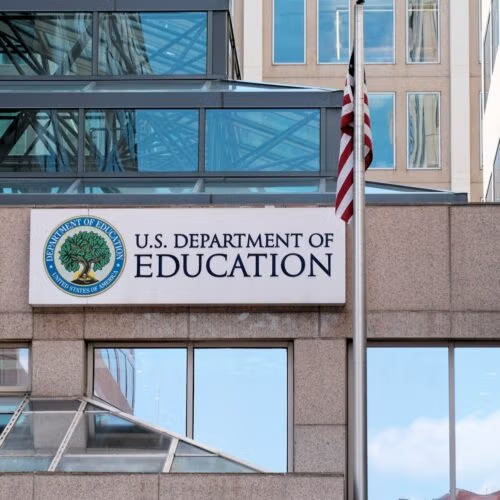
Three days of negotiated rulemaking on higher education accreditation will end today, with accreditors, college heads, business leaders, and members of the Department of Education discussing what regulatory solutions can and should be applied to the accreditation process. The most contentious proposal by the Department, based on the recommendations of the Commission on the Future of Higher Education, involves setting basic performance standards for “similar” colleges and universities. The Department is arguing that colleges should be held accountable for the caliber of students that they graduate. Accreditors are challenging any one-size-fits-all proposal, arguing that the imposition of external measures of achievement would harm the diversity of learning processes and student outcomes in higher education.
Private Donations to Colleges Skyrocket, Particularly at Elite Schools
Stanford, Harvard, Yale, and UPenn Top the List
Charitable giving to colleges and universities hit an all time high this year, with schools raising a record of $28 billion dollarsa 9.4 percent increase from last year. The largest increase in donations came from wealthy alumni, whose contributions rose 18.3 percent, while donations from corporations and foundations increased at a much lower rate. As expected, an elite group of wealthy colleges and universities gained the most. Approximately 25 percent of all charitable donations went to 20 schools, typically those with well-established research programs. Stanford topped the private giving list by raising $911.6 million, the largest amount ever raised in a single year, followed by Harvard with $595 million, Yale with $433 million, and the University of Pennsylvania with $409 million.
Elite Private Colleges Lessen Impact of Home Equity in Financial Aid Calculations
Stanford University officially announced that it is changing how home equity is factored into financial aid calculations. A group of elite private colleges recently made the same change. The ceiling placed on home equity calculated as a part of “family wealth” will be lowered from up to two times family income to up to 1.5 times family income. In other words, in determining financial aid awards, the value of your home will count less when the elite colleges ascertain your ability to pay for school. The change will primarily help middle class families, specifically those whose homes may have gained significant value in recent years as housing prices have skyrocketed. Stanford predicts the change will save middle class families on average about $2,000 a year. Last week, Stanford raised undergraduate feestuition, room and boardfor the 2007-08 academic year from $43,361 to $45,608. The “568 colleges,” a group of 28 private institutions that are allowed to collaborate on financial aid policies, recently changed their guidelines to include home equity of up to 1.2 times family income in aid calculations, whereas previously they had considered home value.
Unique “3+1” Transfer Program at Indiana University
Indiana University (IU) is drawing attention with an innovative “3+1” transfer program that lets out-of-state students earn a bachelors degree from the University with three years of community college courses and one year of online courses from IU. The program has not attracted a large number of students to date, with only 60 students enrolled in 2006. Participating community colleges are required to have a broad-based curriculum and academically qualified faculty. One advantage for out-of-state students is that they are only charged in-state tuition for their year at IU, although a new dean is considering changing this policy. Supporters of the program applaud it for the affordability and flexibility it offers non-traditional students. Others question the fairness and quality of the program, as these students could earn the same degree as a four-year student at IU having completed a potentially less rigorous course of study.
Issues
Programs/Projects/Initiatives
Related

CCAMPIS Changes Put Politics Ahead of Student Parents

The Education Department Gave Us the List of 2026 CCAMPIS Grantees