Richard Davis Jr.
Policy Analyst, Higher Education
New analysis reveals that being enrolled in college offers young parenting students far less protection from eviction than it should.


Imagine a mother named Destiny. She is 22 years old, working part-time at a grocery store while taking classes at her local community college, when her landlord begins the eviction process. She had fallen two months behind on rent after her car broke down, causing her to miss several shifts, a financial shock that parenting students, with little cushion for emergencies, are especially vulnerable to.
Destiny has a two-year-old son at home. She is studying to become a nurse, a job with steady income and career growth. She is, by any measure, doing everything right to care for her family and build a more stable future through higher education. But doing everything right still was not enough to protect her young family from losing their housing. For too many parenting students, Destiny’s experience is not an outlier.
Last year, New America partnered with The Eviction Lab, a Princeton University-based research organization that studies eviction and its consequences across the United States, on a new analysis to understand how eviction affects parents who are attending college while caring for children. In Ousted from Opportunity: Eviction’s Adverse Impact on Parenting College Students, we examined outcome data for parenting students threatened with eviction (defined as receiving an eviction filing) while enrolled, comparing them to similar parenting students who did not. Across the higher education systems in our database, we found that only 15 percent of parenting students who were threatened with eviction went on to complete their degree program, which is 23 percentage points lower than that of those who were not threatened with eviction. The threat of eviction was also associated with lower post-enrollment incomes and an increased risk of death in the ten years following enrollment.
Those data, however, could not tell us how often parenting students face eviction filings in the first place, or how their rates compare to those of parents who are not enrolled in college. The prior brief compared parenting students to their non-parenting peers within the enrolled population — this new series takes a different approach, comparing parenting students directly to non-student parents of the same age.
This two-part series uses linked data from the American Community Survey to estimate nationally representative eviction filing rates by student and parenting status. This first piece focuses on younger parenting students aged 18-24 with young children under 5 and finds that enrollment offers far less protection against eviction than we expected.
We built a new dataset linking eviction court records to Census data to understand the extent to which student parents face the threat of eviction. We drew on housing court records comprising 73.2 million defendants in eviction cases from 2000 to 2018, compiled by the Eviction Lab. We linked the defendants in these records to Census Bureau survey and administrative data to determine individual demographics and parenting status. We used this linked data to estimate eviction filing rates by age group, enrollment status, and parenting status, measured using linked data from the American Community Survey (ACS). For parents, we further split rates by whether they had a young child (aged 0-5) in the household or whether all children were aged 5-18. Technical details on the estimation method, which adjusts for incomplete coverage of eviction records, are described here.
The threat of eviction is used as the point of comparison because it is more challenging to track outcomes after a landlord files an eviction case, and the available evidence shows that the threat alone is immensely disruptive, whether it leads to an actual eviction or not.
Consistent with previous work using these data, we find that eviction filing rates are extremely high among younger adults, especially those with children. Roughly 1 in 4 non-student renters aged 18-24 with young children are threatened with eviction every year. Among parenting students the same age, roughly 1 in 5 face the same threat, only slightly lower (see Figure 1).
Notably, enrollment does appear to offer more protection for 18-24 year olds without young children at home; students face eviction at roughly half the rate of non-students in those groups. But for parents of young children, that protection nearly disappears, which is the focus of this blog.
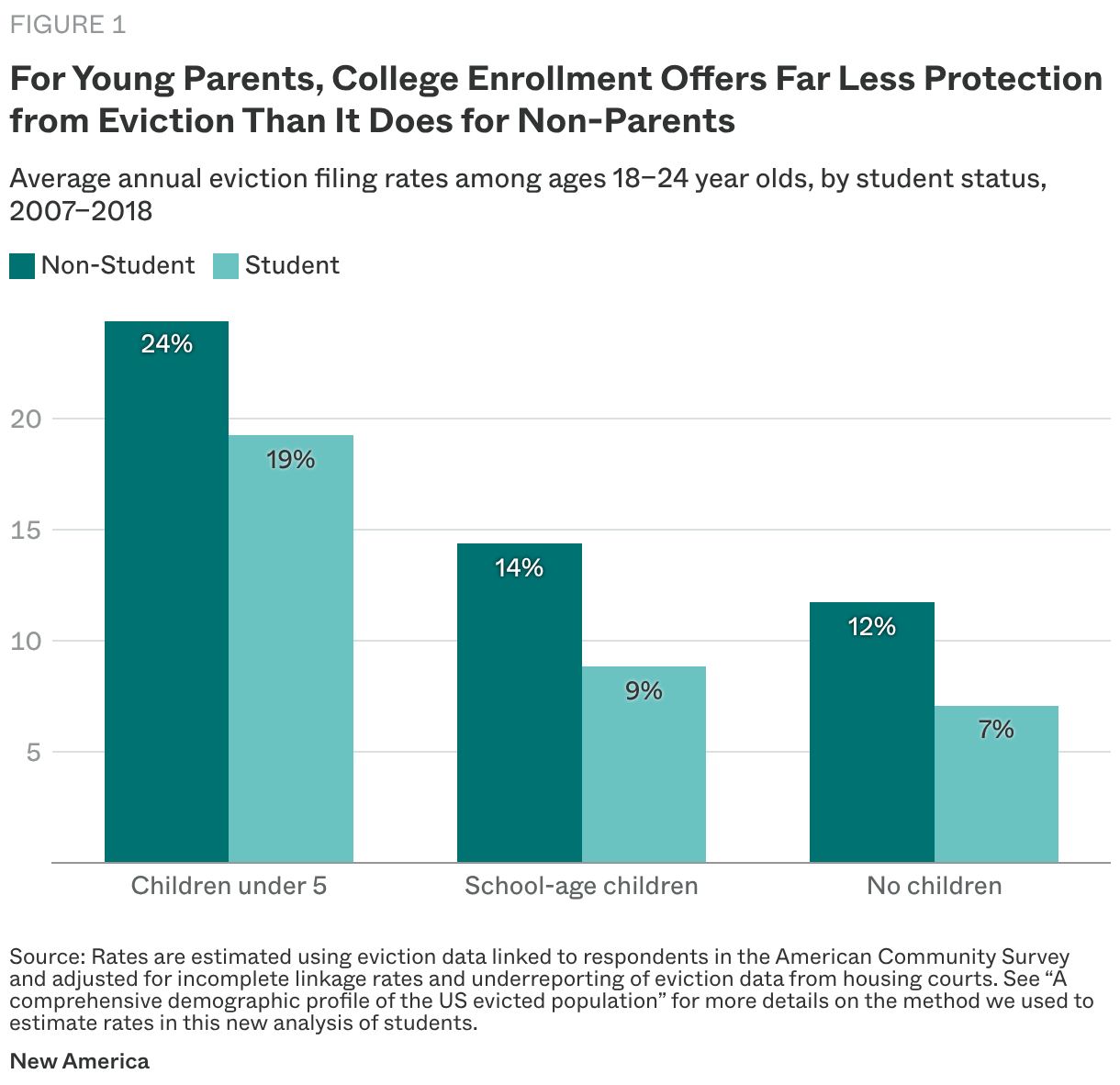
This finding surprised us. We expected enrollment to offer more protection than it does. People who choose to enroll in college, especially while raising children, often do so precisely because they are working to improve their economic circumstances. Once enrolled, students gain access to financial resources unavailable to non-students — including federal and state grants, loans, and institutional aid that can help cover not just tuition but living expenses. Campus-based student support services and housing programs should, in theory, provide an additional layer of protection. And yet, the gap between student and non-student filing rates is remarkably small.
For young parenting students who are doing everything they can to build a more stable future for their families, facing eviction at nearly the same rate as those not in school is a troubling signal that something structural is undermining that effort before it can take hold. These rates are not just high. They reflect housing and financial support systems that were not built to meet the needs of families trying to get ahead through education. And as we will show in Part 2 of this blog series, the picture grows more troubling as parenting students age, suggesting the structural barriers these families face only deepen over time.
It is worth remembering that behind each of these data points is not just one person. Parenting students facing eviction are not facing it alone. Their children, partners, and other family members are swept up in the instability, too. An eviction that derails a student’s path to a degree also disrupts a child’s schooling, a family’s access to stable child care, and the economic security of an entire household. Previous research from the Eviction Lab shows that children whose families face eviction are more likely to switch schools, fall behind academically, and experience developmental setbacks that can follow them for years.
Sechita McNair, a mother profiled in a Hechinger Report article about navigating eviction in Atlanta, described how the scramble to keep her family housed came at the expense of her son’s education: “I was running around doing so many other things just so we have a place to live… I didn’t put enough of my energy there.” Her experience is a reminder that the consequences of housing instability for those families do not end when a student leaves school. They ripple outward.
These filing rates reflect a financial aid and housing support system that was not built with parenting students in mind. Federal financial aid, particularly the Pell Grant, has not kept pace with the real costs facing families, including housing, child care, and transportation. Undergraduate loan limits have not been increased since 2008 — nearly two decades ago, and as of 2022, they had lost more than 20 percent of their value in real terms, even as housing and child care costs have risen dramatically. In addition, recent changes under the One Big Beautiful Bill Act will further reshape the borrowing environment for students, including by making it harder for part-time students to access the federal loans they need—a concern for parenting students, who are far more likely than their peers to enroll less than full-time due to balancing caregiving responsibilities. Until aid is redesigned and adequately funded to reflect those real costs, parenting students will continue to face housing instability at rates that no amount of institutional effort can fully address.
That said, institutions have tools, and the narrowness of the gap between student and non-student filing rates suggests they need to be using them more. Institutions should proactively connect parenting students to available resources, including emergency aid and public benefits programs they may be eligible for outside higher education. They should also ensure that cost of attendance calculations reflect parenting students’ real living expenses, rather than leaving students to navigate these adjustments on their own. Connecting students to legal aid is among the most impactful steps institutions can take.
When the threat of eviction does occur, having access to legal support can mean the difference between a parenting student staying housed or losing everything, and with it, their chances of completing a degree and securing a stable future for their family. Studies across the country consistently show how much representation matters: A 2018 Minnesota study found that tenants with legal representation win or favorably settle 96 percent of their eviction cases, compared to just 62 percent for those without any legal services. A 2022 Dallas court observation study found a similarly stark gap: landlords prevailed in 79 percent of cases when tenants had no representation, compared to just 10 percent when they did. And yet most tenants face those proceedings alone. Institutions that connect parenting students to legal aid are not offering a luxury. They are providing a meaningful intervention that can keep families housed, students enrolled, and futures intact.
The story does not end with young parenting students. In our second piece, we will examine what happens to eviction filing rates as parenting students age, and find a troubling reversal. What that pattern might mean, and what it demands of our financial aid system, is the subject of Part 2.
This is part one of a two-part series with the Eviction Lab examining eviction filing rates among parenting college students. For the second part, see “For Most Renters, Eviction Threat Falls with Age. Not for Older Student Parents.”
This series builds on foundational research from New America and the Eviction Lab published in 2025. “Ousted from Opportunity: Eviction’s Adverse Impact on Parenting College Students” documents the devastating outcomes associated with the threat of eviction for parenting students, including sharply lower degree completion rates, reduced post-enrollment incomes, and higher mortality in the decade following enrollment.
Policy Analyst, Higher Education
Assistant Professor, Department of Sociology and the Institute for Social Research and Data Innovation, University of Minnesota