Stephen Burd
Senior Writer & Editor, Higher Education

A recent Senate report on improper marketing practices by student loan providers participating in the Federal Family Education Loan (FFEL) program landed with a thud in Washington last week. Sen. Michael B. Enzi (R-WY) was not alone when he dismissed the document, saying it “simply plows the same old ground.”
 The report, released by Sen. Edward M. Kennedy (D-MA), provides the most detailed evidence to date that student loan providers have routinely provided gifts and payments to colleges with the express intent of getting the schools to steer borrowers their way, a practice that clearly violates federal law. [Disclosure: The Editor of Higher Ed Watch previously worked for Senator Kennedy.]
But critics of the report, many of whom are strong supporters of the loan industry, say that the report’s findings are old news and that lenders have already paid a high price for these actions. They point out that most of the top lenders in the FFEL program have reached million dollar settlement agreements with New York Attorney General Andrew Cuomo over the last six months, in which they have agreed to abide by codes of conduct barring them from providing gifts to colleges. Student loan giant, Sallie Mae, for example, agreed to pay $2 million into a financial aid education fund Cuomo has established. That’s fine and good, but we wouldn’t be surprised if Sallie Mae officials spent more on cigars last year. They did make over $1.3 billion in profit last year.
Industry supporters also note that both Congress and the Education Department have offered proposals to bar lenders from employing many of the marketing practices that have come to light over the past year. In addition, budget reconciliation legislation that Congress overwhelmingly approved last week would make such significant cuts in lender subsidies that loan providers wont be able to afford to offer the kinds of goodies anymore that have raised so many objections, they say.
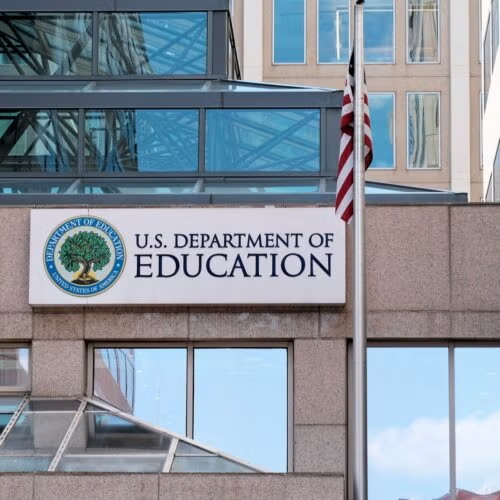
These analyses sound reasonable, but they miss a fundamental point. The Department of Education has not enforced a current and long standing law that prohibits lenders from offering any direct or indirect inducements designed to secure business. When asked why, Education Secretary Margaret Spellings has stressed the difficulty in proving that there is a “quid pro quo relationship” between gifts and special benefits that lenders provide colleges and financial aid administrators and the loans the schools students obtain. Its a very high “hurdle that must be cleared,” Spellings told the House Committee on Education and Labor in May.
Perhaps — although, to us at Higher Ed Watch, it sounds like a convenient excuse for inaction. Nonetheless, Senator Kennedys new report — which builds on an earlier report that he released in June — should make the job of Education Department regulators much easier as it breaks new ground by providing concrete evidence of quid pro quo agreements between lenders and colleges. The report is particularly strong, because it quotes extensively from lenders’ e-mails spelling out exactly what they hoped to achieve by providing gifts, donations, and special services to colleges. Among the examples are the following:
These examples, as well as dozens of others contained in the report, should give the Education Department plenty with which to work. And to make the agency’s job easier, Kennedy released an appendix containing copies of the e-mails and internal company documents that the report cites.
The easiest thing for the department to do might be to start with Sun Trust Bank, which acknowledged to Senate investigators that it had “from time to time, offered, donated, or paid funds to an Institution of Higher Education in exchange for an agreement that the Institution for Higher Education exert efforts to increase FFELP volume with SunTrust.” Sounds like quid pro quo agreements to us.
And maybe once the department digs in, it can take another look at the charges that have been made, and substantiated, against Student Loan Xpress. Imagine the Education Department taking its student loan enforcement responsibilities seriously. Now that would be news, wouldn’t it?
Senior Writer & Editor, Higher Education