Stephanie Baker
Senior Policy Manager, Higher Education
The information raises questions about a critically important program for student parents in college.
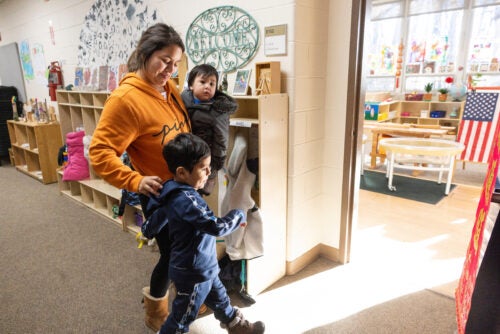
Recently, federal agencies ran the first Child Care Access Means Parents in School (CCAMPIS) grant competition since 2023. The U.S. Departments of Education (ED) and Health and Human Services (HHS) Colleges ran the grant competition, touting that nearly 300 campuses applied. Colleges and universities applied for competitive, four-year grants to subsidize child care for low-income student parents through on-campus child care centers or with off-campus providers.
This month, applicants that received awards were notified—welcome news to those institutions hoping to bolster parenting students on their path to degree completion.
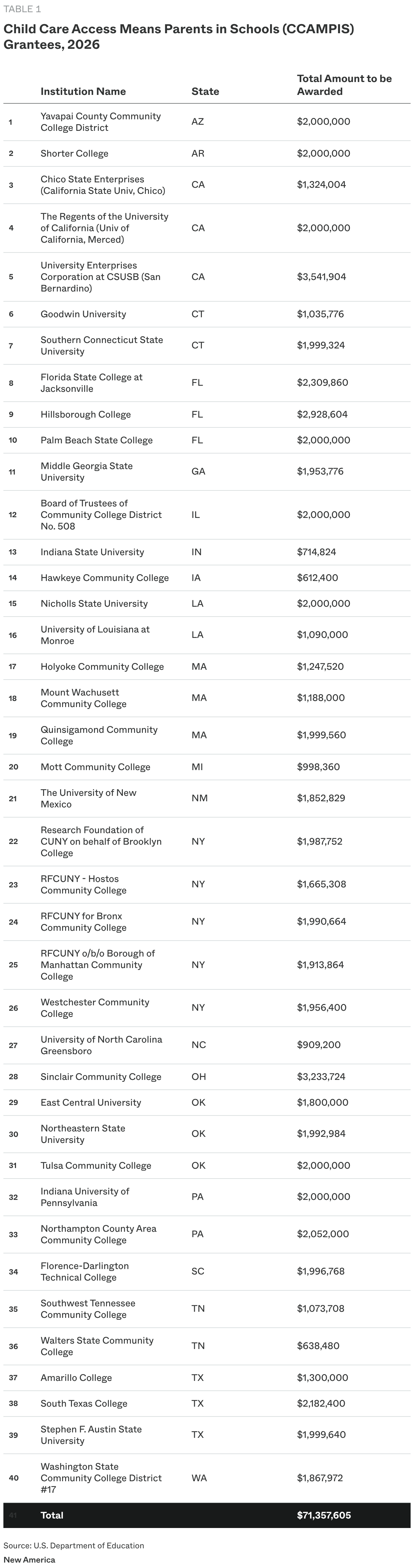
This morning, I asked ED for a list of grantees or whether a public announcement would be imminent. ED replied via email, sharing with me a spreadsheet of 40 grantees and award amounts, which it described as public information that I was “welcome to share.”
I’m publishing the list of 2026 CCAMPIS grantees here (Table 1). As of the time of this writing, staff at eight different campuses have contacted me individually to inquire about whether I had and could share a grantee list. None of those eight campuses received awards, per this list, which raises the question of whether ED or HHS has notified any unsuccessful applicants.
ED made far fewer grants than expected which, in combination with other shifts in the program, raises a few questions:
Although ED said earlier this year that it expected to make 148 grant awards, just 40 campuses received them. The total dollar amount of these grants is just over $71 million, using most of the $75 million fiscal year 2026 appropriation for the program. The grant amounts are strikingly high for many institutions compared to prior years. That suggests that rather than funding the first year of a four-year cycle, ED instead frontloaded all of the money into a single year.
Both the Trump and Biden administrations have frontloaded CCAMPIS funds in recent years, but this ultimately leads to fewer colleges getting grant awards.
Last year, in its ongoing effort to dismantle ED, the Trump administration offloaded the CCAMPIS program via an agreement with HHS. This Interagency Agreement (IAA) outlined that though HHS will oversee much of CCAMPIS, ED will supervise the agency. ED also is supposed to maintain responsibility over key aspects of the program. Because federal law demands that ED manage a number of CCAMPIS’ critical functions, the IAA merely complicated the bureaucracy of a small federal grant program.
In addition to the IAA, the Trump administration has massively cut ED staff beginning in early 2025. There are broad concerns about what reduced staffing levels will mean for CCAMPIS grantees. Grantees don’t just use CCAMPIS dollars to serve student parents—they also rely on communication from ED staff to make sure they’re spending the money legally. It remains to be seen how the IAA’s implementation and reduced staffing could hamstring new grantees in need of technical assistance.
CCAMPIS competitions have generally been held every four years. But from 2017 to 2023, ED held a competition annually, coinciding with a funding increase for the program. In 2024, the Biden administration opted not to run a competition. Last year, the Trump administration also didn’t run a competition and argued that the program should be eliminated.
It’s been a confusing few years for college teams hoping for opportunities to apply for CCAMPIS to shore up child care services for parenting students. College teams are left wondering year to year whether the program will be funded, and if so, whether and when ED and HHS will hold a competition to distribute funds.
We don’t yet know if a competition will be held in 2027. If Congress continues funding the program at current levels, $75 million, and 2026 grantees indeed are receiving four years’ worth of money from the pot of 2026 funds, there would be money to hold another competition, fund applicants who were unsuccessful this year, or both.
Forty colleges have been awarded new CCAMPIS grants this month. Student parents at those colleges will be able to access subsidized child care as they attend college, which is worth celebrating. Bipartisan support for the program led to continued funding in spite of repeated calls from the Trump administration to eliminate it.
A House proposal with bipartisan support would have level funded CCAMPIS for fiscal year 2027, but Congress delayed appropriation negotiations until after the midterm elections. In other words: we don’t know exactly what funding will look like yet, but it appears legislators from across the political spectrum are supportive of appropriating funds for CCAMPIS.
Congress sets appropriation levels and can choose to fund the program more robustly, as a strategy to address affordability and child care needs. Increasing funding for the grant can be accomplished through annual appropriations, as happened between 2017 and 2023, when funding increased from $15 million to $75 million. The CCAMPIS Reauthorization Act calls on appropriators to fund the program at $500 million annually.*
Grantees and student parents also need transparent, thoughtfully planned competitions. We’ll be watching for Congress’ funding decisions that impact the future of the program, and continuing to track these issues. Student parents deserve it.
*Editor’s note: This article was update on October 2, 2026 at 1:50. The original version of this article suggested that the CCAMPIS Reauthorization Act itself would increase funding for the program; this has been corrected to reflect that appropriators would still make annual decisions on funding levels for the program.
Senior Policy Manager, Higher Education