Stephen Burd
Senior Writer & Editor, Higher Education

In approximately three weeks, the U.S. House of Representatives is expected to take up legislation that would impose new restrictions on the relationships between colleges and student loan companies. While the effort is to be applauded, the legislation could go much further in eliminating the types of “pay for play” conflicts of interest in the student loan program that have caused so much controversy over the last year.
 Even more explicitly than current law’s anti-inducement clause, both the House and Senate versions of the Higher Education Act reauthorization would bar lenders from providing, and colleges from receiving, payments, gifts, or other types of inducements in order to win student loan business on the campuses.
The House bill would specifically forbid “financial aid officers and others with responsibilities with respect to educational loans” from soliciting or accepting any type of gift or payment from a lender or a guarantee agency. That includes “any gratuity, favor, discount, entertainment, hospitality, loan, or other item having a monetary value of more than a de minimis amount.” The Senate bill prohibits colleges and their employees from receiving “anything of value” from a lender “in exchange for any advantage sought by the lender to make educational loans to a student.”
Both bills, however, would continue to allow lenders to make philanthropic contributions to colleges as long as their donations are not made in exchange for increased loan business. The House measure, unlike its Senate counterpart, would explicitly require colleges and lenders to disclose these contributions, as well as their purpose and any conditions related to their use.
Both measures have a more significant flaw: they still require the Department of Education to prove that there is a “quid pro quo relationship” between the gifts and payments that lenders provide colleges and the loans the schools’ students obtain. This is not an easy standard of guilt to prove, particularly when lenders and colleges are mostly smart enough not to put all of the details of their agreements in writing.
New Vigor by the Bush Administration in Enforcing the Current “Anti-Inducement” Law
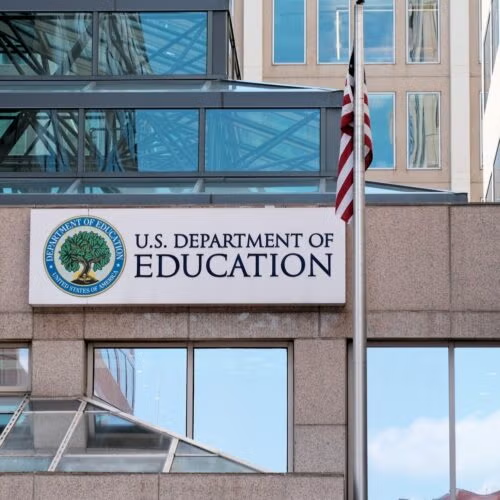
The Department of Education, for its part, has used the difficulty of meeting the “quid pro quo” standard as an excuse for its longstanding refusal — at least up until now — to pursue violations of the current law anti-inducement clause, even in cases that appear clear cut. For instance, SunTrust Bank recently acknowledged to Senator Kennedy’s investigators that it has “from time to time, offered, donated, or paid funds to an institution of higher education in exchange for an agreement that the Institution for Higher Education exert efforts to increase FFELP volume with SunTrust.” Despite the admission, the Department of Education has taken no enforcement action.
To be fair though, under tremendous pressure the Bush Administration appears finally to be starting to act. In October, the Education Department sent letters to 55 colleges and 23 lenders which which the schools had exclusive preferred lender arrangements demanding to learn more about the deals that had been forged. The following month, the Department issued final rules, which go into effect in July, that give the agency greater authority to regulate the relationships between colleges and Federal Family Education Loan (FFEL) program lenders.
Among other things, the new rules lower the standard the Department must use to determine whether lenders have violated the existing prohibition on providing illegal inducements to one of “rebuttable presumption.” Under this standard, the burden of proof has shifted, so that the onus will be on lenders to prove that a gift, payment, or service they provided to a school was not given in order “to secure loan applications.” In other words, if it looks like a duck and quacks like a duck, it’s must be a duck unless the loan provider can prove otherwise.
Lenders and some financial aid adminstrators are apoplectic about the rule change. Michael Bennett, the national chairman of the National Association of Student Financial Aid Administrators (NASFAA) and the financial aid director at Brookdale Community College, echoed the feelings of many loan industry officials in a recent blog item he wrote for the association’s website. “The first time I heard this explained in that manner I blinked twice,” he wrote, adding, “I thought as an American citizen one would certainly be ‘innocent’ until proven ‘guilty.'”
A Tougher Alternative
Here’s a simpler solution: a full-fledged gift ban. Colleges should be barred from receiving any and all gifts or payments from lenders that they recommend to their students or that lend or hold a significant share of loans on their campuses. A bright-line standard is needed to rid the FFEL program of the corruption that has riddled the field.
Colleges may not like the solution, but it seems a reasonable price to pay if they want to continue to be in the business or recommending lenders to students. And lenders that wish to continue to engaging in philanthropy can show their true altruistic spirit by contributing to schools with which they don’t have any business. Most importantly, by establishing such a clear-cut standard, the Department of Education will no longer be able to fall back on the claim that these cases are just too hard to prove.
When lawmakers get back to work, they should revisit these student loan gift regulation provisions. Surely, they don’t want to hand the Education Department another excuse for not taking its oversight and enforcement responsibilities seriously.
Senior Writer & Editor, Higher Education