On Down From the Ivory Towers

Recent announcements by Harvard and Yale universities to expand financial aid are good news for the small number of students helped, but do little to dispel the impression of an ivory tower still removed from regular people.
 Heres a primer for those who may have missed the flurry of media coverage on the Ivory aid plans. Harvards plan, announced in December, would spend $22 million to cap parental contributions at 10 percent of income for all students coming from families making between $120,000 and $180,000 a year. Yales new policy, released on Monday, is slightly more complex, using over $24 million to cap parental income contributions to less than 10 percent for families making $120,000 or less, while significantly reducing expected contributions of families making between $120,000 and $200,000. The Yale plan would result in reductions of one-half to one-third for affected families.
It’s great that Harvard and Yale are making multi-million dollar commitments from their overflowing endowments. But don’t miss the order of magnitude involved. Harvard’s endowment grew by some $6 billion last year alone. To put that number into perspective, Congress just spent $6 billion to cut undergraduate federal student loan interest rates in half over the next five years — nationwide. Harvard’s $22 million commitment equals about 1/3rd of 1 percent of the growth in its endowment last year.
We repeatedly have urged the richest schools in the nation to put their hoarded wealth to better use specifically, preparing, recruiting, providing financial support for, and retaining low-income students. Harvard and Yales new policies get part of the equation right. At least they’re prying open the lock box and not spending it on athletic facilities. But here is where they fall short.
They aren’t improving their outreach to needy students, and they’re helping a lot of relatively upper income students. As Donald Heller of Penn State pointed out in The Chronicle of Higher Education, the Harvard policy (and by extension Yales) belie a suspect conception of who is “middle-class.” Families making at least $120,000 annually represent all but the top 15 percent of U.S. households, while families with annual incomes of $180,000 or higher are all but the top 5 percent of U.S. households, according to census data. Despite this, about half of Harvards students come from families that are above the upper income limit. Not only are the new Harvard and Yale new aid policies doing litle for low-income students and benefiting more than just “middle-class” families, they are also showing the socioeconomic homogeneity of Americas most elite institutions of higher education.
Defenders of the Harvard and Yale policies are quick to point out that the astronomical growth in college costs means that even relatively affluent families have trouble paying for their childrens education. Addressing this issue through aid expansions, however, could have troubling effects on low-income students.
The Traditional Higher Ed Community’s View
A number of folks in the traditional higher ed community are concerned about the ways that Harvard and Yales policies could work to squeeze out low-income students, both at those institutions and elsewhere across the country.
Argument one is that improved and less confusing aid offers are likely to create an influx of wealthier applicants to the top Ivies. At Harvard this means increased competition for a static amount of spots, an issue that Yale at least addressed with an announced plan to expand enrollment by 700 students. Receiving more applications means a greater strain on existing admissions resources. Asking already overbooked admissions officers to review more files could detract from pro-active recruitment efforts that are necessary to increase low-income applicants. Yale has partially addressed these concerns by sending current students out as ambassadors to schools with large numbers of low-income students, but these individuals will not be able to create the lasting relationships with guidance counselors that play a crucial role in locating and admitting students.
Argument two and more disconcerting is the prospect that the decision to expand aid so far up the income spectrum at Harvard and Yale will prompt other institutions to shift their aid policies toward the affluent, as opposed to growing their financial aid budgets. Making Harvard and Yale more affordable could pressure poorer rivals to offer more “merit aid” (at the expense of need-based aid) to avoid losing wealthier applicants. On a national level this could be detrimental for low-income students who are less willing to take on high levels of debt and whose decision to attend college is more likely to be affected by the available financial aid.
Our Take:
Harvard and Yale’s policies are good for the small number of talented students that they help. We wish those two schools were contributing more than 1/3rd of 1 percent of the growth in their endowments to student assistance and that specifically they contributed more of their wealth to low-income (high school and college) student preparation, recruitment, support, and retention.
There may be some adverse consequences to the plans for low-income students elsewhere who are not able to take advantage of Harvard and Yale’s policies. But the far bigger college affordability issue is not what Harvard and Yale are doing on financial aid for a small number of students or even what other institutions do in response, it’s what the Governors are about to do to millions.
As the economy turns down, state budgets are apt to tighten. In turn and forced by state constitutions to balance their budgets, Governors are apt to cut state funding for higher education, as they have done historically in times of economic recession. In response to state budget cuts, public colleges and universities, which educate more than three out of four post-secondary students nationwide, are apt to raise tuition and lessen the proportionate growth in their need-based financial aid.
In other words, the combined effect of the new Ivy policies and a coming downturn in the economy means we’re likely to see an increasingly bifurcated system of higher education nationally. College will become more affordable for the talented lucky few, while becoming less affordable for the masses attending public community colleges and state universities. Unless that is, actions are taken by Congress to prevent the phenomenon from occuring. More on that though in the weeks ahead.
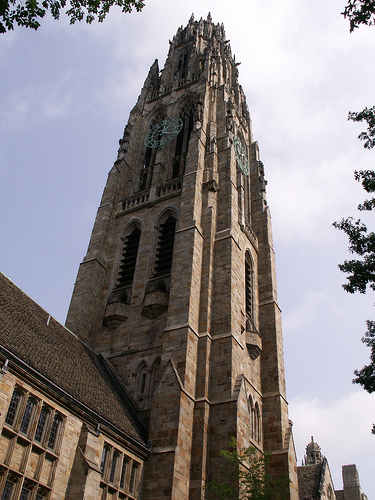
Note: Photo of Yale’s Harkness Tower used under a Creative Commons license from Flickr user Omerka.
Issues
Programs/Projects/Initiatives
Related

Accreditor Exposes Sensitive Student Information in ‘AI University’ Case

New Findings on Student and Public Stances on Higher Ed