A Maintained Effort

Behind closed doors, Members of Congress are battling over a key concept in the pending Higher Education Act reauthorization — a House of Representatives generated requirement that states maintain steady fiscal support for higher education. Not only should Congress ensure this concept makes it through to President Bush’s desk, it should strengthen the requirement to make it more than a toothless accountability measure.
Under the House bill pending in a conference committee with the Senate, states would be required to maintain support for their higher-education systems at a level at or above the average funding for the previous five academic years. States would also have to provide a consistent level of spending on state aid for students attending private colleges within their borders. Failure to meet these “maintenance of effort” standards would result in the loss of some federal funding.
The Senate version of the legislaton doesn’t contain a similar provision. As a result. it has become a major source of strife as lawmakers from both chambers meet to work out differences between the two bills. In fact, according to press reports, disagreements over this provision appear to be one of the main obstacles holding up completion of the legislation.
At Higher Ed Watch, we believe Congress should include this important provision in the final reauthorization measure. As we have stated previously, declining state support for higher education is the single most important force driving tuition increases at state colleges and universities, which educate over 75 percent of all post-secondary students. Federal policymakers, who are tired of increasing spending on federal student aid only to see their efforts squandered by large tuition increases, should use whatever leverage they have to make sure that states live up to their obligation to keep college affordable for their citizens.
Frankly, the House’s maintenance of effort provision is relatively modest. Under pressure from state officials, House lawmakers agreed to exclude from the requirement both capital and research and development expenditures — funds that were initially included in the legislation. Capital expenses are a massive state expenditure (part of the $53.8 billion in state support for non-operating expenses, according to the latest figures released by the National Center for Education Statistics).
In addition, states don’t even stand to lose much money if they fail to meet the House’s maintenance of effort standard. The funds at risk, the newly-created Grants for Access and Persistence, are authorized to receive an appropriation of $200 million. But because an authorized appropriation doesn’t actually compel Congress to provide funds, there is a good chance these grants could end up receiving only a fraction of this total, if anything at all. In other words, the stick is both small at best and far from guaranteed at that.
Still organizations representing state officials, such as the National Governor’s Association (NGA), remain intent on killing the provision. As part of that effort, the NGA has released an analysis claiming that requiring states to maintain consistent funding on higher education would lead to reduced state spending. The group argues that governors and legislators would not propose substantial increases in prosperous years, because they would be afraid that they wouldn’t be able to maintain that level of spending in leaner years. As the analysis put it:
“State higher education funding is cyclical: States freeze or slow the growth in spending during economic downturns, but more than make up for these lean years with significant increases of as much as 10 to 13 percent during good budget times.”
The NGA’s analysis, however, is only half right. States certainly do trim spending on higher education during lean economic times: According to a 2006 report by the Center for Study of Higher Education Policy at Illinois State University, each successive economic recession has led to an increase in the number of states reducing funding in this area. For example, during the 1980 recession, 26 states cut the amount they spent per college student. Ten years later, 38 states reduced higher education funding, and in 2001, 44 states did. If that trend continues, a 2008 recession would likely mean less money and higher tuition in almost every state in the country.
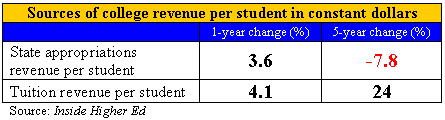
What states haven’t done, however, is return their support to the levels reached before those downturns. As reported recently by Inside Higher Ed, total state spending on higher education in the 2007 fiscal year was 7.8 percent lower than it had been five years ago, despite the fact that the economy did very well for most of that time period. How did public colleges fare in 2007 when the S&P 500 had a return of over 20 percent and the wealthiest college endowments did even better? State support went up a paltry 3.6 percent. If 2007 wasn’t the year for these rumored 10 percent increases, when will be?
Certainly not 2008. The weak economy has already led legislatures and governors in states such in Florida, New Jersey, and Rhode Island to propose or hint at multi-percentage point cuts in college funding, with other states sure to follow as budgets are prepared.
A drop in state funding will undoubtedly necessitate large tuition hikes at public colleges to cover costs. Just look at what happened in Maryland, where tuition increased by as much as 40 percent at some schools because of steep cuts by then-Governor Robert Ehrlich in the early 2000s.
Tuition hikes harm students from all income levels. A sudden increase in sticker price could scare away low-income students from ever enrolling and force those taking classes to drop out. Meanwhile, middle-income students would be forced to take on more and more debt — increasing the likelihood of ending up with a high-interest private loan.
Governors and state legislators have already shown a willingness to place a greater emphasis on tuition rather than state support during good years — education revenue from tuition and fees per full-time student is up 24 percent in constant dollars over the past five years. And that’s with “increased” state support. If that’s the price increase during bullish times, we shudder to think what levels tuition will hit in a bearish economy.
The House at least has already taken some action to address these fears with its maintenance of effort requirement. While the requirement is limited and the penalties are small, it’s at least a start. College students are being asked to pay their share. Congress made a major investment in need-based financial aid year, providing an additional $20-plus billion over the next five years. It’s time to ensure that states keep up their end of the higher education financing system. Budgets ought not be balanced on the backs of students.
Issues
Programs/Projects/Initiatives
Related

Accreditor Exposes Sensitive Student Information in ‘AI University’ Case

New Findings on Student and Public Stances on Higher Ed