
Shining a Light on the University of Phoenix

“Bring on the data,” was the message echoed loudly by representatives of for-profit colleges at a recent event on the sector hosted by the American Enterprise Institute (AEI), a conservative think tank. That same day, the University of Phoenix, the largest chain of for-profit trade schools in the country, took its own step in that direction by releasing the first of what it promises to be an annual self-assessment of academic outcomes.
 At first glance, it appears that the for-profit sector is prepared to usher in a new age of accountability in higher education. But just how ready are these schools to let the sunshine in on their actual performance?
Consider the University of Phoenix’s self study of its students’ success. While perhaps a laudable step toward transparency, there are serious questions about the methodology the institution used to carry out the assessment. (It certainly wouldn’t be the first time that the for-profit sector has preached openness while providing misleading data, about the performance of its students, particularly in the areas of graduation and job placement rates.)
The study was based on comparing the results between “freshmen” and “seniors” at Phoenix and elsewhere on the Measure of Academic Proficiency and Progress (MAPP), a national exam designed by the Educational Testing Service (the different levels are in quotations because the university sets its levels by credit hours obtained, not years completed).
As presented, the results are quite impressive. Seniors showed improvement over freshmen in all MAPP areas, and Phoenix students overall scored at levels roughly equal to students at comparable institutions. Despite starting at lower achievement levels than peer institutions, Phoenix students made gains from their freshmen to senior year that were equivalent to students at these other schools.
But, as Inside Higher Ed pointed out, the data the university used to make these comparisons are problematic. Most troubling is the fact that Phoenix’s study is not longitudinal — meaning the university didn’t actually evaluate the same students as freshmen and then again as seniors. While the for-profit giant is not the first college to take this approach, doing so is especially problematic at schools like Phoenix that predominantly enroll nontraditional students of a diverse range of ages and levels of work experience.
As Trace Urdan, a research analyst on the for-profit higher education industry, recently pointed out in a comment he submitted to Inside Higher Ed on the Phoenix report, it is entirely misleading to compare a 20-something “freshman” with little work experience and a General Equivalency Diploma with a “senior” who is a 40-year-old middle manager with college experience who has come to Phoenix to learn a new skill. The two are apples and oranges. Without at least comparing similar students, we can’t know whether the achievement gains were caused by Phoenix or by other factors.
The Phoenix study also contains an estimate of its cost to taxpayers, presumably to make the point that these achievement gains come at little governmental expense. By focusing on the costs to taxpayers, however, Phoenix shifts the attention away from the hidden costs to students, who ultimately must live with the debt they amass to attend such a high-priced institution.
Not surprisingly, Phoenix’s estimate of taxpayer expenses shows that students at public and private non-profit colleges cost the government substantially more than individuals enrolled at for-profit trade schools, primarily because of the direct federal and state support for these institutions. (Phoenix, in fact, makes the questionable assertion that it actually generates $322.79 in per-pupil taxpayer revenue because of the federal taxes it pays. See chart below.)
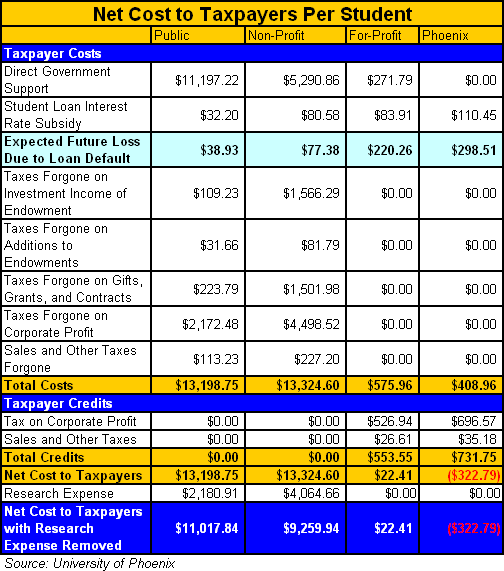
While Phoenix’s analysis makes the school seem cheaper, there are some troubling areas in which it is substantially more expensive than other types of institutions. The largest taxpayer expense at for-profits, for example, is the expected cost of future loan defaults. The report estimates the cost of defaults is $38.93 for public colleges and $77.38 for private ones, compared to a whopping $220.26 at for-profits and $298.51 at Phoenix.
While Phoenix presents the higher default cost as more than offset by the federal taxes the university pays, it fails to mention the devastating consequences that defaulting on a loan can have for indebted students. For example, the government has the authority to seize portions of borrowers’ paychecks, tax refunds, and Social Security payments without a court order. This affects an individual’s ability to consume, save, or contribute to the economy in other ways — which is a further loss of taxpayer revenue.
Ignoring the costs to students also leads to distorted policy recommendations. For example, a recent piece in Reason Magazine fawns over Phoenix, saying by many measures it is “the most successful institution for higher education in American history.” This is certainly true in terms of enrollment and profit. But what about the students it serves? The article defends the school, saying “Phoenix offers the educational equivalent of a subprime mortgage: not the best product the industry has to offer, but a potentially valuable option for people who might not otherwise get into a desired market.”
In reality, attending Phoenix is similar to taking out a subprime mortgage instead of obtaining a widely available subsidized loan from a local non-profit lender — in this case a community college. These schools often offer similar products and cater to comparable populations, while charging tuition that is nearly $10,000 cheaper, according to the College Board. Even if a student successfully pays off their “subprime mortgage,” is the education at Phoenix sufficiently superior to a community college to justify the tuition differential?
While the Phoenix study is a baby step toward transparency, the university still has a long way to go to produce a robust picture of its effectiveness. We especially want Phoenix and other for-profit colleges to demonstrate the added value that their students get from attending such a high-cost institution, rather than taking similar, cheaper programs at community colleges or at other low-cost state universities. If for-profit institutions really want to “bring on the data,” they should be prepared to let the sunshine in on this area.
Issues
Programs/Projects/Initiatives
Related
A Key Piece of the Trump Accreditation Plan Threatens Accountability