Jason Delisle
Director, Federal Education Budget Project

Is there another round of fighting brewing between the government’s two competing student loan programs? Consider recent events:
The stars appear to be aligning for a renewed debate about which loan program is better for students and cheaper for taxpayers.
 Should hostilities be renewed, expect the student loan industry to switch into high gear to try to discredit Office of Management and Budget (OMB) and Congressional Budget Office (CBO) estimates that show that Direct Lending is cheaper for the government to run. In evaluating the loan industry’s claims, lawmakers, journalists, and the public should be especially wary of one line of argument that surely will be made. In recent years, the loan industry has put out a number of reports arguing that the private market would assess the costs and risks of the loan programs differently than OMB and CBO (which must abide by government accounting rules) and that this discrepancy explains away any cost advantage Direct Lending is shown to have.
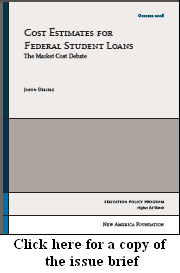
Today, the New America Foundation is releasing an in-depth report examining the lending industry’s claims about determining “market costs” for student loans. We have found that trade associations and consulting organizations working on behalf of the student loan industry have twisted a legitimate budgeting concept into a half-truth. In trying to use the market cost concept to discredit government estimates that show subsidizing lenders to make student loans is more expensive than having the government make loans directly, they have made serious errors in their reasoning and methodology, and many of their conclusions are just plain wrong. Making matters worse, the GAO has made similar errors in its own work on the topic.
To bring more clarity to this debate, our report includes the following:
We hope this report will correct the record and serve as an important reference for those interested in the student loan cost debate.
Director, Federal Education Budget Project