Stephen Burd
Senior Writer & Editor, Higher Education

Over the last two years, as we have investigated and reported on the “pay for play” student loan scandals, we have heard from some skeptical loan industry officials and college leaders and lobbyists who question whether any students have actually been hurt by the unethical practices that have been revealed.
 Well, if lenders and college officials are truly assessing the damage, then they need look no further than two new reports last week showing how predatory lending practices have put students in harm’s way.
These must-read reports –one from The Chronicle of Higher Education and the other from Iowa’s Attorney General — focus respectively on the operations of Sallie Mae, the nation’s largest student loan provider, and the nonprofit lender Iowa Student Loan Liquidity Corporation.
Both reports demonstrate how the loan companies’ drive for profits and market share have at least allegedly led them to engage in improper and possibly illegal activities that have left students with larger debt loads than they should have had.
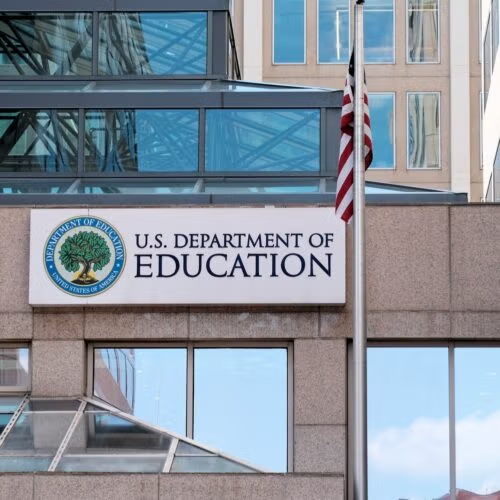
The reports also underscore how the U.S. Department of Education’s appalling lack of oversight over the student loan industry has left financially needy students vulnerable to abuse. Apparently the only people interested in enforcing the law and protecting students– judging by these reports — are state attorneys general and whistleblowers who bring false claims lawsuits against unscrupulous companies on behalf of the government. In the absence of federal leadership, is it any wonder that student loan providers have been so willing to push the envelope?
This item will provide a summary of the Chronicle’s reporting. Later today, we will take a closer look at the Iowa Attorney General’s report.
A Deeply Conflicted Relationship
The Chronicle article focuses on how the conflict-ridden relationship between the student loan giant Sallie Mae and USA Funds, the guarantee agency it effectively controls, has apparently allowed the loan company to take advantage of borrowers who are having difficulty repaying their federal loans.
In 2000, Sallie Mae purchased USA Group, the parent company of USA Funds. On its face, the deal did not put Sallie Mae in charge of USA Funds. Federal law forbids lenders from owning nonprofit guaranty agencies, which are in charge of overseeing their loan collection activities. However, as we have noted previously, Sallie Mae found a creative way around this restriction. While the loan company’s purchase didn’t include USA Funds, it did gain control of USA Group Guarantee Services, a for-profit subsidiary that provided administrative services to help the guarantor carry out its functions. The deal also required USA Funds to contract its loan guarantee services to Sallie Mae. As a result, Sallie Mae employees essentially run the guarantor. “USA Funds, with only about 75 employees of its own, pays Sallie Mae about $250-million a year to provide hundreds of workers to perform most of its guarantor operations,” the Chronicle states. “That effectively has left Sallie Mae since 2000 in the role of overseeing its own lending activities.”
The Chronicle article centers on a false claims lawsuit brought by a former Sallie Mae employee that accuses the loan company of exploiting its relationship with USA Funds “to systematically balloon student loan debts.” According to the lawsuit, Sallie Mae employees working at USA Funds routinely placed delinquent borrowers into forbearance without getting their consent. Instead, the lawsuit says that these employees “routinely falsified borrower requests for forbearances, often just dialing a borrower’s telephone number and letting the line sit open for a few minutes, so that the company’s computers would record an apparent conversation.” Lenders are required to send a written confirmation to borrowers that they have agreed to enter forbearance, but, as the Chronicle notes, “it doesn’t require any proof that the letter was received.”
Being in forbearance allows borrowers to temporarily stop making payments on their federal loans. At the same time, however, interest on the loans continues to accumulate, increasing the size of the borrowers’ total debt load.
Sallie Mae denies any wrongdoing, saying that its practices “are consistent with all laws and regulations governing as they relate to verbal forbearance in the guaranteed student-loan program.” But these charges underscore the hazards inherent in the relationship between Sallie Mae and USA Funds.
The Department of Education’s Inspector General recognized these dangers in 2002 when he issued an opinion that the companies’ arrangement violated the law and needed to be severed. Because Sallie Mae effectively controls the guarantor, the IG wrote, there is no independent agency ensuring that the loan giant is doing all it can to ensure borrowers don’t fall behind on their payments. By working hand-in-hand, the two entities actually have a perverse incentive to let borrowers fall behind so that USA Funds can collect the generous subsidies the government provides guarantors for keeping delinquent borrowers out of default.
The Department’s political leadership rejected the IG’s recommendation. As the Chronicle first reported, Matteo Fontana, a former Sallie Mae official who was in charge of overseeing lenders and guarantee agencies for the agency at the time, ruled in December 2004 that the conflict of interest did not exist because the Sallie Mae subsidiaries that helped manage USA Funds had separate tax identification numbers from other parts of the company.
We said it before. We’ll say it again. Hopefully next year, when the Department’s leadership changes, the agency will revisit this dubious decision, and, as a change of pace, put the interests of students first.
Senior Writer & Editor, Higher Education