A Last Look at Higher Education in the Bush Years

Today, Barack Obama will become the 44th president of the United States. But before turning the page, Higher Ed Watch takes a look back at the Bush administration’s higher education record by the numbers.
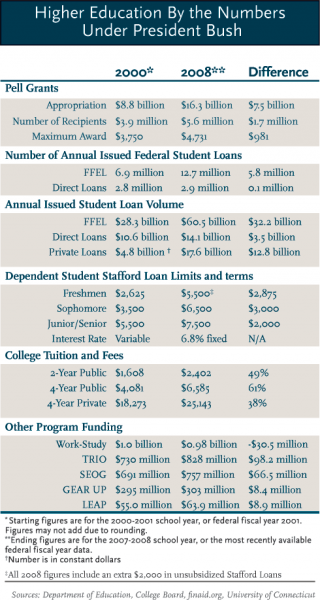
One caveat: Because the current academic year is still ongoing, the table above does not reflect the nearly 50 percent increase in direct-loan volume that has occurred over the past 12 months in the wake of the credit crunch. Were it included, the number and volume of direct loans disbursed would be substantially higher.
We think that it is also important to note that a number of new higher education programs have been created and started during the Bush years. The largest and most consequential of these new programs include:
- Academic Competitiveness Grants (ACG) : These grants are given to low-income first and second year undergraduate students who complete a “recognized rigorous secondary school program of study” and maintain a 3.0 grade point average in college. A freshman can receive up to $750 in ACG aid and a sophomore can receive up to $1,300. According to the College Board, 456,000 students received ACG awards averaging $768 in 2007-08. A more recent analysis of Department of Education data by The Chronicle of Higher Education, found the total number of ACG recipients last year to be slightly lower at nearly 400,000.
- National Science and Mathematics Access to Retain Talent (SMART) Grants: SMART Grants are available to low-income third and fourth year college students majoring in engineering, mathematics, science, technology, or high-priority foreign languages. Students must maintain a cumulative GPA of 3.0 or higher to receive the grants, which are worth $4,000 a year. In 2007-08, according to the College Board, about 72,000 students received SMART Grants averaging $3,194. The Chronicle, however, found the total number of SMART Grant recipients last year to be closer to 65,000.
- Teacher Education Assistance for College and Higher Education (TEACH) Grants: This program provides students $4,000 a year in grant aid if they promise to go into teaching in a high-need area for four years. The grants convert, however, to unsubsidized loans if students don’t fulfill their four- year commitment or their school is no longer deemed high need. The 2008-09 academic year is the first for which students are eligible for the awards. As a result, accurate figures on usage are not yet available.
With that, we bid farewell to the Bush administration and welcome to the Obama administration. We look forward to seeing what changes are made to higher education policymaking over the next four years.
Issues
Programs/Projects/Initiatives
Related
A Key Piece of the Trump Accreditation Plan Threatens Accountability