Get Rehabilitated Loans Back on Track

The global credit crunch is not denying access to federal student loans, but it is making life difficult for thousands of borrowers who are trying to get out of default. As several higher education trade publications have reported, continuing financial market turbulence has made it nearly impossible for defaulted borrowers to rehabilitate their loans — leaving them with tarnished credit records and denying them the benefits of being in repayment. Fortunately, there are easy steps Congress can take to fix this problem. Lawmakers just have to be sure not to devise a solution that creates a new cash cow for student loan guaranty agencies.
 Here’s how loan rehabilitation works in the Federal Family Education Loan (FFEL) program. When a borrower defaults on a loan, its title is transferred to the guaranty agency that administered the loan. Guarantors then work with the borrower to create a repayment plan. Once an agreement is reached, borrowers are expected to make nine payments on the loan over a 10-month period. Once this requirement is met, the loan is considered ready to be rehabilitated. The only remaining hurdle is that the guarantor must sell the loan to an eligible lender.
This is where the credit crunch is gumming up the process. Guaranty agencies cannot find any lenders to purchase loan titles. And without a sale the defaulted loan cannot re-enter repayment.
The inability to sell these loans means borrowers are denied rehabilitation benefits. For example, rehabilitated borrowers have their default history expunged from their credit records — improving their chances of buying or renting a house or obtaining other types of loans that have credit checks. Rehabilitating a loan also makes borrowers eligible for additional federal student assistance — a benefit not available to anyone holding defaulted federal debt. Finally, rehabilitated borrowers become eligible for benefits available in the FFEL program like loan forgiveness.
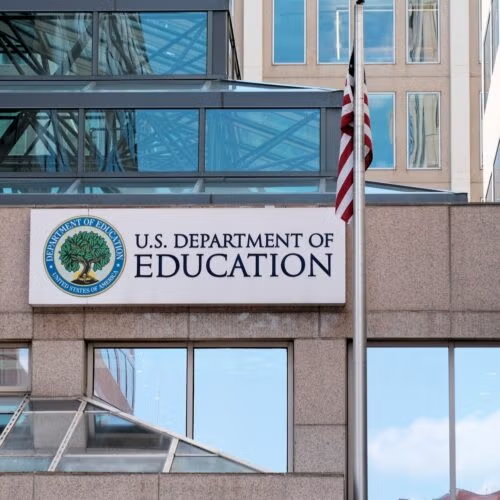
There is an obvious candidate to purchase these loans: the U.S. Department of Education. Ever since Congress approved the Ensuring Continued Access to Student Loans Act (ECASLA) last spring, the Department has been forging agreements with lenders to purchase outright or backstop groups of student loans. While none of these ECASLA programs involve a direct arrangement with guaranty agencies, it makes sense to expand these programs to include them.
Allowing the Department to purchase rehabilitated loans, however, has legal and policy roadblocks. ECASLA authorizes the Department to purchase only loans disbursed on or after Oct. 1, 2003 — excluding all rehabilitation-eligible borrowers with older loans. Moreover, loan purchase authority applies when “there is an inadequate availability of loan capital to meet the demands for loans.” The programs are thus used to ensure new borrowers have access to loans, not provide help to existing borrowers. This suggests the Department would need a legislative change to expand its purchasing authority.
(While Congress works on that change, we recommend that states follow the lead of Illinois’ General Assembly, which introduced legislation in both chambers to offer new bonds that would be used to buy rehabilitation-ready loans. We would also urge guarantors to inform borrowers who are trying to get out of default that they can do so by refinancing their loans in the Direct Loan program, allowing them to take advantage of the income-contingent repayment program. This isn’t a perfect solution because it does not clear up a borrower’s past credit record, but that may be an acceptable trade-off for at least some borrowers who are stuck in limbo).
But any legislative fix should raise two policy questions: how should guaranty agencies be compensated, and what should be done about borrower collection costs?
Making the Department a buyer of rehabilitation-eligible loans without changing how guarantors are compensated could lead to a windfall for guaranty agencies. Currently, these agencies keep at least 22.5 percent of a rehabilitated loan’s sale price (the rest is returned to the Department).[1] Presumably this is done to reward the guarantor both for the work it did in getting the borrower to make on-time payments and also for the difficulty of finding a buyer for the loan.
But having the Department buy rehabilitation-eligible loans reduces the work needed by guaranty agencies. As a result, the agencies should receive less compensation. To address this, Congress could institute a “buyer of last resort” provision that pays guaranty agencies a flat-rate rehabilitation fee for loans purchased by the Department. In contrast to the current percentage-based one, this new fee could be modeled on the Lender of Last Resort program that guaranty agencies currently administer for students who cannot obtain federal loans from conventional lenders.
Here’s how it would work: If a guaranty agency is denied twice by lenders when trying to sell a rehabilitated loan, it would have to sell the loan to the Department. In return, the guarantor would receive a flat per-loan fee that reflects the costs of getting borrowers to make on-time payments. A flat fee ensures that guaranty agencies have no incentive to inflate the loan sale price because their compensation is the same regardless.
Congress would also have to decide what to do with the collection costs charged to borrowers if guaranty agencies sell the rehabilitation-eligible loans to the Department. Currently guarantors are allowed to charge borrowers a collection fee of up to 18.5 percent of the unpaid principal and interest at the time of the loan sale. This money is then capitalized and added to a borrower’s principal balance. These collection costs cover expenses incurred by the guarantor when it rehabilitates and sells the loan. But if the Department acts as a guaranteed loan purchaser, why should the Department increase the balance owed on its newly acquired loans, when doing so increases the likelihood borrowers will default again? Instead, when a rehabilitated loan is purchased by the Department, the guarantor should be reimbursed for an amount that reflects the collection costs involved with returning the loan to repayment. That cost should be passed on to borrowers, but in such a way that it is kept separate from their unpaid principal, meaning it does not compound with interest.
Congress has willingly taken quick action to buttress lenders to guarantee access to federal student loans. Financial conditions now require it do the same for the struggling borrowers who are trying to repay their defaulted loans, while fiscal prudence demands that it do so in such a way that does not result in unnecessary payments to guaranty agencies or excessive charges to borrowers. It’s time to end the rehabilitation treadmill so borrowers can get themselves back on the right track.
[1] The actual percentage amount retained is equal to 100 minus (81.5 multiplied by the guaranty agency’s reinsurance rate). Since most guaranty agencies are reinsured at a rate of 95 percent, this works out to 100 – (81.5 * 0.95), or 22.5 percent. If their reinsurance rate is 85 percent, then guarantors would keep 30.1 percent, while a 75 percent reinsurance rate would result in the agency retaining 38.9 percent of a loan sale.
Issues
Programs/Projects/Initiatives
Related

CCAMPIS Changes Put Politics Ahead of Student Parents

The Education Department Gave Us the List of 2026 CCAMPIS Grantees