Stephen Burd
Senior Writer & Editor, Higher Education

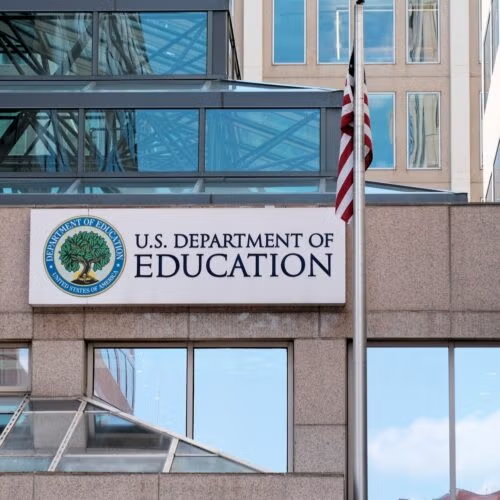
Many of the reporters who covered yesterday’s House of Representatives hearing on the Direct Student Loan program appear to have missed the main story: the utter failure of the Republican leaders of the House Committee on Education and the Workforce to make their case that the U.S. Department of Education has mismanaged the transition to 100 percent direct lending.
In fact, by the end of the two-hour hearing, the House committee’s leaders were forced to acknowledge the Education Department’s success in shifting thousands of colleges out of the Federal Family Education Loan (FFEL) program and into direct lending without any meaningful disruption in service.
“I am glad to see that the transition has gone pretty well,” the education committee’s chairman John Kline (R-MN) said. At the conclusion of the hearing, Rep. Virginia Foxx (R-NC), the chairwoman of the panel’s higher education subcommittee, commended the Education Department “for what it’s done.”
This was a remarkable reversal, considering that the original intention of the hearing — which was entitled “Government-Run Student Loans: Ensuring the Direct Loan Program is Accountable to Students and Taxpayers” — was to bash the Education Department.
Of course, the praise that the Department ended up receiving was well earned, as it has accomplished a tremendous feat. Despite dire warnings from the student loan industry and its allies on Capitol Hill about the risks of the undertaking, the Education Department pulled off the transition without disturbing even a single student’s access to federal student loans.
The Department’s impressive performance has received widespread praise. Many financial aid administrators who had been outspoken in their opposition to the Obama administration’s plan to end the FFEL program have admitted that the transition went more smoothly than they ever expected. And even some of the student loan industry lobbyists who were on the frontlines in the battle over student loan reform have tipped their hats to the Department, however grudgingly.
But up until now, House Republican leaders have never joined in the praise. Instead, they have been ready to pounce on the Education Department for even the slightest problem. So after the Department shut down the direct loan website for two days this month to fix a glitch that had exposed some borrowers’ personal data [a problem that has plagued the entire financial industry — see here and here, and here] for a brief period of time, they jumped at their chance.
In her opening statement, Foxx, whose subcommittee held the hearing, used the incident to try to paint a doomsday picture of the Education Department’s implementation of the direct loan program. “Nineteen months ago, the Democratic-controlled Congress approved a federal takeover of the student loan industry to help pay for the president’s health care law,” she said. “My Republican colleagues and I were rightly concerned this political tactic could have unintended consequences on the nation’s students, higher education institutions, and our economy. Any time the federal government assumes control over a private sector industry, there can be national implications.” [Never mind that FFEL was part of the same federal program as direct lending.] She warned that the glitch provided just a glimpse of what the future holds for the federal student loan program: skyrocketing default rates, declining customer service, and computer malfunctions affecting “millions of borrowers nationwide.”
But even the witnesses that the Republican chairwoman called to testify — Ron Day, the financial aid director at Kennesaw State University, and Mark Bandré, the vice president for enrollment management and student affairs at Baker University — were not buying it. While the two college administrators talked about the “bumps and challenges” that their campuses faced in shifting to direct lending, they said they considered the transition to be an overall success.
“I am happy to report we experienced no disruption in loan availability to our students either during or after the transition,” Bandré said. “The Direct Loan program is working.”
Similarly, Day, who called himself “an avid supporter of FFEL,” said, “schools across the country are successfully operating in the Direct Loan program.”
And while both witnesses said the program was “not perfect” and offered recommendations for strengthening it, neither accused the Education Department of mismanagement. “I do not see these challenges as insurmountable and I feel confident that as we partner together we can see positive outcomes for students,” Day stated.
Without any backup from their witnesses, Foxx and her Republican colleagues were painted into a corner and had little choice but to acknowledge the Education Department’s impressive performance.
Now that this hearing is over, we at Higher Ed Watch hope that the education committee’s leaders will finally turn the page and put their defeat in the battle over student loan reform behind them. While it’s entirely appropriate for the committee to hold the Education Department’s feet to the fire to ensure that the Direct Loan program runs as effectively and efficiently as possible, the time for political grandstanding on behalf of the student loan industry is over.
Senior Writer & Editor, Higher Education