Slam Dunks and Academic Flunks: March Madness 2016

Tonight, Villanova and North Carolina men’s basketball teams will duke it out in the national championship game, wrapping up March Madness. Their players, along with those at similar schools generate massive revenue flows, yet they remain first and foremost students, who are promised a college education in return for their work on the court. This year, New America ranked each of the schools in the men’s and women’s tournaments by how well they delivered on that promise.
In the men’s tournament, Holy Cross, a small nonprofit just outside of Boston, lost in the first round of play, but truly stole the show with their academic performance. Holy Cross’s overall graduation rate is 94 percent, and their basketball team actually outperforms the rest of the student body by a slight margin. This helps them narrowly edge out Butler in the final matchup. Villanova and Notre Dame rounded out the final four in the academic tournament. One of these teams – Villanova – will also be playing in the championship tonight.
Of the three others making up the final four, Syracuse, Oklahoma and North Carolina, none crack even the top half academically. Syracuse comes in at 57th – although their overall graduation rate is just under 80 percent, huge disparities between the team and the rest of the student body hurt them significantly in their overall score.
New America
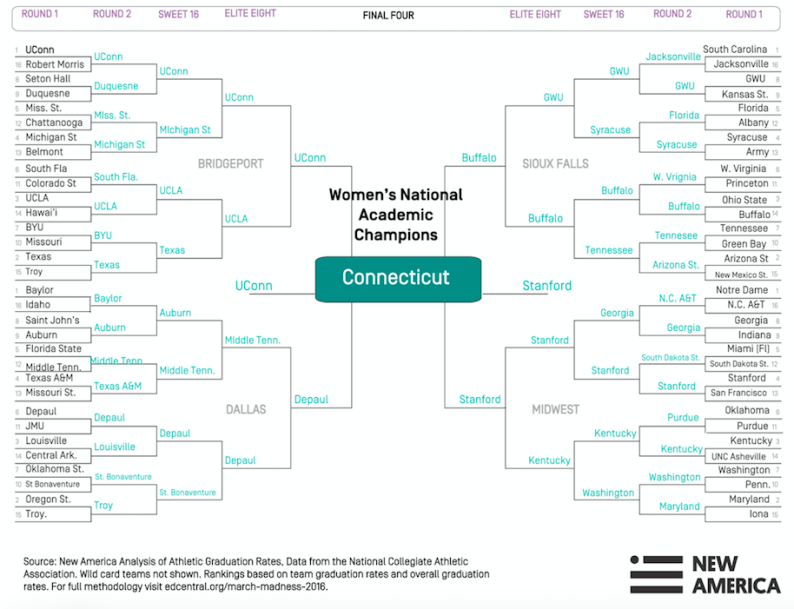
Turning to the women’s tournament, UConn has been a favorite on the court, and also wins the academic bracket handily. With an overall graduation rate of 84 percent, and a team graduation rate of 86, the UConn women perform well and are right in line with the rest of their school academically. Despite placing 8th in our overall rankings, Buffalo benefits from a relatively easy region (with it’s top performers Princeton and West Point sidelined due to inadequate reporting). DePaul and Stanford round out the academic final four.
On the court, Syracuse will face UConn in the title game, after beating Washington and Oregon State over the weekend. In contrast to their men’s team, Syracuse’s academic ranking is actually quite strong: their women’s players graduate almost as often as the rest of their female students, which is not the case for the men. Of these teams, Oregon State is by far the weakest academically, with just 25 percent of their team leaving with a degree.
In conducting our analysis, we ranked each participating school by first using the “graduation student success rate,” a NCAA metric that does not penalize institutions for their players going pro so long as they leave in good academic standing. To arrive at the final score, we made adjustments that reflect the difference between overall and basketball graduation rates, so schools are penalized for either graduating their players significantly higher or lower than their general student population. We hold that expectations and resources should be approximately equal among athletes and other students. To reward institutions who make a commitment to academics, we factor in a small final bonus for schools with overall graduation rates above 70 percent.
Despite their strong showing in the Women’s tournament, UConn is failing to keep its promise to its male basketball players and as a result came in last in this year’s academic rankings. Not only do the Huskies graduate their players at a rate 73 percentage points lower than the general student body, few of their student-athletes went on to play professionally as demonstrated by the team’s low, 20 percent graduation success rate. On the women’s side, Robert Morris neglected to live up to its end of the deal and graduated its basketball players 42 points below its overall female student body. Just over half of them graduated or left in good academic standing.
Overall, these graduation rate disparities affected the men’s players much more significantly than the women’s teams. While it’s unfortunate that the talent and hard work of many of the female players has not generated the same media interest, or revenue as their male counterparts, the silver lining seems to be that the women’s teams are more often held to a similar academic standard as the rest of the student body. Ultimately, this means many of the women playing in the tournament will have a better shot at scoring a college degree.
More About the Authors
Ben Barrett
Issues
Programs/Projects/Initiatives
Related

The Rural Advantage—and Challenge—with Workforce Pell

A Key Piece of the Trump Accreditation Plan Threatens Accountability