Melissa Tooley
Director, Educator Quality

After the housing recession of 2008, reports abounded about how many schools chose to spend federal stimulus dollars on purchasing “tech”—laptops, iPads, SmartBoards, and the like—that weren’t well used or quickly became obsolete. There is no doubt that up-to-date hardware and software are necessary for schools to function, especially in remote and hybrid contexts. But, on their own, they are unlikely to positively impact students’ learning experiences or trajectories without the human talent to effectively leverage them.
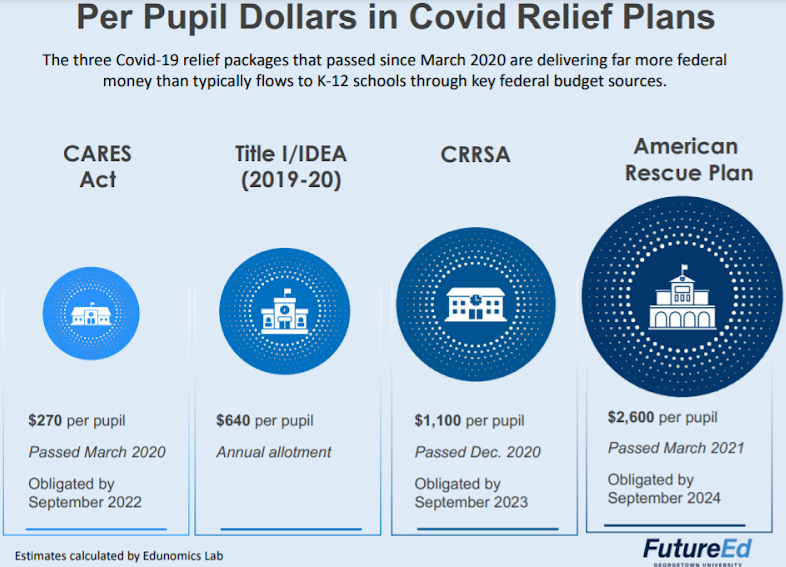
The 2020 and 2021 federal COVID relief investments are the largest single investments in public elementary and secondary schools in recent history (see graphic below for more details), and schools have wide discretion in spending the funds. And, as in 2008, we’re seeing product vendors directly pitch states and districts to adopt discrete tools to improve teaching and learning, from a kit to help students with “academic recovery” in science to an electronic platform to track instruction and student learning. There could be some value to adopting some of these tools. But to ensure this historic investment leads to historic-level changes and outcomes, states and districts need to think bigger and longer-term. And that means investing in and transforming their approach to the “front line” of public PreK-12 education: educators.
Think about it: hospitals that invest in medical equipment must also have nurses, doctors, and other hospital staff that are adept at knowing when and how to operate them in order to save patients’ lives. The same is true for schools. The lesson for states and districts is that in addition to focusing stimulus funds on things like student data platforms, they must seize this opportunity to focus on building and sustaining the educator talent in our schools.
Why? For decades, educators and advocates for students have bemoaned the fact that teaching and school staffing approaches haven’t changed much since the move from one-room schoolhouses to multi-classroom schools. Teachers still tend to lead a classroom on their own, with little input and support from others, even if they are brand new to the profession (often referred to as the “sink or swim” approach to onboarding). Many sink, and even those that succeed may still look back with remorse on the quality of instruction they delivered to students that first year in the classroom. Teachers are generally afforded little time to collaborate, share ideas, and learn from each other, and are often dissatisfied with the opportunities for professional learning their schools do provide. Many schools lack full-time school psychologists, counselors, or nurses, or have too few on staff to adequately serve all students, leaving teachers to pick up the slack, in addition to planning, instructing, grading, connecting with students, communicating with families, etc. Meanwhile, school principals roles have also expanded, and most struggle to manage the myriad responsibilities they hold without burning out.
Add in the relatively low pay that educators earn relative to other professions with similar education requirements and level of responsibility, and it’s not surprising that working in these roles has become less desirable. The result? Many schools—particularly those serving the students with the greatest needs—struggled to attract and retain high-quality educator talent even prior to the COVID-19 pandemic, and are likely to struggle even more in its aftermath as more educators burn out.
This is the moment for states and districts to think big about how to address these issues, and strengthen and diversify the educator workforce for the long-term instead of clutching at short-term fixes.
One of the best ways states and districts can do this is to rethink how we staff schools. Here are eight synergistic approaches to doing this:
Some might say these efforts won’t be sustainable once federal stimulus funding is no longer available. But the best thing about investments in human capital is that—unlike supplies which immediately depreciate in value from the moment purchased—their value should increase over time and even save money, through reduced educator attrition, improved effectiveness, and diminished need to leverage “outside experts” for professional learning because the experts will already be working inside schools. And, of course the most important long-term value will be to the students themselves, who are more likely to learn and thrive in schools that holistically support them to fulfill their potential.
But if states and districts think small, the return on investment over the long run will be minimal, limiting federal investments moving forward, as well as opportunities for current and future students, and our nation as a whole. Now that states and districts have the information they need to make the right choices, it’s time for them to do so.
Enjoy what you read? Subscribe to our newsletter to receive updates on what’s new in Education Policy!
Director, Educator Quality