
Amanda Ballantyne
Senior Fellow, Workers & Technology

AI runs on an enormous, highly concentrated infrastructure, and by the time hardware and software are built and sold, many of the choices about what the technology will do—and how it will affect workers and communities—have already been made.
That infrastructure is privately owned, but it is publicly constituted: Public research money built the science it runs on, public procurement is one of its largest markets, public subsidies underwrite the data centers, and public rules decide who may own and combine which layers of it and what data may be used to fuel the enterprise.1 In nearly every public and private venue where those decisions get made, tech firms hold standing. Workers and communities rarely make it into the room.
Two fronts have emerged in the fight for workers’ rights in the AI economy. In the first, advocates anticipating seismic job loss seek to soften the blow by providing worker retraining programs, overhauling unemployment insurance and other benefits, and otherwise preparing the workforce for labor market shifts.2 On the second front, advocates are demanding guardrails to protect workers from the negative impacts that AI is already having on the workforce. They want to ban robot bosses from making AI-powered decisions about hiring, performance, and firing, limit workplace surveillance, and secure safety measures with teeth.3
These efforts are essential. But even if we are able to upgrade our safety net or build enforceable guardrails that protect workers, the power of the tech industry to control and shape the AI industry—and the dizzying speed of AI development—will create negative outcomes for millions of workers in the United States and around the world.4
Without a third, more fundamental strategy, we will fall short. That third strategy is the creation and empowerment of constitutive rights, which in this brief means formal standing for working people and communities to participate in shaping AI’s development in venues where the AI economy is governed.
Those venues are being built out right now, through policy and regulation of compute (meaning the chips, data centers, and cloud capacity used to train and run AI models), data and privacy, public procurement, research and development funding, and market structure. Solving that power imbalance, with tech firms in the room and workers outside it, is necessary.
The case for giving workers and communities an equal seat where technology is shaped, and not only where it is deployed, has been building for several years among labor and science-policy advocates, labor-law scholars, and civil society organizations.5
This brief offers a proposal and a roadmap, not a blueprint. It puts forward three interventions. First, AI policy packages should include constitutive rights alongside shock absorbers and guardrails. Second, standing should mean parity, not input. Third, parity should be built where the AI economy is actually shaped: science and technology policy, industrial policy and procurement, market structure, and data governance. Winning standing in the AI economy requires organizing, building power, and resourcing worker and community organizations to engage in technical venues where key decisions about AI’s impact on the economy and our democracy are made.
Given the enormous number of AI-related policy proposals at the state and federal levels, we need to have a framework for classifying how various proposals help workers. For any piece of legislation or new initiative, we can ask whether it is designed to help workers recover from AI-driven job and income loss, protect workers from harmful uses of AI, or give workers and communities a meaningful role in shaping the AI economy. These types of rights are complementary and reinforcing, and sound AI governance will require policy packages that include all three (see Table 1).
Shock-absorbing rights (safety nets) compensate workers for job loss caused by AI-driven automation with unemployment insurance, industry adjustment assistance, retraining, and severance.
Guardrails (workplace limits, safety, accountability) create protections and remedies like safety standards, disclosure requirements, prohibited practices, privacy and data ownership rules, and liability for harms.
Constitutive rights (standing to shape the future) determine who gets to make the rules, which constituencies a governance system recognizes as parties, how those parties may interact, and what those parties are entitled to do.
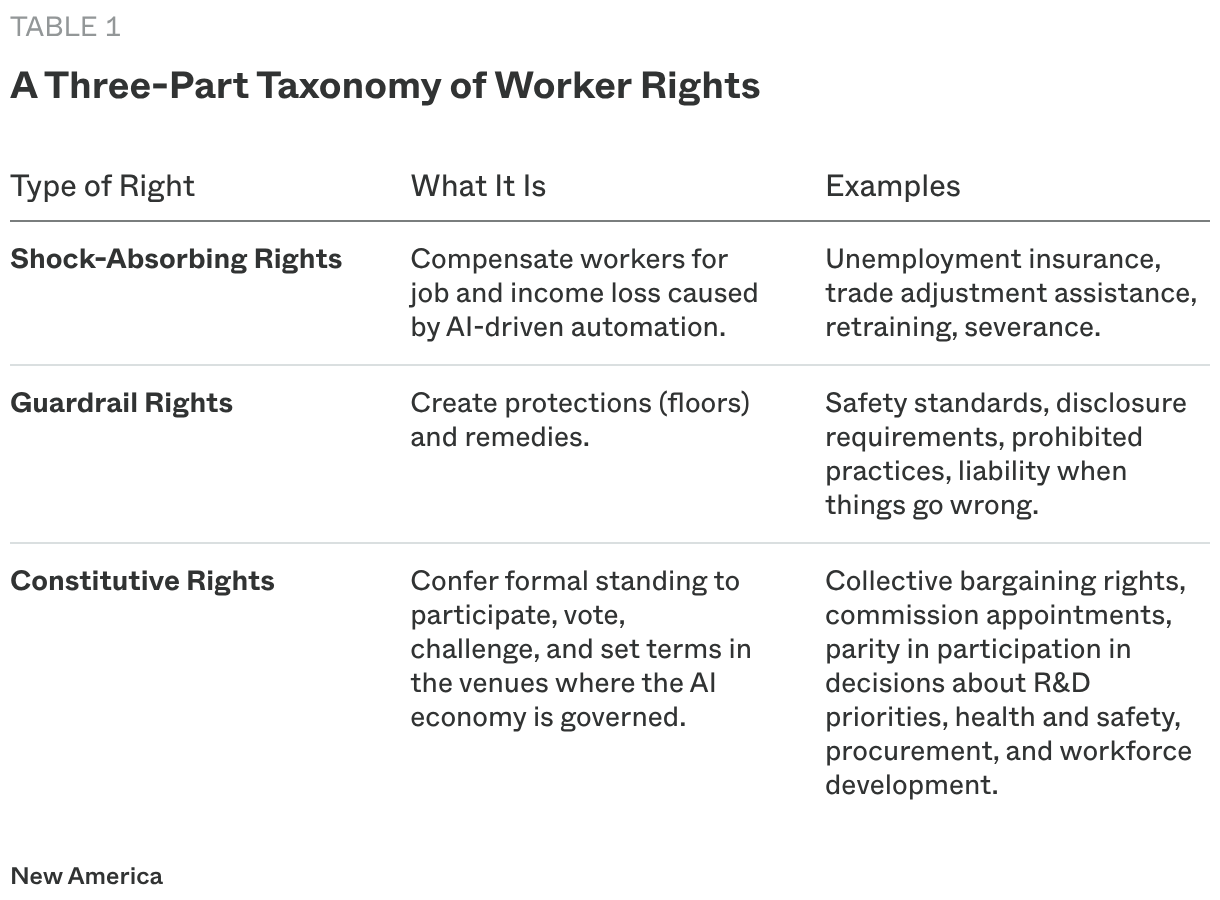
A majority of worker-related AI policy proposals focus on shock-absorbing measures and workplace guardrails. Some of these measures have been advanced through efforts to innovate, reform, or expand collective bargaining, the seminal U.S. constitutive system for workplace governance, so it includes terms that govern worker and employer rules about AI uses, limitations, and requirements.6 The most ambitious labor-law proposals already push worker voice earlier. Harvard Law School’s Center for Labor and a Just Economy (CLJE) would make the decision to adopt AI bargainable, and it has drafted a model state sectoral law that treats AI as a mandatory subject.7 But bargaining, even sectoral bargaining, reaches technology at the point an employer adopts it. By design it does not reach the upstream choices about what is funded, built, and bought, and those choices are made in public venues where workers have no standing at all.
Constitutive standing in this sense has a name. John Kenneth Galbraith called it countervailing power: constituencies organized with enough procedural power to check concentrated private power, and government backing the counterweights.8 Daron Acemoglu and Simon Johnson have carried that idea into the AI era, showing across a thousand years of technological change that the gains were shared only when working people held enough countervailing power to shape the direction of technology, not merely its terms of use.9 In the first half of the twentieth century, the United States built that standing for working people, consumers, and others. Over the last 40 years, it has largely fallen apart.
In the early 1900s, industrial concentration produced private power that neither markets nor courts would check. Progressive-era reformers answered by building public authority where none had existed, creating railroad and utility commissions, antitrust enforcement, and, decades later, federal safety mandates. Expert commissions acted on the public’s behalf while constituencies petitioned from outside. What the public gained was standing to sue and standing to complain. The results were mixed. The same antitrust laws written to break trusts were quickly turned against striking workers.10
The New Deal made a different move. It recognized industrial workers as an organized constituency, made their unions legal parties to bargaining, backed them with federal enforcement, and paired that with new shock absorbers and guardrails. Social Security and unemployment insurance became our premier shock-absorbing regimes, the Fair Labor Standards Act set guardrails that still define the American workplace, and the National Labor Relations Act gave many (but not all) workers a legally protected voice in setting the terms of work.11
Routinized collective bargaining was the shift from standing to sue to standing to shape. The standing it created mattered because it sat where the decisions were made. In a vertically integrated industrial economy, the firm that employed a worker also decided what to build, what machinery to install, and how work would be organized, so bargaining with that employer reached the terms of work and, to a meaningful degree, its direction.
These developments were powerful enough to threaten a wealthy set of ideologues, who organized against them through the Taft-Hartley Act in 1947 and, after the Powell Memo laid out a corporate game plan in 1971, through permanent political infrastructure dedicated to shrinking government’s role in the economy. In the deregulatory environment that followed, corporations restructured themselves through franchising, subcontracting, and outsourcing (a pattern known as fissuring); lobbied to gut public interest regulations; and undermined efforts to update labor law. When trade and automation hollowed out manufacturing in the 1980s and 1990s, the dominant policy response was to accept plant closures as inevitable and invest in retraining.
That response produced catastrophic results. Older, higher-paid workers were pushed into competition with lower-paid workers, wages cascaded downward, labor force participation fell, and many communities never fully recovered. Trade Adjustment Assistance, the program designed for exactly this scenario, was inconsequential, and displaced workers fell back on disability insurance, Medicaid, and early retirement, none of which was attached to any power over the forces driving the transition.
Two generations later, we are living with the results: a widening wealth gap, a serious mismatch of power between corporations and working people, and a democracy that hangs in the balance.
So why not simply say “fix collective bargaining” and be done? Rebuilding union power would raise wages, narrow racial wage gaps, and strengthen democracy.12
The union innovations with the most potential use sectoral bargaining, which sets terms across an industry, and pattern bargaining, in which a standard won at one employer is extended to the rest. UNITE HERE, for example, won technology oversight in contracts covering about than two thirds of its members, requiring advance notice, disclosure of what a system does and what work it will change, and a right to bargain midcycle.13 Advocates building sectoral strategies are already writing technology into the mandate of negotiating bodies. CLJE has proposed sectoral commissions to “negotiate baseline AI safety standards for all firms in the sector,” and its model state sectoral bargaining law makes AI-driven displacement, surveillance, and decision-making mandatory subjects.14 State standards boards already show the form.15
At the same time, labor law makes it hard for workers to bargain over technology at all. Whether unions have the right to bargain over more than the effects of employer technology choices is a contested area. Under First National Maintenance, employers must bargain over the effects of a core entrepreneurial decision. In practice, this often means bargaining layoff conditions, not bargaining technology choices in the first place.16 Unions can win the right anyway, as UNITE HERE and other unions have, but they trade for it against wages and health care. CLJE has argued that the law should treat the decision to introduce AI as one “fundamental to the basic direction of the firm,” and so bargainable. That reform is necessary, but even a fully reformed duty to bargain arrives after many of the decisions described below. Many states bar public-sector workers from bargaining over how the work gets done at all.17
A second challenge is jurisdiction as it relates to the logic of data-driven technology more generally. Bargaining runs on a unit, an employer, a sector, a state. AI runs on aggregation. Data extracted in one workplace are pooled with data from thousands of others and used to build products that automate work. By the time a worker encounters an AI system, many key choices about what it does, and the tasks it replaces, have been made by people she will never meet.18
That does not mean individual employers lack power or liability, or that we should abandon bargaining. It means worker representation needs innovation, and that organized and unorganized workers, along with small business owners, civil rights and civil liberties advocates, and environmental membership organizations need the capacity to shape AI in governance venues that reach above individual firms and even economic sectors.19
Constitutive rights determine which constituencies a governance system recognizes as parties, and what power those parties have over outcomes. That recognition is standing, in a basic sense, and in a democracy it marks the difference between being governed and helping to govern. Most of us know standing as a litigation test, a question of whether a party may sue another over a specific harm. That kind of standing is retrospective, asking who may object after the fact. Constitutive standing is broader. It is the right to help set the terms in the first place, including the terms on which a technology is funded, developed, purchased, and deployed.20
Workers and public interest advocates do participate in rulemaking and serve on advisory committees. But real standing is a matter of degree. A governance system can formally recognize a constituency as a party and still leave it outnumbered and outvoted. The question is how much power to shape decisions party status carries.21
Parity can be measured with a two-part test. The first asks whether the organizations representing affected constituencies hold authority with specific legal significance, which means that the agency cannot skip the process, ignore what it produces without explanation, or starve the participants. The second asks whether those constituencies are resourced well enough to use that authority.
The technology industry’s influence reaches beyond markets to the institutions that govern those markets. The same firms that own the infrastructure hold seats on the bodies that set research priorities and spend heavily to shape the laws that would bind them. A democracy that cannot set terms for its largest industry has a governance problem before it has a technology problem.
Over the past two years, an administration and a Supreme Court hostile to the administrative state have sped its dismantling, stripping agencies of authority, staff, and independence. Our democracy depends on rebuilding it. Ensuring that workers and communities have standing to shape the economy at parity should be a priority of that rebuild.
The administrative state governs what firms may do, writing the rules that firms must follow and enforcing them. It also determines what gets made, by funding research, buying technology, subsidizing industries, and setting conditions on all three. Many agencies have processes for each type of decision.
Most work on public participation addresses the regulatory state. UnidosUS’s comments on the Office of Management and Budget (OMB) AI memorandum are a strong example, calling for impact assessments that show how harms are distributed, advisory bodies with real influence rather than check-the-box consultation, and community auditors.22 Far less work addresses the building side, which is a problem.
Corporate dominance in public technology research, procurement, and standards setting produces unfair power imbalances that erode public trust in both government and the technology itself. It also ignores what workers and communities know about workflow, safety, and civil rights, knowledge that would make the technology better.23 Parity, not simply consultation, should be a building block of governance in the AI era.
Administrative law already requires agencies to take public comment and to explain in the record how they considered it. That process does real work, and strengthening it matters. But it begins after the decisions that matter most have been made. By the time a rule is proposed, its objectives and its scope have been set, usually in consultation with the industry it governs. Agencies give advance notices of proposed rulemaking, requests for information, and negotiated rulemaking committees, and industry shows up. Parity means seating workers and communities there with a meaningful ability to shape outcomes. Commenting on a draft is not the same as helping write it.24
The building blocks of parity are not new. In designing sectoral bargaining and state standards boards, Sharon Block and her colleagues at CLJE have worked through most of them: how to seat worker organizations before a rule is drafted, who chooses their representatives, how to fund their participation, how to keep government’s final say without letting it ignore the parties, and how to let workers enforce the results themselves.25 Those designs govern labor standards within a sector. The argument here is that the same architecture, extended to communities as well as workers, belongs in the venues that decide what the AI economy builds: research funding, procurement, industrial-policy conditions, and the remedies written into merger review.
The obvious objection comes from the Supreme Court, which, over the past decade, has tightened the rules on who may exercise federal power, appoint officers, and resist presidential removal. But a better model for constitutive standing may be collective bargaining rather than a regulatory agency. The Wagner Act did not give unions governmental authority. It made them parties and imposed on employers a legal duty to bargain with them. Seating at parity might work in a similar way. Statutes could require the agency to convene the body, respond to its output on the record by a fixed deadline, and either propose what the body recommends or explain in writing why not. The nondelegation doctrine limits how much binding authority a non-governmental body can hold, but there are well-established ways to craft meaningful standing without running afoul of the Constitution, and keeping final authority with the agency is the central one.26Whether the bargaining model holds when the other party is a public agency and the stakes are the direction of public investment rather than wages, hours, and working conditions is a question worth exploring.
The aim is not to create a new committee for every decision, but, rather, to create a small number of durable bodies where workers and communities have a meaningful stake in shaping the economic impacts of technology on our economy, and that this authority stems from the statutes that govern public money: industrial policy laws, science funding authorizations, and the laws that govern major procurement.27 A single standing body seating workers and communities at parity with industry over research priorities in the federal AI portfolio would do more than dozens of advisory committees with no authority. Building on the tripartite standards boards states have begun to adopt, such bodies could give the United States something it has never had, institutions in which workers, communities, employers, and government negotiate the direction of the economy together.
What parity requires differs by the kind of decision. Four, detailed below, recur across the venues that shape the AI economy. Two sit on the building side—allocation and the conditions attached to public money.
Allocative decisions determine where public money goes and what it is for: research priorities, grant awards, program design. They are usually made by bodies that act by recommendation and vote, which makes parity largely a question of composition. Who holds the seats? Who appoints them, and who can remove them? What threshold does the body need to act? The National AI Research Resource (NAIRR) pilot, which gives researchers access to computing power and datasets, and the CHIPS and Science Act Industrial Advisory Committee, which advises the Commerce Department on semiconductor research and development,28 are both allocative in this sense. In both, industry holds seats and workers do not.
Rulemaking and standards decisions set rules and technical specifications for industry behavior, governmental oversight, and enforcement: eligibility and scoring criteria for industrial policy programs, research priorities for federal AI funding streams, the standards attached to government-wide AI procurement. Most of this moves through ordinary notice and comment, where the public participates through filing comments and the agency decides what to do with those comments.
Structured alternatives exist that can give workers and communities more weight,29 but structure alone is not parity, because an insufficient process can provide cover for power imbalances.30 So the questions are structural: who convenes, who sits, who staffs the non-industry seats, and what the agency owes the committee’s output. Private standards bodies raise the same questions with less visibility.
Adjudicatory decisions resolve a specific matter among named parties: a merger and the consent decree that follows, a license, a rate case. Party status here is consequential, because the outcome is negotiated among the parties and no one else. In merger review, large technology firms negotiate directly with the enforcement agencies over scope, over whether a deal proceeds, and over remedies. Workers whose wages the combined firm will set may submit information, but they are not parties.31 Rate cases show the alternative. There the public holds standing through a state utility consumer advocate,32 an office funded with public dollars to ensure the administration of common carriage obligations, which require service to all comers on reasonable and nondiscriminatory terms.
Expansion of formal standing for workers and communities in market concentration is perhaps a lofty goal. But the ratepayer model may offer a more promising starting point for representing workers and the public interest on these types of issues.
Enforceable conditions attached to public money can be complicated to enforce. One proven structure has three parts: The standard covers every transaction of a given type, the recipient certifies compliance in writing, and someone outside the awarding agency can act on a breach. Davis-Bacon paired with the False Claims Act meets all three. Nothing comparable exists for AI procurement or research funding, where contract terms derive from executive orders, compliance is largely assumed, and only the agency can enforce them. The design questions are whether the standard is set by statute or negotiated deal by deal, whether compliance is certified or assumed, and who holds the enforcement right. Block and Goldman have urged Congress to “expand private rights of action in statutes where agencies currently serve as the only enforcers”;33 conditions on public money are a natural place to start.
Two conditions cut across all four kinds of decision. Represented constituencies must choose their own representatives rather than have them chosen; where the Constitution requires a public appointment, that appointment should be made from slates the constituencies put forward.34 For workers, unions and worker centers already provide that structure. For communities, the answer will vary by venue. Membership organizations with accountable leadership, such as civil rights, environmental, consumer, and small-business groups, can put forward slates, and statutes can set baseline criteria for which organizations qualify, as workforce law already does for labor seats on local boards. And participants must be resourced well enough to use the authority they hold.35
Whether a constituency holds standing depends on what legislators write into statute, not on the good intentions of an agency. Convening and reporting requirements, response deadlines, and funding written into statute already exist across American law. CLJE has shown how such tools fit together for sectoral labor standards.36 What would be new is assembling them in the venues that direct the economy, for constituencies that have never held party status there. Building these institutions raises hard design questions this brief does not resolve: how to keep parity bodies from slowing urgent decisions, how to prevent capture by the largest incumbents on either side, and how antitrust law, which already decides who may coordinate, should allocate that permission to workers and communities. Those are questions for the next stage of this work, and for the people who would sit at these tables.
What would it look like to build parity for workers and communities in shaping the AI economy? Constitutive rights must be created site by site and written into statute. Each of the four sites below was chosen on the same criteria: public money and public authority already shape AI there, corporations already hold standing, and the decisions are made before any workplace encounters the technology.
U.S. science and technology policy governs public and private stakeholders that rely on public money to conduct basic, developmental, and applied research across nearly every sector. Science agencies, research universities, and technology firms together shape the direction of that research, and technology transfer offices convert its results into private enterprise. This is where science policy becomes market structure.37
Decades of federal research funding, flowing through universities and defense contracts, created Silicon Valley. The federal government invests billions every year in AI research, and in nearly every venue that directs it, corporations hold recognized standing. The NAIRR pilot38 runs in partnership with more than two dozen industry, nonprofit, and philanthropic partners, including Microsoft, OpenAI, Anthropic, and Nvidia, which contribute the compute and help shape the initiative. One study of computer science faculty at four leading universities found that 52 percent of those with disclosed funding sources had received money from large technology firms.39 Workers and communities hold no comparable standing anywhere in the pipeline.40
Worker and community organizations should have a role in setting funding priorities, problem selection, and design criteria. Research by Thomas Kochan and colleagues finds that effectiveness and job quality both improve when workers participate from problem definition onward.41 Capacity tends to follow standing, but not on its own.
Industrial policy determines what our government builds, buys, and subsidizes, and therefore shapes markets. As the economist Mariana Mazzucato reminds us, growth has a direction as well as a rate.42 Spending rules, more than the initial appropriation, set that direction. Agencies draft the eligibility criteria, scoring rubrics, and performance standards that decide who qualifies and what they must keep doing, usually in close consultation with the firms that receive the money.
Government is one of AI’s biggest customers, and federal AI spending is growing.43 Procurement does more than fill agency needs. It sets industry standards. Corporations shape federal purchases long before any competition begins, through industry days, draft-solicitation comments, and government-wide deals struck directly between the General Services Administration and AI companies, where tools are offered for as little as a dollar a year. Those same rules could attach pro-worker terms to every covered contract: what vendors must disclose about data provenance, what testing must precede deployment, what monitoring is required, and what uses are banned or require engagement with impacted communities.44
Public investment works the same way. When the Department of Commerce built the Industrial Advisory Committee to guide the CHIPS research hub and workforce agenda,45 all 24 seats went to industry executives, academics, and research institutes. I led the AFL-CIO’s work on CHIPS implementation, and I watched the worker-friendly conditions attached to that money weaken in the deals that followed.46 No constituency inside the process was there to defend them.
Conditions on public money must include a role in governance. Mazzucato and Dani Rodrik argue that public investment should set a direction and share in what it produces. While their focus is the conditions governments attach to that investment, this argument pushes a bit further, that constituencies must hold authority co-equal with corporations, over the direction itself.47 Worker and community organizations also need a formal role in writing the conditions, a seat in the bodies that allocate the money, and enforcement power of their own.
Market structure and public obligation govern the technology stack, the chips, cloud, models, and applications, on which the AI economy runs, including who owns which layers and how concentrated it may become. Antitrust law allocates coordination rights and polices the mergers, partnerships, and compute deals consolidating the stack. Standards consortia, a form of competitor coordination that antitrust permits within limits, decide what counts as acceptable risk and who bears it. Data collection, valuation, and use are governed across dozens of federal and state venues that write the ownership rules for the industry’s most important input.
Corporations have standing throughout antitrust enforcement. When the largest technology firms propose to combine, they negotiate directly with the enforcement agencies over scope, over whether a deal proceeds, and over the remedies written into consent decrees. As Kate Andrias has shown, labor has largely been written out of that story.48 The 2023 merger guidelines marked a step forward, directing agencies to weigh labor-market effects. But the workers whose wages the combined firm will determine may submit information without becoming parties.
What workers and communities need here is an older model. Common carriage created limits on private firms that own essential infrastructure to ensure they don’t discriminate in the market. That obligation is a guardrail rather than standing, but it creates the proceeding where standing becomes possible, which is why ratepayer cases seat a designated public advocate. As Barry Lynn and his colleagues at the Open Markets Institute have argued, the platforms and cloud services the AI economy runs on are essential infrastructure of exactly this kind.49 Regulating them that way would change what dominant firms owe everyone else and create a venue where workers, small businesses, and communities could be parties.50
Data governance is as important as compute. AI systems run on data about workers and communities, often generated by them, in a market now worth hundreds of billions of dollars.51 That market is governed mostly by the companies that collect the data, through terms of service and vendor contracts. Workers understand that these same data train the systems built to replace them. Today, that data is largely taken without consent or compensation from the people who generate it. Sector data-governance bodies could recognize the workers and communities whose work and lives produce that data as parties to its governance, with standing to set rules for its provenance and use across an industry and to decide which uses are acceptable.
The urgency this moment demands is a cohesive policy agenda that empowers civil society and centers democratic values, civil rights, civil liberties, and shared prosperity. That agenda requires that we expand standing to shape the outputs of our public investments, and that working people and communities have the power, and organization, to win and use that standing.
Democratic societies owe working people and communities, who are also the taxpayers funding this buildout and the voters who will live with its consequences, more than an assurance that they will recover from the AI transition. Decisions made with public money, in public institutions, about the direction of our economy should belong to the people whose lives those decisions reorganize.
Most of the instruments required already exist in American law: parity for workers and impacted communities, procedural rules that make it meaningful, requirements that impacted parties can enforce in court, and funding that survives changes in administration. We have used all of them before. Tech companies are running the table because nothing in the current architecture requires anyone else’s assent.
What has been missing is not the will to fight—it’s a more comprehensive vision of what we’re fighting for. The organizations fighting data center siting, litigating algorithmic discrimination, bargaining over technology on the shop floor, and defending small firms’ access to the market are all fighting for the same thing. So are the workers and communities demanding that the AI economy produce security for families, not increasing precarity. All of them are fighting for a standing to shape our economy. That is economic democracy in the AI era.
Senior Fellow, Workers & Technology