Table of Contents
- Executive Summary
- Acknowledgements
- Introduction
- Economic Insecurity and the Future for Low-Wage Workers
- The Search for Stability While Work is Changing
- Workers Want to Feel Respected and That They Matter
- Technology on the Job Today
- How Workers Imagine Their Jobs in the Future
- Barriers to a Better Future for Workers, Especially Women
- Obstacles to Obtaining Skills and Degrees
- Career Transitions are Difficult and Often Out of Reach
- Conclusion and a Human-Centered Agenda for the Future of Work
- Appendix: Study Methodology
The Search for Stability While Work is Changing

The second contextual theme that emerged in interviews was a near-universal quest for stability. When we asked workers what they most wanted from their work, the most common answer was stability. The workers seeking stability through their jobs overwhelmingly desired employer-provided benefits like health insurance and paid time off. They often viewed the prospect of a job change through the lens of access to benefits, with a job loss equating to a (potentially catastrophic) loss of stability and benefits. Most mid-career and older workers desired job security and few wanted any job change at all.
This consistent desire of workers for stability is at odds with the changes that technology will propel. Technological change is the opposite of stability. Workplace technology like artificial intelligence and automation will alter the organization and nature of work, the demand for skills, the tasks involved in existing and new occupations, and the requirements for a good living. Some workers will need to adapt to new job activities and new technologies on the job, while others might need to develop entirely new skills—or change jobs altogether. The workers who will experience these changes will be even more vulnerable to instability because of the connection between employment and benefits and the limitations of the social safety net.
The looming displacement of administrative and clerical jobs also present a threat to workers’ stability. A surprising number of administrative and clerical workers whom we interviewed previously worked in fast-growing care and other “pink-collar” jobs like social work and education, which failed to provide them with the stability and benefits they desired. These workers described finding satisfaction in better quality and more stable clerical and administrative jobs, which are projected to shrink by several hundred thousand positions in the next 10 years alone. In comparison, the care jobs that will grow fastest over the next decade are much lower quality with poor pay, working conditions, and stability. Much greater attention is required from policymakers to ensure the jobs of the future—like care jobs—are good jobs that provide workers with the security and stability they desire.
Workers looked to jobs as a route to security, stability, and benefits
When we asked what workers want from their jobs, stability was the dominant theme. Most often, workers said they wanted security, a stable paycheck, and benefits. Often, workers reported that there were other career options that held more appeal to them, but they valued stability and benefits more. Most interviewees said that they did not want any job change at all.
Job security and the ability to count on a consistent paycheck was especially important to many of the workers we interviewed who faced precarious economic circumstances. One grocery manager, 25, “wanted to be a game developer for a long time,” but “I started looking” into it “and learning the coding and everything. It’s just that the industry is very fluctuating. One day, you’ll work on a game, the next day, we’ll it’s sold, we’re done, laid off and it just doesn’t seem a very stable place.” This manager knew that "I need something that I know is going to be there.”
The connection between jobs and benefits exposes workers to even greater instability when jobs change or are displaced
The structural constraints facing workers shape this overriding concern for stability. Today, the safety net for American workers and their families is tied to employer-provided benefits. A job is not just a paycheck for workers whose employers provide these benefits—it is also their security and their access to life-saving benefits that they count on for their families.
Overwhelmingly, workers expressed a desire for—and a reliance on—employer-provided benefits like health insurance, paid time off, unemployment and disability benefits, and retirement contributions. A retail cashier, 39, summed up this connection: the job "pays my mortgage and keeps my daughter in day care. It is insurance, so my kids can get their health exams. It is a 401(k) so when I retire at 80, there is something there. This job is a steady paycheck, a 401(k), health insurance.”
The reliance on employer-provided benefits also locks workers into jobs and limits workers’ ability to connect to new and potentially better opportunities. Several workers expressed dissatisfaction in their jobs but felt they could not leave their positions because of their need for health insurance. This was especially true for workers who were providing for children. A grocery courtesy clerk, 25, said that the “great” benefits are “one of the reasons I’ve stayed there so long….When morale was low, when I wasn’t comfortable doing my own thing, I wanted to leave but the insurance kept me there.” A grocery manager, 45, put it more bluntly: “I pretty much hate my job, more or less. But it is a job, and it has benefits; I have a lot of vacation.”
The connection between jobs, stability, and benefits makes potential job changes and disruptions even more destabilizing for workers. This is true for any job disruptions, including those caused by automation and technological change. A retail cashier, 39, discussed this reality and the decisions she faced when her job was automated. “I was told I could either severance out, because I have more than five years with the company or take another position. I can’t severance. I need health insurance and 401(k), I have kids. I have paid time off. I am full time.”
Older workers express the greatest desire for stability and aversion to change
Older workers expressed the greatest desire for stability and staying in their jobs, saying that they had a lot to lose in benefits, compensation, stability, and autonomy if they had to change jobs. Several older workers said they would not be able to get a better pay and benefits package elsewhere given their current seniority. A 55-year-old pricing clerk said
Please don’t make me find something new all over again. It has crossed my mind that I could do something different, but I took a couple of college classes but never finished my two-year degree….I think a lot of people at my age are comfortable where they’re at and they don’t want to make a life change. Because you are ready for retirement, you’re secure in what you are doing. I don’t usually make change myself unless I absolutely have to change. If I lost my job, that would force me to, but right now, I get a paycheck, I’m close to work. I have security, absolutely.
And an administrative assistant, 58, told us
I can tell you right now that at my rate, I couldn't find anything better in the city just because they have been so good to me over the years. We have a lot of young people who come in and they learn but to go somewhere else. Whereas I came in and said, “We’ll just see how long this lasts.” A lot of things have happened. My house got done. My mother passed away.…[The company was] with me every step of the way. For me, I’m getting too old to move. I know this job.…Why would I move? Nothing closer to home is going to pay me what they pay me here. I don’t know what else I would do.
A fast food worker, 54, with two decades of experience said she hopes to stay in her job until she retires. Her job consists of preparing the vegetables and meat and making sandwiches. She says she enjoys it and does not want to change, even to other roles in the fast food outlet outside of the kitchen. If she had to find other work, she would return to work in the agriculture field or cleaning houses, but this work is harder on her and she prefers to stay in her current job. She said, “I like it. When you begin it is hard. But once you start cooking, you know about everything. It’s easy. I hope to be in the same job in five years.”
Given this preference for stability and the prospect for losing pay, benefits and seniority in a job transition, older workers face costly adjustments to technological change. Older workers that are displaced have higher rates of leaving the labor force altogether.1 Greater policy attention is required to address the risks that older workers face.
Administrative and clerical workers found the stability and benefits they desire, but in the future, technology will eliminate many of these jobs
Overall, the administrative and clerical workers expressed positive views about the benefits and stability of their jobs. Some even reported loving their job. Most of the older administrative workers were especially satisfied and expressed a strong desire to remain in their positions. They also frequently noted that the work is hard and the pay is not considerable.
One assistant, 58, said, “I love this job. It’s not like I have to be an admin. I mean, I would now. But I just like doing. I think I found my place. I just feel like I’ve found my place.” A legal assistant, 65, said, "I like the work that I do. But, it's just that it's very challenging, you know? Generally, I like the firm. I like the attorneys. I like the staff here. People are willing to help each other, which is great. It's great for your brain, it fuels your thinking processes and stuff. It doesn't pay the best." And a medical secretary, 32, told us, "there's parts of my job that I don't love, but I appreciate my job a lot. I'm really happy that I have it.”
Most of the clerical and administrative workers we interviewed pointed to generous benefits and decent—but not especially high—pay as a draw of the job. For instance, a 58-year-old administrative assistant at a corporate headquarters with 23 years of tenure explained
We get medical benefits, dental, and half-day Fridays during the summer, which is an amazing benefit for us. We have a 401(k), and in February they give you a 6 percent dump of whatever you're making at that time. So, it's significant. And then they give us a bonus in September. They’ve given me the opportunity to make enough money to do what I have to do to have a better life, not just pinching pennies. So I can’t complain about the benefits, [or] anything.
The views shared by administrative and clerical workers suggest that administrative and clerical jobs are an important source of good quality, middle-paying jobs that offer the stability that many workers desire. National data on these positions reflect the positive reviews of the workers in our study. Overall, administrative and clerical jobs are higher-paid positions than frontline fast food, grocery, and retail positions and are more likely to offer stability, benefits and predictable hours. In 2018, the median salary for an administrative assistant was $38,800, compared to $23,700 for a food preparation worker.2 Many administrative roles are considered a middle-skilled and middle-paying job, much like production work.
Automation and artificial intelligence are already changing the nature and number of these jobs. The Bureau of Labor Statistics projects that between 2018 and 2028, administrative and clerical jobs will shrink by 4 percent, shedding hundreds of thousands of jobs held by administrative assistants and bookkeeping and accounting clerks. Longer-term estimates of the automation potential of these jobs suggest even more scope for job displacement in the decades ahead. In a 2019 report, the McKinsey Global Institute identified office support jobs as the largest source of projected displacement through 2030 of the occupational categories they examined. In their estimates, technology could replace more than a third of all hours worked by office support staff, which equals 8.1 million displaced full-time workers.3 These changes are not expected to happen abruptly, like the sudden laying off of manufacturing workers. But even a gradual decline in the number of workers across the economy who are hired into these middle-paying, good jobs represents a loss of a source of stability and opportunity for American workers.
A key question for policymakers and employers is what good jobs will be created to replace the lost jobs in administrative and clerical work, especially those that do not require an advanced degree to earn a family-sustaining wage. Additional research should be done to find out how clerical workers weathered transitions and job dislocation during the last several decades, when automation shrank the number of administrative jobs. What lessons can be learned for connecting this workforce to new opportunities and helping administrative workers keep pace with technological changes?
Casimiro PT / Shutterstock
Many administrative workers previously worked in care and other “pink-collar” jobs that offer little stability and are projected to grow in the future
One of the surprising trends we encountered in our interviews was the striking number of administrative and clerical workers who had previously worked in “pink-collar” and care-oriented jobs. Nearly half of the administrative and clerical workers we interviewed worked previously in jobs like social work, teaching, child care, and social services. Additionally, several food, grocery, and retail workers had previous experience in education or in home healthcare before switching careers. All of these former care workers reported a high degree of satisfaction in their new administrative, food, or retail roles. (See box below, Moving Away from “Pink-Collar” Jobs to read about their experiences.)
For nearly all of these women, their earlier care-based work was a source of passion and meaning—but not stability. Often, interviewees spoke movingly about the meaning they found in their jobs and their love for working with children or vulnerable populations. But they left these jobs because the work failed to provide the schedules, compensation, benefits, safety, and balance that they desired and ultimately found in their administrative or service roles. They explained that their need for benefits like health insurance, their preference for work/life balance and family-friendly or age-friendly jobs, and their desire for less physically and emotionally demanding work became more important than emotional fulfillment.
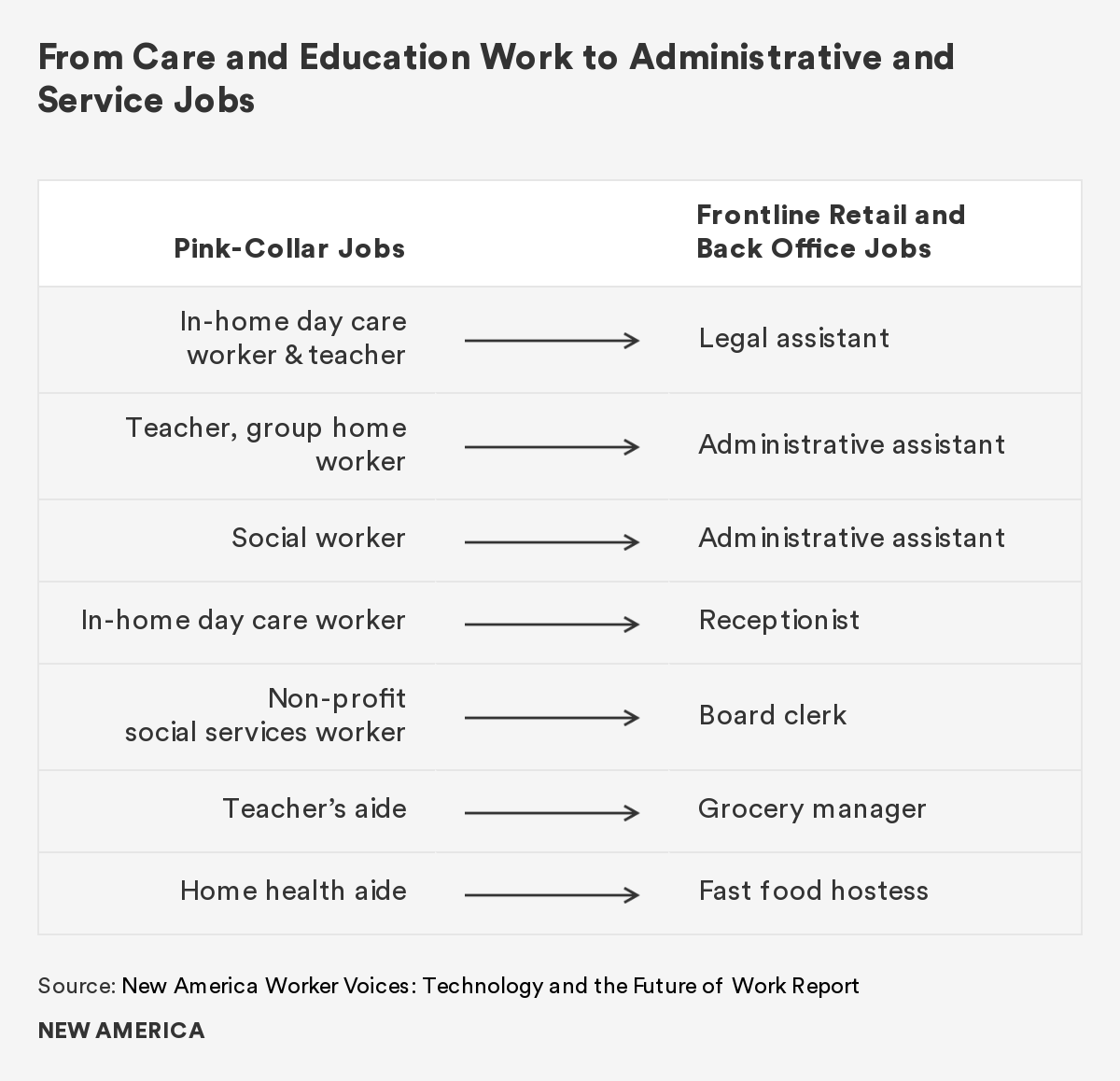
Moving Away from Fast-Growing Care and other “Pink-Collar” Jobs
The following stories describe the career decisions that five interviewees made in moving from care-oriented and education roles into clerical, administrative, fast food, and grocery jobs:
1) From education to administrative support: Tara is a 56-year-old immigrant. She has worked as an administrative support staff for the same private sector employer for 20 years. Earlier in her career, she worked as an elementary school teacher and at a group home with children who suffered abuse. “They just wanted more love. It was heartbreaking.” At the time, she said she “wanted to move on to something more. I used to work night shifts at the group home, and that was not for me. I wanted a different schedule.” To make herself more marketable, Tara paid for a computer course to learn the basics of programs like Word, Excel, and Photoshop. A contact Tara met through the computer class helped her find her first administrative assignment as a short-term temp. This assignment led to a year-and-a-half placement before she was offered her current full-time administrative job.
Two decades later, Tara is very satisfied with her work. She is especially pleased with the generous benefits, her work/life balance, the respect she gets from her manager and her peers, and the autonomy she enjoys as a long-time employee. When she was diagnosed with cancer in 2002, she said the company took very good care of her and she has been “comfortable” ever since. Today, Tara lives in a house that she owns with her siblings and she enjoys gardening and traveling. She expressed an interest in finding opportunities to work with children again. “I want to volunteer. I feel like I’m missing something.”
2) From social work to entry-level administrative work: Nicole is a 27-year-old administrative assistant. Several years ago, she graduated from a private college with a bachelor’s degree in sociology. After college, she held social work positions working with children with autism and ADHD. She liked the work, even though it was exhausting. But she was frustrated with the low pay while struggling to pay back $40,000 in student loans. She had another social work opportunity with slightly higher pay but the requirements to work at night scared her. Nicole expressed frustration that she felt “stuck” at a certain income unless she went back to school for a master’s degree, and even then, the salary is not much higher despite the cost of the additional schooling. She is loath to take on even more debt and is “very against” more schooling at this point.
Nicole never envisioned herself working in an administrative role, but overall, she likes the stability and work-life balance that her job affords. She and her fiancé are thinking ahead to family-friendly considerations. “That's one reason I took an admin role, because of work-life balance. When I go home, I don't have to do too much with my job. I feel like one day when I have kids, that'll be a benefit of staying in this role. There's always the potential of maybe working remotely eventually.” Because her fiancé does not have benefits, she described the employer-provided health benefits of her job as “huge” to her. If money were not a consideration, Nicole said, “I'd probably go back to school. I probably wouldn't stay in the admin role, to be honest. I'd probably go back into social work or counseling, or maybe do sociology research. In college, my dream job was to be a sociology professor.” For now, Nicole is content in her job and has her eye on possible internal promotions within the company over the next few years.
3) From schools to grocery: Sofía is 45 year-old married mother of five. She works full time as a manager at a grocery store. When her children were young, she stayed home to care for them. After 10 years, she decided to look for paid work, but she was “a little bit scared because I stayed home right after high school.” At the time, she was volunteering so much in her children’s school that the principal encouraged her to apply for a paid position. “I started working with lunch recess, helping out with the little ones at my kid's school. Then I moved on to special education and being a teacher assistant, which I loved.” She also worked for the school district as an interpreter. She really enjoyed the jobs in the school, but her needs changed. “By then, we needed health insurance. I decided to go and try [national grocery chain], just so that I could get benefits for the children, for my family. And here I am.”
Sofía has worked full-time at the grocery chain for 11 years and was promoted to a manager position. She enjoys her job, describing it as “exciting and never boring” and part of who she is. She appreciates that her employer is flexible. “What I like about [grocery chain] is that it works with you and your family. It flexes, which was always very important to us.” To Sofía, her family comes first. She tried a corporate job with the company in money management, but “it was taking over my family life.” So she quit and now just works for one store only. When she clocks out of work, she said, “I want to go home and be a mom. I don't want to get calls on my phone.”
4) From education to administrative work: Donna is a 55-year-old mother of four. She works as an administrative assistant in a private company. She graduated with a degree in education and has held several teaching jobs. Throughout her career, she has moved between jobs in teaching, child care, and administrative work. When her children were very little, she worked in home day care so that she could be with them. A few times, she found that she could make more money in administrative and secretarial roles than in teaching.
Donna enjoys her administrative role. “I’m happy to be here,” she reported. She likes the people she works with and says that they all work together as a team. She also values the work/life balance it provides. “At my age, I do appreciate a lot being able to walk out the door and not worry about taking work home.” At this point, she said she would prefer not to do child care for a living, beyond caring for her grandchildren. Day care work is tiring and “it’s a lot of work.” Donna loves children but is no longer interested in teaching. “I did enjoy teaching a lot, but it has changed through the years as well; it's not something that I would want to do full time anymore, unfortunately. I love doing the educating part, but I don't enjoy grading papers as much. They take a ton of time. Back when I was a full-time teacher, I would be grading papers till 11:00 p.m. or midnight and then I’d get up at 5:00 a.m. It's a very, very difficult job. Dealing with parents nowadays is just kind of ridiculous sometimes. There was a day when parents would back up teachers, but they don't anymore. They want you to make it easy for their kids, so that's frustrating. Even some administrators don't back up their teachers because they're afraid of the parents. It's a different world out there.”
5) From home health aide to hostess: Tanya is a 52-year-old hostess at a fast food restaurant and mother of three. Early in her career, she worked at fast food chains and restaurants. About a decade ago, she needed to earn more money, so she started a new career as a home health aide. She took a two-month course and passed a series of CNA certification tests. She did this work for five or six years. She said, “that was my thing, that is what I liked to do.” But then a back injury changed her career direction. “You have to roll your patients, and sometimes they don’t want to help you and my back did something. It was my back that stitched me up.” Due to her back injury, she returned to food service.
Tanya has been in her current fast food job for two years. She said it is not a career move beyond sustaining her for the moment. “For right now it’s paying the bills, keeping the roof over our heads. It’s not a bad place to work, the people are great, the customers are even better. This is definitely not something I’m going to stick with. I’ll probably go back into nursing or retire. I enjoy nursing.”
Job quality and the future of work
These career transitions illustrate how important job quality is to workers. However, the movement from jobs that are at very low risk of automation to higher-risk jobs is the exact opposite of trends for the future. As the U.S. population ages, care-oriented jobs like home health aide and personal care aide are some of the fastest growing jobs, projected to grow by more than a million jobs by 2028. In many ways, these jobs are the future of work for many women. These jobs have few of the positive job quality attributes of the administrative jobs that are on the decline. Median pay is barely $24,000, compared to $38,800 for secretaries and administrative assistants. In addition to low pay, care jobs offer workers little scheduling control and poor working conditions. According to researchers at the Institute for Women’s Policy Research, fewer than half provide benefits like health insurance and pension plans. Often, the work is physically demanding and injury-inducing, and conditions are at times unsafe for the workers.4
To ensure a better future for workers, and especially for women and workers of color, it is imperative that policymakers prioritize making the fast-growing jobs of the future good jobs. There are clear steps they can enact that will improve the quality of these jobs, such as raising wages, improving working conditions and safety, and enhancing opportunities for upward mobility and training. It is not enough to move workers out of these jobs. With an aging populace we will continue to need people to fulfill these care roles and we must make these jobs better. Much greater political will is needed for policymakers to prioritize the needs of a workforce that is disproportionately comprised of African American and Latina women, who are far less visible in future of work discussions and policymaking processes than white male workers.
Work is changing so the safety net and benefits system should change too
The views expressed by workers illustrate the mismatch between workers’ desire for stability and the instability caused by the changing nature of work. The current system of employer-provided benefits and the broader safety net system require a major overhaul to better meet the needs of low-wage and middle-skilled workers at risk of automation and technological change. A more responsive social safety net would include new models for workers to access key benefits outside of the workplace and that meet the needs of low-wage and older workers. Fresh thinking and new policies are needed to help older workers weather displacement and job loss and adjust to technology on the job.
Citations
- Harry J. Holzer, “The Robots Are Coming. Let’s Help the Middle Class Get Ready,” Up Front (blog), Brookings Institution, December 13, 2018, source
- U.S. Department of Labor, Bureau of Labor Statistics (website), “Occupational Outlook Handbook: Secretaries and Administrative Assistants,” last modified September 4, 2019, source
- Susan Lund, James Manyika, Liz Hilton Segel, André Dua, Bryan Hancock, Scott Rutherford, and Brent Macon, The Future of Work in America: People and Places, Today and Tomorrow (New York: McKinsey Global Institute, July 2019), source source
- Cynthia Hess and Ariane Hegewisch, The Future of Care Work: Improving the Quality of America’s Fastest-Growing Jobs (Washington, DC: Institute for Women’s Policy Research, 2019), source