Table of Contents
- Executive Summary
- Acknowledgements
- Introduction
- Economic Insecurity and the Future for Low-Wage Workers
- The Search for Stability While Work is Changing
- Workers Want to Feel Respected and That They Matter
- Technology on the Job Today
- How Workers Imagine Their Jobs in the Future
- Barriers to a Better Future for Workers, Especially Women
- Obstacles to Obtaining Skills and Degrees
- Career Transitions are Difficult and Often Out of Reach
- Conclusion and a Human-Centered Agenda for the Future of Work
- Appendix: Study Methodology
Economic Insecurity and the Future for Low-Wage Workers

The starting point of our research is the context of workers’ lives. Understanding the constraints and struggles workers face today is critical to anticipating how they will experience technological change tomorrow. This context impacts how workers experience their jobs, their resilience to changes, and their ability to plan for and connect to opportunity.
In our interviews with frontline grocery, retail, and fast food workers, economic precarity emerged as one of the most prominent and important themes. Most of the low-wage workers we spoke with faced financial insecurity, sometimes profoundly. Many struggled to afford the basics, pay off debt, provide for their families, and weather any financial challenges. This economic stress was top of mind and impacted many other aspects of their lives and work, from their career choices to the widespread preference for job stability to their difficulties pursuing higher education and learning.
While technological change was not the direct cause of workers’ precarity, it can add insult to injury. Automation and the adoption of new workplace technology can exacerbate workers’ financial insecurity when jobs change, earnings or hours are cut back, or when workers are displaced altogether. Economic insecurity also limits workers’ resilience to technology changes by undermining their ability to weather a job transition, pay for training or schooling, and connect to a new or better opportunity.
Financial insecurity suppressed upward mobility and limited workers’ ability to get new skills or change jobs
Economic precarity was a major challenge for the workers in our study. The fraught combination of low wages, expensive cost of living, persistent debt, lack of family support and any financial cushion, and—in some cases—the absence of health insurance created daunting headwinds for many of the workers we interviewed. This was especially true of those in the fast food industry, workers living in the Bay Area, undocumented workers, and those carrying student debt without a completed degree.
Many workers reported living paycheck to paycheck and struggling financially. Several people referenced the challenges of carrying debt, including auto loans, credit card debt, student loans, and medical debt. This debt often served as a barrier to upward mobility and to workers’ ability to go back to school or invest in new skills or career changes.
Other interviewees expressed concern about the challenges of establishing financial security and struggling to establish enough savings for the inevitable emergencies and expenses that arise.
A 25-year-old grocery manager acknowledged
I don’t have the greatest car in the world. It is old and it’s probably going to break down on me soon, which would suck because I need it for work. I keep trying to save and then I just can’t. I’m constantly worried about it. That’s pretty much the only thing I worry about. I have some bonds from college that I was supposed to use for college, which I haven't, that I would probably use in the emergency. Otherwise, I don't actually have a plan.
Low pay and insufficient hours added to workers’ financial insecurity and stress
The low wages that employers pay frontline workers is a major factor in their economic insecurity. Many fast food, grocery and retail workers reported frustration with low pay. A grocery manager reported not receiving a pay raise in over a decade despite other living costs rising. One 29-year-old truck driver (see Jasmin’s Profile) described the impossibility of making ends meet with the low compensation from her fast food jobs. Even after her pay rose from $5.35 an hour to $11 an hour a decade later, she explained that “still, it didn’t pay the bills.” A gas station manager, 23, explained a similar frustration: “The pay is not as high as I thought it would be. I tell my husband, ‘I'm working my butt off there and I have to live check by check.’ And then I ask for a raise and they just tell me later on, later on.”
Despite perceptions of a booming economy with low unemployment, many workers voiced frustration about not getting enough hours to pay their bills. A cashier, 55, despaired that he had not been given full-time hours by his grocery employer in the many years he worked there and, as a result, he could not keep up with the expensive cost of living in the Bay Area: “In 18 years, I never got a full-time position, never. You can’t believe it. I’ve always been part-time and looking for hours. Sometimes, they give me 24 hours. I can't survive with 24 hours. I feel stressed out and depressed.” Another grocery manager, 45, explained the struggle that her colleagues faced in trying to get enough hours
Store directors are hiring a lot of young people at minimum wage. To be a 40-hour employee, you have to get into this lottery, which I heard these days doesn’t even exist if you’re just a checker or a bagger. Take that lady who’s been there for 30 years, but she’s never been a 40-hour employee. She makes $22 but they’re giving her the bare minimum hours. I know a baker who’s worked here forever, she’s very much older and comes to me and cries because her hours are being cut so much she doesn’t know how she’s going to make rent this month. I don’t know if they really go and see how it’s being affected by them cutting hours, saving the $10. To [the grocery chain], it’s all money. That’s why you’re constantly seeing “we’re hiring!” and why we are constantly hiring, but you can’t give me 40 hours?
Workers worried about insufficient hours when hours equal benefits
Workers’ desire for hours is especially fraught because of the relationship between hours and benefits. Several grocery and retail workers with longer tenures observed that their employers have made it harder for workers to qualify for benefits. Today, they see their employers denying newer workers the full-time hours required to gain eligibility for health insurance and other benefits. One grocery cashier with a decade of experience contrasted his eligibility for health insurance in just three months when he started his job with the more than three years that new cashiers hired by his employer have to wait for benefits eligibility.
An employee of a different grocery chain described a similar experience: "the people coming in now have to do so many hours to get insurance. The company doesn't make it easy, because they're not giving a lot of hours. You're going to take five years to even get to the point to get insurance, and it used to be 18 months.” This pricing clerk, 55, continued, “once you were an employee, [the grocery chain] gave insurance, health insurance. But now, this depends on how many hours you are doing."
A manager, 45, explained that workers in the retail sector increasingly struggle for benefits and hours as well. While hourly wages have gone up, he sees employers offset the cost of these raises by denying new hires the hours required to qualify for benefits. By 2020, his chain, he said
is working toward $15 an hour and they’re ramping up to that now, even for cashiers and stockers. Each year they’re going up a dollar. At the same time, they’ve cut hours a little bit. A lot of retail is going to that, so they don’t have to pay as much in benefits. So you hear feedback on that from people. The compensation is now a little better for team members, but if you lose your benefits and that is your goal, then I think you’ve lost a little. When I started here, probably half the team members qualified for benefits. And now it’s much less than that. It’s more that we lose the people who had benefits. And with new people, they tell them ahead of time how many hours they’ll get, and it won’t be enough for full time benefits.
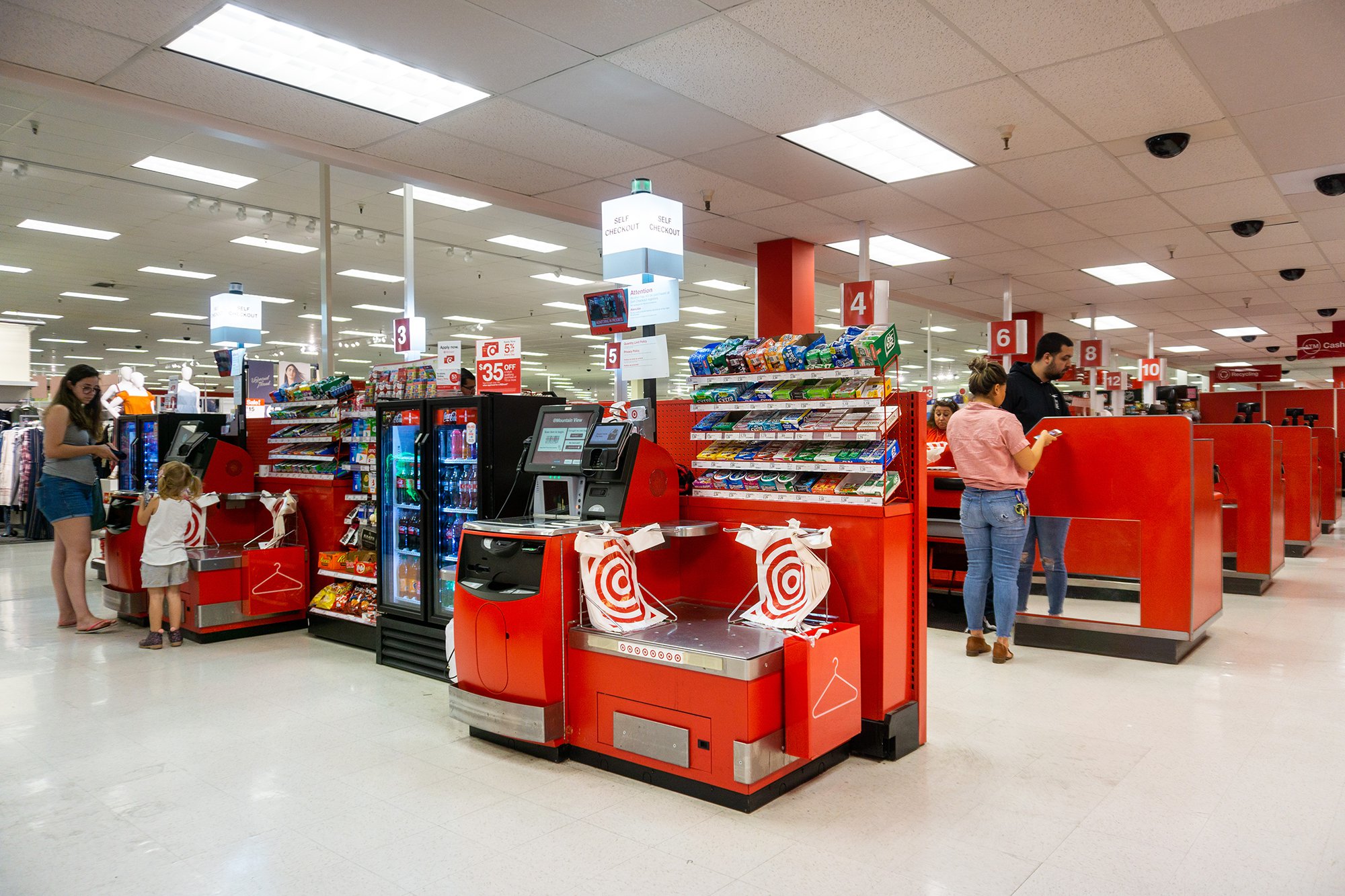
Sundry Photography / Shutterstock
Workers feel it is getting harder to earn a decent living as employers prioritize shareholders and the bottom line
A persistent theme from grocery and retail workers with long tenures was the sense that compensation and work environments have changed for the worse. Numerous interviewees lamented the loss of bygone era when their employers had “family values,” invested in their employees, and created opportunities to earn a decent living.
One grocery employee with 25 years of tenure described the gradual decline in the company’s values and benefits offered to workers: “When I first started, it was a family-oriented business. They gave us stock options. They used to have a staff organization that took a dollar out of our weekly paycheck, and would do things for us: parties, a crab fest, trips to Six Flags. Over the years,” this 47-year-old bookkeeper said, “all that has changed. It’s not family-oriented anymore. They started taking things from you, stock benefits for instance. It makes people not want to be a part of this company.”
Even younger workers with shorter tenures noted a change in values and culture, including when ownership changed hands. A 25-year-old grocery courtesy clerk said
it was a little bit more fun before. They would have more employee appreciation days and fun…gimmick days, like a cowboy day, and stuff like that. And I don't think it has happened since the turnover. The scheduling has gotten worse, and I don’t know if that’s the managers or the people above them. I think it is just penny-pinching. We’ve had less help, and that’s not the store manager’s fault; it’s whoever’s above them.
A grocery department manager, 53, described the positive role that his employer played in his life and his children’s lives, and his frustration in seeing the company’s values and priorities—especially the focus on shareholders’ needs rather than supporting the workers who produce that value—change over time. When he came to the store
it was more of a family-oriented company. The company has been good to me. In a few years, I hope to retire. And the company took care of my family. My oldest son went to college, you know what I mean? So it's been good to me. It means everything to me. And I want to see the company do well, just because I've devoted so much time and years to the company. But now we are caught up in a world that’s just a corporate conglomerate. Everything is about the bottom line and bonuses.…It’s just not what it once was. They’re not interested in how we used to do business. When you have shareholders and people who want to get paid; they aren’t interested in people like myself, who made this company.
Several interviewees expressed disappointment that grocery and retail jobs no longer provide a pathway to the middle class. A grocery cashier, 50, said
it used to be fun. You started at the bottom and you worked your way up. Back then, if you wanted to be a department manager or manager, it was a process and it was a good place to work for. Now,…I would tell young people if they're not going to move into management … to find something else. Because that job is kind of like a dead-end job now, ….It's not like when I came in. Our rate of pay was different, the whole package with benefits was different then. So if they're expecting a lot more [they’re] not gonna get it just staying there.
One grocery manager we interviewed was drawn to the industry after observing her father’s career as a butcher and the way he was able to provide comfortably for her family growing up. She does not feel that the jobs today provide the same middle-class opportunity for those willing to work hard. See Melanie’s Profile, below.
Melanie: Working hard is no longer a path to the middle class
Melanie is a 45-year-old manager at a grocery chain. She is the mother of two children, both of whom graduated from college. Twenty-five years ago, she started as a grocery clerk.
Growing up, Melanie’s father was a meat cutter and in a union. It was a good job that provided well for her family. “When we grew up, my dad was the only provider. We lived very comfortably growing up. So I was like, ‘Wow, this would be a great thing to get into. Look at how we did.’ That was kind of my motivator.” She no longer feels that grocery jobs provide a path to the middle class. “The grocery industry is not like what it was then,” explaining that her company has been cutting everyone’s hours. “It’s a very up-and-down kind of thing; there’s no real guarantees. If you’re not a full-time employee, which very few of us are, then they don’t honestly have to give you more than 24 hours a week. I think it’s hard for people to not always know. So, I think it’s a little scary sometimes, because it can all just be taken away from you without you being able to really do anything about it.”
Melanie feels that the work has become harder over time as her store has cut back on employee hours. “I've basically taken on two people’s jobs because they eliminated the middle person. That's definitely a challenge now, to try to do all that work still in your eight hours.” She is very unhappy at work. “I have gotten to the point where I pretty much hate my job. But it's a job. It has benefits and I have a lot of vacation.” She shared her frustration with the stagnant pay. “We haven't had a raise in 10 years. It’s very challenging.”
Melanie is also frustrated by the lack of appreciation. “Honestly, I don't enjoy it because they don't make it enjoyable, and they don't appreciate you whatsoever. We have a lot of supervisors that come in and no one ever tells you ‘good job,’ no one says thank you. It’s just simple things, I think, that could be done to get morale a whole lot better. Because everybody likes to be told that they did a good job. No matter how big or small the job is.”
Undocumented workers and those with felony convictions struggled with lack of access to services, benefits, or certain types of jobs
Several workers described facing especially precarious circumstances and even greater vulnerability to falling further behind. The workers we interviewed who lack legal immigration status faced the most extreme economic circumstances in our study. A lack of health insurance was a major struggle for this group. Those without legal status reported ineligibility for state healthcare schemes and working for fast food employers who did not provide benefits. Their financial insecurity was further compounded by a lack of a financial cushion and financial support from family members. In fact, all of the undocumented workers we spoke with sent money home to relatives. One fast food worker, 54, said
I worry about getting sick and not being able to help my parents [in Mexico], because I am the one who helps them the most. I am the only one who takes care of them. I don’t want to get sick, because I don’t have benefits, I don’t have medical insurance. In [a fast food chain] we don’t have anything if we get sick….Well, last year I got ill. I made a payment plan, and I am paying off $1,500. They give me about a year.
Another undocumented fast food worker, 21, agreed about the special danger of falling ill: “I worry a lot. I won’t be able to pay my bills, I won’t be the person I want to be, I won’t achieve my dreams. In this country, you need to fight for your dreams. I lost my car. When I got sick, I couldn’t pay for it because I was really sick and couldn’t work. I applied for medical insurance, but I don’t qualify.”
The economic and legal precarity of the undocumented workers in our study severely limited their upward mobility and their ability to prepare themselves for better and less automatable work in the future. Jasmin’s Profile below outlines how workers with felony convictions face additional challenges and obstacles.
Jasmin: Financial challenges, fast food, and felony conviction
Jasmin is a 29-year-old woman and mother of two children. Jasmin has a felony conviction and will be on house arrest for another three and a half years. Since she was 15, Jasmin has worked in fast food restaurants, often working two jobs at once. She started out making $5.35 an hour and after more than a decade, earned $11 an hour. “I wanted to quit because they just don't pay my bills.” Jasmin has been living “paycheck to paycheck forever” and does not have an emergency cushion to pay for unexpected expenses. “I've been trying to save money, but every time, it doesn't work. I increased my credit score in three months and then I didn't pay my bill and it dropped down again. My main goal is to get a high enough paying job so I can save money.”
Jasmin is now starting out as a truck driver, which at $16 an hour, pays more than fast food. She isn’t happy in the job and said it is “scary” to drive. “I do not like trucking. You don't get to be around customers. It's depressing. My customers are what drives me.” Her entire focus is to become more financially secure. “This job is just to save money. Save, save, save. When I get financially where I want to be, then I will make a career. That's why my case manager, she is always like, ‘You sure want to do this? Because this ain't you.’ I'm like, ‘I don't care, I need money right now. This job is not my career.’” Jasmin has a lot of career dreams, but her felony conviction limits her ability to be promoted to manager or to consider specific types of jobs. “I really, really, really want to own a day care. That was my ultimate dream, but my background won’t let me do anything with customers or kids.”
Jasmin doesn’t want her daughters to go into fast food when they get older. “I don't want them struggling like I struggled. Living paycheck to paycheck. I tell them all the time, ‘You have to get some type of education or trade.’ You've got to do something besides fast food. Fast food is not it. Hopefully I can be stable enough that they can maintain until they can get a good job. Because when you're young, you just take whatever job.”
The high cost of living in the Bay Area made economic concerns especially acute
The high cost of living in the Bay Area contributed to especially acute feelings of economic insecurity for workers in that region. The fast food, grocery, and retail workers living there reported feeling squeezed financially. Many struggled to keep up with the high cost of rent and felt that they could not get ahead. Some interviewees reported renting out rooms or living with roommates and extended family as a way to manage the burdensome cost of housing. One retail assistant manager said, “I enjoy living here, but it's kind of getting expensive here. Sometimes we're just like, I can't do it no more. You're just living check by check by check.” A grocery cashier, 55, fleshed out these burdens
I live in a small room in a house. They made the living room of the house a small studio where we live, with a bedroom, a small kitchen and bathroom. I pay $1,000 a month. Living in the Bay Area is expensive. A room with no kitchen is $800! It’s not healthy for me and my daughter. Our beds are right next to each other. She…needs her own privacy. I've been trying to afford that, but with the hours I'm getting right now, I can't afford an apartment. My daughter is working two jobs and going to school at community college. She was taken off my insurance because she is 26. She has a medical problem with her kidneys. She needs her medical care, but I can't afford to pay her insurance. I can't. And that's the reason she's working for [fast food chain that offers health insurance to all workers], to try to get insurance with them.
Administrative workers, managers, and unionized workers reported more financial security
Not everyone we interviewed reported financial insecurity. Overall, clerical and administrative workers describe substantially more economic security than the retail, fast food, and grocery workers. This difference is not surprising. On average, clerical jobs are middle-wage positions with greater access to benefits, while entry-level workers in food, retail, and grocery earn low pay and have uneven access to employer-provided benefits. Many of the administrative and clerical workers we spoke with had more solid financial cushions and reported fewer financial worries.
Among food, retail, and grocery workers, several factors were associated with greater financial security among the minority of workers who reported stable economic footing. These factors include holding higher paid management positions; sharing expenses with partners, spouses, or children earning middle-class wages (such as plumbers and pharmacists); union membership; and, among younger workers, having financial support and/or health insurance from parents.
Technology and economic insecurity: adding insult to injury
These near-term economic pressures were more on the minds of workers than longer-term questions around technological change. One grocery manager, 45, explained that conversations with colleagues at work focused mostly on the present-day challenges of securing hours and pay, instead of possible future risks from technology. “I mean, I never hear about the future, or anything like that. I think it’s more conversations like ‘what’s going on? Why are our hours being cut right now?’ That kind of stuff. I don’t think people think past today to think ‘oh my God, in 20 years will this job still be here for me?”
Technology was not the cause of the insecurity that workers felt, but can act as a force multiplier.1 Many workers today experience deep precarity, to which technology is a force with which some will also need to contend, whether in the form of reduced hours or wages, displacement from a job, greater stress, and lower job quality,2 or even increased surveillance.3 Without concerted policies to mitigate these trends, technological advancement will further widen inequality and exert additional downward pressure on wages.
Furthermore, the present of work matters to workers’ future. The low wages and economic precarity that many workers experience today undermine their ability to be resilient tomorrow. The personal stories of those we interviewed spotlight the many ways that financial insecurity limits economic mobility and undermines workers’ adaptability to shifting labor market trends. If workers cannot afford to make ends meet and feel a basic level of security today, they will be ill-equipped to prepare for tomorrow.
As the present and future of work are inextricably linked for many low-wage workers, the future of work discussion would benefit from a greater emphasis on enhancing the financial security, compensation, and job quality of low-wage workers today. Too often, policy discussions around issues such as the minimum wage, collective bargaining, and job quality are siloed and set apart from the future of work. Reducing inequality and improving the economic security of workers is key to ensuring a better future of work for those at greatest risk of change. Moreover, compensation is a critical consideration for companies who employ fast food, grocery, and retail workers and other low-wage workers in industries likely to experience technological change. Educational benefits are often cited by large companies as their contribution to preparing their workforce for technological change and automation. However, these benefits are insufficient and underutilized when employers do not pay workers enough to secure a stable living.
Citations
- Jason Furman and Robert Seamans, AI and the Economy, NBER working paper no. 24689 (Cambridge, MA: National Bureau of Economic Research, June 2018), source
- Beth Gutelius and Nik Theodore, The Future of Warehouse Work: Technological Change in the U.S. Logistics Industry (Berkeley, CA: UC Berkeley Labor Center, October 2019).
- Brishen Rogers, Beyond Automation: The Law & Political Economy of Workplace Technological Change, working paper (New York: Roosevelt Institute, June 2019), source