Table of Contents
- Executive Summary
- Acknowledgements
- Introduction
- Economic Insecurity and the Future for Low-Wage Workers
- The Search for Stability While Work is Changing
- Workers Want to Feel Respected and That They Matter
- Technology on the Job Today
- How Workers Imagine Their Jobs in the Future
- Barriers to a Better Future for Workers, Especially Women
- Obstacles to Obtaining Skills and Degrees
- Career Transitions are Difficult and Often Out of Reach
- Conclusion and a Human-Centered Agenda for the Future of Work
- Appendix: Study Methodology
Career Transitions are Difficult and Often Out of Reach

According to most experts, technology changes in the workplace will require millions of people to change jobs in the years ahead.1 To mitigate the negative impact of displacement, policymakers and experts have highlighted the need to re-skill workers from jobs that are declining, such as those described in this report, and position them for those jobs that are on the rise. A partner at the consulting firm McKinsey summarized this challenge when he said, “we should be worrying about mass redeployment rather than mass unemployment.”2
Our conversations revealed a disconnect between the need for a mass redeployment of talent and the ability of workers at the front lines of technological change to redeploy and adapt. The workers we interviewed faced many constraints that undermine their ability to react quickly to job changes, reposition themselves, and proactively change their career trajectory. Most lacked financial savings to weather a job transition or to forgo a salary or benefits while training for a new career. Moreover, neither the education and workforce systems nor the employment policies in the U.S. are set up to redeploy adult talent. In the absence of a talent and workforce system that is structured for this purpose, career transitions for workers are overwhelming and extremely difficult.
Younger workers had the biggest dreams for careers outside of retail, grocery, fast food, and administrative work but often put these dreams on hold
The boldest career dreams came from workers in their late teens and early 20s. They discussed their aspirations of entering fields ranging from skilled trades to fast-growing health careers and the social sciences. Nearly all of the jobs that these young workers aspired to require additional postsecondary education. In a few exceptional cases, young workers in retail and clerical roles were building towards those dreams by studying while working full time. More often than not, the dreams of young workers were put on hold by a range of challenges and setbacks.
The most common career preference of the young workers we interviewed was in the health sector, including interest in several fast-growing occupations like medical assistant, healthcare management, and nurse. A 25-year-old entry-level grocery worker explained his draw to the medical field: “my mom was a nurse and my girlfriend’s mother is schizophrenic. I have a real sympathy for people that go through things like that. Ideally, I'd like to work in that type of environment dealing with patients.”
Several other young retail workers were drawn to trades that require associate degrees. A 21-year-old manager shared with us his dream of becoming an automotive technician. He is a “car fanatic, and a workaholic.” He was one of the two interviewees who was working full time and studying part time. He is studying at a community college towards his associate degree in automotive science, with an ultimate plan to enter the military to be a car mechanic. A young fast food worker, 18, explained his exploration of mortuary science as a possible career
I could also see myself going to trade school for something that would help people. I’ve been doing a lot of research in the mortuary sciences because I'm good with people and those jobs involve a lot of having to be good with people. My grandmother died when I was young….Everyone experiences grief in different ways, and when it happens to you, it’s a lot. My mom and I were really close with my grandmother. When you lose someone close to you, it’s shell shock, no matter the warning signs.
The second of our two interviewees who was working full time and taking classes part time is described in Isabella’s Profile, below.
Isabella: Working while studying toward a dream career
Isabella* is a 23-year old working full time as an administrative assistant and studying graphic design part time at community college. Graphic design seemed practical. “For me it felt like the safest option financially that I would prefer the most. I know that if I just go into strictly fine arts it's going to be a tough road for me. I'm a very tech-savvy person so as soon as I figured I can mix these two together, I decided on graphic design.”
To achieve her goal of becoming a creative director, Isabella plans to transfer to a four-year college to complete her BA in graphic design after she completes her associate degree. Isabella needs to work full time as she studies. Financing her degree is challenging and creates delays. “It's really hard just paying out of pocket. Sometimes there is money, sometimes there isn't any money. I'm not sure when I'll graduate.”
Right now, she is able to fit classes in around her full-time work schedule. “The majority of the classes that I'm taking now are online because I'd rather get those out of the way now.” She hopes that her employer will allow her the scheduling flexibility she needs to complete the remaining courses on campus. “As soon as I'm finished with all the possible online courses, I do want a schedule where I have that time in the morning to attend school.” She is optimistic that she’ll be able to work something out with her employer.
In the meantime, she has asked her managers for internal opportunities that use her creative talents and is excited about the possibilities. “That is something that I'm hoping that I get the chance to do. I feel very lucky there and I feel like there's the potential to grow. For now, I see myself staying there and going to school.”
Challenges and obstacles undermined young workers’ career goals
The experience of Isabella, in the profile above, stands out as the exception. Most of the young workers we interviewed faced financial hurdles, practical constraints, family commitments, and setbacks with their education that undermined their career goals. Often, these challenges resulted in workers ending up in careers they had never planned to be in. Frequently, the younger workers we interviewed lamented that progress toward their desired career had been derailed or put on hold. A variety of obstacles stood in their way, ranging from economic insecurity to care responsibilities, school debt, and the immense challenges of juggling full-time work and school. Laura, in the profile below, faces multiple obstacles.
Laura: Obstacles to a dream career
Laura is a 22-year-old receptionist. Growing up, she dreamed of a career working with children, such as opening her own day care or becoming a preschool teacher. After high school, she worked in an in-home day care and loved it. “The job was my life. Those kids were like my family. I did not care about anything, just because I loved it.” But after several years in the job, Laura grew frustrated with the lack of benefits. Without employer-provided health insurance, she had to be on her mother’s insurance. “And that was one thing I was really struggling with, because my mom has to work so many hours to get benefits and she didn’t want to work those hours anymore.’”
A few months ago, she started a new job as a receptionist in a private company. Her job provides the benefits that her day care position lacked: health insurance, a 401(k), paid time off, and parental leave. Her salary nearly doubled overnight. “My first check, I was like, ‘what’? And obviously the benefits, those are huge.” The pay and benefits have brought her relief. “Now that I've made the change, I feel so different. I feel happier. I sleep better. I sleep harder, if that makes any sense.”
One of the biggest perks of her job is that it is family-friendly. “I've always wanted to have kids and I want to have them within the next few years. At the day care, I would have only had a two week maternity leave, and that’s not what I want. With this job, I will get eight weeks or more, which is huge for me. Also, this job is super lenient. In my other job, if I had an appointment or something, my boss would tell me I need to hurry back, and I just always felt rushed. And with this job they're like, ‘you have an appointment at 1:00? leave at 11:00.’ They are also talking about potentially changing our phone system to Skype so then we could possibly work remotely. That'll be awesome to be able to work from home maybe two days a week.”
She still has dreams of a career caring for others. “About a year ago, I looked into trying to get grants to go back to school to be a labor and delivery nurse. That’s something I still am super interested in. I just don't foresee it happening. I don't have time, I don't have the money to do it. But if there was something that I ever wanted to do, that would 100 percent be it.”
Most workers viewed dream jobs as impractical
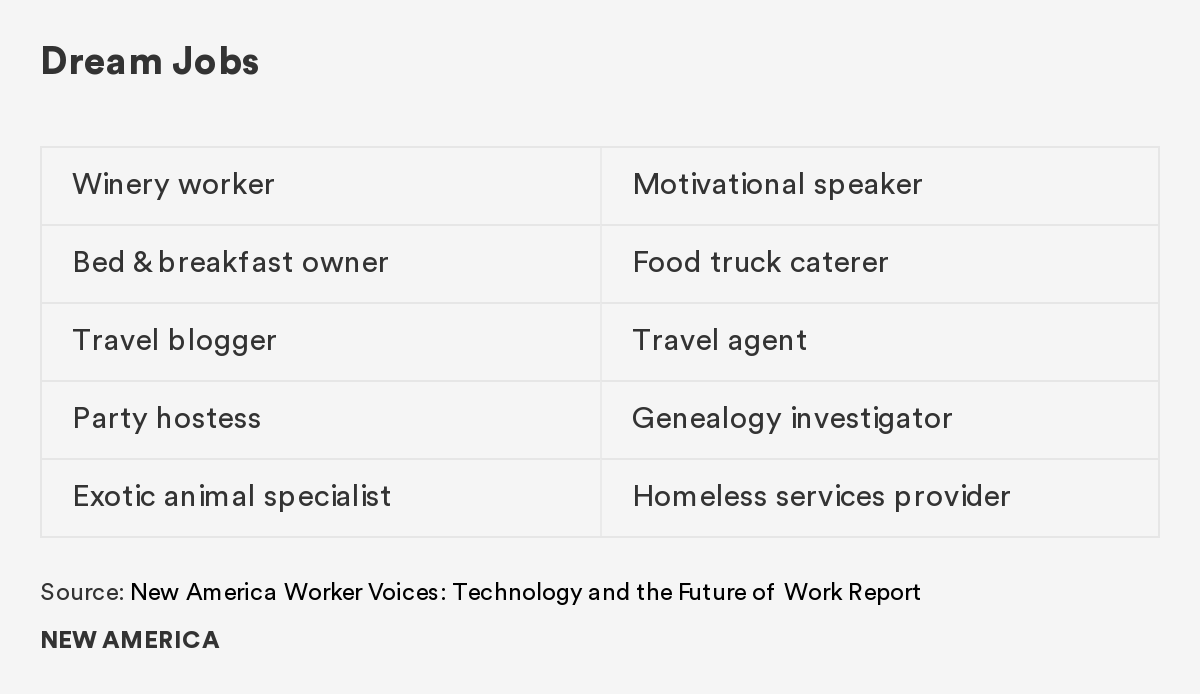
Interviewees of all ages and occupations shared with us dream jobs that they would love to hold if they could wave a magic wand and put aside practicalities (see Dream Jobs, below). None of the interviewees seriously considered these jobs. The language they used to describe these dreams suggested they were fantasies. For the workers we interviewed, stability, benefits, and practicalities took priority. A retail cashier, 41, put it this way: "It's one of those things, where you get drunk and you talk about what you want to do in life. ‘We're going to open a bed and breakfast.’ ‘No, honey, it's Jack Daniels that's talking, not us.’ There's no way that that can work in where my life is right now. I need steady and I need secure….Because I got little people that rely on me.” Another mid-career professional said the same thing: “I really did think about what if I just kind of like pitched it all to the wind and said, ‘I'm just going to go where the wind blows me.’ But ultimately,” said this 40-year-old county information clerk, “I came back to stability. I think because I value stability, it was sort of always a pipe dream.”
If needing a job quickly, most would rapidly redeploy to a similar job
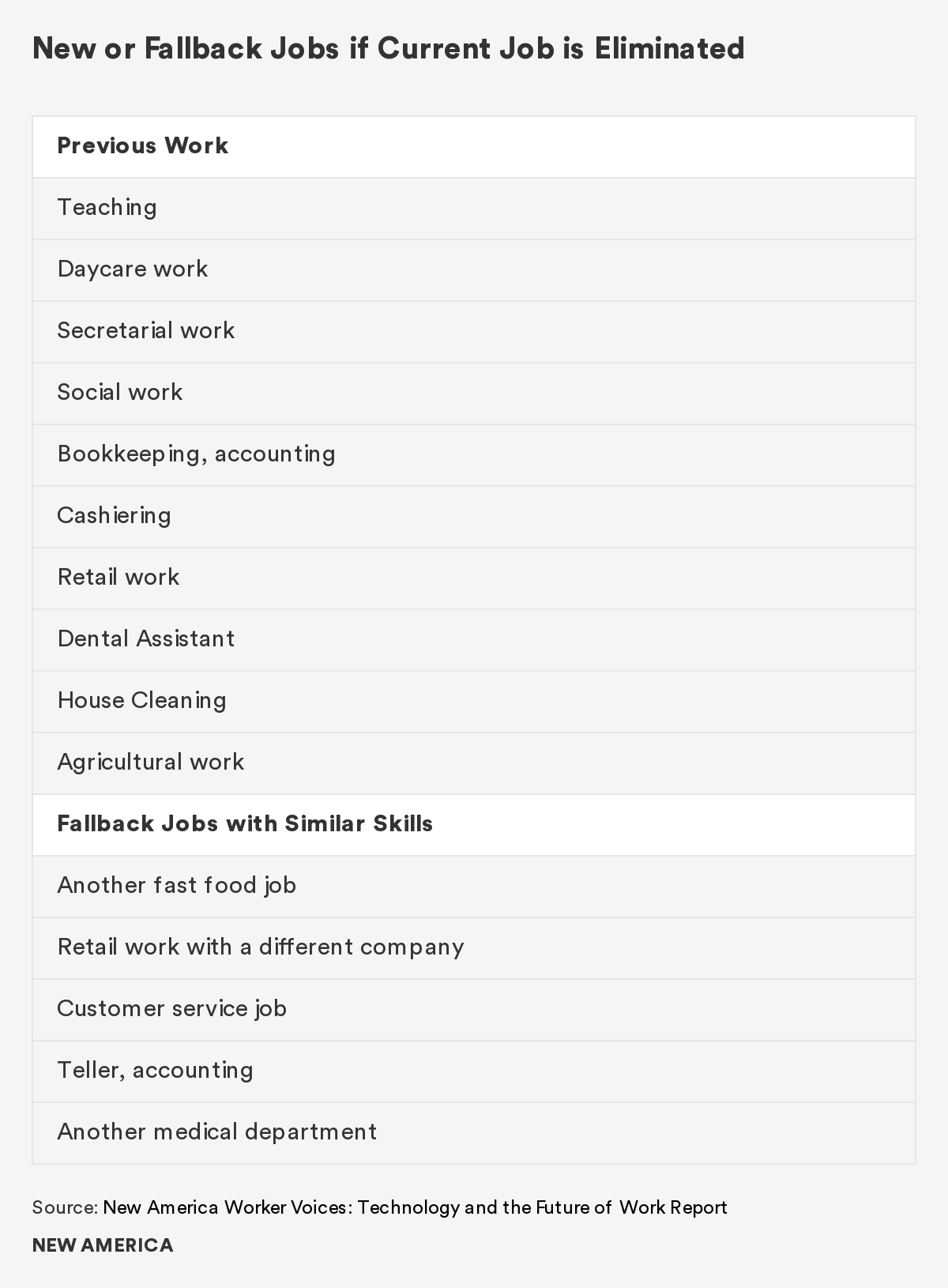
We asked what type of work interviewees would seek if for any reason, their job did not exist and they needed to find other work. Unsurprisingly, most responded that they would look for the quickest path to a new job by leveraging their existing skills and experience. This might mean returning to previous work—such as care jobs, education, or retail—or finding another position similar to the one they currently hold in food, grocery, retail or clerical work. If they faced a disruption to their work, most interviewees said they would connect to a job for which they are already qualified for and that is relatively easy to access. A few people even said they would take any opportunity, even if it was worse, just to make sure they could continue paying their bills. “If I had to do something now, what would likely be the easiest for me to secure?” asked a grocery bookkeeper, 31. “I would do something similar, because I already have a lot of experience there."
The approach of rapid redeployment to a similar job maximizes economic security in the short-term, but not necessarily in the medium- or long-term. The jobs identified by workers that are similar to the ones they now hold also face a high risk of automation. Moving from one retail job to another, from bookkeeper to teller, or from an administrative role to a secretarial role results in a shift from one high-risk job to another.
In contrast, several of the fallback jobs that interviewees identified were considerably less at risk for automation. Jobs in day care, education, social work, and healthcare, for instance, are all low risk of automation. However, the workers who had left those jobs for what they considered better ones in administrative and retail work signaled that they were dissatisfied with the benefits, hours, pay, respect, and stability of these positions. Thus, while a move back to these jobs may reduce overall automation risk, they may also result in a decline in the workers’ quality and standard of living.
Career transitions are out of reach for most busy adults, and older workers prefer no change at all
Rarely did busy working adults in our study have explicit plans to change careers—or even ideas for what they would want to do. Unlike some of the younger workers, mid-career and older workers were mostly focused on the present, juggling busy lives and busy jobs, with limited bandwidth, time, and resources to plan major career changes.
Just a few older workers identified alternative careers that they were actively considering. None of these career plans required additional formal, postsecondary education toward a degree. Real estate came up several times as a career interest. Workers pointed out that changing to this career would be a relatively quick and easy transition and would require minimal schooling and training. A retail cashier, 41, considered a new position in her children’s school system as an advocate working one-on-one with autistic children. To qualify for the job, she would just need to take an online course and a test, since she already has a college degree. She is drawn to the job, but frets that educators are “totally underpaid and underappreciated” and wonders if her family could afford a pay cut. "Do I have the patience for that because that sounds fulfilling and exciting? But I'd have to talk to my husband because it'd be like,…‘if I quit my job and get a job where it's going to pay a dollar an hour less, how do you feel about that?’"
For the most part, workers beyond the earliest part of their careers were not plotting major shifts. Several workers said they struggled to imagine doing another job and didn’t know what else they would want to do. A grocery cashier, 29, invoked a higher power, musing
Honestly, I am not sure. I just know that He didn't put me here to just run a register. I mean, I get it, that job really helped me. It has already helped me meet good people. But I just feel like I am here for a better purpose, a higher purpose. My mom, she says…all the time, “You can't help everybody.” [But] it would be that much better if somebody was paying me to do it. So, I don't know, its' just—I really feel like I'm here to help, but just…haven't quite figured it out.
A medical secretary, 32, said,
It’s funny, a couple of my coworkers and I were talking about our dream jobs the other day. We’re always saying we want to travel, do all these things, but what’s a profession that you can, like, travel? One girl said, “I’m going to become a flight attendant.” I was like, “I don’t think I’d like doing that, my whole family is here.” I don’t know about another job, or what I really want to be doing. I feel like I have been doing the medical stuff for so long now.
Making Career Transitions Easier for Workers
Career transitions are overwhelming for low wage workers with limited financial resources, time, and professional networks. It is clear that the workers we interviewed lacked the support and resources that could make career transitions easier and less destabilizing. Many workers we spoke with would benefit from high-quality career guidance. Frequently, we heard from workers that they lacked a clear idea of what they wanted to do in the future and lacked models of friends, family, or community members engaged in work that seemed appealing. Most workers found jobs and discovered their career interests through personal connections, and only a small minority connected to jobs through online platforms or searches. Quality career guidance can help them expand their career possibilities and navigate change.
Currently, the workforce system is fragmented, underfunded, and ill-suited to the needs of the workers in our study and the challenges of technological change. Policymakers should take a human-centered approach to make the workforce system and the existing infrastructure of America’s job centers more user-friendly, better quality, and more responsive to the needs and preferences of workers.
Citations
- James Manyika, Susan Lund, Michael Chui, Jacques Bughin, Jonathan Woetzel, Parul Batra, Ryan Ko, and Saurabh Sanghvi, Jobs Lost, Jobs Gained: Workforce Transitions in a Time of Automation (New York: McKinsey Global Institute, December 2017), source
- Susan Lund, James Manyika, Liz Hilton Segel, André Dua, Bryan Hancock, Scott Rutherford, and Brent Macon, The Future of Work in America: People and Places, Today and Tomorrow (New York: McKinsey Global Institute, July 2019), source source