
Awista Ayub
Director, Fellows Program
New America’s Fellows Program invests in thinkers—journalists, scholars, filmmakers, and public policy analysts—who generate big, bold ideas that have an impact and spark new conversations about the most pressing issues of our day.
Every year, we choose our National Fellows through a rigorous, competitive selection process. We seek to support individuals who advance big ideas and do so through projects that utilize in-depth research, keen reporting, nuanced analysis, and a thoughtful storytelling approach.
Over the past 20 years, the Fellows Program has contributed to a deeper understanding of trends around pressing issues most interesting to journalists, academics, and thought leaders. Our program’s success and impact is only underscored by the growing volume of applications we receive year over year.
For our Class of 2020, we received 368 applications and awarded 15 fellowships (a 4 percent acceptance rate). Here are some observations about the Class of 2020 candidate pool and how they compare to trends from the applications received for the classes of 2017-2019.
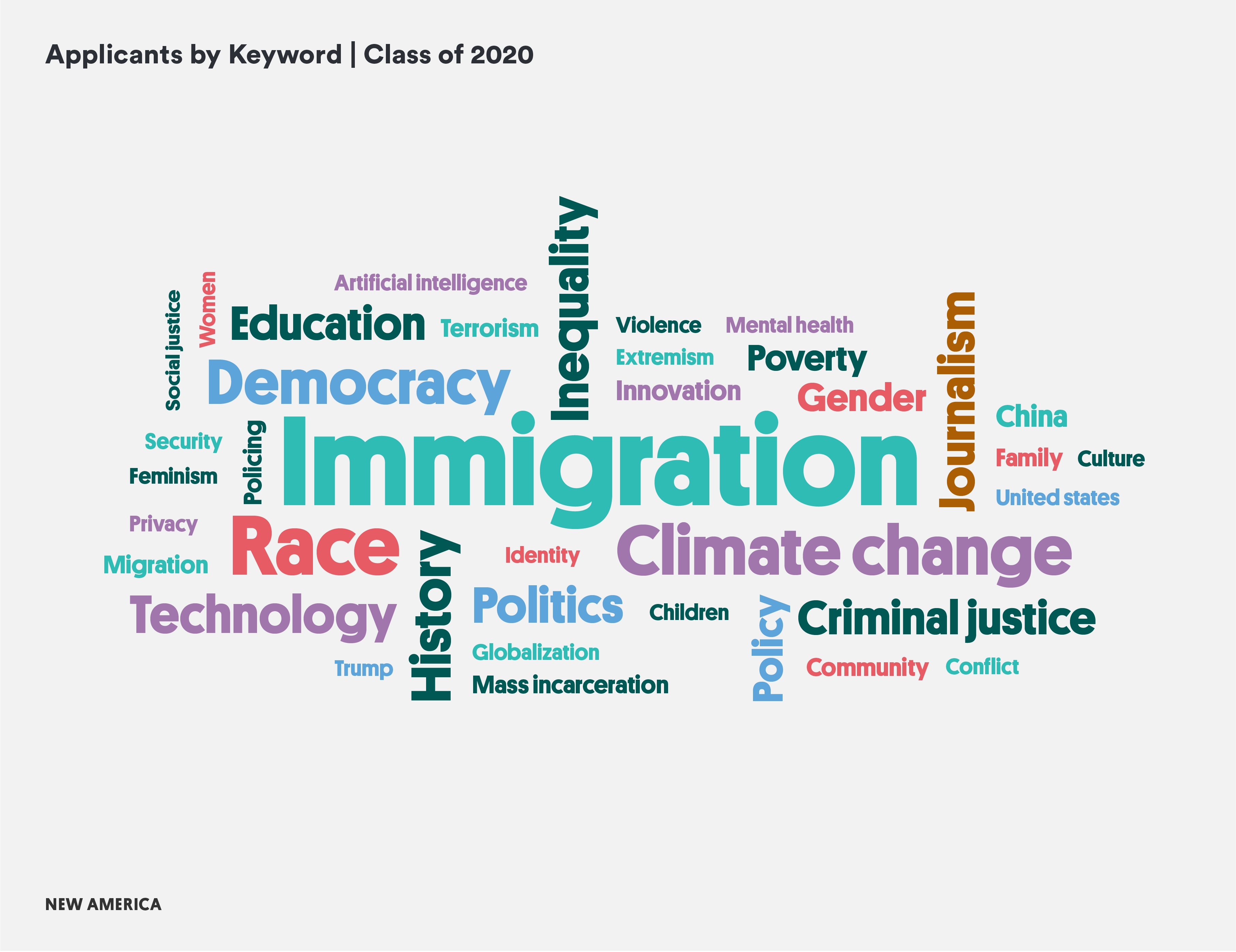
An extensive analysis of the keywords submitted with each application yielded the following cloud of the top 38 words used this year. The size of the word represents the frequency of use, and the color-coding of the word aligns, broadly, with the issue areas they represent.
The top five words based on the frequency of use for the Class of 2020 are immigration (27), race (25), climate change (23), democracy (21), and history (20).
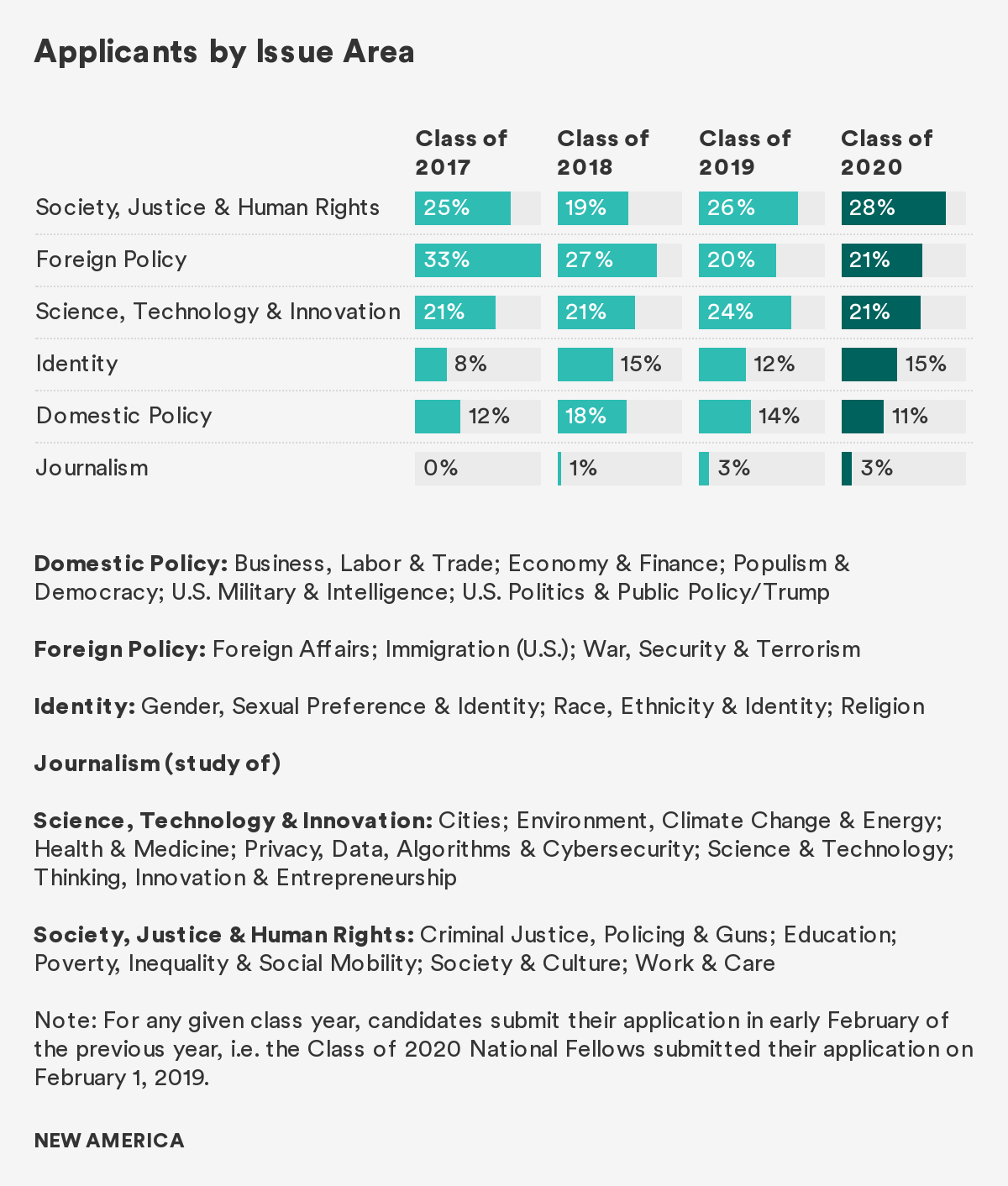
Every year, candidates submit applications that speak to a range of pressing global and domestic issues. Given the annual application cycle, this provides the program with a unique insight into the types of issues that journalists, academics, and other thought leaders are attuned to in that given year.
Over the past three years, there has been a downward trend with the number of applications in the “Foreign Policy” issue area; 33 percent for the Class of 2017 to 21 percent for the Class of 2020. Applications focused on societal issues (“Society, Justice & Human Rights” and “Identity”) made up nearly half of this year’s applicant pool; a steady increase over the past three years from 33 percent for the Class of 2017 to 43 percent for the Class of 2020.
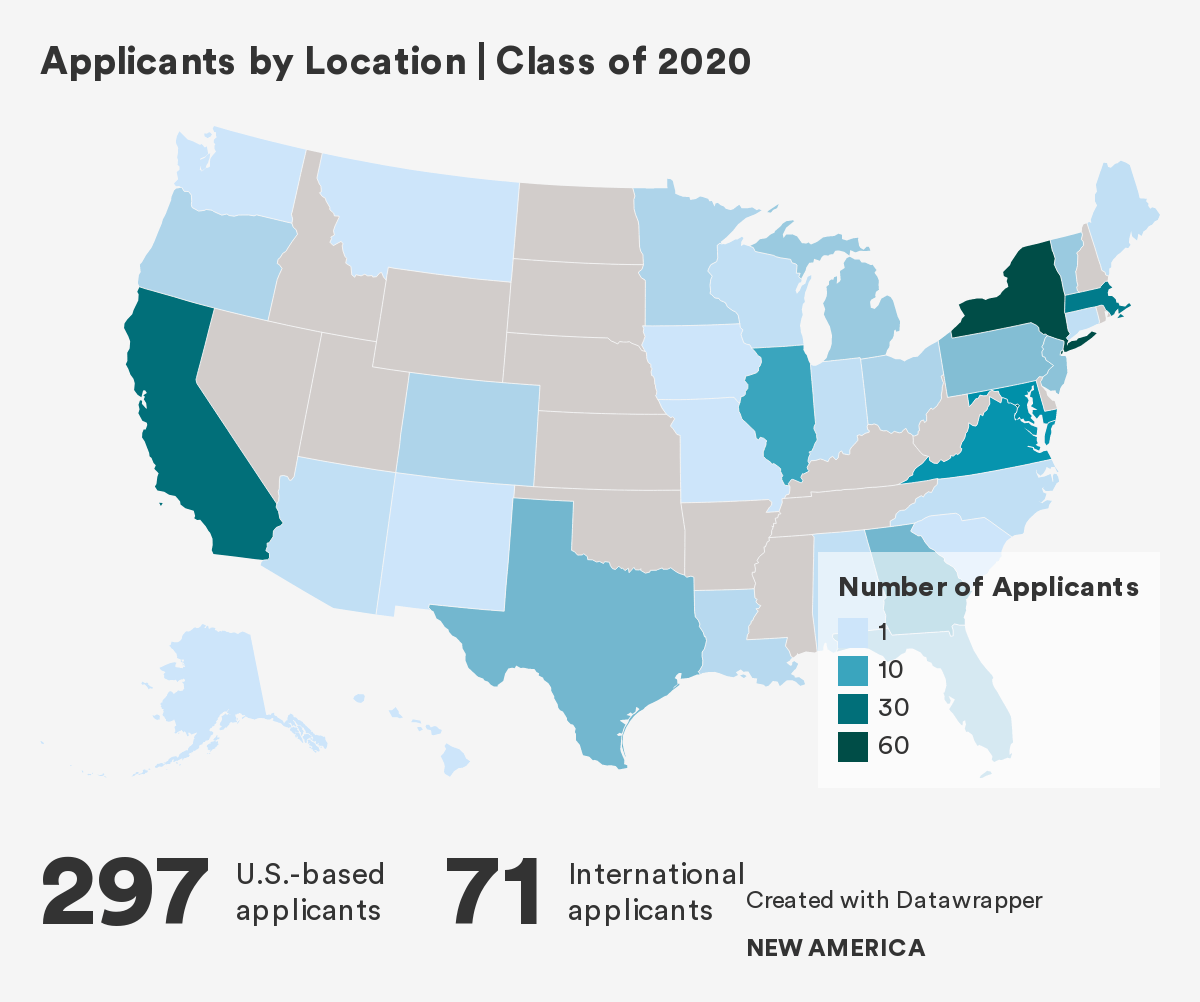
Of the broader candidate pool, 297 applicants were based in the United States and 71 were based abroad (up from 59 last year).
The U.S.-based applicants came from 33 states (down from 36 last year) and the District of Columbia, with most of the applicants concentrated in New York (77), the District of Columbia (39), California (34), Massachusetts (21), Maryland (16), Virginia (15), and Illinois (10):
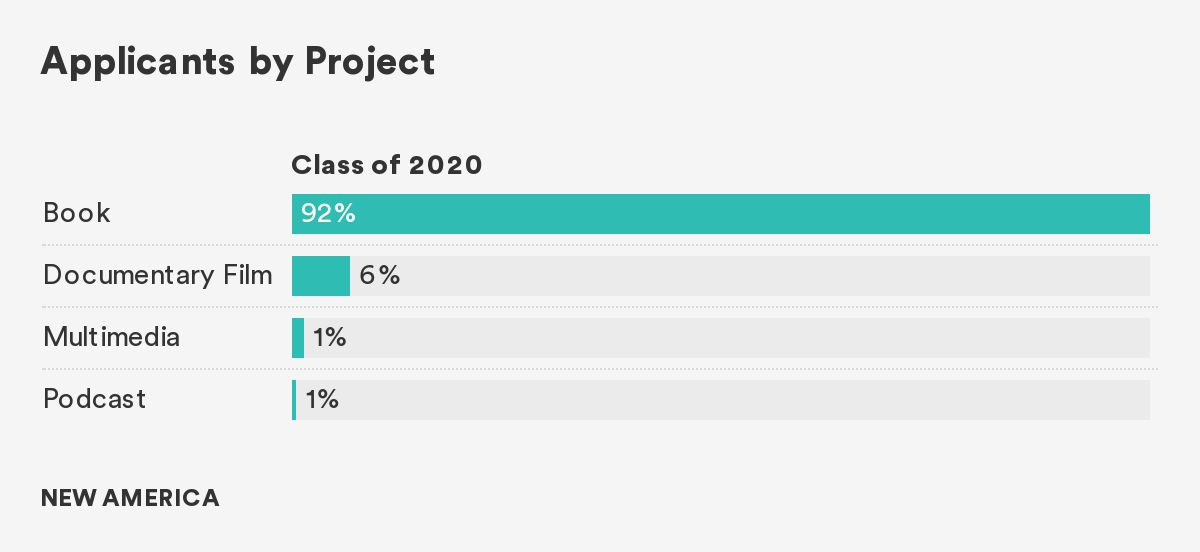
As we celebrate our 20th anniversary, to date, the Fellows Program has supported the publication of 115 books, nine films, and several award-winning long-form reporting projects. While the Fellows Program has an established reputation as a premier fellowship for nonfiction writers, this year we received a range of new projects that varied in form and approach. In addition to 12 books, we are supporting two films as well as a podcast project (the program’s first) with the acceptance of this class.
Though 92 percent of this year’s applicants submitted book projects, we did see an increase in the number of non-book projects submitted this year.
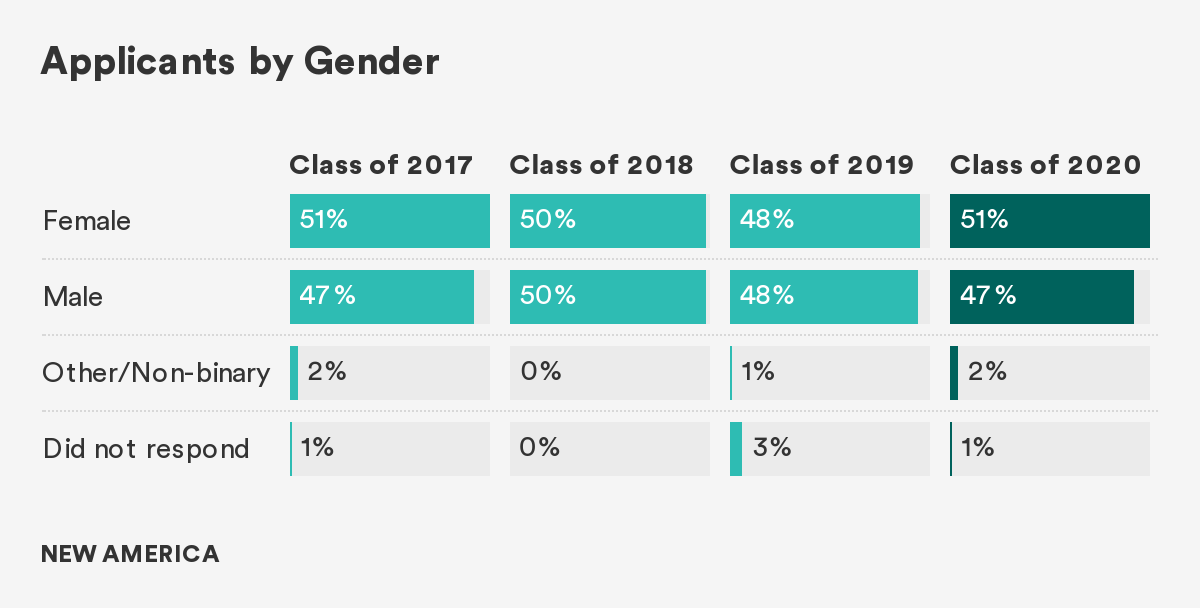
This year, 51 percent of the candidate pool identified as female and 47 percent identified as male. The breakdown (nearly at parity) is in line with the last three year’s candidate pool and is a promising trend to note as it relates to who applies to the program.
You can learn more about the work of our 15 Class of 2020 National Fellows here.
New America’s Fellows Program thanks Eric & Wendy Schmidt, New America's board of directors, Emerson Collective, the Center for the Future of Arizona, Southern New Hampshire University, the 11th Hour Project, Arizona State University's Center on the Future of War, as well as the Political Reform Program for their support this year.
We would also like to thank Samantha Webster, Naomi Morduch Toubman, Clarke Reeves, Elizabeth Pankova, Maria Elkin, Joanne Zalatoris, and Sarah Baline for supporting the design and preparation of this report.
Director, Fellows Program