
Naissa Charles
Fellow, New America Chicago; Summer Research Fellow


In 2024, the Department of Justice (DOJ) updated Americans with Disabilities Act (ADA) Title II regulations to establish clearer technical standards for digital accessibility. The rule adopts the Web Content Accessibility Guidelines (WCAG) 2.1 Level AA as the baseline accessibility standard and created phased compliance deadlines—April 24, 2026, for public entities serving populations over 50,000 and April 26, 2027 for all others.
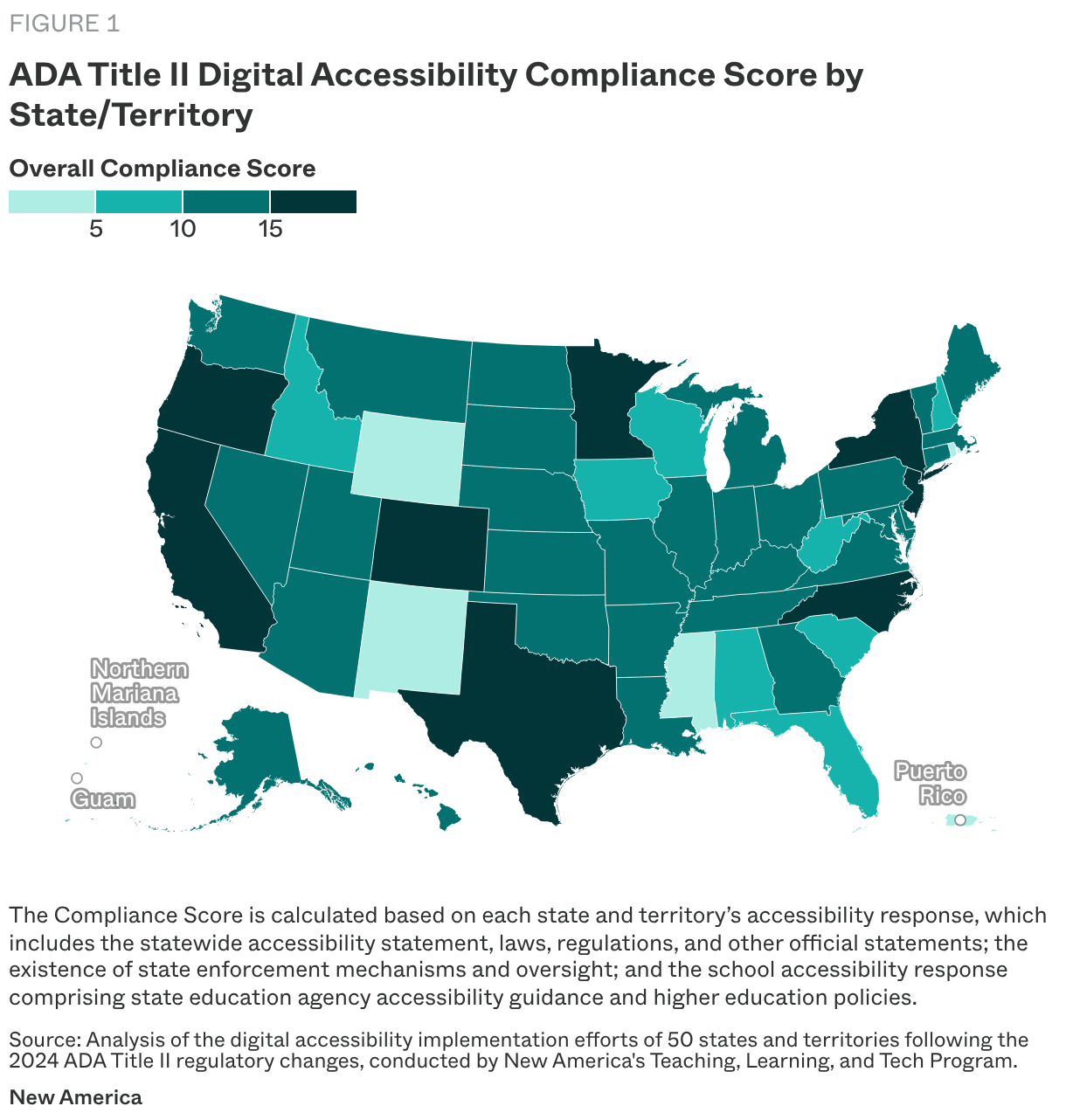
In early 2026, New America’s Teaching, Learning, and Tech team conducted a 50-state-and-territory scan to examine state-level implementation efforts of these institutions and, based on stakeholder interviews and analysis of publicly available materials, concluded that only a handful of states and public institutions have the capacity and infrastructure to make progress towards reaching compliance. Based on the scan examining how states and school systems are responding to digital accessibility regulations, the New America team created an interactive map to better visualize state progress (Figure 1).
On April 20, 2026, just days before the first compliance deadline, the DOJ issued an interim final rule delaying implementation by one year and signaling that additional regulatory changes may follow. Importantly, the delay did not change public entities’ existing obligations—digital accessibility still remains a legal requirement under the ADA. It did, however, raise questions about the current status of compliance. Additionally, the DOJ signaled that more substantive changes to the rule could be forthcoming.
This new deadline will give leading states an opportunity to strengthen their accessibility programs and give lagging states more time to build the infrastructure and capacity needed to come into compliance.
Since then, several proposed policy changes to federal funding streams that impact funding for broadband access and Medicaid have emerged that could influence how states and public entities progress toward the revised compliance deadline.
On June 25, 2026, the Federal Communications Commission (FCC) voted in favor of reviewing whether the E-Rate program should be terminated or limited to rural areas. The Universal Service Fund’s Schools and Libraries Program, also known as E-Rate, is a program created by Congress that helps schools and libraries to obtain affordable broadband. The discounts on telecommunications, internet access, and broadband infrastructure range from 20 to 90 percent. The level of discount depends on the school or library’s poverty level, often using the National School Lunch Program (NSLP) as a proxy, and its location, whether urban or rural. Over the 30 years since the program was established, E-Rate has become instrumental in public school and library infrastructure, with a 96.3 percent and 73 percent participation rate among the nation’s public schools and libraries, respectively. During FY2025, the FCC, which administers the program, committed $2.66 billion in support to schools and libraries across the country.
The FCC chairman’s stated reasoning for proposed changes to the program is to limit kids’ screen time. However, eliminating or significantly reducing access to this program overlooks how technology can support students with disabilities through accessible digital content and assistive tech that rely on internet connectivity. With a program that has such a broad impact, the end of E-Rate would negatively impact low-income and rural student populations and would leave behind learners with disabilities who benefit from assistive technology and are often overlooked when considering decreased use of technology in the classroom. Studies have shown the benefits of assistive technology, such as enhancing communication through text-to-speech software programs, which in turn increases academic and classroom engagement.
More importantly, E-Rate threatens digital accessibility compliance in two ways. First, undifferentiated screen-time restrictions would directly conflict with Title II’s requirement that schools provide accessible digital content. Second, if E-Rate funding is cut, districts will still need broadband and internet to function, so schools will be forced to pull funding from other budget lines like assistive technology just to maintain basic connectivity. Either path leads to the same outcome: schools will deprioritize the tools and resources they need to meet the new accessibility bar. This isn’t because districts don’t value accessibility, but because funding for accessibility and connectivity is pulled in opposite directions.
A federal bill, H.R. 1, also known as the One Big Beautiful Bill Act, was signed into law in July 2025 and cut almost $1 trillion in federal funding for Medicaid over the next decade. Cuts to the Medicaid program have significant implications because Medicaid plays an important role in funding school health and related services, providing approximately $8 billion annually. Schools are crucial in delivering health care services, as 87 percent of low-income children with special health care needs lack access to the necessary care. As a result, school health services provide care beyond physical health; they also provide specialized behavioral and mental health care led by social workers, speech-language pathologists, and other related professionals.
For learners with disabilities, these cuts could mean fewer specialized staff, reduced access to therapies, and a potential loss of assistive technology that enables students to participate in the classroom. Of school-aged students served under the Individuals with Disabilities Education Act (IDEA), 95 percent are enrolled in public schools. A survey of districts across 50 states in response to the announcement of Medicaid cuts indicated that approximately 46 percent of Medicaid funds are spent on assistive technology and specialized equipment for students with disabilities. With Medicaid cuts, respondents expect a 62 percent reduction in resources like assistive equipment and tech for their students with disabilities.
Medicaid cuts more directly impact accessibility compliance by reducing funding for assistive technology that both drives student engagement and meets general ADA requirements. As reimbursement shrinks, districts will have to pull assistive technology funding from already strained budgets, meaning accessibility tools compete with core spending and funding that could instead be used to achieve new ADA compliance.
Fellow, New America Chicago; Summer Research Fellow
Social Impact Fellow, Teaching, Learning & Tech

 Video
Video