
Findings
Value
The majority of Americans have experienced some type of education after high school.1 According to the U.S. Census Bureau’s 2017 American Community Survey, 60 percent have at least some college experience, and 30 percent hold a bachelor’s degree or higher. These numbers are encouraging, as the value of education beyond high school for individuals and society has been well documented. People with a higher education earn more over a lifetime than those with only a high school diploma.2 They generally live a healthier life, pay more in taxes, and contribute more to charities.3
Since 2017, Varying Degrees has shown that Americans also believe in the value of education beyond high school. Americans believe that education beyond high school creates more opportunities, is worth the investment, and promotes social mobility.
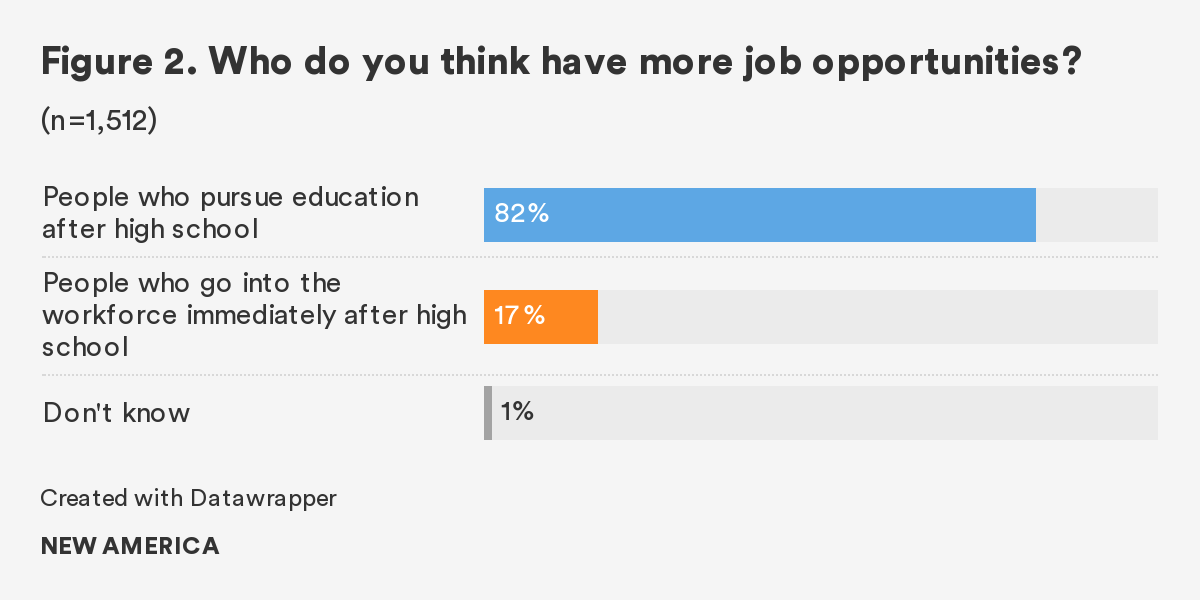
Three out of four Americans (75 percent) think that people without education after high school are limited in their career growth, and 82 percent believe people who pursue further education will have more job opportunities than those who only work after graduating from high school. Nearly 80 percent of Americans also believe education beyond high school offers a good return on investment and 92 percent believe it offers a pathway to upward economic mobility. The rates of agreement in these areas have remained mostly consistent since 2018 (See Figures 1-2).
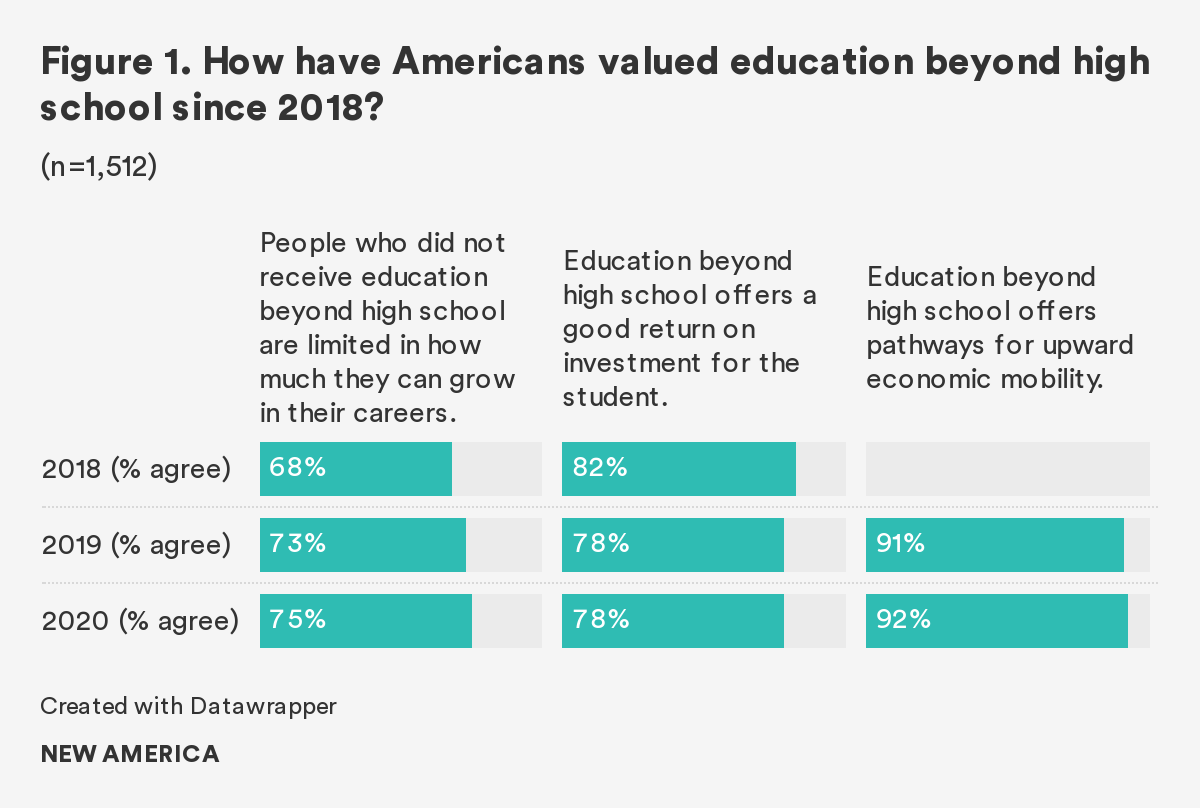
Americans believe that people with any level of higher education—be it some college but no degree, technical certificate, associate degree, or higher—will be better off than those without it. One in two Americans believe that people with some college but no degree will earn more than those without any education beyond high school, and 71 percent believe it is easier for people with only some college to find a well-paying and stable career than those without any education after high school. The share of those agreeing with those statements increases with each higher level of education. Nearly three in four Americans believe those with technical certificates and associate degrees will earn more than those without them. The share rises to 87 percent for those with bachelor’s degrees and more than 90 percent for those with graduate degrees.
Only a small share of Americans (17 percent) recommend their children or family members pursue only up to a high school diploma. Most hope that their close family members will enroll in college and earn some type of higher education credential. A majority of Americans also value apprenticeship, which is an educational model that combines paid, structured on-the-job training with in-classroom learning. Eighty-five percent of Americans feel comfortable recommending their children or family members enroll in an apprenticeship program; 90 percent would do so if that apprenticeship program leads to an associate or bachelor’s degree.
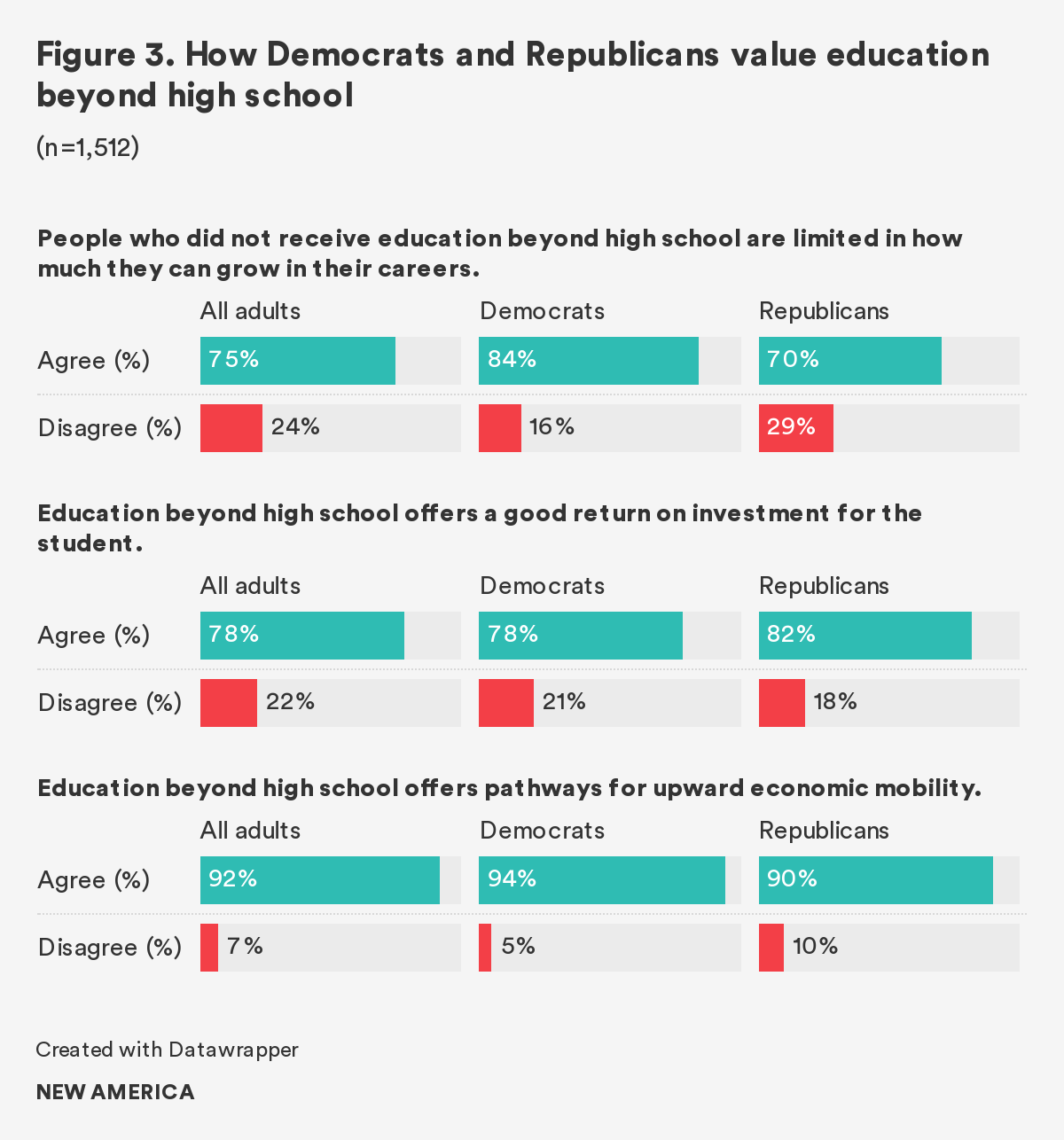
It is rare to see that Democrats and Republicans agree on anything, but the value of higher education is one of the few things that unite them (See Figure 3). A significant majority of Democrats and Republicans think that people without education beyond high school face limitations in their career development, although a significantly greater share of Democrats than Republicans (84 percent versus 70 percent) believe so. Similar shares of both groups agree that education beyond high school offers a good return on investment (Democrats: 78 percent, Republicans: 82 percent) and provides pathways for upward economic mobility (Democrats: 94 percent, Republicans 90 percent). They also agree that each level of education after high school will bring greater income and stability to those who have it and feel comfortable recommending their children or family members pursue education beyond high school.
However, stark differences exist among generations and racial groups, although a majority still believes in education after high school.
Among all generations,4 Millennials seem to be the most dubious about the value of higher education. The share of Millennials who think that people with education after high school have more job opportunities is the smallest (76 percent) among all generations, significantly less than Generation Z (90 percent) and the Silent Generation (93 percent). Fewer Millennials believe in the upward economic mobility provided by education after high school (88 percent) and see the return on investment from higher education (71 percent), than Baby Boomers (95 and 81 percent, respectively) and the Silent Generation (99 and 88 percent, respectively).
A majority of Americans from all races agree with the opportunities that education from higher education can bring, but white and Asian Americans agree at a much higher rate compared to Black and Latinx Americans. A significantly greater share of white and Asian Americans (94 and 96 percent, respectively) agree that education after high school offers pathways for upward mobility than Black and Latinx Americans (86 and 87 percent, respectively). Significantly more white and Asian Americans (86 and 89 percent) think that people with education after high school have more job opportunities, compared with only 69 percent of Black and 74 percent of Latinx Americans.
Americans’ Support for Institutions of Higher Education
Most Americans pursue their undergraduate credentials at a public institution. In 2016, nearly two in three American undergraduates enrolled in either a public two-year or four-year university.5 This number is actually down from the year 2000, when nearly three in four Americans studied at a public institution.6 The expansion of for-profit colleges and universities in the past 20 years is responsible for at least some of the decrease in public higher education enrollment. But, as Varying Degrees has shown since 2017, Americans strongly support public colleges and universities over private nonprofit and for-profit ones (Figure 4).
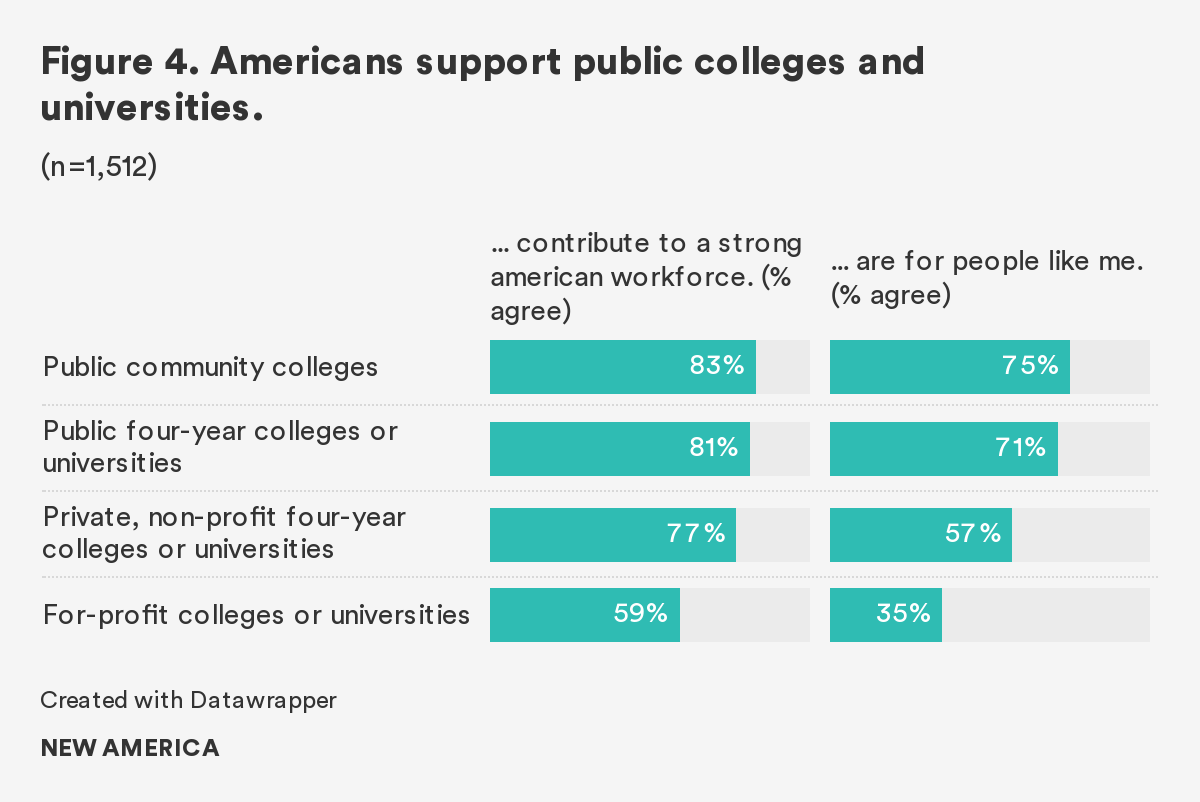
More than four in five Americans agree that community colleges (83 percent) and public four-year colleges and universities (81 percent) contribute to a strong workforce. More than 70 percent think that these institutions are for people like them (75 percent for community colleges and 71 percent for public four-year colleges and universities).
Support for these institutions is widespread across political parties. Eighty-seven percent of Democrats and 84 percent of Republicans think community colleges contribute to a strong workforce, and 78 percent of Democrats and 74 percent of Republicans think community colleges are for people like them. Members of both parties also support public four-year colleges and universities, although a greater share of Democrats (86 percent) than Republicans (79 percent) think public four-year institutions contribute to a strong workforce, and 82 percent of Democrats compared with only 65 percent of Republicans think that public four-year institutions are for them.
The support wavers when it comes to private institutions.
Although more than three in four Americans still believe that private, non-profit colleges and universities contribute to a strong workforce, only 57 percent think that these institutions are for them. These views are similar across the political divide. Eighty percent of Democrats and Republicans think that private, non-profit colleges and universities contribute to a strong workforce, but only around 60 percent think these institutions are for them.
When it comes to for-profit colleges and universities, 59 percent of Americans think that they contribute to a strong workforce, and only 35 percent of Americans think these institutions are for them. While a majority of members of both political parties think that for-profit institutions contribute to a strong workforce (59 percent for Democrats and 61 percent for Republicans). The parties are fairly similar when it comes to believing for-profit institutions are for them: 41 percent of Republicans agree with that statement, compared with 36 percent of Democrats.
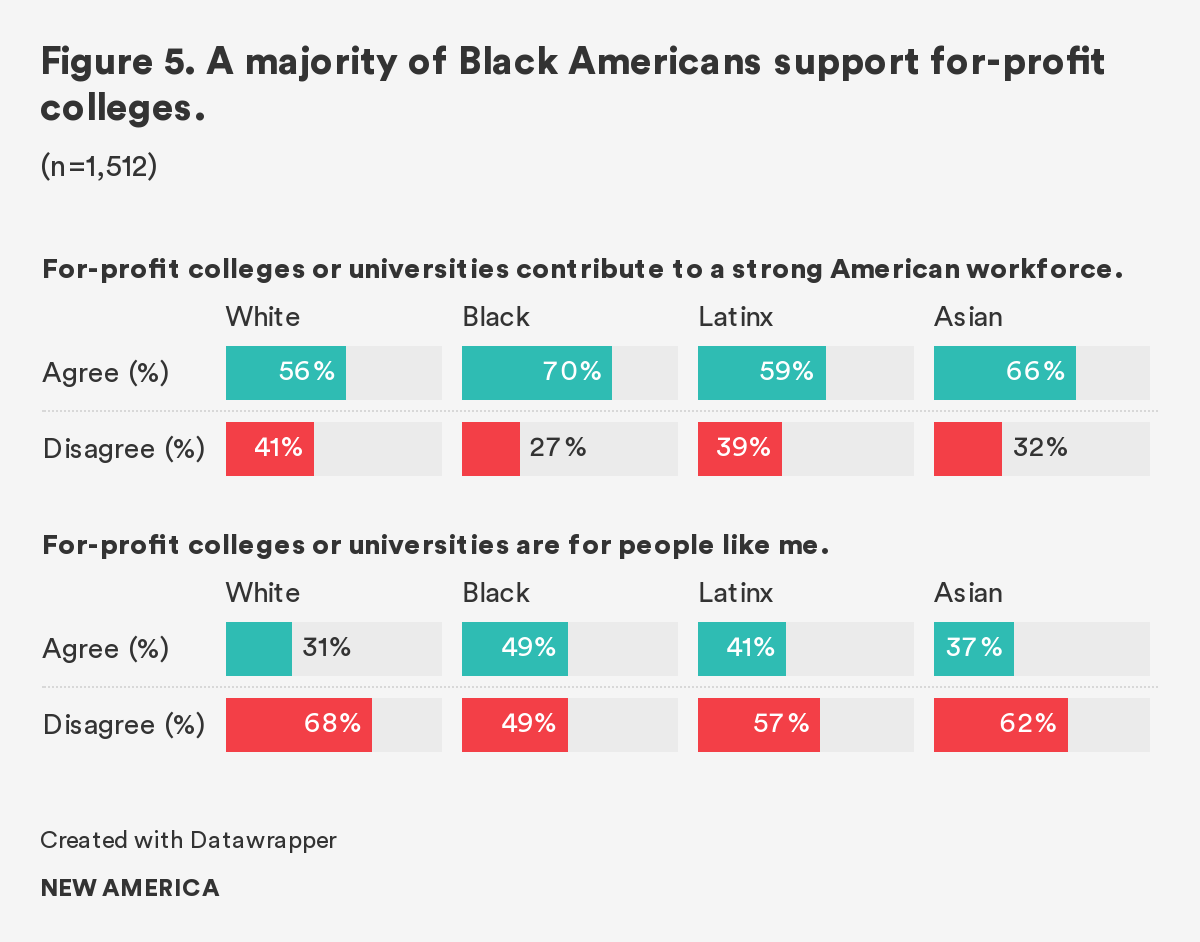
While most Americans do not favor for-profit colleges and universities, a majority of Black Americans think otherwise. Seventy percent of Black Americans believe that for-profit colleges and universities contribute to a strong workforce, significantly more than the share of white (56 percent) and Latinx (59 percent) Americans who think so (Figure 5). Nearly half of Black Americans (49 percent) think that for-profit institutions are for people like them, significantly more than the share of white Americans (31 percent) who do so. This is deeply concerning, given the notoriously poor outcomes of for-profit colleges.7
Despite any differences Americans have over college sectors, a majority of them still think positively of colleges and universities near them and across the country. Four in five Americans (78 percent) have a positive view of the colleges and universities near them, and 71 percent have a positive view of these institutions across the U.S.
Although a greater share of Democrats than Republicans have a positive view of institutions of higher education locally (84 versus 75 percent) and nationally (79 versus 68 percent), the response shows that Republican support for colleges and universities remains solid.
To further explore how the two parties differ in their views of higher education, we adopted a question from the Pew Research Center’s survey on what Americans think of institutions in the U.S. In a Pew survey conducted in 2019, only half of Americans thought colleges and universities have a positive effect on the ways things were going in the country, and 38 percent said the effect was negative.8 In the survey, the partisan divide on colleges and universities runs deep: 67 percent of Democrats think these institutions have a positive effect, while a significant share of Republicans (59 percent) think they have a negative one.9
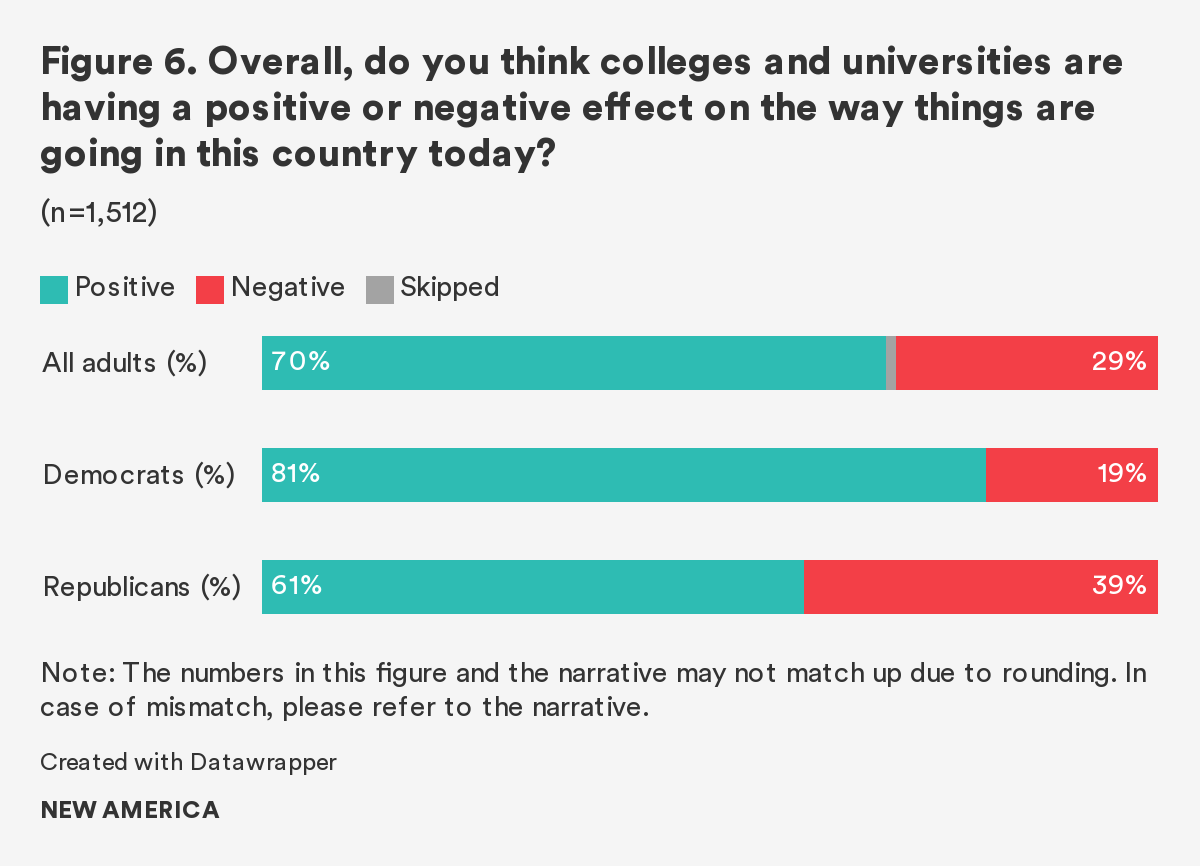
But Varying Degrees shows different responses to this same question (Figure 6). In our survey, 69 percent of Americans think colleges and universities have a positive effect on the way things are going in the country today, and a majority of both Democrats (80 percent) and Republicans (60 percent) believe so. The widely different responses between the two surveys could be due to differences in survey design, but they also suggest that Republicans’ perceptions of higher education is more nuanced than can be captured in the two surveys.
As Varying Degrees has shown over past years, both Republicans and Democrats recognize the value of education beyond high school, believe that different types of colleges and universities contribute to a strong American workforce, and have positive views of colleges and universities located near them.
Funding
While Americans value education after high school and want their children to enroll in college, many are deeply concerned about how much it costs and how it should be funded to ensure there is broad access.
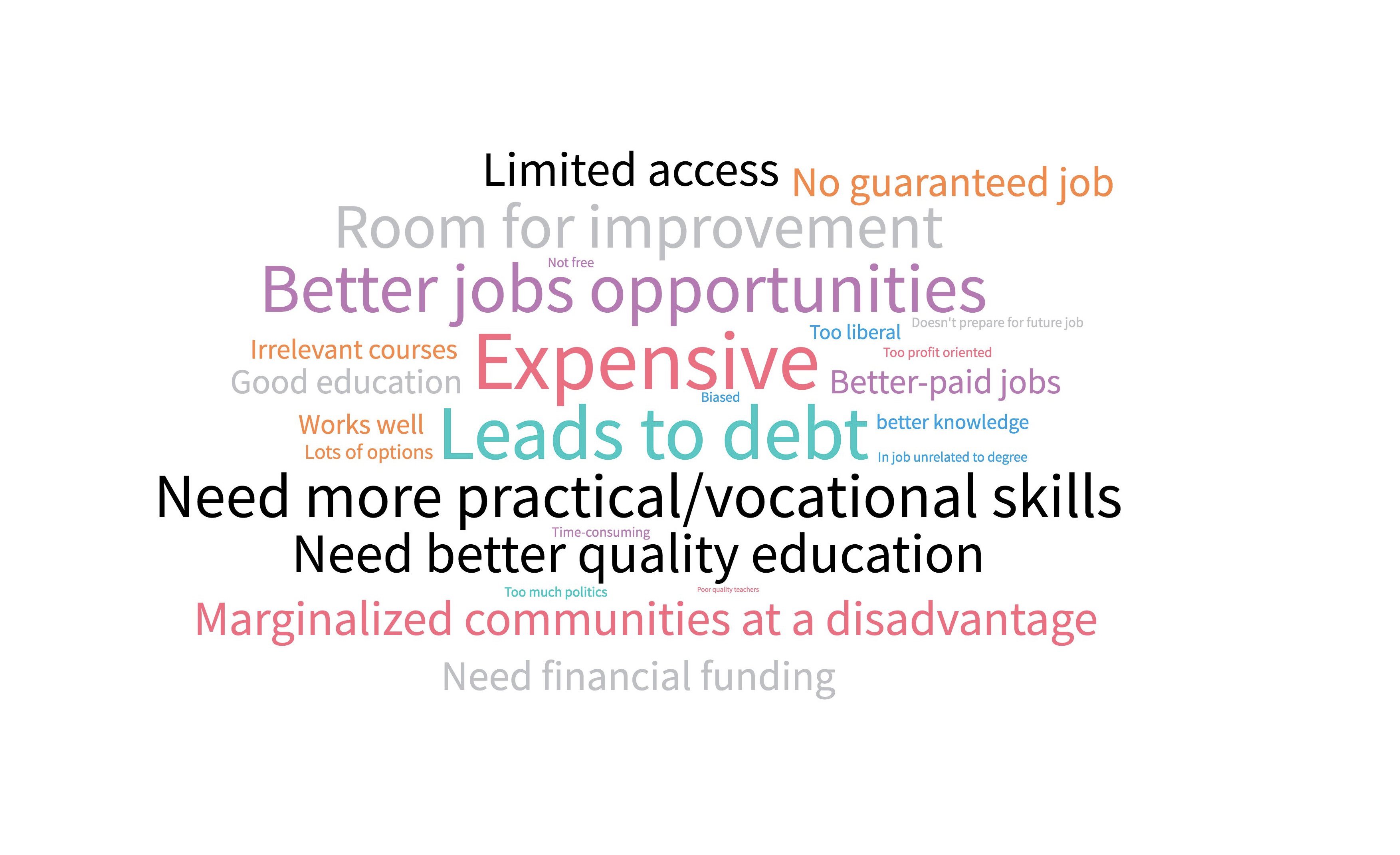
Only about one in three (35 percent) Americans believe higher education is fine how it is (Figure 7). While this is an improvement from when we first asked this question in 2017—when only about a quarter of Americans agreed higher education was fine the way it is—people still strongly indicate that higher education needs to change. The major reason: concern over price (Figure 8).
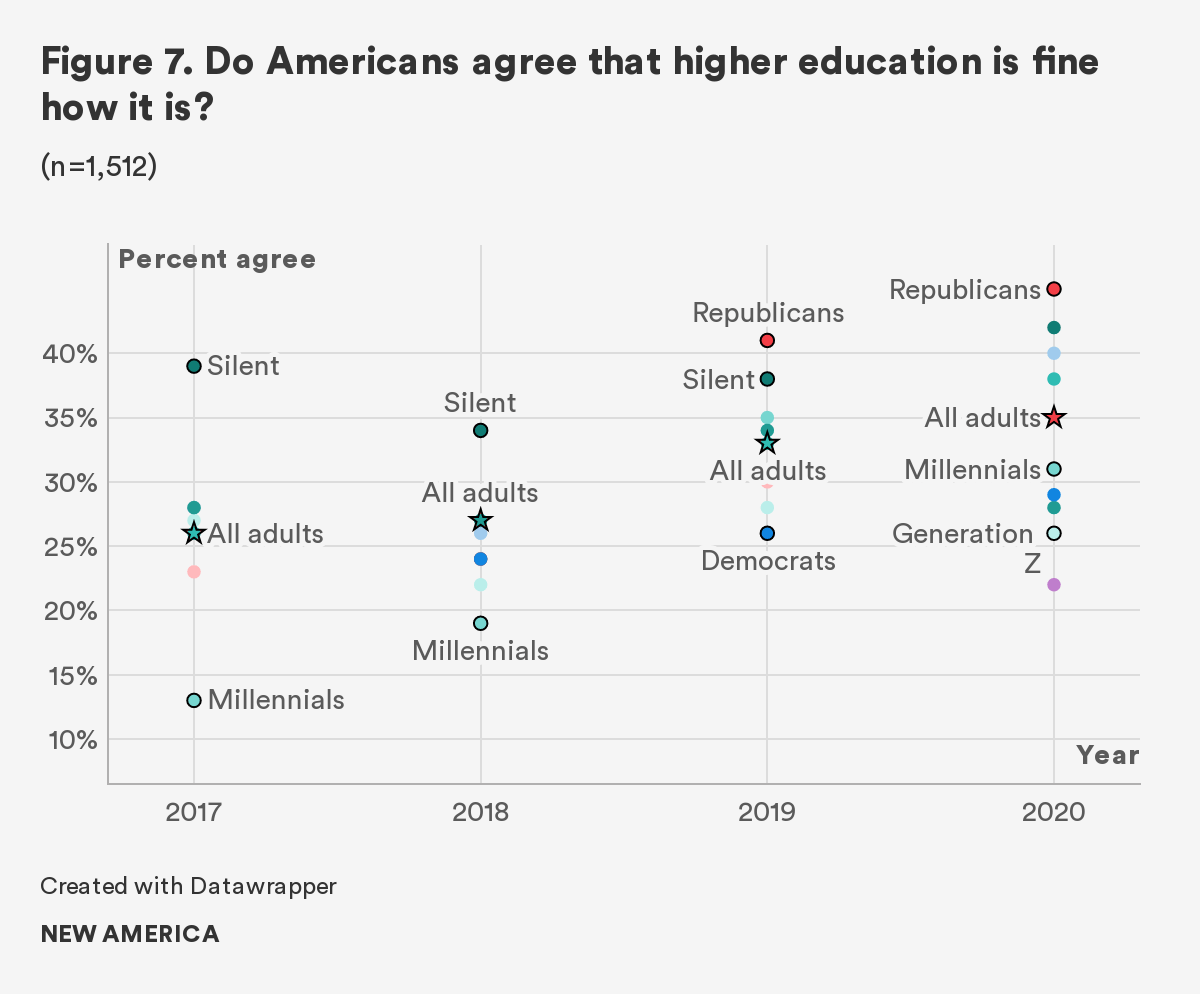
This concern—that higher education needs to change—holds true among all demographics, though at varying levels of intensity. For example, Republicans are more likely to agree (45 percent) that higher education is fine the way it is, compared with Democrats (29 percent). The younger you are, the less agreement that higher education is fine (Generation Z, 26 percent; Millennials, 31 percent; Generation X, 38 percent; Baby Boomers, 38 percent, and the Silent Generation, 42 percent). Men (40 percent) are more likely to agree higher education is fine compared with women (31 percent). And only about one in five (22 percent) student loan borrowers agree higher education is fine. Everyone’s top concern, over and over, is price.
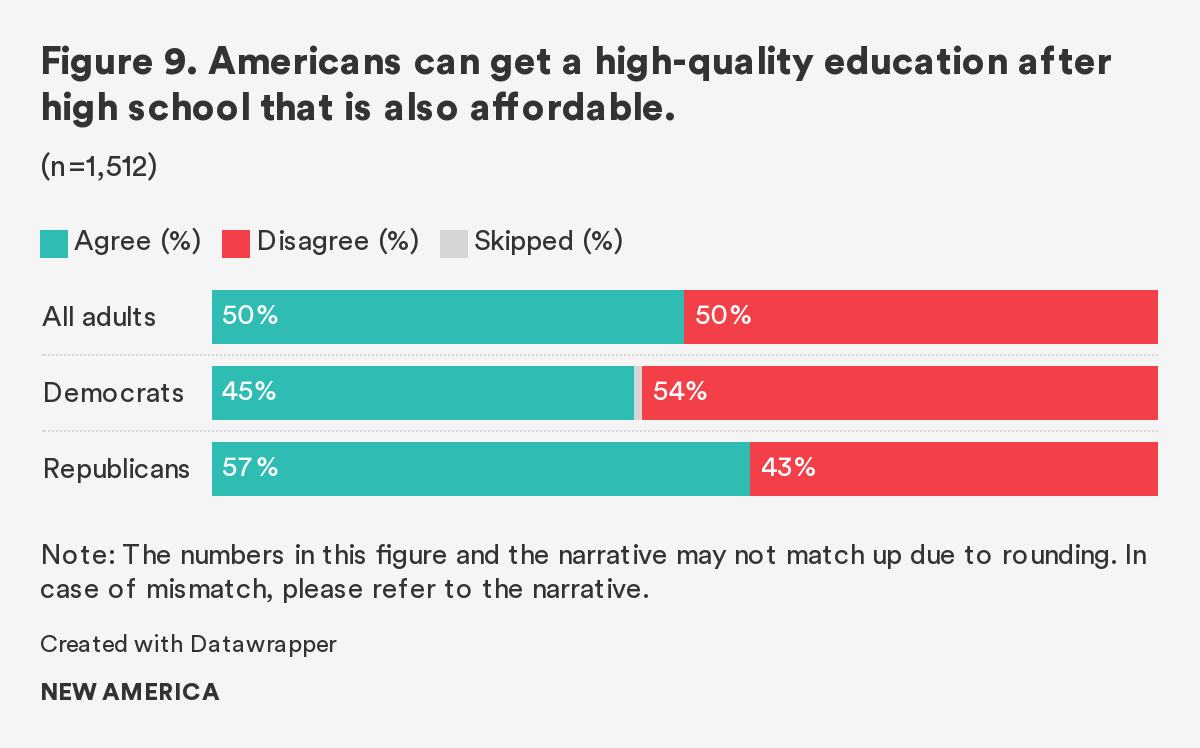
Similar to last year, those polled are equally divided (50 percent agree, and 50 percent disagree) about whether Americans can get a high-quality education after high school that is also affordable (Figure 9). There is a significant difference along party lines on the matter, with over half (57 percent) of Republicans and under half (45 percent) of Democrats agreeing that Americans can get a high-quality and affordable education after high school.
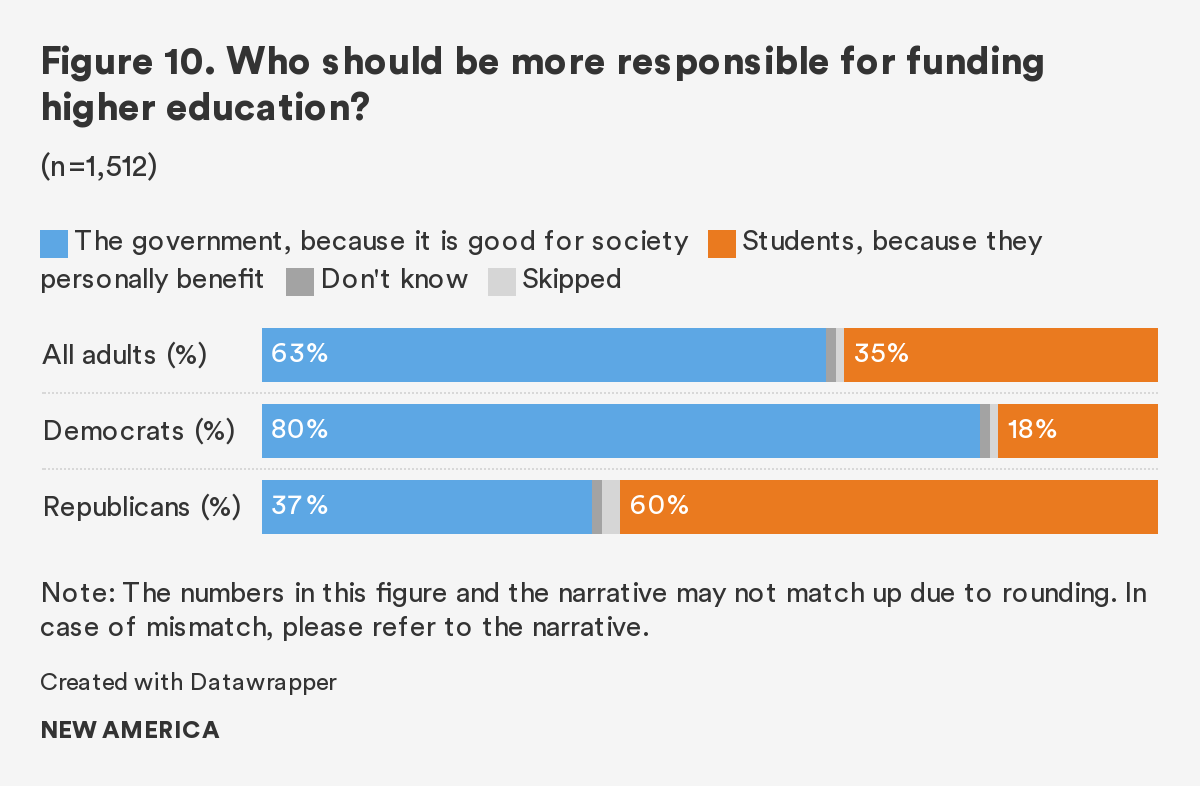
This divergence in opinions over access to an affordable education after high school could partly be explained by opposing views about who should be more responsible for funding higher education: government or individuals. Similar to last year, 63 percent of Americans overall believe that higher education should be funded by the government because it is good for society, compared with 35 percent who believe it should be funded by individuals because they personally benefit (Figure 10).10 But when looking at party identification, a stark ideological difference emerges. For Democrats, a large majority (81 percent) believe it is government who should fund higher education, whereas 60 percent of Republicans believe just the opposite, that individuals should fund it because it is a personal benefit.
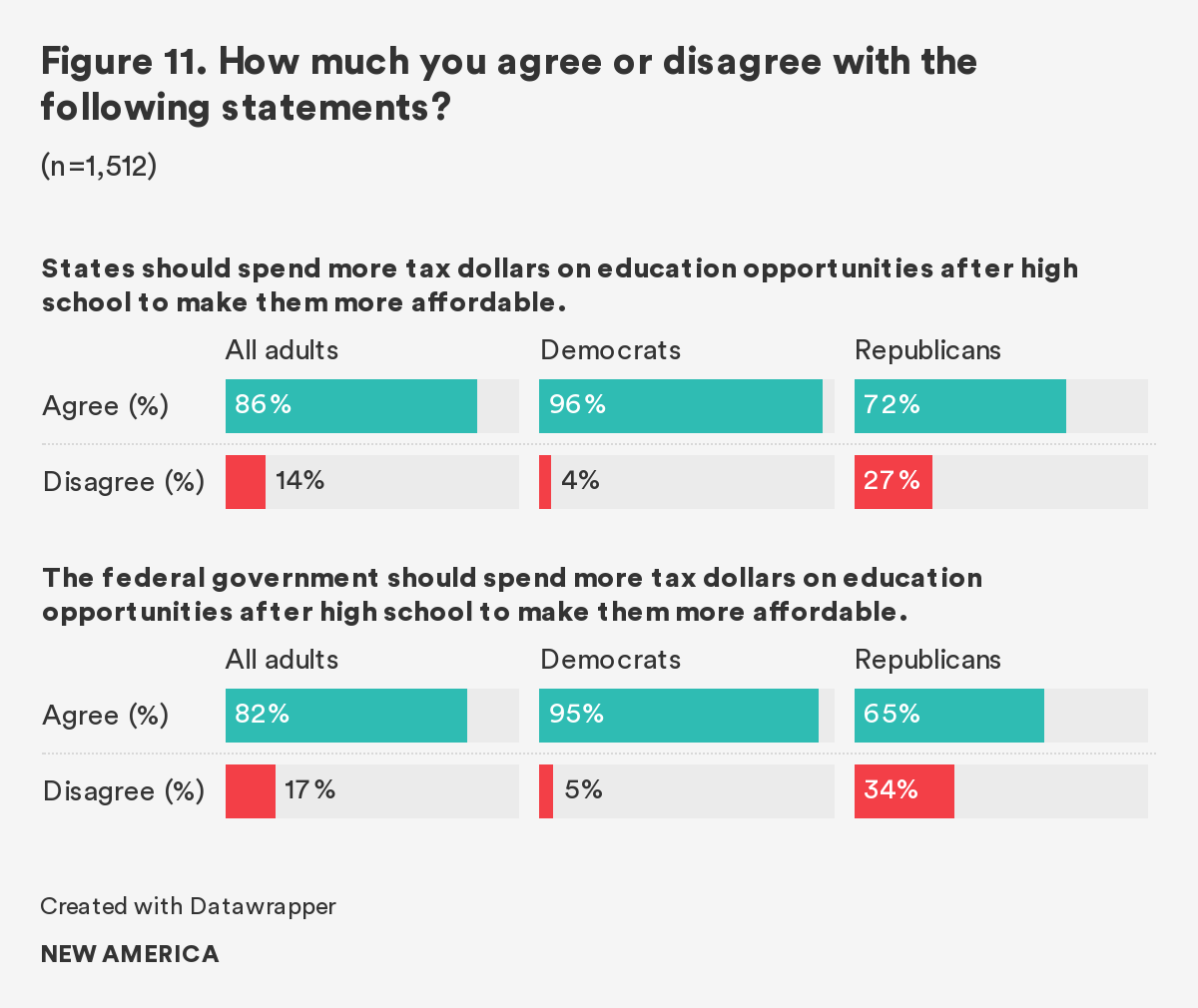
Yet despite the divergent views over who should fund higher education, Democrats and Republicans agree that more state and federal tax dollars should be spent on educational opportunities after high school to make them more affordable, though at varying levels of intensity (Figure 11). Overall, and similar to previous years’ surveys, a sizable majority of Americans believe that states (86 percent) and the federal government (82 percent) should spend more tax dollars on post-high school educational opportunities to make them more affordable. But Democrats are much more likely to agree that states (96 percent) and the federal government (95 percent) should make higher education more affordable compared to Republicans (72 percent agree states should spend more; 65 percent agree the federal government should spend more).
While Americans are clear in their agreement that state and federal governments should spend more to make education after high school affordable, they have different thoughts about which types of institutions that money should be targeted at, and to which kinds of students.
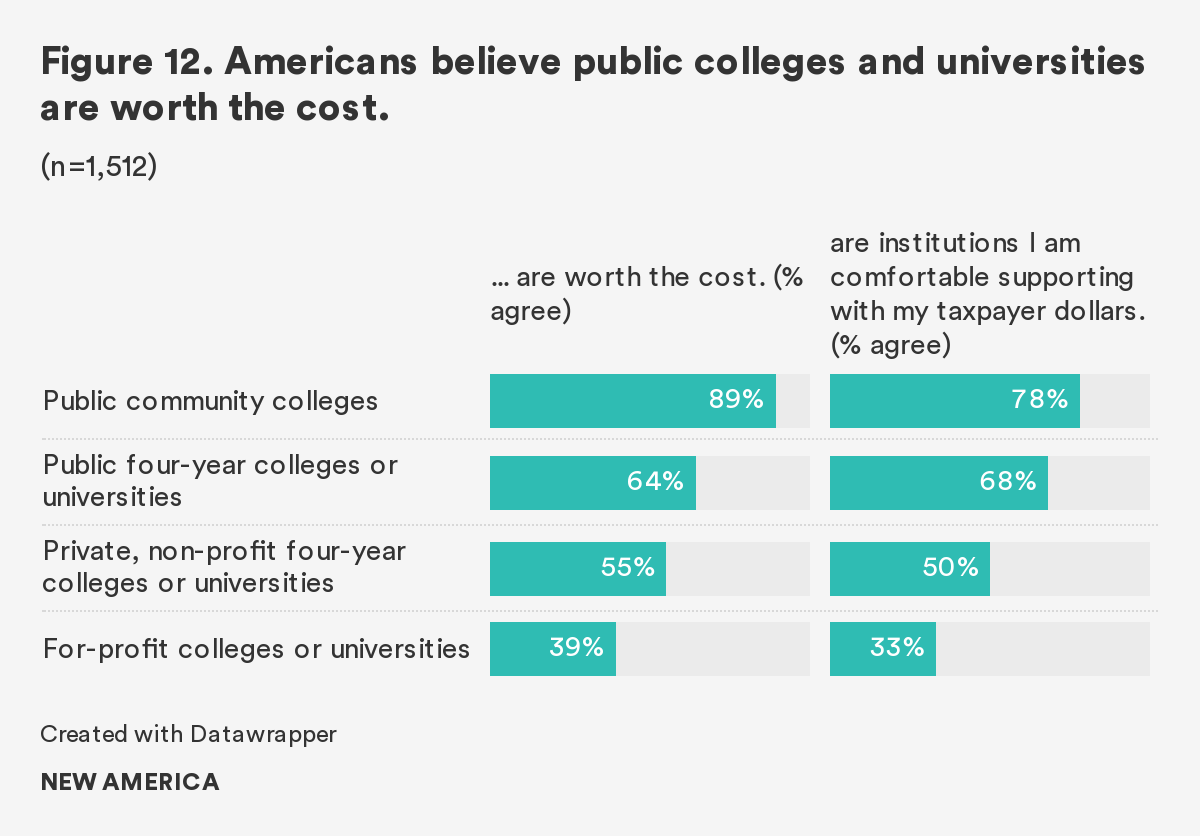
Overall, most Americans believe that colleges and universities in the public and private nonprofit sector are worth the cost, although they believe this most strongly for public two-year institutions (Figure 12). Approximately 89 percent of Americans believe public two-year colleges are worth the cost compared with 64 percent of American who believe this to be true for public four-year colleges, and 55 percent who do so for private nonprofit institutions. However, the majority of Americans do not believe that for-profit colleges are worth the cost. Only 39 percent said they were. This is a drop from last year’s survey, in which 46 percent of Americans agreed that they were worth the cost.
Republicans and Democrats agree that public and private nonprofit institutions are worth the cost. However, a larger share of Democrats believe this to be the case for public community colleges (86 percent of Democrats versus 78 percent of Republicans) and public four-year colleges and universities (72 percent versus 63 percent, respectively). A larger share of Republicans (46 percent) believe that for-profit institutions are worth the cost compared with Democrats (38 percent).
In terms of where tax dollars should be spent, a greater percentage of those polled believe that their tax dollars should go to support our nation’s public colleges and universities than private nonprofit and for-profit institutions. Approximately 78 percent of Americans are comfortable supporting public community colleges and 68 percent of Americans are comfortable supporting public four-year colleges and universities with their tax dollars. Support is much lower for spending tax dollars on private nonprofit and for-profit institutions. Approximately half of Americans are comfortable spending tax dollars on private non-profit colleges, and only one-third are comfortable supporting for-profit institutions in this way.
A larger share of Democrats is comfortable supporting public community colleges (86 percent), public four-year institutions (84 percent), and private nonprofit institutions (59 percent) than Republicans. A majority of Republicans are comfortable with their tax dollars going to support public community colleges (69 percent) and public four-year colleges (54 percent). However, unlike Democrats, less than half of Republicans agree they feel comfortable using their taxpayer dollars to support private nonprofit colleges and universities (41 percent). When it comes to for-profit institutions, only about a third of both Democrats and Republicans agree that they feel comfortable supporting these institutions with their tax dollars even though the Trump administration and Republican congressional leadership often try to expand government funding to these institutions.
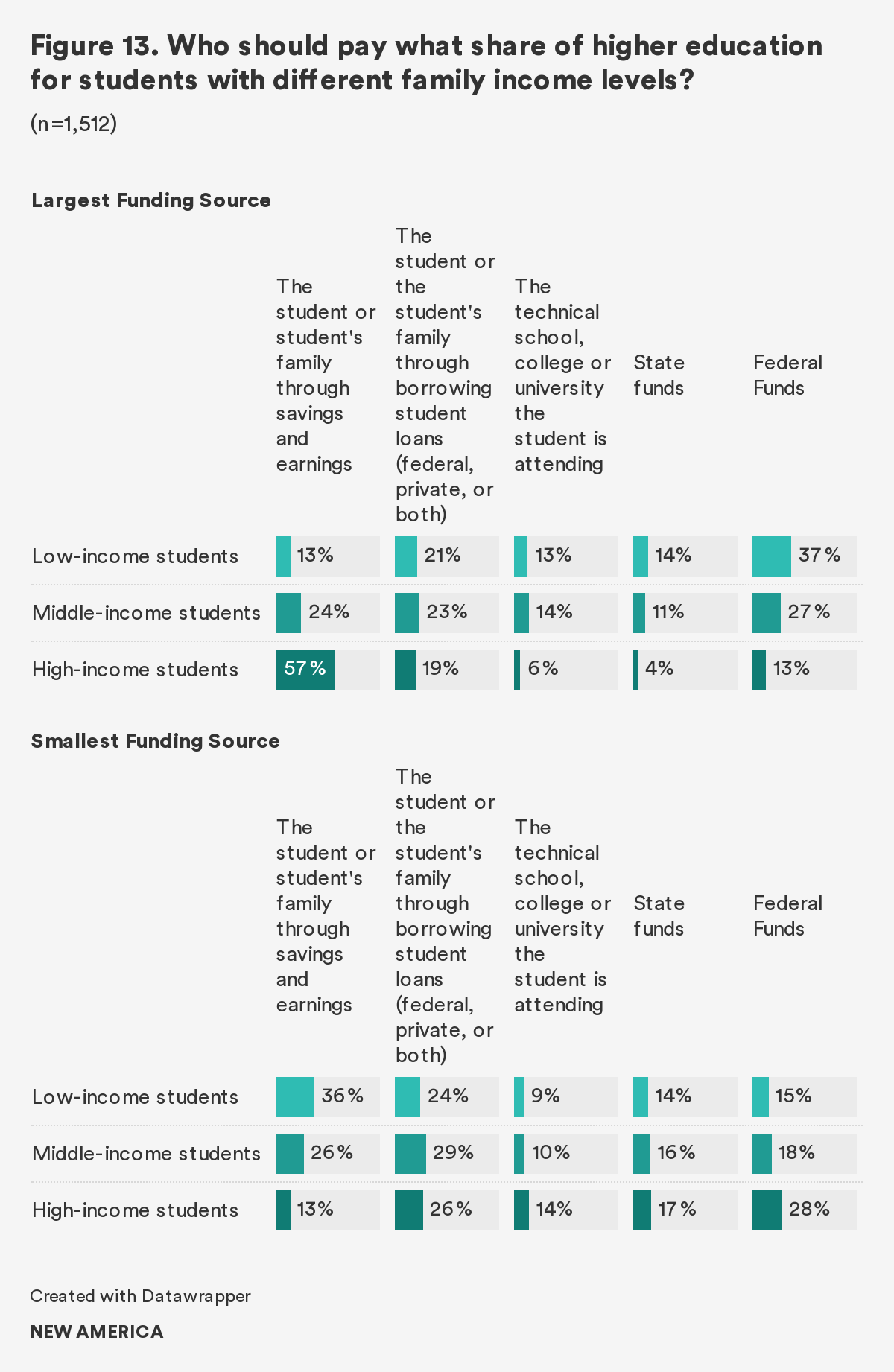
Americans are also divided about who should pay what share of college costs: the student or student’s family through savings and earnings, the student or the student’s family through borrowing loans, the school through institutional grants and scholarships, the state, or the federal government (Figure 13). A plurality of Americans (37 percent) believe the largest source of funding for low-income students—those with family incomes less than $45,000—should be federal funds, and the smallest should be the student or the student’s family through savings (36 percent) or loans (24 percent).
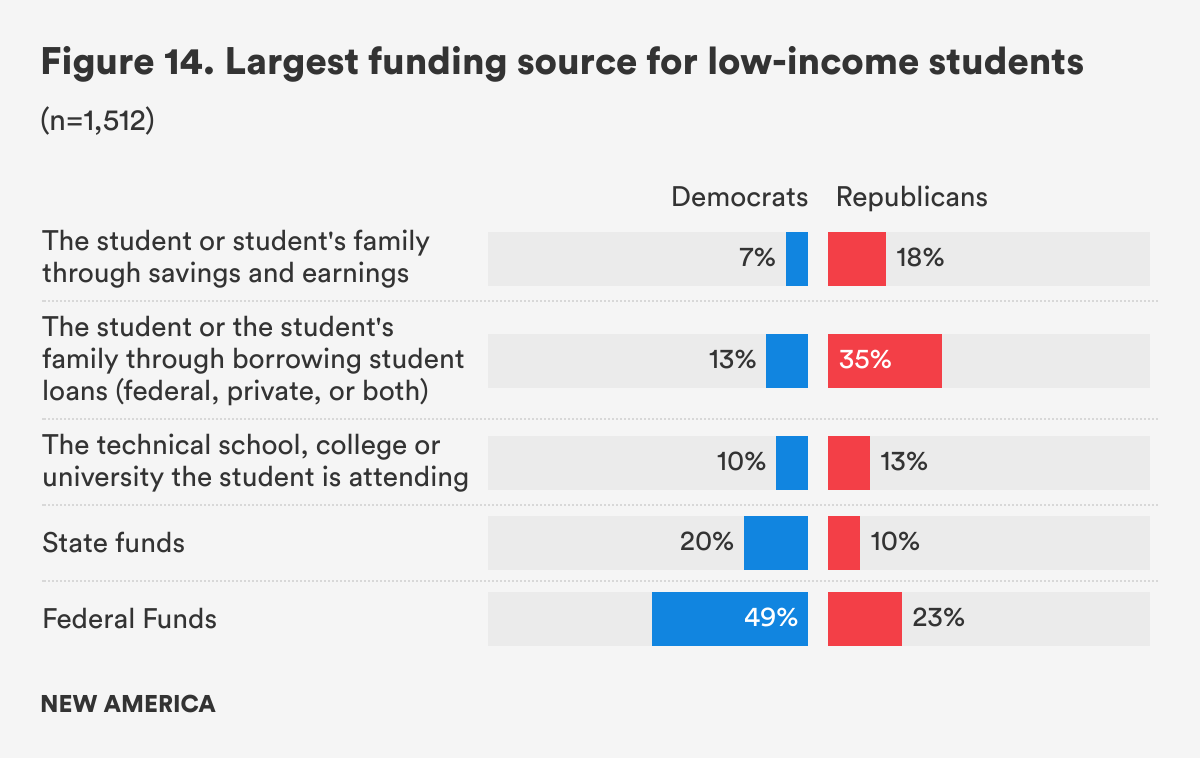
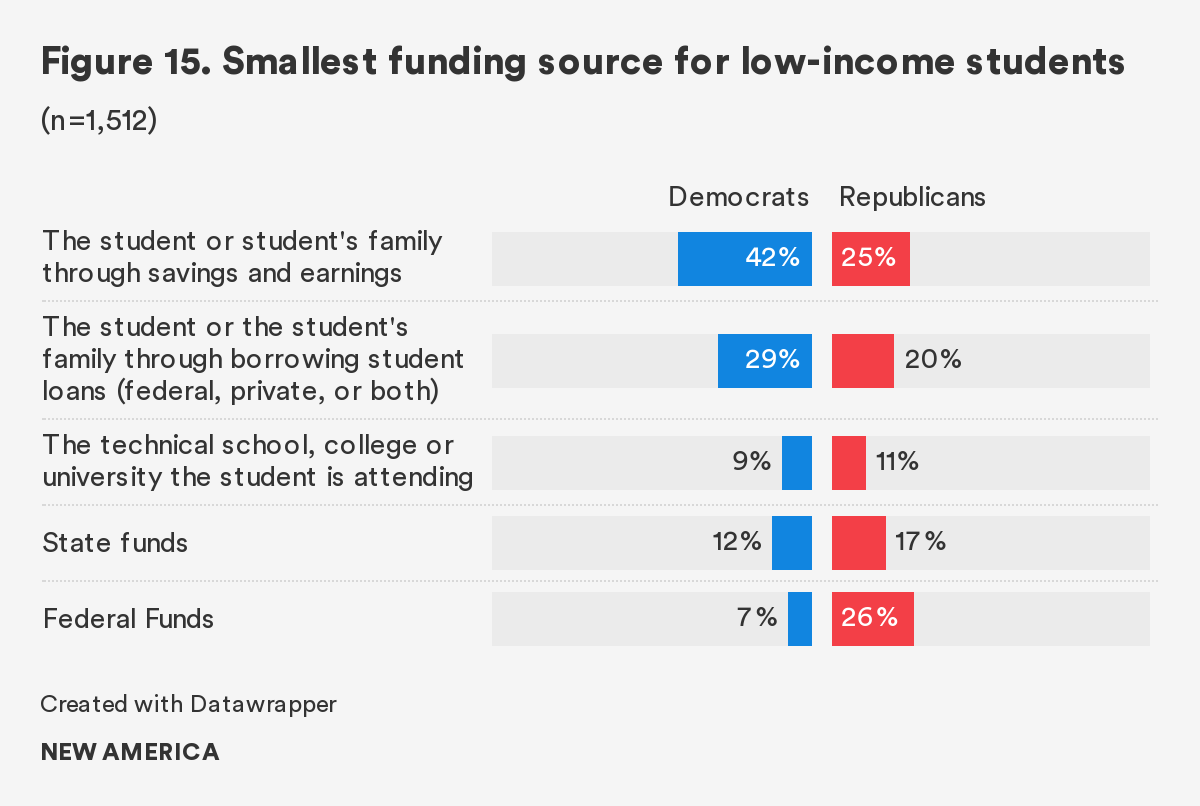
For Democrats, nearly half (49 percent) believe the largest source for low-income students should be from federal funds, whereas a plurality of Republicans (35 percent) believe the largest source should be students and families through borrowing loans (Figure 14). A plurality of Democrats (42 percent) believe the smallest source of funding should be the family through savings and earnings, whereas Republicans are split believing the smallest source should be federal funds (26 percent) and the students family through savings and earnings (25 percent) (Figure 15).
Americans are less certain about who should fund middle-income students—those with family incomes of $45,000 to $135,000—splitting their responses evenly among many of the options. A small plurality of Americans (27 percent) believe the largest source of funding for middle-income students should be federal funds, followed by the student and the student’s family through savings (24 percent) and loans (23 percent). A small plurality (29 percent) believe the smallest source should be student loans, followed by the student and his or her family through earnings (26 percent).
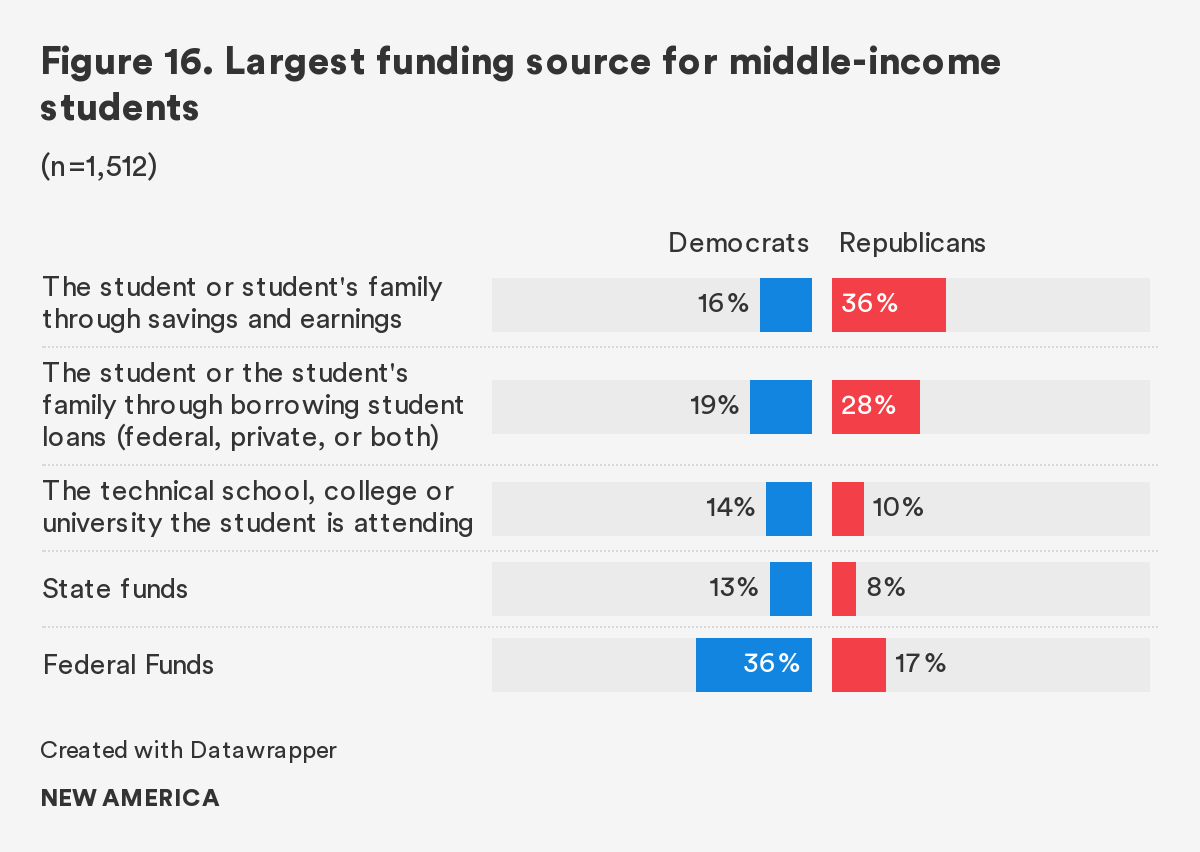
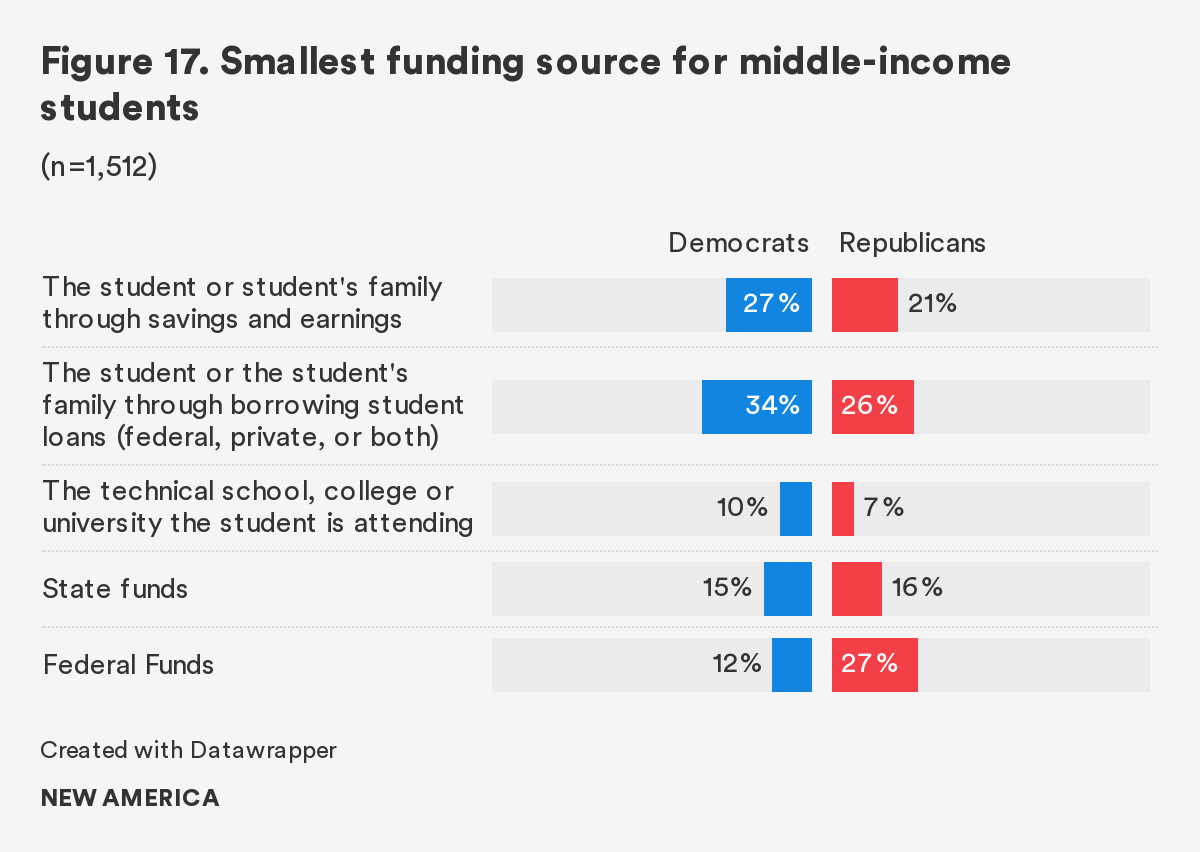
The partisan divide among Americans is particularly strong over the question of who should fund middle-income students, with 36 percent of Democrats thinking the government should be the primary funder, and Republicans believing it should be the student and his or her family through earnings and savings (36 percent) (Figure 16). Democrats believe that loans should be the smallest source of funding for middle-income families (34 percent). For Republicans, a plurality believes that both federal funds (27 percent) and loans (26 percent) should be the smallest source (Figure 17).
A majority of Americans (57 percent) believe that high-income students—those with family incomes over $135,000—should use savings and earnings to pay for college. They are split, however, as to whether the smallest source of funding should come from federal funds (28 percent) or loans (26 percent).
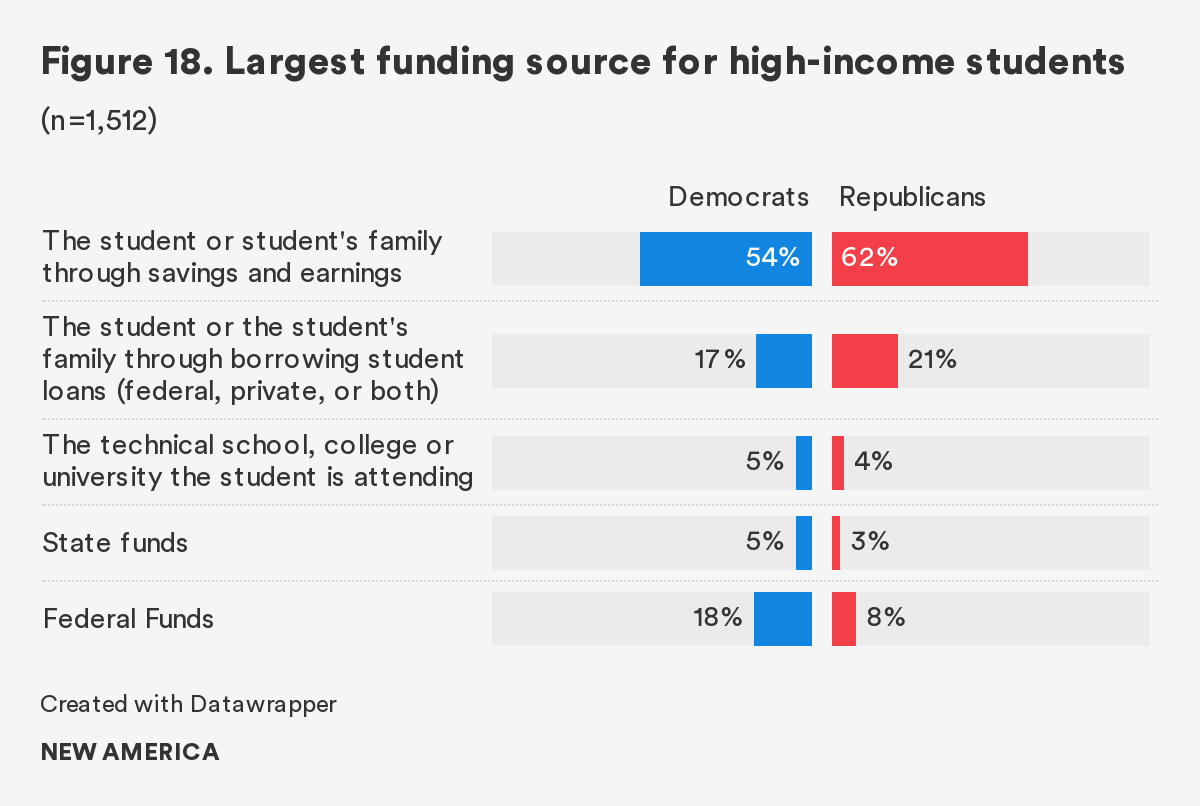
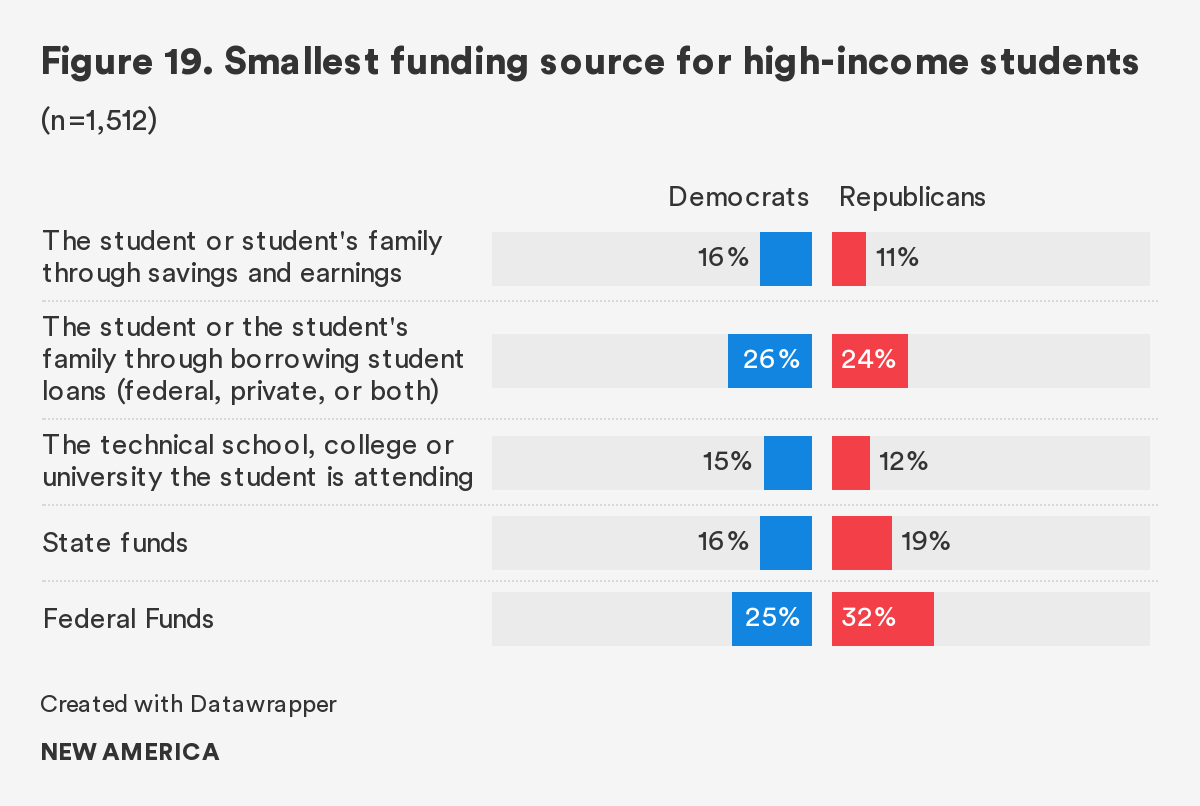
Both Democrats (54 percent) and Republicans (62 percent) agree that the primary source of funding for high-income students should be the student or the student’s family through savings and earnings (Figure 18). They are similarly split over whether the smallest source of funding should be federal funds (25 percent for Democrats and 32 percent for Republicans) or loans (26 percent and 24 percent, respectively) (Figure 19).
When it comes to borrowing, Varying Degrees added a question this year that asked about which types of programs merit taking out loans (Figure 20). In general, a majority of Americans believe that it is acceptable to take out a loans for just about any type of academic credential, whether a technical certificate, associate degree, bachelor’s degree, advanced degree, or professional degree. The percentage who agree that it is acceptable to borrow rises with each increasing level of education: 56 percent agree that it is acceptable to take out loans for a technical certificate, 61 percent for an associate degree, 79 percent for a bachelor’s degree, 81 percent for an advanced degree, and 85 percent for a professional degree.
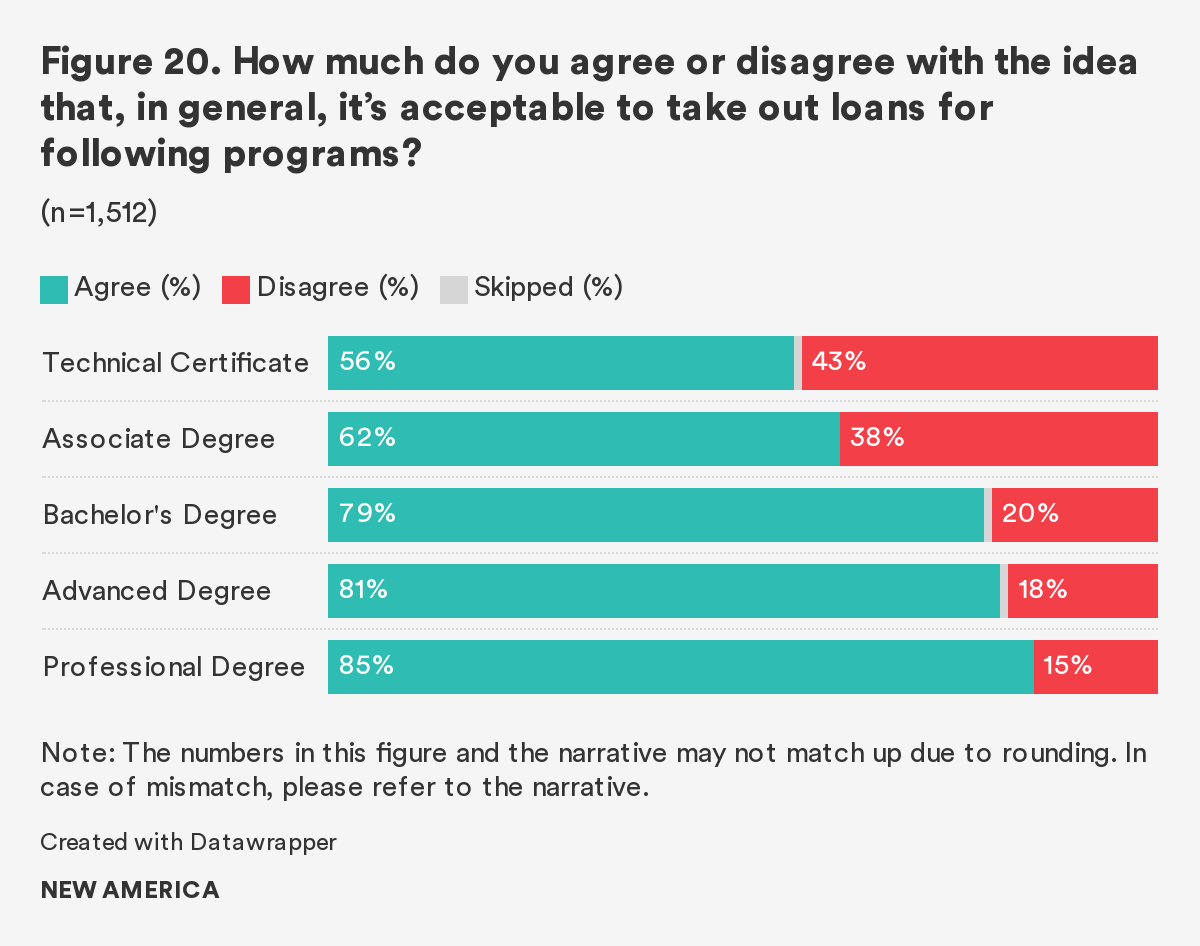
Republicans and Democrats generally agree that it is acceptable to borrow loans for various credentials. For Democrats, 55 percent agree it is acceptable to borrow loans for a technical certificate, 62 percent for an associate degree, 78 percent for a bachelor’s degree, 80 percent for an advanced degree, and 84 percent for a professional degree. For Republicans, 63 percent agree it is acceptable to borrow loans for a technical certificate, 67 percent agree for an associate degree, 84 percent agree for a bachelor’s degree, 85 percent for an advanced degree, and 88 percent for a professional degree.
Accountability
Low graduation rates, high dropout rates, low earnings, high student loan default rates: these are among the signs of a school that is not delivering value. Policymakers and students can use these indicators to measure the quality of higher education institutions; this rationale guides the Department of Education’s College Scorecard,11 which compiles key indicators into a tool for students to help them compare schools. College and university data can inform the decisions of prospective students and serve as a warning for when schools begin to take a turn for the worse.
The vast majority of Americans (90 percent) believe that publicly available data on key indicators of quality are important. While there is general bipartisan support for this belief last year, there is a slight shift from last year’s findings. This year, Varying Degrees finds that 84 percent of Republicans and 93 percent of Democrats agree that these data are important. In 2019, 90 percent of Republicans believed so, compared with 94 percent of Democrats.
Many of those polled also believe that federal and state financial support for colleges and universities should be tied to some of these outcomes (Figure 21). Americans agree that a school should lose taxpayers’ money if it has low graduation rates (78 percent); low rates of graduates earning a living wage (74 percent); or high rates of graduates earning less than the average high school graduate (72 percent).
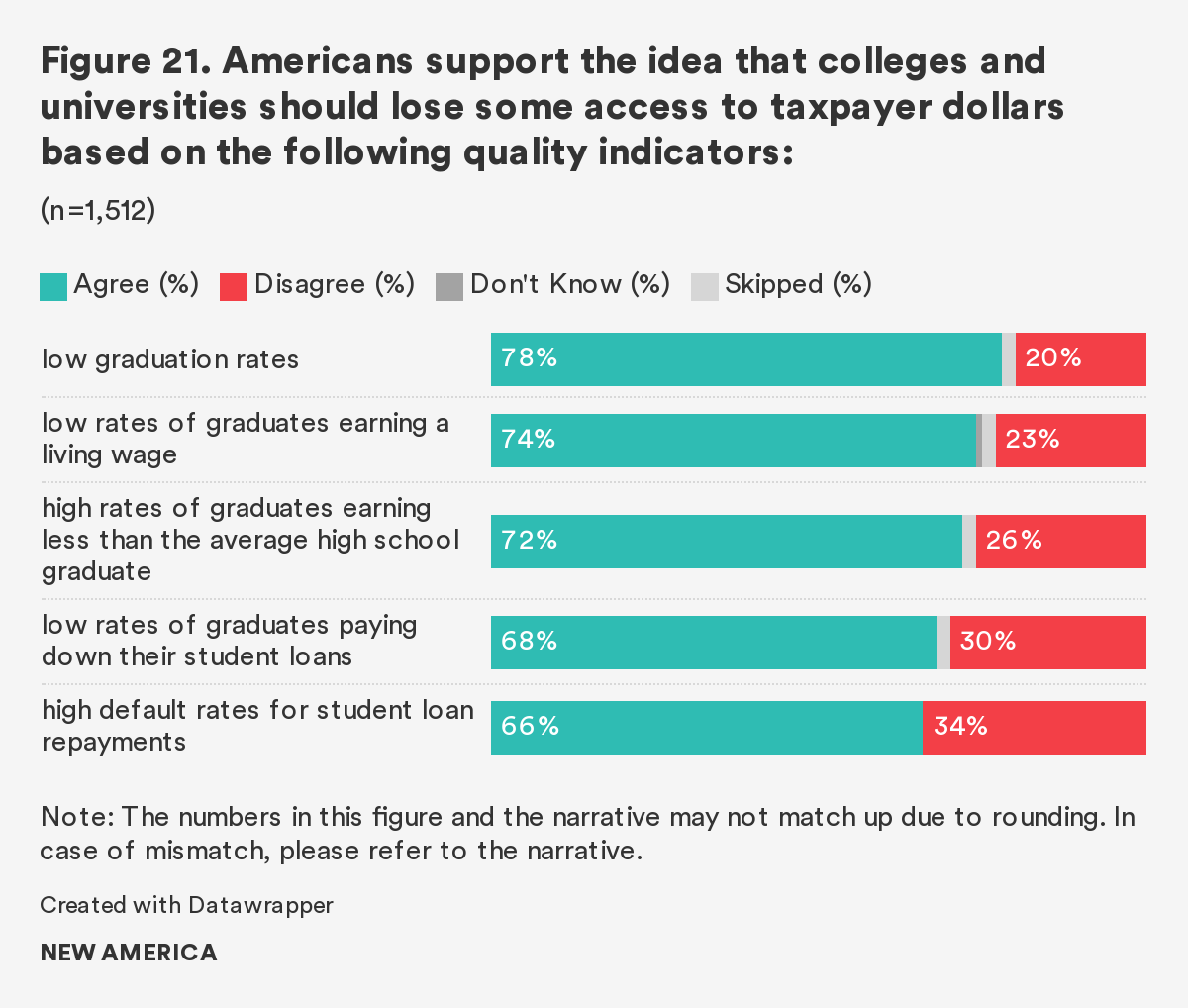
Slightly fewer (but still a majority of) Americans also agree that low rates of graduates paying down their student loans (68 percent) and high default rates on student loans (64 percent) also justify restricting access to taxpayers’ money.
These results could indicate that Americans are less concerned about student loan repayment outcomes as an indicator of quality and more focused on the value of the degree or certificate after graduating. These findings are generally consistent across political parties. When it comes to student loan default rates: 71 percent of Republicans support cutting off access to taxpayer dollars if a college or university has high default rates, while a smaller percentage (63 percent) of Democrats agree.
Accreditation
This year Varying Degrees posed a new set of questions concerning accreditation. These questions give insight into public perception of accreditation and its value as a tool to hold schools accountable.
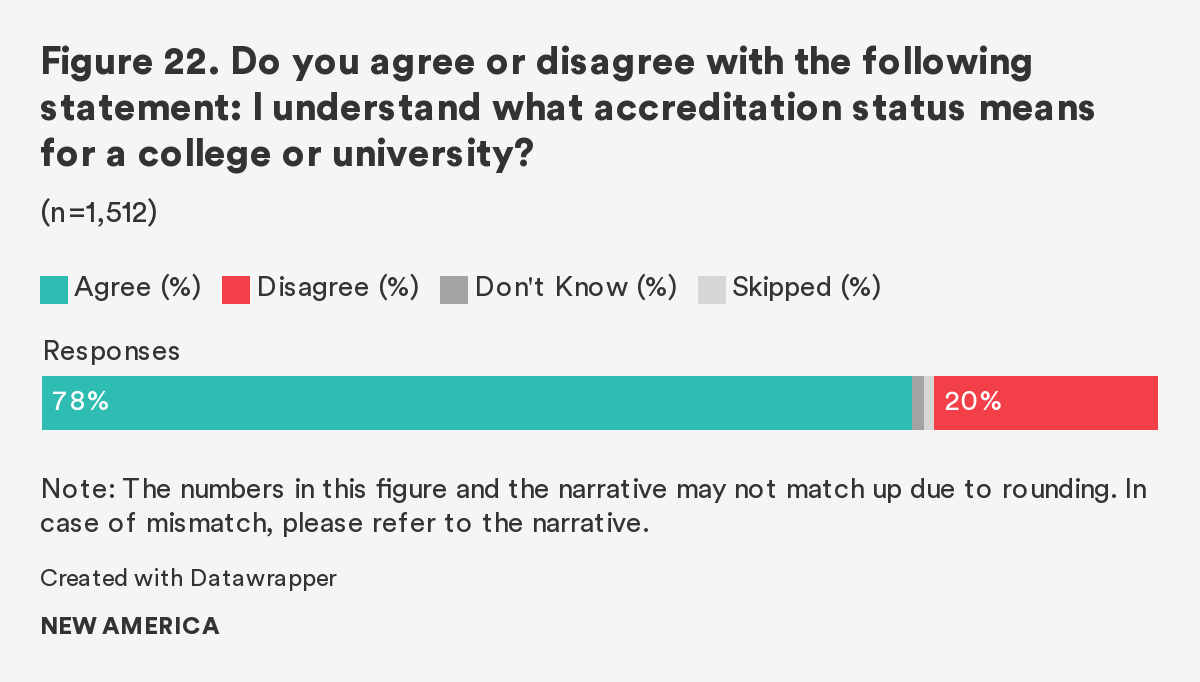
However, it is clear that Americans do not fully understand how accreditation works in practice: nearly four out of five (78 percent) respondents believe that they understand what accreditation status means for a college or university (Figure 22), but more than 70 percent of Americans misidentified the statement from Varying Degrees about accreditation below as true (Figure 23).
One of the aspects of accreditation is that if a school is accredited, the accreditor verifies the school provides good student outcomes. Examples of good student outcomes include: high graduation rates, low default rates for student loan repayments, high rates of graduates paying down their debt, and high rates of graduates earning a living wage.
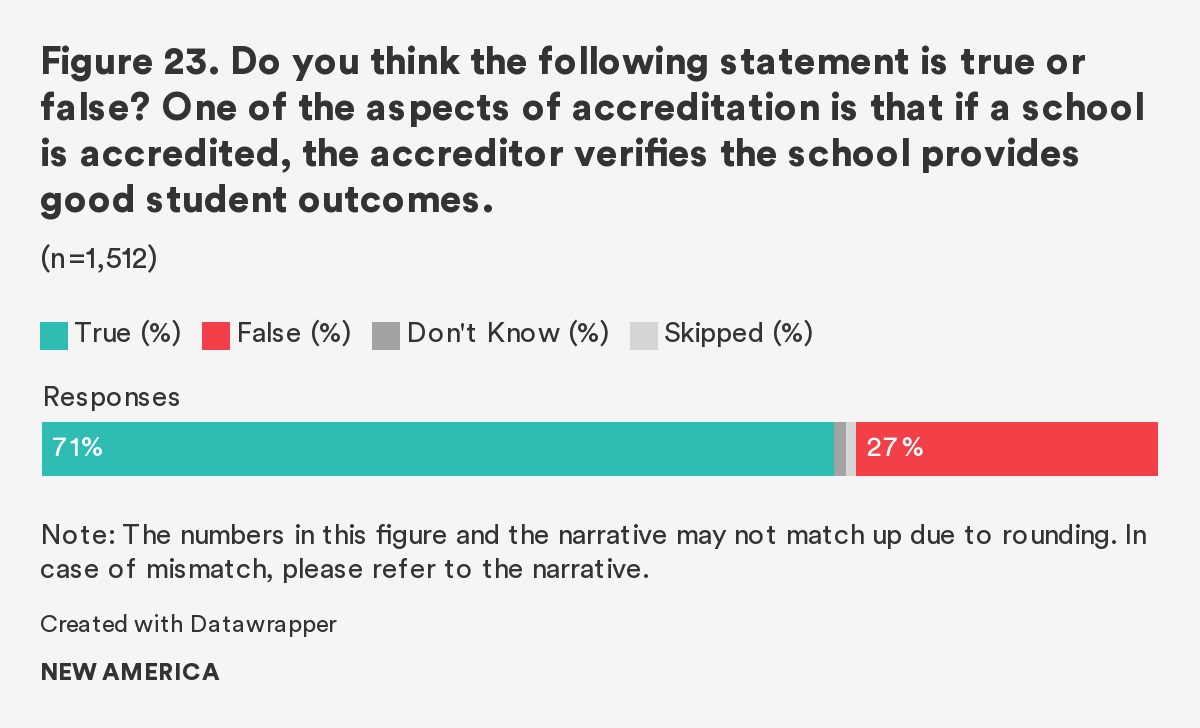
While it is true that all accrediting agencies are required to establish standards for accreditation based on student achievement,12 many of the regional accreditors that mostly approve public and nonprofit colleges do not have a standard definition of student achievement; they do not assess or hold institutions accountable for student outcomes like graduates’ wages or default rates for student loan repayments. While they may consider institutions’ graduation rates, regional accreditors almost never condition their approval of colleges on meeting a graduation rate benchmark.
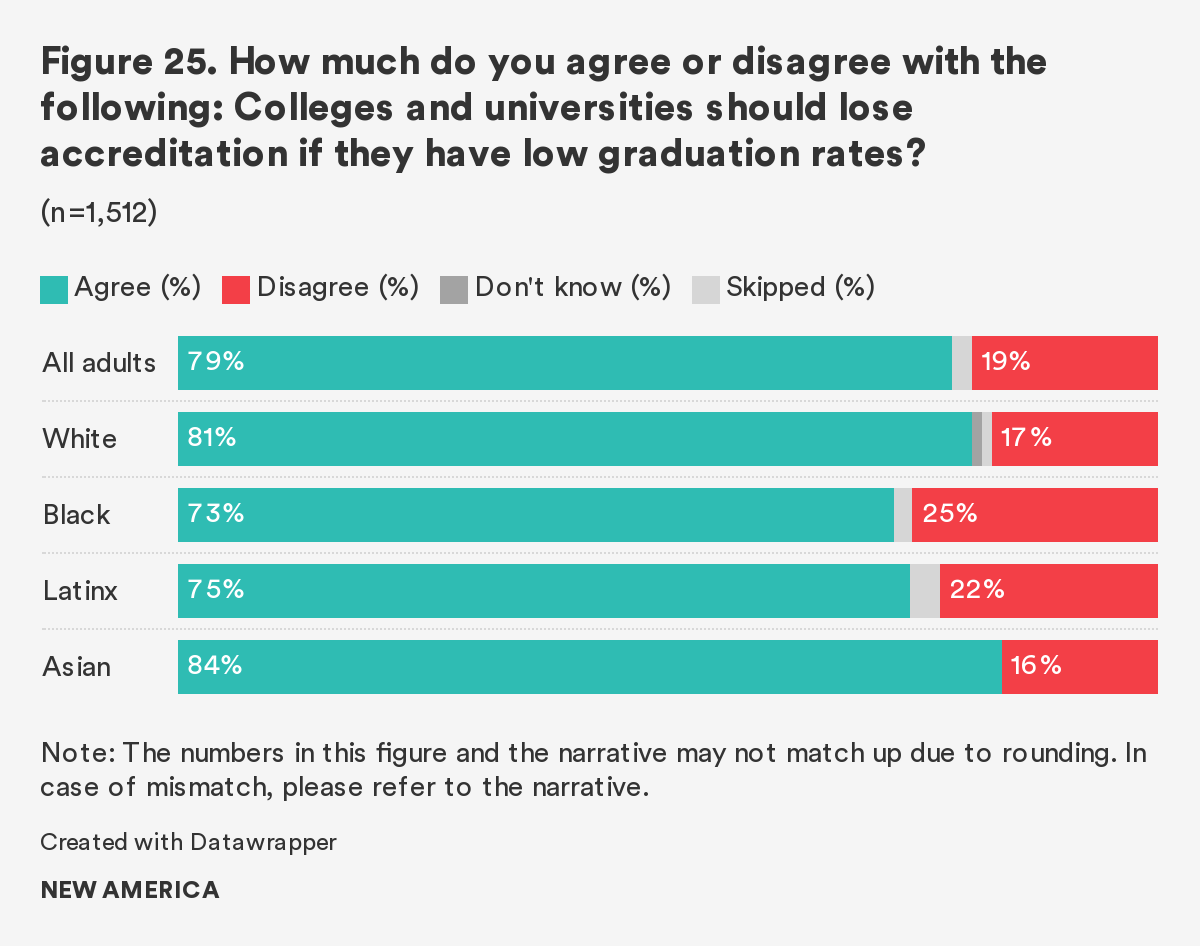
In general, most Americans support tying accreditation status to key indicators of quality (Figure 24). The highest number of respondents (79 percent) agree that colleges and universities should lose accreditation if they have low graduation rates. However, agreement with this statement varies somewhat among racial groups: 81 percent of white respondents agree that low graduation rates merit a loss of accreditation, compared with 73 percent of Black and 74 percent of Latinx respondents (Figure 25).
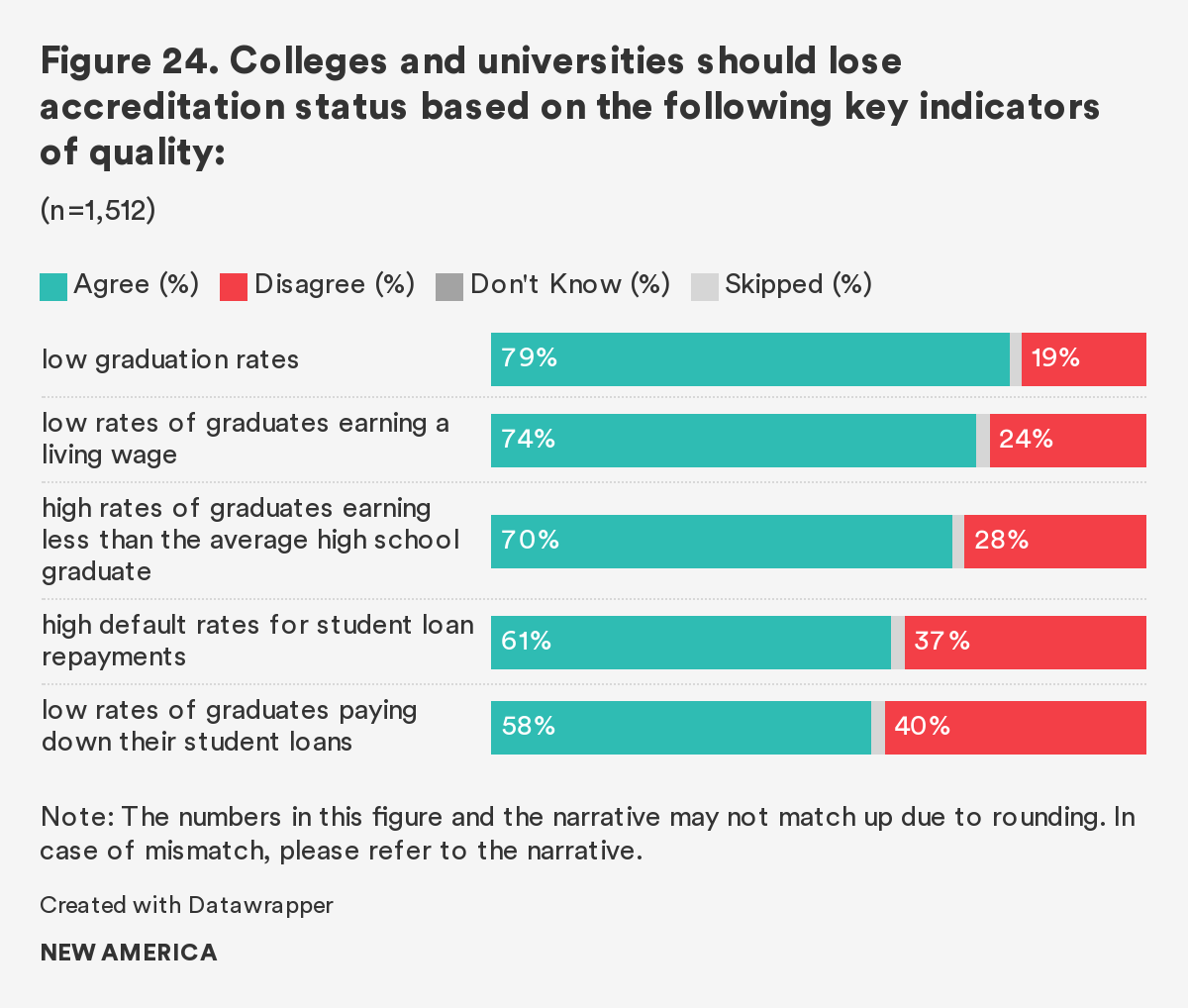
Nearly three-quarters (74 percent) of Americans think that colleges should lose accreditation if an insufficient share of their graduates earn a living wage. This is a belief that crosses the political aisle: 77 percent of Democrats and 72 percent of Republicans agree,
While a majority still agreed, there is less support for stripping colleges of their accreditation based on the struggles their former students have repaying loans. Only 61 percent of Americans think that high default rates on student loans are a reason for colleges and universities to lose accreditation. Similarly, only 58 percent of respondents agree that colleges and universities should lose their accreditation if they have low rates of graduates paying down their student debt. Responses to this question varied among age groups: 63 percent of Baby Boomers agreed that this was a sign that schools should lose accreditation, compared with 52 percent of Millennials.
While it is important to hold higher education institutions to account through metrics like key indicators of quality and accreditation status, Americans are also deeply concerned about college costs, and therefore the efficiency and fiscal responsibility of an institution. How well are schools spending money and how efficient are they? Headlines in the media scrutinize college and university management, placing institutions and their practices in the public eye; Varying Degrees posed questions to gauge respondents’ feelings about money management and efficiency in different types of institutions.
Public community colleges found the most favor (Figure 26). About three in five Americans (62 percent) say that public community colleges run efficiently. While this figure is the same as last year, responses vary among racial groups. When asked if they believe public community colleges run efficiently, 71 percent of Black respondents say that these institutions are efficient, while only 59 percent of white respondents agree.
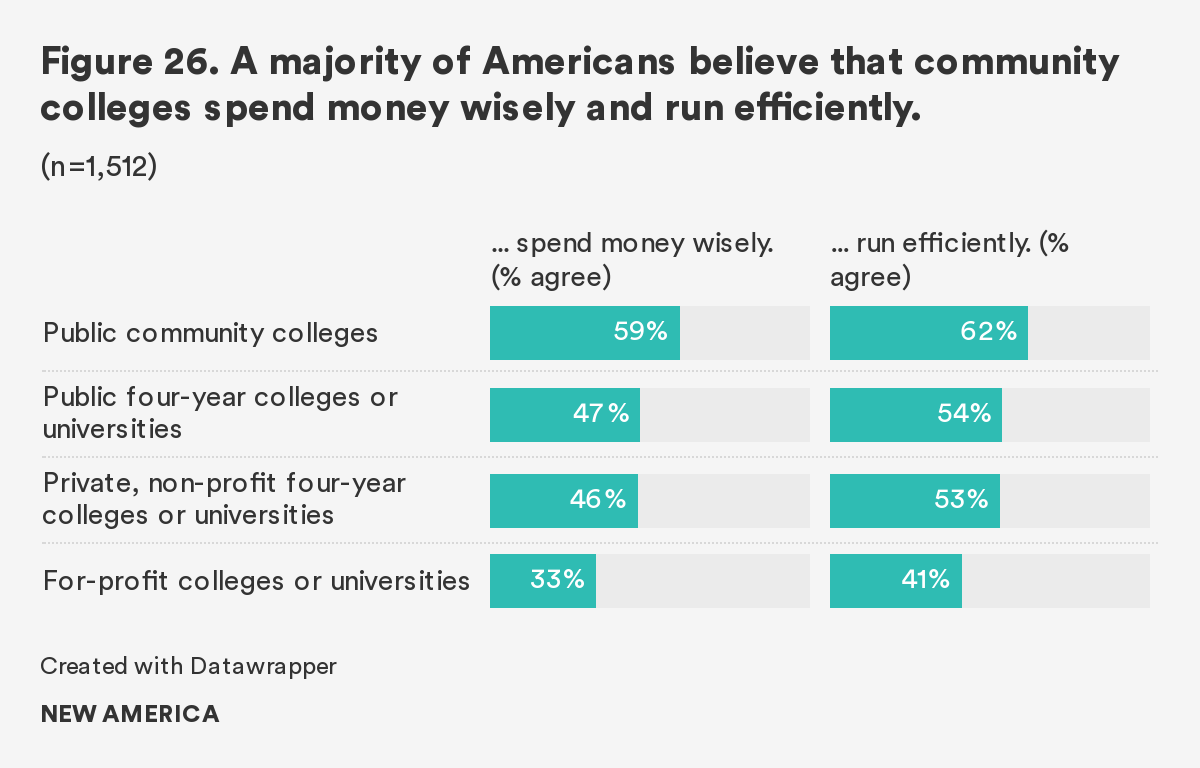
In general, 59 percent of Americans agree that public community colleges spend money wisely; this is slightly lower than the 62 percent of respondents who agreed last year. Democrats and Republicans are divided on this matter: 65 percent of Democrats believe that public community colleges spend money wisely, compared to 56 percent of Republicans.
Slightly less than half of Americans (47 percent) agree that public four-year colleges and universities spend their money wisely. There is a difference among party identification; 57 percent of Democrats agree that these institutions spend money wisely, while 47 percent of Republicans say the same. Racial groups are also divided on the matter: 56 percent of Black respondents agree that public four-year colleges and universities are wise with money, compared with 43 percent of white respondents.
A similar share of people believes private, nonprofit four-year colleges and universities spend money wisely as believed that of public four-year schools. Slightly less than half of Americans (46 percent) agree that private, nonprofit four-year colleges and universities spend money wisely. Half of both Republicans and Democrats agree that these institutions spend money wisely.
The public has a more positive outlook on public four-year colleges’ and universities’ efficiency, as 54 percent of Americans believe that these institutions run efficiently. The data reveal a significant partisan divide: 66 percent of Democrats agree that public four-year colleges and universities run efficiently, compared with 51 percent of Republicans. There was also a significant difference among racial groups: 66 percent of Black and 59 percent of Latinx respondents agreed that these institutions run efficiently, compared with 49 percent of white respondents (Figure 27).
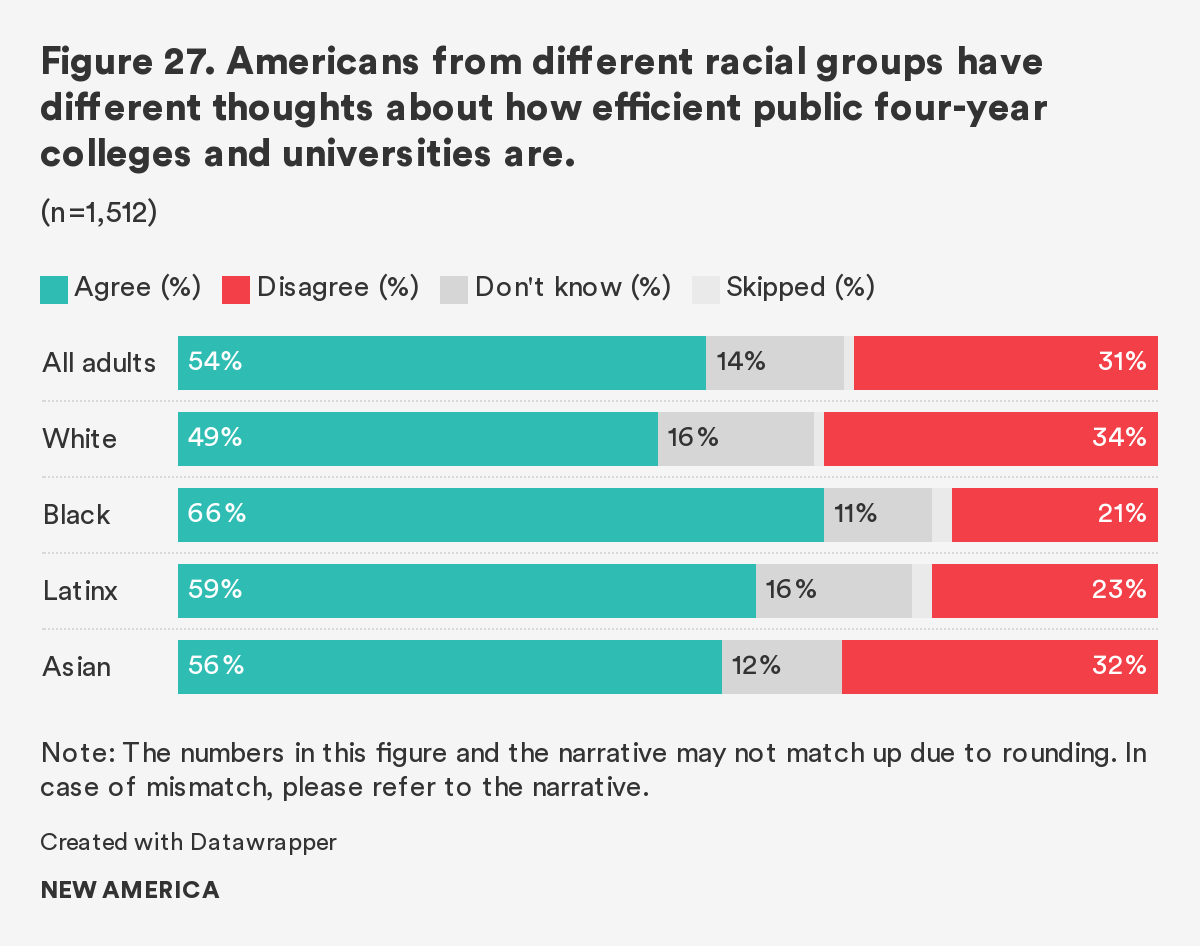
Slightly more than half (53 percent) of Americans say that private, nonprofit four-year colleges and universities run efficiently. Racial groups agree with this belief to different degrees: 59 percent of Black, 59 percent of Latinx, and 58 percent of Asian respondents believe that these institutions run efficiently, compared to 49 percent of white respondents who say the same.
The general public holds less esteem towards for-profit colleges and universities. Unlike the other types of colleges and universities, a majority of Americans do not view for-profit colleges and universities’ as efficient; only 41 percent of respondents agree that these institutions run efficiently, a figure which is six points lower than that for last year. These sentiments about for-profit colleges and universities are bipartisan: roughly the same percentage of Democrats (41 percent) and Republicans (44 percent) agree that these institutions run efficiently. There is some disagreement with this statement among racial groups: 57 percent of Black respondents and 49 percent of Latinx respondents agreed that for-profit colleges run efficiently, which are both significantly higher than the 36 percent of white respondents who say the same (Figure 28).
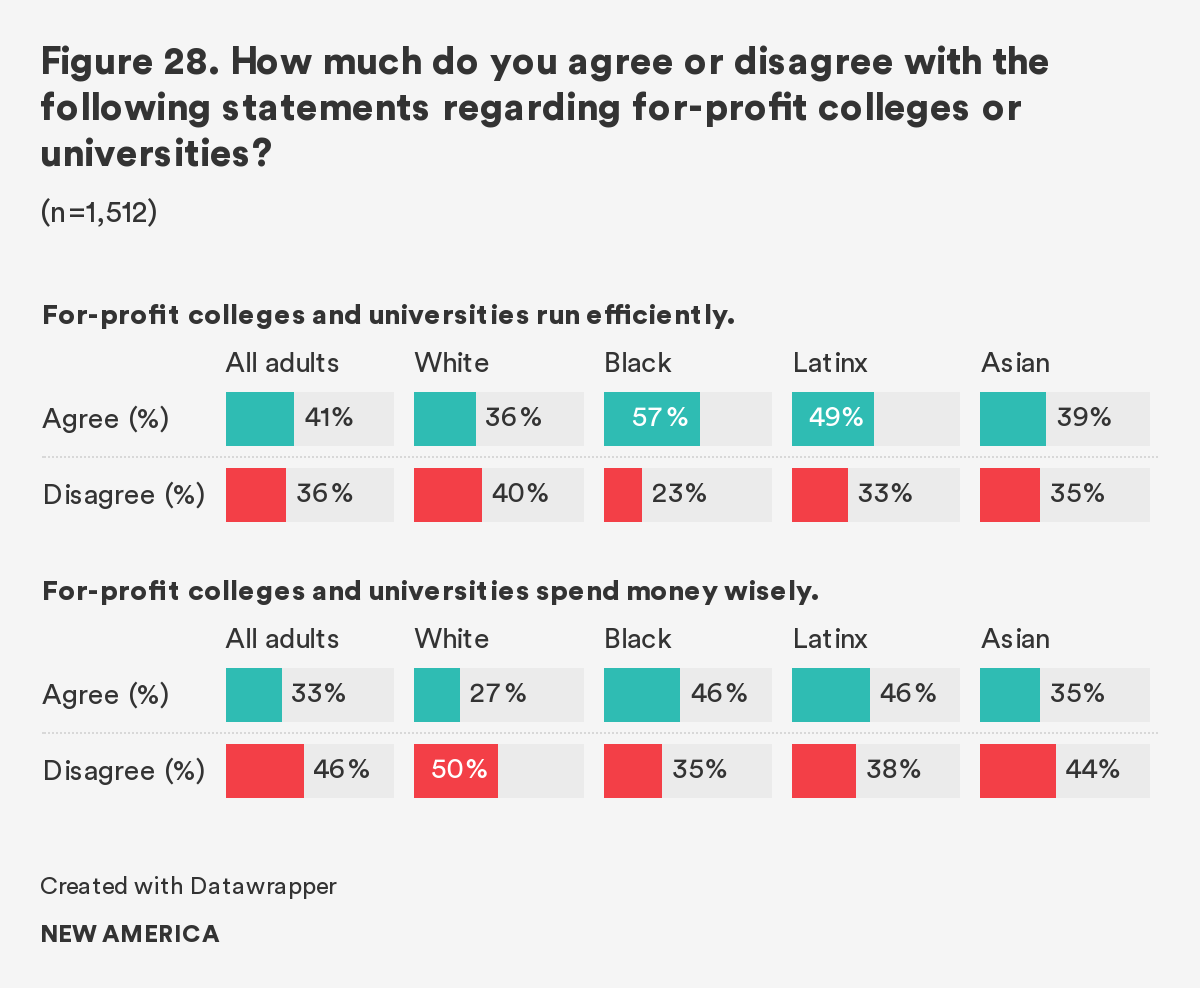
Even fewer Americans believe that for-profit colleges and universities spend their money wisely. Only one-third (33 percent) of respondents said that these institutions are wise with money. This figure is also six points lower than last year’s findings and similar among political parties; 36 percent of Democrats and 34 percent of Republicans agree that these institutions spend their money wisely. Given that Republican lawmakers routinely support13 for-profit colleges and their practices, this is somewhat surprising. Racial groups are divided on the issue; 27 percent of white respondents believe that for-profit colleges and universities are wise with money, compared with 46 percent of Black respondents and 46 percent of Latinx respondents.
It is clear that a larger portion of Americans believe that public community colleges run more efficiently and are wiser with money than both public and private nonprofit four-year colleges and universities, and especially than for-profit colleges and universities.
Citations
- In Varying Degrees, education beyond high school includes any formal education and/or training, including apprenticeships, technical education, vocational education, and coursework applicable to an associate, bachelor’s, or advanced degree.
- Anthony P. Carnevale, Stephen J. Rose, and Ban Cheah, The College Payoff: Education, Occupations and Lifetime Earnings (Washington, DC: Georgetown University Center on Education and the Workforce, 2011), source
- Philip Trostel, It’s Not Just the Money: The Benefits of College Education to Individuals and to Society (Indianapolis, IN: Lumina Foundation, 2015), source
- In Varying Degrees, Generation Z includes those who were born in and before 1995, Millennials include people who were born between 1980 and 1994, Generation X includes people who were born between 1965 and 1979, Baby Boomers include people who were born between 1946 and 1964, and the Silent Generation includes those who were born in and before 1945.
- National Center for Education Statistics (website), The National Postsecondary Student Aid Study 2016 (NPSAS:2016), source
- National Center for Education Statistics (website), The National Postsecondary Student Aid Study 1996-2016 (NPSAS:1996-2016), source
- Robert Shireman, “The For-Profit College Story: Scandal, Regulate, Forget, Repeat,” The Century Foundation (website), January 24, 2017, source
- “Pew Research Center, July 2019 Political Survey, Final Topline,” Pew Research Center, source
- Kim Parker, “The Growing Partisan Divide in Views of Higher Education,” Pew Research Center, August 19, 2019, source
- This was a forced-choice question: it only offered these two response options, forcing respondents to choose which one most aligned with them.
- College Scorecard (website), source
- Antoinette Flores, “How College Accreditors Miss the Mark on Student Outcomes”, Center for American Progress, source
- Stephen Burd, “How the G.O.P. Became For-Profit College Abuse Deniers,” EdCentral (blog), New America, January 16, 2017, source