Who is at Risk?
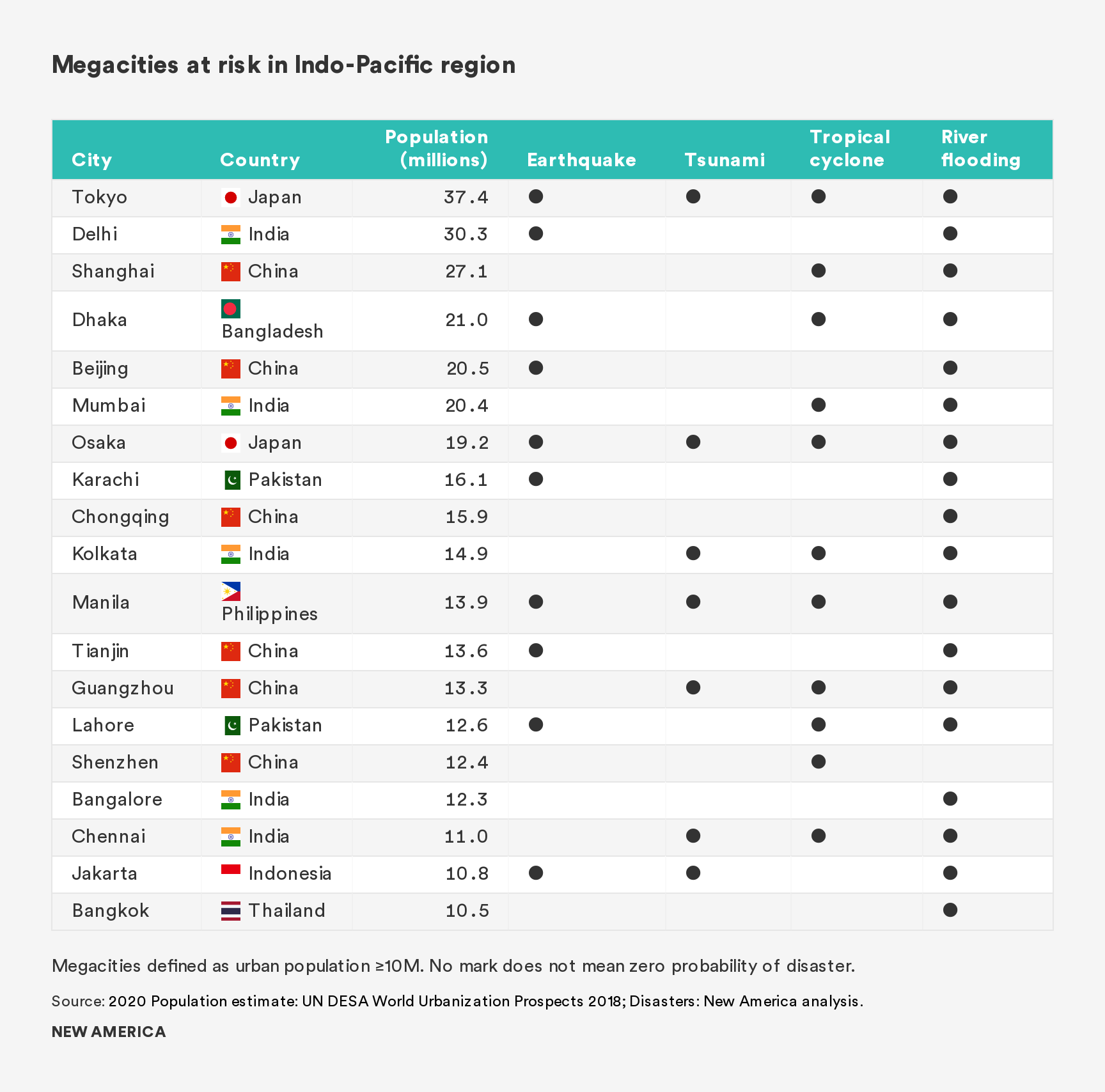
The whole Indo-Pacific region is at risk for a range of natural disasters, including health epidemics like the novel coronavirus that exploded in Wuhan, China in December 2019. While this includes American cities, this report does not look at domestic disaster relief. Seven other countries in the region have particularly high disaster risk, a history of U.S. humanitarian and disaster relief missions, and high relative strategic importance for the United States, including Bangladesh, India, Indonesia, Myanmar, the Philippines, Sri Lanka, and Vietnam. Only one of those seven, India, has significant military capabilities of its own for disaster relief. In addition, about 2.5 million people live along the coastlines of Pacific and Indian Ocean small island states, such as the Marshall Islands, Nauru, and the Maldives. These populations are highly exposed to sea level rise, tsunamis, and storm surge, with limited ability to respond to major disasters. The other important concentration of risk in the region are the megacities, bulging urban nuclei of 10 million or more people. Twenty of the world’s 33 megacities are in the Indo-Pacific region, and more cities meet this threshold every year. These cities expose large numbers of people, in many cases people who are especially vulnerable due to poverty or other disadvantages, to potential breakdowns in city operations when natural hazards strike.