Oscar Pocasangre
Senior Data Analyst, Political Reform Program
Shortly after becoming prime minister of the United Kingdom earlier this year, Andy Burnham announced a plan to make sure “everyone’s vote counts and everyone’s voice is heard” by setting up a commission on electoral reform. Buoyed by a surge in support for his Labour Party, Burnham has the political capital to do something transformational for the U.K. He has previously championed proportional representation, so his announcement strongly indicates an intention to move away from winner-take-all elections to ones in which seats are allocated to parties proportionally to their vote shares.
Burnham’s proposal for electoral reform has already been met with skepticism about whether it will improve British politics and with fear that it will result in political chaos. These concerns are largely based on the conventional wisdom that proportional representation creates instability and complicates governance, while winner-take-all delivers stability and prevents extremism.
But that conventional wisdom has fully crumbled.
The rotating cast of prime ministers in the U.K. (Burnham is the seventh in 10 years) and the dysfunctionality of the two-party system in the United States should be enough to make skeptics question the ability of winner-take-all systems to provide stability, manage fragmentation, or diffuse polarization. Moreover, extensive research has shown that proportional representation can foster stability and good policymaking while including more voices in the political process.
The old logic was that, because only one candidate can win in a district, winner-take-all discourages voters from wasting their votes on minor parties and political entrepreneurs from defecting to form new ones. These dynamics are generally supposed to funnel voters and politicians into two large tents in each district rather than enable the rise of multiple parties. Two-party dominance makes it difficult for small parties to get elected, providing a bulwark against fringe and extremist parties that lack majority support while facilitating governance and accountability. Or so we thought.
In the face of historically unpopular parties, the winner-take-all system has been unable to prevent defections from the Conservative and Labour parties. Now, five viable parties are eyeing the next general election in the U.K. But in a winner-take-all system, candidates can win races without a majority of votes—they just have to lose less than the others. In 2024, Labour won 63 percent of Parliamentary seats with only 34 percent of the votes. The 2026 local elections provided many more egregious examples of the shortcomings of winner-take-all. Take the city council election in Milton Keynes: The Liberal Democrats won a majority despite finishing fourth in vote share. This makes politics unstable not only because candidates win with weak mandates, but also because the bar for victory is so low that control of councils and Parliament comes down to arbitrary shifts in a few votes here and there.
With a proportional system, parties win seats in proportion to their vote share, so that even if a party does not win the most votes, it still has a shot at legislative representation. Fewer wasted votes and potentially more political parties representing different sectors of society, including minorities, enhances the legitimacy of the political system. The inclusion of multiple parties makes it unlikely that any one party can command a majority to govern as it pleases and makes it harder for extremist parties to capture all of government. Instead, it forces parties to form coalitions and build consensus. Yes, this process is often messy, but democracy is messy, and that back-and-forth between parties can ultimately produce policies more aligned with what the majority of voters want. Plus, voters seeing their party forging coalitions can also reduce affective polarization.
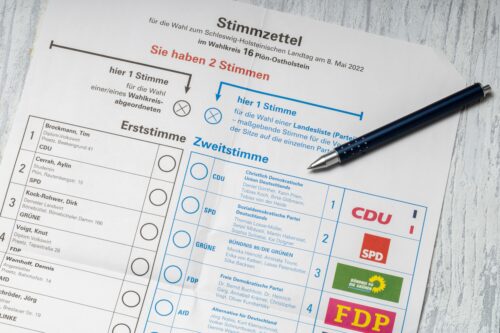
There are many different designs of proportional representation systems, and Burnham’s proposed commission doesn’t have to look that far to find options. The Scottish Parliament uses a mixed-member electoral system that adds a compensatory tier to winner-take-all elections to improve proportionality. The Welsh Parliament previously used a similar system but switched to a closed-list system where seats are allocated to parties based on their vote share and filled by candidates in the order ranked by the party. Meanwhile, the single transferable vote (ranked-choice voting in multi-member districts) is used for local elections in Northern Ireland and Scotland. As the political scientist Simon Hix has pointed out, the U.K. is now a “veritable electoral system laboratory.”
The British example is instructive for the U.S., where primaries and winner-take-all elections have contributed to a rise in extremism, legislative policymaking characterized by either gridlock or whiplash, and a system best characterized as two one-party systems.
There is already a growing movement advocating for proportional representation for the U.S. House of Representatives. But the U.S. needs champions like Burnham to make electoral reform happen: elected officials from different parties willing to use their political capital to disrupt the system that got them elected in the first place and who recognize the shortcomings of winner-take-all elections. It needs a congressional caucus pushing for electoral reform from the inside, much like the All Party Parliamentary Group for Fair Elections in Westminster. After this year’s midterm elections, Democrats have been given wide margins to pursue big pro-democracy reforms that strengthen democracy; a possible governing trifecta in 2028 could make those a reality. Proportional representation should be on their agenda. Until then, it’s up to voters to call for electoral reform and show their representatives that there is a constituency for reform.
Senior Data Analyst, Political Reform Program