Oscar Pocasangre
Senior Data Analyst, Political Reform Program
This paper was originally published by Political Research Quarterly on April 29, 2026.
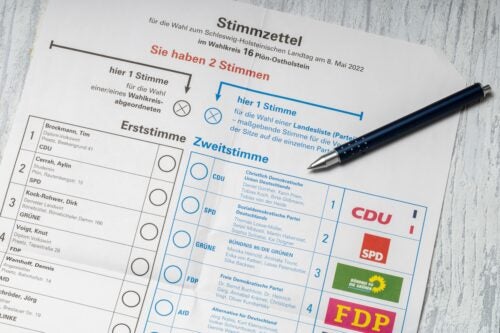
Growing frustration with the American electoral system—intensified by concerns about potential unconstrained gerrymandering triggered by the Supreme Court’s 2026 decision in Louisiana v. Callais—has prompted interest in alternative electoral systems. Mixed-member proportional (MMP) systems are often proposed as appealing alternatives because they combine district-based elections with compensatory party-list seats to balance accountability and fair, proportional representation.
Could such a system work for the U.S. House of Representatives? If so, what would it look like?
A new paper published in Political Research Quarterly by Oscar Pocasangre, Alex Keena, and Natasha Romero-Moskala tackles these questions. The paper first reviews the comparative scholarship on these systems and explains their basic mechanics and design features. The paper then explores how an MMP system would need to be adapted to fit the framework of the U.S. Constitution. Finally, it illustrates how MMP could neutralize the effects of gerrymandering and enable accurate and fair legislative representation.
The paper aims to encourage more discussions and analysis regarding MMP in the United States. There are many open questions about the design of such a system that still need to be addressed. Some of these questions include: whether all states should have compensatory seats; whether the party-list tier uses open or closed lists; what role do primaries play in selecting candidates; how to deal with decoy parties (parties created by the major parties to compete only in the compensatory tier); how would compensatory seats affect a state’s Electoral College votes, among others.
Senior Data Analyst, Political Reform Program