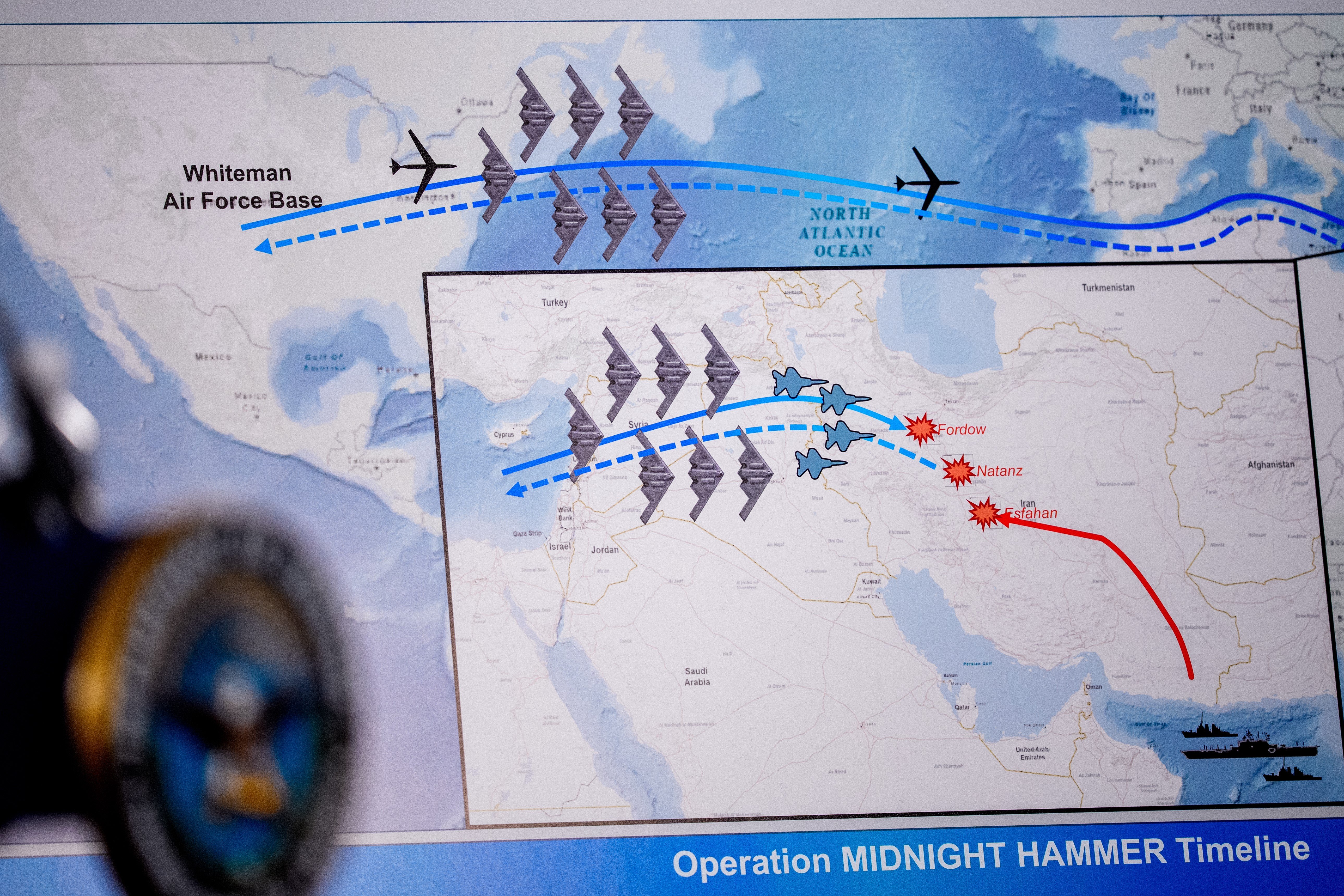
Operation Epic Fury has achieved its immediate objectives. Iran’s senior leadership has been decimated. Its ability to project power is degraded. Its nuclear infrastructure is severely damaged. But the regime remains, with the Islamic Revolutionary Guard Corps (IRGC) increasingly calling the shots.
The question that now matters is not what was destroyed but what comes next: how will the next leaders of the Islamic Republic ensure its survival?
I was an “Iran Watcher” on the country’s doorstep in Armenia during Maximum Pressure—the Trump administration’s 2018-2021 campaign of sanctions and diplomatic isolation of Iran. This moment has a familiar quality. Most analysts of post-strike Iran gravitate toward two outcomes: regime collapse or IRGC consolidation. Realistically, Iran faces four plausible trajectories shaped by two variables: who governs and what nuclear path they choose. Here’s what might happen next.
The combinations are straightforward: the IRGC could consolidate power and pursue a bomb, or maintain strategic ambiguity. Alternatively, a reformist or technocratic leadership could emerge, either continuing a nationalist nuclear program or pursuing diplomatic restraint.
Of these, one outcome is both the most dangerous and the least prepared-for: IRGC dominance paired with an active pursuit of nuclear weapons. This is the scenario that demands immediate attention.
Why the IRGC Might Seek the Bomb—And How It Could Get It
The IRGC enters this moment with three structural advantages: control over a massive parallel economic system, dominance over internal security institutions, and mature sanctions-evasion and procurement architecture. It did not weaken under maximum pressure—it adapted.
A post-strike IRGC faces a simple reality: it can no longer rely on distance, deniability or regional proxies to protect itself. Its buffers are degraded. Its leadership has been directly targeted. And future strikes remain a credible threat. In that environment, the logic of nuclear acquisition becomes stark.
Imagine the near term. The strikes end, but the regime survives. The IRGC, already dominant, consolidates further as alternative power centers fail to reconstitute. Its proxy network is degraded, its missile forces weakened, and its leadership exposed to direct targeting. The lesson is immediate: the buffers that once absorbed pressure are gone.
At the same time, its internal position remains intact. The security apparatus continues to suppress dissent, and its parallel economic networks keep resources flowing. The regime is weaker externally, but still durable at home.
That combination—external vulnerability and internal control—creates the strongest possible incentive to seek a decisive deterrent.
This is not ideological. It is organizational. And it is rational.
The IRGC oversees a vast economic and political system built on coercion and control. Preserving both requires preventing further external intervention. Nuclear weapons offer the only consistently demonstrated mechanism for doing so. An otherwise weak North Korea has resisted regime change because of its weapons. States that gave them up (like Libya and Ukraine) faced fierce external intervention. From the IRGC’s perspective, the lesson is clear: ambiguity invites pressure. Nuclear weapons deter it.
The Pathway Already Exists
The scenario does not require building new capabilities from scratch. Despite the strikes, Iran retains both nuclear material and technical expertise. The most technically demanding stages of enrichment have already been completed, and monitoring gaps mean the current status of key stockpiles is uncertain. But the more important advantage is organizational: the IRGC has spent decades building a parallel global trade architecture designed to move goods, capital, and technology outside formal systems. At its core is a sanctions evasion ecosystem that spans maritime, financial, and commercial domains.
Central to this is a “ghost fleet” of hundreds of tankers, moving 1.3 to 1.6 million barrels per day of Iranian crude to Chinese refineries through opaque ownership structures, resilient shell companies, and logistics pipelines that operate across permissive jurisdictions. While the United States has twice sanctioned the ghost fleet network run primarily by Hossein Shamkhani—the son of Iran’s recently killed senior defense minister—the network quickly registers new companies, reformats ready-made procurement infrastructure, then launches ships with their trackers turned off. Built to survive disruption, these robust, durable systems can again be repurposed.
This maritime network is mirrored by civil-military airlifts and affiliated carriers that have historically moved sensitive cargo across the region. Even where strikes have degraded physical assets, the procurement infrastructure remains intact.
This logistical prowess fuels broader strategic relationships, including the IRGC’s cooperation with Russia. The IRGC’s role in supplying UAVs for Russian use in Ukraine, and subsequent reverse flow of upgraded systems back to Iran, demonstrates a functioning exchange channel for military technology under wartime conditions. The mechanism exists; what will move through it next?
The precedent for how this could unfold is well established. The A.Q. Khan network demonstrated that a state could acquire not just components but a functioning nuclear capability through dispersed commercial channels. Centrifuge designs, components, and weapons-relevant knowledge moved through front companies across multiple countries, evading detection until the program was effectively operational.
Today, the barriers are lower. Critical knowledge no longer requires physical transfer. Designs, simulations, and technical guidance can move digitally. Procurement can be fragmented across jurisdictions, embedded in legitimate trade flows, and obscured within high-volume commercial activity. Already, the IRGC’s ghost fleet quickly registers new shell companies, reformats procurement infrastructure, and continues operations under different names. To restart its nuclear program, Iran would likely follow a pattern, obtaining specialized components routed through intermediaries, technical expertise transferred through covert channels, and assembly occurring out of view. And now, the IRGC does not need to start from scratch, but just complete what remains.
Why Strikes Alone Cannot Stop This
Military action can destroy infrastructure. It cannot eliminate knowledge, networks, or incentives. Strikes may even strengthen the incentive to proliferate. Historically, military pressure has hardened Iran’s determination to preserve and rebuild its nuclear capabilities rather than abandon them.
This exposes a gap in current policy. Existing counterproliferation approaches remain oriented toward facilities: enrichment sites, reactors, and visible infrastructure. But a procurement-driven pathway operates differently. It is distributed, adaptive, and embedded in legitimate global systems.
By the time it becomes visible in traditional ways, it is often too late. Preventing this outcome requires shifting from targeting infrastructure to monitoring and disrupting the networks that sustain it.
What a Prevention Strategy Looks Like
A viable strategy must focus on early detection and disruption before procurement activity coalesces into a weapons capability.
Map the Network Rather than the Facilities.
Instead of using sanctions enforcement to respond to the continuously shape-shifting network of entities involved, the U.S. must leverage existing—albeit stovepiped—information. Further, proliferation monitoring requires not only satellite imagery of fixed facilities, but rather correlation of dispersed commercial activity across corporate, financial, maritime, and scientific domains over extended time periods. The U.S. must integrate more effectively and proactively and leverage known patterns.
Detect Transfers Before They Arrive
Early indicators are subtle: unusual flight patterns of cargo aircraft, procurement of dual-use components, or shifts in travel and collaboration among key technical personnel. Individually, these signals are weak. Detection depends on connecting and making sense of fragments across signals, human sources, and commercial data into recognizable patterns. It also requires rapid intervention mechanisms like diplomatic engagement, establishing shared nonproliferation redlines, and verification through technical monitoring.
Disrupt Digital Transfer Channels
The Khan network used luggage, cargo planes, and shipping containers. Today’s proliferators rely more on intangible data and software rather than materials. The IRGC’s cyber apparatus is establishing covert digital channels to receive weaponization data. Disruption requires finding the digital handoff before the download completes—monitoring not just who communicates, but what technical knowledge moves through those channels and whether the pattern matches a weapons program’s requirements. Enforcement agencies can monitor digital infrastructure by monitoring anomalous data flows, unusual access to specialized resources, and atypical communication patterns.
None of these measures are purely technical. They require coordination across governments, alignment with private-sector data holders, and sustained diplomatic engagement with states that influence Iran’s choices. Without that shift, enforcement will remain reactive and insufficient.
The Stakes
An IRGC that acquires nuclear weapons does more than just alter regional deterrence. It transforms the internal trajectory of Iran. Nuclear capability would harden the regime against external pressure, increasing its confidence in suppressing domestic opposition, while gradually rebuilding its regional networks under a nuclear umbrella.
Preventing proliferation does not guarantee a better future for Iran. But failure to prevent it would lock in the worst one: a regime that is both internally coercive and externally insulated from pressure.
From the IRGC’s perspective, the lesson is clear: ambiguity invites pressure. Nuclear weapons deter it. If it acts on that logic, the pursuit of a bomb will not be gradual or visible. It will be fast, distributed, and designed to succeed before anyone can stop it.