Leslie Villegas
Senior Policy Analyst, Education Policy

Linguistically diverse children enrolled in public school in the United States are screened and assessed to determine if they need additional language support to engage academically. Students who fall below their state’s English proficiency threshold are classified as English learners, and in order to exit this group, they must meet their state’s criteria for reclassification. The reclassification process varies from state to state, yet, few comprehensive resources explore English learner reclassification policies and trends from a national vantage point.
New America conducted a national scan of state-level English learner reclassification policies and trends between 2018—the first full year the Every Student Succeeds Act (ESSA) was implemented1—and 2025. The two briefs in this series provide information about how reclassification policies have changed, trends in reclassification rates, and how states compare with each other. We hope this information will be useful to policymakers as states hone their reclassification processes.
This first brief offers an account of the changes that states have made to English learner reclassification policies. We focus on two questions:
In 2015, Congress approved the Every Student Succeeds Act (ESSA) reauthorizing the Elementary and Secondary Education Act (ESEA) of 1965. Among its provisions, ESSA ushered in new accountability measures for students identified as English learners (ELs) in public K–12 schools. Chief among these changes was the requirement that states adopt objective and uniform identification and reclassification criteria. Identification and reclassification policies set the parameters for schools and districts to use in determining whether students need language support to access academic content. They also determine when students have developed enough academic English proficiency to thrive without these supports.
Prior to ESSA, states were not required to have uniform statewide English learner reclassification policies. How and when English learners were reclassified was often determined by district-level policies and processes.2 This meant that English learners attending school in the same state—and sometimes the same district—could be held to different English proficiency standards.3 Inconsistent application of reclassification policies creates an undue barrier for English learners’ to access this critical juncture in their education. ESSA attempted to address this inequity by requiring states to adopt objective exit criteria and apply these criteria evenly for all students.
Being classified as an English learner often results in diminished educational opportunities, particularly in the secondary grades. English learners’ educational experiences and opportunities have been the focus of various research studies,4 including seminal research in California conducted by Ilana Umansky—a prominent English learner expert—in 2018. She found that many EL-classified students lack equitable access to grade-level content and are instead placed in low-track classes and excluded from honors and Advanced Placement courses.5 These curricular conditions create an environment defined by remediation and isolation, rather than acceleration and interaction.6 As a result, EL-classified students are less likely to graduate from high school or enroll in and complete college.7
Reclassification, on the other hand, can unlock a completely different scholastic environment if the right supports and policies are in place. Umansky’s work suggests that once reclassified, English learners’ educational opportunities improve in terms of the curricula they have access to, the peers they are surrounded by, and the teachers that are leading their classrooms.8 Once reclassified, English learners can perform on par, if not better, with their English-only peers.9 This means that making sure English learners reclassify at the right time—and are not left to languish in English learner status—can define long-term success for millions of students.
Karen Thompson, a professor at Oregon State University whose research has focused on the educational experiences of multilingual learners, in 2017 identified a “reclassification window” in the upper elementary grades, and concluded that “students not reclassified by this point in time become less likely ever to do so.”10 Research has shown that English learners can take three to five years to develop oral proficiency and four to seven years to develop academic English proficiency.11 Whether English learner students are reclassified in a timely manner is heavily influenced by both the type and quality of educational opportunities they are provided with, and by the criteria used to determine when a student has reached English proficiency.
Per ESSA, states’ English learner reclassification criteria must, at minimum, take into account the student’s performance on the statewide English language proficiency (ELP) assessment. States are also allowed to consider additional measures, such as performance on academic tests and teacher observations, as long as the additional criteria only evaluate language skills and minimize subjective judgements.12 In 2020, five years after ESSA was enacted, the Migration Policy Institute conducted a comprehensive review of states’ initial federally mandated ESSA plans. It confirmed that ESSA did push states to adopt consistent and uniform identification and reclassification procedures as intended.13 The policies established through states’ ESSA plans, however, were subject to change.
Reclassification criteria are not fixed; they can change from year to year. States can amend their ESSA plans and seek waivers for certain ESSA requirements at any time.14 And even outside of ESSA’s purview, states have the authority to change their proficiency and reclassification thresholds as necessary. It is reasonable to expect states to review and update these reclassification policies to ensure the policies are still functioning as intended. In fact, when states developed their initial ESSA plans the majority of them expressed intent to revisit and modify their proficiency standards once they had more time to administer their tests and collect valid and reliable data.15 This is because many states were administering updated assessments between 2016 and 2018 and had set their ESSA exit criteria based on one to two years of operational data.16 A number of states have routinely taken advantage of this authority since ESSA was adopted.
In 2024, the Collaborative for Applied Research in Education at Northwestern (NCARE) conducted an analysis of how test-based reclassification requirements—including ELP and academic assessments—had changed between 2015 (before ESSA), 2018 (as ESSA was being implemented), and 2023 (five years after ESSA implementation). It found that a considerable number of states changed their test-based reclassification policies, particularly during the first three years after ESSA was signed into law. States trended in the direction of simplifying their exit criteria by eliminating academic test-based criteria, such as performance on an English language arts assessment. The number of states without additional academic test-based criteria increased from 12 states in 2018 to 24 states in 2023.
The research also found that 15 states that use the WIDA ACCESS assessment17 lowered the minimum ELP composite score required to exit. These changes resulted in less variation in the composite scores used by states in 2023 compared to 2018. The researchers concluded that despite these changes “there remain substantial differences in the number and kind of test-based criteria across states,” as well as “variation in what defines English proficiency.”18
Variation in English language proficiency expectations is not surprising—or necessarily a bad thing—given the decentralized governance of education in the United States. Having different English proficiency standards and expectations is consistent with how other academic content standards and proficiency expectations are approached nationwide.
Take, for example, the fact that every state has its own math and English language arts standards, testing, and proficiency expectations.19 In theory—and according to ESSA—the “English proficiency” threshold adopted by each state must be aligned with those academic proficiency standards.20 This is because students scoring proficient on the ELP test should signal that they have developed the language skills necessary to participate in learning and assessment in English without linguistic support services. And since these academic standards vary by state, a universal English proficiency definition or standard across the country is likely unfeasible.
Our analysis focuses on reclassification criteria in 2025 and whether these policies have become more or less stringent since the implementation of ESSA. We separated states based on the ELP assessment used and three basic reclassification policy characteristics listed here:
By separating states into these categories, it is easier to observe and compare trends between states with similar policies. This analysis includes 50 states and the District of Columbia. (See here for more on our methodology.) Our findings are presented for all states, and then states are sorted into four groups based on the ELP assessment used.
As Figure 1 shows, most states (36)21 used the WIDA ACCESS assessment as the foundation for reclassification procedures in 2025. Nine states used ELPA21. Five states used independently created assessments. One state used an off-the-shelf ELP assessment called the LAS Links. The map illustrates the chaotic and fragmented national picture of English learner reclassification policy.
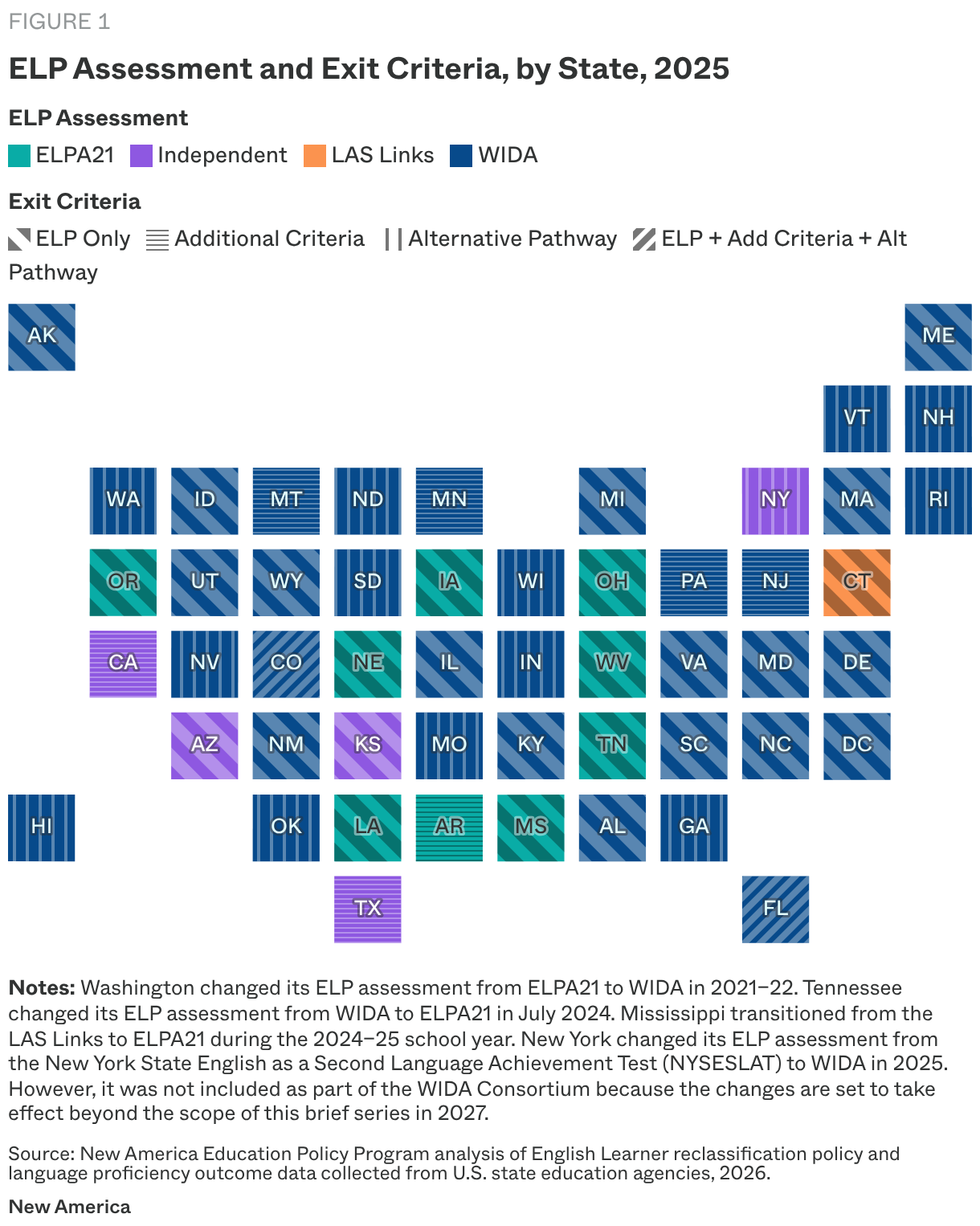
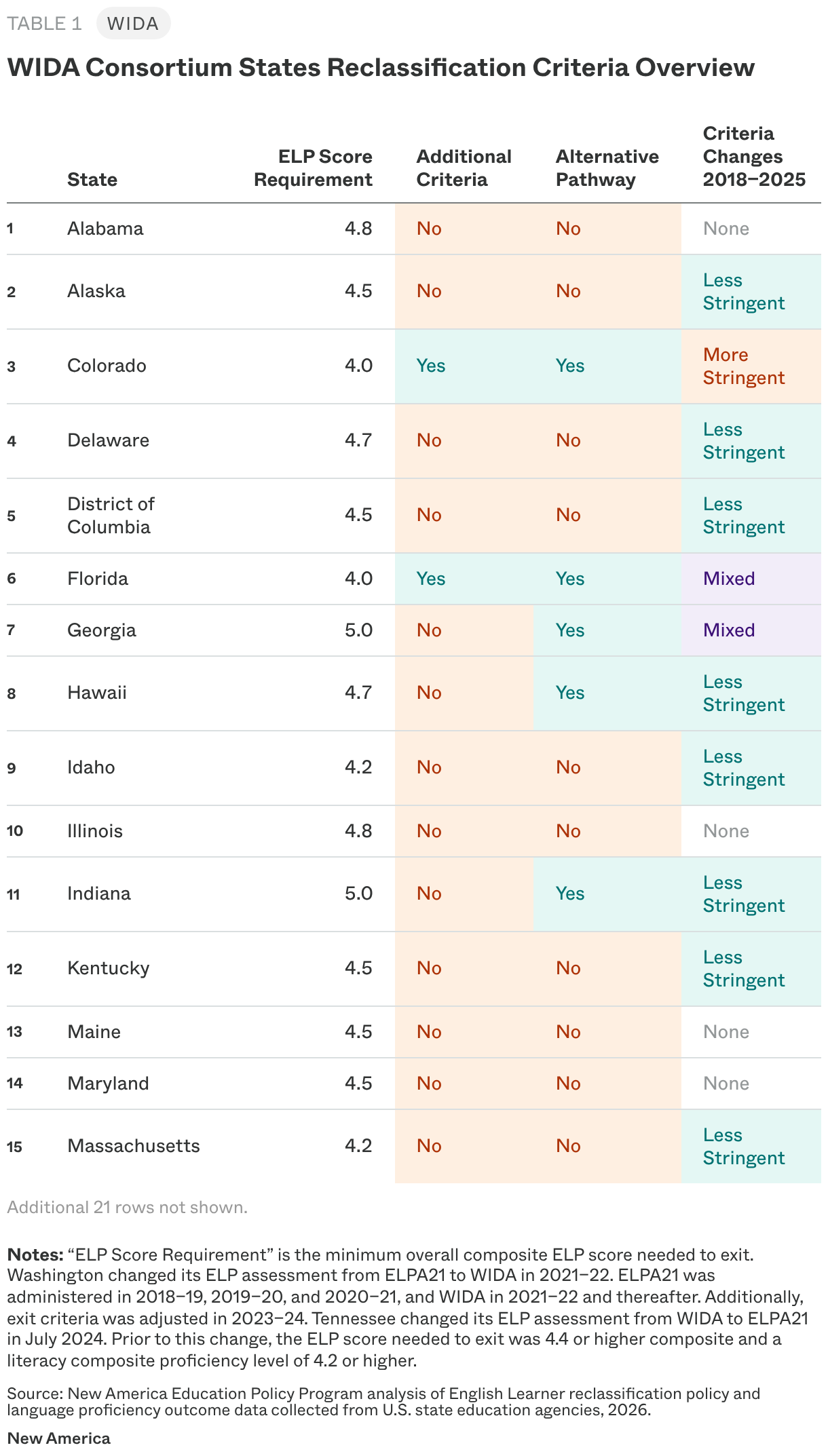
Eighteen WIDA states only require English learners to meet the “English proficient” threshold to be reclassified, four WIDA states require English learners to meet additional criteria to exit services, and 13 WIDA states have an alternative pathway for English learners who meet certain criteria.24 Colorado and Florida have both additional criteria and an alternative pathway as part of the reclassification process.
The WIDA awards scores in eight different categories.28 Four of these include the language domains of listening, speaking, reading, and writing. These domain-specific scores are combined to create four additional composite scores, which include oral language (listening and speaking), literacy (reading and writing), comprehension (listening and reading), and overall proficiency (all four language domain scores).
WIDA proficiency levels are based on scale scores, which are calculated using complex statistical formulas. There are six proficiency levels intended to interpret a student’s grasp of social and academic English, listed below:
The 13 states in this category have two ways students can exit. Students can exit because they meet primary reclassification criteria (e.g., a 4.5 on WIDA) or because they satisfy the criteria set forth in the alternative pathway. Alternative pathways often include a combination of a students’ ELP score and a measure of academic progress. For example:
Observations about the proficiency scores used by these 13 states include:
Two states (Colorado and Florida) consider ELP scores, additional criteria, and alternative pathways in their EL reclassification processes.
Colorado requires both a minimum composite score of 4.0 and a 4.0 in the literacy domain. It also calls for two additional pieces of evidence to demonstrate the ability to transition to classrooms with minimal and appropriate English language development (ELD) support. And the state created an alternative pathway for districts and schools to consider when students have documented absences or their WIDA ACCESS assessments are incomplete due to documented misadministration.
Florida’s English proficiency requirements differ by grade band. Students in K–2 must score at least a 4.0 in the listening and speaking domains. English learners in grades 3–12 must score at least a 4.0 overall composite score and at least a 4.0 in the reading domain. The state also requires English learners to meet certain academic criteria, which also differs by grade band. If students do not meet the proficiency scores, a teacher, parent, or administrator can request a holistic review from an English Language Learner (ELL) Committee. The committee can decide to reclassify students if they meet at least two additional criteria.
In 2024–25, nine states were part of the ELPA21 consortium (Table 2).
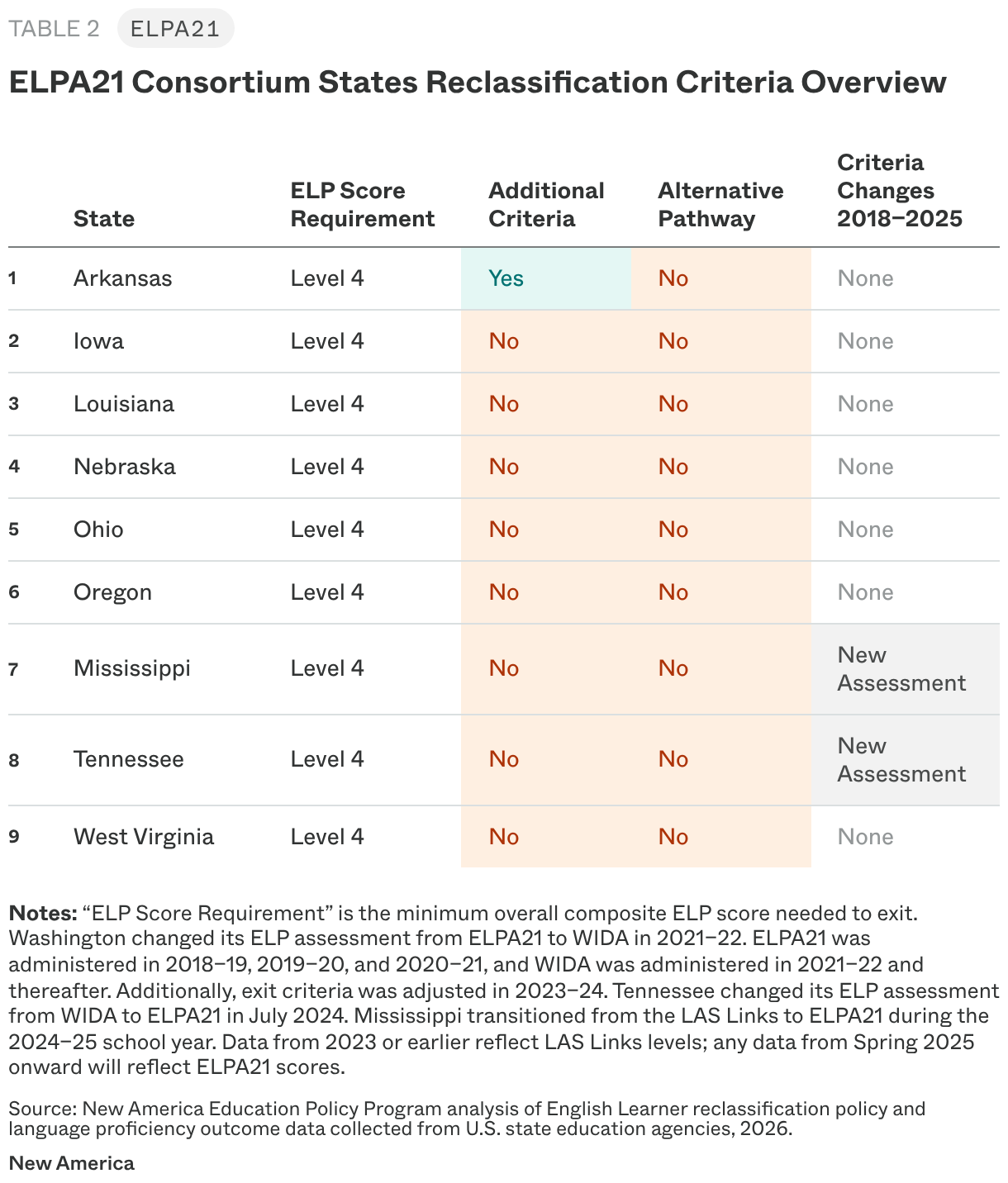
Students who take the ELPA21, like all other ELP assessments, are assessed in each of the four language domains (listening, reading, writing, speaking). Scale scores in each of these domains are used to create a domain profile for each student according to the following five performance levels:31
Students are assigned one of the following overall proficiency levels that corresponds with their domain profile:
Five states used independently developed ELP assessments (see Table 3).
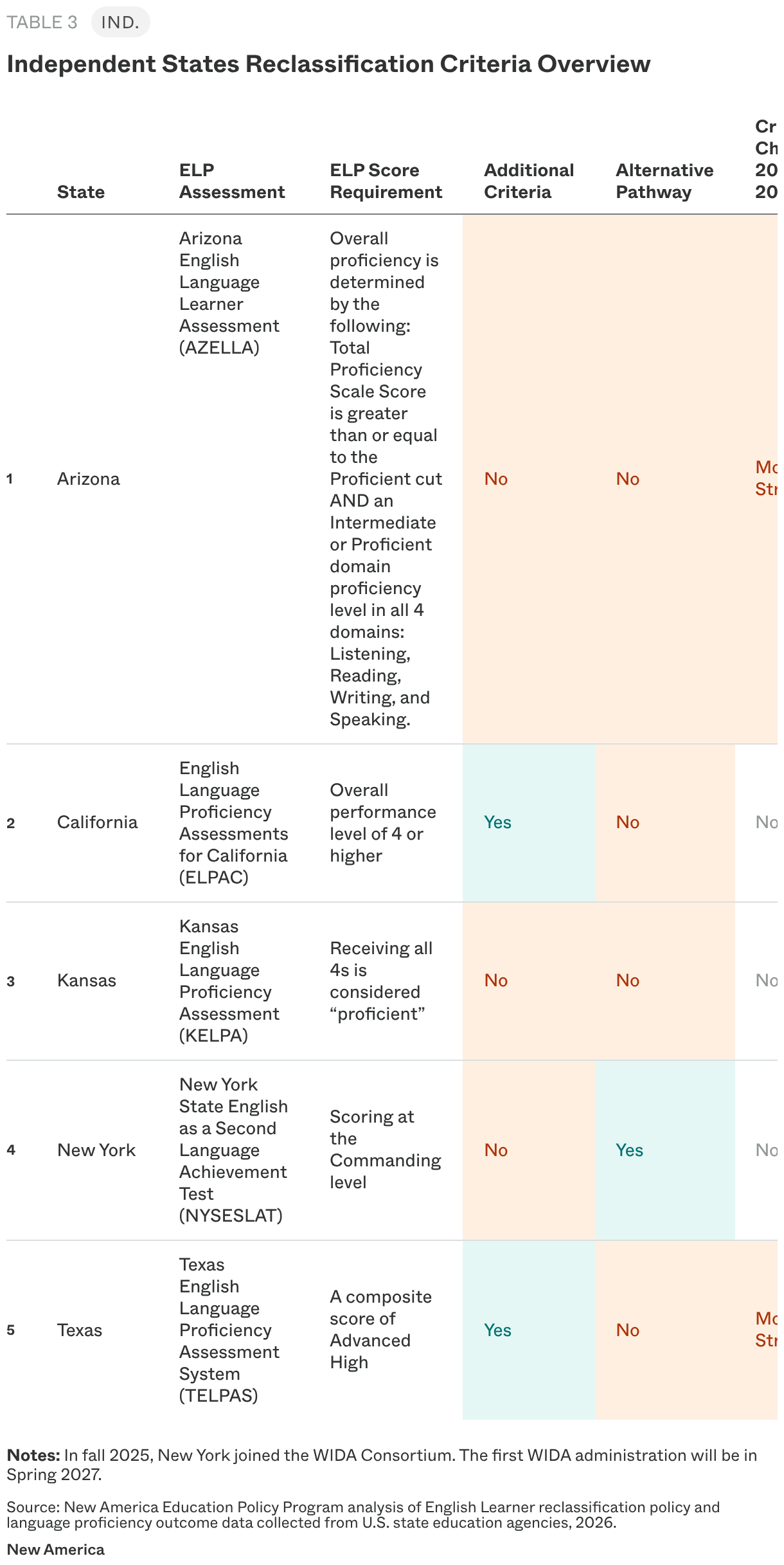
In Arizona, students are considered proficient in English when they meet the following criteria: their total proficiency scale score is greater than or equal to the proficient cut score set by the education agency, and they achieve an intermediate or proficient domain proficiency level in all four domains: listening, reading, writing, and speaking. In Kansas, students who receive all 4s, or higher, on the ELP assessment are considered “proficient.”
California and Texas both required students to meet additional criteria to be eligible for reclassification.
In California, in addition to achieving a level 4 on their ELP exam, students must submit three additional criteria: (1) teacher evaluation, including a curriculum review; (2) parent opinion and consultation; and (3) evaluation of “basic skills” measured against the performance of English-proficient students of the same age.32
In Texas, in addition to the ELP exam, students must meet certain performance standards on state standardized reading assessments that differ by grade and receive a subjective teacher evaluation. These criteria are presented to the language proficiency assessment committee, which makes the final recommendation.
Prior to switching to WIDA in 2025, New York used its own ELP assessment and offered students an alternative pathway to reclassification.
New York’s alternative pathway allowed ELs who were close to proficiency to exit by combining a high NYSESLAT score with their performance on standard ELA assessments. In grades 3–8, students were required to score at the “expanding” level on the NYSESLAT and level 3 or above on the New York State English Language Arts assessment taken within the same school year. In grades 9–12, students were required to score at the “expanding” level on the NYSESLAT and 65 or above on the Regents Examination in English Language Arts taken within the same school year.
In 2025, only Connecticut used the LAS Links ELP assessment. Mississippi transitioned from the LAS Links to ELPA21 during the 2024–25 school year. Before Mississippi switched assessments, both states used only ELP in reclassification decisions and used the same minimum ELP score to exit students: a level 4 or 5 in overall score, reading, and writing.33
Reclassification criteria changed markedly between 2018–19 and 2024–25, particularly among states that use the WIDA assessment. Overall, 31 states changed their criteria (see Table A). Changes include adjusting the ELP threshold that determines when students are “proficient” in English, adding or eliminating additional criteria, or adding or eliminating alternative pathways to reclassification for certain students. Three states—Mississippi, New York, and Tennessee—changed their ELP assessment altogether.
A total of 26 states in the WIDA consortium made changes to reclassification criteria. Among these states, 19 made their criteria less stringent, lowering what is considered English proficient, which could expand the pool of students eligible for exit. Three states made criteria more stringent, which could reduce the pool of students eligible for exit. Four states tweaked reclassification criteria in ways that could have mixed effects on the pool of students considered for exit.
Here are examples of these three kinds of reclassification changes:
Among independent states, only Arizona and Texas appear to have made slight changes to their reclassification criteria. In Arizona, documents show that in 2018, ELs were expected to score “proficient” on the reading, writing, and overall domains; it has since made exit criteria more stringent by adding subdomain requirements in listening and speaking. In Texas, documentation shows that students must meet certain performance standards on state standardized reading assessments that differ by grade, in addition to other criteria, to reclassify. This appears to be more specific criteria than what was required in 2018 according to their ESSA plan, so Texas is tagged as making its exit criteria more stringent.
Michigan’s Move to Automate Reclassification
In the summer of 2020, Michigan began using a mix of automatic and manual processes to reclassify English learners.34 First, an “auto-exit” policy ensures that students who hit the 4.8 threshold are automatically reclassified. Districts can also manually exit students in rare cases, like when they move to the state with qualifying scores from another WIDA state. Lastly, a “district override” component ensures that, even if students meet the 4.8 score, local districts can override the auto-exit if they believe they would still benefit from language support.
This tiered policy was implemented for ELs in grades 3–12 and has since been expanded to kindergarten through second grade. This kind of policy change can expand or constrain which students reclassify without actually changing the proficiency threshold criteria.
Prior to these changes, English learners had to meet 4.0 sub-domain proficiency thresholds in both reading and writing, in addition to a composite score of 4.5 and grade-level proficiency in literacy.35 Evidence used to change this policy showed that there was significant variation in what was considered “proficient” from district to district, according to Caroline Bartlett, Joseph R. Cimpian, and Madeline Mavrogordato, with notable “disparities between the number of students meeting reclassification criteria and those actually reclassifying.”36
Subsequent research conducted by Bartlett, Cimpian, and Mavrogordato on the impact of this policy change found that reclassification rates increased by 35 percentage points for EL students just above the 4.8 threshold.37 These researchers also found that when manual reclassification procedures were used in Michigan, Spanish-speaking students were less likely to reclassify among their EL peers. This apparent bias disappeared when automatic reclassification procedures were put in place.38
As a group, ELPA21 states remained relatively unchanged over time in terms of reclassification policy. The most significant change among this group was the initiation of two new states. Connecticut, the last remaining LAS Links state, remained unchanged as well.
Since ESSA was implemented, states have coalesced around two primary ELP assessments—WIDA and ELPA21, which are used by 45 states. States have continued to move in the direction of only requiring a proficient score on the state’s ELP assessment to exit English learner status. Alternative pathways are more common than in 2018, and the way states use additional criteria has shifted. Now, additional criteria are used to compensate for lower ELP performance instead of being used to supplement an ELP score. English learner reclassification criteria between states remains highly variable. Below we offer two observations and three considerations for strengthening English learner reclassification policies.
There are various layers to reclassification policies including the ELP assessment used, whether additional criteria are required in decisions, and whether there is an alternative exit pathway. Even states with the same ELP assessment, such as WIDA, use different cut-off scores to determine when students reach English proficiency. Even as additional criteria have become less common, states’ exit criteria and English proficiency expectations continue to be layered and complex.
In our survey of reclassification criteria, WIDA states were the most complex. These states could have up to four different components, including overall proficiency threshold, subdomain score(s), additional criteria, and alternative pathway. There were also interesting dynamics between proficiency threshold and other reclassification components. For example, the five states with the highest ELP threshold (5.0) also had alternative pathways. And the two states with the lowest ELP threshold (4.0)—Colorado and Florida—had the most complex criteria overall.
Complexity should not be taken to suggest that policies are bad. These policies were designed to ensure that English learners reclassify when they are able to meet grade-level standards without language support within a specific state context. However, every layer in the reclassification process—which is supposed to be objective and uniform—opens it up to subjective interpretation and increases the room for implementation error. Each layer also affects the ability to calculate, report, and analyze reclassification rates within states.
The purpose of classifying students as English learners is to ensure they are provided the support they need to succeed in school. Leaders need to ensure their reclassification policies are shaped in ways that balance students’ continual language development with their need to access academic content that will help them succeed throughout their K–12 years and beyond.
Policy Consideration: States with complex and layered reclassification criteria should conduct a comprehensive review to understand whether these policies are ushering through English learners once they are ready, or creating undue barriers to their reclassification.
Questions to ask include:
Since 2018, not only have most states changed their English learner reclassification policy, but those that have done so have reduced and simplified the burden of proof needed to exit. Because most states based their initial criteria on limited information, these changes may be an adjustment of expectations based on better and longer-term data on how English learners were faring (before and after reclassification) under the previous reclassification standards. States may have also been paying attention to research that has identified overly stringent or restrictive exit criteria as a contributing factor to the growing long-term English learner population.39
However, in our process of collecting states’ reclassification policies, it was not always clear if and when exit criteria had changed. Too many consecutive changes can cause confusion at the local level. Additionally, students reclassified at different points (before or after changes) are being measured against different standards, which can compromise the ability to make comparisons over time.
Changes to reclassification criteria are not necessarily a good or bad thing. That said, transparency over how and when policies change is critical to ensuring that English learners are being reclassified using the most up-to-date, objective, and uniformly applied criteria. And clear documentation around changes can aid in tracking states’ reclassification outcomes and the public’s understanding of how English learners are being served.
Policy Consideration: State leaders in charge of academic and ELD standards should together ensure that language development expectations are aligned with academic assessment expectations.
Policy Consideration: State assessment and English learner education leaders should consult local education policy leaders and educators when considering changes to reclassification policies and practices. When changes are approved, they should be clearly documented and communicated with schools, districts, and the public.
This research project would not have been possible without the data visualization and thought partnership of Liz Cory, who leads data visualization design and development at New America.
This brief series was created with generous support from the Heising-Simons Foundation. The findings and conclusions contained in this series are those of the author and do not reflect positions or policies of the foundation.
The author would like to thank Amaya Garcia for her involvement in this project, as well as Zahava Stadler and Ivy Love for their keen data visualization advice in its early stages. Thanks to Lisa Guernsey for reviewing the final drafts, Sabrina Detlef for editing, and Katherine Portnoy, Maggie Navracruz and Amanda Dean for publication and dissemination support.
Special thanks to Molly Faulkner-Bond, English learner assessment and reclassification expert, who generously reviewed iterations of this series. The author is also immensely grateful to the state education agency staff who responded to inquiries throughout the data collection process.
Senior Policy Analyst, Education Policy