Changing Perceptions, Changing Security Threats
Americans’ perceptions of the national security challenges we confront—and indeed, the issues that policymakers and the American public identify as security threats—have changed repeatedly over the last three decades, with change accelerating over the past 10 years. Our analysis of several surveys of U.S. public opinion finds that a decade ago, while Americans’ views had changed since the end of the Cold War, through 2010 they still most often identified “traditional” security threats, such as terrorism, nuclear proliferation, and energy security, as the most pressing national security threats that the United States faced. Survey respondents were also less likely to identify great power competition, whether with China or Russia, as a critical threat.
Today, while these traditional threats remain on the table, they are joined by a set of non-traditional security threats, ranging from the effects of climate change to racial and economic inequality in the United States. These changes in the United States occurred against a global backdrop of the 2008 Great Recession and uneven recovery; the end of an immediate post-Cold War trend of declining conflict and democratic expansion; the return of American perception of threat from terrorism, which had been in slow decline after 9/11; and a global uptick in complex humanitarian emergencies.
While the U.S. threat landscape 10 years ago was by no means simple or easily solvable, the additional challenges we face today may be even more complex. We propose that these new types of security threats hinge on interdependencies and can broadly be broken down into two categories: transnational threats and domestic-foreign nexus threats.
Transnational threats cross the boundaries of foreign and domestic policy, involve non-state actors, and require solutions that fall outside of traditional national security silos. They must be addressed at a global as well as a domestic level, and can only be solved with innovative forms of international cooperation that will require the cooperation of an array of actors, including states, international organizations, NGOs, for-profit companies, scientists, and more.1
As we explain in the next section, the United States also now faces a set of what we term “nexus threats,” such as political polarization. Until very recently the political violence that arises out of the combustible mix of political polarization and extremism would not have been flagged as a security threat in part because it emerges from domestic politics, typically seen as wholly separate from the foreign policy arena. Tackling many of these issues will involve structural-level domestic reforms, like advancing racial equity and building trust in democratic institutions, which are typically seen as far from the realm of national security.
The question of which domestic concerns rise to the level of a national security challenge is now a matter of partisan contestation, with centrist forces focusing on extremism and violence, while progressive voices add racial and other forms of injustice. Nationalist conservative voices propose immigration as a threat to domestic safety, while progressives see migration as a global humanitarian challenge. Moreover, although these concerns are domestic in origin, they have significant transnational elements, from the “push” factors of migration to transnational criminal networks. Political polarization is therefore a security threat unto itself as well as an accelerator of other threats, like domestic violent extremism and dis/misinformation.2 The January 6 insurrection was both a specific example of the problem of polarization and a general demonstration of the threat that white supremacism poses to democracy.
Of course, we must also acknowledge that the idea that our theoretical definitions of security do not align with most peoples’ lived experiences is not new. Indeed, the human security paradigm that evolved out of the milestone 1994 UN Development Report identified the need to shift the security lens from an emphasis on military power to a focus on the human needs of freedom from want and freedom from fear. But while the human security paradigm had some resonance in international organizations, it had very little uptake in the United States. In recent years, new focus has emerged on how different communities within the United States, particularly the most vulnerable, view security. As Ambassador Bonnie Jenkins points out, “The way that the U.S. defines threats does not adequately capture the challenges many people of color feel in America.”3
Survey Analysis
In order to track changing perceptions in the national security threats that America faces, and to identify whether and how those threats have evolved over the past decade, we compared the findings of three highly-regarded surveys that track Americans’ views on international security and foreign affairs: the annual Chicago Council Survey,4 the annual Pew Research Center’s Global Attitudes Survey,5 and TRIP (Teaching, Research, & International Policy) Project’s October 2020 Snap Poll.6
Each survey asked respondents to identify whether they believed a list of security issues constitute a critical or major threat faced by the United States. These surveys’ findings are necessarily circumscribed because they ask respondents to respond to a set of threats pre-identified by the survey administrators: many surveys have only begun to ask about pandemics as a national security threat in the past few years, for example. Nevertheless, they offer a clear picture of how perceptions of the national security threats that the United States faces have evolved over the past decade.
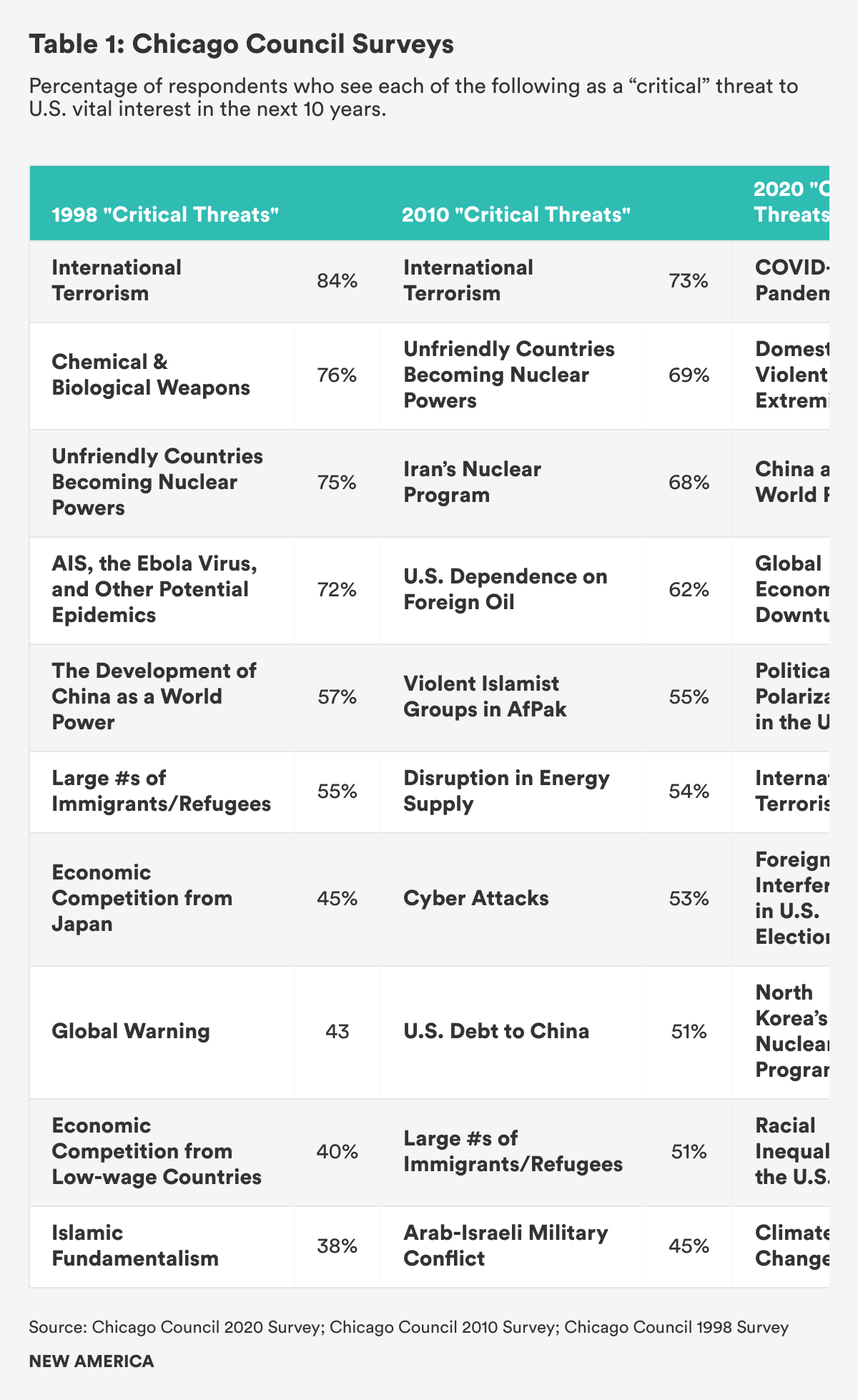
Table 1 compares the top 10 threats most often identified as critical threats by respondents in the Chicago Council Survey in 2020, 2010, and 1998.7 In 2010, Americans responding to the Chicago Council Survey identified international terrorism and nuclear proliferation most often as critical threats. The survey frames the basket of issues related to climate change around potential interruptions to energy supply and dependence on foreign sources of oil. China as a world power was ranked 13th, with 43 percent identifying it as a critical threat: While on the list of issues, great power competition with China did not rank as highly.
In some ways, the priorities of 2010 do not represent a major shift from 1998, when concerns about international terrorism and chemical, biological, and nuclear proliferation topped the list. China’s role vis-à-vis the United States and “large numbers of immigrants and refugees coming into the country” also remained on the list. However, issues that we might associate with the concept of human security, such as climate change/global warming and “AIDS, the Ebola virus, and other potential epidemics” which made the top 10 list in 1998, had fallen out of the top by 2010. Americans also had concerns about Japan as a global economic competitor with the United States in 1998, although by the late 1990s, U.S. trade anxiety about Japan had already begun to diminish.
Terrorism, nuclear proliferation, energy dependence, and even great power competition—these are all framings of security that strategists in the 1970s or 1980s understood and had the policy frameworks at hand to address. These historical framings shaped the bureaucratic development of the national security bureaucracy and research agenda over the twentieth and early twenty-first centuries.
In 2020, respondents prioritized several non-traditional security issues as the most critical threats we currently face. While long-standing security issues like terrorism and nuclear proliferation remained, the list of most critical threats in 2020 added a number of issues that many would not even have identified as potential national security threats a decade ago or more, and would instead have been viewed as domestic political issues or as "soft" security issues.
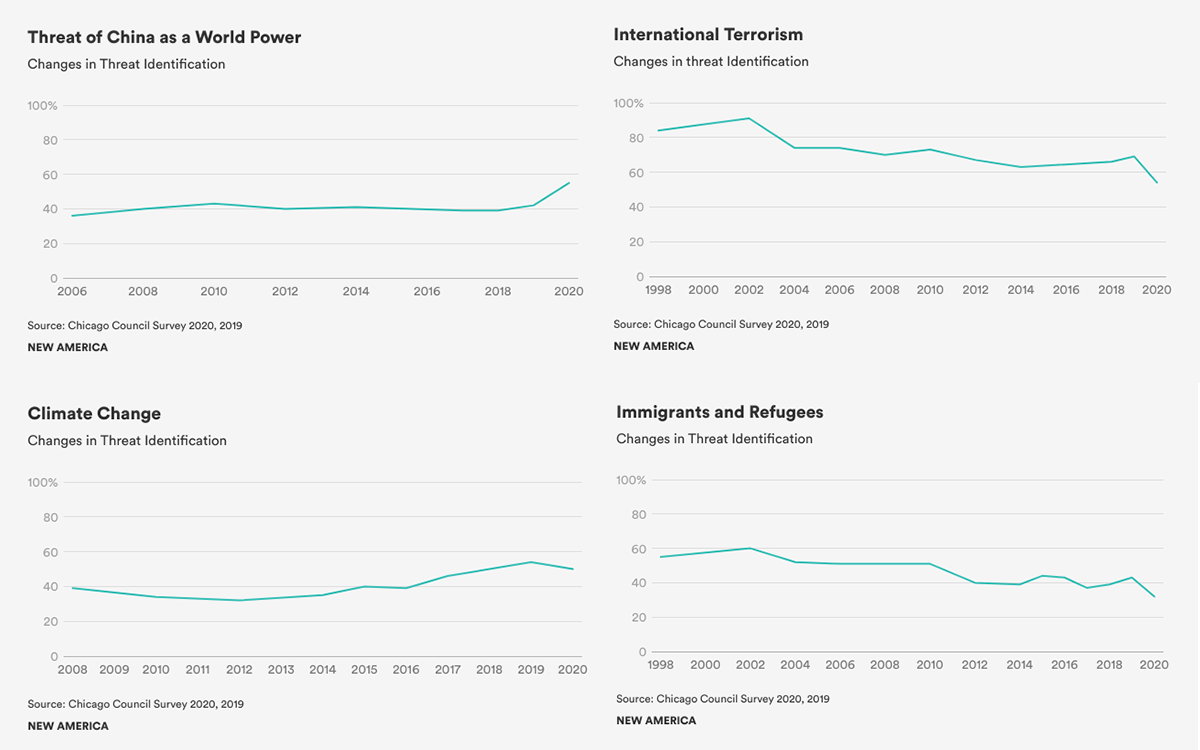
The COVID-19 pandemic—a new threat in 2020—has risen to the top of the list. Other issues including the global economic downturn, domestic violent extremism, political polarization in the United States, and foreign interference in elections also appear as top concerns. China as a world power rose to the top three critical threats. International terrorism remained a top threat, but was identified by fewer respondents as a critical threat than in 2010 and the preceding decade.
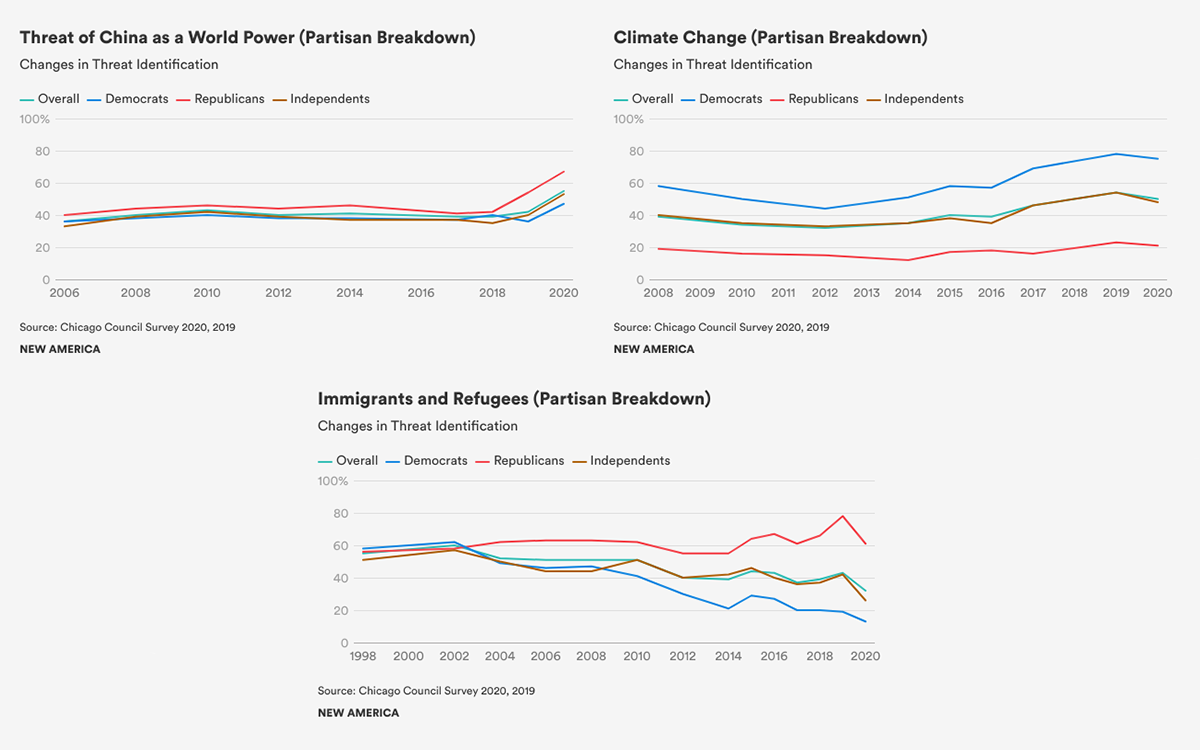
However, the survey also reveals a growing partisan divergence. On climate change, China, and immigration in particular, the Chicago Council noted in 2019 that “the gap between Democrats and Republicans is at record highs,” with Democrats more likely to identify climate change as a threat, and Republicans much more likely to see a rising China and immigration as security issues. In general, Democrats are more likely to select non-traditional issues like climate change (75 percent identified as a critical threat in 2020) and the pandemic (87 percent) as critical challenges, while “Republicans identify traditional security challenges as the most critical threats facing the country, including the development of China as a world power (67%), international terrorism (62%), and Iran’s nuclear program (54%).”8
Democrats and independents, meanwhile, were less likely to identify “large numbers of immigrants and refugees coming into the U.S.” as a critical security issue in 2020 than they were in 2002 or even 2010. The same is not true of Republicans.9 In 2019, the Chicago Council found that “more Republicans consider large numbers of immigrants and refugees coming into the United States a critical threat than any of the other 13 potential threats presented (78%). While immigration is the top threat for Republicans, only two in 10 Democrats (19%) view it as a critical threat—ranked lowest among all threats presented. This 59-percentage-point difference between partisan groups is the highest registered gap since the Council first asked the question in 1998.”10
These views appear to be shaped by political polarization and by messaging from elites to mass audiences, or "elite cues." The literature suggests that partisan divergence tends to be stronger on issues like immigration or defense spending that are more closely linked to domestic policy than on more traditional foreign policy issues, like arms control or trade.11 In an already-partisan environment, the public’s receptiveness to elite cues is shaped more sharply by partisan divergence.12 Elite factionalization, when political leaders come to see the democratic process as a zero-sum competition for political power, has steadily worsened in the United States over the past several years, according to the Fragile States Index.13
Trend lines over the last decade, and the accelerating effect of both the pandemic and the January 6 insurrection, suggest that security issues—or indeed, the U.S. political arena more broadly—are unlikely to become less polarized in the near term. This trend has profound implications for national security narratives—and for the future of U.S. security policy itself. It is a commonplace of international relations theory, across ideologies, that a nation must have foundational consensus, or at least public acquiescence in an elite consensus, in order to conduct effective policy. We have very little thinking on what it looks like to build security for a country whose residents lack shared conceptions of what threats they face.
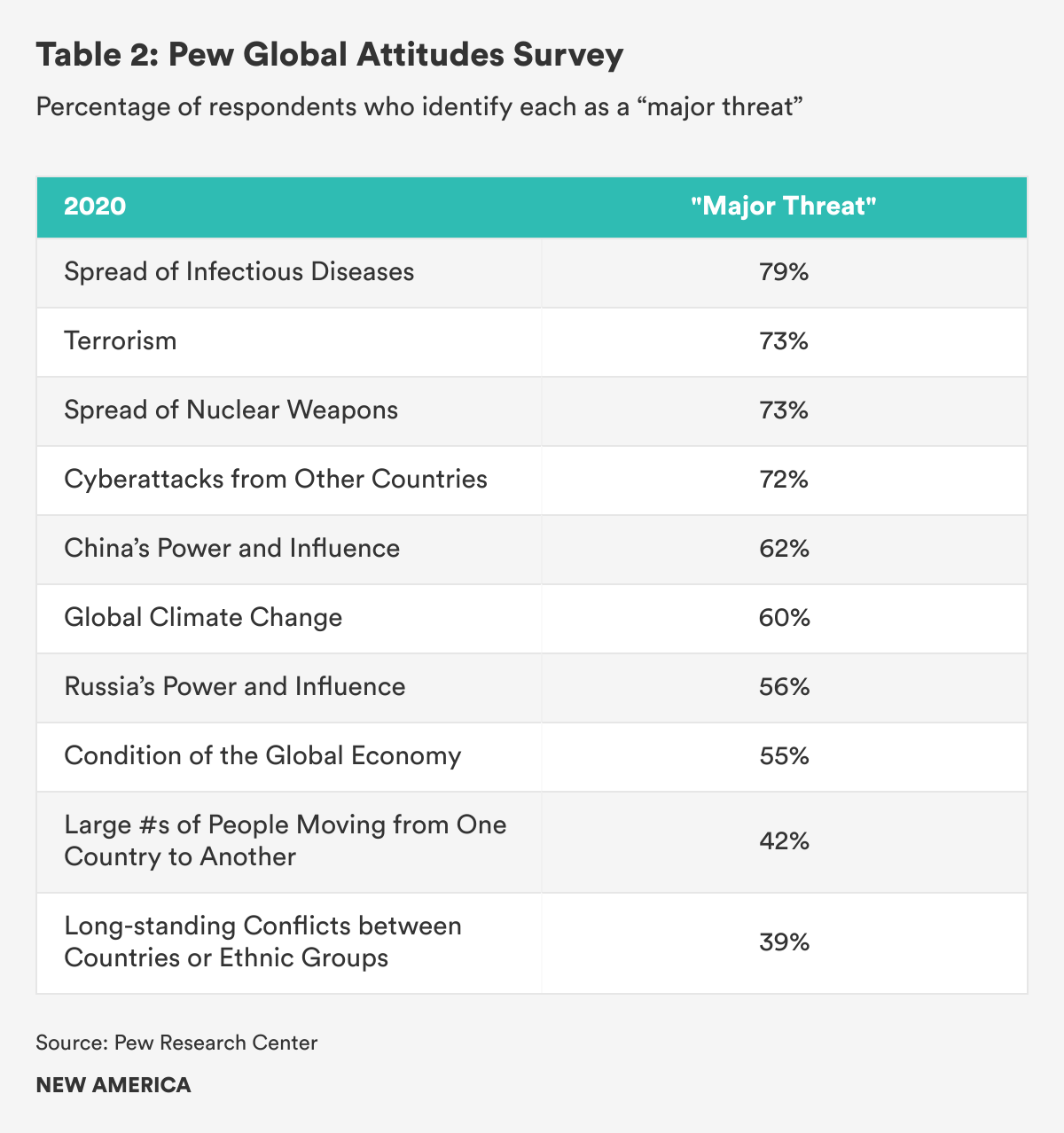
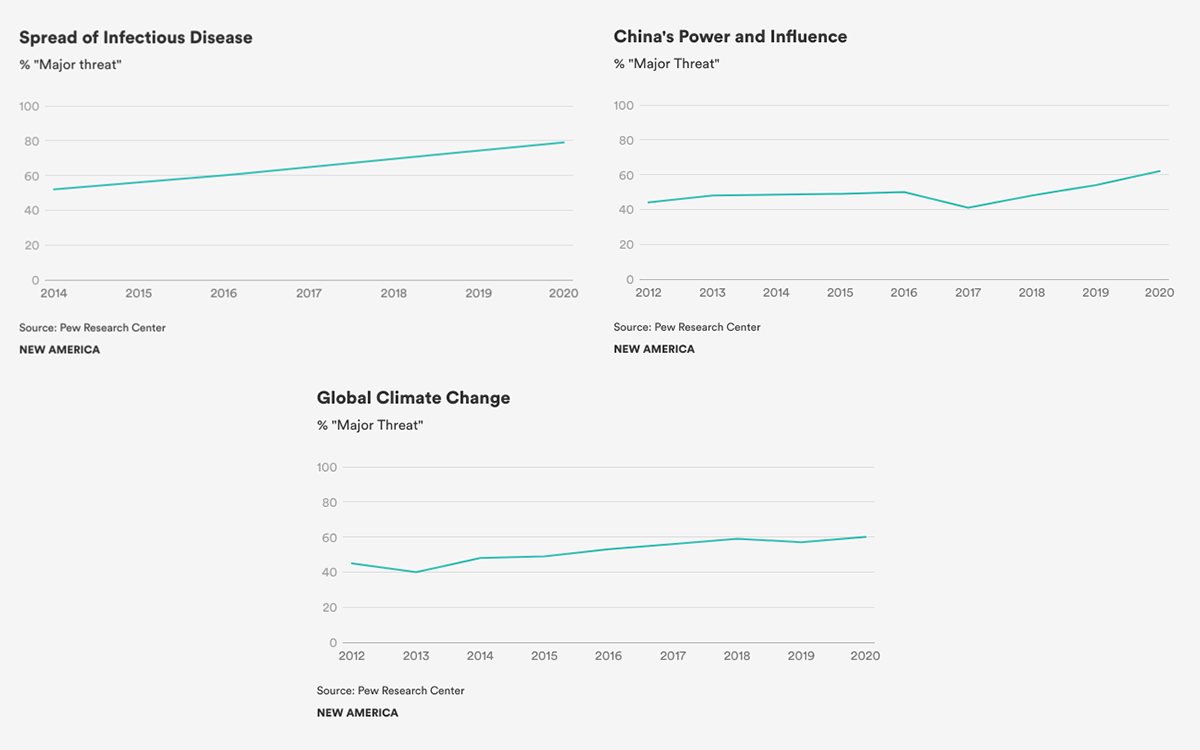
Pew Research Center’s 2020 Global Attitudes Survey surveyed respondents on a different set of potential threats but found similar results: while respondents identified terrorism and the spread of nuclear weapons as major threats, the spread of infectious diseases topped the list for the first time. Only 2 percent of respondents said that infectious disease was not a threat. “Concerns about China and the condition of the global economy have also been on the rise,” note the studies’ authors. “The survey,” which was conducted on March 29, 2020, in the midst of the first spike in COVID-19 cases, “found that worries about both the threat of infectious diseases and the condition of the global economy rose after President Donald Trump declared a national emergency on March 13.”
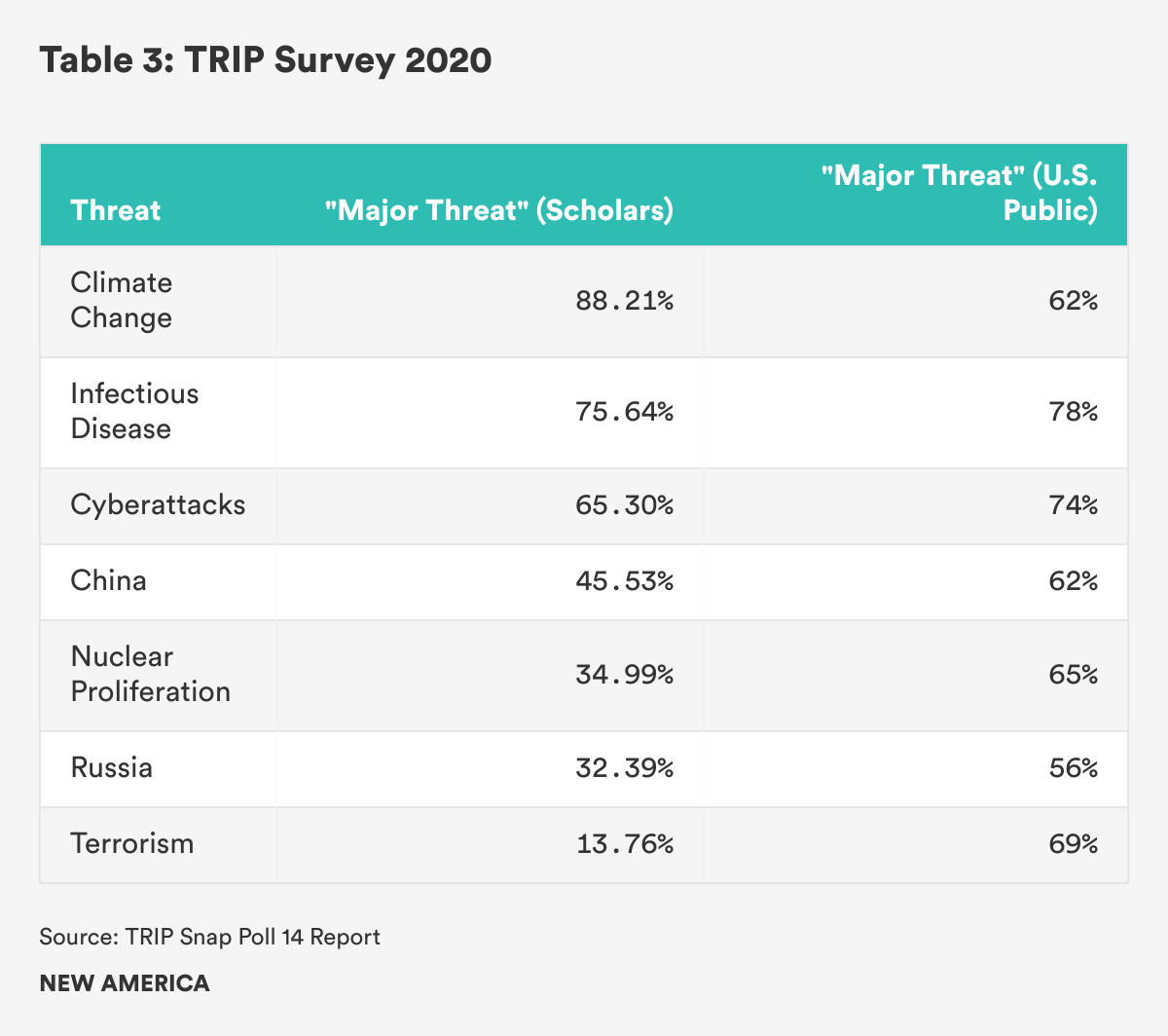
This shift towards non-traditional security issues appears even more significant amongst those who study these issues closely. The 2020 TRIP survey found that while both the general public and international relations scholars ranked non-traditional issues like climate change and infectious disease as top security concerns, scholars were much less likely to identify more traditional security topics—namely, terrorism, China and Russia’s power and influence, and nuclear proliferation—as major threats when compared to the U.S. public.
Finally, there is evidence that younger Americans’ views on national security threats are changing even more rapidly than the country as a whole. A recent Carnegie Endowment study on the foreign policy views of Generation Z noted that this generation cares “more about issues like climate change and human rights than war or great power competition. Nearly half of Generation Z say U.S. foreign policy should prioritize combating climate change; only 12 percent say it should focus on countering Chinese aggression.”14 A 2019 Center for American Progress survey found that compared to other generations, Generation Z was more likely to rank combatting climate change, fighting global poverty, and promoting human rights as one of their top three U.S. foreign policy priorities, while they were less likely to select “protecting against terrorist threats from groups like ISIS or al-Qaeda” as a top-three issue.15 While younger generations are often more progressive than those above them and may become more moderate over time, Generation Z is also coming of age in a world that looks very different than it did for previous generations.16
The DNI’s Worldwide Threat Assessment
Another way to measure perceptions of the most pressing national security threats that we face is through the unclassified section of the Worldwide Threat Assessment,17 testimony delivered annually by the Director of National Intelligence (DNI) to the U.S. Senate Select Intelligence Committee. This testimony outlines the U.S. intelligence community’s perspective on the most preeminent threats that the United States faces.
An analysis of these assessments from 2010 to 2019, the year of the most recent public assessment at the time of writing,18 shows remarkable stability in many of the top threats identified by the U.S. intelligence community. Terrorism, cybersecurity, weapon of mass destruction (WMD) proliferation, and counterintelligence have all been featured consistently as key threats since 2010. More recently, elections interference, space and counter-space, and emerging technologies have also been added.
But there has also been a consistent acknowledgement of non-traditional sources of security threat. Both health security and climate change each had their own sections in the assessment in 2010, when DNI Dennis Blair testified, “We continue to assess that global climate change will have wide-ranging implications for U.S. national security interests over the next 20 years because it will aggravate existing world problems—such as poverty, social tensions, environmental degradation, ineffectual leadership, and weak political institutions—that threaten state stability.”19
Likewise in 2010, a section on “Strategic Health Challenges and Threats,” notably written during the Swine flu pandemic, pointed out that “significant gaps remain in disease surveillance and reporting that undermine our ability to confront disease outbreaks overseas or identify contaminated products before they threaten Americans.”20
In the 2015 assessment, these issues were merged into an overarching “Human Security” section, which persisted through the most recent assessment in 2019, which included “emerging infectious diseases and deficiencies in international state preparedness to address them,” extreme weather events in combination with water and food shortages, and political instability. The 2019 assessment noted that “the United States will probably have to manage the impact of global human security challenges, such as threats to public health, historic levels of human displacement, assaults on religious freedom, and the negative effects of environmental degradation and climate change.”21
Findings
Our analysis of how Americans’ perceptions of security threats have changed over the past decade shows that:
- Threats to U.S. national security have shifted significantly over the past decade, and even the past year: Traditional security threats like terrorism, WMD proliferation, and energy dependence have not gone away, but have been joined by a range of non-traditional security threats, such as the COVID-19 pandemic and the spread of infectious disease more broadly, climate change, and political polarization. Compared with other issues, immigration is on the whole less likely to be identified as a critical security threat, although there is substantial partisan divergence. By their very nature, these emerging national security issues go beyond traditional conceptions of national security, and will require us to develop alternative frameworks and policy solutions in order to effectively address them.
- Emerging security threats may be divided loosely into two categories: transnational challenges and domestic-foreign nexus challenges. While there is of course some overlap between these two categories, and each have significant domestic and international ramifications, transnational issues spread across borders and involve cooperation from a wide range of state and non-state actors to solve, including adversaries like China. Domestic-foreign nexus issues largely originate at the domestic level in the United States (although they too have transnational connections and international ramifications). These issues will require structural reform and are politically contentious.
- Partisan divergence will make it more difficult to agree on a shared narrative. Political polarization is itself a threat to U.S. national security, as well as an accelerant of other important threats, such as domestic extremist violence and mis/disinformation, and a barrier to addressing other threats, such as climate change and the emergence and spread of infectious disease. At the same time, many of these threats have become politicized in the context of American politics, such that addressing climate change or domestic extremist violence is often viewed as taking a side. Political obstruction and dysfunction in our institutions of governance, such as Congress, will make these threats even more difficult to address. There is even significant partisan divergence among Americans about the most critical threats that we face as a country. All of this will make it difficult to agree on a shared national security narrative, let alone a shared approach to dealing with these critical security threats.
The Rise and Fall of the Human Security Paradigm
The end of the Cold War generated a seismic shift in thinking about what security means.22 The proliferation of non-state actors and increasing urgency of transnational issues like climate change challenged the central importance of the state; globalization connected the world in unprecedented ways; and regionalized sub-state conflicts in the Balkans, Afghanistan, Rwanda, and elsewhere, forcefully demonstrated that wars fought solely among state actors was no longer the most important framework for conceptualizing international conflict.
These changes pushed thinkers and practitioners to revisit a fundamental question of security: who should be protected, and from what. Traditional notions of security shaped security policy throughout the Cold War saw the state as the primary actor, and protecting the territorial integrity of the state and its monopoly over the domestic use of force as the aim. This framework placed a heavy emphasis on military tools, while largely neglecting the safety and well-being of people and communities within the state.
The United Nations Development Programme’s 1994 Human Development Report introduced a new way of thinking about security.23 The human security framework equated “security with people rather than territories, with development rather than arms.” It drew a bright line under human well-being, defining human security as “a child who did not die, a disease that did not spread, a job that was not cut, an ethnic tension that did not explode in violence, a dissident who was not silenced. Human security is not a concern with weapons-it is a concern with human life and dignity.” In situating the individual, rather than the state, as the referent object of security, the human security framework emphasized seven dimensions of threat: economic security, food security, health security, environmental security, personal security, community security, and political security.
The human security concept changed how many practitioners and theorists think about what security means, and a loose coalition of states and NGOs that took human security as their banner scored a number of tangible victories in the late 1990s and early 2000s, according to Roland Paris, including the establishment of the International Criminal Court and the signing of the Antipersonnel Mine Ban Convention.24 The paradigm’s multidisciplinary approach had important repercussions in the field of development, but did not really permeate the security studies field.25 And it had even less impact in the United States security establishment.
Yet following 9/11, the human security paradigm largely fell out of vogue as immediate post-Cold War thinking about security was overtaken by the Global War on Terror framework. It launched the wars in Afghanistan and Iraq, as well as drone wars in several countries where the United States was not officially at war;26 saw a rapid reorganization and expansion of the U.S. counterterrorism bureaucracy;27 and prompted the United States to partner with militaries around the world on local counterterrorism operations.
The same expansiveness and lack of precision that made the human security concept appealing to a wide coalition also made it less useful as a tool of policymaking and research.28 By “encompassing everything from physical security to psychological well-being,” as Paris notes, the human security framework “provides policymakers with little guidance in the prioritization of competing policy goals and academics little sense of what, exactly, is to be studied.”
Citations
- Anne-Marie Slaughter and Gordon LaForge, “Opening Up the Order: A More Inclusive International System,” Foreign Affairs, March/April 2021, source.
- Brian Kennedy and Courtney Johnson, “More Americans see climate change as a priority, but Democrats are much more concerned than Republicans,” Pew Research Center, February 28, 2020, source.
- Bonnie Jenkins, “Redefining our concept of security,” Order from Chaos, Brookings Institution, December 4, 2019, source.
- Access all of the Chicago Council Surveys since 1974 here: source
- Access the Pew Global Attitudes surveys here: source
- Susan Peterson, Ryan Powers, Michael J. Tierney, “TRIP Snap Poll 14 Report,” Teaching, Research & International Policy (TRIP) Project, Global Research Institute (GRI), William & Mary, October 2020, source.
- 1998 is the first year this question was asked in the Chicago Council survey.
- Dina Smeltz, Ivo Daalder, Karl Friedhoff, Craig Kafura, and Brendan Helm, “Rejecting Retreat: Americans Support US Engagement in Global Affairs,” The Chicago Council on Global Affairs, 2019, source, p. 4.
- In 2020, 13% of Democrats and 26% of Independents surveyed identified “large numbers of immigrants and refugees coming into the US” as a critical threat. In 2010, those same numbers were 41% of Democrats and 51% of Independents; in 2002, 62% of Democrats and 57% of Independents. That number has been more consistent for Republicans: In 2020, 61% of Republicans identified this as a critical threat; 62% in 2010; 58% in 2002. Dina Smeltz, Ivo H. Daalder, Karl Friedhoff, Craig Kafura, and Brendan Helm, “Divided We Stand: Democrats and Republicans Diverge on US Foreign Policy,” The Chicago Council on Global Affairs, 2020, source.
- Ibid, p. 28
- Joshua D. Kertzer, Deborah Jordan Brooks, and Stephen G. Brooks, “Do Partisan Types Stop at the Water’s Edge?” forthcoming in Journal of Politics, (2020).
- Alexandra Guisinger and Elizabeth N. Saunders, "Mapping the boundaries of elite cues: How elites shape mass opinion across international issues." International Studies Quarterly 61, no. 2 (2017): 425-441.Amnon Cavari and Guy Freedman, "Partisan cues and opinion formation on foreign policy." American Politics Research 47, no. 1 (2019): 29-57.
- J.J. Messner De Latour et al., “Fragile States Index 2020 – Annual Report,” The Fund for Peace, May 8, 2020, source. For more on the “factionalized elites” indicator, see: “C2: Factionalized Elites,” Fragile States Index, source.
- Samuel Barnett, Natalie Thompson, and Sandy Alkoutami, “How Gen Z Will Shake Up Foreign Policy,” Carnegie Endowment for International Peace, December 3, 2020, source.
- Center for American Progress: Foreign Policy and National Security, Nationwide Online Survey, February 25-March 3, 2019, source.
- Colby Itkowitz, “The next generation of voters is more liberal, more inclusive and believes in government,” Washington Post, January 17, 2019, source.
- Previously called the Annual Threat Assessment.
- Jodie Fleischer, Rick Yarborough, and Lance Ing, “Public Report on Worldwide Threats Is More Than 7 Months Overdue,” NBC Washington, September 22, 2020, source.
- Dennis C. Blair, “Annual Threat Assessment of the US Intelligence Community for the Senate Select Committee on Intelligence,” February 2, 2010, source, p. 39.
- Dennis C. Blair, “Annual Threat Assessment of the US Intelligence Community for the Senate Select Committee on Intelligence,” p. 41.
- Daniel R. Coats, “Worldwide Threat Assessment of the US Intelligence Community,” Statement for the Record: Senate Select Committee on Intelligence, January 29, 2019, source, p. 21.
- Jessica Tuchman Mathews, “Redefining Security,” Foreign Affairs, Spring 1989, source.
- UNDP, “Human Development Report 1994: New Dimensions of Human Security,” 1994, source.
- Roland Paris, "Human Security: paradigm shift or hot air?" International Security 26, no. 2 (2001): 87-102.
- United Nations Trust Fund for Human Security, “What Is Human Security,” source.
- Peter Bergen, David Sterman, and Melissa Salyk-Virk, “America’s Counterterrorism Wars,” New America, March 30, 2020, source.
- Alexandra Stark, “COVID-19 Is This Generation’s 9/11. Let’s Make Sure We Apply the Right Lessons,” New America Weekly, April 23, 2020, source.
- Benjamin Zyla, “Human Security,” Oxford Bibliographies, source.