Jeremy Bauer-Wolf
Investigations Manager, Higher Education

Bryanna Bailey had just been kicked out of college.
It was early June, and the 34-year-old had settled down in the room she shares with her young son in her parents’ Florida home. When she logged onto her online courses that day, she found the links to her lessons were grayed out and inaccessible. Panicked, Bailey pulled up a chatbot that the college set up for students to report problems. She had wrapped up all of the lessons she could in her AI software engineering program. But per the college’s policy, she still needed to participate in some form of academic work weekly to stay enrolled.
Bailey didn’t understand she had violated this policy at first. Over and over, she asked the chatbot to talk to a real person. “It’s a personal issue and I’d like to speak to a human,” she wrote.
The chatbot refused repeatedly, and informed her she had been withdrawn. It did offer her a URL where she could reapply to the college.

It’s a personal issue and I’d like to speak to a human.
Bailey has never spoken to any employee of Maestro College. To her knowledge, nor have her classmates. No faculty give lessons at Maestro. No employee database is readily available, so students often don’t know who handles crucial services for the college, like financial aid. Absent such a list, some students don’t think those staff members exist.
Maestro markets itself as a free, accredited college, where students can embark on online degree programs at their own pace, spearheaded by an AI instructor. At the school, which at one point last year was advertising itself on TikTok as “the AI University,” a chatbot “teacher” will walk through lessons, ask students questions, and guide their examinations. It’s a tempting prospect for students who may be cash-strapped or feel mismatched with a more traditional college.
In practice, I found through months of public records requests, interviews, and research, Maestro is a hasty rebrand of a brick-and-mortar for-profit college that was floundering financially. It is also not free. Its business model appears structured to maximize Pell Grant revenue from students. This pot of financial aid benefits the country’s poorest households—and is paid for by taxpayers.
This financial aid scheme may be illegal, as it’s structured like a program at an Ohio college that was closed down. Adding to these concerns, one of Maestro’s owners has led another for-profit college accused of engaging in systemic fraud, ATI Enterprises.
Maestro’s instructional model features an AI “instructor” that substitutes for human interaction. A faculty member whom I spoke with, and granted anonymity to, said he has never communicated one-on-one with students, and only makes contact with them on online discussion boards that, until recently, were optional. Maestro officials disputed this characterization of instruction to me, arguing the faculty members have an active role in monitoring and teaching students.
@maestro_ai_university Hello future, goodbye tuition bills! #theaiuniversity #becomeanything #learning #futureoflearning #career #ai
♬ original sound - Maestro — The AI University
Source: @maestro_ai_university, TikTok video, June 19, 2025.
There are other digital barriers. When students need help, for instance, with disability accommodations, they typically send their requests through an online portal, where it’s not guaranteed a human will respond to them. Those answers can come from nameless email addresses.
Such a laissez-faire approach might anger students, but most of them feel they’re getting a Maestro credential for free. The college is a new sort of education, it is working out all of the kinks, students told me. And if they’re not paying out of pocket, the stakes seem lower.
Most students don’t understand the fine print of federal aid, though. Pell money is finite. Once students have exhausted their individual lifetime financial aid limits, they can’t tap the grants to help pay for college down the line. They might not be able to afford college ever again. Maestro students who deplete Pell aid on a chatbot-delivered degree may only discover this fact when they try to land at another college.
Maestro’s owners built the college in a way that has so far allowed them to dodge oversight from regulators, like its accreditor, which helps judge whether the institution should qualify for federal aid. As it has come online, Maestro seemingly has run afoul of not just accreditor rules, but likely also federal laws and regulations.
Still, Maestro has seen success, which reflects the realities and anxieties that define U.S. higher education today.
Like on cost. The institution’s pitch, a “free” credential, has proven alluring, juicing its enrollment, reaching 7,000 to 8,000 students, according to Maestro officials, when its previous fall enrollment often didn’t reach 100 students at its primary campus. Many Americans still view their postsecondary dreams as too expensive to pursue, even with the upward social mobility a degree promises.
Students I talked to were cynical about that promise, though. Those who attended college before Maestro told me they were adrift and alienated at more traditional campuses. They said instructors couldn’t (or wouldn’t) assist them if they didn’t grasp the work. That they didn’t feel they could ask classroom questions without drawing the eyes and judgments of their peers. An AI teacher, however flawed, can devote as much time to students as they wish. It can rewrite questions to a context that fits their lives. It doesn’t make them feel dumb, students told me. Using AI has created a sense of belonging in a space that Maestro students have perceived as excluding them.
That often overrides their concerns about the quality of Maestro’s education, including that the AI chatbot can make mistakes. A couple of students told me the AI “instructor” has marked answers wrong on an exam when they are correct.
Colleges, too, are anxious about AI use, as it floods every corner of society. Financial and cultural strains—a plummet in birth rates from the Great Recession and the Trump administration’s pressure campaign against colleges, among them—have already constricted institutions. AI appeals to students. Colleges must acknowledge this. They are well-positioned to help incorporate the technology into the classroom and beyond, especially since government regulations have not yet kept pace with AI.
Maestro College may be a fleeting venture. Its accreditor—in response to my team at New America flagging Maestro’s potential policy and legal violations earlier this year—suspended enrollment to the college in June. But AI is not temporary. If Maestro is any indication, higher education’s regulatory and policy machinery is not yet equipped to meet the challenge.
Whether students spend months hunting for the right school, or they know right away they want to attend their local community college, actually enrolling can be daunting. Students and families may talk to staff and administrators on multiple occasions as they mull over programs and try to parse the quirks of each college’s financial aid packages. The unease around this process has only heightened as the public has grown mistrustful of the value of college—and institutions in general.
At Maestro College, no adviser sits across a desk, or on the phone, to walk applicants through their choices of academic major or financial aid options. Enrollment is self-serve. Maestro students apply, enroll, and generally have to figure the rest out themselves. Without those clear points of contact, students seek answers in all sorts of places: with the college’s online portal, which may never put them in touch with a human, or their peers online, whom they’ve never met.
The college functions online, rebranded from an existing for-profit school in Texas (more on that later) and focuses on certificates and associate degrees. One of Maestro College’s owners also converted a second for-profit school, in Utah, into Maestro University, and have been attempting to assemble an academic pipeline where students can move from an associate’s degree at the college straight into a bachelor’s program there.
To apply, students only have to share basic information about themselves on a school webpage—for example, whether they attended college previously, and their income. They typically receive an admissions decision within a couple of weeks, students told me.
Students accepted to degree programs and who make under $100,000 a year receive what the college has labeled its “pro scholarship.” Every student enrolled at Maestro receives this scholarship, according to the college. This makes the entire education free, Maestro claims.
Not quite. The college has developed a pricing strategy that follows the traditional for-profit college playbook.
Federal aid is the lifeblood of American colleges. Most rely on Pell Grants and student loans to grow and stay in business. Predatory for-profit colleges have historically exploited this system, targeting and enrolling as many low-income students as possible and, in doing so, reap gobs of federal money.
Maestro’s scholarship is “last dollar,” meaning it covers all tuition costs—but after students apply all of their other financial aid, like Pell. Students can take out federal loans, too, for living expenses.
Maestro president Shakeitha Sims initially told me in an interview that between 5 percent to 6 percent of students do not receive any federal financial aid. But she wrote in an email later that she misunderstood my question and that actually, about 62 percent of students do not get any federal aid.
I reviewed the financial aid offers of five Maestro students, and found four of them received the maximum amount of Pell possible per academic year, $7,395. Maestro is hoovering up all of it, as well as the $3,698 in Pell each student would normally spend on summer classes. The “scholarship” covers the rest of tuition, but essentially, most of the students I interviewed are burning through three years’ worth of Pell dollars for a two-year associate degree. And this degree has been outsourced to an AI chatbot, rather than professors.
I explained this to one of the Maestro students I spoke with. Lucy King, who is 42, signed up for Maestro because her diabetes had progressed to the point that she couldn’t stand for long periods. She had to give up her full-time work as a human resources professional and wanted to test out a new career path. (Lucy King is a pseudonym; she asked to remain anonymous for privacy considerations.)
When I talked with her in June, King told me that even though she had some concerns about the school, she appreciated Maestro because she felt judged in a conventional college classroom “for not knowing anything.”
After I walked through with her that the college wasn’t actually free, and how the Pell aid she was expending on the program was limited, she had a different reaction. “Now that’s a problem,” King said. “Because at this point, that’s my financial aid. I’m well over the age for having considered my parents’ income. So the fact they’re taking money that is money that is mine for my education, I could have gone to my local community college…” She trailed off.
As my colleagues and I wrote last year, access to federal aid was decisive in pulling one of the most prominent for-profit cosmetology chains in the country back from the brink of financial ruin decades ago. In the 1970s, Empire Beauty School was losing students, fast. Becoming eligible for federal aid at that time swelled enrollment—and the chain’s budget. It was a financial lifeline the college needed, even though its graduates weren’t consistently finding jobs, or paying off their debts. Today, Empire has more than 70 campuses nationwide and in 2024, raked in $65 million in federal aid.
Maestro’s gambit achieved similar results, and its student numbers skyrocketed. But sudden jumps in enrollment are often a hallmark of a for-profit college looking to take as much financial aid as it can, Denise Morelli, a former U.S. Department of Education attorney of more than 30 years, told me. Denise worked to enforce colleges’ compliance with financial aid programs, known as Title IV, and helped with high-profile cases, including one of the worst-known cases of cosmetology fraud, the Marinello School of Beauty.
Major enrollment spikes are “a red flag that there are likely serious Title IV compliance issues, if not fraudulent activity, at an institution, especially in the for-profit sector where in many cases more bodies mean more profit,” Denise said.
And Maestro was after more bodies. For instance, Maestro projected an aggressive enrollment uptake in its associate of applied science in business administration program, from 120 students in the first month to more than 1,000 by the end of the first year of the program, according to public records.
students enrolled in the first month of the program
enrolled in the program by the end of the first year
Its financial aid ploy in particular is an urgent matter for regulators. It mirrors an aid program that the Education Department in 2022 alleged to have violated federal rules. An Ohio community college maintained a scholarship, like Maestro, and charged Pell students the exact amount of what their grants covered. It zeroed out the bills of non-Pell students, too, labeling the reduction a “scholarship,” but the Education Department determined that the scholarships weren’t backed by real accounting, and the school was actually shifting Pell money to subsidize those who weren’t eligible for the grants.
“Essentially, under this program, students who receive Pell funding are being charged for the program, but students not receiving Pell are not,” the Education Department wrote in a letter to the institution, Eastern Gateway Community College, which shut down in 2025.
Maestro may be carrying out the same scheme. Students’ scholarship agreements outline how the school will “cover any remaining tuition after eligible federal or state aid” (emphasis added)—“even for scholars who don’t qualify for any federal or state grants.”
Sims also said during our interview that the school is “essentially” zeroing out tuition bills.” I asked Denise Morelli, who worked on the Eastern Gateway case, to review Maestro’s enrollment agreements to confirm that arrangement appears the same as that used by the community college. It does. If Maestro Pell recipients are charged a different rate than those without the grants, the college would be in violation of federal financial aid rules.
Student onboarding at Maestro resembles no typical college. Once they enroll and secure any financial aid they’re eligible for, students are encouraged to register for a Reddit account. Maestro has dedicated a Reddit page for students to talk with one another, and college officials can post updates about the school. The college uses Reddit to communicate about everything from financial aid to explaining punishments by its accreditor.
Reddit may have been intended to replace a Maestro email address, which students didn’t have for months until they complained.
One of Maestro’s selling points, which several students mentioned to me, was that the college sends them a free laptop—though that perk has lost a bit of its luster. Students told me Maestro used to distribute the laptops right away, but now they must wait until they finish their first term. The laptop itself changed, too: Maestro recently switched from the MacBook Air to a cheaper model, the MacBook Neo, which has the same processor as the iPhone. Students in my conversations criticized the Neo for not being powerful enough to handle the coding work they would learn.
For some students, the new laptop was a necessity, not a bonus, and the turbulence around getting one undercut their studies. Corey Smart signed up for Maestro last year, tapping into her Pell Grants. She qualified for the maximum amount. Then, the college was still distributing laptops immediately, Smart said, but hers did not arrive on time. The Floridian, who has dyslexia, had to try to master coding on her cracked, outdated iPhone screen.
She said she reached out to Maestro a couple of times to sort out the laptop issue and the fact that she was falling behind on her work. She didn’t hear back. In December, she was hospitalized for about 10 days with pneumonia and couldn’t follow up with the school. By the time she was home, Maestro had ejected her from the program. Smart told me she could have just dropped out, but the college then presented her different degree options that had become available, and she reenrolled.
“I don’t think I really could have caught up,” Smart said of her coding program.
Maestro students progressively unlock multi-lesson courses once they enroll. They can advance through those classes at their own pace, but Maestro doesn’t give access to all of them at once, so students can’t blow through an entire term in a week or two. Once students wrap up those lessons with the AI bot, a final review opens, and they have a set amount of time to work through it.
They will never have to communicate with a real-life instructor in order to finish a class, several students and one adjunct faculty member told me.
That faculty member, Kody Jones, found Maestro on LinkedIn and started his job in January. (Kody Jones is a pseudonym, since he asked to remain anonymous to avoid retaliation.)
Jones said he has never talked with any students. He said the college pays him $1 for every post he makes on the discussion board for students, and $4 for each final review he checks.
Maestro officials told Jones he could use AI to generate replies on the discussion boards, he said. And ostensibly, Jones was hired to teach one particular subject, which I am not disclosing to avoid identifying him. But he weighs in on the discussion board on topics of all sorts, like basic psychology.
“I can’t say I’m very knowledgeable about that,” he admits.
Verifying final reviews is part of his job because sometimes the AI will mark a student’s answer wrong, even if it’s correct, Jones told me. Whenever students take lessons, there’s a disclaimer in small print at the bottom of the college’s interface: “Maestro can make mistakes. Check important information.”
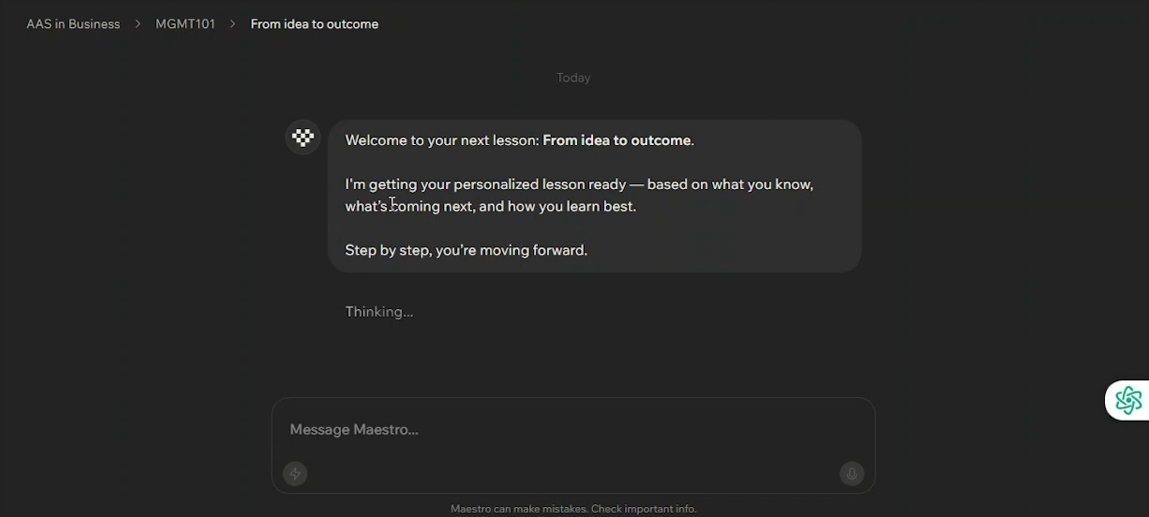
Jones said he can’t see the identity of the students whose exams he’s reviewing. But he’s noticed that students will post on the discussion boards, asking for help, asking to speak to a teacher.
“I have no means of resolving that or reaching out to the student,” Jones said. “At this point, I don’t even know what I’m doing. That’s not how academia is.”
Federal regulations mandate that students have regular, substantive contact with their instructors. The penalty for failing to provide this kind of meaningful instruction across an entire college would be removing its Pell Grant eligibility.
When I interviewed Maestro officials in June, they took exception with that faculty member’s description of the instruction. They were eager for me to talk to other faculty—who they picked. I had told them my deadline was in a couple of days, and so, on that same day I interviewed Maestro’s leaders, they speedily set up another call with me and three faculty members. The president, Shakeitha Sims, also sat in on the call.
The call was clearly engineered so Maestro officials could dispel the idea that faculty weren’t interacting with students. It did not. Those on the call confirmed with me that until recently, the discussion boards were optional. They also outlined how faculty draft curriculum, and have access to students’ progress so they can reach out if a student is flailing academically. One faculty member claimed that staff members regularly call students to check on them when that’s the case.
When I asked, though, where the mandatory interactions between students and instructors occur during lessons, one faculty member, Emerald Artist, said: “I don’t know that there were many opportunities for that.”
“I actually think that’s a very beautiful thing …. and we are able to initiate our interactions with students who have deeper questions,” Artist said on the call. “By lessening the mandatory interactions, we’re seeing more engaging interactions, if that makes sense.”
Immediately after Artist gave that answer, Sims ended our interview.
I asked Maestro for a response to what Artist had said, and it provided a statement, which I am publishing here in full.
“All programs include Regular and Substantive Interaction (RSI), delivered by a team of more than 140 faculty members. Maestro has always met this standard through required faculty grading, feedback on coursework, and faculty responses to academic questions within 48 hours, often the same day,” it reads in part.
Maestro officials did acknowledge they’re in violation of its accreditor’s policies for the classroom. The Council on Occupational Education, or COE, demands at least a quarter of a college’s students—measured in full-time equivalents—take classes face-to-face. COE wrote to Maestro in June, noting that with the leaps in enrollment, the school was flouting that policy.
Maestro leaders told me in June they planned to comply with the 25-percent requirement.
Like COE, I had also suspected that this AI college wasn’t really using the physical address listed in some of its documents online. I decided to check.
A course catalog for Maestro online indicates that some of its day classes occur for several hours on Mondays through Wednesdays weekly. I sent a Dallas local to the main Maestro campus in mid-June during that time, and the college’s suite was dark and empty.
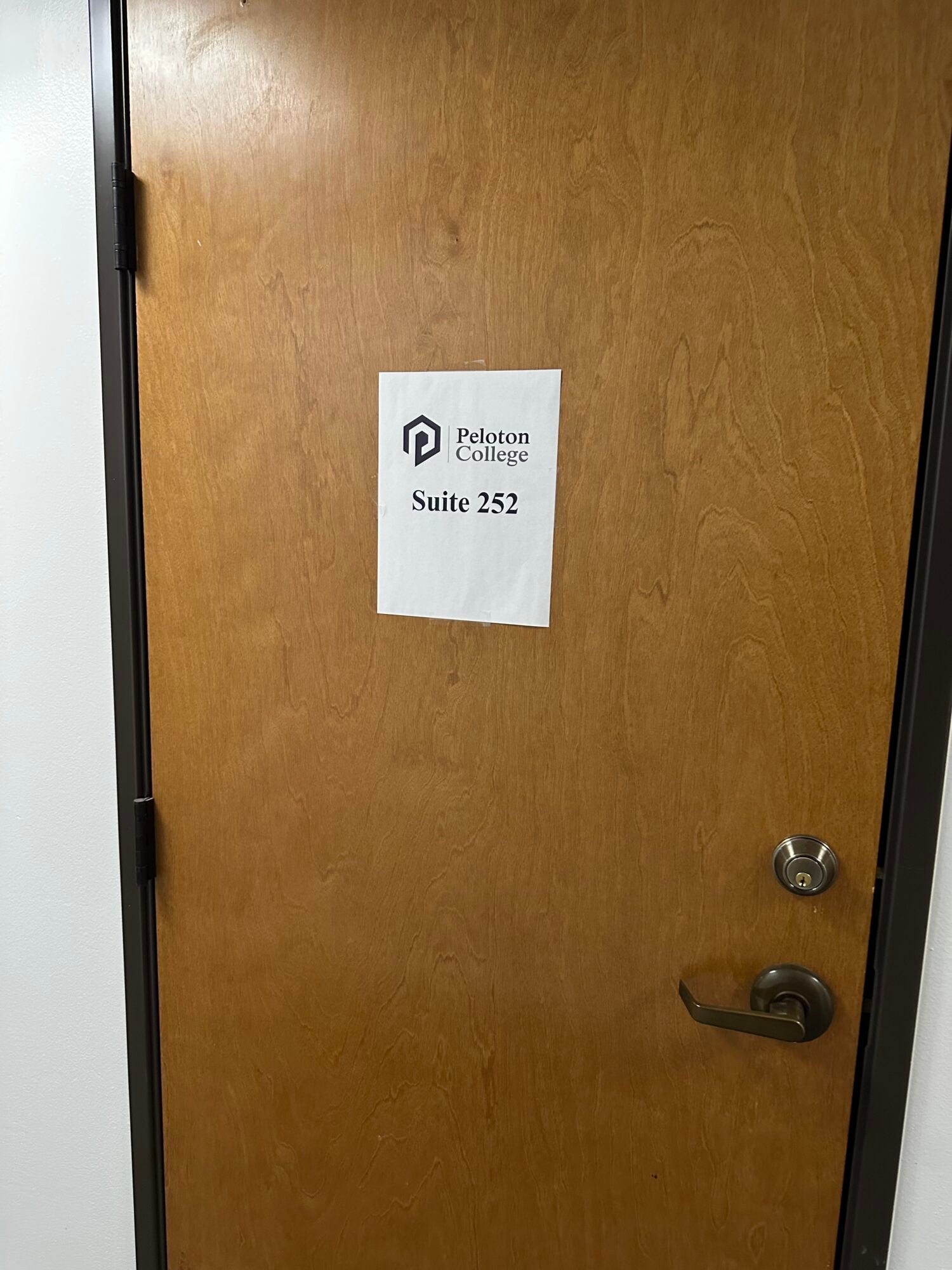
No staff or students present, and there was a sign advertising the institution under its old name affixed to a suite door.
In its June letter, COE noted the incorrect signage, which Maestro officials told me has since been fixed. The accreditor investigated four complaints it had fielded over the last several months, it wrote, including allegations of “limited or no direct human interaction with institutional personnel” and “over-reliance on artificial intelligence.” The accreditor issued the school a “show cause” order, which forces Maestro to explain why it shouldn’t lose accreditation. It also blocked the college from enrolling new students, effective immediately. Maestro now must submit a plan for what happens if COE revokes accreditation, and students want to transfer.
Maestro was once Peloton College, a Texas-based, for-profit institution with a lot of problems.
Peloton had opened as a modest legal training school, but it began to resemble the institution it is today in 2009, when it gained access to federal aid.
To qualify for that money, Peloton needed accreditation. It secured it with one of the most notoriously passive accreditors in American history.
The Accrediting Council for Independent Colleges, or ACICS, would become known for rubber-stamping some of the worst for-profit operations. Among these, Corinthian Colleges and ITT Tech are the most notable. The overnight implosion of both of the chains a decade ago exposed to the public the profound failures inherent in some for-profit operations: the anemic quality of their programs, their relentless recruitment tactics.
ACICS was so toothless as a watchdog that the federal government in 2022 took the exceedingly rare step of removing its power as a financial aid gatekeeper, and it folded after.
But even with ACICS’ reputation for leniency, it rescinded Peloton’s accreditation in 2018 because so few of the school’s graduates were finding work. Peloton jumped to COE, its current accreditor, that year, escaping ACICS’ sanction. But the school’s financial burdens were still mounting.
The school’s headcount was never gargantuan. But by fall 2024, enrollment on the Dallas campus had sunk to 60 or so students, plummeting from roughly 170 students just a few years prior, in fall 2019, according to federal data. Diminishing enrollment drags on the bottom line. Last year, COE put the college’s accreditation on probation over financial concerns.
The institution was so short on cash that early this year, according to emails, it was not eligible to participate in a national reciprocity agreement allowing colleges to enroll online students across most state lines. That would mean it couldn’t accept out-of-state students into online programs, which could further threaten its finances. The college ultimately rejoined the pact when it submitted updated documents showing the health of its budget had improved—marginally.
It needed financial salvation. It found it with an Israeli company called Masterschool.
Peloton was on life support for years, but Masterschool was awash with investor capital, a $100 million round of seed money in 2022. At the time, Masterschool wooed investors with its business around income-share agreements. With an ISA, students don’t front college tuition themselves but pay it back in installments once they land a job. Income-share agreements have so far not been commonplace in the United States, in part because the government ramped up ISA scrutiny. In 2021, the Biden administration clarified that ISAs are a type of private loan, subject to more stringent lending laws.
Masterschool specializes in coding and other tech programs, notably in Germany, where students can tap government vouchers called Bildungsgutschein to pay for them, similar to Pell Grants. Online student reviews of Masterschool programs are highly mixed.
Masterschool connected with Peloton after college officials noticed its in-person enrollment waning, they told me. In a letter in April 2025, COE confirmed the new ownership structure with school officials: Masterschool had bought up a 20 percent stake.
It only claimed a small share in the venture, but its involvement ushered in the wholesale abandonment of Peloton’s model. A “beta” version of Maestro’s website had sprung up by that April, according to online archives.
Masterschool taking a minority ownership position dodged closer COE scrutiny. The accreditor operates two tiers of review—one for more routine changes at a college, which only requires it be notified, and one for more substantive developments, which sends staff to a campus and triggers a vote from the accreditor’s governing body. That more extensive assessment would have caught the absence of real faculty at Maestro. But COE only applies it to changes of ownership when 50 percent or more of an institution’s assets shift to another person, according to its policies.
Other evidence that Maestro rushed the transformation from Peloton, perhaps to project legitimacy to regulators, abounds.
For instance, students who complained have sometimes been forwarded to a real person: Sims, the president.
While a president often serves as a public face for a campus, it is unusual for one to become involved in the minutiae of individual student cases and their financial aid. But Sims has done so continually, according to documents I reviewed. The college has publicly urged negative reviewers on Google to reach out to Sims directly, and posted her email address.
When I questioned Sims about her role, she said she served as both a campus president and the financial aid director, a remnant from when Maestro was a smaller operation as Peloton. She said there are about 19 staff members in student services.
In one email I reviewed, Sims told a student she was the correct point of contact not just for financial aid, but also for questions on “transcripts, enrollment verification, and academic records” and for “ADA accommodations, exam adjustments, and related support.” These assignments would typically not fall to a campus president.
Large sections of two Maestro catalogs also appear lifted verbatim from one from Peloton—importing policies designed for the brick-and-mortar institution that make little sense for a college now operating seemingly entirely online.
Peloton’s catalog, dated January 2025, and Maestro’s, from October 2025, both specify that students must attend an informational interview and tour a school facility before they’re admitted, unless they’re taking seminar courses. None of the students I spoke with had ever done that. A newer version of Maestro’s catalog, from January 2026, exempts students from the admissions tour and interview if they’re enrolled in fully online classes.
It’s not unusual for colleges to update these kinds of materials over time. But students I spoke with had been handed outdated catalogs, or they had unearthed other versions of it using AI search tools.
Each layer of that operation students try to make sense of independently compounds their confusion.
On one occasion, when Bryanna Bailey was trying to figure out who to contact for exam accommodations, she stumbled upon Peloton’s website, which remains active. She said she had no idea if she should try to reach out to any of the contacts she found there. “I didn’t know who I was supposed to talk to,” Bailey said. “No one was being helpful.”
While a skeleton staff absorbs student complaints, Maestro’s actual owners remain out of their view. They include Larry Jobe, who was a founder of Peloton, according to public records. He also is on the board of directors for Mannatech, a multilevel marketing outfit that hawks supplements that the company allegedly told customers could cure cancer and Down Syndrome.
I connected personally with another owner, Carlos Strength, who goes by Carli, in March, when he called my cell phone. I had filed a public records request in Texas, and the agency I was working with wasn’t sure whether it could legally release certain documents. It sought advice from the state’s attorney general, and in doing so, notified the college’s leadership that I was asking for records.
Strength wanted to know who I was, if I was writing about Maestro. I told him I likely was. As we were speaking, I pulled up Strength’s LinkedIn, and asked if this was his first foray into higher education. He said no, that he also had worked at ITT Tech. That wasn’t listed on his profile.
Later in the conversation, I told him that I would welcome talking to him again, that my aim was to ensure students aren’t exploited, and that this was a goal that I’m sure he shared.
Strength agreed with that sentiment. But after researching him, I had more questions. Strength worked at ITT Tech, the ill-famed for-profit chain, as an admissions director in the 1990s, he later told me in a June interview. During that chat, he vocally objected to the idea that I would frame his employment with ITT Tech as part of a pattern that he was a bad actor in the for-profit space. That’s fair. But Strength was also once chief executive of ATI Enterprises, a collection of for-profit schools accused of defrauding students.
Strength was at ATI’s helm 15 years ago, when Texas informed the school it had found that it misrepresented how successful its graduates were finding jobs. Strength left the organization in 2011. Two years later, ATI settled a case with the U.S. Department of Justice for almost $4 million. It had accused the schools of not only fraudulent job placement rates, but also illegally trying to “induce students to enroll.”
“This falsely increased the schools’ enrollment numbers, and consequently, the amount of federal dollars they received at the expense of taxpayers and students, who incurred long-term debt,” the Justice Department said at the time.
Strength, Larry Jobe, and two other Peloton officials—Larry Van Loon, one of the owners, and Arthur Rodriguez, its former chief administrative officer—were sued by three whistleblowers, former employees, in 2019. The trio, one of whom was a former Peloton president, alleged the college’s leadership would fraudulently alter student records, in part to avoid having to refund financial aid. They also accused the Peloton officials of providing its accreditor and a Texas agency with falsified documents, and illegally paying employees bonuses to aggressively recruit students.
The whistleblowers dropped most of the central claims against Peloton and its owners after the federal government declined to intervene in the case.
Strength, in his conversations with me, emphasized the fact that the government didn’t take up the case, calling the lawsuit “baseless.”
However, there’s any number of reasons the government wouldn’t pursue False Claims Act litigation, and not just because it didn’t see merit in the accusations, said Renée Brooker, the former civil frauds assistant director at the U.S. Department of Justice, and who specializes in such cases. “I liken it to, someone murders their spouse, the government says, we can’t pursue the guy right now, we need proof, we can’t find specific intent to kill,” Brooker said. “It doesn’t mean they cleared the guy.”
A federal judge dismissed the remainder of the case in 2021 because two of the whistleblowers had signed agreements with Peloton that they would arbitrate legal claims they brought against the school. No one ever ruled on their actual accusations.
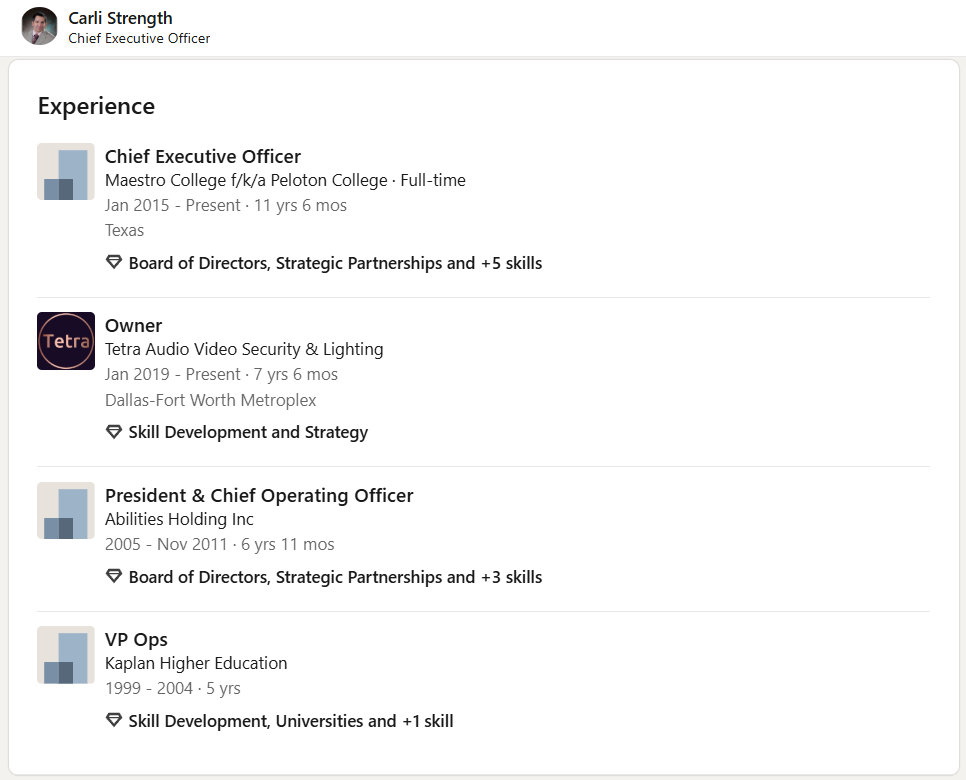
Strength told me he is a minority owner of Maestro. Some public documents I received also list him as Maestro’s CEO, but he said later in Education Department records that he is chief financial officer, and formerly chief information officer. Sims, the president, told me in an email she serves as chief executive for the Education Department’s purposes. Strength is “strategic CEO for Maestro College,” Sims wrote in an email.
Strength also called himself CEO, up until recently. I captured a screenshot of his LinkedIn profile on June 23, 2026, where he listed himself as Maestro’s chief executive.
Strength and Peloton’s other owners do not appear to have any stake in what was known as Bottega University, the Utah-based for-profit campus that Masterschool took full control of and rebranded as Maestro University, according to a November 2025 letter from the institution’s accreditor, the Distance Education Accrediting Commission, DEAC.
Bottega hasn’t historically been eligible for or accepted federal financial aid, so Masterschool has been trying to lock down various approvals, so it can carry students from an associate to a bachelor’s degree, according to posts on the school’s Reddit page. DEAC approved the ownership change late last year, and intended to follow up six months after the sale to Masterschool closed, which was in December 2025, according to the institution’s catalog.
DEAC is still reviewing Maestro University’s applications for “substantive changes” the school is attempting to make, the commission’s executive director, Leah Matthews, wrote in an email. Matthews wrote that the sanction against Maestro College “is also an important factor” in DEAC’s review.
Tim Harrington, the president of Bottega, now Maestro University, did not provide a comment by publication time. He sits on DEAC’s primary governing body.
Maestro should be shut down. Its owners have seemingly concocted an operation where they fund the barest minimum of services that colleges normally maintain. That in turn would enable them to maximize the amount of financial aid—taxpayer money—they rake in.
The college has emerged as an early example of the type of scheme possible in an AI-saturated society. It will not be the last, and college regulators must react accordingly. This will entail a long, significant policy overhaul among accreditors, and state and federal governments. Maestro should reconsider the following policies:
Whenever any private college changes owners, its accreditor should treat this as what’s known as a “substantive change,” which would prompt a thorough review of the institution’s finances and instructional model.
COE, which already has a reputation for being hands-off, missed glaringly obvious signs that Maestro wasn’t above board. Had it kicked off its deeper review process and visited the campus after it was reconstituted, Maestro may not have even been able to launch. COE is itself up for review by a key advisory body to the Education Department this summer. Its failings with Maestro warrant further investigation.
Accreditors should also examine whether their policies on faculty-student contact and teaching are comprehensive enough to capture problems with AI-delivered instruction. Existing accreditor standards were written assuming a human was teaching, so they wouldn’t define “instruction” for when a professor is actually a chatbot. Accreditors should define minimum thresholds for human faculty interaction, as well as establish boundaries for what AI cannot substitute for in instruction.
When a college adds a program that’s AI-centered, or when an institution’s classroom model relies mostly on artificial intelligence, accreditors should demand evidence that human faculty are meaningfully involved in designing courses and assessing students.
At the federal level, the regulation governing how often students and faculty must interact in online programs should be strengthened for an AI age. The current regulatory language, cemented in 2021, is so loose that even infrequent classroom touch bases can count as “regular and substantive.” The Trump administration’s Education Department fired much of the staff responsible for policing fraud prevention, however, which poses a problem if AI scams proliferate.
Accrediting agencies, if not the Education Department, should define faculty members as credentialed human beings. Regulations should also mandate that students be told precisely how much of their instruction will be delivered by AI.
Finally, the Education Department should construct policy scaffolding that will help protect students (and taxpayer money) from fraud broadly.
The Trump administration walked back a Biden-era rule requiring the main owner of a for-profit college to sign an agreement with the federal government that sets out the policies they must follow to receive federal aid. This was a hook in case the school or its owner broke laws and left students in the lurch and taxpayers holding the bag. The Education Department should redouble its efforts to enforce this regulation, especially when those owners have already come under fire for defrauding students at other colleges. It could also extend liability to parent companies and foreign ownership structures, a gap the original rule didn’t address.
A more philosophical challenge is lurking for higher education, too, and the entities that oversee it: Many students appreciate the idea of leveraging AI for learning—a concept that energizes them more than the traditional college pathway. That became evident to me as I talked to multiple students who shared why Maestro was exciting for them.
There was Bruce Allen and his wife, Caitlin, who enrolled in Maestro together. He and his wife enjoyed the lessons, they told me on a Zoom call in May. (Both of their names are pseudonyms.) The AI instructor will repeat itself as many times as they ask, rewording questions and tailoring lessons. Caitlin Allen wants to cultivate a small bodyworks business—candles, bath bombs, and the like. She can ask the Maestro bot to reframe abstract business concepts just for her, like asking about her own products and margins.
Zachary Taylor, 58, joined Maestro because he wanted specifically to learn coding taught by AI. He had been diagnosed with Parkinson’s, which affected his thinking, and so he liked the personalized attention from his AI teacher. (Zachary Taylor is also a pseudonym; he requested anonymity.) That overshadowed the grievances that Taylor had about Maestro: the fact that three years’ worth of his Pell was being burned up on a two-year program, for one. “I do think it’s worth my Pell Grant,” he said.
Not every Maestro student shares that feeling.
Bryanna Bailey, the student who had been removed from her program for not completing her weekly check-in, ended up asking to reenroll. She told me she had already drained her Pell Grants on Maestro, and if she walked away now, “what was the point?”
She got word from Maestro in late June that her withdrawal from the program was in error—the school said it had failed to remind students that they were inactive, so it restored her enrollment.
That was a Friday, and the next morning Bailey received a notice that she’d been removed again. She has “no clue” why.
“They’re just getting away with this,” she said, pausing. Bailey had once found her way out of an abusive relationship, she said, and she “refused” for Maestro to make her feel like she was to blame. “This is wrong, and I am allowed to be the victim,” she said.
Investigations Manager, Higher Education