
Olivia Sawyer
Policy Analyst, Higher Education

This publication is a product of a collaboration between New America and Third Way. Tables A1 and A2 in the appendix on future and current cohort fiscal years are available for download here.

The Cohort Default Rate (CDR) is one of the federal government’s longest-standing higher education accountability measures and the only accountability metric applied to colleges and universities that is focused on student loan outcomes. CDR tracks whether borrowers default on their federal student loans within three years of entering repayment. Those who default, which is the worst repayment outcome borrowers can experience, face steep financial consequences, including the garnishment of wages, tax refunds, and federal benefits.1 While CDR does not capture all repayment struggles, or every student loan default, it provides a consistent, comparable measure of whether institutions leave significant shares of their borrowers unable to repay.
Given the amount of taxpayer money invested in higher education each year, there has been a growing focus on earnings-based accountability measures. The new “Do No Harm” accountability standards—required by the One Big Beautiful Bill Act (OBBBA) and the U.S. Department of Education’s (Department) related regulatory framework—assess whether students are better off after attending college, with the benchmark for those who have completed undergraduate degrees or certificates set at the earnings of the typical high school graduate in their state. This approach offers one way to evaluate institutional quality: A college degree should position students to earn more than they could without it. But if the debt incurred to obtain that education is too steep, or borrowers are otherwise unable to repay, those gains may not translate into financial security.
CDR examines the loans side of the equation and whether borrowers are able to repay what they borrowed shortly after leaving school. The premise of CDR is straightforward: If students borrow to attend college, the institution should be accountable when a large share of students cannot repay their loans. Research indicates that institutions both play a key role in borrower outcomes and can help borrowers avoid default.2 CDR includes both students who complete a program and those who do not, reflecting a core principle that institutions bear some responsibility for the outcomes of all borrowers, not just graduates.
Earnings-based metrics capture post-college outcomes, while CDR also reflects the financial burden of borrowing and repayment success. And while the “Do No Harm” standard provides a targeted mechanism for removing low-earning programs, the CDR provides a way to remove institutions from the federal financial aid programs when they produce catastrophic outcomes for borrowers. Together, these measures provide a more complete picture of institutional quality, the value students receive from their education, and student outcomes. While this publication focuses on CDR, both measures can be strengthened, as each sets a bar for success that targets the lowest performers.
The current CDR framework was put into place through Department rules in the late 1980s and then through congressional action in the early 1990s under Section 435 of the Higher Education Act (and related regulations).3 These efforts were undertaken in response to rising rates of default. In the late 1980s and early 1990s, the national cohort default rate peaked at above 20 percent and was even higher at for-profit institutions.4
In 2008, Congress updated the CDR calculation, expanding the cohort from two years to three. The two-year measure often failed to capture the true scale of short-term defaults and institutional performance, in part because institutions had strategically managed at-risk borrowers to ensure that if they defaulted, it would be after the two-year window.5 Congress also increased the CDR threshold from 25 percent to 30 percent, to mitigate concerns that the new model would disproportionately affect institutions serving under-resourced students.
While Congress has occasionally intervened to protect schools at risk of CDR-related sanctions, there have been no major regulatory or legislative changes to CDRs since 2008, despite a host of shifts in higher education and the federal student loan program. At the same time, though, research continued to suggest that institutions strategically managed defaults.6 For example, according to pre-pandemic data, only 2.1 percent of colleges had high (30 percent+) default rates three years after borrowers began repaying their loans, but this figure rose to 13.1 percent after five years.
While the CDR metric has remained largely unchanged over the last two decades, the higher education environment has undergone a number of significant shifts that affect CDR, especially in recent years.
The COVID-19 pandemic-related federal student loan payment pause, initiated in March 2020 and extended through August 2023, meant that most borrowers did not have to make payments for an extended period and did not default on their loans.7 They also couldn’t enter default—and were largely protected from the financial consequences of nonpayment—during the subsequent, year-long “on-ramp,” intended to ease borrowers back into repayment. As a result, institutions have not faced default-related accountability since before the pandemic. The effects of the payment pause and on-ramp have extended for multiple CDR cycles. Schools may have higher-than-typical CDRs and some are likely to next face CDR sanctions in late 2027. (See Appendix Table A1.)
Department data released in early 2026, and updated in May 2026, show that more than 1,900 institutions had nonrepayment rates of 25 percent or higher. Nonrepayment rates, as the Department calculated them, are not the same as defaults, and these institutions should not be automatically assumed to be at risk of failing their CDR assessment; nonetheless, these figures underscore significant repayment challenges.
By the end of March 2026, approximately 9 million borrowers were in default on their federal student loans—a substantial increase relative to pre-pandemic numbers (7.6 million by the end of FY 2019).8 Another 2.5 million were more than 90 days behind. Historically, those who defaulted on their loans tended to be low-income and low-wealth; borrowers of color, particularly Black borrowers; older borrowers; noncompleters; have attended for-profit institutions; and held less than $10,000 in student debt.9 While a number of those who entered default after the pandemic have similarities to those already in default, this group may include some borrowers with different characteristics; many of those who are now in default were not behind on their payments before the pandemic pause.10
In addition, multiple cohorts of borrowers exited school and entered repayment during the pause, and thus, they may be new to repayment. Others may have exited default during the pandemic via Fresh Start or another mechanism, become disconnected from the loan system, been unable to afford their payments, or been unaware of or unable to access the tools that prevent default. While the rates of borrowers becoming delinquent on their loans has returned to pre-pandemic levels—highlighting the potential temporary nature of higher CDRs for some institutions—the consequences for borrowers are longer-term. Borrowers who are behind on their payments now have higher balances, and those who enter default often remain trapped there for years.11 During the second half of 2026, borrowers will exit the SAVE forbearance, and more could become delinquent on their loans, potentially ushering in a second wave of post-pandemic defaults.
OBBBA and its related regulations also affect the CDR. For example, OBBBA restricts a borrower’s use of forbearance, which was previously allowed for up to a year at a time and for three years maximum, to nine months within a 24-month period for those taking out loans on or after July 1, 2027. As a result, future borrowers may use forbearances for no more than 18 months within a three-year cohort default period. For the same group of borrowers, OBBBA also eliminates economic hardship and unemployment deferments, options used to pause payments by those struggling financially. If borrowers are unable to access an affordable repayment plan during times when they would have previously been able to pause their payments, more borrowers might default on their loans. However, these changes will also improve the effectiveness of the CDR measure by making it more challenging for borrowers to remain in a paused payment status throughout the three-year CDR measurement window—a status that is not always in the best interest of borrowers and a tactic previously used by some institutions and default management consultants to avoid CDR penalties.12
Borrowers can currently only rehabilitate their loans once to exit default, but after July 1, 2027, changes made via OBBBA will allow them to use this option twice. Loans that default and then are rehabilitated during the cohort default period are counted as loans in good standing. If more borrowers than is typical choose to use rehabilitation quickly after defaulting—because they have another opportunity to use rehabilitation, because they become aware of this option, or because the Department implements its recently announced plans to streamline the rehabilitation process—it could lower CDRs. But these changes may not ultimately have a significant impact on CDR. The rehabilitation process is lengthy, requiring nine months of payments within a 10-month period. As a result, some borrowers do not complete the rehabilitation process, and those who default closer to the end of the three-year CDR window will not be able to complete the process before that window closes.
Via the College Scorecard, the Department publishes a repayment rate measure that assesses borrowers’ ability to pay down at least $1 of their balances over a certain period of time, which some have suggested could replace or supplement CDR. OBBBA’s new income-driven repayment plan—the Repayment Assistance Plan, or RAP—aims to limit loan balance growth through interest subsidies and principal matches, which will affect what the College Scorecard’s (or a similar) repayment rate measure would mean as a complement to CDR. For example, in the future, borrowers’ ability to pay down $1 of their balance could be an indication of how well the loan repayment system is working and the effectiveness of RAP’s on-time payment provision. (Borrowers must make on-time payments to qualify for subsidies, matches, and forgiveness at the end of the payment period.) In addition, under RAP, lower-income borrowers will experience higher payments than under previous repayment plans and be subject to a new $10 minimum payment, which may affect their repayment trajectories and could contribute to higher rates of default, at least in the short term.
New loan limits and the elimination of PLUS loans for graduate and professional students (which are excluded from CDR) mean that a different proportion of graduate borrowers will be included in CDR calculations going forward. More undergraduate families and graduate borrowers will likely also be balancing federal and private loan payments, which could suppress payment rates on federal loans for some. In addition, colleges’ new authority to limit loans by program might mean that some institutions choose to set limits for programs with high default rates. A number of institutions left the federal student loan program in response to the introduction of CDRs.13 This provision could also mean that some non-participating institutions enter or reenter the program.
As OBBBA implementation moves forward—and as uncertainty continues in the student loan environment and about the Department’s operations and staffing—there is much the field does not yet know. This includes how the new repayment plans, loan limits, and the “Do No Harm” accountability metric will ultimately change behavior in ways that affect CDR; whether new tactics to avoid CDR will emerge; how the planned transfer of debt collection from the Department to the U.S. Department of the Treasury will affect loan repayment and servicing; and how the Department, with diminished oversight and operational capacity, will manage coming periods in which it is likely to receive large numbers of CDR appeals from schools.14
The cohort default period follows borrowers who enter repayment during a given federal fiscal year—the cohort fiscal year, or the fiscal year for which an institution’s CDR is calculated—and tracks defaults over the subsequent two fiscal years. While default technically occurs for a borrower after 270 days of missed payments, CDR is calculated by dividing the number of borrowers who are 360 days or more behind during the cohort default period by the total number of borrowers from the institution who entered repayment in the cohort fiscal year. (See Figure 1, and see Appendix Table A1 for an example.) If an institution has fewer than 30 borrowers entering repayment during a cohort fiscal year, borrowers from the previous two cohort fiscal years are included in an “average rate” formula.
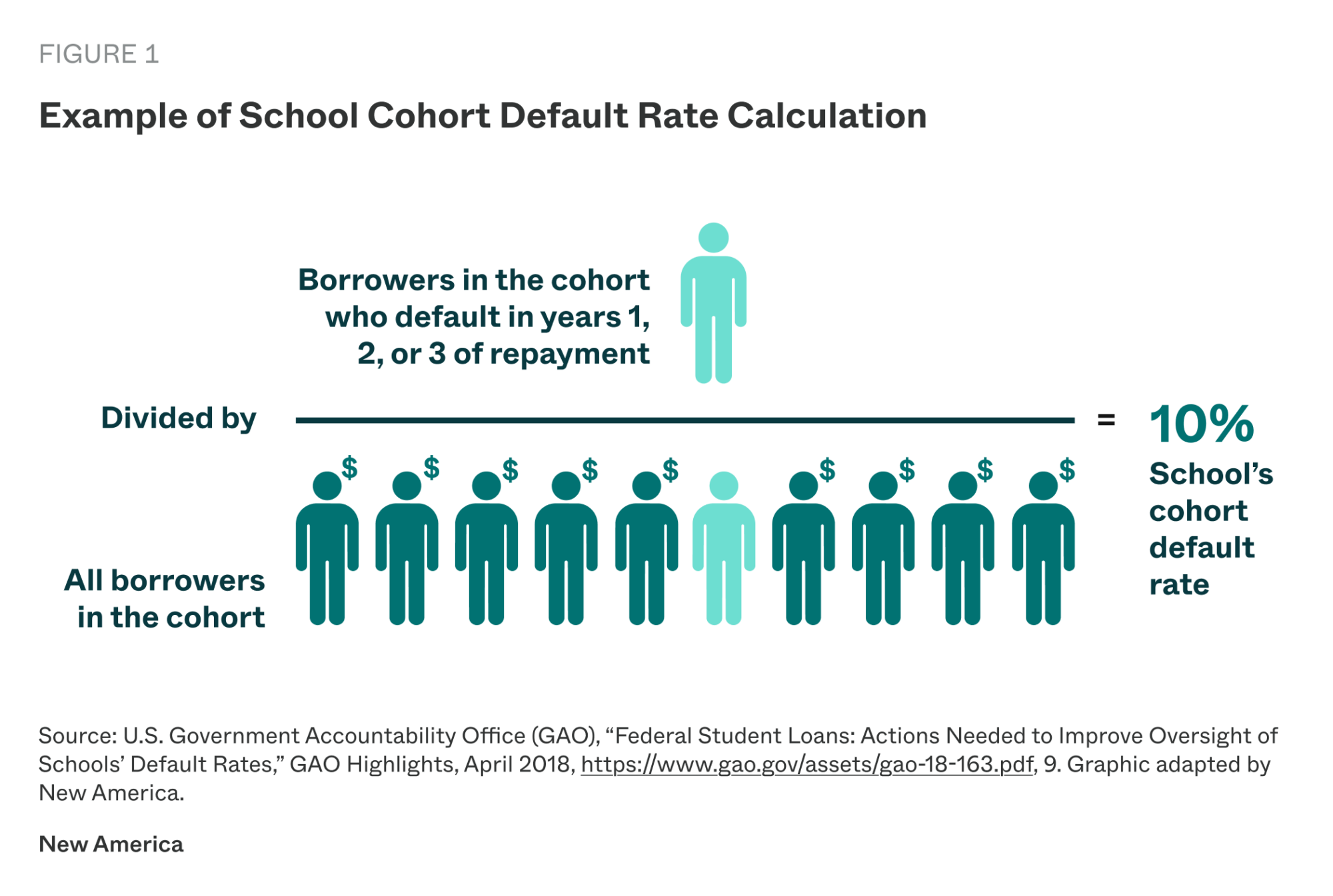
The CDR calculation doesn’t include federal PLUS loans for graduate and professional students and for parents (although it does include graduate unsubsidized loans); converted TEACH grants; federal consolidation loans (although these loans can still affect the calculation if the borrower defaults within the cohort default period); canceled loans; and closed school, false certification, and identity theft-related discharges. Loans that default and then are rehabilitated during the cohort default period are counted as in good standing.
An institution that fails CDR loses access to federal aid for at least the remainder of the fiscal year in which the determination was made and the two subsequent fiscal years. It must then reapply to the Department. The CDR is compiled by the Department using data from the National Student Loan Data System (NSLDS). Draft CDRs are sent to schools, typically in February or March of the following fiscal year, and official CDRs are required to be released (and are sent to schools) by September 30.
The most recent CDRs released before the pandemic payment pause—published in September of 2020—were for FY 2017. Most schools subject to sanctions were proprietary.15 Two-year and other institutions serving under-resourced students also had higher rates of students defaulting on their loans, although the proportion of students who borrow to attend for-profit institutions and the amount they borrow tend to be greater.16 (The most recently reported CDRs are included in Appendix Table A2.)
Colleges and universities with high CDRs have two main pathways for appealing, challenging, or requesting adjustments to CDR calculations. The first requires an institution to prove that errors in data calculations led to incorrect CDR determinations or sanctions. The second acknowledges high CDRs but argues that institutions shouldn’t be held accountable based on specific circumstances. Each appeal or challenge has its own criteria, and institutions must meet them to be eligible. However, if an institution submits an eligible appeal, it will maintain access to Title IV funds while the appeal is under review, even if its CDR is 40 percent or higher. While the interim availability of funds—and the burden of regaining access to these funds should they lose eligibility—incentivizes institutions to pursue appeals, those that are unsuccessful may be liable for certain disbursements made during the appeal period.
The Office of Federal Student Aid’s (FSA) Cohort Default Rate Guide provides information about the ten categories of appeals, challenges, and adjustments:
CDR is an important accountability mechanism in higher education, but it has historically faced challenges, a number of which continue in the current environment.
Today, only a handful of institutions typically have rates that exceed 30 percent each year. Among those that do, few face sanctions. However, a number of schools initially lost federal financial aid eligibility, and many closed in the years after CDRs took effect. For example, the Congressional Research Service notes that “from 1992 to 1999 (early in the CDR’s use), 1,846 IHEs were subject to sanctions due to high CDRs. For the FY 2017 CDRs, 12 IHEs were subject to CDR sanctions.”17 Only two of the 12 schools subject to sanctions that submitted appeals were unsuccessful in their appeals, largely due to the expansive appeals process.18
While the appeals process can ensure data are accurate and exempt institutions with certain circumstances from sanctions, it can also delay corrective actions, allowing institutions with problematic rates to continue receiving Title IV funds until the Department issues a final determination, often several months after the release of the official rates in September. (This period may be longer in the future, as the Department has lost enforcement capacity and expertise.) In more extreme circumstances, Congress—through a variety of appropriations riders and reconciliation acts—has authorized the Department to waive CDR sanctions for certain institutions, further reducing the effectiveness of high-CDR enforcement.
In recent years, fewer institutions have been subject to sanctions because extremely high-risk institutions have closed (often following a CDR sanction), risky institutional practices may have changed in a way that CDRs do not capture, institutions were more actively managing short-term repayment outcomes, and student loan repayment has evolved—including the fact that more borrowers enroll in income-driven repayment plans and can use automated enrollment and recertification processes—in ways that help avoid default.
While repayment options have evolved, the CDR framework has not. More borrowers are enrolling in income-driven repayment plans, and enrollment and annual recertification for these plans are being automated via the FUTURE Act. Before OBBBA, analysts, advocates, and government watchdogs pointed to schools’ use of default management consultants and other mechanisms to encourage borrowers to enroll in lengthy forbearances and deferments, thereby pushing defaults past the three-year CDR window.19 The changes made through OBBBA reduce the number of deferments available to borrowers and make it more difficult for borrowers to use forbearance over the long term.
The CDR approach is largely all-or-nothing. Institutions are not incentivized to reduce default rates if they are not close to the thresholds, which carry severe consequences. Default management plans are required only after a high percentage of borrowers default, and once institutions hit the CDR thresholds, they can lose eligibility for the Direct Loan and Pell Grant programs, without which most would not be able to operate. In addition, CDR isn’t always well coordinated with the rest of the accountability system. For example, while the Department has limited capacity for program review, the Secretary may target program reviews at institutions with high default rates but does not always do so.
While some data have been released, there is still a lack of transparency around the CDR process and default in general. The Department previously published both cumulative cohort default rates, which track cohorts of borrowers over time, and lifetime cohort default rates, which project borrowers’ long-term defaults. It now typically includes much of this information in its annual budget request. It also publishes information about new defaults and quarterly default volume; data about institutions’ CDRs, sanctions, and appeals; and annual trends related to CDR. But not all of these data are structured in ways that help identify where default-related issues are occurring, and they do not include information about borrowers’ pathways to and through default.
In addition, the Department has traditionally used a light touch in overseeing schools’ communication with borrowers and their work with third-party default prevention entities, although it recently provided more specific guidance about schools’ communications to borrowers and announced online training courses on CDR and default prevention.
Before the pandemic, higher education stakeholders proposed a number of reforms to address these challenges, including:
In the coming months, the field must consider, and we will propose additional, updated recommendations to strengthen and modernize CDR, protect students and taxpayer dollars, and ensure institutions have support to effectively serve under-resourced students.
| Cohort Fiscal Year* | Cohort Default Period** | Date of Publication | Consequences for Institutions |
|---|---|---|---|
| CFY 2023 |
Borrowers enter repayment:
Borrowers default (360 days past due):
|
Draft CDR sent to schools: Mar. 2026 Official CDR sent to schools + published: By Sept. 30, 2026 |
N/A |
| CFY 2024 |
Borrowers enter repayment:
Borrowers default (360 days past due):
|
Draft CDR sent to schools: Feb./Mar. 2027 Official CDR sent to schools + published: By Sept. 30, 2027 |
|
| CFY 2025 |
Borrowers enter repayment:
Borrowers default (360 days past due):
|
Draft CDR sent to schools: Feb./Mar. 2028 Official CDR sent to schools + published: By Sept. 30, 2028 |
|
| CFY 2026 |
Borrowers enter repayment:
Borrowers default (360 days past due):
|
Draft CDR sent to schools: Feb./Mar. 2029 Official CDR sent to schools + published: By Sept. 30, 2029 |
|
Note: Orange and teal text indicate periods in which borrowers generally didn’t default or reach 360 days past due on their loans.
* Cohort Fiscal Year (CFY): The fiscal year in which borrowers entered repayment and for which an institution’s CDR is calculated.
** Cohort Default Period: The three years starting October 1 of the CFY and ending on September 30 two fiscal years later.
| Cohort Fiscal Year* | Cohort Default Period** | Data Published | National Rate | Public | Private | Proprietary | Notes |
|---|---|---|---|---|---|---|---|
| CFY 2022 | Oct. 1, 2021–Sept. 30, 2024 | Sept. 2025 | 0% | 0% | 0% | 0% |
Rates impacted by payment pause (Mar. 2020–Sept. 2023) and “on-ramp” (Oct 2023–Sept./Oct. 2024). |
| CFY 2021 | Oct. 1, 2020–Sept. 30, 2023 | Sept. 2024 | 0% | 0% | 0% | 0% |
Rates impacted by payment pause (Mar. 2020–Sept. 2023). |
| CFY 2020 | Oct. 1, 2019–Sept. 30, 2022 | Sept. 2023 | 0% | 0% | 0% | 0% |
Rates impacted by payment pause (Mar. 2020–Sept. 2023). |
| CFY 2019 | Oct. 1, 2018–Sept. 30, 2021 | Oct. 2022 | 2.3% | 2.3% | 1.7% | 3.1% |
Rates impacted by payment pause (Mar. 2020–Sept. 2023). In CFY 2019, 3 schools were subject to sanctions and submitted appeals. One was successful in its appeal. |
| CFY 2018 | Oct. 1, 2017–Sept. 30, 2020 | Sept. 2021 | 7.3% | 7.0% | 5.2% | 11.2% |
Rates impacted by payment pause (Mar. 2020–Sept. 2023). In Sept. 2021, the Department also published rates for community colleges and HBCUs. In CFY 2018, 8 schools were subject to sanctions and submitted appeals. All were successful in their appeals or were designated no longer subject to sanctions. |
| CFY 2017 | Oct. 1, 2016–Sept. 30, 2019 | Sept. 2020 | 9.7% | 9.3% | 6.7% | 14.7% |
In CFY 2017, 12 schools were subject to sanctions and submitted appeals. Ten were successful in their appeals. |
* Cohort Fiscal Year (CFY): The fiscal year in which borrowers entered repayment and for which an institution’s CDR is calculated.
** Cohort Default Period: The three years starting October 1 of the CFY and ending on September 30 two fiscal years later.
Policy Analyst, Higher Education

Policy Advisor, Third Way

Director of Education, Opportunity, and Mobility

Deputy Director of Higher Education Policy, Third Way