Terrorism in America 18 Years After 9/11
Abstract
Eighteen years after the 9/11 attacks, the terrorist threat to the United States and around the world looks very different than it did on that day when 19 foreign hijackers who had entered the United States on temporary visas killed almost 3,000 people in a matter of hours.
While the jihadist threat to the United States is relatively limited, the United States continues to face a resilient jihadist terrorist threat across the Middle East, North Africa, and South Asia. Europe also faces a more severe jihadist threat than the United States. Yet, the United States has demonstrated its capability to deal military defeats to jihadist groups that seize territory. At the same time, the United States faces an increasing threat from terrorist violence inspired by a range of ideologies including white supremacy.
This annual report assesses the threat of terrorism to the United States 18 years on from 9/11.
This report is published as New America commemorates its 20th anniversary. This year, New America celebrates 20 years of creating and incubating the next big ideas that address some of the nation's and the world’s toughest problems. We are thinkers, researchers, problem-solvers, and storytellers, united by our goal to hold our nation to its highest ideals. We recognize the challenges presented by rapid technological and social change, and work to ensure that the solutions made possible by those changes lead to greater opportunity for all. As we reach forward toward the next 20 years of New America, we will strive to be an engine of American renewal, at home and abroad. Read more about our 20th anniversary.
Acknowledgments
The authors would like to thank New America interns Sumaita Mulk, Robin Bradley, and Ian Wallace for their research support on this paper. Former New America Senior Program Associate Emily Schneider provided a deeply informed copyedit of the paper. The authors also like to thank those who co-authored or worked on prior years’ assessments which form the basis of much of this report.
Downloads
Introduction
Eighteen years after the 9/11 attacks, the terrorist threat to the United States and around the world looks very different than it did on that day when 19 foreign hijackers who had entered the United States on temporary visas killed almost 3,000 people in a matter of hours.
The jihadist terrorist threat to the United States today is relatively limited. Since the 9/11 attacks, no foreign terrorist organization has successfully directed and carried out a deadly attack inside the United States. With the territorial collapse of the Islamic State in Iraq and Syria (ISIS), the threat posed by the group has receded. It has been more than a year since the last deadly jihadist terrorist attack, and the number of terrorism-related cases in the United States has declined substantially since its peak in 2015, though there will almost certainly be an uptick in cases this year.
However, “homegrown” jihadist terrorism including that inspired by ISIS is likely to remain a threat. As this threat is not inherently tied to ISIS’ possession of territory, policymakers should not expect a substantial shift in the nature or extent of the threat of ISIS to the United States.
Rather than jihadist attacks from abroad, the most likely threat to the United States today comes from terrorists inspired by ideologies across the political spectrum, including jihadist, far-right, and idiosyncratic strains. These individuals tend to be radicalized on or via the internet, and they take advantage of the availability of weapons, particularly semi-automatic firearms, in the United States. Of particular note, in the last few years, white supremacist extremism has posed a particularly significant threat.
While the jihadist threat to the United States remains relatively limited, the United States continues to face a resilient jihadist terrorist threat across the Middle East, North Africa, and South Asia. Europe also faces a more severe jihadist threat than the United States. Yet, the United States has demonstrated its capability to deal military defeats to jihadist groups that seize territory.
The War on ISIS and Other Extremist Groups
The United States has demonstrated its ability to deal substantial military defeats to jihadist1 groups that take territory. In March 2019, the United States Central Command (CENTCOM) congratulated the Syrian Democratic Forces (SDF) on the “elimination of Daesh’s self-proclaimed territorial caliphate.”2 The territorial defeat of ISIS3 illustrates the stark limitations to jihadist efforts to establish long-term safe havens. However, instability and social conditions in the Middle East, North Africa, and parts of South Asia combined with the connecting power of social media ensure that jihadist militancy—including but not limited to its expression in the form of ISIS and al Qaeda—will remain a resilient regional and local threat.
These conditions suggest the need for a foundational evaluation of U.S. goals in its counterterrorism wars, and what is achievable at what cost. Under the Trump administration, the United States has escalated many of these wars and continues to backtrack on the already limited transparency surrounding these wars, making the ability to assess the true impact of the Trump administration’s policy changes difficult in this environment.
The Territorial Defeat of ISIS in Syria and Iraq
Over the past year, the United States and its partners have successfully eliminated all of ISIS’ territory in Iraq and Syria. In March, the U.S.-backed SDF liberated ISIS’ last piece of territory in Syria in Baghuz. However, in effect, ISIS’ territorial caliphate in Iraq and Syria had already collapsed. The group lost Raqqa, the capital of its self-proclaimed caliphate almost two years ago in October 2017 when the SDF took the city.4 A month later, ISIS lost its last populated territory in Iraq.5 In early 2018, the United Nations (UN) Security Council Committee’s Analytical Support and Sanctions Monitoring Team reported that ISIS “lost control over all remaining urban areas [in Iraq and Syria].”6 By March 2019, all that remained was the 1.5 square mile of ISIS territory in Baghuz liberated by the SDF that month.7
The loss of its territory in Iraq and Syria dramatically undercuts ISIS’ claim that it is the caliphate, because the caliphate has historically been a substantial geographic entity, such as the Ottoman Empire, as well as a theological construct.8 Not only did it hold vast territory and theological significance, but the so-called caliphate allowed the organization to have a constant influx of money through its vast crop and oil holdings, in addition to its income from antiquities sales, ransoms, and taxation.9
As ISIS’ territorial caliphate collapsed, there has been a noticeable decline in its propaganda capability. Key propaganda outputs including ISIS’ English-language magazine Rumiyah appear to have ceased publication.10 According to Europol’s 2019 report, ISIS’ losses “had a significant impact on its digital capabilities,” leaving its weekly Arabic Al-Naba newsletter as its only regular output.11 Likewise, the UN Analytical Support and Sanctions Monitoring Team’s January 2019 report assessed that ISIS’ “media production fell during the course of 2018 as did the quality of its output and the reliability of its claims for responsibility for attacks.”12 In addition to an increased number of false claims of attacks, there has been confused messaging on ISIS’ part regarding the structure of its provincial and affiliate network.13 The Sanctions Monitoring Team’s January 2019 assessment mirrors its February 2018 assessment that “the propaganda machinery of the ISIL core is further decentralizing, and the quality of its material continues to decline.”14
Limits to ISIS’ Defeat in Syria and Iraq
While ISIS’ territorial collapse represents a major success for the counter-ISIS coalition, this is not the first time that ISIS has been dealt substantial tactical defeats. The group remains capable of exploiting current and potential future instability in Iraq and Syria to improve its position.
The UN Sanctions Monitoring Committee in February 2019 assessed that in Iraq, the group’s transition “into a covert network is well advanced” and that ISIS poses a “major threat” in the form of assassinations of officials and “frequent attacks” on civilians.15 Indeed, ISIS has previously demonstrated its ability to continue operations in areas where it has lost territory during the so-called “surge” that began in 2007 and in areas previously liberated during the current counter-ISIS campaign.16
In Syria, security conditions in Raqqa remain poor. According to New America fellows David Kilcullen and Nate Rosenblatt, Raqqa and its surroundings—rather than having been stabilized—is “power-locked” with American power suppressing large-scale challenges to the SDF. But an American withdrawal or other shift in conditions could reignite broader conflicts and allow ISIS to reapply the strategy it used to take Raqqa in the first place.17
Some analysts conclude that ISIS, even with its territorial defeat, is in a far stronger position with regards to a number of capabilities than it was in the aftermath of the surge when it managed to turn post-Arab Spring instability and other factors into the fuel for its burst onto the global stage.18
However, there are other factors that may limit the group’s ability to achieve a resurgence in the near-term. Iraq has exited the ISIS crisis in far better shape than conventional wisdom expected at the outset of the counter-ISIS campaign, providing a stronger basis for preventing an ISIS resurgence having faced it once already.19 In addition, the presence of U.S. forces as well as the U.S.-backed SDF and the Iraqi Counter Terrorism Service—all of whom are well aware of the danger posed by ISIS—makes an ISIS resurgence less likely. In addition, ISIS’ surge in strength was in part the result of the revolutionary environment of the Arab Spring’s immediate aftermath and substantial foreign fighter flows from around the world.20 It is unclear whether such conditions will reemerge in the near-term or if ISIS can generate anywhere near the strength it did in 2014 in the absence of such conditions.
What is clear, however, is that the territorial defeat of ISIS in Syria and Iraq does not mean the defeat of the organization as a whole, let alone the larger jihadist movement in the two countries.
ISIS Beyond Syria and Iraq
ISIS continues to pose a threat beyond Iraq and Syria through its networks of affiliates and provinces as well as its use of social media to promote and support terrorism. Through these groups and networks, ISIS will likely remain capable of at least claiming and amplifying attacks and smaller scale efforts at governance over a large area.
Viewing ISIS or even the group’s territorial structure as merely its presence in Iraq and Syria is dangerously myopic. On Easter Sunday, April 21, 2019, terrorists killed more than 250 people in coordinated bombings of three churches and three hotels in Sri Lanka.21 The two groups tied to the attacks are ISIS22 and National Thowheed Jamath (NTJ).23 ISIS claimed the attack two days after it took place, and later reporting indicated that multiple family networks coordinated the bombings. According to the UN Secretary General’s July 2019 report on the threat posed by ISIS, Abu Bakr al-Baghdadi, ISIS’ leader, was not aware of the attack before it happened.24 However, the attackers were sufficiently connected to ISIS’ network that ISIS was able to release video of the attack via its official platforms.25
The Sri Lanka attack illustrates ISIS’ ability to inspire attacks outside of Syria and Iraq. And it is not a stand-alone case. Since 2017, ISIS and its supporters have conducted attacks in more than 25 countries.26 Even so, there is reason for optimism. The UN Sanctions Monitoring Team reported a “substantial reduction in global external attacks” associated with ISIS in 2018.27
ISIS’ ability to conduct such attacks is bolstered by two overlapping sources of international strength. One is its online networks—or what some have termed a “Virtual Caliphate”—which produce and spread propaganda but also provide advice for attacks while helping ISIS’ central organization claim ties to attacks carried out by people thousands of miles away.
The rise of social media has helped spread this network’s power. Since these networks depend on individual connections and local roots more than ISIS’ core organization, they might survive a more substantial collapse of the group. They also rely upon templates for activity that are easily adopted and scaled. As Mitch Silber, former New York Police Department director of intelligence analysis, and Jesse Morton, the former leader and cofounder of the American Salafi-jihadist group Revolution Muslim, which advanced much of the online propaganda techniques that would later be used by ISIS, noted in a report for New America, “[a] key lesson of the effort against Revolution Muslim is that countering virtual jihadist recruitment will be an ongoing struggle, and law enforcement and intelligence agencies should not overemphasize the collapse of any particular group.”28 Even if such activity doesn’t occur under the ISIS brand, such virtual networks will continue to pose a challenge for the future.
The second factor is ISIS’ more official structure of wilayat (provinces) and affiliates. In January 2019, the UN Sanctions Monitoring Team reported that a centralized ISIS leadership remains that “communicates and provides resources to its affiliates, albeit at a reduced level."29 Al-Qaeda’s continued existence and maintenance of its own affiliate network after Osama Bin Laden’s death warns against dismissing the ability of the group to maintain a coherent albeit reduced network after territorial or leadership losses.
ISIS has shown some evidence of its ability to build or sustain its brand and affiliate structure in the wake of the territorial collapse in Syria and Iraq. In April 2019, it claimed its first attack in the Democratic Republic of Congo, announcing a Central African province.30
On the other hand, the strength of ISIS’ affiliates should not be overestimated. Giving ISIS too much credit for its control over affiliates with pre-existing constituencies or exaggerating its affiliates’ strength can aid ISIS’ media strategy of portraying itself as in control of a highly centralized, globalized Caliphate even in the wake of its territorial defeat in Iraq and Syria.31 Many of ISIS’ affiliates and provinces are either struggling or are under substantial military pressure.
In Libya, once viewed as a potential fallback for the group, ISIS lost its territorial hold in the city of Sirte in late 2016.32 Yet the group appears to continue to pose a resilient insurgent and terrorist threat.33
In other areas, where ISIS held less power, affiliates are facing even tougher environments. In January 2019, the UN Sanctions Monitoring Committee reported that “ISIL in Yemen now has only a few mobile training camps and a dwindling number of fighters;” the group is not economically self-sufficient; it receives few foreign fighters; and its activities in Al-Bayda “now consist mainly of protecting the group’s leaders and their family members.”34
Some affiliates have also seen the deaths of important leaders. For example, Abdulhakim Dhuqub, ISIS’ second in command in Somalia, was killed by a U.S. airstrike in April 2019 in Xiriiro, Somalia.35 Abu Sayed Orakzai, also known as Sad Arhab and the leader of ISIS in Afghanistan, was killed by an airstrike by Afghan and coalition forces in Afghanistan in August 2018.36
The fact that ISIS has been able to maintain substantial capabilities and loyalties in the wake of its territorial collapse in Iraq and Syria showcases the limitations of military action against particular groups when pursuing broader objectives than preventing the particular threats posed by that group’s safe haven. That said, the territorial collapse has had an impact on the broader networks and effectiveness of ISIS’ brand.
The Resiliency of al-Qaeda
Even as ISIS suffers repeated setbacks, al-Qaeda has shown resiliency in the face of the counterterrorism campaigns directed against it and the challenge from within the jihadist movement posed by the rise of ISIS. In August, al-Qaeda marked the 31st anniversary of its founding, making the group one of the longest-lasting terrorist groups in history.37
Eighteen years after 9/11, al-Qaeda continues to operate across North Africa and South Asia despite the heavy losses it has sustained, including the death of its founder, Osama bin Laden, and of dozens of other al-Qaeda leaders who have been killed in drone strikes in Pakistan and Yemen. Al-Qaeda in the Indian Subcontinent, Al-Qaeda in the Arabian Peninsula, and Al-Qaeda in the Islamic Maghreb all retain capacity for sustained local attacks.
In Syria, al-Qaeda’s fortunes are far from clear, though any accounting must acknowledge a substantial al-Qaeda presence in the country. Al-Qaeda in Syria has undergone changes to its naming and organizational design. Initially known as the Nusra Front or Jabhat al-Nusra, al-Qaeda in Syria adopted the name Jabhat Fateh al-Sham in July 2016 to distance itself from al-Qaeda core, though then-Director of National Intelligence James Clapper labeled it a “PR move … to create the image of being more moderate.”38 In January 2017 another rebranding occurred, with the group taking the name Hayat Tahrir Al-Sham (HTS).39 In turn, Hurras al-Din, a group closely tied to al-Qaeda and its global vision, split off during the creation of HTS publicly announcing itself in February 2018.40 Regardless of the shifting monikers, the group and its various manifestations and splinters remain a potent force, as seen by its role in the takeover of Idlib, a prominent city and province in the country’s northwest corner, in July 2017.41 However, according to some analysts, the series of splits and rebrandings represents a meaningful loss of organizational control in Syria on the part of al-Qaeda and a major setback.42 Even so, al-Qaeda continues to count on the loyalty of thousands of fighters. The analysts Tore Hamming and Pieter Van Ostayen put the number at about 2,000 while others who give less credence to the meaningfulness of the splits put the number at up to 20,000.43 This demonstrates al-Qaeda’s resilience.
Despite its resilience, al-Qaeda has not demonstrated a capability to strike the West in more than a decade. The last deadly attack in the West directed by al-Qaeda was the July 7, 2005 bombing of London’s transportation system, which killed 52 commuters.44 Despite this poor record of successfully attacking the West, al-Qaeda cannot be dismissed as a threat.
It is also possible that al-Qaeda could feed off of ISIS’ setbacks to regain leadership of the global jihadist movement.45 The UN Sanctions Monitoring Team notes that al-Qaeda remains stronger than ISIS in some regions, and that its leader Aymen al-Zawahiri released more statements than ISIS’ leader in 2018.46 On the other hand, al-Qaeda has its own troubles with the reported death of Hamza bin Laden, who was widely believed to have been being groomed for leadership, and al-Zawahiri’s reported health issues.47
The possibility of parts of ISIS and al-Qaeda merging also cannot be ruled out. At the very least, al-Qaeda’s ability to remain resilient after decades of counterterrorism efforts suggests that ISIS remnants may similarly be able to continue on long after losing its hold on Syria and Iraq.
Underlying Instability and the Resiliency of Jihadism
Beyond the fates of particular organizations, whether al-Qaeda or ISIS, the jihadist movement has proven resilient in the Middle East, parts of the Sahel, North Africa and the Horn of Africa, as well as South Asia. This is in large part because it serves as a response to underlying stressors and continuing instability across these regions, as well as a continuous exporting of radical religious education that focuses on sectarian narratives.48
These underlying stressors include the Sunni-Shia sectarian conflict that overlaps with the Saudi-Iran regional proxy war playing out in Syria, Yemen, and elsewhere; state collapse across the Middle East and North Africa, most extensively in Iraq, Libya, Syria, and Yemen; high unemployment and economic strain in much of the region; and an ongoing youth bulge.49
This combination of factors, along with trends that reduce the barriers to entry to jihadist organizing including the sustained use of social media, make it likely that instability will continue in the Middle East and North Africa and that this instability will enable jihadist activity for the foreseeable future.
Today there could be as many as 230,000 jihadists worldwide, quadruple the number from 18 years ago.50 However, some analysts have noted that this large count includes groups and a large number of people who don’t quite fit the jihadist label as well as many whose focus is local and not global.51
Policymakers should remain attentive to the potential for surges of new revolutionary activity and how they might affect the extent of the jihadist threat in the aftermath of the Arab Spring. However, one region-shaping political dynamic is worthy of particular attention for its potential to fundamentally reshape the future of jihadist activity.
That dynamic is the substantial escalation in Saudi-Iranian and U.S.-Iranian tensions and proxy war over the past year, and the potential for these conflicts to escalate to more direct conflict. This escalation was largely predictable in the wake of the Trump administration’s unilateral reneging on the Iran Nuclear Deal and adoption of a strategy of “maximum pressure.”52 In June 2019, Iran shot down an American drone in the Strait of Hormuz.53 The Trump administration reportedly pulled back at the last moment after approving retaliatory strikes against Iranian targets.54
Aside from the fallout of the incident with the drone being shot down, there have been other steps by both parties that illustrate an escalation in tensions. The United States, for its part, has ramped up sanctions on Iran. Iran has begun to show signs of moving away from the Iran Deal itself (having seen the United States already renege on the deal). Iran surpassed its agreed upon low-enriched uranium level of 3.67 percent enrichment, reaching 4.5 percent, although even that rate is well below the 90 percent rate required for a weapon.55 A number of Iranian-supported forces in the Middle East have appeared to increase the aggressiveness of their activity and Iran has been blamed for targeting tankers in the Gulf as well.
The consequences of a major escalation for the United States, Saudi Arabia, and Iran have so far prevented a larger direct confrontation, and for now the conflict has remained mostly in the realm of proxies. The countries have incentives to pull back when there are more direct clashes, as demonstrated with the drone shoot-down in June 2019.
However, the risk of a major escalation to a broader conflict should not be dismissed for several reasons. First of all, the conflicts at the root of these tensions are not confined to the balance of threats and deterrence made by two rival states.56 Instead there are a number of local conflicts as well as a broader regional Sunni-Shia conflict layered atop the U.S.-Iran and Saudi-Iran tensions. Approaching the situation primarily through the lens of affecting Iranian decision-making regarding its use of proxies risks escalating these conflicts. New America fellows Douglas Ollivant and Erica Gaston, for example, warn that a focus on Iran could generate a security dilemma where actions aimed at providing security vis-à-vis Iran appear threatening and escalate local underlying tensions in Iraq.57
Second, it is not clear what the envisioned exit from the current tensions is. The United States walked away from an existing deal and Iran is unlikely to accept surrendering to pressure. It is not clear what the U.S. objective is, aside from that expressed in the past by some administration officials; for example, now-former National Security Advisor John Bolton has been an outspoken proponent of regime change.58 In this environment, repetition of crisis moments is likely increasing the potential for one moment to escalate in the absence of major policy changes on the part of one or more of the involved states.
Third, the risk that certain parties within the administration are seeking escalation towards war should not be dismissed. John Bolton still thinks the decision to invade Iraq was correct and has sought military options against Iran, in addition to repeatedly voicing support for regime change in the country.59 His departure from the administration may change this dynamic but it remains to be seen what it will mean for the administration's Iran policy. It is far from clear whether any of these factors will drive the United States and Iran towards war, but the two countries are closer to war than at any point in the past decade.
Further escalations in either the U.S.-Iran or the Saudi-Iran conflicts could provide fresh fuel for jihadists. A major escalation or war would likely fuel apocalypticism in the region and do so in a way that aligns with the jihadist ideology that has framed Iran and Shia Muslims as enemies; the consequences could be similar to the regional catastrophe triggered by the 2003 U.S. invasion of Iraq.60 In addition, escalated interstate conflict could provide new opportunities for al-Qaeda to benefit, potentially by integrating its efforts within the proxy force structures developed by competing states or by taking advantage of the broader rise in conflict even without more direct links to states.61
In last year’s assessment we identified a second potential region-shaping dynamic: the reform efforts of Saudi Crown Prince Mohammed bin Salman. The potential for positive region-shaping outcomes from that effort has been largely lost. The Trump administration squandered the opportunities to press the Saudi government on issues of importance, instead providing unquestioning support.62 The murder of Jamal Khashoggi, credibly alleged63 to have been authorized and directed by the Saudi government on October 2, 2018, has resulted in Western skittishness regarding being involved in or tied to the Saudi government’s policies and an unravelling of the Saudi government’s ability to pursue its reforms.64
Already the Saudi government’s reform effort was running into issues due to its being tied to bin Salman’s moves to consolidate personal power, which resulted in the arrest of hundreds of prominent Saudis, their detention, and alleged physical abuse, purportedly as part of an anti-corruption drive.65 Bin Salman also authorized a series of covert missions that targeted Saudis for rendition and Saudi women’s rights activists (members of the team were also reportedly involved in Khashoggi’s murder).66
U.S. Targeted-Killing Program and the Evolution of Counterterrorism Policy Under President Trump
In countering the resilient threat posed by ISIS, al-Qaeda, and other jihadists, air and drone strikes as well as occasional counterterrorism raids remain a major tool. In 2019, the United States conducted counterterrorism strikes in at least six countries.67 Though these operations have yielded important successes in degrading terrorist capabilities, it is difficult to assess whether or not they are achieving strategic objectives and the costs to civilians and other American interests imposed by their use. This is partly the result of the complex conflicts in which the United States finds itself using force, but also a result of policy decisions by the Trump administration.
The Trump administration reshaped U.S. policies regarding counterterrorism strikes, particularly regarding transparency over reporting civilian casualties and what qualifies as a militant target. The Trump administration walked back the Obama-era standard of annual reporting of civilian casualties from covert counterterrorism strikes,68 as well as the Obama-era Presidential Policy Guidance rules on targeting militants in conflict zones.69 While the administration has replaced the Presidential Policy Guidance, it has not publicly released its new guidance on counterterrorism strikes.
The extent and nature of the Trump administration’s changes remains unclear, and there has been little governmental transparency regarding counterterrorism operations under Trump, and what little is known often comes from the news media. U.S. Africa Command has regularly released press releases on strikes it claims in Somalia.70 However, there are significant questions regarding its assessments of civilian casualties, particularly in the aftermath of its April 2019 admission when it failed to report known civilian casualties due to what it said was a recording error.71 CENTCOM has given individual reports of the date and location of strikes when requested, but has not put such individualized information consistently on its site and continues to not report casualty assessments for each strike.72
Despite the lack of transparency and clarity regarding American policy, the Trump administration has escalated some counterterrorism campaigns seemingly in the hopes of countering resilient terrorist insurgencies. On the other hand, the administration has de-escalated or not escalated other counterterrorism campaigns and has proposed withdrawals from Afghanistan and Syria.
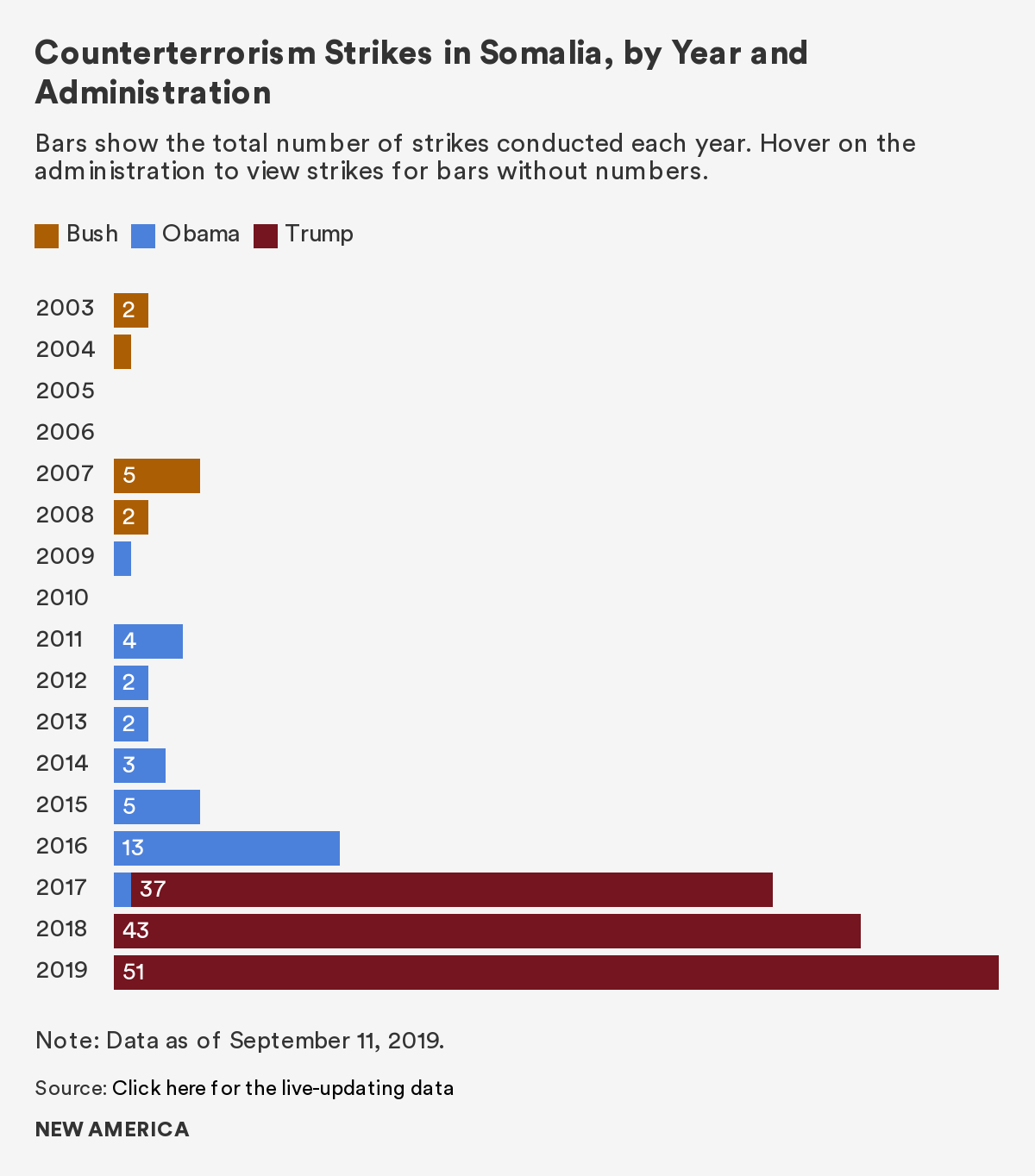
This year in Somalia, the Trump administration has further escalated strikes, continuing what was an already unprecedented escalation last year. In 2018, The United States carried out 43 strikes—either air strikes or ground raids—and through September 11, 2019, there have been at least 51 strikes, surpassing any other year recorded by New America. The United States is on track to have more casualties from these strikes than any other year recorded. In 2018, the United States killed between 350 and 40873 people according to New America’s database, the highest number recorded since the U.S. air campaign in Somalia began. So far in 2019, the United States has reportedly killed between 326 and 357 people. Between three and four of these deaths involved people whose combatant status is unknown or disputed.
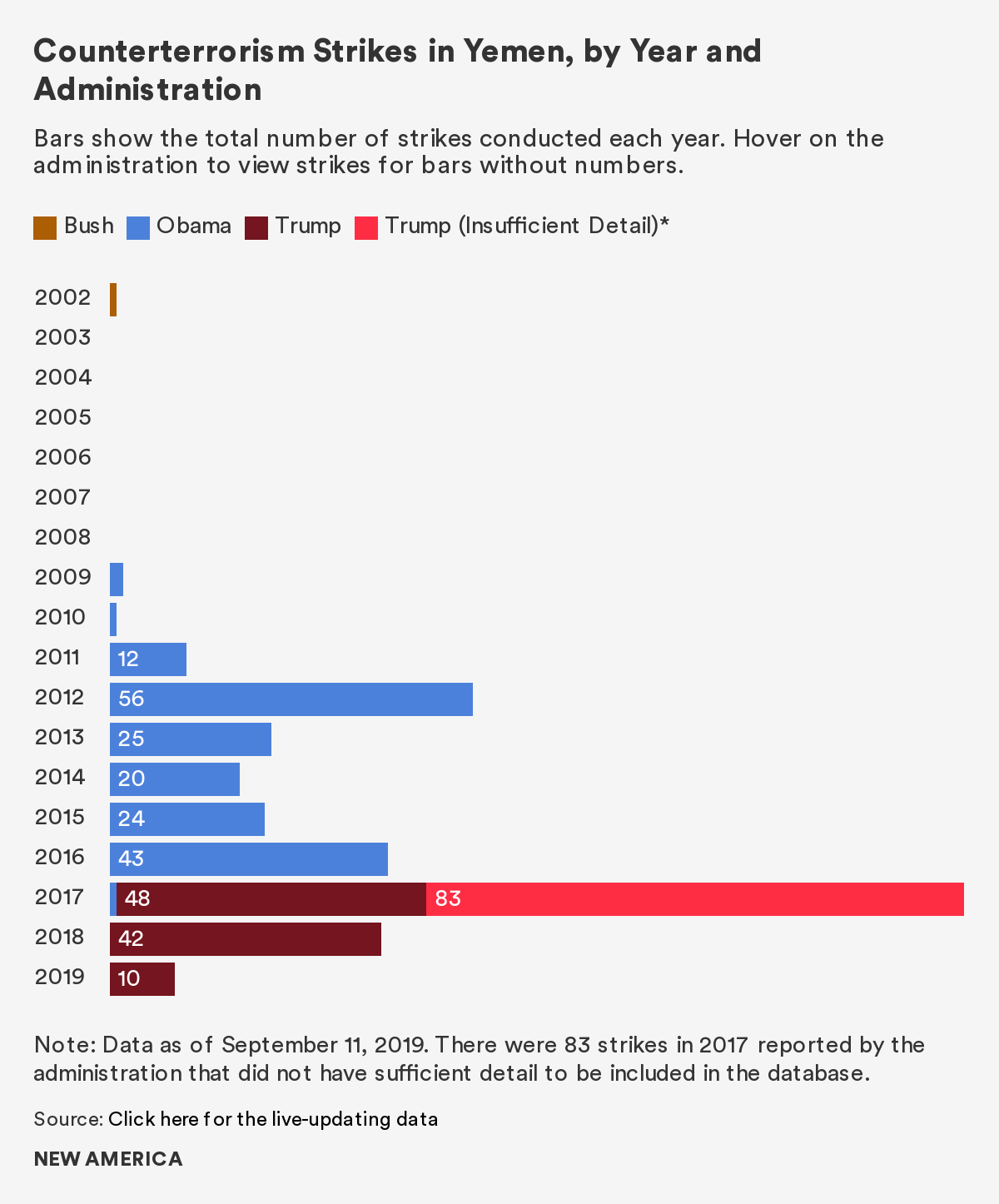
In its first year in office, the Trump administration also escalated the counterterrorism war in Yemen. However, in the past two years, the pace of strikes has substantially fallen from that peak. As of September 11, 2019, the United States has conducted ten strikes in Yemen, according to New America. The United States had conducted 40 strikes by September 11, 2018 (and 42 in the entire year), according to New America. In 2017, CENTCOM stated it conducted at least 131 strikes in Yemen.74 One caution regarding the apparent decline is it is possible the United States is conducting covert strikes in Yemen or relying upon Saudi Arabia, the United Arab Emirates, or other partner nations to conduct counterterrorism strikes. There have been multiple strikes attributed to the United States in recent years that CENTCOM does not acknowledge carrying out.75
Despite the substantial changes and escalation under Trump in Somalia, there should be caution in attributing the escalating strikes to Trump’s decision style. The campaigns in Yemen and Somalia had begun escalating—although to lesser extents—under the Obama administration.76
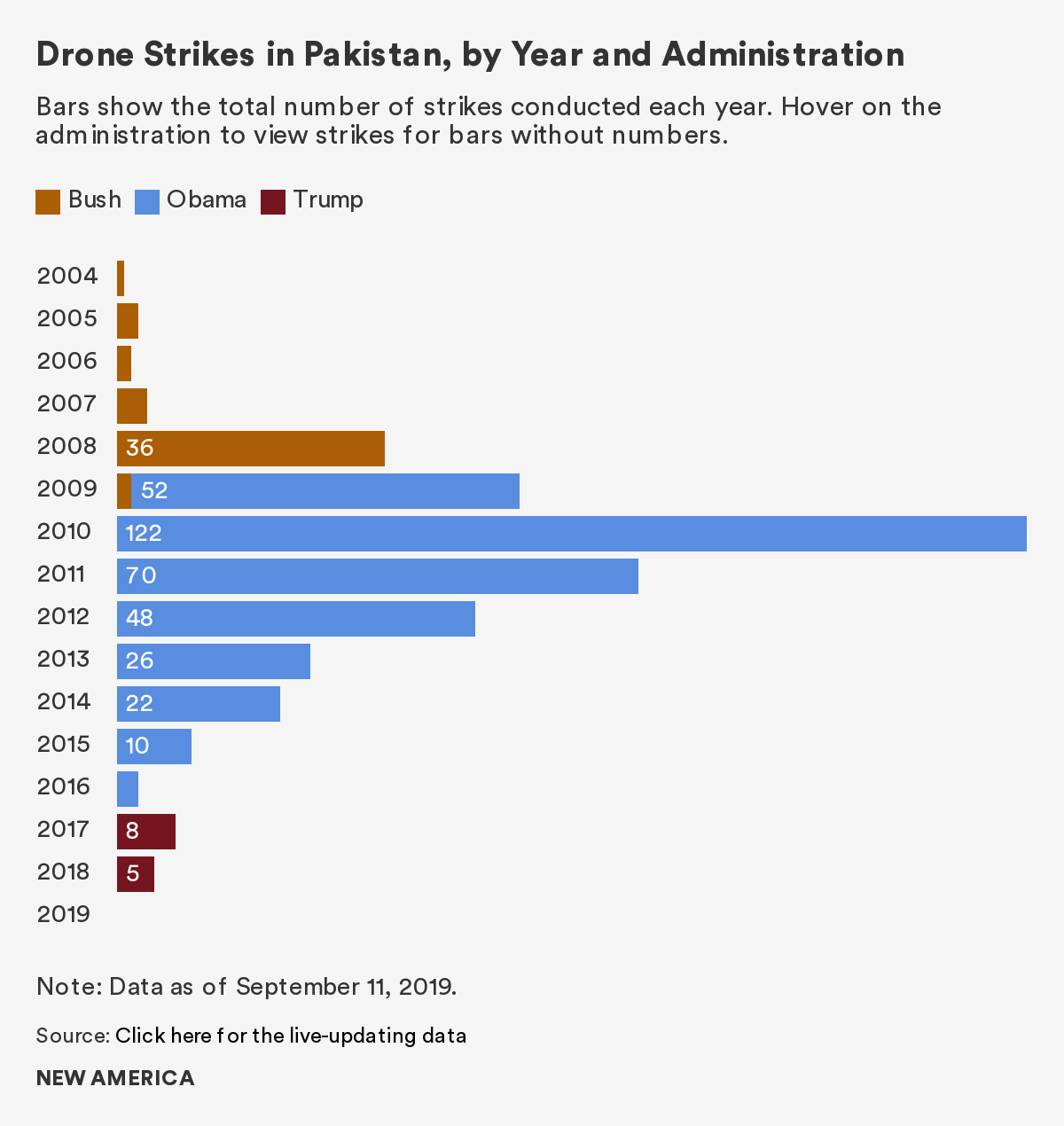
Moreover, the Trump administration has not substantially escalated the drone war in Pakistan.77 Instead, under Trump, the war in Pakistan has seen its longest halt since the campaign began, with Pakistan marking a full year without a drone strike on July 4, 2019.78 In 2018, the Trump administration conducted a total of five strikes, compared to the total of eight strikes in 2017. Over its entire term so far, the Trump administration has conducted far fewer than the 122 strikes the Obama administration conducted in a single year at the peak of the drone campaign in Pakistan in 2010.
There are many possible reasons for the decline in strikes in Pakistan. One likely key factor is that the United States now has far fewer troops in Afghanistan than it did in 2010 and thus less need to carry out strikes to protect its forces. Another likely key factor is that Pakistan carried out a major military operation in its northwest tribal regions in 2015 that drove many militants into Afghanistan and killed others, reducing the number of militant targets in Pakistan. Both of these factors illustrate the importance of matters beyond the Trump administration’s policy changes in the conduct of the drone war.
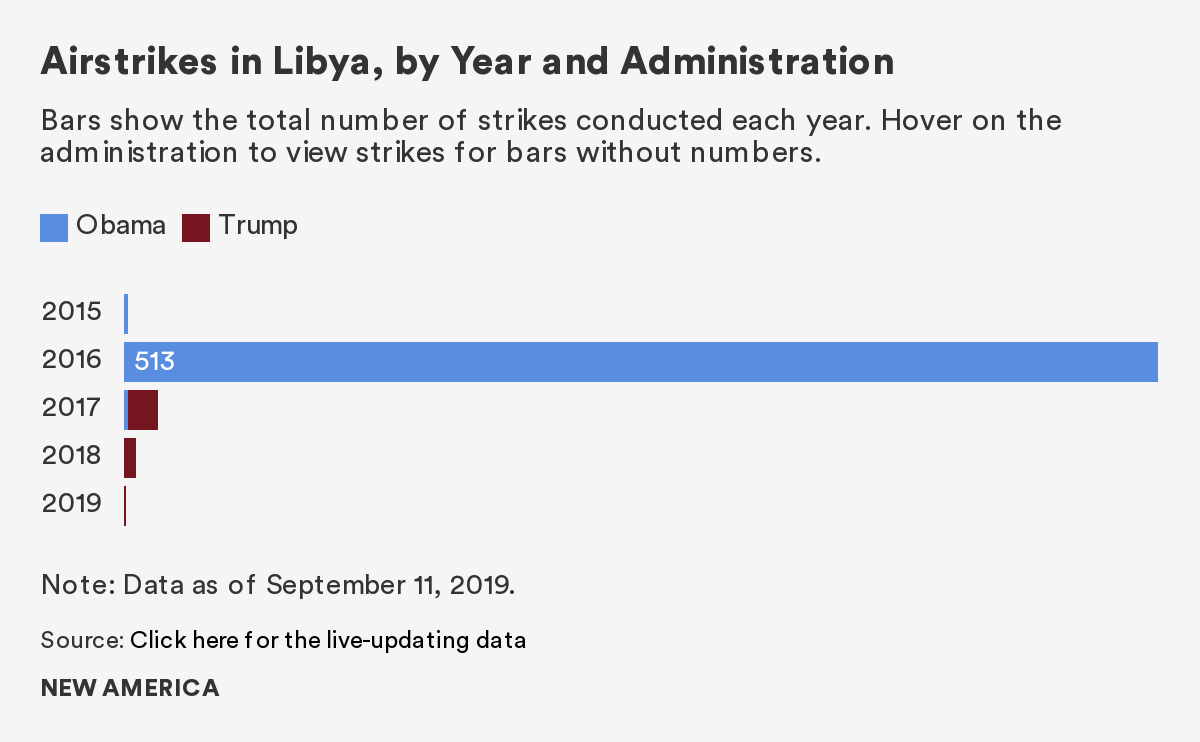
In Libya, the Obama administration carried out a major escalation of airstrikes in 2016, conducting 513 strikes, up from only two in 2015, according to research by New America and Airwars.79 This major escalation was the result of a decision in the second half of 2016 to authorize strikes against ISIS in and around Sirte, Libya.80 In contrast, under Trump, the number of strikes in Libya fell in 2018 to only six strikes, and one strike in 2019 as of September 11, according to New America and Airwars research.81
Citations
- We define jihadist to include those who are motivated by or directly support those motivated by versions of Osama bin Laden’s global ideology. We do not include Hamas, Hezbollah, or similar groups that do not follow bin Laden’s ideology.
- U.S. Central Command, “Coalition, Partner Forces Liberate Last Territory Held by Daesh,” press release no. 20190323-01, March 23, 2019, source
- The Islamic State of Iraq and Syria is referred to by several names in the literature, including ISIL, Daesh, IS, or the Islamic State. Throughout this paper we use ISIS except when a quoted passage utilizes a different term.
- Anne Barnard and Hwaida Saad, “Raqqa, ISIS ‘Capital,’ Is Captured, U.S.-Backed Forces Say,” The New York Times, October 17, 2017, source
- Mustafa Salim and Tamer El-Ghobashy, “Iraqi Forces Retake Last Town under Islamic State Control,” Washington Post, November 17, 2017, source
- “Twenty-First Report of the Analytical Support and Sanctions Monitoring Team Submitted Pursuant to Resolution 2368 (2017) Concerning ISIL (Da’esh), Al-Qaida and Associated Individuals and Entities” (United Nations Analytical Support and Sanctions Monitoring Team, January 17, 2018), source
- Rukmini Callimachi, “ISIS Caliphate Crumbles as Last Village in Syria Falls,” The New York Times, March 23, 2019, source
- Peter Bergen, “Is the Fall of Mosul the Fall of ISIS?,” CNN, July 11, 2017, source
- Callimachi, “ISIS Caliphate Crumbles as Last Village in Syria Falls.”
- “Twenty-First Report of the Analytical Support and Sanctions Monitoring Team.”
- “Terrorism Situation and Trend Report 2019 (TE-SAT)” (EUROPOL, 2019), source
- “Twenty-Third Report of the Analytical Support and Sanctions Monitoring Team Submitted Pursuant to Resolution 2368 (2017) Concerning ISIL (Da’esh), Al-Qaida and Associated Individuals and Entities” (United Nations Analytical Support and Sanctions Monitoring Team, January 15, 2019), source
- “Terrorism Situation and Trend Report 2019 (TE-SAT)”; “Twenty-First Report of the Analytical Support and Sanctions Monitoring Team.”
- “Twenty-First Report of the Analytical Support and Sanctions Monitoring Team.”
- “Twenty-Third Report of the Analytical Support and Sanctions Monitoring Team.”
- Daniel Milton and Muhammad al-’Ubaydi, “The Fight Goes On: The Islamic State’s Continuing Military Efforts in Liberated Cities” (West Point: Combating Terrorism Center, June 2017), source; Brian Fishman, “Redefining the Islamic State” (New America, August 18, 2011), source
- Nate Rosenblatt and David Kilcullen, “How Raqqa Became the Capital of ISIS: A Proxy Warfare Case Study” (New America, July 25, 2019), source
- Jennifer Cafarella, Brandon Wallace, and Jason Zhou, “ISIS’ Second Comeback: Assessing the Next ISIS Insurgency” (Institute for the Study of War, July 23, 2019), source
- Douglas Ollivant and Bartle Bull, “Iraq After ISIS: What To Do Now” (New America, April 24, 2018), source; After ISIS: What Is next in the Middle East (Future of War Conference: New America, 2018), source
- David Sterman and Nate Rosenblatt, “All Jihad Is Local: Volume II ISIS in North Africa and the Arabian Peninsula” (New America, April 5, 2018), source
- Roshni Kapur, “Sri Lanka’s Easter Sunday Bombings: Moving Forward,” Middle East Institute (blog), May 7, 2019, source; Amarnath Amarasingam, “Terrorism on the Teardrop Island: Understanding the Easter 2019 Attacks in Sri Lanka,” CTC Sentinel 12, no. 5 (June 2019), source
- Jeffrey Gettleman, Dharisha Bastians, and Mujib Mashal, “ISIS Claims Sri Lanka Attacks, and President Vows Shakeup,” The New York Times, April 23, 2019, source
- Ethirajan, Anbarasan. "Sri Lanka Attacks: The Family Networks behind the Bombings." BBC News, May 11, 2019. source
- “Ninth Report of the Secretary-General on the Threat Posed by ISIL (Da’esh) to International Peace and Security and the Range of United Nations Efforts in Support of Member States in Countering the Threat” (United Nations Security Council, July 31, 2019), source
- Amarasingam, “Terrorism on the Teardrop Island: Understanding the Easter 2019 Attacks in Sri Lanka.”
- Jin Wu, Derej Watkins, and Rukmini Callimachi, “ISIS Lost Its Last Territory in Syria. But the Attacks Continue,” New York Times, March 23, 2019, source
- “Twenty-Third Report of the Analytical Support and Sanctions Monitoring Team.”
- Jesse Morton and Mitchell Silber, “From Revolution Muslim to Islamic State: An Inside Look at the American Roots of ISIS’ Virtual Caliphate” (New America, June 4, 2018), source
- “Twenty-Third Report of the Analytical Support and Sanctions Monitoring Team.”
- Steve Wembi and Joseph Goldstein, “ISIS Claims First Attack in the Democratic Republic of Congo,” New York Times, April 19, 2019, source; Rukmini Callimachi, “ISIS, After Laying Groundwork, Gains Toehold in Congo,” New York Times, April 20, 2019, source
- For a discussion of these risks see, for example: Daveed Gartenstein-Ross and Nathaniel Barr, “Neither Remaining Nor Expanding: The Islamic State’s Global Expansion Struggles,” War on the Rocks, February 23, 2016, source
- Lachlan Wilson and Jason Pack, “The Islamic State’s Revitalization in Libya and Its Post-2016 War of Attrition,” CTC Sentinel 12, no. 3 (March 2019), source
- Wilson and Pack; “Twenty-Third Report of the Analytical Support and Sanctions Monitoring Team.”
- “Twenty-Third Report of the Analytical Support and Sanctions Monitoring Team.”
- Kyle Rempfer, “US Killed No. 2 Leader of ISIS-Somalia, Officials Say,” Air Force Times, April 15, 2019, source
- Ehsan Popalzai, Ryan Browne, and Eric Levenson, “ISIS Leader in Afghanistan Killed in Airstrike, US Says,” CNN, August 26, 2018, source
- For one discussion of terrorist group longevity, see: Jodi Vittori, “All Struggles Must End: The Longevity of Terrorist Groups,” Contemporary Security Policy 30, no. 3 (December 2009): 444–66, source
- Bryony Jones, Clarissa Ward, and Salma Abdelaziz, “Al-Nusra Rebranding: New Name, Same Aim? What You Need to Know,” CNN, August 7, 2016, source
- “Tahrir Al-Sham: Al-Qaeda’s Latest Incarnation in Syria,” BBC, February 28, 2017, source
- “The Best of Bad Options for Syria’s Idlib,” Middle East Report (International Crisis Group, March 14, 2019), source; Tore Refslund Hamming and Pieter Van Ostaeyen, “The True Story of Al-Qaeda’s Demise and Resurgence in Syria,” Lawfare, April 8, 2018, source
- Suleiman Al-Khalidi, “U.S. Says ‘Grave’ Consequences If Syria’s Al Qaeda Dominates Idlib Province,” Reuters, August 2, 2017, source
- See, for example: Charles Lister, “How Al-Qa`ida Lost Control of Its Syrian Affiliate: The Inside Story,” CTC Sentinel, February 2018, source; Seth Jones, Charles Vallee, and Maxwell B. Markusen, “Al Qaeda’s Struggling Campaign in Syria” (CSIS, April 2018), source; Hamming and Ostaeyen, “The True Story of Al-Qaeda’s Demise and Resurgence in Syria.”
- Hamming and Ostaeyen, “The True Story of Al-Qaeda’s Demise and Resurgence in Syria.”
- Al-Qaeda in the Arabian Peninsula, or AQAP, trained two brothers in Yemen in 2011 who, more than three years later, attacked the Paris offices of Charlie Hebdo, a satirical magazine. It is far from clear if AQAP had any real role in directing this attack beyond providing training years before the attack took place. For more on this attack see: Maria Abi-Habib, Margaret Coker, and Hakim AlMasmari, “Al Qaeda in Yemen Claims Responsibility for Charlie Hebdo Attack,” Wall Street Journal, January 14, 2015, source.
- Bruce Hoffman, “The Coming ISIS–al Qaeda Merger,” Foreign Affairs, March 29, 2016, source
- “Twenty-Third Report of the Analytical Support and Sanctions Monitoring Team.”
- “Twenty-Fourth Report of the Analytical Support and Sanctions Monitoring Team Submitted Pursuant to Resolution 2368 (2017) Concerning ISIL (Da’esh), Al-Qaida and Associated Individuals and Entities” (United Nations Analytical Support and Sanctions Monitoring Team, July 15, 2019), source; Julian E. Barnes, Adam Goldman, and Eric Schmitt, “Son of Qaeda Founder Is Dead,” New York Times, July 31, 2019, source
- Examining the Global Terrorism Landscape, Subcommittee on Middle East, North Africa and International Terrorism (Committee on Foreign Affairs) Cong., 1-12 (2019) (testimony of Ali Soufan).
- This draws on: Peter Bergen, “Normandy, Istanbul, Dhaka, Nice, Baghdad, Orlando: WHY?” CNN, July 26, 2016,source
- Seth G. Jones et al., “The Evolution of the Salafi-Jihadist Threat” (CSIS, November 2018), source
- Sam Heller, “Rightsizing the Transnational Jihadist Threat,” Intenational Crisis Group (blog), December 12, 2018, source
- Peter Bergen, “Trump’s Smart Call on Iran,” CNN, June 22, 2019, source; Peter Bergen, “How Donald Trump Created One Hell of a Mess with Iran,” CNN, June 21, 2019, source
- Joshua Berlinger et al., “Iran Shoots down US Drone Aircraft, Raising Tensions Further in Strait of Hormuz,” CNN, June 20, 2019, source
- Michael D. Shear et al., “Strikes on Iran Approved by Trump, Then Abruptly Pulled Back,” The New York Times, June 20, 2019, source
- Jon Gambrell and Amir Vahdat, “Iran Breaches Uranium Stockpile Limit Set by Nuclear Deal,” AP, July 1, 2019, source; Erin Cunningham, “Iran Surpasses Uranium Enrichment Limit in Its First Major Breach of Nuclear Deal,” Washington Post, July 8, 2019, source
- Candace Rondeaux and David Sterman, “Twenty-First Century Proxy Warfare: Confronting Strategic Innovation in a Multipolar World” (New America, February 20, 2019), source
- Douglas Ollivant and Erica Gaston, “The Problem with the Narrative of ‘Proxy War’ in Iraq,” War on the Rocks, May 31, 2019, source
- Bergen, “How Donald Trump Created One Hell of a Mess with Iran.”
- Peter Bergen, “John Bolton Is Donald Trump’s War Whisperer,” CNN, May 16, 2019, source
- Jesse Morton and Amarnath Amarasingam, “How Jihadist Groups See Western Aggression Toward Iran,” Just Security, April 16, 2018, source
- Daveed Gartenstein-Ross and Varsha Koduvayur, “How to Win Friends and Wage Jihad,” Foreign Affairs, July 1, 2019, source
- Peter Bergen, “Trump’s Art of the Giveaway,” CNN, November 25, 2018, source
- “Annex to the Report of the Special Rapporteur on Extrajudicial, Summary or Arbitrary Executions: Investigation into the Unlawful Death of Mr. Jamal Khashoggi” (United Nations Special Rapporteur on Extrajudicial, Summary, or Arbitrary Executions, June 19, 2019), source
- Peter Bergen, “The Global Fallout from the Khashoggi Murder Is Bad News for the Saudis,” CNN, November 1, 2018, source
- Ben Hubbard, David D. Kirkpatrick, Kate Kelly, and Mark Mazzetti, “Saudis Said to Use Coercion and Abuse to Seize Billions,” The New York Times, March 11, 2018, source
- Mark Mazzetti and Ben Hubbard, “It wasn’t Just Khashoggi: A Saudi Prince’s Brutal Drive to Crush Dissent,” The New York Times, March 17, 2019, source
- Those countries are Afghanistan, Iraq, Syria, Yemen, Libya, and Somalia.
- Exec. Order. No. 13,862, 84 C.F.R.8789, March 6, 2019, source
- Charlie Savage, "Trump Revokes Obama-Era Rule on Disclosing Civilian Casualties From U.S. Airstrikes Outside War Zones," The New York Times, March 06, 2019, source
- United States Africa Command, June 26, 2019, accessed July 01, 2019, source
- John Vandiver, “Civilian Deaths in Somalia Airstrike Weren’t Reported Properly, AFRICOM Says,” Stars and Stripes, April 5, 2019, source
- David Sterman, “CENTCOM Improves Transparency of Yemen War Civilian Casualties, But Gaps Remain,” Just Security, January 28, 2019, source; David Sterman, “Four Policies Candidates Can Embrace Today on America’s Counterterrorism Wars,” New America (blog), June 25, 2019, source
- New America’s data includes a range of casualties reported for militants, civilians, and unknown. Of the 350-408 people killed in 2018, the combatant status of nine was unknown or disputed, and between two and six were civilians.
- Courtney Kube, Robert Windrem, and William M. Arkin, “U.S. Airstrikes in Yemen Have Increased Sixfold under Trump,” NBC, February 1, 2018, source
- Sterman, “CENTCOM Improves Transparency of Yemen War Civilian Casualties, But Gaps Remain.”
- This section draws upon: David Sterman, “Can the Next Presdient Dismantle an Inherited Drone War,” Fellow Travelers (blog), April 4, 2019, source
- This section draws upon David Sterman, “The Drones in Pakistan Are Silent,” New America, June 13, 2018, source and Melissa Salyk-Virk, “U.S. Drone Strike Hits Pakistan’s FATA Region After Nearly Five Months,” New America, July 6, 2018, source
- David Sterman, “Pakistan Set to Mark One Year with No U.S. Drone Strikes: Is the War Over?,” New America (blog), July 3, 2019, source
- Peter Bergen et al., “Airstrikes and Civilian Casualties: Libya,” New America, source
- Peter Bergen and Alyssa Sims, “Airstrikes and Civilian Casualties in Libya,” New America, June 20, 2018. source
- "Airstrikes and Civilian Casualties: Libya," America’s Counterterrorism Wars, accessed September 11, 2019, source
What is the Threat to the United States?
The jihadist terrorist threat to the United States is relatively limited. Since the 9/11 attacks, no foreign terrorist organization has successfully directed and carried out a deadly attack inside the United States. With ISIS’ territorial collapse, the threat posed by the group has receded. It has been more than a year since the last deadly jihadist terrorist attack, and the number of terrorism-related cases in the United States has declined substantially since its peak in 2015, though there will almost certainly be an uptick in cases this year.
However, “homegrown” jihadist terrorism, including that inspired by ISIS, is likely to remain a threat. As this threat is not inherently tied to ISIS’ possession of territory, policymakers should not expect a substantial shift in the nature or extent of the threat to the United States.
The most likely threat to the United States comes from terrorists inspired by a mixture of ideologies including jihadist, far-right, and idiosyncratic strains, radicalized on or via the internet, and taking advantage of the availability of weapons, particularly semi-automatic firearms, in the United States. While ISIS’ inspirational power has lessened in recent years, white supremacist extremism is increasingly inspiring deadly violence.
When it comes to the jihadist terrorist threat, the main threat remains terrorists inspired by ISIS as opposed to ISIS-directed attacks of the sort seen in Paris in 2015 and Brussels in 2016. The most typical jihadist threat to the United States remains homegrown rather than from foreign nationals infiltrating the country. The travel ban is not an effective response to this threat.
A Limited Threat
The threat to the United States from jihadist terrorism remains relatively limited. New America’s Terrorism in America After 9/11 project tracks the 479 cases of individuals who have been “charged” with jihadist terrorism-related activity in the United States since September 11, 2001.1
Author’s Note
The data in this report consists of individuals accused of jihadist terrorism-related crimes since 9/11 who are either American citizens or who engaged in jihadist activity in the United States. The data also includes a small number of individuals who died before being charged but were widely reported to have engaged in jihadist criminal activity, as well as a small number of Americans charged in foreign courts. Unless otherwise noted, “charged” refers to all of these cases in this report.
In the 18 years since the 9/11 attacks, individuals motivated by jihadist ideology have killed 104 people inside the United States. Every one of those deaths is a tragedy, but they are not national catastrophes as 9/11 was. The death toll from jihadist terrorism over the past 18 years is far lower than what even the most optimistic of analysts projected in the immediate aftermath of the 9/11 attacks. Al-Qaeda and its breakaway faction, ISIS, have failed to direct a successful attack in the United States since the 9/11 attacks. Indeed, no foreign terrorist organization has carried out a successful deadly attack in the United States since 9/11, and none of the perpetrators of the 13 lethal jihadist attacks in the United States received training from a foreign terrorist group.
The rise of ISIS caused many to fear that the threat had fundamentally changed. Yet five years after the declaration of the caliphate, ISIS has not managed to direct an attack inside the United States, and its territorial collapse makes it unlikely that it will do so in the future.
ISIS did manage to inspire an unprecedented number of Americans to conduct attacks and otherwise engage in jihadist activity. In 2015, 80 people were charged with jihadist terrorism activity, the highest number in the post-9/11 era. More than three-quarters of all deaths caused by jihadists in the United States since the 9/11 attacks occurred in 2014 or later, the period when ISIS came to prominence, despite those years accounting for only a third of the post-9/11 era. More than half of the deadly attacks since 9/11 were ISIS-inspired in some way.
However, there has not been a deadly jihadist terrorist attack in the United States in more than a year, with the last deadly attack being a March 2018 stabbing at a sleepover in Florida that killed one person. The perpetrator was a 17-year-old who admitted being inspired in part by ISIS.2 This is the longest pause in attacks inside the United States since 2014. Even in this case, the perpetrator appears to have been influenced by a range of extremist ideologies, including white supremacy, and other factors as well.3 The respite suggests that ISIS’ ability to inspire violence in the United States has suffered in the wake of its territorial losses.
Policymakers and analysts should not expect ISIS’ territorial collapse to remove the threat of ISIS-inspired or jihadist terrorism in the United States or even to fundamentally change the level of threat for a sustained time.
The continued threat was demonstrated by a March 26, 2019 incident in which Rondell Henry, a 28-year-old naturalized U.S. citizen from Trinidad and Tobago, allegedly stole a U-Haul truck and, inspired by ISIS, attempted to find a location to carry out a vehicular ramming attack similar to the ISIS-inspired attack in Nice, France.4 He failed to locate a suitable target and was eventually arrested as a result of the police reaction to the stolen truck, but he was not stopped prior to his initiation of the process for an attack, even though he failed to carry it out. The incident involving Rondell Henry occurred the same week that CENTCOM announced that U.S.-backed SDF liberated ISIS’ last piece of territory in Syria.5
Because the ISIS threat to the United States was homegrown and relatively limited even at the peak of ISIS’ strength, rather than being directed from Syria, the impact of ISIS’ territorial collapse on the threat is limited.6 Territory is not essential to ISIS’ ability to inspire attacks, as demonstrated by Rondell Henry’s attempted attack. This state of affairs was also demonstrated by Sayfullo Saipov’s truck ramming attack that killed eight people in Manhattan in October 2017, the same month that ISIS lost control of its capital in Raqqa.
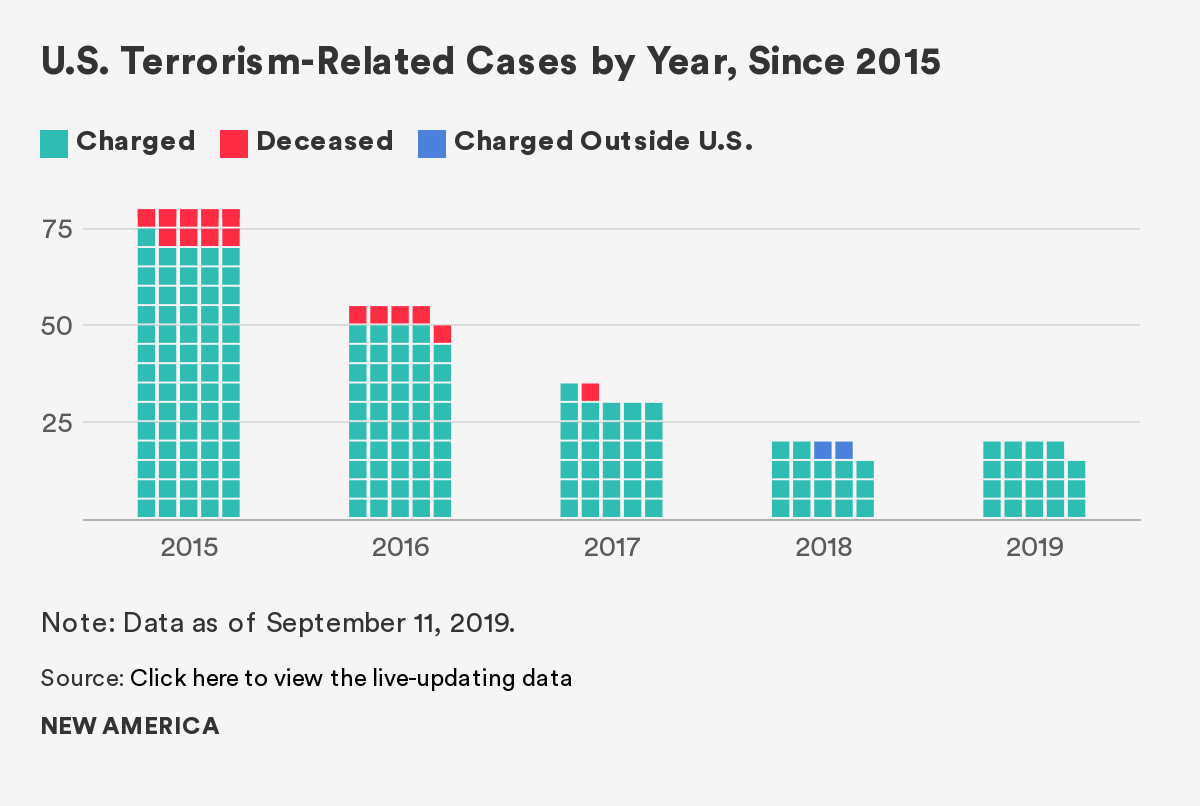
The number of cases of individuals being charged with terrorism-related crimes has dramatically decreased since 2015 when it was at its peak with 80 cases. This trend of decline is almost certain to reverse this year with a slight uptick in charges. There have been 19 cases as of September 11, 2019, compared to 19 cases over the whole year in 2018. Policymakers should be wary of reading too much into the number of prosecutions. There may be cases that are not yet public but were charged in 2018, and the number of prosecutions can reflect prosecutorial decisions regarding how aggressive to be or the wrapping up of investigations where the bulk of the activity occurred in earlier years. However, the decline from the peak in 2015 is notable.
The limited threat to the United States is in large part the result of the enormous investment the country has made in strengthening its defenses against terrorism in the post-9/11 era. The United States spent $2.8 trillion on counterterrorism efforts from 2002 to 2017, constituting almost 15 percent of discretionary spending during that time frame.7 That effort has made the United States a hard target.8 On 9/11, there were 16 people on the U.S. “No Fly” list.9 In 2016, there were 81,000 people on the list.10 Before 9/11, there was no Department of Homeland Security, National Counterterrorism Center, or Transportation Security Administration.
The United States benefits from a layered series of defenses that help to limit the ability of jihadists to mount complex operations within the country. Of the 19 cases so far in 2019, all but seven involved individuals monitored by an informant or undercover officer. Two of the 18 cases involved tips from family or community members who would have personally known the accused extremist, and in one case there was a tip from a suspicious member of the public.
In January 2019, Director of National Intelligence Dan Coats testified that the United States is a “generally inhospitable operating environment” for homegrown violent extremists compared to most Western countries.11
By the beginning of the Trump administration, the jihadist threat inside the United States was overwhelmingly lone-actor, ISIS-inspired attacks such as Sayfullo Saipov’s 2017 vehicular ramming in Manhattan. This threat stressed law enforcement, given the diversity of the perpetrators and the lack of organization needed to conduct such attacks. However, it is still a far cry from the type of attack that al-Qaeda carried out on 9/11.
Law enforcement and intelligence services will of course still need to combat and monitor the threat to the homeland from foreign terrorist organizations. Plots such as the 2009 underwear bomb attempt, the 2009 case in which three Americans trained with al-Qaeda and returned with a plan to bomb the New York City subway, and the 2010 failed Times Square bombing by Faisal Shahzad, who trained with the Pakistani Taliban, are sufficient reminders of this fact.
The Most Likely Terrorist Threat: Individuals Inspired by a Range of Ideologies and White Supremacy
Today, the terrorist threat to the United States is best understood as emerging from across the political spectrum, as ubiquitous firearms, political polarization, images of the apocalyptic violence tearing apart societies across the Middle East and North Africa, racism, and the rise of populism have combined with the power of online communication and social media. This mixture has generated a complex and varied terrorist threat that crosses ideologies and is largely disconnected from traditional understandings of terrorist organizations.12
Since the 9/11 attacks, individuals inspired by jihadist ideology have killed 104 people in the United States. However, individuals inspired by far-right ideology (including white supremacist, anti-government, and anti-abortion views) have killed 109 people. On August 3, 2019, Patrick Crusius, a 21-year-old white man, allegedly shot and killed 22 people at a Walmart in El Paso after posting a manifesto that described his motive as a “Hispanic invasion” and expressed support for the deadly attacks against mosques in Christchurch, New Zealand.13 The attack is the deadliest far-right attack in the post-9/11 era.
Individuals inspired in part by black nationalist or separatist ideology killed eight people, and individuals inspired by forms of ideological misogyny also killed eight people. The diversity of political motivations warns against overly focusing on any single ideology at the risk of obscuring broader systemic factors that are relevant across ideologies.
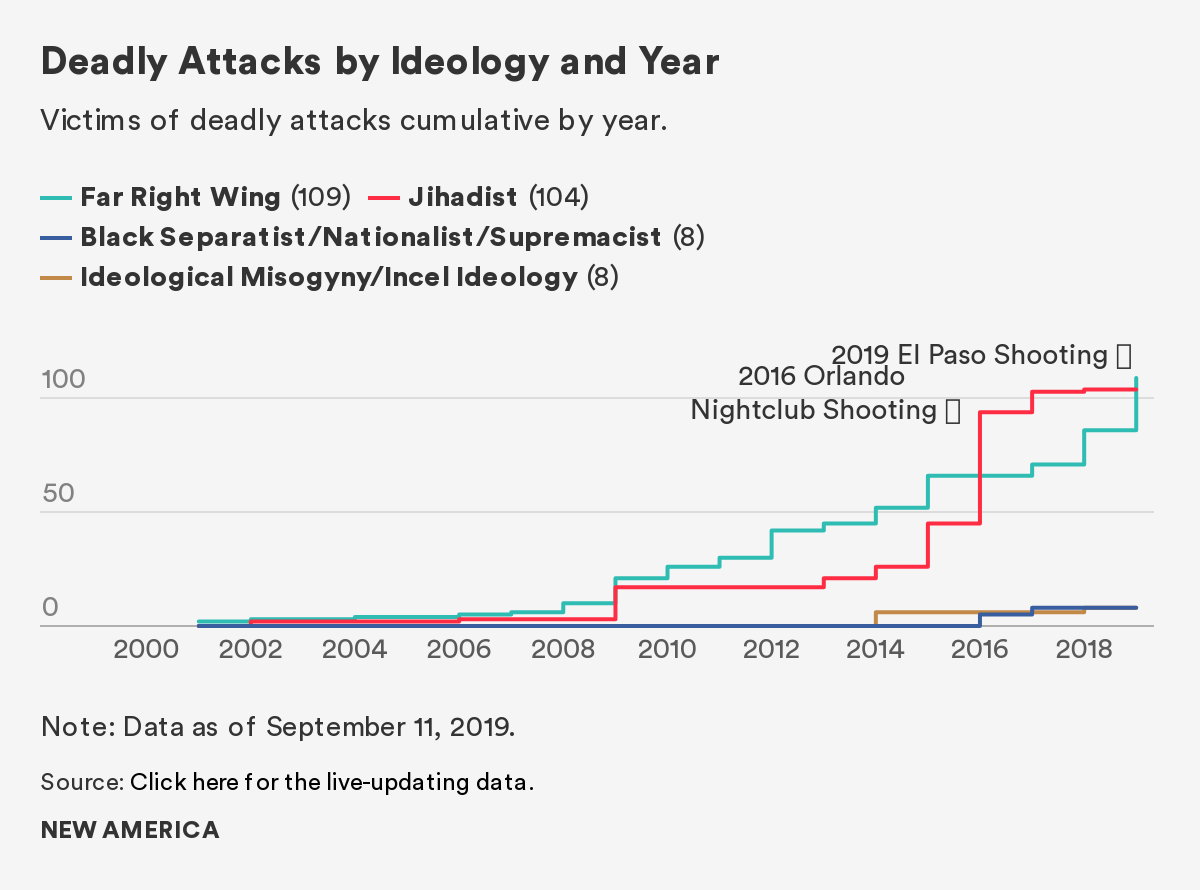
Though there are many ideological strands, and attackers’ ideological reference points are often in flux or complex, one particular ideological strand—white supremacy—stands out as a particular danger. Over the past three years, since the inauguration of President Donald Trump, the United States has seen a spate of deadly white supremacist terrorist attacks. Every deadly far-right attack in this period identified by New America had a nexus to white supremacy. Together these attacks killed 43 people, which is four times the number of people killed in jihadist terrorism in the same period. There were also more than three times as many deadly far-right attacks with connections to white supremacy in the same period as deadly jihadist attacks.
According to Michael McGarrity, assistant director of the FBI’s counterterrorism division, and Calvin Shivers, deputy assistant director of the criminal investigative division, “individuals adhering to racially motivated violent extremism ideology have been responsible for the most lethal incidents among domestic terrorists in recent years, and the FBI assesses the threat of violence and lethality posed by racially motivated violent extremists will continue.”14 They also testified before Congress that “there have been more domestic terrorism subjects disrupted by arrest and more deaths caused by domestic terrorists than international terrorists in recent years.”15
White supremacist terrorist attacks and violence more generally, appears to be increasingly interlinked and internationalized. A study by the New York Times determined that “at least a third of white extremist killers since 2011 were inspired by others who perpetrated similar attacks” and that the connections cross international borders.16 Several events illustrate this dynamic. On April 27, 2019, a man shot and killed one person in a white supremacist attack on a synagogue in Poway, Calif. The attack came six months to the day after the white supremacist attack on the Tree of Life Synagogue in Pittsburgh, which killed eleven people in the deadliest attack on Jews in American history. The attacker specifically referenced the Pittsburgh attack in an online manifesto as well as citing the attack on mosques in Christchurch, New Zealand that killed 51 people.17
The New Zealand attacker in turn cited a wide range of previous attackers and historical reference points with broad international range. He had financial interactions with the Austrian far-right, having donated money to the account of Martin Sellner, head of Austria's Identitarian Movement.18 The larger movement, of which the Austrian branch is part, extends across Europe and North America, including Identity Evropa, which participated in the Charlottesville rally, where a far-right attack killed a counterprotester.19
The attack in New Zealand is not a lone case of the internationalization of white supremacist and far-right terror. In June 2016, Thomas Mair, who was inspired by white supremacist ideology, assassinated British Member of Parliament Jo Cox in the midst of the contentious debates surrounding Brexit. Mair was influenced by Anders Brevik’s massacre in Norway, an attack cited by a range of white supremacist attackers and plotters including the New Zealand attacker and Coast Guard Lieutenant Christopher Hasoon, who gathered a cache of arms and was accused of plotting a mass casualty attack motivated by white supremacy.20 Mair had also purchased a range of neo-Nazi publications from the U.S. neo-Nazi movement, National Alliance.21 Mair also subscribed to a far-right South African paper (that had relocated to the United Kingdom) to which he sent letters expressing support for Apartheid.22 Similarly, Dylann Roof, who murdered nine people in a black church in Charleston, S.C. was also influenced by internationalized politics of nostalgia for Apartheid South Africa, and named his blog (where he posted his manifesto) “The Last Rhodesian,” a reference to the apartheid government of Rhodesia.23 Alexandre Bissonnette who killed six people at a mosque in Quebec, closely followed a range of American far-right and right-wing figures, and specifically looked up Roof before his attack.24 These ties should not be taken as evidence of an organized international far-right terrorist threat, but they do point to a mesh of interlinked movements, organizations, and ideologies drawn upon by right-wing terrorists.
The internationalization of far-right terrorism is cause for substantial concern, but white supremacy and far-right terrorism more generally pose a particular challenge for the United States. In part, this derives from this peculiar moment when the President of the United States has used the political influence of his office to promote conspiracies and other ideas embraced by and motivating those who are committing violence. For example, the white supremacist attacker who killed eleven people at the synagogue in Pittsburgh framed his attack in terms of the conspiracy theory that Jews through the Hebrew Immigrant Aid Society were orchestrating the Central American migrant caravan that included Muslims who he demonized as terrorists.25 The media focus on the caravan leading up to the attack was driven by President Trump’s false claims in which he alleged there to be a terrorist threat from the caravan.26
Trump’s influence on the synagogue attacker is not a lone case. Cesar Sayoc, who mailed bombs to a range of perceived liberals and political opponents of Trump was an avid Trump supporter who attended his rallies.27 One study has found evidence that Trump’s rallies may have increased hate crimes in the areas where they were hosted.28
The challenge cannot be reduced to Trump’s rhetoric. White supremacy has deep roots in American history. There is overlap not just with some right-wing politics but also broader societal views and ways of interpreting events that can make policies aimed at stopping the spread of the ideology on social media or the prosecution of cases difficult.29 This “proximity to political power” and the decentralized nature of far-right and white supremacist extremism has posed particularly difficult challenges for social media companies’ regulation of content, particularly when compared to the more easily identified and stigmatized jihadist online presence.30
The more developed white supremacist and far-right violent extremist movements should not lead policymakers to underestimate the threat from individuals motivated by other ideologies with less developed or no meaningful support networks. Doing so is a misunderstanding of the nature of the threat in a country where the ubiquity of firearms allows individuals to give violent expression to a range of ideological influences even without connection to a broader movement. That said, applying counterterrorism methods based in theories of dismantling organizational threats or ideological networks are also unlikely to impact individuals with more idiosyncratic ideological reference points who lack connection to a broader movement.
For example, in June 2017, 66-year-old James T. Hodgkinson, who held left-wing political views, shot Republican congressmen during a June 2017 baseball practice in Alexandria, Va., which did not kill anyone but injured multiple people including Rep. Steve Scalise (R-La.), the number three House Republican leader.31 Hodgkinson was a lone individual who lacked ties to organized violent groups. Yet if Hodkinson had successfully killed his targets it would have been a major political shock. As such, his attack illustrates the dangers of focusing solely on the ideological ecosystems when the availability of firearms and other dynamics enable more isolated individuals to have substantial impact.
Indeed, the El Paso attack occurred alongside two other major attacks, where the ideological roots are far from clear, but the actual activity looks like domestic terrorism. On July 28, 2019, Santino William Legan allegedly shot and killed three people at the Gilroy Garlic Festival in California. The FBI opened up a domestic terrorism investigation, having discovered a target list, but so far has not identified a motive, noting that Legan, who did not leave a manifesto, had materials from multiple violent ideologies.32 Similarly, hours after the terrorist attack in El Paso, a mass shooting in Dayton, Ohio killed nine people. According to the FBI, the perpetrator was also exploring multiple violent ideologies, although they have not determined that any one in particular motivated the attack.33 It is possible that it will turn out that these attacks have clear political motivations that will eventually come to light. However, these attacks do demonstrate that a fully thought out ideology is not necessary for a deadly attack, and that perpetrators may conduct attacks influenced by multiple, and even conflicting, ideologies. That, combined with the recent political violence across a wide range of ideologies and repeated mass shootings with no clear political motive, warns against focusing on only one ideology—be it jihadism, white supremacy, or something else.
The Jihadist Threat in the United States Is ISIS-Inspired and ISIS-Enabled, but Not ISIS-Directed
Since 2014, the year ISIS burst onto the global scene after seizing Mosul and declaring the caliphate, there have been eight deadly jihadist attacks in the United States. Eighty-three people were killed, accounting for more than three-quarters of all deaths caused by jihadists in the United States since the 9/11 attacks. Seven of the eight attacks were ISIS-inspired, the exception being Muhammad Youssef Abdulazeez’s 2015 attacks at a recruiting station and a U.S. Navy Reserve center in Chattanooga, Tenn. Abdulazeez was inspired by jihadist ideology in general.
In addition, since 2014, there have been 14 non-lethal attacks by individuals inspired by jihadist ideology in the United States. Of these attacks, none were directly carried out by ISIS, al Qaeda, or any other foreign terrorist organization. None of the attacks involved returnees from the Syrian conflict or any other conflict. Moreover, in only one case were the perpetrators known to have been in touch with ISIS operatives abroad with regards to the attack. That attack was the May 2015 shooting in Garland, Texas. There, two U.S.-born citizens, Elton Simpson, 30, and Nadir Soofi, 34, opened fire on an “art contest” organized by the American Freedom Defense Initiative that involved drawing cartoons of the Prophet Muhammad. Simpson had exchanged multiple messages with Mujahid Miski and Junaid Hussain, two well-known ISIS virtual recruiters who were based in Somalia and Syria, respectively, in the run-up to the attack.34 This was the only ISIS-enabled—as opposed to ISIS-inspired—attack in the United States and one person was injured before the gunmen were killed by police. New America defines an enabled attack as an attack in which a perpetrator has online communications regarding their activity with an ISIS militant based abroad. It is distinguished from inspired attacks, where an individual may interact with online ISIS propaganda but has not connected on specific matters with ISIS operatives, as well as from directed attacks, where ISIS provides material aid, such as training abroad, and organizes the plot beyond online encouragement.
While the incident in Garland has been the only ISIS-enabled attack in the United States, there have been several foiled plots in which ISIS’ virtual recruiters sought to encourage and aid attacks.35 These include a foiled plan by three men in Boston in June 2015 to attack Pamela Geller, the organizer of the Prophet Muhammad cartoon contest in Garland.
One case in particular that illustrates the danger of ISIS-enabled plots is that of Justin Sullivan. Before his arrest in June 2015, Sullivan plotted with Syria-based ISIS recruiter Junaid Hussain to conduct an attack.36 He agreed at Hussain’s behest to make a video of the attack that could be used by ISIS in its propaganda.37 The danger that Sullivan posed is emphasized by his conviction for a murder, in which he shot and killed his neighbor.38
The conclusion that the main threat to the United States is ISIS-inspired and ISIS-enabled, but not ISIS-directed, mirrors the statements of a variety of government officials. In January 2019, Director of National Intelligence Dan Coats testified: “Homegrown violent extremists (HVEs) are likely to present the most acute Sunni terrorist threat to the United States,” echoing his similar testimony in 2018 and 2017.39 In October 2018, FBI Director Christopher Wray testified: “The FBI assesses HVEs are the greatest terrorism threat to the Homeland.”40
The Threat in the U.S. Is Homegrown and Not Infiltration from Countries Affected by the Travel Ban
One of the most significant changes to American counterterrorism strategy implemented by the Trump administration is the new-found focus on border security and immigration control as a counterterrorism method. This strategy is clearest in the administration’s so-called travel ban,41 first promulgated on January 27, 2017, and then narrowed by court challenges before eventually having its revised version upheld in a 5-4 Supreme Court decision in June 2018. This strategy fundamentally misunderstands the terrorist threat in the United States, which is homegrown and not the result of foreign infiltrators.
The travel ban would not have prevented a single death from jihadist terrorists since 9/11. Nor would it have prevented the 9/11 attacks, which were perpetrated by 15 Saudis, two Emiratis, an Egyptian, and a Lebanese citizen—all originating from countries that are not on the travel ban list.
Eighty-four percent of the 479 individuals tracked by New America and accused of jihadist terrorism-related crimes in the United States since 9/11 were either U.S. citizens or U.S. legal residents.42 Just under half of them, 233, were born American citizens. Around three in ten were converts.
Syrian refugees who have settled in the United States have not posed a threat, either. No lethal act of jihadist terrorism since 9/11 has been carried out by a Syrian refugee. An ISIS terrorist with any sense is quite unlikely to try to infiltrate the United States as a Syrian refugee. Anne Richard, a senior U.S. State Department official, testified at a Senate Homeland Security Committee hearing in November 2015 that any Syrian refugee trying to get into the United States is scrutinized by officials from the National Counterterrorism Center, the FBI, the Department of Homeland Security, the State Department, and the Pentagon. Further, Leon Rodriguez, then the director of U.S. Citizenship and Immigration Services, who also testified at the November 2015 hearing, said that of the millions of people who try to get into the United States each year, “applicants for refugee status, and in particular refugees from Syria, are subjected to the most scrutiny of any traveler, of any kind, for any purpose, to the United States.”43 This process can take up to two years.
Every lethal attacker since 9/11 was either a citizen or permanent resident of the United States at the time of the attack, and none came from a country covered by the travel ban. Nine—more than half—of the 15 deadly attackers were born in the United States.
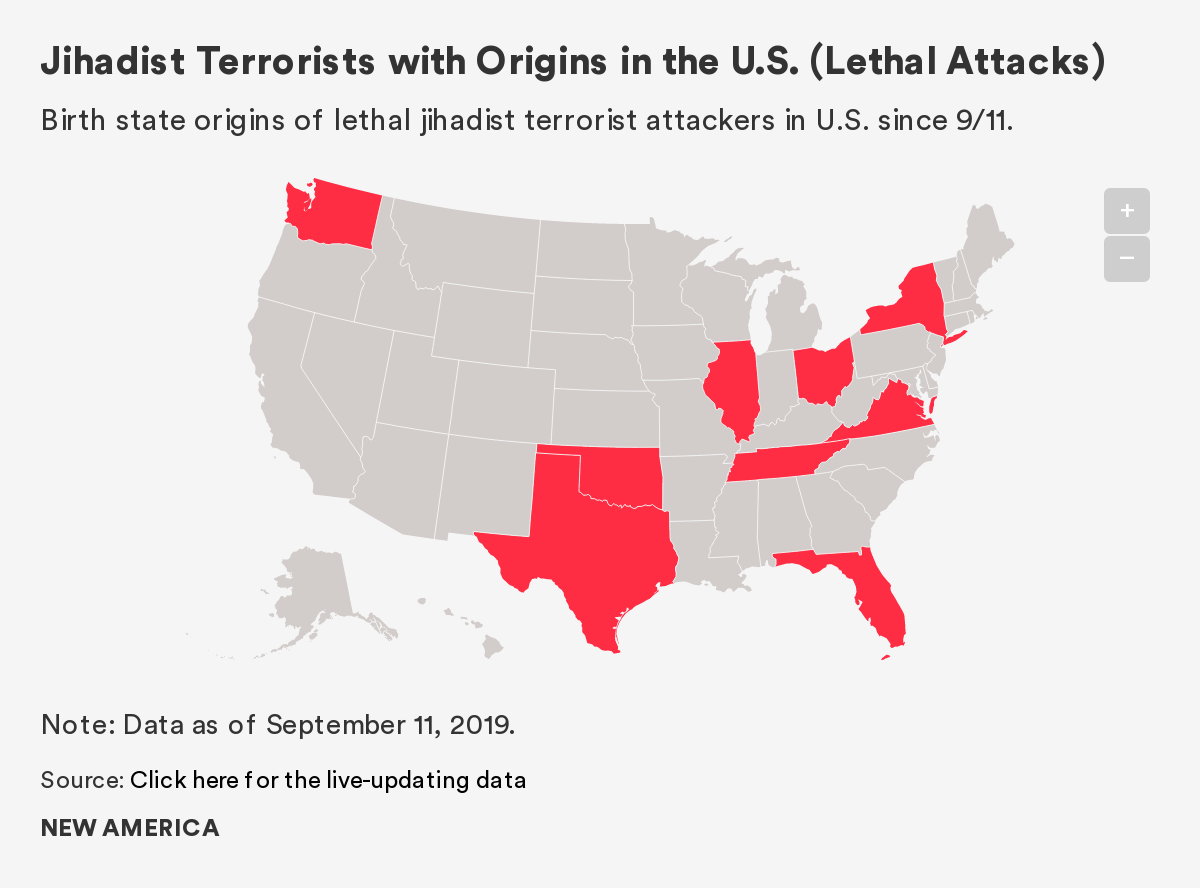
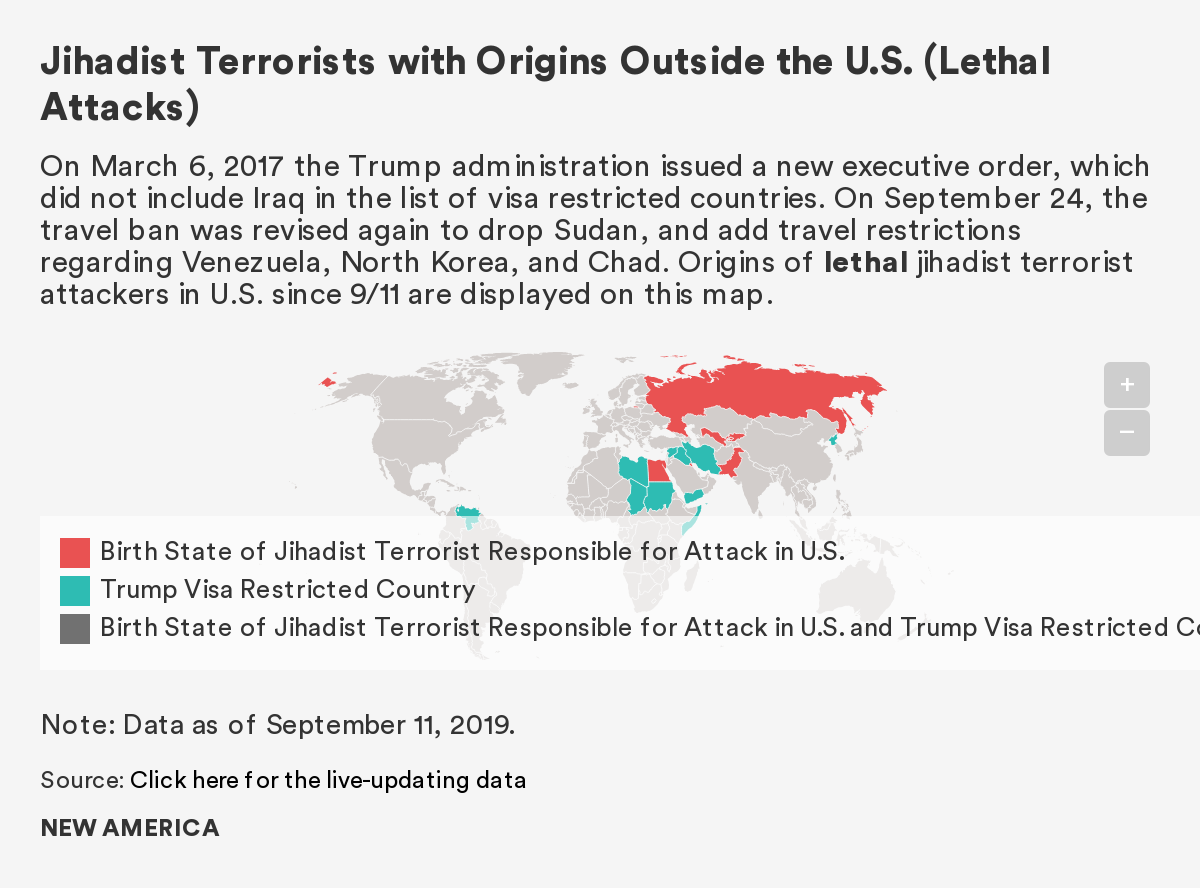
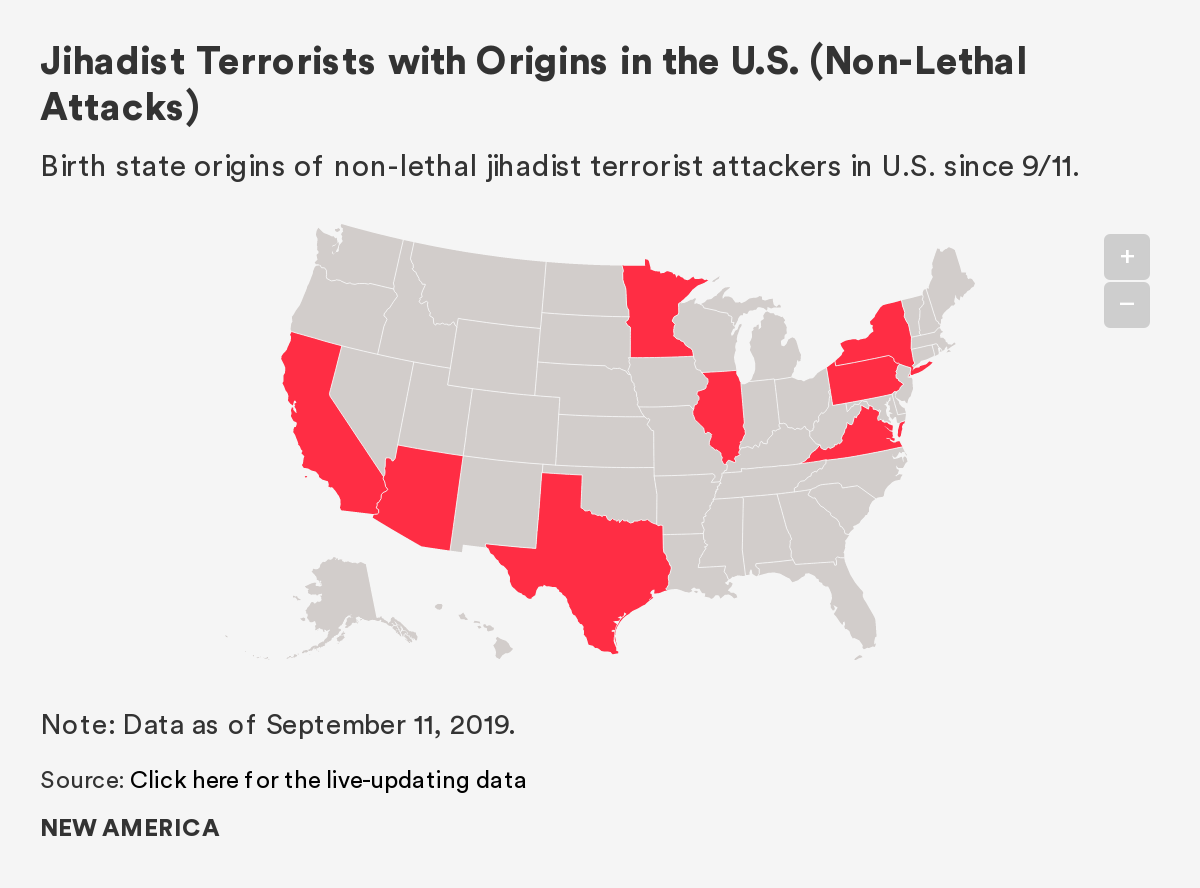
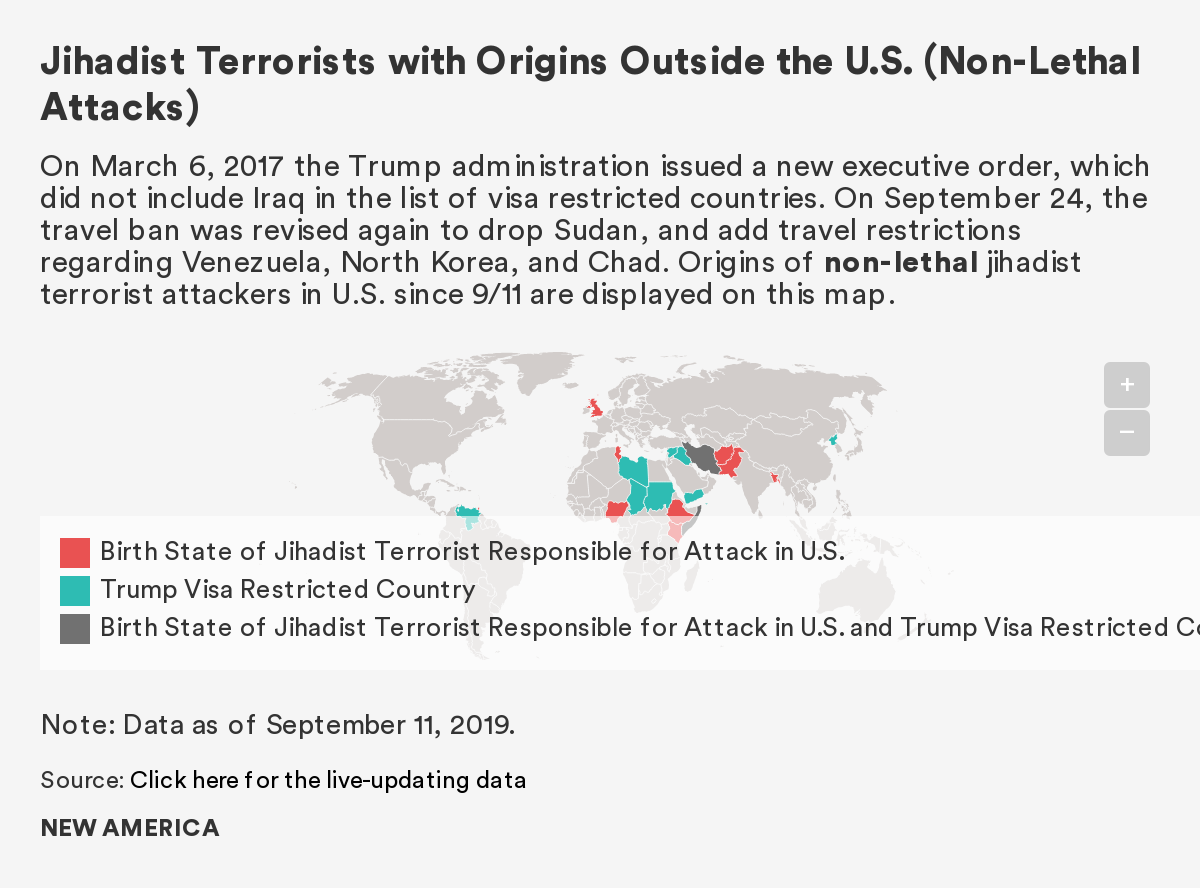
Among the individuals who conducted potentially lethal attacks inside the United States that were foiled or otherwise failed to kill anyone, there are only four cases that the travel ban could have applied to. None of these cases provides a convincing argument for the travel ban. In two of the cases, those of Taheri-Azar, a naturalized citizen from Iran who injured nine people in a 2006 vehicular ramming attack, and Dahir Adan, a 20-year-old naturalized citizen from Somalia, who injured ten people in a 2016 knife attack, the attackers entered the United States as young children and clearly radicalized within the United States. Taheri-Azar conducted his attack about two decades after he entered the United States. Abdul Razak Ali Artan, an 18-year-old legal permanent resident who came to the United States from Somalia as a refugee in 2014, injured 11 people in a 2016 attack at Ohio State University. He likely radicalized abroad—potentially in Pakistan—having left Somalia as a preteen, and was also inspired by online jihadist influences like Anwar al-Awlaki that have inspired many others, including U.S.-born citizens. The fourth, Mahad Abdirahman, a 20-year-old naturalized citizen from Somalia, who stabbed and injured two men at the Mall of America in November 2017, had been previously hospitalized for mental illness. In none of these cases is there any evidence that they radicalized in the travel ban countries or infiltrated the United States with the intent to conduct a terrorist attack.
The Department of Homeland Security’s (DHS) own analyses from February and March 2017 undercuts the justification for the travel ban. One leaked DHS report assessed that the “country of citizenship is unlikely to be a reliable indicator of potential terrorist activity” and found that half of the 82 extremists it examined were native-born American citizens.44Another leaked DHS report assessed that “most foreign-born U.S.-based violent extremists likely radicalized several years after their entry to the United States, limiting the ability of screening and vetting officials to prevent their entry because of national security concerns.”45 The report also found that about half of foreign-born extremists were younger than 16 when they entered the country and the majority had lived in the United States for 10 years.46
A report authored by the Cato Institute’s David Bier found only 13 post-9/11 vetting failures in which an individual entered the United States and committed a terrorism-related crime after 9/11.47 The report also found that the rate of vetting failure was 99.5 percent lower following 9/11 and the resultant reforms to immigration security.
Only one vetting failure identified by the Cato study, which covered the period from 2002 through 2016, involved a deadly attack — a rate of one for every 379 million visa or status approvals.48 That failure was the entry of Tashfeen Malik, who killed 14 people in San Bernardino alongside her husband, a natural-born U.S. citizen who had already acquired the weapons used in the attack and had plotted violence before her entry to the United States. Further, Malik was born in Pakistan and would not have been covered by the travel ban.
This does not mean the system is perfect. In August 2018, the United States arrested Omar Ameen, a 45-year-old Iraqi who had come to the United States as a refugee, in order to extradite him to Iraq where he faced charges for a June 22, 2014 murder of a police officer on behalf of ISIS. According to court records, Ameen had been a member of ISIS and its precursor groups since 2004 and faced two prior warrants for arrest before he entered the United States.49 His entry represents a failure of the system that requires review. However, the court documents do not refer to any terrorist plotting within the United States, and the vetting failure in Ameen’s case is a rarity among the terrorism cases involving U.S. persons.
In addition, on June 18, 2019, the FBI arrested Mustafa Mousab Alowemer, a 21-year-old Syrian refugee who had entered the United States in 2016 accusing him of plotting an attack on a church in Pittsburgh, Pa.50 However, the complaint in the case does not provide any reason to believe that Alowemer was radicalized when he entered the United States or that he entered the country with the intent to commit terrorism. The complaint shows that Alowemer had to reach out to an FBI online covert employee posing as an ISIS supporter to seek help in getting to Syria, an approach that would not make sense if he had prior Syria-based contacts. Instead, it appears that Alowemer was active in online jihadist circles, a pathway that has appeared with regards to far more U.S.-born citizens than Syrian refugees since 9/11.51 Indeed, it is telling that Alowemer appears to have communicated with Waheba Dais (referred to as Person 1 in the complaint), a 45-year-old married woman and U.S. permanent resident of Israeli origin, who first entered the United States in 1992.52 Given that connection, it is misleading to spin Alowemer’s story as one of Syrian refugees rather than online radicalization.
The Trump administration has marshalled its own politicized and highly misleading data to justify the travel ban and its immigration and border security-centric counterterrorism effort. A joint report by the Justice and Homeland Security departments in January 2018 asserted that “three out of four individuals convicted of international terrorism and terrorism-related offenses were foreign-born.”53
This DOJ-DHS report is highly misleading.54 First, even taking the report at face value, it suggests that the threat is largely homegrown, with a majority of cases involving citizens and a quarter of the cases involving natural-born citizens. Second, the report includes among the international terrorism cases it examines numerous examples of individuals extradited to the United States from other countries, who are simply not immigrants. By some counts it may include as many as 100 cases of individuals who were extradited.55 In addition, by using international terrorism cases, the report excludes domestic terrorism cases—particularly those motivated by far-right and similar ideologies. Yet this exclusion cannot be justified by claiming the report focuses on the jihadist threat, as the report includes cases involving the Revolutionary Armed Forces of Colombia (FARC, from the initials in Spanish) and other non-jihadist groups. Third, the report assumes that naturalized citizens are meaningfully distinct from natural-born citizens and represent a border security issue, without providing evidence to substantiate this distinction. In fact, as the aforementioned leaked DHS reports show, this is at odds with DHS’ own findings in other reviews of the data. White House adviser Stephen Miller sought to explicitly include language emphasizing the threat from children of foreign-born citizens in the report, a goal that the DHS Secretary at the time, Kirstjen Nielsen, reportedly objected to because it was unsubstantiated.56 Fourth, the report looks only at federal convictions for terrorism-related crimes and thus misses multiple important cases of U.S.-born citizens, including Omar Mateen, who died conducting the Orlando attack that killed 49 people in 2016; Carlos Bledsoe, who was charged with murder in state court for his 2009 attack on a military recruiting station in Arkansas; and Nidal Hasan, an Army major and psychiatrist who was charged in military court for his attack on Fort Hood in Texas in 2009 that killed 13 people.
Today’s extremists in the United States radicalize online, and the internet knows no visa requirements. Just under half of the jihadists charged in the United States since 9/11 either maintained a social media account where they posted jihadist material or interacted with extremists via encrypted communications; in recent years, an active online presence has been almost universal among American jihadists.57
The attack in Garland, Texas, described above, is a case in point. Not only were the perpetrators both native-born American citizens who would not have been stopped by the travel ban, but their interlocutors from ISIS did not set foot in the United States, instead encouraging the plot through online communication. The travel ban does nothing to respond to the most likely threat today: ISIS-inspired and ISIS-enabled homegrown attacks.
What Is the Threat to the United States From Returning Foreign Fighters?
The threat posed by American “foreign fighters” returning to the United States is quite limited. To date, no one who fought for ISIS or other extremist groups in Iraq or Syria has committed an act of terrorism in the United States after returning, according to a review of cases conducted by New America.
Of the few Americans who have fought with militant groups in Syria and returned, only one, Abdirahman Sheik Mohamud, conspired to carry out an attack. Mohamud, a Somali-American, traveled to Syria to join the Nusra Front in April 2014, only three months after he became a naturalized citizen. He returned to the United States that June and shortly thereafter communicated with an unnamed individual about his desire to travel to a military base in Texas and kill three or four U.S. soldiers.58 Mohamud was arrested in February 2015—before attempting to carry out this plot—and pleaded guilty to material support charges in June 2017.
Prison Releases
The United States will also need to prepare for the higher numbers of people convicted of terrorism coming out of prison in coming years. At least 98 Americans who have been convicted of jihadist terrorism-related crimes since 9/11 have been released, according to New America’s research. An additional 76 are scheduled to be released by the end of 2025. In May 2019, John Walker Lindh, the first detainee in the war on terror, was released from prison, sparking concern on the part of some as government documents suggested he remained radicalized.59
Coming releases of terrorism ex-convicts should not be viewed as necessarily posing a substantial threat. Those being released have served their debt to society, and should and must be allowed to return to society—within the terms of their release conditions and sentences. There is little evidence of a major prison radicalization or recidivism problem so far, despite a substantial number of people having been released.60 However, with more people moving through the justice system in recent years, it is an issue of which to be aware.
Citations
- Peter Bergen, David Sterman, Albert Ford, and Alyssa Sims, “Terrorism in America After 9/11,” New America, Accessed September 11, 2019, source
- “Incident/Investigation Report Case #17-000176” (Jupiter Police Department, January 12, 2017), source
- Paul Mueller, “Former Homeland Security Official Says Better Communication Needed in Wake of Stabbing,” CBS 12, March 14, 2018, source
- Heather Murphy, “Maryland Man Planned to Run Down Pedestrians at National Harbor, U.S. Says,” The New York Times, April 8, 2019, source
- “Coalition, Partner Forces Liberate Last Territory Held by Daesh,” CENTCOM, March 25, 2019, source
- David Sterman, “Why Terrorist Threats Will Survive ISIS Defeats,” CNN, October 23, 2017, source
- “Counterterrorism Spending: Protecting America While Promoting Efficiencies and Accountability,” Stimson Center, May 2018, source
- This draws on: Peter Bergen, Emily Schneider, David Sterman, Bailey Cahall, and Tim Maurer, 2014: Jihadist Terrorism and Other Unconventional Threats (Washington, DC: Bipartisan Policy Center, 2014), source
- Steve Kroft, “Unlikely Terrorists on No Fly List,” CBS News, October 5, 2006, www.cbsnews.com/news/unlikely-terrorists-on-no-fly-list
- “Feinstein Statement on Collins Amendment,” Office of Senator Dianne Feinstein, June 23, 2016, source
- Daniel R. Coats, “Statement for the Record: Worldwide Threat Assessment of the US Intelligence Community,” § Senate Select Committee on Intelligence (2019), source
- Peter Bergen and David Sterman, “The Real Terrorist Threat in America,” Foreign Affairs, October 30, 2018, source
- Peter Bergen and David Sterman, “The Huge Threat to America That Trump Ignores,” CNN, August 4, 2019, source
- Michael C. McGarrity and Calvin A. Shivers, “Confronting White Supremacy” (FBI, June 4, 2019), source
- McGarrity and Shivers.
- Weiyi Cai and Simone Landon, “Attacks by White Extremists Are Growing. So Are Their Connections,” New York Times, April 3, 2019, source
- Deanna Paul and Katie Mettler, “Authorities Identify Suspect in ‘Hate Crime’ Synagogue Shooting That Left 1 Dead, 3 Injured,” Washington Post, April 28, 2019, source
- Sheena McKenzie and Stephanie Halasz, “Christchurch Suspect Had Financial Links with Austrian Far-Right,” CNN, March 27, 2019, source
- Jason Wilson, “With Links to the Christchurch Attacker, What Is the Identitarian Movement?,” Guardian, March 27, 2019, source
- J. M. Berger, “The Dangerous Spread of Extremist Manifestos,” The Atlantic, February 26, 2019, source; Ian Cobain, Nazia Parveen, and Matthew Taylor, “The Slow-Burning Hatred That Led Thomas Mair to Murder Jo Cox,” Guardian, November 23, 2016, source
- Cobain, Parveen, and Taylor, “The Slow-Burning Hatred That Led Thomas Mair to Murder Jo Cox.”
- Alex Amend, “Here Are the Letters Thomas Mair Published in a Pro-Apartheid Magazine,” Southern Poverty Law Center (blog), June 20, 2016, source; Cobain, Parveen, and Taylor, “The Slow-Burning Hatred That Led Thomas Mair to Murder Jo Cox.”
- John Ismay, “Rhodesia’s Dead — but White Supremacists Have Given It New Life Online,” New York Times, April 10, 2018, source; Zack Beauchamp, “One Incredibly Revealing Line from Obama’s ISIS Speech,” Vox, September 10, 2014, source
- Amanda Coletta, “Quebec City Mosque Shooter Scoured Twitter for Trump, Right-Wing Figures before Attack,” Washington Post, April 18, 2018, source
- Masha Gessen, “Why the Tree of Life Shooter Was Fixated on the Hebrew Immigrant Aid Society,” New Yorker, October 27, 2018, source; Lois Beckett, “Pittsburgh Shooting: Suspect Railed against Jews and Muslims on Site Used by ‘Alt-Right,’” Guardian, October 27, 2018, source
- Adam Serwer, “Trump’s Caravan Hysteria Led to This,” The Atlantic, October 28, 2018, source
- Faith Karimi, “Pipe Bomb Suspect Cesar Sayoc Describes Trump Rallies as ‘New Found Drug,’” CNN, April 24, 2019, source
- Ayal Feinberg, Regina Branton, and Valerie Martinez-Ebers, “Counties That Hosted a 2016 Trump Rally Saw a 226 Percent Increase in Hate Crimes,” Washington Post, March 22, 2019, source
- For a historical discussion of the difficulty that emerges from white supremacy’s connection to and use of broader societal views see: Kathleen Belew, Bring the War Home: The White Power Movement and Paramilitary America (Cambridge, Massachusetts: Harvard University Press, 2018), 157.
- Ryan Broderick and Ellie Hall, “Tech Platforms Obliterated ISIS Online. They Could Use The Same Tools On White Nationalism.,” BuzzFeed, March 20, 2019, source; J. M. Berger, “The Alt-Right Twitter Census” (Vox-Pol, 2018), source
- Peter Bergen and David Sterman, “The Return of Leftist Terrorism?,” CNN, June 15, 2017, source
- Eric Levenson and Cheri Mossburg, “Gilroy Festival Shooter Had a ‘target List’ with Religious and Political Groups,” CNN, August 6, 2019, source
- “Dayton Shooter Expressed ‘Desire to Commit a Mass Shooting’ and Explored ‘Violent Ideologies,’” CBS, August 6, 2019, source
- Alexander Meleagrou-Hitchens and Seamus Hughes, “The Threat to the United States from the Islamic State’s Virtual Entrepreneurs,” CTC Sentinel 10, no. 3 (March 2017), source
- Further analysis on virtual plotters from: Rukmini Callimachi, “Not ‘Lone Wolves’ After All: How ISIS Guides World’s Terror Plots From Afar,” The New York Times, February 4, 2017, source); Daveed Gartenstein-Ross and Madeleine Blackman, “ISIS’s Virtual Planners: A Critical Terrorist Innovation,” War on the Rocks, January 4, 2017, source
- Department of Justice, Office of Public Affairs, “North Carolina Man Sentenced to Life in Prison for Attempting to Commit an Act of Terrorism Transcending National Boundaries,” June 27, 2017, source
- Ibid.
- Sharon McBrayer, “Justin Sullivan Sentenced to Life for Clark Murder,” News Herald, July 17, 2017, source
- Coats, Statement for the Record: Worldwide Threat Assessment of the US Intelligence Community.; Daniel R. Coats, “Statement for the Record: Worldwide Threat Assessment of the US Intelligence Community,” presented before the Senate Select Committee on Intelligence, February 13, 2018, source; Terence P. Jeffrey, “IC: U.S. Likely to See Homegrown Sunni Violent Extremist Attacks ‘With Little or No Warning,’” CNS News, May 11, 2017, source
- Christopher A. Wray, “Statement of Christoher A. Wray Director of the Federal Bureau of Investigation Threats to the Homeland,” § U.S. Senate Committee on Homeland Security and Governmental Affairs (2018), source
- The ban restricted entry by individuals from initially seven countries, capped the number of refugees admittable to the United States, and suspended the entry of Syrian refugees. The exact details of the restrictions and the countries targeted by them have changed over time.
- Bergen, Sterman, Ford, and Sims, “Terrorism in America.”
- This draws on: Peter Bergen, “Trump's Big Mistake on Syria Refugees,” CNN, January 28, 2017, source; Leon Rodriguez, “The Impact of ISIS on the Homeland and Refugee Resettlement,” § Senate committee on Homeland Security and Governmental Affairs (2015), source
- Citizenship Likely an Unreliable Indicator of Terrorist Threat to the United States (Washington, DC: Department of Homeland Security, 2017), source
- “TRMS Exclusive: DHS document undermines Trump case for travel ban,” MSNBC, March 3, 2017, source
- Ibid.
- David J. Bier, “Extreme Vetting of Immigrants: Estimating Terrorism Vetting Failures,” Cato Institute, April 17, 2018, source
- Ibid.
- U.S. Department of Justice Office of Public Affairs, “Iraqi National Wanted for Murder in Iraq Arrested In California,” August 15, 2018, source
- “Syrian Man Arrested on Terrorism Charges After Planning Attack on Christian Church” (Department of Justice Office of Public Affairs, June 19, 2019), source
- “Syrian Man Arrested on Terrorism Charges After Planning Attack on Christian Church.”
- “Wisconsin Resident Waheba Dais Pleads Guilty to Attempting to Provide Material Support to ISIS” (Department of Justice Office of Public Affairs, April 22, 2019), source; “Syrian Man Arrested on Terrorism Charges After Planning Attack on Christian Church.”
- U.S. Department of Justice, Office of Public Affairs, “DOJ, DHS Report: Three Out of Four Individuals Convicted of International Terrorism and Terrorism-Related Offenses were Foreign-Born,” January 16, 2018, source
- This section draws upon David Sterman, “Five Problems with the DHS/DOJ Report on Foreign Terrorist Entry into the United States,” New America, January 16, 2018, source
- Lisa Daniels, Nora Ellingsen, and Benjamin Wittes, “Trump Repeats His Lies About Terrorism, Immigration and Justice Department Data,” Lawfare, January 16, 2018, source
- Josh Dawsey and Nick Miroff, “The Hostile Border Between Trump and the Head of DHS,” Washington Post, May 25, 2018, source
- Bergen, Sterman, Ford, and Sims, “Terrorism in America.”
- United States of America v. Abdirahman Sheik Mohamud, Case No. 2:15-cr-00095-JLG-EPD, Indictment (S.D. Ohio, 04/16/2015)
- Niraj Chokshi and Carol Rosenberg, “John Walker Lindh, the ‘American Taliban,’ Was Released. Trump Said He Tried to Stop It.,” New York Times, May 23, 2019, source
- Peter Bergen and David Sterman, “Jihadist Terrorism 17 Years After 9/11” (New Ametrica, September 10, 2018), source
What Is the Threat to Europe?
While the jihadist threat in the United States has receded, the threat in Europe is more severe, consisting of a mixture of attacks directed by ISIS and its affiliates as well as homegrown ISIS-enabled and ISIS-inspired attacks.
While the United States has experienced no attacks directed by foreign terrorist organizations since 9/11, there have been five ISIS-directed attacks in Europe since 2014. These five ISIS-directed attacks in Europe since 2014 killed 188 people, more than the death toll of all deadly jihadist attacks in the United States since 9/11.1
Europe may have turned the corner regarding the immediate threat of ISIS-directed attacks. It has not seen an ISIS-directed attack since May 2017. With the demise of ISIS’ territorial state in Syria and Iraq, attacks in Europe are increasingly likely to be ISIS-enabled or ISIS-inspired but not ISIS-directed.
In its 2019 report, Europol stated that in 2018: “All jihadist terrorist attacks were committed by individuals acting alone,” and noted that “the diminished sophistication in the preparation and execution of jihadist terrorist attacks contributed to a lower number of casualties in completed attacks.”2 This assessment echoes Europol’s 2018 report, which also cited a “decrease in sophistication” in attack plots in the European Union.3 Additionally, according to Europol, the number of arrests for jihadist terrorism in Europe declined for the second year in a row to 511 in 2018 from 705 in 2017 and 718 in 2016, after increasing every year from 2013 through 2016.4 The number of failed, foiled, and completed attacks in 2018 declined from 33 in 2017 to 24 in 2018.5 Data on launched and foiled attacks in Europe collected by Petter Nesser, a senior researcher at the Norwegian Defence Research Initiative, also shows a decline from 2017 to 2018.6
Despite these promising signs, Europe faces a continued and substantial threat. While Europe may be turning the corner with regard to attacks, the 33 foiled, failed, or successful attacks in 2017 represented a doubling of the number in 2016 by Europol’s count.7 Likewise, Nesser notes that the number of foiled and launched attacks in 2018 was still higher than in any year prior to 2015.8
New America’s research, which tracks failed and successful attacks, suggests a similar trend of declining attacks and sophistication in the past couple of years. The number of attacks per year grew through 2016 while staying stable in 2017. This growth was driven by a steady increase in the number of attacks inspired by jihadist ideology in Europe but not known to have been directed or enabled by ISIS, even as attacks known to have closer ties to ISIS tapered off. The number of attacks then substantially decreased in 2018; as of September 11, 2019 is on track to end with a slightly lower number of attacks than occurred in 2018.
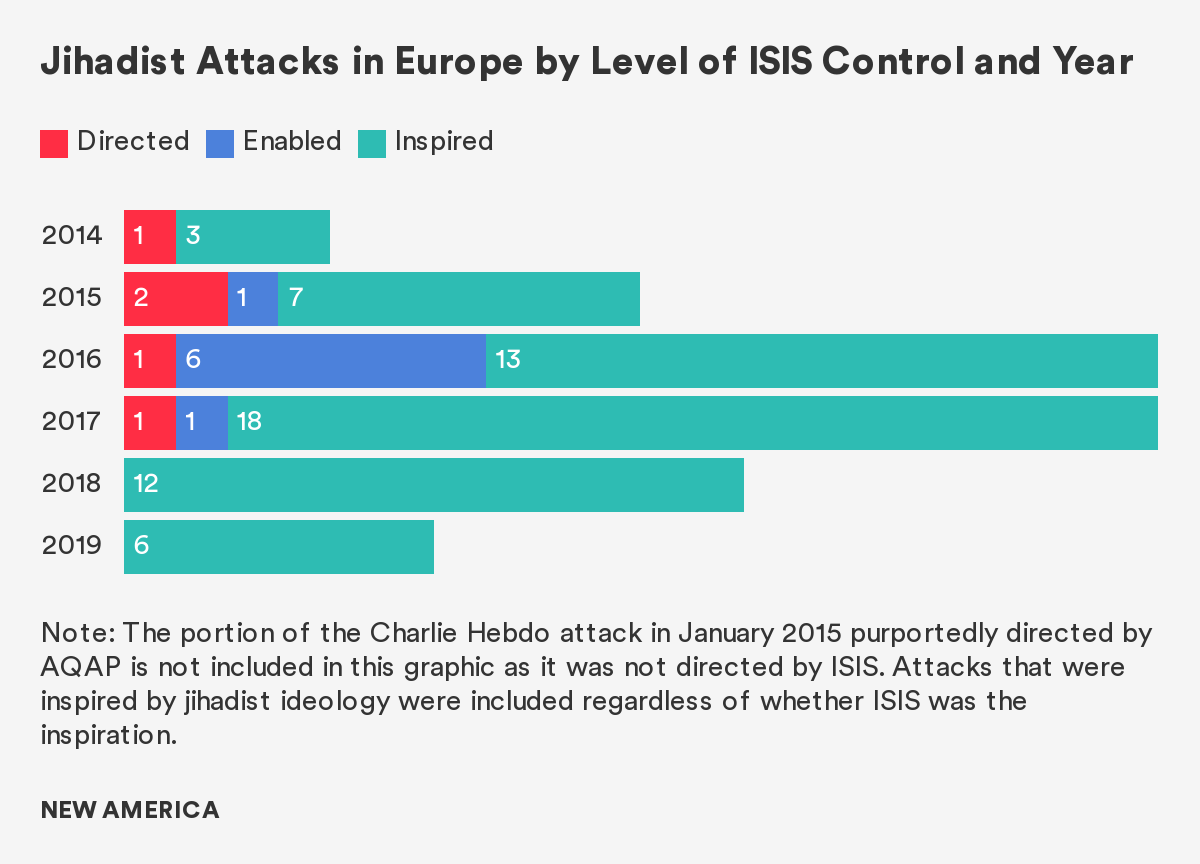
Europe has experienced eight ISIS-enabled attacks since 2014,9 compared to one in the United States. Twenty people have died in ISIS-enabled attacks in Europe, while no one other than the perpetrators has died in an ISIS-enabled attack in the United States. The last10 ISIS-enabled attack in Europe occurred in April 2017, when Rakhmat Akilov drove a truck into a crowd in Stockholm, Sweden, killing five people. Before the attack, Akilov shared images of his target and received a green light for the attack from his contacts in ISIS via encrypted message.11 While Akilov’s attack is the last enabled attack recorded in New America’s data, it is worth noting that the UN Sanctions Monitoring Team’s January 2019 report cited a “recent re-emergence of communication between ISIL command and control, and individuals in different European countries.”12
Finally, there have been 59 attacks inspired by jihadist ideology in Europe that have not been directed or enabled by ISIS or other foreign terrorist organizations since 2014. These inspired attacks have killed 149 people in Europe since 2014, more than jihadist terrorists have killed in the United States during the 18 years since the 9/11 attacks.
Europe faces a more severe threat than the United States in large part due to four major factors: the large number of European foreign fighters, the larger and more developed nature of European jihadist networks, the marginalization of Muslims within Europe, and Europe’s geographic proximity to conflict zones.
Foreign Fighters
The first factor is the far larger number of foreign fighters who left for Syria and Iraq from Europe and the correspondingly large number of returnees. In its 2019 report, Europol estimated that about 5,000 Europeans had traveled to conflict areas in Syria and Iraq and put the number of Europeans still in the region at less than 2,000.13 In its 2018 report, Europol estimated that those in Syria numbered 2,500, with 1,500 having returned home and 1,000 having died.14 It is not clear from the latest Europol report the relative extent to which additional returnees, additional deaths, or other factors account for the decline from 2,500 to less than 2,000 believed to remain in the region.
These numbers are far greater than the number of Americans who have traveled to fight in Syria and Iraq. According to the FBI, 300 Americans have “traveled or attempted to travel to Syria and Iraq to participate in the conflict,” a number that appears to include those who fought with any group.15 In addition, many of these Americans were arrested before setting foot in the conflict zone. Even with such caveats, the number of American “fighters” is more than 16 times smaller than the number of European fighters who actually traveled to Syria or Iraq.
The far larger number of European fighters is confirmed by ISIS’ own records. A set of 3,577 ISIS personnel records examined by New America contained 34 times as many fighters reporting residence in Western Europe than fighters reporting residence in the United States. Correspondingly, the number of American returnees is also far lower than the 1,500 European returnees.
The large number of European foreign fighters increases the threat to Europe in several ways. First, such fighters were behind the far deadlier and more sophisticated set of directed attacks that hit Europe. With the demise of ISIS’ territory in Iraq and Syria, this is less likely to be a driver of major attacks in the immediate future.
However, the impact of returned European fighters is not limited to such directed attacks. Returnees can also act as organizers and facilitators, using their experience and knowledge to help build jihadist networks—whether to enable attacks by others or to enable terrorist travel, propaganda, and fundraising activity.16
Beyond the threat of returnees from Syria conducting directed attacks or coordinating homegrown attacks by building networks, many of the returnees remain potential sources of inspired violence without direction from ISIS itself. The large radicalized population will remain a concern regardless of the state of ISIS control over operations.
The contours of the foreign fighter and returnee problem in Europe have shifted over time. For now, the flow of fighters to ISIS has been cut to, at most, a trickle. According to Europol’s 2019 report, “the number of EU [foreign fighters] travelling to the Iraq and Syria conflict zone in 2018 was very low.”17 This echoes similar statements of a substantial decline in travel in Europol’s 2018 and 2017 reports.18
In May 2017, then-National Counterterrorism Center Director Nicholas Rasmussen commented: “The good news is that we know that the rate of foreign fighters traveling has steadily declined since its peak in 2014.”19 Today, the flow to Syria and Iraq is close to zero.
That said, there are signs that there is still interest on the part of some militants for travel to conflict zones. Europol’s 2019 report cited a small number of attempted journeys to the Iraq and Syria conflict zone citing cases, and also stated that Spain reported that two individuals successfully traveled to Syria and Iraq.20 This resembles the Europol assessment in 2018, where it reported that in June 2017, a Dutch man successfully reached ISIS in Syria (the first known case at the time since November 2016).21 Similarly a search warrant in Minnesota alleged that an American attempted, but failed, to reach Syria via Europe in 2017.22 In its 2019 report, Europol also reported that a “relatively small” number of Europeans have traveled to conflict zones other than Syria and Iraq, departing from either Europe or Syria and Iraq.23
Such cases do not provide a reason to contest the finding that the number of travelers has declined precipitously. They do, however, warrant continued attention, particularly as the flow of fighters may increase again if another conflict becomes a popular field of jihad.
The flow of foreign fighter returnees back to Europe has also declined substantially. In its 2019 report, Europol stated that the number of returnees, “remained very low.”24 In its 2018 report it stated that, in 2017 there was a “diminishing number of returnees,” in part due to the difficulty of leaving ISIS territory as a result of military actions against ISIS.25 In July 2017, Rasmussen noted: “I look at the problem now as not so much as one of quantity but as one of quality,” emphasizing not the number of returnees but the skills that the small number of those who might return have obtained and how they might use them.26
There is a wild card with regard to European foreign fighter returnees: the unclear fate of the reportedly large number of Europeans currently imprisoned or detained in Syria and Iraq or otherwise remaining in the conflict zone. European countries have so far—on the whole—refused to take back hundreds of detained European fighters.27 This has resulted in some detained European fighters held in Syria reportedly being released.28 This produces the possibility that such fighters may return without being arrested at a later date, increasing the threat in Europe.
Jihadist Networks
The second factor compounding the threat in Europe is the existence there of stronger, more developed jihadist networks than those that exist in the United States. One reason ISIS was able to successfully conduct the November 2015 Paris attacks was that the attackers relied on a support network of at least 20 other people.29 Similarly, Belgium tried 46 members of the radical group Sharia4Belgium who traveled to fight in Syria or helped others to do so.30 Those 46 are only a small portion of the larger Sharia4Belgium network. These large networks are not things of the past. In its 2019 report, Europol noted that “terrorist networks continue to be detected in Europe,” citing the identification of 25 inmates across 17 prisons in Spain in which individuals were radicalizing in prison.31As noted above, according to Europol, European states arrested 511 people for jihadist terrorism crimes in 2018, 705 in 2017, and 718 in 2016.32 That is more jihadist terrorism-related arrests each year than have been made in the United States since 9/11.33 Over the three-year period from 2016 through 2019, European states arrested more people for jihadist terrorism-related crimes than the FBI reports having open investigations of ISIS-related crimes.34
Marginalization and Anti-Muslim Feeling
The third factor is that Europe faces more substantial challenges in successfully integrating its Muslim population than does the United States, and is thus likely to continue to struggle with a significant homegrown threat rooted in these challenges. In particular, the lack of opportunities and the identity challenges facing second-generation Muslim immigrants in Europe will likely continue to radicalize some for the foreseeable future.35
As a result of war, revolution, and poor economic and social conditions in the Middle East and North Africa, there has been an unprecedented wave of immigration from Muslim-majority countries into Europe in recent years. Germany alone took in more than 1 million refugees and asylum seekers.36 In 2019, and more broadly since the height of the crisis in 2015 and 2016, the number of migrants reaching Europe fell substantially.37 According to Frans Timmermans, the European Commission’s first vice-president, “Europe is no longer experiencing the migration crisis we lived in 2015, but structural problems remain.”38
European countries lack the ideological framework the United States has in the shape of the “American Dream,” which has helped to successfully absorb wave after wave of immigration, including Muslim Americans who are generally well integrated into American society.
There is no analogous French Dream or German Dream. The proportion of the French prison population that is Muslim is estimated to be around 60 percent, yet Muslims account for only about 8 percent of France’s total population.39 Muslim citizens in France are 2½ times less likely to be called for a job interview than similar Christian candidates, according to researchers at Stanford University.40 Many French Muslims live in grim banlieues, the suburbs of large French cities (similar to housing projects in the United States), where they find themselves largely divorced from mainstream French society. According to the Renseignements Généraux, a police agency that monitors militants in France, half the neighborhoods with a high Muslim population are isolated from French social and political life. The French term for these neighborhoods is equivalent to “sensitive urban zones,” where youth unemployment can be as high as 45 percent.41 In Belgium there is a similar story: 20 to 30 percent of the prison population is Muslim, yet Muslims make up only 6 percent of the overall population.42
It is not surprising that many of the perpetrators of attacks in Europe come from these economically marginalized communities or have spent time in French and Belgian prisons, which can function as universities of jihad. The members of the ISIS cell responsible for the November 2015 attacks in Paris that killed 130 and the March 2016 attacks in Brussels that killed 32 had bonded through criminal activities or in prison.43 Abdelhamid Abaaoud and Salah Abdeslam, the cell’s masterminds, were childhood friends who grew up in the impoverished Brussels neighborhood of Molenbeek. In 2010, the men were arrested and spent time in the same prison. Ibrahim Abdeslam, Salah’s brother, also spent time in prison with Abaaoud.44 He would go on to be one of the terrorists in the Paris attacks. Khalid and Ibrahim El Bakraoui, both suicide bombers in the Brussels attacks, had served lengthy prison sentences for armed robbery and assault on police.45
The marginalization of European Muslims and its role in jihadist radicalization is likely to be exacerbated by anti-Muslim and anti-immigrant feeling in Europe. Anti-immigrant, ultranationalist and anti-Muslim parties once played a marginal role in European politics. In recent years, their political power has increased, though the extent of their power is still contested. In the 2019 European Parliament elections, centrist parties lost ground while the far-right gained ground.46 Marine Le-Pen’s far-right National Rally (formerly the National Front) party slightly outperformed French President Emmanuel Macron’s party and in Italy, the far-right populist party scored a more substantial victory.47 The far-right gains in the election appear to have not translated into meaningful parliamentary power, however they demonstrate the continued relevance of far-right politics in Europe.48
This situation mirrors the political situation that was apparent last year, where far-right parties made their power known. Marine Le Pen made it to the runoff in the French presidential race with the second strongest showing in the first round race. Far-right parties had also expanded their power in Germany, the Czech Republic, Austria, the Netherlands, Italy and Poland, while left-wing parties have collapsed and center-right parties have moved rightward on immigration.49
In April 2018, anti-immigrant nationalist Viktor Orbán was reelected as prime minister in Hungary with overwhelming support.50 Orbán’s government proceeded to criminalize providing assistance to undocumented migrants.51 Before the election, Orbán called for a global anti-migrant alliance and stated that “Christianity is Europe’s last hope,” warning that, with mass migration, “our worst nightmares can come true. The West falls as it fails to see Europe being overrun.”52 In 2019 the Hungarian government was set to sponsor a festival hosted by a far-right movement, members of whom were convicted for a bomb plot in Romania, before backing off and withdrawing support.53
In 2018, Denmark’s government proposed new laws that would radically restrict the behavior of people living in ghettoized neighborhoods that are predominantly Muslim; they include doubling the sentences for certain crimes committed in the listed neighborhoods and criminalizing taking children on extended trips to their countries of origin that could damage their “schooling, language and well-being.”54 In Denmark’s 2019 elections, anti-immigrant feeling found expression not just on the right but among Denmark’s liberal and social democratic parties.55As anti-immigrant parties and agendas exert strength, they risk escalating the sense of alienation among Europe’s already marginalized Muslim population, potentially contributing to further radicalization.
In some cases, anti-immigrant and anti-Muslim politics have been expressed through terrorism. In June 2019, Germany saw the murder of Walter Lübcke, a regional politician who supported Merkel’s policies of accepting refugees. The suspect in the case had a long history of ties to Germany’s neo-Nazi scene and had been involved in previous attempts at violence, including an attempted bombing for which he did prison time. According to Germany’s domestic intelligence agency, there are 12,700 potentially violent right-wing extremists in the country.56 The agency reported a 50 percent increase in the number of extremists over the past two years.57
Britain, which saw its own political assassination in recent years—that of anti-Brexit MP Jo Cox in 2016—is also noticing warning signs regarding a rise in far-right terrorism. British Home Secretary Sajid Javid noted a “marked shift in the nature of extreme right-wing activity” towards actual terrorist violence.58
Europol only identified one far-right terrorist attack that took place in Europe in 2018. The attack occurred in Italy and injured six people who the perpetrator believed to be Africans. The perpetrator had previously unsuccessfully run for local office with an anti-migrant party.59 However, Europol reported that an “escalation of right wing sentiments across Europe resulted in an increase in arrests” for the third year in a row.60 2018 saw some serious terrorist plots foiled including one in June 2018, where France arrested 10 people suspected of plotting a terrorist attack against Muslims who had acquired rifles, handguns, and grenades.61 While this far-right violence poses a significant threat on its own, it should also raise concerns about the potential for homegrown cycles of violence driven by polarization in European politics.
Geographic Proximity
The fourth factor that results in Europe facing a more severe threat is that Europe is simply closer in geography to the parts of the world where revolution and war have opened opportunities for jihadist organizing, while the United States is separated from these areas by thousands of miles and two oceans. As a result, the repercussions of instability in the Middle East and North Africa have more impact on Europe than on the United States.
Citations
- In addition, AQAP conducted a directed attack on the offices of Charlie Hebdo in 2014, killing 12 people, though the extent of its direction beyond providing training for the attackers years before the attack is not clear.
- “Terrorism Situation and Trend Report 2019 (TE-SAT).”
- “European Union Terrorism Situation and Trend Report 2018,” Europol, 2018, source
- Europol 2019; Europol 2018.
- Europol 2019 p. 14.
- Peter Nesser, “Military Interventions, Jihadi Networks, and Terrorist Entrepreneurs: How the Islamic State Terror Wave Rose So High in Europe,” CTC Sentinel 12, no. 3 (March 2019), source
- Europol 2019; Europol 2018.
- Nesser, “Military Interventions, Jihadi Networks, and Terrorist Entrepreneurs: How the Islamic State Terror Wave Rose So High in Europe.”
- Those attacks are: the April 2017 Stockholm, Sweden, truck attack that killed five people and injured 14; the December 2016 Berlin, Germany, Christmas market attack that killed 12 and wounded 56; the July 2016 music festival suicide attack in Ansbach, Germany, that injured 12 people; the July 2016 ax attack on a train in Wurzburg, Germany, that injured four; the July 2016 killing of two people in Magnanville, France; the stabbing attack in February 2016 of a police officer by a 16-year-old girl in Hanover, Germany, that injured one; and the April 2015 church attack in Villejuif, France, that killed one.
- Tracking ISIS-enabled attacks is particularly susceptible to undercounting when it comes to more recent cases, as details on online ties to ISIS often become confirmed only later in the course of investigations.
- “Stockholm attacker appears baffled over lack of Isis claim,” AFP/The Local, February 21, 2018, source
- “Twenty-Third Report of the Analytical Support and Sanctions Monitoring Team.”
- Europol 2019
- Europol 2018.
- Hollie McKay, “Almost All American ISIS Fighters Unaccounted For, Sparking Fears They Could Slip Through Cracks and Return,” Fox News, October 26, 2017, source
- See discussion in the following: Alastair Reed, Johanna Pohl, and Marjolein Jegerings, “The Four Dimensions of the Foreign Fighter Threat,” International Centre for Counter-Terrorism – The Hague, June 2017, source; Europol, 2018.
- Europol 2019
- Europol, 2018; EU Terrorism Situation and Trend Report (TE-SAT) 2017, (The Hague: Europol, 2017), source
- Nicholas Rasmussen, “Director Rasmussen Opening Remarks CNAS Keynote Policy Address” (National Counterterrorism Center, May 3, 2017), source
- Europol 2019.
- Europol, 2018.
- Stephen Montemayor, “Affidavit Reveals Twin Cities Man's Aborted Attempt to Join ISIS Last Year,” Star Tribune, May 31, 2018, source
- Europol 2019.
- Europol 2019
- Europol 2018.
- Nick Rasmussen, “Tour d’Horizon,” (Session, Aspen Security Forum, Aspen, Colorado, July 19-22, 2017).
- Stacy Meichtry and Julian E. Barnes, “Europe Balks at Taking Back ISIS Fighters,” Wall Street Journal, February 13, 2018, source
- Josie Ensor and Brenda Soter Boscolo, “European ISIL Jihadists Released under Secret Deals Agreed by UK’s Allies in Syria,” Telegraph, June 15, 2018, source
- Peter Bergen, David Sterman, Alyssa Sims, and Albert Ford, ISIS in the West: The Western Militant Flow to Syria and Iraq (Washington, DC: New America, 2016), source
- Bergen, Sterman, Sims, and Ford, ISIS in the West.
- Europol 2019.
- Europol 2019.
- Bergen, Sterman, Ford, and Sims, “Terrorism in America.”
- Lisa Rose, “US has 1,000 Open ISIS Investigations but a Steep Drop in Prosecutions,” CNN, May 16, 2018, source
- Scott Shane, Richard Perez-Pena, and Aurelien Breeden, “‘In-Betweeners’ Are Part of a Rich Recruiting Pool for Jihadists,” New York Times, September 22, 2016, source; Peter Bergen, “A Pattern in Terror — Second Generation, Homegrown,” CNN, May 24, 2017, source
- Patrick Donahue and Arne Delfs, “Germany Saw 1.1 Million Migrants in 2015 as Debate Intensifies,” Bloomberg, January 6, 2016, source
- Demetrios Papademetriou, “The Migration Crisis Is Over: Long Live the Migration Crisis,” Migration Policy Institute (blog), March 2017, source; Jennifer Rankin, “EU Declares Migration Crisis over as It Hits out at ‘Fake News,’” Guardian, March 6, 2019, source
- Ibid.
- Christopher de Bellaigue, “Are French Prisons ‘Finishing Schools’ for Terrorism?” Guardian, March 17, 2016, source
- This draws on: Peter Bergen and Emily Schneider, “How the Kouachi brothers turned to terrorism,” CNN, January 9, 2015, source ; Claire L. Adida, David D. Laitin and Marie-Anne Valfort, “Identifying barriers to Muslim integration in France,” Proceedings of the National Academy of Sciences of the United States of America 107 (December 2010), source
- Steven Erlanger, “A Presidential Race Leaves French Muslims Feeling Like Outsiders,” The New York Times, April 4, 2012, source
- Steven Mufson, “How Belgian prisons became a breeding ground for Islamic extremism,” Washington Post, March 27, 2016, source
- “Unraveling the Connections Among the Paris Attackers,” The New York Times, March 18, 2016, source
- Ibid.
- “Ibrahim and Khalid el-Bakraoui: From Bank Robbers to Brussels Bombers,” New York Times, March 24, 2016, source
- Meg Anderson, “4 Takeaways From The European Parliament Election Results,” NPR, May 27, 2019, source
- Anderson; David M. Herszenhorn and Maia De La Baume, “Mainstream Parties Block Euroskeptics from Top Parliament Posts,” Politico, July 11, 2019, source
- Valentina Pop, “Nationalists Fail to Join Forces in European Parliament,” Wall Street Journal, June 13, 2019, source
- William Galston, “The Rise of European Populism and the Collapse of the Center-left,” Brookings, March 8, 2018, source
- Marc Santora, “Hungary Election Gives Orban Big Majority, and Control of Constitution,” The New York Times, April 8, 2018, source
- Patrick Kingsley, “Hungary Criminalizes Aiding Illegal Immigrants,” The New York Times, June 20, 2018, source
- Marton Dunai, “Hungary's Orban Calls for Global Anti-Migrant Alliance with Eye on 2018 Elections,” Reuters, February 18, 2018, source
- Lili Bayer, “Orbán Government Withdraws Support for Extreme-Right Festival,” Politico, June 17, 2019, source
- Ellen Barry and Martin Seloe Sorensen, “In Denmark, Harsh New Laws for Immigrant ‘Ghettos,’” The New York Times, July 1, 2018, source
- Stine Jacobsen, “Danish Muslims Feel Backlash as Immigration Becomes Election Issue,” Reuters, May 31, 2019, source; Vanessa Gera and Jan M. Olsen, “Nordic Liberals Take Harder Line On Migrants To Win Votes,” AP, June 26, 2019, source; Lisa Abden/Vordingborg, “An Island for ‘Unwanted’ Migrants Is Denmark’s Latest Aggressive Anti-Immigrant Policy,” Time, January 16, 2019, source
- Katrin Benhold, “A Political Murder and Far-Right Terrorism: Germany’s New Hateful Reality,” New York Times, July 7, 2019, source
- Austin Davis, “Far-Right Extremism on Rise in Germany, Report Warns,” Telegraph, April 28, 2019, source
- Jamie Dettmer, “European Security Chiefs Alarmed at Threat From Far-Right Terrorism,” Voice of America, May 3, 2019, source
- Europol 2019.
- Europol 2019.
- Angelique Chrisafis, “Ten Face Charges in France Over Suspected Far-Right Terror Plot,” Guardian, June 27, 2018, source
Key Trends in Terrorism
Technology and tactics play an important role in shaping terrorist capabilities and threats. This section examines four specific areas at the intersection of technology and tactics. It finds that although there are some specific areas of concern, in the West terrorist activity continues to rely upon less sophisticated forms of attack including firearms, bladed weapons, and vehicular ramming. Explosives continue to be an issue though not all plots involving explosives are of the same sophistication. Chemical, biological, radiological, and nuclear weapons remain absent from jihadist attacks but a few plots warn against dismissing the potential for chemical and biological attacks. Drones continue to be one of the most significant areas of jihadist technological and tactical innovation and continue to spread in use.
Low-Technology Attacks: Firearms, Knives, and Vehicles
The United States should expect unsophisticated and low-technology forms of violence (reliant on firearms, knives, and vehicular rammings) to remain the most common type of terrorist violence in the West.1 Of the eight jihadist attacks in the West in 2019 identified by New America, only one involved explosives. In six of the eight attacks, a knife or other bladed weapon was used. In one attack, the perpetrator attempted but failed to carry out a vehicular ramming.
New America only recorded one attack involving vehicular ramming in 2019 (the Rondell Henry case in which Henry allegedly stole a U-Haul and was looking for potential targets) and the attack was foiled while still in the preparation phase. However, vehicular ramming is likely to remain a threat as illustrated by its adoption by attackers inspired by a range of ideologies, including a January 1, 2019 attack in Japan that injured nine people and which the perpetrator said was retaliation for the use of the death penalty against members of Aum Shinrikyo.2
Of the 108 jihadist attacks in the West since 2014 identified by New America, only 18 have involved explosives. Of the 14 deadly jihadist attacks in the United States since 9/11, only two involved explosives. In contrast, 10 involved firearms.
Explosives and TATP 3
The attacks involving explosives in the West since 2014 can be divided into two categories: 1) those involving TATP, triacetone triperoxide, which has long been the bomb of choice for jihadists in the West due to the ease of acquiring the components to make it, as compared to military-grade explosives; and 2) those involving improvised explosives. Seven of the eighteen attacks in the West involving explosives since 2014 involved TATP. Eleven involved other improvised explosives.
TATP can be built using the common household ingredient hydrogen peroxide, which is used to bleach hair. Though generally more accessible than military grade explosives in the West, making a TATP bomb is tricky because the ingredients are highly unstable and can explode if improperly handled. The danger of building TATP bombs without training can be seen in the case of Matthew Rugo and Curtis Jetton, 21-year-old roommates in Texas City, Texas.4 They didn’t have any bomb-making training and were manufacturing explosives in 2006 from concentrated bleach when their concoction blew up, killing Rugo and injuring Jetton. The pair had no political motives: They had just wanted to blow up vehicles for fun.
TATP therefore can indicate that a perpetrator received training or direction from a foreign terrorist group. Indeed, three of the seven attacks involving TATP since 2014—the 2015 Paris bombings, the 2016 bombings of the Brussels metro and airport by the same ISIS cell, and the 2017 bombing of an Ariana Grande concert in Manchester, England—were directed by ISIS. This accounts for half of the attacks known to have been directed by foreign terrorist organizations in the West since 2014 and all of the directed attacks that involved explosives.
The four other attacks since 2014 involving TATP—the September 2017 bombing at the Parsons Green tube station in London in which the bomb failed to fully explode, the August 2017 attacks in Barcelona where traces of TATP were found at a suspected bomb factory tied to the plot, a June 2017 failed bombing of the Brussels metro that killed only the perpetrator; and a May 2019 attack in which a 24-year-old Algerian man exploded a bomb that included TATP in Lyon, France injuring 14 people—had no known operational link to ISIS.5 These attacks account for less than 5 percent of all inspired or enabled attacks and only a third of inspired or enabled attacks involving explosives.
All of the attacks involving TATP occurred in Europe and none occurred in the United States. This may be another sign of the greater development of and diffusion of expertise and technology in jihadist networks in Europe compared to the United States.
Eight ISIS-inspired attacks and three ISIS-enabled attack in the West since 2014 used other explosives. For example, Tashfeen Malik and Syed Rizwan Farook, who killed 14 people in San Bernardino, Calif., had built pipe bombs using Christmas lights and smokeless powder.6 They learned the bomb recipe they used from Inspire, the English-language propaganda magazine of Al-Qaeda in the Arabian Peninsula, whose article “Make a Bomb in the Kitchen of Your Mom” was also used by the Boston Marathon bombers.7
Continued Absence of Chemical Biological Radiological or Nuclear Attacks
Weapons of mass destruction have continued to be absent in attacks by jihadist terrorists in the West. Of 108 attacks conducted by jihadists in the West since 2014, none involved chemical, biological, radiological or nuclear (CBRN) weapons. In its 2018 report, Europol noted, “As in previous years, no terrorist attacks using chemical, biological, radiological or nuclear (CBRN) substances were recorded in the EU in 2017.”8 The 2019 report provides no cases of such attacks in 2018.9 Of the 479 people in the United States accused of jihadist terrorism-related crimes since 9/11, none acquired such weapons.
Despite the lack of CRBN attacks and greater innovation and interest on the low but deadly end of terrorist technology, jihadists have little compunction about using such weapons, as demonstrated by a series of recent plots.
For example, in 2019 Europol reported “several disrupted plots” involving attempts to produce explosives and CRBN as well as an increase in propaganda related to such weapons.10 Europol noted three plots in 2018 involving CRBN weapons.11
Two of the 2018 plots mentioned by EUROPOL involved the biological toxin Ricin. In June 2018, German authorities arrested a Tunisian man who allegedly had successfully created ricin and was plotting to use it in an attack in Germany.12 In May 2018, an Egyptian was arrested in France, who had tutorials on how to make ricin.13 There was also one case in the United States involving jihadists and ricin. In June 2018, the United States arrested Waheba Dais, a 45-year-old woman and legal resident who helped spread instructional material regarding ricin online.14
The threat from jihadists interested in ricin should not be exaggerated. Ricin makes a poor mass casualty weapon, as it has to be ingested to be deadly.15 Though numerous militants have expressed interest in ricin or even produced it, there have been few if any deaths as a result of ricin attacks: A 2010 Department of Homeland Security document lists only one such case—the 1978 assassination of Bulgarian dissident Georgi Markov in London.16
The third 2018 plot involving chemical or biological weapons listed by Europol revolved around a Lebanese citizen arrested in Italy who plotted to poison water supplies and was connected to another individual in Lebanon.17
Likely the most concerning recent plot involving chemical weapons is the 2017 Sydney plot in which Australian law enforcement discovered hydrogen sulfide precursors among the materials held by plotters who were in communication with a senior ISIS figure and virtual recruiter located in Syria.18
Historically, al Qaeda-linked attackers have lacked backgrounds that would aid in the development of biological weapons. An examination of the educations of the 79 terrorists responsible for some of the worst anti-Western al-Qaeda attacks19 (the World Trade Center bombing in 1993, the Africa embassy bombings in 1998, the 9/11 attacks of 2001, the Bali nightclub bombings in Indonesia in 2002, and the London bombings on July 7, 2005) found that only one had obtained a degree in biology. One of the three masterminds of the Bali bombings, Aris Sumarsono, better known as Zulkarnaen, had studied biology at an Indonesian college and is among the top leaders of the al-Qaeda affiliated group Jemaah Islamiyah.20
Other evidence points to a continued lack of sophistication when it comes to CBRN weapons. In its 2018 report, Europol noted that most of the propaganda urging CBRN attacks in Europe focused on dual-use toxic chemicals rather than more sophisticated weapons.21
ISIS had the opportunity to acquire cobalt-60, a highly radioactive material that it could have used to build a radiological “dirty bomb” when it overran Mosul in 2014, but did not take advantage of the opportunity.22 Actual nuclear weapons remain well beyond the development capabilities of jihadist groups.
Terrorists instead continue to prefer the old standby weapons of bombs and firearms. The innovation that has occurred in weaponry and tactics used in attacks in the West has been almost entirely on the low end, through the adoption of vehicle rammings and stabbings. This is likely because such methods have proved to be just as effective at creating mayhem and murder without a need for technical know-how or training. Even so, the recent plots involving ricin and other CBRN weapons suggest that it is an important area to keep an eye on while avoiding overhyping the threat.
The Use of Armed Drones by Terrorist Groups
The United States should expect the use of armed drones by terrorist groups and other non-state actors to expand and remain a substantial aspect of the threat environment. In August 2018, Venezuelan President Nicolas Maduro was the target of a bungled assassination attempt utilizing two quadcopter drones rigged with explosives during a speech in Caracas.23 He blamed far-right political opponents for what he called an assassination attempt.24 This imaginative, yet forbidding, attack has not only raised concerns over the possibility of taking out a head of state with drones, but the possibility of attacks at public events, parades, sporting events, etc. Already, groups such as ISIS, Hezbollah, the Houthis in Yemen, and Hamas, among others, have all used drones in varying capacities, such as intelligence, surveillance, target acquisition, and reconnaissance (ISTAR) and armed attacks.25
ISIS has deployed drones extensively. In January 2017, ISIS announced in its newsletter “al-Naba” the establishment of the “Unmanned Aircraft of the Mujahideen,” an operational unit organized to engineer and deploy drones in combat.26 The terror network has been experimenting with drone technology since at least 2015, when Kurdish fighters in Syria shot down two small commercial drones reportedly belonging to the group—both of which were armed with explosives.27
Since losing its territory in early 2019, ISIS’ threat has largely been reduced, but its full defeat should not be assumed. It is one of many groups that has masterminded ways to infiltrate trade networks to acquire commercial drones for its use. ISIS alone has been able to insert itself into a complex trade labyrinth that has given it access to drones and drone parts from at least 16 companies across seven countries.28 One of the more recent accounts of these acquisitions was in September 2018 when two individuals were arrested in Denmark for attempting to ship drones to ISIS.29
The Houthi rebels in Yemen have also been actively using drones. In the first half of 2019, they have attacked the Jizan and Abha airports30 in southern Saudi Arabia, as well as Saudi oil pipelines.31 The multiple airport attacks have led to significant civilian injuries. This escalation does not show signs of stopping in the near future.
Though ISIS and the Houthis are the clearest cases of sustained armed drone campaigns by non-state actors, numerous other groups have used drones in combat or maintain the capability to do so. Non-state actor UAV use has been seen in as many as twenty countries or territories, but only a fraction are used as weapons.32 In most cases, UAV use has been for intelligence, surveillance, target acquisition, reconnaissance, or logistics, and often used for criminal activities such as trafficking or smuggling.33 In November 2018, Nigeria’s president announced that Boko Haram had acquired and begun using drones.34 In July 2018, Russia claimed that one of its military bases in Syria was again attacked by drones,35 though the responsible group is unknown. The PKK used drones against Turkish soldiers in August 2017.36
Hezbollah and Hamas were early adopters of drone technology and maintain an armed drone capability. In 2004, Hezbollah flew a military-grade drone, reportedly acquired from Iran, over Israeli airspace.37 The Lebanese militant group also conducted strikes in Syria in 2014 with an armed drone and in 2016 with over-the-counter drones armed with small explosives.38
Terrorist use of drones, whether as part of military campaigns or as one-off attacks, is likely to continue and be an important area of terrorist innovation to monitor. United Nations guidance highlights a few points that should be considered when looking to address why non-state actors use drones: attacks, disruption, surveillance, and propaganda. 39 Some ways to counter drone technology include detection and tracking systems; interdiction (jamming, lasers, nets, etc.); and interference that can be performed by ground, hand-held, and other unmanned-aerial systems.
Citations
- For the purposes of New America’s database, the West is defined as consisting of Western Europe, the United States, Canada, and Australia. While we recognize that there is substantial variation in the threat among these locations, we believe that the countries making up this region share similar patterns with regard to the jihadist threat that are distinct form other regions and worthy of examination.
- Euan McKirdy and Junko Ogura, “Tokyo Car Attack: Driver Hits New Year’s Revelers in City’s Harajuku District,” CNN, January 1, 2019, source
- This draws on: Peter Bergen, “Paris Explosives are a Key Clue to Plot,” CNN, November 17, 2015, source
- Cindy George, “Man Going to Prison for ’06 Texas City Apartment Blast,” Houston Chronicle, June 17, 2008, source
- Aurelien Breeden, “Lyon Bomb Suspect Told Police He Pledged Allegiance to ISIS,” New York Times, May 30, 2019, source; Ian Cobain, “Parsons Green Bomb Trial: Teenager ‘Trained to Kill by ISIS,’” Guardian, March 7, 2018, source; Laura Smith-Spark, Erin McLaughlin, and Pauline Armandet, “Explosive TATP Used in Brussels Central Station Attack, Initial Exam Shows,” CNN, June 21, 2017, source; Paul Cruickshank, “Source: Early Assessment Finds TATP at Barcelona Attackers’ Bomb Factory,” CNN, August 19, 2017, source
- Richard Esposito, “San Bernardino Attackers Had Bomb Factory in Garage,” NBC News, December 4, 2015, source
- Adam Nagourney, Richard Perez-Pena, and Ian Lovett, “Neighbor of San Bernardino Attackers Faces Terrorism Charges,” New York Times, December 17, 2015, source; Scott Malone, “DIY bomb instructions, device remains shown at Boston trial,” Reuters, March 19, 2015, source
- Europol, 2018.
- Europol 2019.
- Europol 2019.
- Europol 2019
- “German prosecutors arrest man over alleged ricin attack plot,” AP, June 14, 2018, source
- Europol 2019
- Department of Justice, Office of Public Affairs, “Wisconsin Woman Charged With Attempting to Provide Material Support to ISIS,” June 13, 2018. source
- Peter Bergen, “Ricin Almost Never Deadly,” CNN, April 19, 2013, source
- “Made From Castor Beans, the Poison Ricin Causes Far More Scares than Deaths,” Associated Press, April 16, 2013, source
- Europol 2019.
- Markus K. Binder, Jillian M. Quigley, and Herbert F. Tinsley, “Islamic State Chemical Weapons: A Case Contained by its Context?,” CTC Sentinel, March 2018, source
- Peter Bergen and Swati Pandey, “The Madrassa Scapegoat,” Washington Quarterly 19 (Spring 2006), source
- “Still on the Run: S-E Asia’s Most Wanted Terror Masterminds,” Straits Times, May 11, 2009; “Broken JI Spawns Even More Deadly Menace,” Straits Times, October 19, 2004.
- Europol, 2018.
- Joby Warrick and Loveday Morris, “How ISIS Nearly Stumbled on the Ingredients for a ‘Dirty Bomb,’” Washington Post, July 22, 2017, source
- Peter Bergen and Melissa Salyk-Virk, "Attack of the Assassin Drones," CNN, August 07, 2018, source
- “Apparent Drone Attack in Venezuela Highlights Growing Concern for U.S.,” CBS News, August 6, 2018, source
- “Drone Wars: The Next Generation Report,” May 2018, accessed June 26, 2019, source
- Joby Warrick, “Use of Weaponized Drones by ISIS Spurs Terrorism Fears,” Washington Post, February 21, 2017, source
- David Hambling, “ISIS is Reportedly Packing Drones with Explosives Now,” Popular Mechanics, December 16, 2015, source
- Don Rassler, “The Islamic State and Drones,” July 2018, accessed June 26, 2019. source
- Fergus Kelly, "Denmark Police Charge 2 in Investigation into Shipping Drones to ISIS," The Defense Post, September 26, 2018, source
- "Yemen's Houthis Attack Saudi's Abha Airport, Injuring Civilians," Saudi Arabia News, Al Jazeera, July 02, 2019, source
- Marwa Rashad, "Yemen's Houthis Target Two Saudi Airports with Multiple Drone Attacks," Reuters, June 15, 2019, source
- Michael Kameras, Bethany McGann, and Jenny Sue Ross, “U-AV TO ACT NOW: A Pilot-Less Study of Trends in Non-State Actor UAV Use and Related U.S. Government Policy Recommendations” (Washington, DC: George Washington University, April 2019).
- Kameras, McGann, and Ross.
- “Nigeria Says Boko Haram Now Uses Drones, Mercenaries Against Military,” November 30, 2018, source
- "Unidentified Drones Attack Russian Khmeimim Airbase in Syria," Uawire.org., July 17, 2018, accessed July 3, 2019. source
- Gurcan Metin, “Turkey-PKK ‘drone-wars’ escalate,” Al-Monitor, September 18, 2017, source. com/pulse/originals/2017/09/turkey-pkk-drone-conflict-escalates.html
- David Axe, “Hezbollah Drone Is a Warning to the U.S.,” Daily Beast, August 17, 2016, source
- Ibid; Peter Bergen and Emily Schneider, “Hezbollah Armed Drone? Militants’ New Weapon,” CNN.com, September 22, 2014, source
- "Greater Efforts Needed to Address the Potential Risks Posed by Terrorist Use of Unmanned Aircraft Systems," CTED Trends Alert, May 2019, source
More About the Authors

Melissa Salyk-Virk
Fellow, Future Security

David Sterman
Deputy Director, Future Security

Peter Bergen
Vice President, Global Studies & Fellows; Professor of Practice, Arizona State University
Issues
Programs/Projects/Initiatives
Related