Christopher L. Fussell
Senior Fellow, Future Security
When General Stan McChrystal
took command of the Joint Special Operations Task Force in 2003, he quickly
realized that conventional military leadership approaches were failing. Al
Qaeda in Iraq was a decentralized network that could move quickly, strike
ruthlessly, and seemingly vanish into the local population. The allied forces
had a huge advantage in numbers, equipment, and training—but none of that
seemed to matter.
To defeat Al Qaeda in Iraq,
McChrystal and his colleagues discarded a century of conventional wisdom and
remade the task force, in the midst of a grueling war, into something new: a
network that combined transparent communication with decentralized
decision-making authority. The walls between silos were torn down. Leaders
looked at the best practices of the smallest units and found ways to extend
them to thousands of people on three continents, using technology to establish
a oneness that would have been impossible even a decade or two earlier. The
task force became a “team of teams”—faster, flatter, more flexible—and beat
back Al Qaeda.
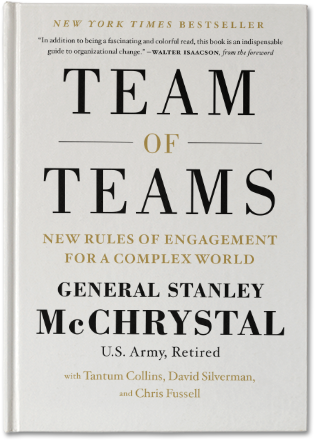
In this powerful book,
McChrystal and his colleagues show how the challenges they faced in Iraq can be
relevant to countless businesses, nonprofits, and other organizations. The
world is changing faster than ever, and the smartest response for those in
charge is to give small groups the freedom to experiment while driving everyone
to share what they learn across the entire organization. As the authors argue
through compelling examples, the team of teams’ strategy has worked everywhere
from hospital emergency rooms to NASA and has the potential to transform
organizations large and small.
Senior Fellow, Future Security