Table of Contents
Introduction
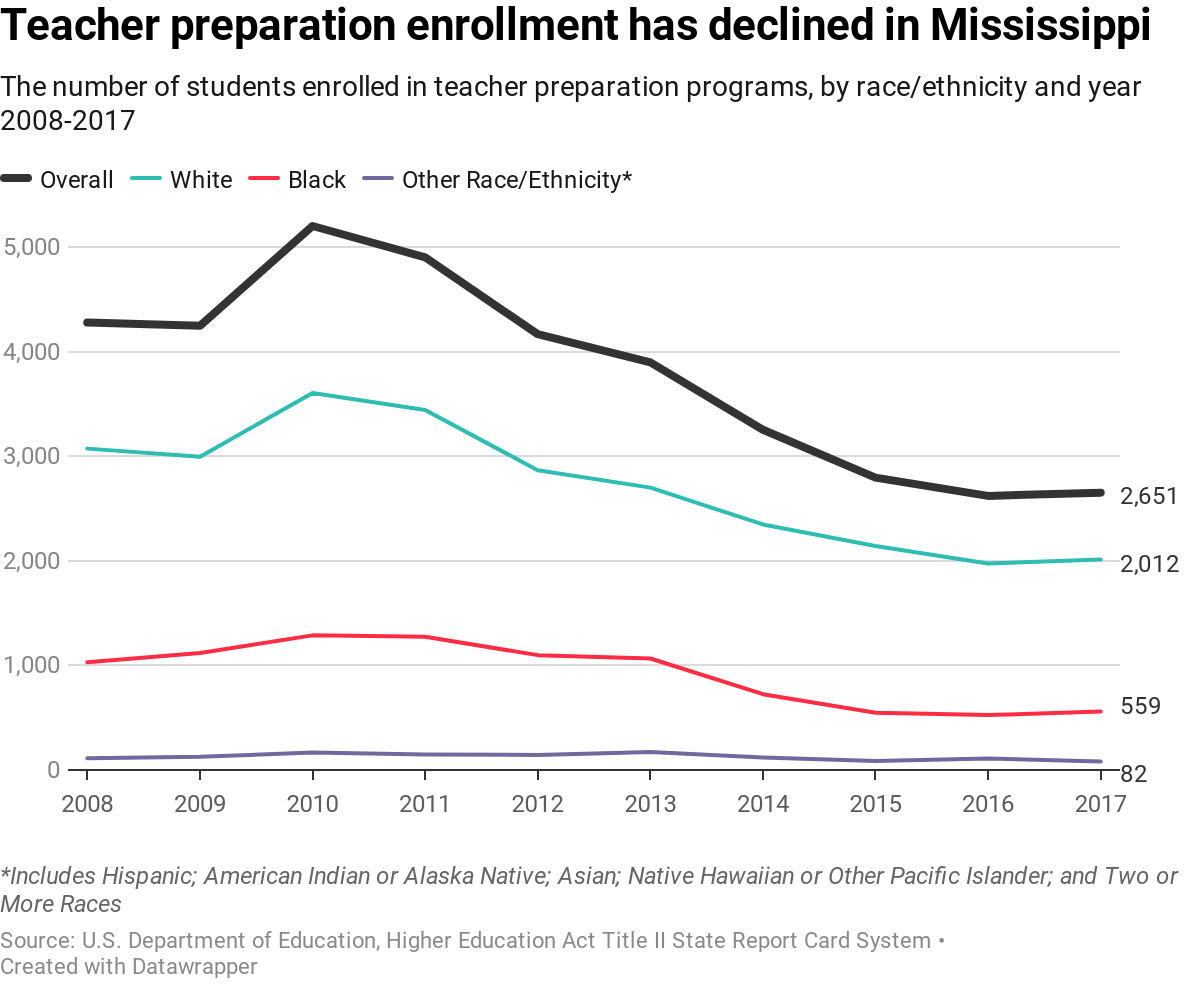
Across Mississippi, the majority of school districts are facing teacher shortages. The scope of this problem was documented across a three-part series by the Hechinger Report and Mississippi Today.1 That series noted sharp enrollment declines in teacher preparation programs—between 2011 and 2016 enrollment in teacher prep programs across the state dropped from over 5,000 students to 2,795—and little action by state legislators to address the issue.2 The state has also seen a nearly 50 percent decline in the number of initial teacher licenses issued between 2011 and 2018 (from 3,626 to 1,624).3
And while the cost of college attendance has risen, teacher salaries have remained relatively flat4 and low.5 These challenges are most acute in the Mississippi Delta, which a 2017 Mississippi State University study describes as “a nexus of poverty, isolation, and teacher shortage.”6 Of the 1,067 teacher vacancies reported in the state in 2018, close to half were in the Delta.7

Quitman County is an agrarian community located in the Mississippi Delta, flat and fertile land that lies between the Yazoo and Mississippi Rivers in the northwest part of the state. Fifty years after the Reverend Martin Luther King, Jr. led the Poor People’s Campaign from its county seat, Quitman County and its schools remain mostly poor and segregated. The school district enrolls 973 students across grades PreK–12, nearly all of whom (97 percent) are Black, and just over 50 percent of students live below the poverty line. Close to one-third of teachers in the district have a provisional license8 (a temporary license issued to teachers who have not met the requirements for a full license).9
Evelyn Jossell, superintendent of Quitman County School District, has experienced the challenges of attracting and retaining teachers to this area firsthand. “When I became superintendent, we had 30 vacancies at the end of the school term. Many teachers were not fully licensed and needed to pass the Praxis exam,” she told us.10
The Mississippi Department of Education (MDE) is helping to coordinate and lead three overlapping initiatives aimed at increasing teachers in the state by removing barriers to entry and providing support along the way: Grow Your Own (GYO) programs to develop local teachers, a state-run teacher residency program, and a pilot program exploring the possibility for teachers to earn a license based on their performance in the classroom.11 State Superintendent Carey Wright has framed this work as “part of a statewide strategy to diversify the teacher pipeline and ensure that all students have access to teachers who are well-prepared, appropriately licensed and serve as role models for success.”12
Profiled below, these initiatives individually serve as ways to bolster Mississippi’s teacher workforce. Collectively, they represent a collaborative approach to solving shortages and increasing teacher diversity that provides lessons for other states.
In a time of localized teacher shortages,13 declining interest in teaching,14 and calls to diversify the educator workforce,15 states across the country are innovating to transform teacher recruitment, preparation, and hiring. Mississippi stands out for taking a wide-reaching and creative approach to addressing critical shortages, including in the Delta.
Citations
- To read the full series, see source
- Aallyah Wright and Kelsey Davis, “After Years of Inaction, Delta Teacher Shortage Reaches ‘Crisis’ Levels,” Mississippi Today, February 18, 2019, source
- Bracey Harris, “Mississippi’s Teacher Shortage: What We Know,” Clarion Ledger, January 30, 2019, source
- Telephone interview with Rachel Canter, (executive director, Mississippi First) February 10, 2020.
- Starting teacher salaries range from $35,890 to $40,608. See Mississippi Department of Education, 2019-–2020 Salary Schedule, source
- Kenneth V. Anthony, Dana Franz, and Devon Brenner, “Understanding the Nature of Teacher Shortage in Mississippi,” Mississippi Economic Review 1 (2017): 24–31. source
- Mississippi Grow-Your-Own Teacher Task Force Report (Jackson: Mississippi Department of Education, 2019), source
- Usage of the terms provisional and temporary vary by state. State by state licensure terms detailed here: source
- Guidelines for Mississippi Educator Licensure K–12 (Jackson: Mississippi Department of Education, February 2020), source
- Interview with Evelyn Jossell, Jackson, MS, January 27, 2020.
- The terms "grow-your-own" and "teacher residency" are used for a variety of different approaches to preparing candidates to be fully-licensed teachers. Outside of the definition of teacher residencies for the Teacher Quality Partnership competitive grant program outlined in the federal Higher Education Act, there aren't nationally-agreed-upon definitions. Therefore, Mississippi’s chosen nomenclature for these specific models may not reflect that of other states or local education agencies
- Mississippi Department of Education, “MDE to Prepare Educators through Teacher-Residency and Performance-Based Licensure Pilot Programs,” News Release, October 31, 2018, source
- Jenny Muñiz, “States Consider Financial Incentives to Mitigate Teacher Shortages—But Will They Work?” EdCentral (blog), New America, October 3, 2018, source
- Lisette Partelow, What to Make of Declining Enrollment in Teacher Preparation Programs, (Washington, DC: Center for American Progress, 2019), source
- Roxanne Garza, “The Demographic Mismatch Between Students and Teachers Continues to Grow, Despite Increases in Teacher Diversity,” EdCentral (blog), New America, December 13, 2018, source