Nerin Kadribegovic
Founder and Principal Architect, KADRE ARCHITECTS

This article is part of The Rooftop, a blog and multimedia series from New America’s Future of Land and Housing program. Featuring insights from experts across diverse fields, the series is a home for bold ideas to improve housing in the United States and globally.
To make a sweeping impact on solving the housing crisis, we must realize that the highest-leverage opportunities are those that create momentum through a holistic, systemic approach.
As Los Angeles navigates another mayoral election cycle, homelessness and housing insecurity are two of the defining challenges gripping the city. Public debate often centers on a singular attempt to mitigate the disturbing humanitarian crisis of people living on the streets. Discussions circle back to permanent, supportive, or interim housing; rental assistance; mental health services; or encampment-clearing enforcement.
What is far less visible, and not often discussed, is the extent to which housing insecurity spans the income spectrum. Many middle-income Angelenos are facing the impact of decades of limited construction, expansive corporate investment in residential properties, and rising housing demand–all of which have contributed to escalating costs and reduced affordability for home buyers and renters alike.
One lesson is clear: there is no silver bullet.
Solving housing insecurity requires a family of solutions, an agile response to meet a spectrum of housing needs for people across economic levels and stages of recovery. The following five-point framework is based on the experience that Kadre Architects, where I serve as Founder and Principal Architect, gained from designing projects ranging from emergency and interim housing to adaptive reuse; permanent supportive housing; and community facilities serving vulnerable populations throughout Los Angeles.
One of the most overlooked strategies might prove to be one of the most impactful.
This is low-hanging fruit. Faster permitting does not require new land, new legislation, or significant new funding. It simply requires modernizing how projects move through the system.
Artificial intelligence may not immediately replace plan checkers, but it can serve as a tool to review projects more efficiently and help project teams navigate increasingly complex regulatory requirements.
The City of Los Angeles has multiple layers of extensive permitting requirements, departmental clearances, and administrative procedures. While many of these encumbrances were well-intentioned, the cumulative effect has resulted in higher costs, lengthy permitting timelines, and still no guarantee that projects will be approved, or approved in a timely manner.
The City can initiate a comprehensive audit of the Los Angeles Department of Building and Safety (LADBS) clearance process, which will eliminate massive time constraints and costs. This review will streamline clearances by consolidating redundant reviews, encouraging more concurrent agency coordination, automating fee payments and routine administrative approvals, and modernizing outdated procedures.
Automation ultimately frees up staff time to apply needed expertise where it adds the greatest value.
Temporary interim housing remains one of the most effective tools available for housing people quickly. Projects such as Tiny Home Villages have demonstrated that housing communities can be designed, approved, and constructed in a matter of months. These homes are prefabricated, allowing them to activate sites that might otherwise remain vacant, including irregular parcels of land adjacent to infrastructure corridors, industrial uses, and remnant City-owned properties.
But speed alone should never be the measure of success. Architecture can powerfully communicate without words: “Someone cared enough to design this for you.”
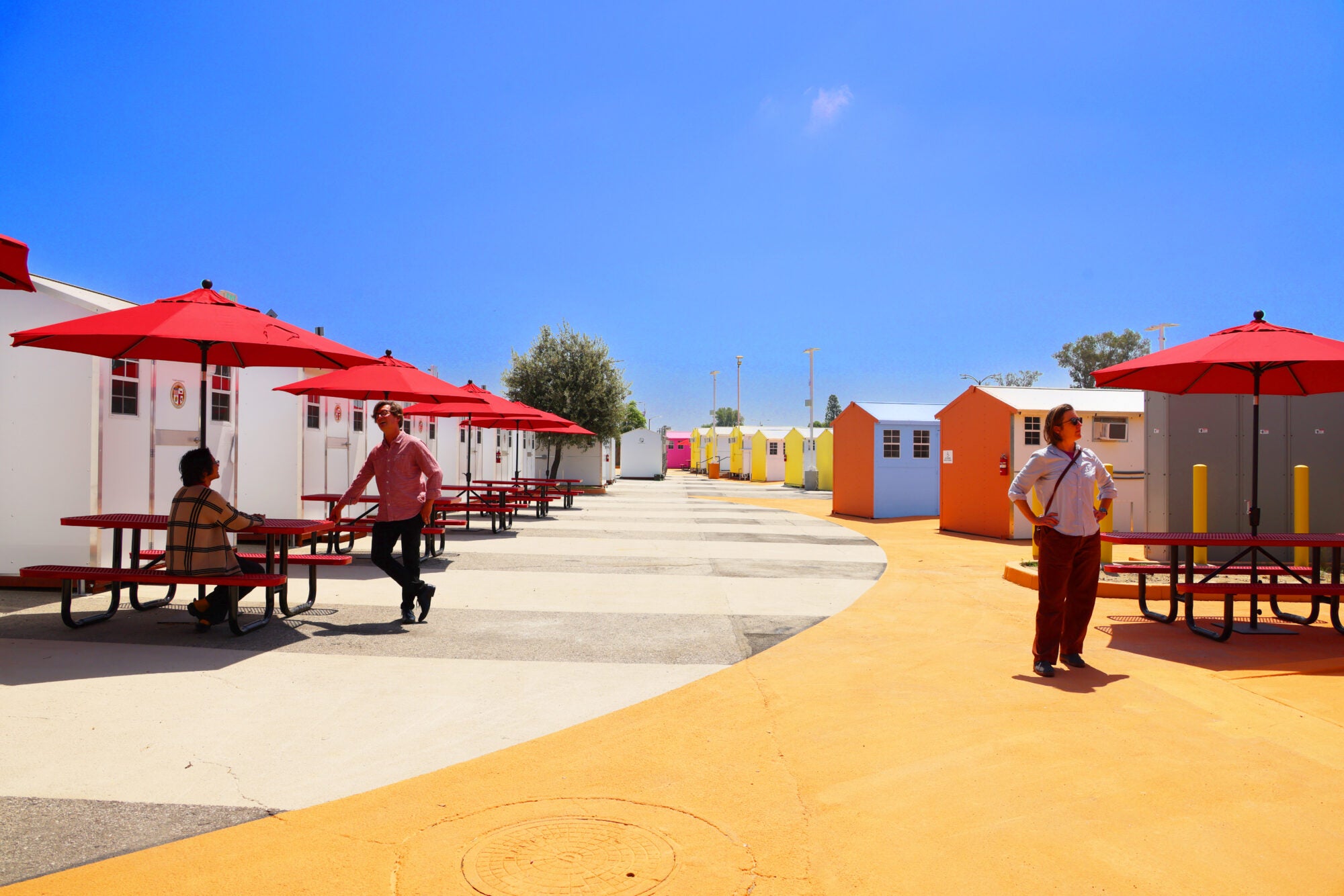
The quality of these environments matters just as much as the speed of their delivery. For many residents, these communities are the first safe and stable places they have experienced in years.
Imbuing dignity is not decorative. Design influences how people treat their surroundings and should not be compromised. Natural light, color, landscaping, community kitchens, shaded gathering spaces, and thoughtful circulation are not luxuries—they are the physical framework through which community begins to form. Design encourages social integration and complements the work of service providers who guide residents in rebuilding their lives.
Interim housing is not a replacement for permanent housing. It is a critical step within a larger housing ecosystem. Every person moved from a tent into a safe, supportive, and thoughtfully designed community has a greater opportunity to stabilize, access services, and prepare for long-term housing.
California’s Project Homekey program demonstrates what becomes possible when governments remove unnecessary barriers and align funding behind a clear objective. Across California, aging hotels, motels, and other underutilized buildings have been converted into interim and permanent housing in a fraction of the time and at a fraction of the cost required for new construction.
We have designed several housing communities as part of Project Homekey; many were delivered in one to two years–or even less than a year–after receiving funding. The cost of adaptive reuse was often a fraction of comparable ground-up permanent supportive housing developments.
Los Angeles should continue investing in the acquisition and rehabilitation of many vacant office buildings, older hotels, and similar structures, while preserving the flexibility that made Homekey successful. Every vacant motel represents housing that can come online, years before a traditional development would break ground.
The majority of the Los Angeles metropolitan area is reserved exclusively for single-family housing. State legislation such as Additional Dwelling Unit (ADU) laws, SB 9 and SB 1123 provides a framework for duplexes, lot splits, and small multifamily housing that fit naturally within existing neighborhoods. While these neighborhoods should not be radically transformed overnight, they can evolve thoughtfully through gentle densification.
The challenge is that the permitting process remains difficult for homeowners and small developers to navigate.
The City needs to continue to simplify approval pathways by instituting and expanding self-certification programs for licensed professionals, increasing ministerial approvals for qualifying projects, non-redundant discretionary reviews, and removing procedural barriers that disproportionately burden small housing development. Small projects repeated across thousands of lots collectively expand housing supply while preserving the character that residents value.
Housing alone does not solve homelessness or housing insecurity.
The most successful programs recognize that housing is only one part of recovery. Organizations providing supportive services and trust-based care, such as Hope the Mission, SHARE!, Covenant House, The People Concern, The USC Mobile Clinic Street Medicine Team, and many others, ultimately make the difference in people returning to stability.
Independent living spaces, transitional environments, peer support, intensive case management, and community-based living arrangements all play vital roles in fostering stability. Dedicated professionals and volunteers operating within these settings are essential for successful reintegration, bringing consistency, compassion, humanity, and perseverance in creating solutions. They are the fiercest advocates who address major barriers that contribute to homelessness, including access to affordable housing, healthcare, employment, education, and community support. Investment in them is investing in the system.
California’s housing crisis is decades in the making, and eradicating it requires collective will. Various initiatives listed in the above framework require significant investment, and Californians are well known to pass bond measures to pay for any number of things. Our leaders should allocate these funds to programs that visibly move the needle and have a proven track record. A strategic, productive, humanitarian solution is possible through collaboration and committed action.
The housing crisis was not created by a single failure, and it will not be solved by a single idea. The work begins by meeting people where they are—with compassion rather than judgment. The goal should not simply be moving people indoors; it should be helping people rebuild their lives.
Editor’s note: The views expressed in the articles on The Rooftop are those of the authors alone and do not necessarily reflect the opinions or policy positions of New America.
Founder and Principal Architect, KADRE ARCHITECTS