Stephen Burd
Senior Writer & Editor, Higher Education

The share of freshmen receiving institutional financial aid at both public and private four-year colleges and universities has skyrocketed over the past two decades.
A New America analysis has found that the median share of freshmen receiving institutional aid at the 544 private nonprofit colleges and universities I examined increased to 99 percent in 2023–2024, from 85 percent in 1999–2000.1 In the 2000 academic year, only 3 percent of these schools provided institutional aid to each and every one of their freshmen. By 2024, 43 percent awarded aid to all first-year students.2
private colleges provided institutional aid to all of their freshmen in the 2000 academic year
private colleges provided institutional aid to all of their freshmen in the 2024 academic year
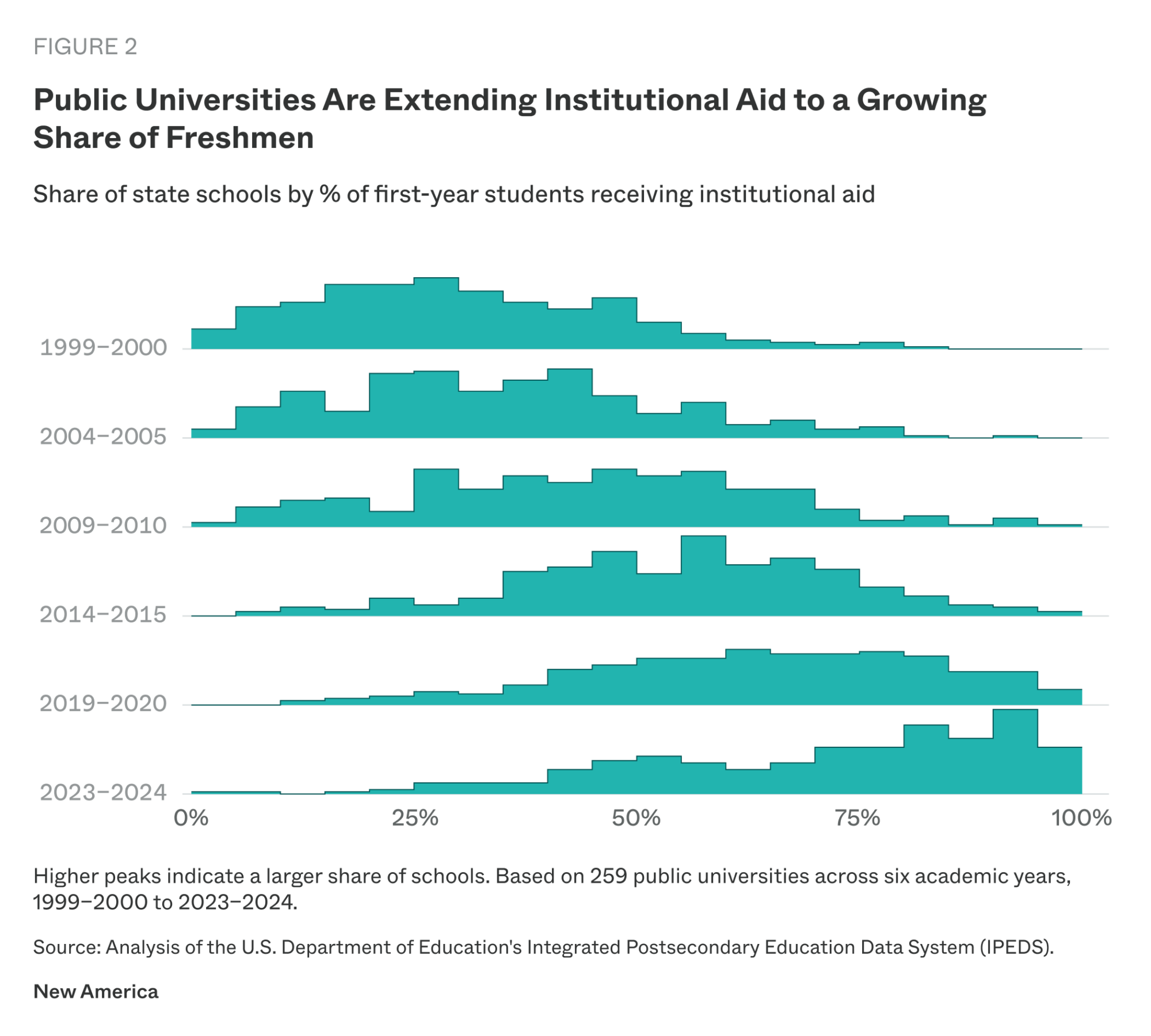
The shift was nothing short of extraordinary at public universities. At the 259 public universities I examined, the median share of freshmen receiving institutional aid jumped from a little more than one-quarter (28 percent) to more than three-quarters (76 percent) between 2000 and 2024. And while less than a handful of public universities awarded aid to 75 percent or more of their freshmen in the 2000 academic year, more than half did so by 2024.
median share of freshmen at public universities receiving institutional aid in 2000
median share of freshmen at public universities receiving institutional aid in 2024
While these developments sound like good news, they aren’t. By extending their aid to so many students, including large numbers from families at the top of the income scale, these schools are stretching their aid dollars too thin. The colleges may appear generous, but these institutions are leaving those who need aid the most with substantial funding gaps that they and their families can only fill by assuming hazardous debt loads.
What accounts for these substantial institutional aid jumps? At issue is that most of these public and private colleges and universities engage in financial aid leveraging or financial aid optimization, in which analysts determine the precise price points at which these institutions can enroll different groups of students without spending a dollar more than is necessary. At selective colleges, both private and public, the largest tuition discounts go to the most desirable students, typically the highest-achieving applicants, who help the schools rise up the U.S. News & World Report rankings, and to the wealthiest, who, even with the tuition break, can boost the institutional bottom line. While lower-income students often receive some aid, those dollars won’t come close to meeting their financial need.
To be fair, some selective colleges use financial aid leveraging strategies for only a subset of their students. And if these colleges remain committed to meeting the full financial need of their students, they may use the additional revenue they generate from recruiting affluent students to boost need-based aid at their institutions.
But that is a small number of schools. Today, only about three dozen selective private colleges leverage some of their aid but meet 100 percent of their students’ financial need. In reality, the vast majority of colleges that leverage their aid do not even try to do so. At the urging of private enrollment management consultants, they reserve the best financial aid packages for those students they want the most.
Meanwhile, the firms that dominate the multibillion-dollar enrollment management industry aggressively market financial aid leveraging products designed to help colleges use all of their aid to pursue the most desirable prospective students and increase their bottom lines. As EAB, the giant enrollment management consulting company, has stated in its marketing materials, “Our Financial Aid Optimization program ensures that every dollar you commit to aid is used to further your enrollment and net tuition revenue goals.”3
In this brief, I set out to see whether these firms’ marketing pitches have paid off. Unfortunately, I ran into a major obstacle while conducting this analysis: There are no national data available that show how much institutional aid colleges are leveraging.
We do know that the amount of money that colleges are spending on aid to students who lack financial need has been soaring. In a previous analysis I conducted for the 2024 book Lifting the Veil on Enrollment Management, I found that selective colleges’ use of non-need-based aid surged from $2 billion annually in 2000 to more than $8 billion in 2020, after adjusting for inflation. Here are the figures broken down by sector:4
These figures show the extent to which colleges have ramped up their use of aid leveraging to benefit students from upper-middle-income and wealthy families. But they don’t tell the whole story. That is because the data don’t reveal how colleges are using their need-based aid.
Colleges disclose data on their use of institutional aid as part of an annual survey for college guidebooks and ranking publications called the Common Data Set.5 In this dataset, any aid that goes to financially needy students is counted as need-based aid, which means that “merit” aid that goes to financially needy students is counted as need-based aid, even though the purpose of these funds is not to fill financial need.
Despite this data limitation, we know that colleges are meeting less financial need than they did at the turn of the century. In the institutional aid data analysis I conducted for Lifting the Veil on Enrollment Management, I found that as colleges ramped up their engagement in financial aid leveraging, they reduced the amount of financial need that they met for their freshmen student aid recipients. Between 2000 and 2020, private colleges reduced the average amount of financial need that they covered from 90 percent to 85 percent, and public universities reduced the average amount from 74 percent to 65 percent. Over this time period:
While it’s not possible to determine which colleges are leveraging all of their aid, the data I analyzed show which are providing aid to all of their freshmen, including those who come from incredible wealth. Instead of targeting their aid dollars to those who need them the most, these colleges are spreading these dollars out and trying to pinpoint the exact price breaks needed to reel in students. That way, they don’t spend more than necessary to get the class that they want.
Since 1998–99, the U.S. Department of Education’s Integrated Postsecondary Education Data System has annually collected data from colleges on the share of first-time, full-time students receiving institutional grant aid (colleges count discounts as grants).6 For this analysis, I examined these data for 803 public and private colleges and universities, starting in 1999–2000 and then every five years until 2023–24, the latest data available, to see whether the data fluctuated year to year or were consistent and indicative of long-term trends. Our examination found a trend.
What we are left with is a four-year higher education system that overwhelmingly caters to students at the top of the income scale. According to the National Association for College Admission Counseling, upper-middle-income students are the biggest beneficiaries of private colleges’ financial aid leveraging practices. These well-to-do students receive the largest institutional aid awards ($22,000, on average, compared to $18,200 for the lowest-income students), and they are more likely to receive them than the lowest-income students (82 percent compared to 76 percent).7
The Century Foundation reports that more than half of students in the top income quartile receive grants from their colleges and states in excess of their financial need, as determined by the U.S. Department of Education, compared to 0.2 percent of low-income students. “In other words, students in the top quartile are 280 times more likely to receive grants in excess of need as students in the bottom quartile,” the report states.8
These actions fly in the face of national goals to increase access to higher education and help more students earn high-quality degrees. Sixty years ago, the federal government committed itself to removing the financial barriers that prevent low-income students from enrolling in and completing college. Each year, the federal government spends tens of billions of dollars to help millions of low- and lower-middle-income students pay for college, primarily through the Pell Grant program.
For years, colleges complemented the government’s efforts by using their financial aid resources to open their doors to the neediest students, and states heavily subsidized public universities to keep the cost of attending low for their citizens. But those days are long gone.
By using their institutional financial aid strategically to raise their rankings and revenue, both public and private colleges and universities are undermining the federal student aid programs. Worse yet, many of these schools appear to be engaged in an elaborate shell game, using Pell Grants to supplant institutional aid they would otherwise provide to financially needy students, and then shifting these funds to help recruit wealthier students.9 This is one reason why the college-going gap between low-income high-school graduates and their wealthier counterparts remains as wide as ever. Low-income students are not receiving the full benefits intended for them.
Overall, the data show that both public and private colleges and universities are on the same track. Private colleges have been riding these enrollment management rails longer, and are much further along. But despite their late start, public universities are picking up speed and, unfortunately for the sake of college access, affordability, and equity, appear determined to catch up to their private college counterparts.
Private colleges first adopted enrollment management policies and practices in the late 1970s and 1980s. In the previous three decades, these colleges had opened their doors wider than ever before. Selective private college leaders pledged to admit students regardless of financial need and to fully meet the need of students whose families could not afford to send them to college without this help.10 In this way, the institutions worked hand in hand with states that offered need-based aid funding and the federal government, which first provided student aid through the GI Bill and then through the Higher Education Act.
But with the economy in turmoil in the late 1970s and early 1980s and the college-age population plummeting, many private colleges found themselves less able and willing to meet their students’ full financial need. The newly elected Reagan administration emphasized the private returns of higher education over public ones as it pushed Congress to slash federal student aid spending.11 And U.S. News began ranking colleges, at first based solely on reputational surveys filled out by college presidents, and then, by the end of the decade, a simple set of metrics that could be easily gamed.12
All these forces led to the emergence of an extremely influential enrollment management industry that pushed colleges to operate more like businesses, with a focus on building their brands and bottom lines. Firms such as Maguire Associates and Noel-Levitz entered the market, promising to help these schools become more competitive in recruiting the students they wanted the most. These firms encouraged colleges to break down the firewalls between the institutions’ admissions and financial aid offices and to use non-need-based aid, which they called merit aid, to compete for high-quality and more affluent students. And once some private colleges started using their financial aid this way, it became difficult for others to resist, for fear of being put at a competitive disadvantage.
Initially, private colleges tried to outbid their competitors by providing larger and larger merit scholarships.13 But over the years, enrollment management firms began offering far more sophisticated tuition discounting strategies that aimed to ensure that schools were not overpaying to reel in high-achieving students. For many schools, the ultimate goal of institutional financial aid changed from meeting students’ need to maximizing the colleges’ revenue.14
The enrollment management firm Noel-Levitz did not invent financial aid leveraging, but it became one of the most aggressive evangelists for the practice.15 Like missionaries, the company’s consultants crisscrossed the country in the 1990s promising cash-strapped colleges salvation with the company’s financial aid leveraging software and consulting services. Most of the company’s early clientele were financially struggling private colleges that were desperate to keep their doors open and attract affluent students. But the company also caught the attention of some wealthier institutions that were looking to rise up the U.S. News rankings.
Denison University was an early convert. Competing with dozens of private liberal arts colleges in Ohio and the state’s strong public universities for a shrinking group of college-age students, Denison had looked in this direction in the late 1980s when it started providing small non-need-based aid awards to fewer than 10 percent of its freshmen. It then doubled the share of students the program served and increased the size of the awards.16 But after missing its enrollment targets by several hundred students in 1994, the university, with the help of the consultants, started providing discounts of up to $5,000 each to students who graduated in the top half of their school class and had SAT scores of at least 1050. The discounting helped Denison boost its enrollment and net tuition revenue. “You spend money to make money,” a senior member of Denison’s admissions staff told U.S. News in a 1998 article that described the school’s merit aid program.17
According to our analysis, 210 private colleges, or 38 percent of the institutions examined, awarded aid to at least 90 percent of freshmen in 2000.
By 2000, 94 percent of Denison freshmen received institutional aid. The school was hardly alone. According to our analysis, 210 private colleges, or 38 percent of the institutions I examined, awarded aid to at least 90 percent of freshmen that year. But unlike Denison, most of these schools had endowments under $100 million.
While the enrollment management business grew steadily in the 1980s and 1990s, it truly exploded in the decades that followed and attracted the attention of wealthier private colleges. As the higher education journalist Jon Marcus has written, the business had modest origins but evolved into a highly profitable industry “dominated by a few big players that have diversified through acquisitions, often backed by private equity and investment funds that expect returns and constant growth.”18
Altogether, 443, or 81 percent, of private colleges, including dozens of fairly wealthy ones, were just as generous, providing aid to 90 percent or more of their freshmen in 2024.
In 2024, 94 percent of freshmen at Denison were still receiving institutional aid. But the university was no longer in the vanguard. Altogether, 443, or 81 percent, of private colleges, including dozens of fairly wealthy ones, were now just as generous, providing aid to 90 percent or more of their freshmen (Figure 1). And while only 15 schools had provided aid to 100 percent of their incoming class in 2000, 232, or 43 percent, did so in 2024.
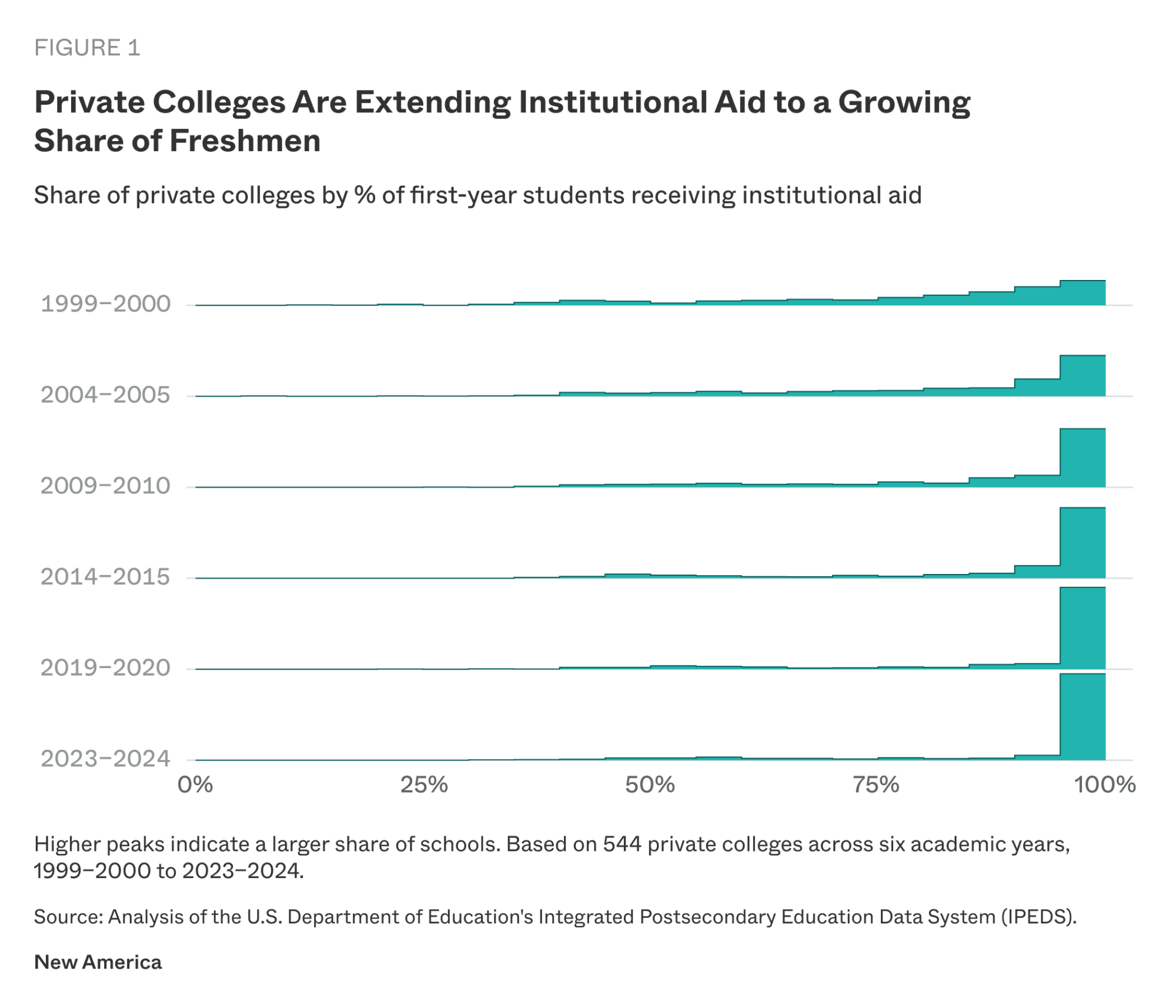
On the other end of the spectrum, the number of private colleges that award institutional aid to fewer than two-thirds of their freshmen fell from 131, or 24 percent, in 2000, to just 58, or 11 percent, in 2024. The remaining schools include the country’s wealthiest and most exclusive private colleges, which are flooded with applications from the best and brightest students and therefore don’t need to use their financial aid to entice top students to enroll. This group is made up of the Ivy League schools, MIT, and Stanford, as well as the most elite liberal arts colleges, such as Amherst, Swarthmore, and Williams.
These 31 institutions tend to admit students regardless of financial need and meet their students’ full need, although they generally enroll a relatively small number of low-income students. In 2000, the median share of freshmen receiving institutional aid at these schools was 42 percent. The share rose to 53 percent in 2024. One reason for the increase is that many of these schools have tried to protect their flanks from the merit-aid arms race by making it easier for students from affluent families to receive need-based aid at their institutions. At Princeton, for instance, students from families earning up to $300,000 annually qualify for need-based aid.19
There are another 35 private colleges that leverage a portion of their aid but meet 100 percent of need. These schools include small private liberal arts colleges like Davidson, Grinnell, Kenyon, and Oberlin, as well as bigger research universities, such as Carnegie Mellon, Johns Hopkins, Notre Dame, and the University of Chicago. The median share of freshmen receiving aid from these institutions increased from 57 to 66 percent between 2000 and 2024.
But there is a growing number of affluent private colleges and universities that leverage the bulk of their institutional aid and make no attempt to meet financial need. Instead, they leave low- and lower-income families who are intent on sending their children to these schools with little choice but to assume a dangerous amount of hazardous debt. In February, I published a report, The Subprime PLUS Loan Crisis, which identified 41 selective private and public universities that aggressively leverage their aid and push the families of low- and lower-middle-income students to borrow Parent PLUS loans. The list includes 23 private universities with endowments of $500 million or more. Eleven are among the country’s wealthiest universities, with endowments over $1 billion.
For this study, I found that the median share of freshmen receiving aid at these 23 private colleges increased to 98 percent in 2023–24, from 75 percent in 1999–2000. In 2000, only one of the institutions, Saint Louis University, provided institutional aid to 100 percent of its freshmen. By 2024, seven of the schools provided aid to all of their freshmen, and another eight awarded discounts to 90 percent or more of the entering class.
These institutions stretch their aid so thin that after all grants and scholarships were considered, these private universities, as a group, charged freshmen from families with annual incomes of $30,000 or less an average net price of nearly $24,000 in 2023.20 To cover these funding gaps, many low-income families were left with little choice but to take out Parent PLUS loans they cannot afford. Data from the Education Department’s College Scorecard indicated that 12,000, or 44 percent, of the 26,000 parents who had children who either graduated or left these 23 institutions in 2020 and 2021 with PLUS loans were the families of Pell Grant recipients. These low- or lower-middle-income families assumed a median PLUS loan debt load of nearly $40,000 each.21 How they will be able to repay this debt is anyone’s guess.
Parent PLUS debt, like federal student loans, generally can’t be discharged in bankruptcy, and the loans are subject to the government’s extraordinary debt collection powers, including wage garnishment and partial offsets of defaulted borrowers’ Social Security benefits and income tax refunds. Failure to repay these loans can lead to financial disaster, particularly for older Americans with few resources.22
Making matters worse, the Republican-controlled Congress has recently removed the ability of parents to consolidate their PLUS loans and pay the debt back as a percentage of their income through the Income-Contingent Repayment Program. This was the one safety net available in the Parent PLUS loan program for financially distressed borrowers, and it is no longer available.
It appears that some of the 23 private universities I identified in The Subprime PLUS Loan Crisis were not leveraging aid two decades ago. Take Loyola Marymount in Los Angeles. In 2000, the school provided institutional aid to only 43 percent of its freshmen. By 2024, it was awarding aid to every single one of them. Hofstra University in New York has experienced a similar surge, from 60 percent to 99 percent during that time period. And Quinnipiac saw its share grow from 64 percent to 100 percent.
Most of these 23 universities predominantly serve affluent students. For example, nearly two-thirds of students at Fordham University come from families in the top 20 percent of the income scale.23 Fordham is providing discounts to almost all of them, while charging students from the lowest-income families an average net price of more than $32,000 annually after all grant and scholarship aid is exhausted. And Fordham is hardly alone.
The vast majority of private colleges provide discounts to nearly all of their students. According to the National Association of College and University Business Officers, 90 percent of full-time freshmen at private colleges receive institutional aid. On average, these institutions are giving back 57 cents for every dollar they receive in tuition from first-year students. Meanwhile, the association found that after all the discounts, the schools’ net tuition revenue rose by only 1.4 percent.24
Discontent about the strategies that enrollment management firms hawk has been growing. Many financially stressed schools are finding that these practices have been doing more harm than good. The more tuition-dependent schools discount their sticker price, the less they have to spend in other areas important to student recruitment, including the quality of academic programs and the upkeep of facilities, leaving it difficult to stay afloat.
“The financial model sustaining enrollment-dependent institutions is increasingly a house of cards,” Teege Mettille, a higher education professional with more than 20 years of experience in college admissions, wrote in his new book College Is Broken (And What We Can Do to Fix It!). “We give back more than half of listed tuition revenue to fill seats, then depend on constant new enrollment to replace what was given back, all while hoping the cycle does not end before something changes,” he wrote.25
The data I have examined for this brief make clear how dramatically public universities have transformed their admissions and financial aid policies over the past two decades, shifting decisively away from the “low tuition, low aid” approach they took for most of their history.
Few public universities leveraged their aid in the 1999–2000 academic year. At the time, only four schools awarded aid to 75 percent or more of their first-year students. Nearly nine out of ten schools (88 percent) provided aid awards to less than half their freshmen, and two out of five awarded institutional aid to fewer than one-quarter of them.
Nearly nine out of ten schools (88 percent) provided aid awards to less than half their freshmen, and two out of five awarded institutional aid to fewer than one-quarter of them in 2000.
By 2023–2024, the tides had shifted to a “high tuition, high aid” approach. At more than half of the public universities I examined, three-quarters or more of freshmen received aid. At 59 schools, or one-quarter of those examined, 90 percent or more of first-year students received discounts. Only 25 percent of these institutions now provided aid to less than half of their first-year students. And just five schools provided aid to fewer than one-quarter of these students (Figure 2).
What happened? To answer that, we need to go back.
For generations, public universities had a different mission than private colleges. The federal government spurred states to create public universities in the second half of the nineteenth century expressly to serve those who had been shut out of elite private colleges: “the industrial classes,” as the 1862 Morrill Land-Grant College Act stated.26
Most states heavily subsidized public universities to keep the cost of attending low for their citizens. These institutions were generally accessible for students regardless of family income, and they didn’t award much aid. Instead, the schools relied on the federal government to provide need-based aid to low-income students.
But by the late 1980s, this low-tuition, low-aid approach was no longer working as effectively as it had been. States started to pull back funding for public universities, especially during recessions. Unable or unwilling to raise taxes to increase revenue and facing ever-growing healthcare and public safety costs, state policymakers left public universities with little choice but to hike up tuition. As their institutions’ price tags increased and Pell Grant funding stagnated, public university leaders realized that they couldn’t stay out of the student aid game anymore.
At first, public universities primarily used their aid to meet students’ financial need. In the fall of 1995, these schools spent about $1.5 billion on financial aid, with 55 percent going to need-based aid.27 But public university officials were far less committed to need-based aid than private college leaders had been because they hadn’t taken part in its creation. And it didn’t take long for enrollment management firms, recognizing a lucrative market when they saw it, to push selective public universities to leverage their aid. In the face of state disinvestment and the lure of rising up the U.S. News national university rankings—where public universities compete fiercely with elite private ones for the top 100 spots—this wasn’t a tough sell.
Still, it took a global economic meltdown to really shake up the sector. The dramatic cutbacks that state legislators made in per-student spending during the financial crisis of 2008 and the recession that followed pushed many more public flagship and research universities to embrace enrollment management and financial aid leveraging.28 With state spending still lagging in the years after the recovery, and enrollment growth slowing, more schools became aggressive in using non-need-based aid to pursue wealthy out-of-state students with standardized test scores high enough to boost schools in the rankings and increase their revenues. According to The Century Foundation, public universities now make institutional aid awards to out-of-state students that are larger “by a factor of two-to-one, on average” than the ones they award to the in-state students they were created to serve.29
To be sure, there are still many public universities that haven’t embraced enrollment management and don’t leverage their institutional aid. But these schools tend to be in a declining number of states, such as California, Florida, North Carolina, and Texas, that have kept their public universities affordable and generally do a good job of meeting their students’ financial need. The median share of freshmen receiving institutional aid at the 44 public universities from those four states was just 52 percent in 2023–24.30
There is one state with a 28 percent median share: Georgia. It has not only kept its public universities affordable, but it also offers the extremely generous, lottery-funded HOPE Scholarship program, which provides large merit-based scholarships to high-achieving students who remain in-state and take rigorous courses. Researchers have found that students from affluent families disproportionately benefit from the lottery-funded program.31 This may mean that the state’s public universities feel less pressure than schools in other states to engage in financial aid leveraging.
In 31 states, the median share of freshmen that received institutional financial aid in 2023–2024 was 75 percent or higher (Figure 3). Public universities from all parts of the country are well represented in this group. However, competition among the public flagship and research universities in the Midwestern states is especially intense. Faced with a shrinking number of high school graduates and lackluster state funding, these schools use their financial aid strategically to shop for students around the country. A median share of 90 percent or more of freshmen received discounts in Michigan, Missouri, and Ohio.
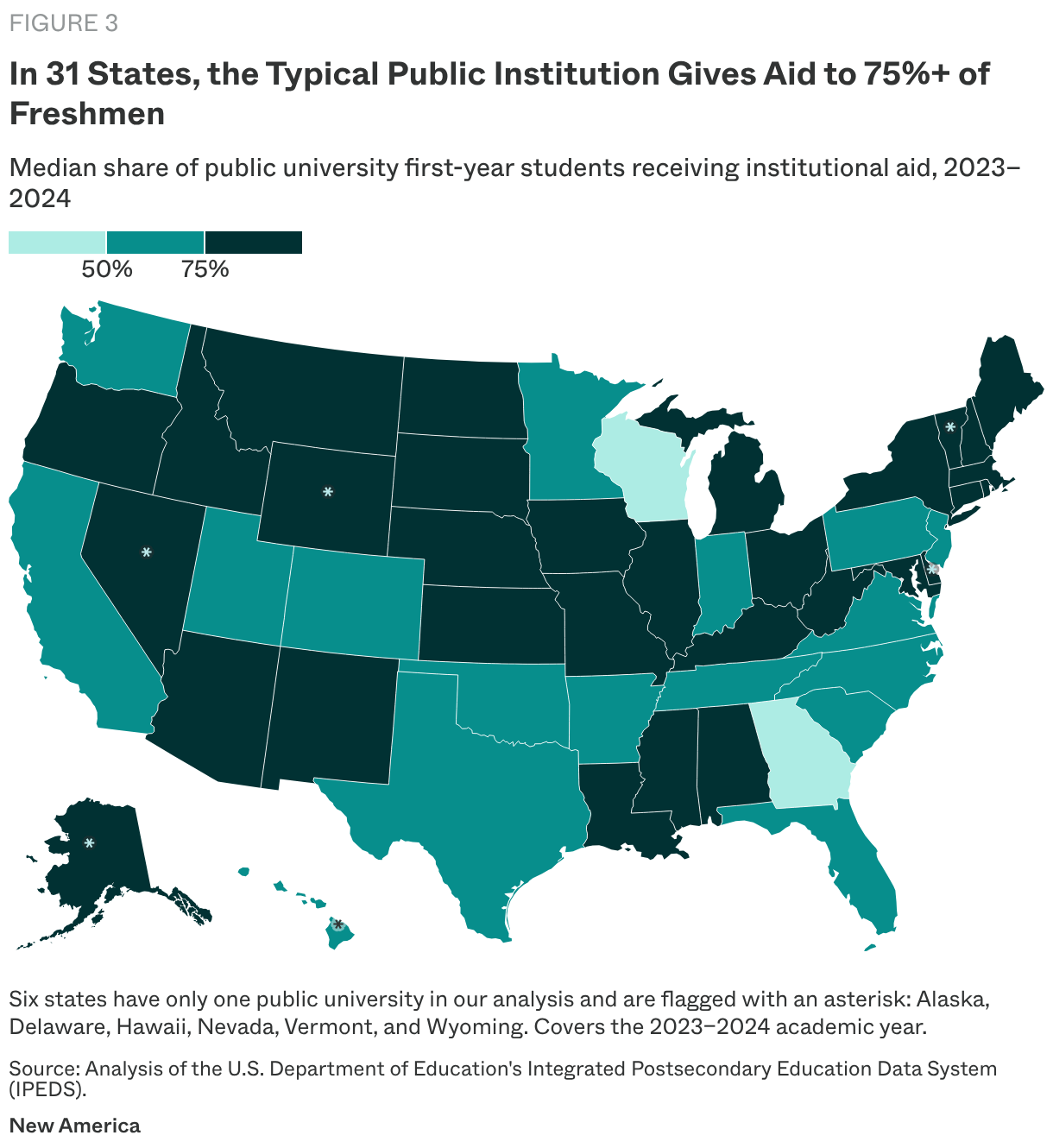
This group also includes a half dozen public universities in the South. Many of these schools have embraced enrollment management to make up for severe state budget cuts, better compete with one another, and build national brands. These include Kentucky (89 percent), West Virginia (84 percent), Mississippi (80 percent), Alabama (77 percent), and Louisiana (77 percent).
In The Subprime PLUS Loan Crisis, I identified 18 selective public universities that aggressively leverage their financial aid and push the families of low- and lower-middle-income students to borrow Parent PLUS loans.32 Two-thirds of the schools on the list were from the Midwest and the South. Other states represented were Arizona (93 percent), Connecticut (81 percent), New Jersey (73 percent), Oregon (86 percent), and Pennsylvania (68 percent).
For this study, I found that the median share of freshmen receiving aid at these 18 public universities increased to 79 percent in 2023–24, from 40 percent in 1999–2000. In 2000, not a single one of these institutions provided aid to more than half of their incoming class. By 2024, only George Mason University continued to give aid to less than half of its freshmen. Sixteen of the schools awarded aid to more than two-thirds of their first-year students, and eight provided discounts to more than 80 percent. Four universities—Kent State, and the Universities of Missouri, Arizona, and Louisville—provided aid to more than 90 percent of their freshmen.
These institutions stretched their aid so thin that after all grants and scholarships were considered, these public universities, as a group, charged freshmen from families with annual incomes of $30,000 or less an average net price of $14,000 in 2023. To cover these funding gaps, many low-income families, like their counterparts at private colleges, were left with little choice but to take out Parent PLUS loans they cannot afford. Data from the Education Department’s College Scorecard indicated that nearly 21,000, or 46 percent, of the 46,000 families who had children who either graduated or left these 18 institutions in 2020 and 2021 with PLUS loans, were the families of Pell Grant recipients. These low- or lower-middle-income families assumed a median debt load of more than $21,000 that they may not be able to repay.
It is bad enough that private colleges engage in financial aid leveraging practices that put low-income families’ financial well-being in jeopardy. The fact that public universities, which educate about 70 percent of undergraduates at four-year colleges, engage in the same harmful financial aid leveraging practices should stop us all in our tracks.
While we can’t tell how many colleges are using all of their aid strategically, the data show that the majority of both public and private colleges and universities are providing discounts to the bulk of their students, including the wealthiest ones.
These schools may be in for a rude awakening. As more and more of these institutions provide deep discounts for affluent students while leaving low-income ones with substantial funding gaps, they may be putting the millions of dollars of federal student aid funds they each receive annually in jeopardy. At some point, policymakers are going to wake up and ask whether the Pell Grant funds they send to these campuses are being well spent.
Losing federal student aid funds would be catastrophic for these colleges. It is certainly not something that we would like to see. I will soon offer proposals to rein in the enrollment management industry and make higher education more accessible and affordable for low- and lower-middle-income students and their families.
In the meantime, if the worst were to come to colleges that use their aid strategically to reel in wealthy students, they’ll have nobody to blame but themselves.
The author would like to thank Rachel Fishman and Sabrina Detlef for their keen editing skills. He would also like to thank Katherine Portnoy, Amanda Dean, and Liz Cory for their communications, production, and data visualization support.
Senior Writer & Editor, Higher Education