
Table of Contents
- Introduction
- Districts Shaped by Discrimination
- Understanding the Data
- National Findings
- Local Stories
- Divided Districts and Native Students
- A Future Not Determined by the Past
- Appendix A: 100 Most Segregating School District Borders by Difference in Poverty Rate
- Appendix B: 100 Most Segregating School District Borders by Difference in Percent Students of Color
- Appendix C: Segregating Borders by State
- Appendix D: Data and Methodology
Local Stories
Along the school district borders that mark the steepest racial and economic divides, students are getting shortchanged. In too many cases, the districts serving more students in poverty or more students of color are more cash-strapped than their neighbors. In all of the districts defined by these borders, children are segregated from their peers, deprived of the opportunity to learn alongside students of different backgrounds.
The specific causes and effects of these divides, however, vary from region to region and community to community. Here, we share stories told by members of local school communities to illuminate different facets of the issue. Utica City School District in New York and neighboring New Hartford Central School District demonstrate the persistent influence of lines drawn to segregate. Saginaw City School District and bordering Frankenmuth School District in Michigan show what happens when a local economy changes within the confines of school district boundaries. Dallas Independent School District, along with the Highland Park Independent School District carved out of it, offers a look at what it can mean to educate students of color in a segregated city. And Washington’s Wahluke School District and its neighbor, Kittitas School District, demonstrate what rural segregation can mean in today’s public schools.
Utica City School District and New Hartford Central School District, New York
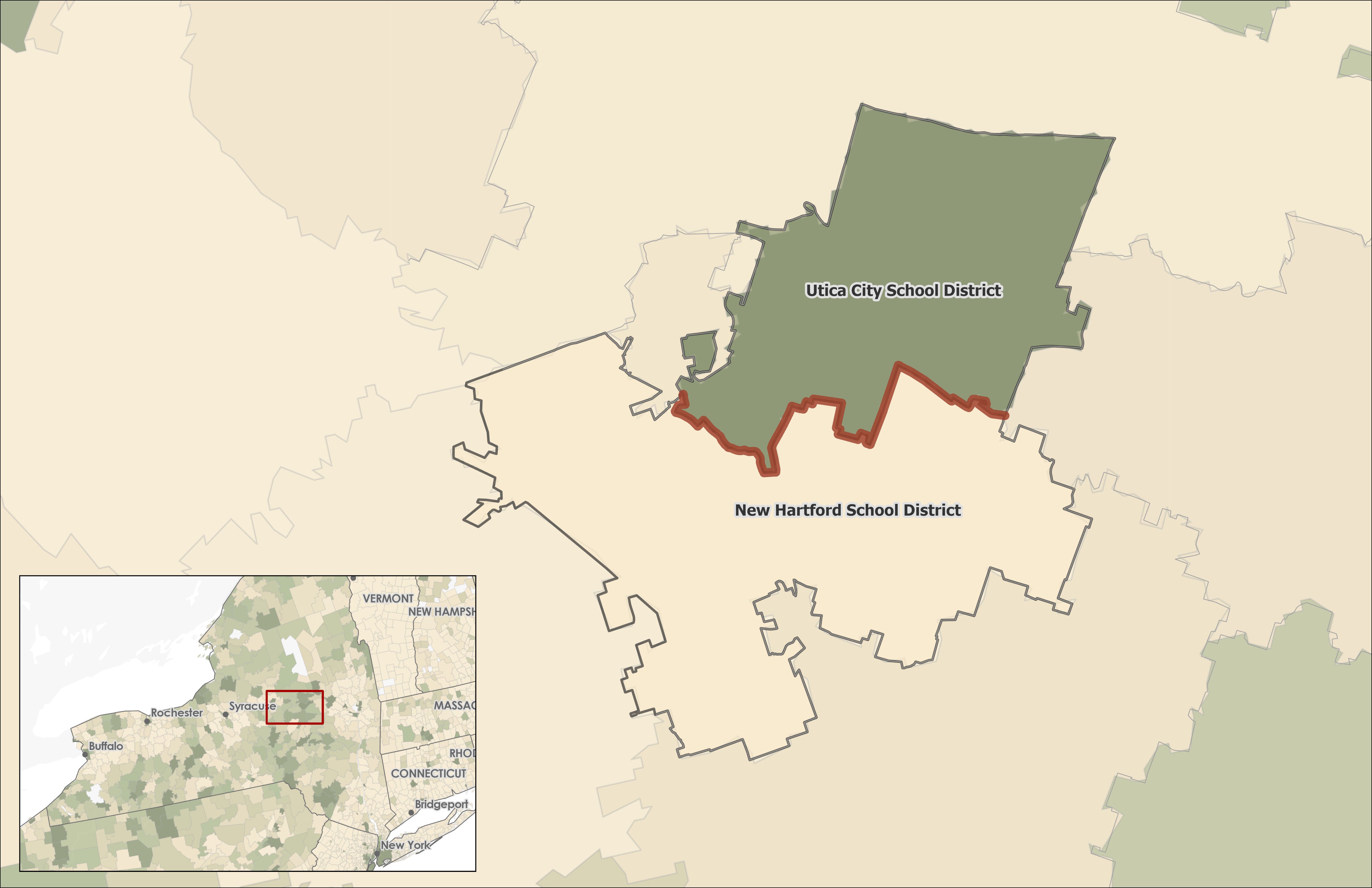
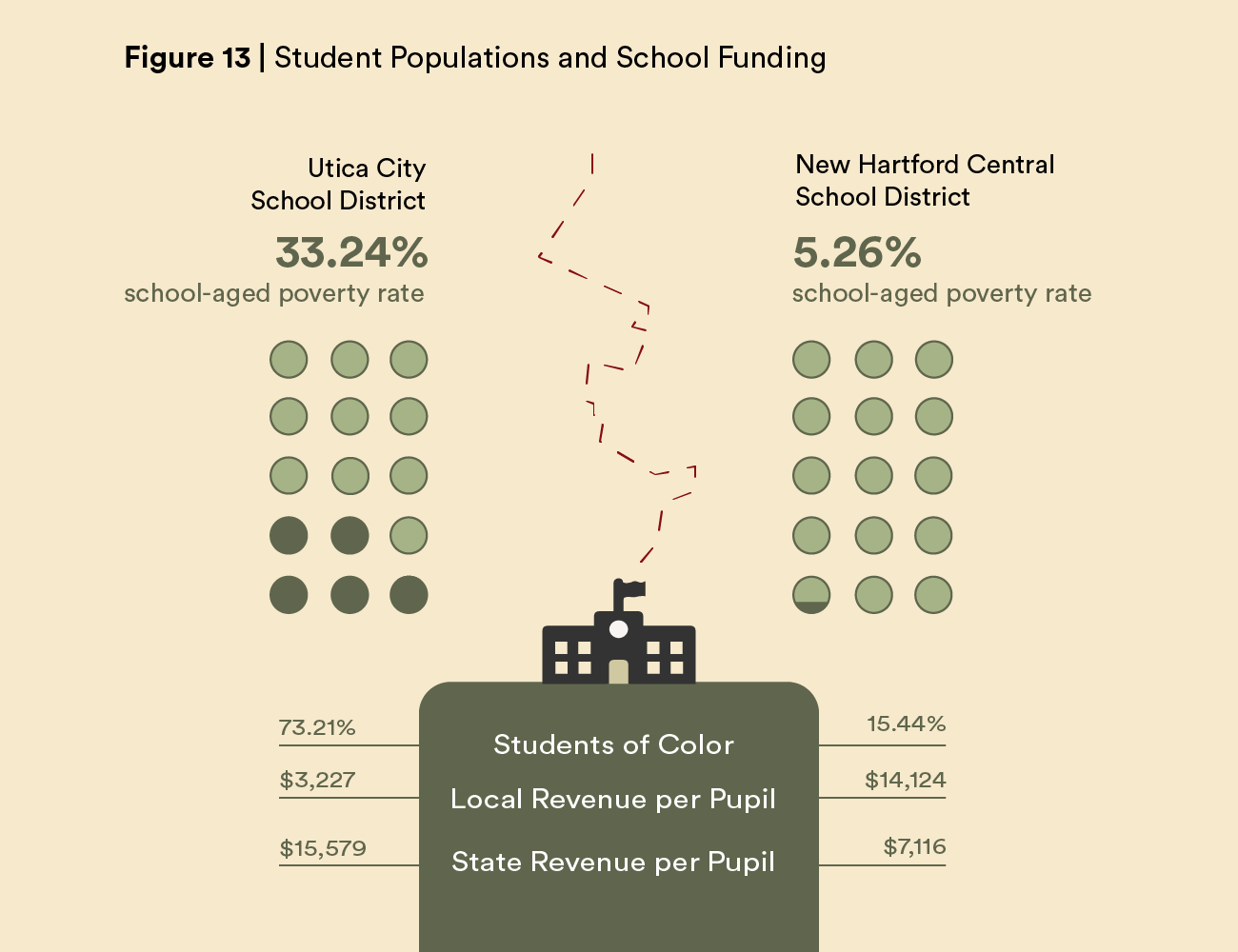
Utica City School District serves a city with pronounced internal divisions, some of which were present already in 1936, when the city engineer approved the redlining map that sectioned Utica by race and class.1 For example, the map includes notes on public housing projects that were then being constructed; some of those still exist. Areas that were then rated “declining” by assessors because of the presence of Italian immigrants are now home to newer arrivals from Bosnia and Somalia. In addition to evaluating parts of the city proper, the map also noted a town on its southeastern edge: New Hartford, which was rated “desirable” and described as “highly regarded,” with mention of its large home lots. The map description also noted, as a “favorable influence,” that “village zoning restrictions are very rigid." The border between Utica and New Hartford on the map closely tracks the boundary between their two school systems today, and almost nine decades later, New Hartford Central School District is able to raise far more local property tax revenue for its schools than Utica City School District.
By James Paul, member of the Utica City School District Board and co-director of the civic youth organization Junior Frontiers of the Mohawk Valley, as told to New America. Edited for length and clarity.
I’ve lived in Utica for 26 years. I’ve seen a lot of change in the city. A lot of it has been for the better, but we still have a ways to go. I ran for school board to help all students get the education that my children did. My three children went through the city school district. Their education kept me involved, and kept me seeing the shortcomings in our system; inner-city districts tend to stumble when it comes to educating our students. My wife and I were able to walk our kids through it, but we still struggled with getting the services they needed. We need to make sure that all children, no matter how involved their parents are able to be, get a proper education.
I think that this district is doing a much better job than it has, but we’re still not serving all students as well as we should be. For a stellar student, the teachers and counselors are engaged. Those kids tend to get what they need. But kids that cause problems in school, or those who fly under the radar—I don’t think we do a good enough job for those students. Our kids have dreams for themselves, but they need direction. If a young person says, “I want to be a doctor,” and they’re not taking four years of science, they’ll never be a doctor. If a student is told by their guidance counselor that they don’t need to take the SAT—maybe because it isn’t always required for college admissions any longer, or maybe because the counselor doesn't think the student is college-ready—they’ll be behind the eight ball when it comes to getting into college, and they’ll miss out on scholarships that use SAT scores to decide who’s eligible. But we don’t have enough professionals in our buildings to help young people understand what they need for their chosen pathways.
The district had been struggling for years because of a prior administration that held us back. We had a culture that wasn’t inviting to staff. But we're heading in the right direction now. We’re seeing the culture in this district has changed; we’ve done a 180, and our staff understand that they have autonomy to try things that will lead to growth.
But culture change only goes so far when you’re not being properly funded. So much of the district’s budget is taken up by basic things. For instance, our district serves a high number of students in poverty. A lot of our kids only eat when they’re at school, so these are the kids that we want to wrap our arms around and give them programming after school that includes food to help them get through the evening. Some of our schools have started food pantries. We’re also very diverse. Over 40 languages are spoken in our district, and we have a large refugee population. You can come to our elementary schools to see smiling faces from all over the world. But that can be also a challenge, because we have to hire more bilingual teachers and more translators to engage with our non-English-speaking families. Couple those needs with not being adequately funded and you’re doing more with less. The state isn’t saying, you don’t have to educate those students because you don’t have enough money to do it. You need to find a way. Our neighboring districts don’t have those challenges.

There are some changes happening in the city now—businesses popping up around our new hospital, a new sports center, hotels downtown, a nanotechnology facility near the city. That development is driving construction, like new luxury lofts downtown. That’s great for growth, but it doesn’t solve the affordable housing problem here. Those homes will be for people who work in the new business and can afford it, but they’re not going to be the residents that need it the most. There was a housing project downtown, Washington Courts, that was torn down, and now, there are luxury buildings maybe 200 yards from where those projects were. But the people who were in the projects aren’t living in those lofts. We’ve got high-priced apartments advertised everywhere, but when you’ve still got a significant homelessness situation, it just doesn’t make sense.
When you look across the city line to New Hartford, you see a lot of former Utica residents. Our children graduate from high school, go away to college, and when they move back to this area, it’s not to the city. They move to surrounding areas like New Hartford and Whitesboro to raise and educate their kids. They don’t move back to the district. And because we were underfunded for so long, folks moved away, and we weren’t replacing the tax base. So, we haven’t looked to raise local taxes. Instead, we filed a lawsuit against the state to fight for fair funding, and we’ve won an increase in aid.2
To us, fair funding means that all of our kids get the same chances that children in New Hartford have. It means we can now properly educate our children, and give them field trips and labs and the kinds of things you may not be able to do when you’re underfunded. We’ll increase our test scores, which improves the likelihood that a family moving to this area would choose to live in Utica instead of moving to New Hartford or Clinton or Whitesboro. That will increase our tax base, which in turn helps with the funding.
We’re on the right track now. I think that in the next three or four years, we’ll see an increase in the district’s standing, and I believe we’ll see our funding levels get closer to New Hartford’s. We’ve got some good things on the horizon. We’re not fully there. But we’re definitely getting better.
Saginaw City School District and Frankenmuth School District, Michigan
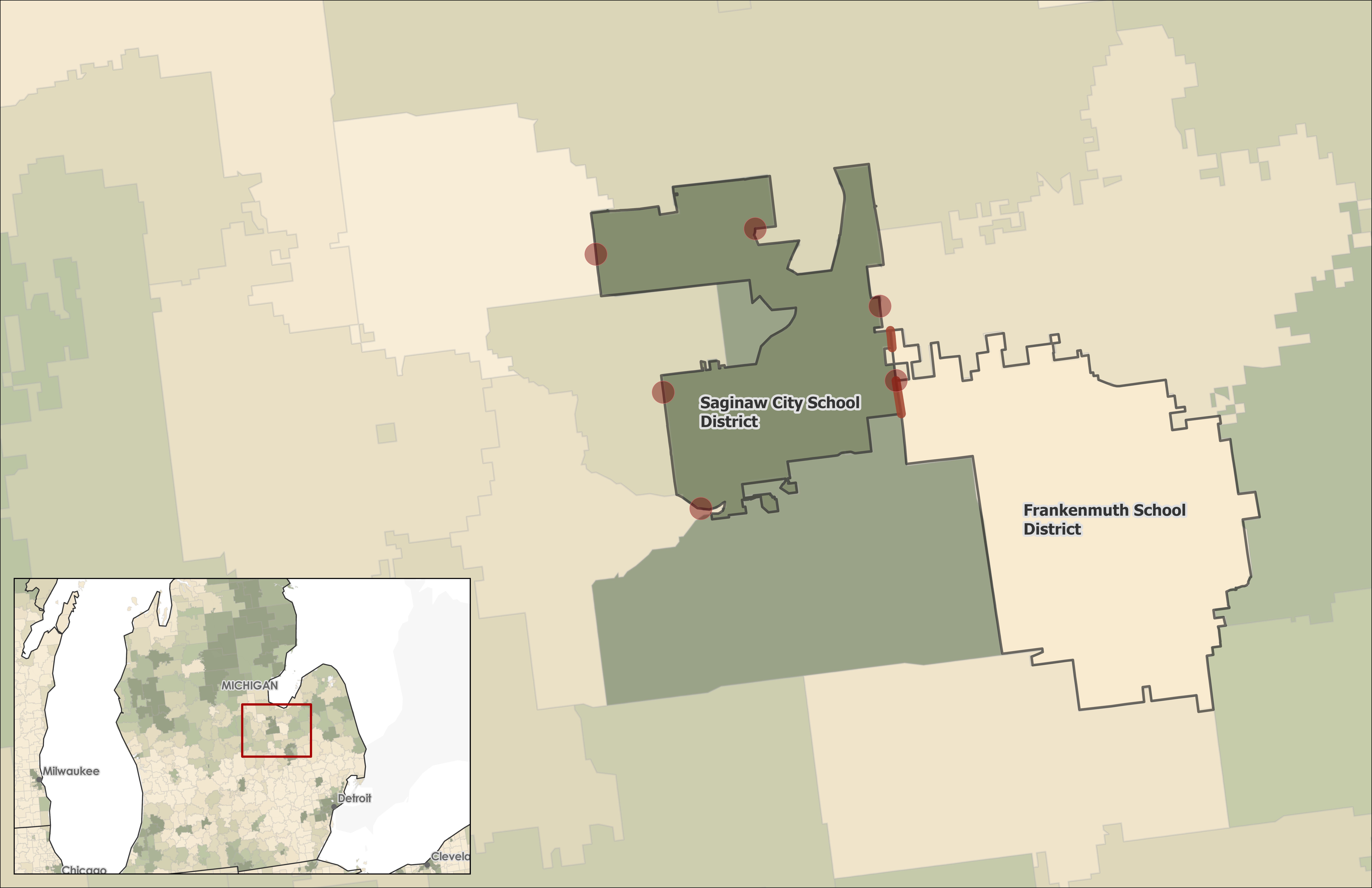
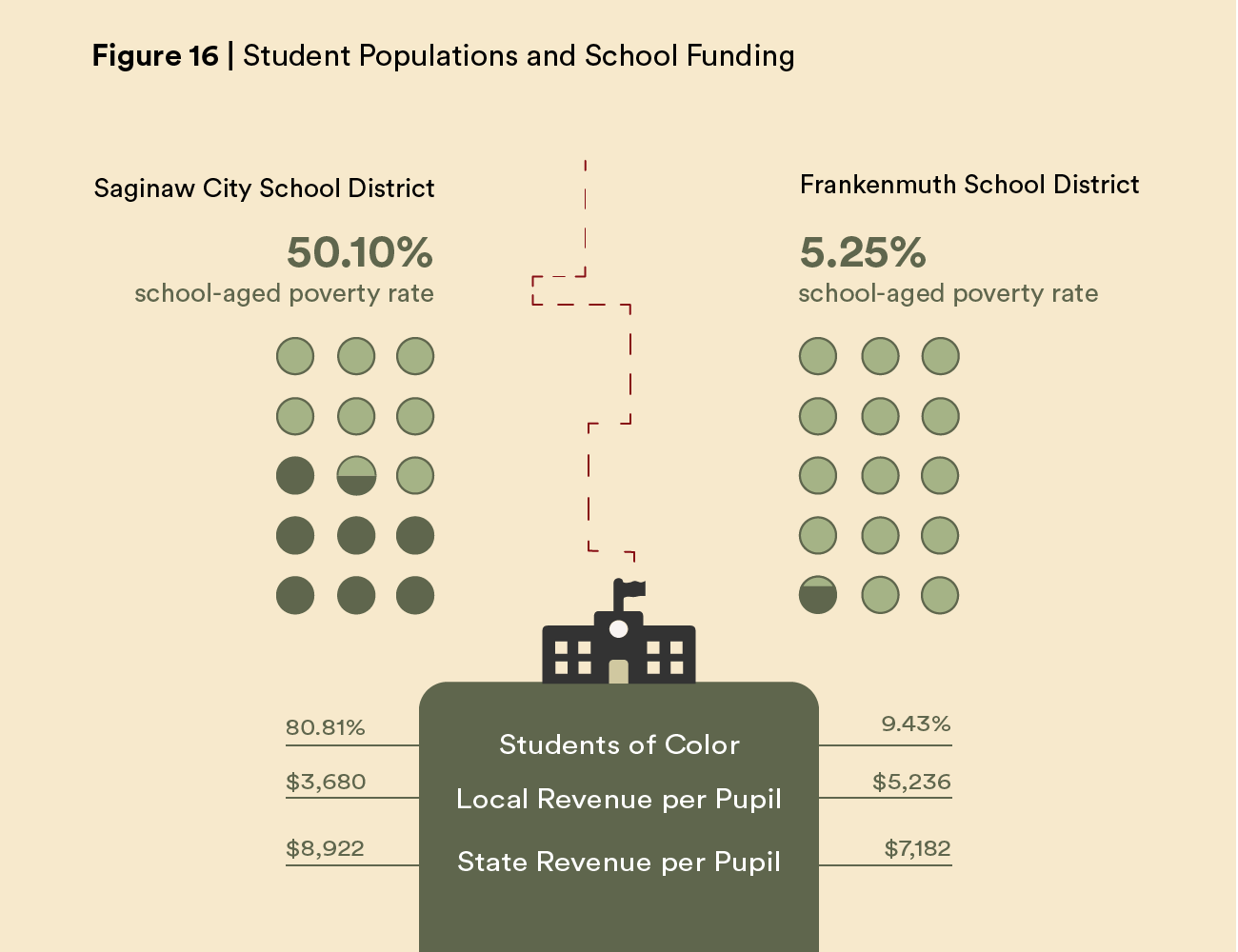
The border between Saginaw City and Frankenmuth School Districts is the most segregating in the country by school-aged poverty rate, and Saginaw City has six of the country’s 100 most segregating borders by this measure. The district was widened in 2013 to absorb most of Buena Vista,3 another high-poverty district. Otherwise, the borders of Saginaw City School District have remained largely unchanged over decades. These borders did not always surround an economically troubled community. But as industry in the area has declined, the lines have come to enclose a diminishing tax base and a dwindling number of students and families.
By Julian Morris, Saginaw City high school student, and Denita Dorsey, Julian’s mother and Saginaw City alumna, as told to New America. Edited for length and clarity.
Denita:
The landscape of Saginaw has changed drastically since I was a child. I was born here in 1982. At that time, jobs were booming. But when General Motors disinvested from Saginaw, the quality of life declined, because we were a city that had relied heavily on those manufacturing jobs.
Now, we have a generation that doesn't have that same financial security. You see a lot of boarded-up homes and empty lots. You see a lot of liquor stores and dispensaries. You don't see grocery stores in the city—places to get healthy and whole food. You see parks that have been closed. You see a lot more homeless people, and during distributions from the East Side Soup Kitchen or a church giving out food boxes, there are long lines wrapped around corners.
The Saginaw City population has been on a steady decline. When I was young, we had so many elementary schools. Most of those have closed. We had at least seven middle schools. Now we have two, and our two high schools are consolidating into one next year. Kids don't see a booming Saginaw. They don't see what I saw.
There are some new industries opening up. Hemlock Semiconductor is about 20 minutes outside the city. Nexteer Automotive, which is high-tech manufacturing, is closer by. And people from the city of Saginaw do work there, in low-level production jobs. But they don’t get the higher-paying skilled jobs or supervisory roles, because they don’t have the degree or the technical skills they’d need.
So, there are opportunities here in manufacturing and technology, but they’re out of reach. Even at the Saginaw Career Complex, where my son is a student in entrepreneurship—they have courses in those fields, but it’s mostly the young white kids enrolled, students from Frankenmuth, Birch Run, and Saginaw Township. Since there is testing and an interview process to get in, the kids who get the training are those whose parents who are already in those careers.
I know that I'm my son's first educator. What he's missing at school, I make sure that he gets at home. But I don't care about just my son. I care about all of the other students. And the quality of the classes is not there. When I was in high school, trigonometry, precalculus, and calculus were all offered. Now, nothing is offered beyond geometry. I asked why there wasn’t any higher math anymore, and the teacher told me that it’s because they don't have any students to take those courses. They don't have high expectations of the children.
There are many days when I'm dropping Julian off at school and there’s hardly anyone there yet. And when I'm picking him up, I see the teachers coming out at the same time as the students. I know COVID took a toll on our educators. Other districts in the area, because they were already fully staffed with certified teachers, could just add additional staff for those students who needed a bit more. In our schools, they may have added one or two academic or behavioral interventionists, but many classrooms were still operating with long-term substitutes instead of certified teachers. It was more of a strain in Saginaw City. And now, with students needing so much coming back from COVID, teachers are tired. They just come to work and they go home. They're not there to run after-school programs, to do clubs, to oversee student government. They just cannot do anything extra.
As a parent, I don't feel like the kids get enough exposure to possibilities for after high school. I believe that sometimes, you need to see something to know you can aspire to it. But our city kids don't know everything that's out there for them, because the people inside the schools are not exposing them to those different routes and careers. They take an interest in the students who are already interested in going that way—students who are in the top 10, or students like Julian, who are intelligent and don't cause any problems. But what about the C-average student? There are college options for them as well, and skilled trade opportunities. But if you're not already a person that they consider to be headed in the direction of college, you get left behind.
Julian:
Students in the city are very driven to be successful. They want to max out their opportunities in school. But we don’t really get what we need to prepare for college or do well there. We meet the requirements—four years of math, three years of science, a foreign language—but it’s just basics, the bare minimum. We do have a guidance counselor, who goes to different classes to go over scholarship options. He'll call students to his office to talk to them about what college they might want to go to, or direct them to another program, like courses at the county Saginaw Career Complex or Delta College. But it isn’t too deep—it doesn’t give kids an idea of what college will be like and what they can expect, or what colleges are aligned with their goals.
I get a lot of that at home. But many other kids my age don't have that; their parents expect the school to fully prepare them for college, and unfortunately, we don't have schools that truly prepare us to succeed when we go out those doors. So, if they're not being challenged at home, then they won’t have what it takes to make it to the next level.
The pandemic was a big change in how we learn. Before COVID, I never used Google Classroom. Nowadays, most of our work is online. I think it's a double-edged sword. It forced our school system to pick up the pace technologically, and it’s a lot easier to keep track of the work. But we don’t use books, and we can’t take our school computers home; they keep them locked up at the school. (They say they don’t have the money to replace them if we lose them.) So, they rely on us to have a way to access Google Classroom from home, and a lot of kids aren’t doing their work outside of school.
I look at other districts in the area, like Frankenmuth, Davison, and even Saginaw Township Community Schools, which is separate from the city school district. I take classes at the Saginaw Career Complex with students from those schools, and their experience is a lot different. The courses that they have available, their books—they just have more resources to better prepare the students for college.
In conversations among people my age, I hear all the time, “Oh, I can't wait to get out of Saginaw. When I graduate, I'm leaving. I'm never coming back.” The kids are looking at the city and they're not seeing anything worth investing in. They want better for themselves, and they don't believe that Saginaw can give them better. And that's the sad reality. But if the people it raises don’t care for it, if everybody wants to leave, how is the city ever supposed to grow?
Dallas Independent School District and Highland Park Independent School District, Texas
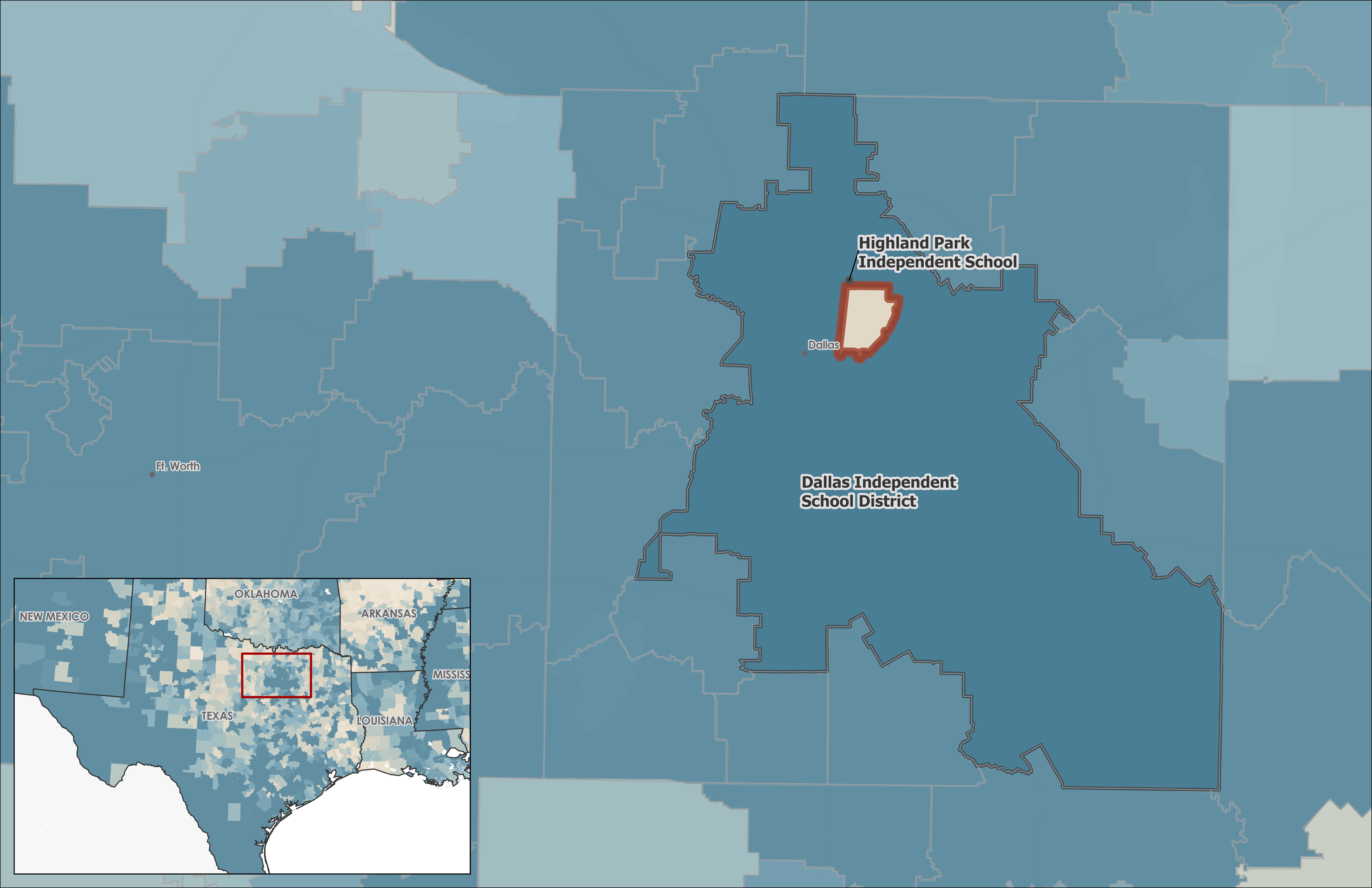
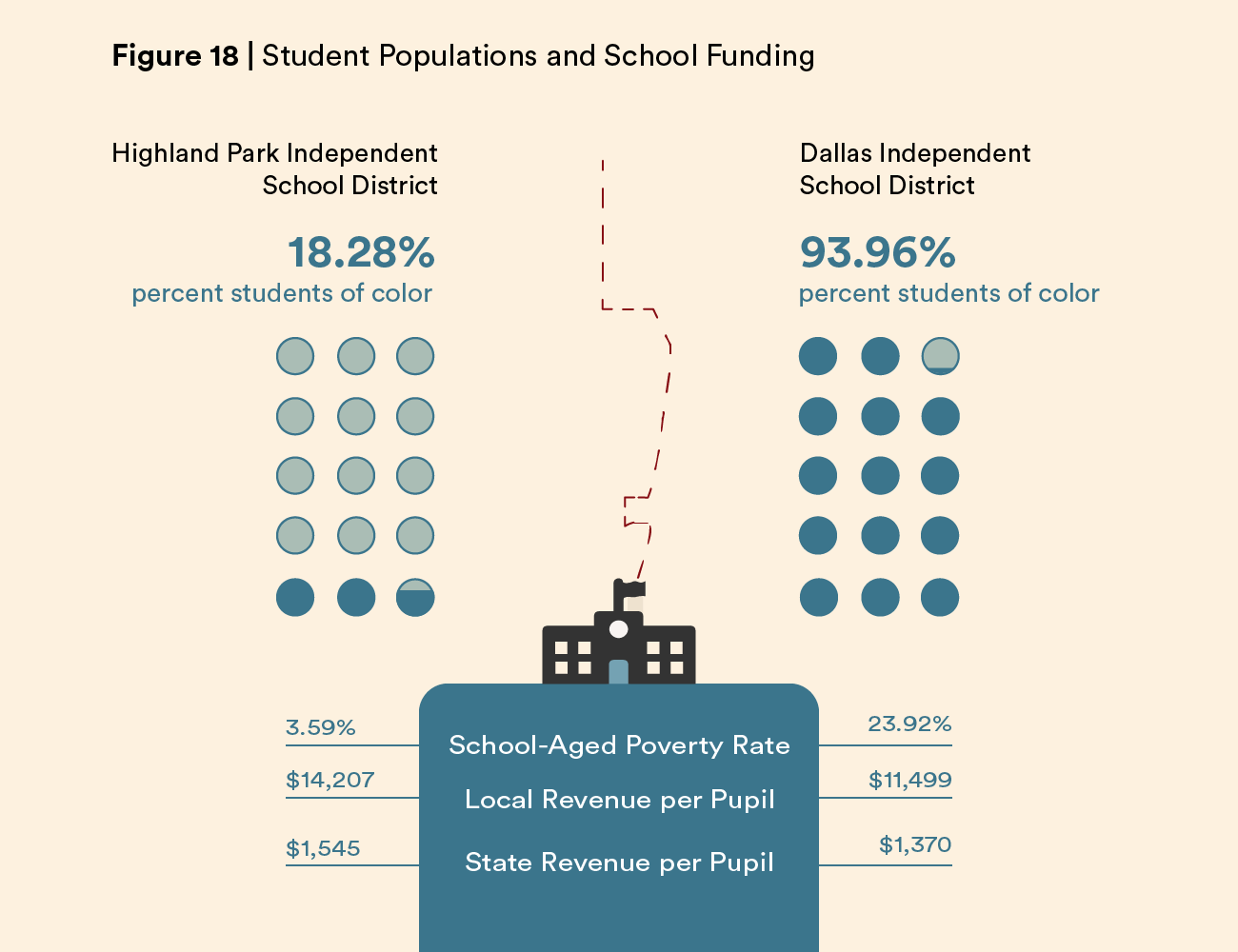
After Highland Park incorporated as a town in 1913, it resisted annexation by the city of Dallas for decades.4 After a final failed attempt in 1945, Dallas instead annexed nearly all the land around Highland Park, leaving it an island within the city. There was one further attempt to bring Highland Park Independent School District (ISD) into the borders of the city school district. In 1975, as part of the federal school desegregation case Tasby v. Estes, plaintiffs sought to have Highland Park ISD consolidated with Dallas ISD to help racially integrate the city schools.5 Because the town was such a small enclave, however, the court found that its operation as a separate school district had not affected Dallas ISD’s composition enough for it to be included in Dallas’s desegregation plan.
The town’s strict zoning and housing rules tightly control what can be built in its small area.6 Today, the median home value in Highland Park ISD is $1.97 million, more than seven times the median home value in Dallas ISD. Highland Park ISD receives over $2,700 more per pupil from local sources than Dallas ISD—a funding advantage that would be far greater if not for Texas’s policy of “recapture,” which redirects some tax revenue from property-wealthy districts into a state pool for other school systems. Highland Park ISD also receives a substantial amount of money from private fundraising, including through the Highland Park Education Foundation, which raises money that is not subject to the recapture system.7
By Lakashia Wallace and Robbie Esteban, Dallas Independent School District parents and advocates
Dallas is a divided city. Highland Park is one of the most expensive zip codes you can imagine. But you can drive five miles north or south and you will find some of the poorest areas in our city. That impacts our schools, communities, and the relationships we can build. We’re very much divided by income, race, status, and education. The quality of education in Highland Park looks a lot different than in Dallas schools around the corner.
If we were to put kids from different neighborhoods in Dallas, from different wealth levels and backgrounds, in the same room, the kids that would often be the most well-spoken, responsible, and emotionally mature would not necessarily be the children who score the highest on tests or whose families have the most money. But when we talk about the quality of education and who we assume is most capable, we are making it a whole lot harder for kids in neighborhoods that have less money—not because of the money, but because of the level of stress on campus, and the level of stress of the adults in the room. We have some exceptional and very qualified teachers in our public schools. Unfortunately, they have to deal with so much more than just teaching a kid how to read, write, and do math. As a result, too many walk away from education entirely, further diminishing the public school system.
As a parent, one of us, Ms. Wallace has had her own children experience a lack of certified teachers in critical core classes, sometimes being taught by long-term substitutes for years. Students have described not learning about science or math, but completing worksheets on unrelated subject matter instead of building college readiness.
We’re also deeply concerned about how rules are enforced in this district, especially for our students of color. One of us, Robbie, was once leading a discussion with students from different high schools: a wealthy private school, a magnet school, and an under-resourced district school. They were asked, “What is the dress code on your campus, and how is it enforced?” The students from the private school said they weren’t sure they had a dress code policy, but if they did, there was an elected board of their peers that decided how to handle any violations. The kids from the magnet school said they did have a uniform, but if they ever didn’t have the clothes they needed, they could go to the counselor’s office. And the kids from the under-resourced school said, “We get an in-school suspension for wearing the wrong color socks.”
Robbie said the students came to their own conclusions about how what they had been led to believe about “good schools vs. bad schools” and “good kids vs. bad kids” was simply not true. She shared that one student said, “We keep hearing about all of the behavior issues at your school, but if the color of your socks is part of that, I don’t know what to think. I don’t have to think about my socks at all.”
We’ve heard public school teachers tell us that when a student breaks rules by ordering food from a delivery app, they‘ll take and dispose of the food, directly in front of the students. Kids have been suspended in school for minimal reasons, like being out of uniform compliance—that is, they’re showing up to school to take part in the educational process just wearing what clean clothes they may have instead of a uniform. It's unfortunate, but many of our parents live paycheck to paycheck. Imagine a single mother with five kids attending school, unable to afford to wash 20 shirts and pants every week, only to see her child get punished as a result.
We’ve even seen students physically assaulted, thrown against the walls and lockers by administrative staff. Our expectation as parents is that that staff would be in a position to be understanding and capable of responding to the crisis. But instead, what we're doing to kids in under-resourced communities is policing them wildly differently. We are placing additional barriers in the way of students who are burdened by situations out of their control. Students face real challenges in our community. If they need help, supporting them should be the main focus
There are some really high-quality programs in the district now. People were fleeing public schools 20 years ago, but within the last decade, Dallas ISD has created options that parents feel are very competitive with those in other school districts. The reality is, though, many students are not gaining access to those schools, so not all students benefit and those solutions, which are often short-lived, create more chaos than support. Charter schools are part of the issue; with great marketing departments, they seem like a solution for families, but once they get there they realize that many of the schools are failing campuses and, worse yet, there is no mechanism for accountability because charter schools are run by companies, not a public institution.
Also a DISD parent, Robbie had a child at Townview Magnet Center, which houses six schools on one campus. But even there, you would see relatively few white students in any of the schools, other than the School for the Talented & Gifted. And parents in District 9, where Ms. Wallace lives, are asking why so few of the Black and brown students from their middle school are getting into the magnets and specialty schools. There are also non-magnet schools that specialize in law or medicine, and there are neighborhood schools that have developed strong programs—the quality is there. But in District 9, some schools have special programs that are struggling. Lincoln High School has a communications program that for many years was award-winning. Over the years, the program has been overlooked. We know how important communications careers are right now. Why hasn't the district resourced that program in that community to be successful? How do we even the playing field, when everything we build is taken away?
And while we push to have Dallas ISD do better for students of color, Highland Park remains a world apart. When Ms. Wallace was growing up here, Black people were warned against driving through or in Highland Park for fear of being stopped by the police. Many people of color just avoided the community altogether, out of trepidation. In retrospect, race and money were the two most important factors pertaining to Highland Park. The assumption was their kids would go to the best schools and get whatever they needed or wanted. It’s gotten a lot better—it’s not what it used to be—but the income disparity is still there. Let's be honest: whether in Dallas ISD or in Highland Park, all parents share a common denominator—to strive to provide the best for our kids, whether that’s by way of education, opportunities, finances, or family. The difference isn’t the goal. But the truth is, the educational experience looks very different in most of Dallas ISD than Highland Park, and that’s due to the power of money.
Wahluke School District and Kittitas School District, Washington
By administrators of Wahluke School District (Amy Marlow, assistant superintendent; Gigi Calaway, director of student support services; LaDonna Fogle, director of special education; and Bethany Martinez, director of migrant and multilingual services), as told to New America. Edited for length and clarity.
In the Wahluke School District, we like to say that we’re an hour from everywhere. Being rural and remote shapes everything about our district.
First, many of our students come from families who have come to this area, and this country, to work in agriculture. Some families have been here for three or four generations, while others are newcomers. Fifty-two percent of our kids receive English language development services and are formally identified as multilingual learners, but really, over 90 percent speak Spanish at home. That multilingualism is a huge asset to our community. Many of our students from Mexico speak Mixteco, and we have recently had families arriving from Guatemala who speak Q'anjob'al. Those new dialects are a challenge for us; we don’t have a lot of employees who can provide translation services, so we’ve been working on that this year to better engage with all of our families.
Our parents are amazing. They want the best for their kids, and a lot of them came here so that their children could have a better education. Fifty-nine percent of our students are migratory. Years ago, our class sizes were cut in half in winter months. Now, fewer families leave during winter; they move during the summer harvest instead. Those winter months are hard for them, but parents make the choice not to disrupt their kids’ schooling. Fourteen percent of our students are legally considered homeless; we don’t have shelters here, but we have a lot of families that double or triple up in a home, because there just isn’t a lot of adequate housing.
Because our community is so small and isolated, we don’t have a lot of services in the area—no Boys and Girls Club or YMCA—so our schools are the hub for everything, and families tend to come to the school for help before looking to outside providers. We also have to think about what will be available for our students after graduation. There isn’t any transition support or job coaching for adults with special needs, so our program has to fully prepare our students with disabilities for life after school. We support everyone as best we can. Our McKinney-Vento liaison works year-round connecting families to food assistance and mental and physical health resources. All of our staff function as informal social workers to some degree. We say that we don’t have full plates here—we have full platters. There is a lot of turnover, because our teachers are burned out doing so much more than just teaching.
Downloaded from https://www.google.com/url?sa=i&url=https%3A%2F%2Fwww.wahluke.net%2Fpage%2Flibrary-and-information-literacy&psig=AOvVaw3bqPaM0_qBslKe8ePVex5q&ust=1708030394896000&source=images&cd=vfe&opi=89978449&ved=0CBYQ3YkBahcKEwiw2eia26uEAxUAAAAAHQAAA
Because of our location, we have trouble filling licensed roles like nurses, psychologists, or mental health counselors. And when we do hire those professionals, if they don't already live in the community, they often don't want to stay, so we have to pay especially high salaries. Finding special education providers is a particular challenge; we just can’t get applied behavior analysis professionals to come to our campuses, for instance. Speech and occupational therapy are all virtual, and that means paying not only the therapist, but also an on-site paraprofessional to help the student actually do the exercises.
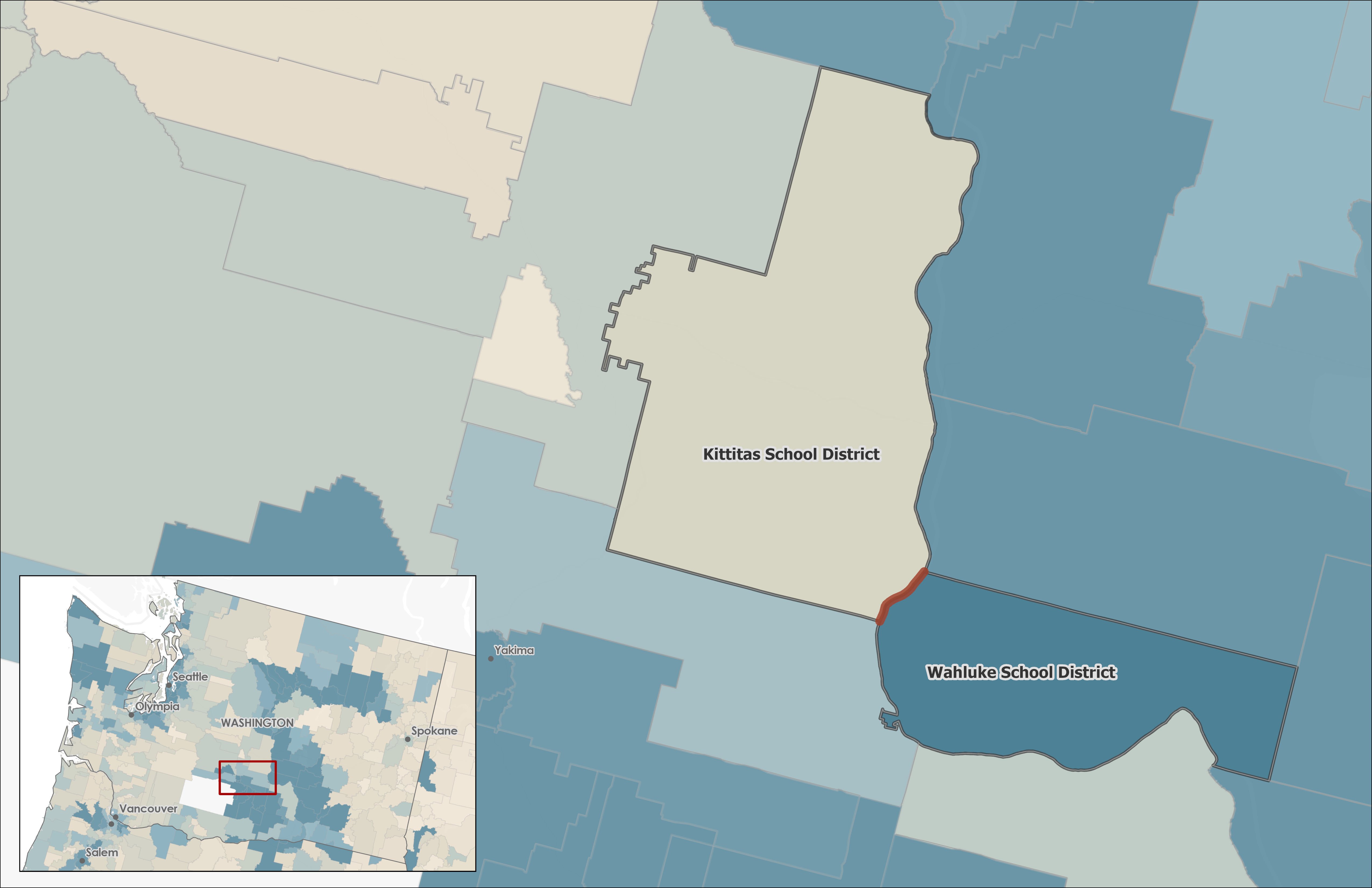
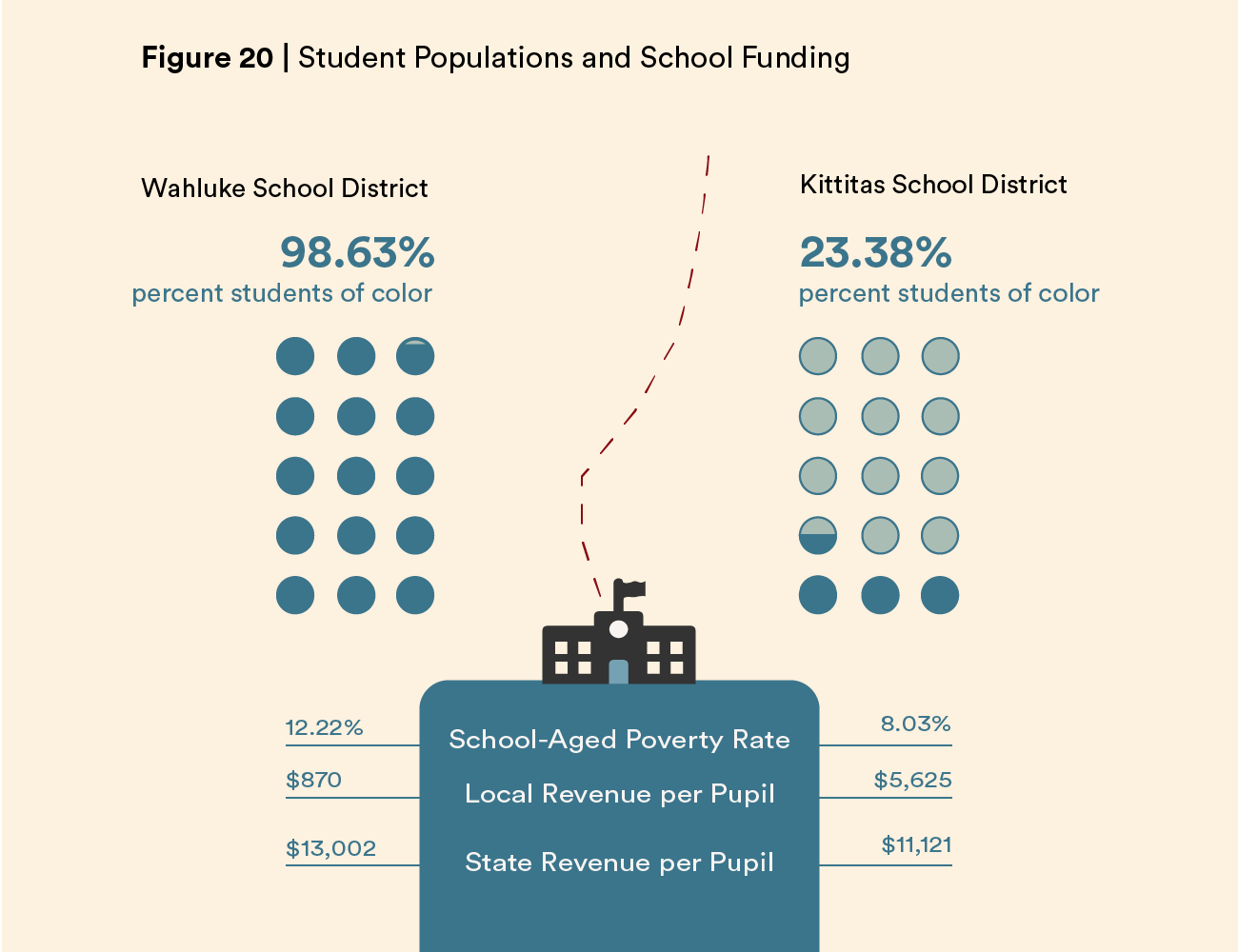
Another big factor in our budget is transportation. The geographic area for our schools spans 30 miles, and gas is expensive here. We also can’t expect families to have reliable cars or the time to bring students to extracurricular activities, so we provide transportation for everything—sports, career events, Future Farmers of America fairs. We go to competitions and Wahluke is the only district there with a bus; everyone else is there with parents. And unlike Kittitas, which can sell tickets to football games to pay for uniforms and equipment, we don’t charge families for anything, so it always comes back to the district. It’s a little over $3 a mile for the bus and $36 per hour for drivers. We’ve had to start saying no to some events because we just can’t afford to send our students. Two of our robotics program students were invited to nationals and we had to turn it down.
It’s hard when we have to ask our students to forgo an opportunity, but funding is tight. Many of our property taxpayers feel disengaged from the district. That includes farm owners, many of whom don’t live locally, and the community around the Desert Aire Golf Club, where a lot of people have second homes or are retirees on a fixed income. That disconnection really matters in Washington State, where all local property taxes for schools have to be voter-approved; our last levy election failed by 36 votes. Federal funding has also been a challenge. Many of our families are undocumented and were fearful of filling out the census, so the new data doesn’t really reflect our population. Our federal funding for low-income students has gone down because our poverty rate is artificially low, and we recently lost our Rural and Low-Income Schools funding. We try to get as many grants as we can, but they don’t go up along with the cost of living, and we have to pay our staff a living wage. As a result, we had to cut 27 positions this past year.
As district parents, we’ve felt that sting. If our kids had gone to school in Kittitas or Richland, it would have been a different experience. They know they didn’t have the choice of courses that they could have had in other schools. We will never have the music or theater programs that other communities have, in part because of the number of locals able to volunteer—our small community is so overstretched. But we’re doing our best for our kids, because they deserve the best. The good thing about a small town is we take care of each other. You see those who don't have much giving that little bit just to help somebody else out. And that community is a huge asset.
Citations
- “Utica, NY: Area Descriptions,” in "Mapping Inequality: Redlining in New Deal America," ed. Robert K. Nelson and Edward L. Ayers, American Panorama: An Atlas of United States History (Richmond, VA: Digital Scholarship Lab at University of Richmond, 2023), source.
- See Amy Neff Roth, “Appeals Court Finds State Funding of Small City Schools, Including Utica, Unconstitutional,” Utica Observer Dispatch, June 3, 2021, source.
- Lindsay Knake, “Buena Vista School District Is No More; Students to Attend Saginaw, Bridgeport-Spaulding, Frankenmuth Schools,” MLive, July 30, 2013, source.
- Lisa C. Maxwell, “Highland Park, TX,” Texas State Historical Association, source.
- Justia, “Tasby v. Estes, 412 F. Supp. 1185 (N.D. Tex. 1975),” source.
- Maxwell, “Highland Park, TX.”
- Highland Park Education Foundation, Annual Report: 2022–2023, source.