The property-value divides between Long Island school districts, like those between districts around the country, are not accidental. They are the legacy of a deep history of local housing discrimination.
In the first half of the 20th century, Long Island had high rates of racially restrictive covenants (contracts that prevented homeowners from selling to Black buyers). This was true, for example, of the famous Levittown, a large housing development built just after the Second World War that excluded Black residents, including returning veterans.1 Government construction projects also enshrined segregation and racial exclusion. The federal government provided public financing for segregated developments,2 and town governments pursued “slum clearance” and “urban renewal” agendas that cleared neighborhoods of Black residents and redirected them to segregated areas and densely built public housing.3
Contemporary discrimination continues to shape housing patterns on Long Island. Investigative journalists have found that real estate agents tend to steer buyers of color to different neighborhoods than white buyers, informally enforcing the segregation that was once official government policy.4 Long Island is also rife with what housing experts call exclusionary zoning policies, or local building rules that make housing more expensive and are often calculated to maintain racial segregation.5 In particular, many towns ban multifamily homes, which disproportionately house low-income families and people of color, and require large lot sizes that drive up the cost of single-family houses.6
These policies and practices have produced a map of extremes: communities with near-uniformly low or high incomes, severe differences in property values, and very sharp racial divides. Since school district lines closely track municipal borders on Long Island, this also means stark segregation between school districts, both economic and racial. Of the 100 most racially segregating school district borders in the United States, four are on this narrow strip of New York land.
The kinds of policies and practices that have segregated Long Island have also created racial and economic divides throughout the country, and have created property value divides between communities of color and predominately white towns and neighborhoods.
This discrimination included policies in many localities that mirror Long Island’s specific problems: racially restrictive covenants, exclusionary zoning, and racist approaches to urban renewal. It also involved the notorious practice of redlining, in which, beginning in the 1930s, federal housing agencies and their state branch offices surveyed and mapped American cities, rating neighborhoods by their perceived “mortgage security”—whether federal and private lenders should consider an area a good investment for home loans.7 (See Figure 3 for an example of such a map.) These assessments took into account the condition of housing stock, but they were also openly based on the race and class of local residents. The presence of Black, Latino, and Asian families in an area almost always resulted in a grade of “hazardous,” colored red on the map, giving the practice its name. Neighborhoods with Jewish or white immigrant (such as Italian or Polish) populations were generally classified as “definitely declining” (colored yellow) and sometimes rated “hazardous,” while “best” areas (colored green) consisted of upper-income white households. Judgments like these set the standard for mortgage lending and made homebuying either difficult or impossible for minoritized families.
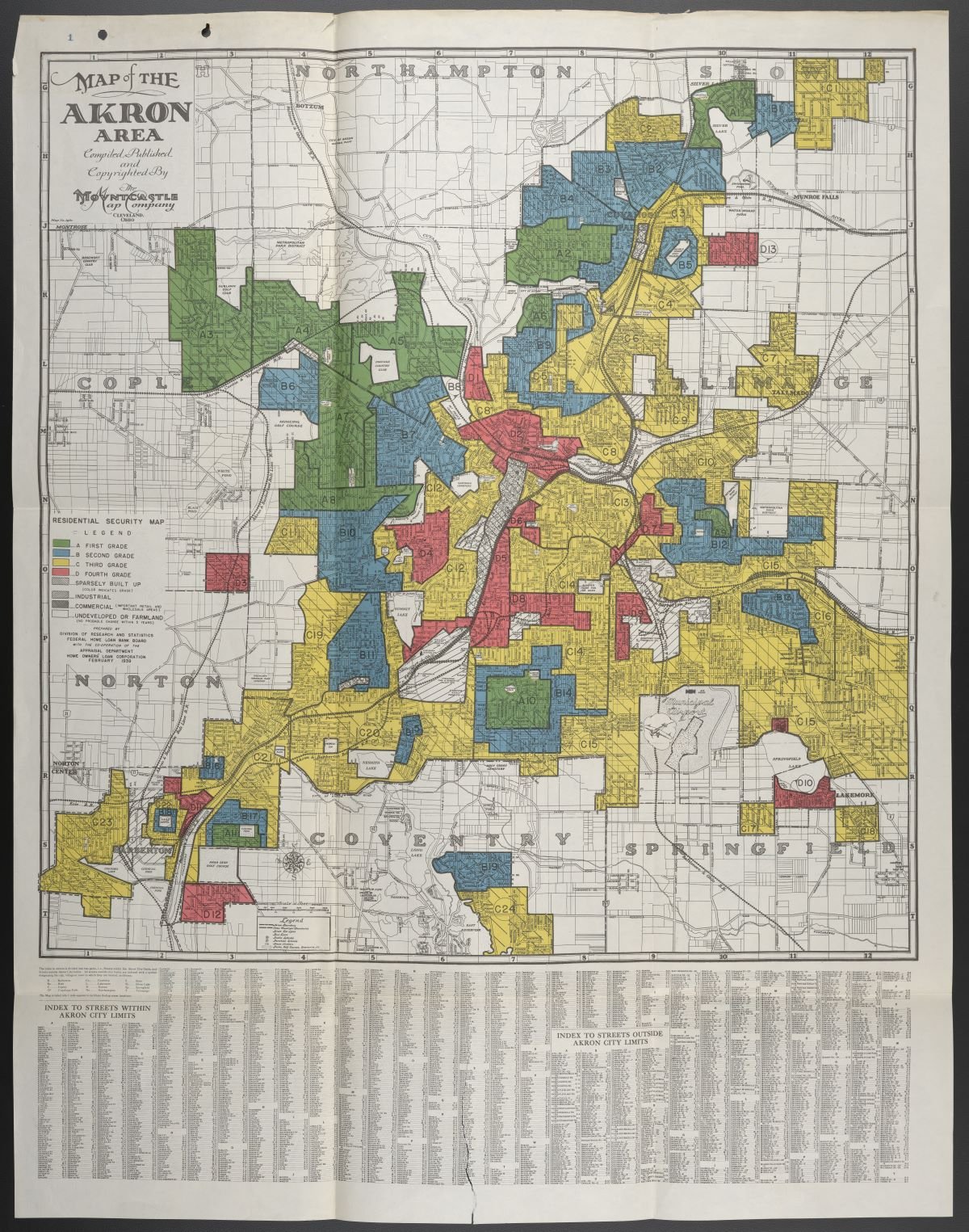
The inability to access home loans also had the effect of making other housing support programs useless to many buyers of color. For instance, the Servicemen’s Readjustment Act of 1944 (known as the G.I. Bill) officially allowed all veterans to take advantage of lower-cost mortgages. But in practice, Black veterans returning from the Second World War could not take advantage of these discounts when banks refused to lend to them in the first place,8 in much the same way that the G.I. Bill’s education aid was of little help to Black veterans who were excluded from most institutions of higher education.9
The result of all these racist and exclusionary housing policies is stark. America continues to have extreme income and racial segregation between neighborhoods.
"And today, the homeownership gap between Black and white households has reached its highest level in 50 years, even higher than when open discrimination against Black homebuyers was legal.10 School district boundaries are drawn atop the communities that have been shaped by segregating policies and practices."
This means that the segregation of the neighborhoods is often replicated in school systems, with students divided among school districts by race. These school system boundaries also define the areas in which property can be taxed to generate the dollars that make up about 30 percent of the average U.S. school district’s budget.11 In property-wealthy districts like West Islip, those revenues push spending levels well beyond the reach of less advantaged districts—even ones that are right next door, like Brentwood Union.
Once segregated neighborhoods produce unfairly funded school districts, unequal schools then serve to perpetuate and worsen neighborhood segregation. Wealthy school districts can pay higher teacher salaries and build better school facilities that drive up property values, making wealth disparities larger still. This is one reason that residential segregation by income is worse for families with children than those without. As Ann Owens, a University of California sociologist whose research has demonstrated this fact,12 explains, “Income segregation between neighborhoods has increased only among families with children since 1990. As income inequality has increased, high-income families have more resources and low-income families have even fewer. One way high-income families are using their rising resources to secure their advantages are by buying homes in their preferred school districts.”13
Every student deserves a well-funded school that has the resources to meet their needs. And students with higher needs must be provided not just with the same funding levels as their wealthier counterparts, but with the greater funding required to support their success. But because America’s history of housing discrimination has led to lower property values in precisely the neighborhoods with the most students in poverty and the most students of color, the opposite is happening. Meanwhile, the wealthiest communities can use their property tax receipts to power school spending well out of proportion to their students’ needs—and well beyond the reach of their neighbors.
Citations
- Richard D. Kahlenberg, Housing and Educational Inequality: The Case of Long Island (Washington, DC: The Century Foundation, June 1, 2023), 8, source.
- Kahlenberg, Housing and Educational Inequality.
- Robert Courtney Smith, “Separate and Unequal: A History of Segregation and Discrimination on Long Island and in Nassau County, and African American and Latino Communities of Interest,” summary prepared at request of plaintiff, June 30, 2011, for Boone et al. v. Nassau County Legislature, Eastern District of New York, United States District Court, 10, source.
- Anthony Carrozzo, “Undercover Investigation Reveals Evidence of Unequal Treatment by Long Island Real Estate Agents,” Newsday, April 6, 2023, source.
- Cecilia Rouse, Jared Bernstein, Helen Knudsen, and Jeffery Zhang, “Exclusionary Zoning: Its Effect on Racial Discrimination in the Housing Market,” The White House, June 17, 2021, source.
- Kahlenberg, Housing and Educational Inequality, 13.
- Robert K. Nelson, “Introduction,” in "Mapping Inequality: Redlining in New Deal America," ed. Robert K. Nelson and Edward L. Ayers, American Panorama: An Atlas of United States History (Richmond, VA: Digital Scholarship Lab at University of Richmond, 2023), source.
- “After the War: Blacks and the G.I. Bill,” Smithsonian American Art Museum, source.
- Sarah Turner and John Bound, “Closing the Gap or Widening the Divide: The Effects of the G.I. Bill and World War II on the Educational Outcomes of Black Americans,” The Journal of Economic History 63, no. 1 (2003): 145–77, source.
- Urban Institute, “The Data on Black Homeownership,” Reducing the Racial Homeownership Gap, source.
- U.S. Census Bureau, “2021 Public Elementary-Secondary Education Finance Data,” source.
- Ann Owens, “Inequality in Children’s Contexts,” American Sociological Review 81, no. 3 (April 27, 2016): 549–74, source.
- Ann Owens, email message to author, February 2, 2024.