Table of Contents
- Introduction
- Districts Shaped by Discrimination
- Understanding the Data
- National Findings
- Local Stories
- Divided Districts and Native Students
- A Future Not Determined by the Past
- Appendix A: 100 Most Segregating School District Borders by Difference in Poverty Rate
- Appendix B: 100 Most Segregating School District Borders by Difference in Percent Students of Color
- Appendix C: Segregating Borders by State
- Appendix D: Data and Methodology
Introduction
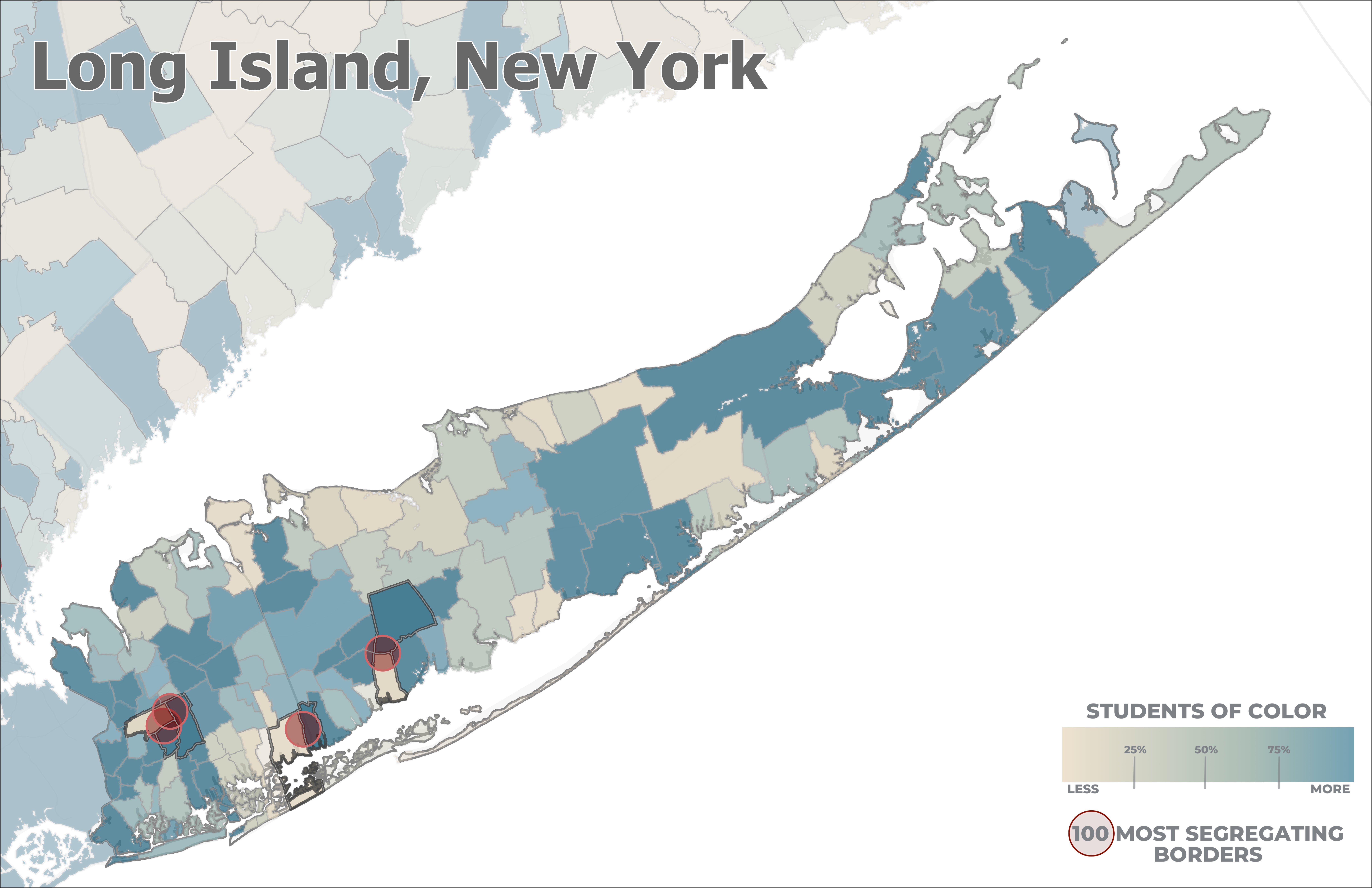
Long Island, just outside New York City, contains 124 separate public-school districts—an average of one for every 10 square miles (see Figure 1). This proliferation of tiny districts exists because, like most northeastern states, New York largely matches its school district borders to municipal boundaries, and Long Island is split into a great many cities, towns, villages, and hamlets. Long Island shows how district boundaries separate students from resources, and from each other, a problem that repeats in states and regions across the United States.
School district boundaries don’t just define the area where a certain group of children attends a given set of schools. They also determine the local taxing jurisdiction that supports those schools. As a result, disparities in property values between school districts create disparities in the opportunity to learn. In New York, districts draw, on average, 58 percent of their funding from local revenue sources, nearly all of which comes from local property taxes.1 Big differences in property value can lead to large funding gaps, even between districts that are directly next to one another.
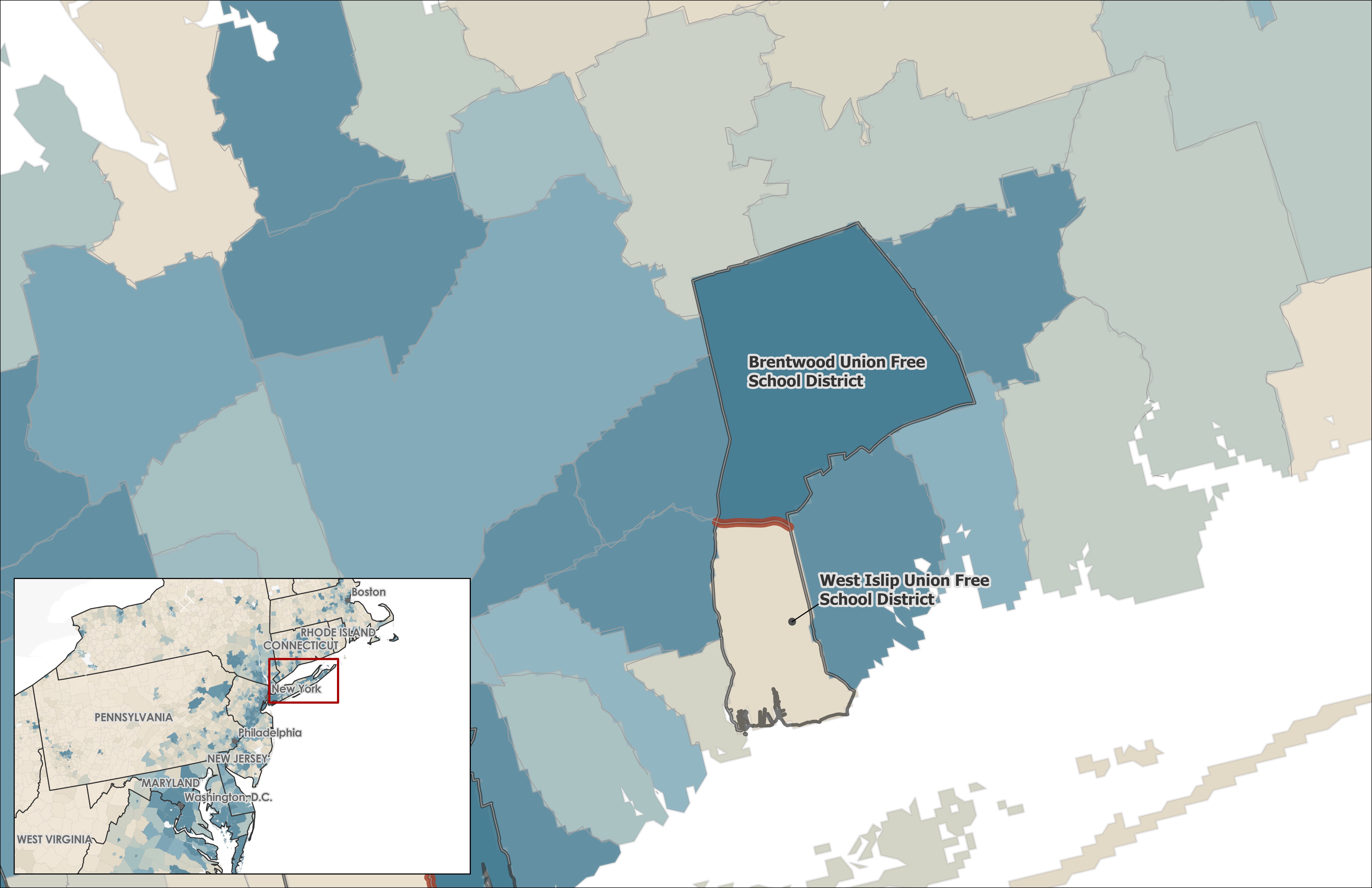
As an example, take Brentwood Union Free School District. The central Long Island region surrounding the district is affluent. The median household income in its county is more than four times the income at the federal poverty line.2 But 11 percent of school-aged children residing in Brentwood Union live below the poverty line—a staggering number given the economic resources nearby. Thirty-five percent of the district’s students are English learners3 and 86 percent are Latino.
Brentwood Union borders seven other school districts, six of which serve fewer students of color (that is, students identified as a race or ethnicity other than non-Hispanic white in U.S. Department of Education data). Brentwood Union’s greatest divide is with West Islip Union Free School District, whose student body is 82 percent white. (See Figure 2.) The line that separates these two districts is among the most racially segregating in the country, ranked 33rd out of nearly 25,000 borders analyzed in this report for the size of the divide they create in percentage of students of color enrolled. West Islip has a school-aged poverty rate below 3 percent, and just 1 percent of its students are English learners.4
The state of New York provides school districts with funding using a formula that recognizes Brentwood’s greater need for resources in order to provide for things like more counseling, small-group instruction, and other support for students in poverty. It calculates that Brentwood Union needs $17,6785 per pupil, compared to a funding need of $10,772.29 per pupil in West Islip.6 But West Islip has much higher property values—triple the valuation per pupil in Brentwood.7 West Islip takes advantage of that tax base to raise over $21,000 per pupil in local revenue, compared with Brentwood’s $6,380. West Islip’s local property tax dollars completely overwhelm the state’s intention to support Brentwood’s students at a higher level. Including all state and local revenue, Brentwood Union students get about 71 cents for every dollar given to students in West Islip.
School funding debates tend to focus on how much money school districts should receive and the state and federal policies that deliver those dollars. But they almost always take the shape and size of the districts themselves as a given, even though, as this report will show, many school district boundaries follow lines that were explicitly to drawn to segregate by race, ethnicity, and economic class, and continue to perform that function today. Like school funding distributions, district borders are a product of state policy. State laws specify how these lines are drawn and the processes and requirements for changing them. District borders can be redrawn, and border policy can be changed, to produce better outcomes for students and their schools.
This report will describe the history of discriminatory policies that created the conditions for segregation and funding inequality between neighboring districts. It will then take a close look at how our school districts are currently divided, identifying the borders that most severely segregate neighboring districts by both racial composition and poverty rate. It will also feature stories about the impact of these borders on local school communities, and offer ways to rethink and redraw district lines for the benefit of all students. We hope that policymakers and advocates will use the findings in this report as both an inspiration and a foundation for work to reform the school district map, creating more diverse and equitably funded school systems.
Citations
- Compare to 44% for school districts nationally. United States Census Bureau, "Summary of Public Elementary-Secondary School System Finances by State: Fiscal Year 2021," in Annual Survey of School System Finances, Table 1, revised May 15, 2023, source.
- This figure is calculated using the federal poverty line for a family of three. ASPE (Office of the Assistant Secretary for Planning and Evaluation), “2021 Poverty Guidelines,” source.
- Data.nysed.gov (New York State Education Department), “Brentwood UFSD English Language Learners Data (2020–21), source.
- Data.nysed.gov, “2021 West Islip UFSD English Language Learners Data (2020–21),” source.
- New York State Education Department (NYSED), “State of New York: 2020–21 State Aid Projections: Foundation Aid,” Brentwood, March 31, 2020, source.
- NYSED, “State of New York: 2020–21 State Aid Projections: Foundation Aid,” West Islip, March 31, 2020, source.
- NYSED, “2020–21 State Aid Projections,” Brentwood and West Islip.