
Table of Contents
Background
Exclusionary discipline refers to a school disciplinary action, typically a suspension or expulsion, that removes a student from his or her typical education setting. The specific issue of exclusionary discipline in ECE began to receive increased attention in 2005, with the release of a paper by Yale University professor Walter Gilliam. Gilliam found that the national rate of expulsions for pre-K children was over three times higher than that of K–12 students, with an estimated 5,000 pre-K students expelled each year, based on teacher-reported data. Additionally, Gilliam found that Black pre-K students were about twice as likely to be expelled as their white and Latino peers.1
While these numbers are alarming, experts caution that the real numbers are likely even higher. A 2019 study used parent-reported data to estimate that over 174,000 pre-K students were suspended each year, with an additional 17,000 expelled, translating to about 4,800 suspensions and 475 expulsions each week of the school year.2 Data like these have led scholars to conclude that pre-K remains “the highest-risk period for expulsion and suspension in a child’s educational journey.”3 Excluding children from early childhood settings is often not technically classified as suspension and expulsion; it is common for parents to be told that their child is “not a good fit” for a program rather than being formally expelled. This is commonly referred to as a “soft expulsion.” Or a provider might regularly ask a parent to come pick up a child having a tough day as opposed to formally suspending him or her—a “soft suspension.” Parents can be driven to withdraw their child from a program prior to an official expulsion if they perceive a lack of support from the program.
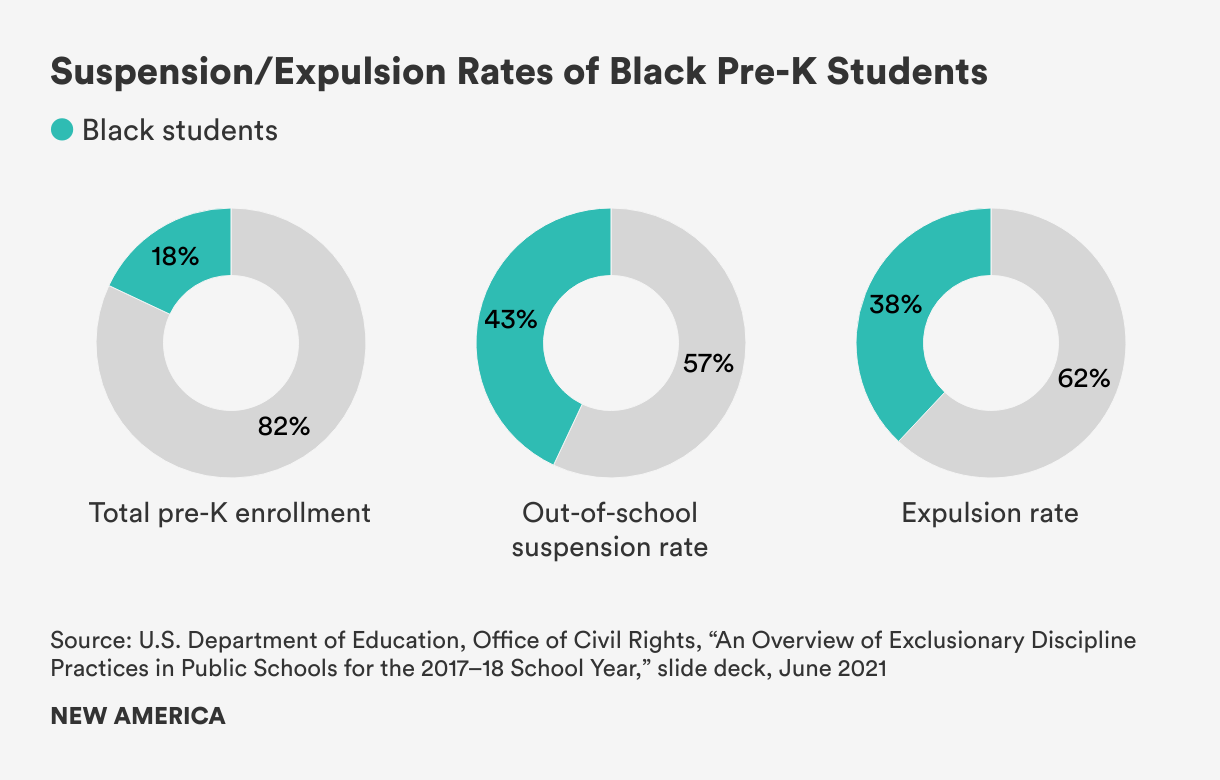
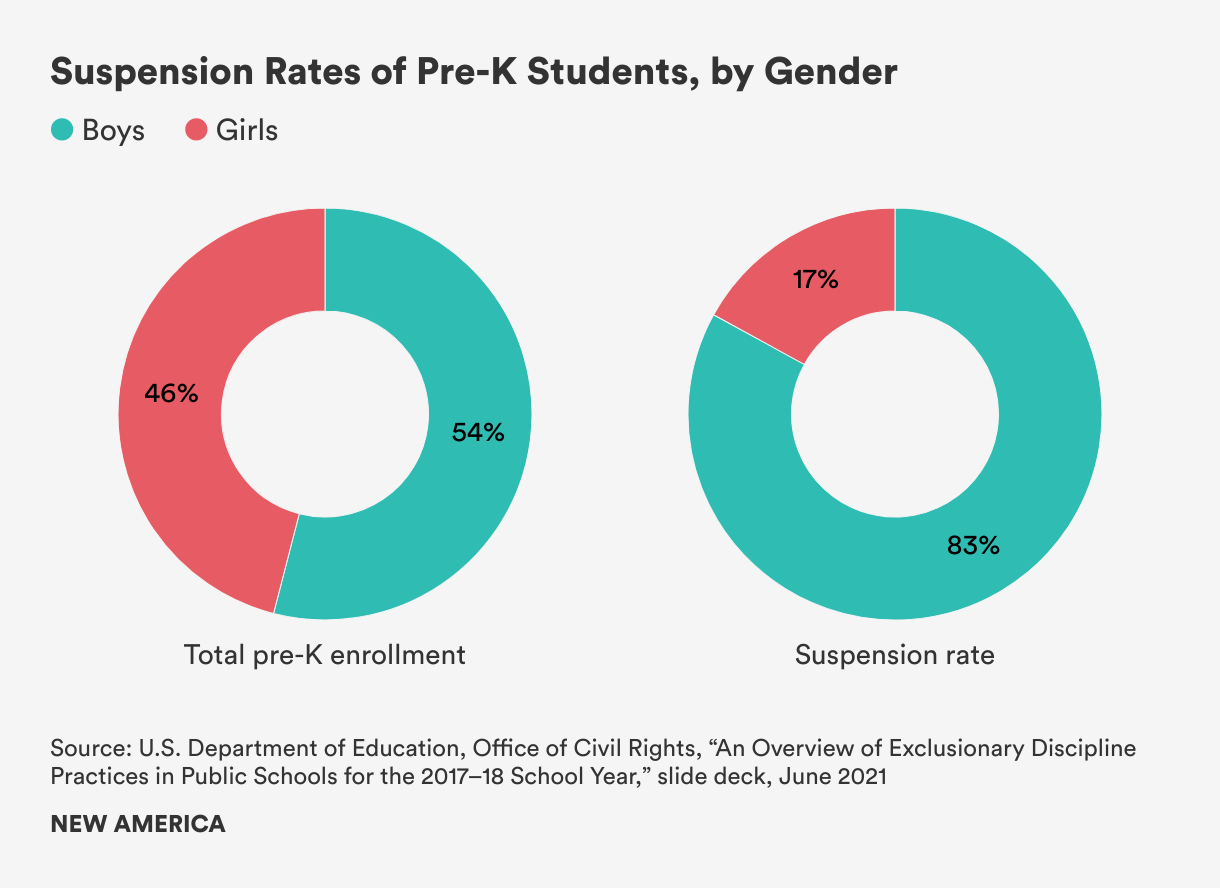
While exclusionary discipline is a problem for all students, it is particularly troubling given the data suggesting disproportionate rates of suspensions and expulsions for young Black children. The 2017–18 Civil Right Data Collection reveals that Black pre-K students are suspended from school at disproportionately high rates. Black children make up 18 percent of total pre-K enrollment, but received 43 percent of out-of-school suspensions and 38 percent of expulsions.4 Black boys in pre-K were both suspended and expelled at a rate more than three times their share of total enrollment. The data also show that boys overall were more likely to be suspended than girls, with boys representing 83 percent of pre-K suspensions despite making up only 54 percent of total pre-K enrollment.5
Significant disparities in disciplinary practices have also been found for children with disabilities. A 2018 analysis found that children ages three to five with disabilities and/or emotional and social challenges make up only 12 percent of early education students but represent 75 percent of suspensions and expulsions. The same analysis found that the odds of being suspended and expelled were 33 times higher for young children with ADHD and 10 times higher for young children with autism compared to their typically developing peers.6 The disparities are even worse when race and disability intersect, as would be the case, for example, for a Black child with a learning disability.7
Excluding Children from ECE Programs Is Ineffective
Decades of research show that exclusionary discipline practices in the early years are ineffective and developmentally inappropriate. Children who are removed from the classroom lose out on valuable learning opportunities. Their emotional well-being may suffer and school might no longer feel like a safe place. Instead, they may feel unwelcome and develop a negative association with school. Exclusion also disrupts the continuity of care, which is important to fostering strong early education experiences.8 Searching for suitable new child care arrangements also creates significant stress for families.
According to a study published in the January issue of The Review of Educational Research, there may be long-term consequences, as “early experiences of exclusion may trigger a cascade of negative interactions with schools, increasing the risk of future exclusions.”9 The authors warn that “the earlier the pattern of exclusion is established, the more likely children are to be expelled in elementary school, resulting in greater losses in cumulative instructional time and more significant achievement gaps separating removed children from their included peers, particularly during critical development periods.”10
Young children are usually removed from the classroom because teachers consider their behavior to be challenging; they are viewed as either too disruptive or dangerous. However, many of the behaviors that teachers associate with being disruptive or dangerous are relatively common in young children. And teachers’ perceptions of what constitutes challenging behavior differ substantially, often depending on their ability to cope with it.11 While program administrators are ultimately responsible for disciplinary decisions, research shows that “educators who are stressed, depressed, or unsatisfied with their job are more likely to request to expel children in their classroom.”12 Opinions around children’s behavior may also be influenced by teachers’ implicit biases. A 2016 study led by Gilliam found that teachers tended to observe Black children, especially Black boys, more closely when they were asked to look for challenging behaviors.13
Efforts to Address Inappropriate School Discipline Practices
Policymakers at the federal and state levels have taken steps to address exclusionary discipline practices in recent years. The 2014 Child Care and Development Block Grant (CCDBG) reauthorization added a requirement for states to report their policies around suspension and expulsion, bringing needed attention to the issue for child care providers.14 CCDBG requires lead agencies to offer information to child care providers about appropriate discipline strategies and social-emotional development. While already common practice in Head Start, the 2016 update to the Head Start Performance Standards specifically banned expulsion and severely limited suspension in programs.15 Under the Obama administration, the U.S. Departments of Health & Human Services and Education also released joint guidance on limiting exclusionary discipline practices in ECE settings.16
More and more states are establishing policies to reduce or eliminate expulsion and suspension for young children. Between 2015 and 2018, members in both Republican and Democratic controlled legislatures introduced 13 bills across 12 states, nine of which passed.17 A 2021 report from the BUILD Initiative and the National Center for Children in Poverty that looked more broadly at state agency regulation, guidance, and legislation found that 29 states have early childhood expulsion or suspension policies in place, with 18 states having fully implemented them.18 There is significant variation across states regarding which programs are covered under the guidance, whether new funding has been provided with the policy changes, and what is required or suggested of programs. Roughly one-third of state policies include specific language about racial equity and equity for children with disabilities.19
But to see meaningful change, policies must get to the root of the problem. They need to acknowledge that part of the reason young children are removed from the classroom is because educators do not have the knowledge, tools, or supports they need to manage certain behaviors and appropriately support children. Educator buy-in is key for successfully implementing changes to discipline approaches, as they are the ones dealing with these issues in the classroom. Without this acknowledgment, programs may continue to exclude children for lack of more appropriate tools and strategies.
Popular Interventions and Approaches to Supporting the Workforce
States have taken different approaches to recommending alternative actions for early childhood programs to use, and research points to several strategies that can be employed to support early educators in handling challenging behaviors and supporting students.20 In this report we focus on the two strategies that have received significant traction: early childhood mental health consultation (ECMHC) and improved training for educators on children’s social-emotional development.
Early Childhood Mental Health Consultation
ECMHC places mental health professionals in early childhood settings and elementary schools to work with educators and families to address challenging behaviors. In a 2021 survey of states, 16 reported that ECMHC is widely available to ECE programs.21 The updated Head Start Program Performance Standards mandate that programs have access to regularly scheduled on-site ECMHC.22 ECMHC is intended to be a preventative measure to improve educator practice and overall program quality. Consultants do not work directly with children, but instead guide teachers and coach them to consider a child’s “contextual factors such as trauma, parenting, cultural expectations and developmental differences.”23
The specifics of ECMHC may look different from one state or locality to the next and may vary among types of programs, according to need. Numerous reports have noted positive outcomes in children as a result of ECMHC interventions, such as decreased behavior problems, especially externalizing behaviors, and improved social and emotional skills.24 There is evidence that ECE programs with regular access to ECMHC are less likely to have expelled a child in the previous year.25
Professional Learning on Children’s Social-Emotional Development
Professional development for teachers and school leaders around implicit bias, culturally responsive teaching, classroom management, and social-emotional development can all be important to strengthening teacher practice and helping them manage student behavior. Professional development on promoting children’s social-emotional growth and addressing challenging behavior is reported to be widely available in more than half of states.26
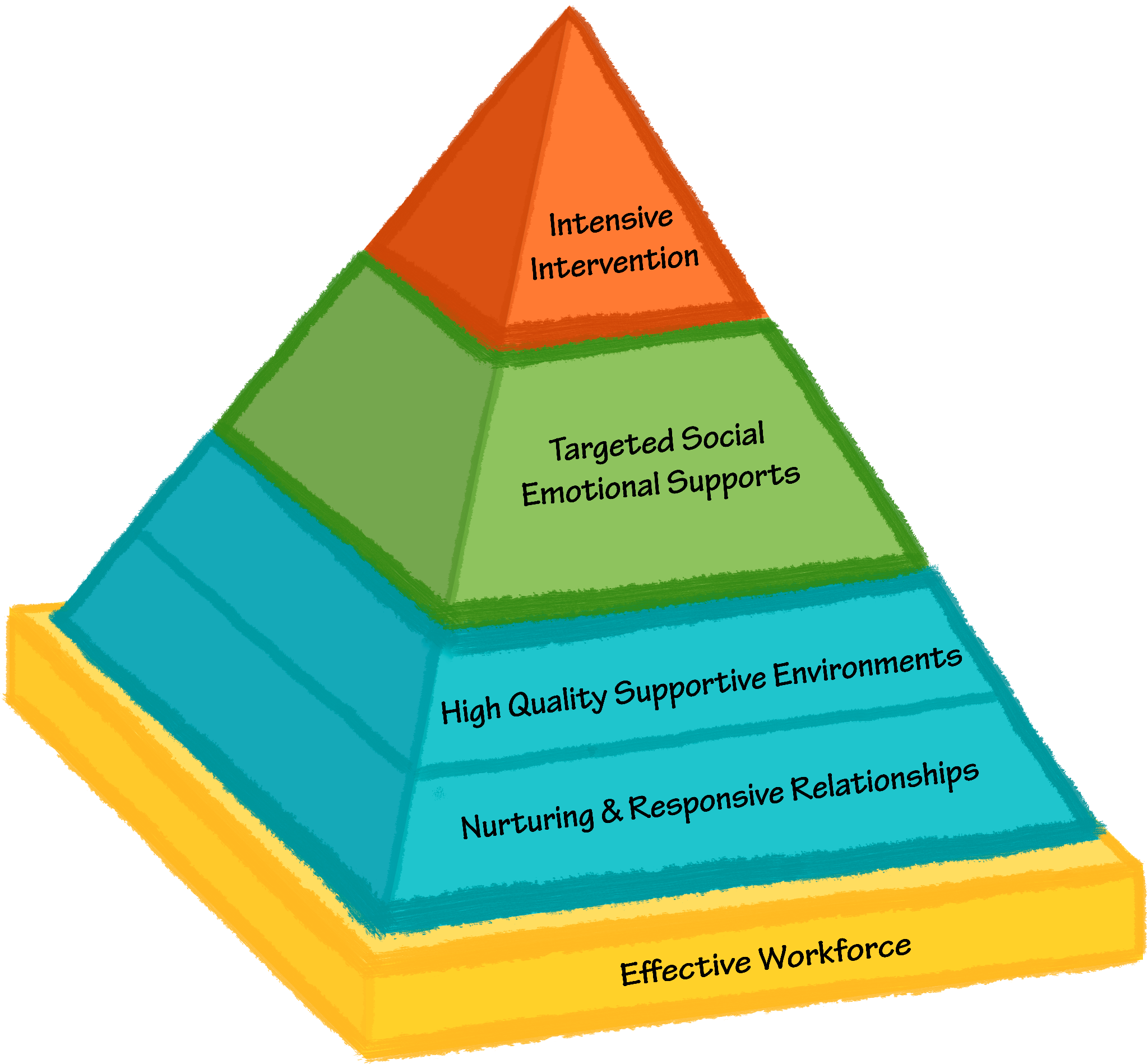
There are multiple professional development models that are designed to equip teachers to build children’s social-emotional skills. The Pyramid Model for Supporting Social Emotional Competence in Infants and Young Children has been associated with lower rates of expulsion.27 When implemented to fidelity, the Pyramid Model is associated with fewer teacher reported problem behaviors.28 It is a tiered system of support for children below the age of six, somewhat similar to positive behavior intervention and support (PBIS) frameworks used in elementary schools.29 The model is designed to provide ECE programs with the guidance necessary to appropriately address challenging behaviors and teach children and families effective strategies for developing healthy social-emotional behaviors, habits, and routines. It includes an extensive training curriculum and ongoing coaching focused on social-emotional development and well-being strategies for individuals working with young children.30 Pyramid Model training, coaching, and tools are reported to be widely available in 15 states.31
Trauma-informed Professional Development
One type of professional development that states and districts are increasingly pursuing is trauma-informed practice. Childhood exposure to trauma is associated with poor academic performance and emotional and social challenges.32 A study looking at the impact of traumatic or adverse events among young children found that the odds of suspension or expulsion increased significantly for each traumatic event they experienced.33 Children experiencing greater numbers of traumatic events displayed less behavioral control and more conflicts with peers and teachers.34
Trauma-informed professional development can lead to more supportive and responsive teacher-child interactions, reducing children’s behavioral issues and improving academic outcomes in later grades.
To learn more about how one district is using a trauma-informed lens, see New America’s recent brief, Incorporating Anti-Racist Principles into Preschool Classrooms. Oakland Unified School District (OUSD) is working to change practices and incorporate anti-racist principles in early learning settings. As one piece of this work, OUSD partners with the city of Oakland Head Start and others to host group trainings, monthly professional learning communities, and coaching in the classroom, designed to build teachers’ knowledge and skills to help children who have experienced trauma. An evaluation by Engage R+D found positive results for this coaching, which led to improvements in OUSD student outcomes, teaching quality, and classroom quality for teachers who participated in the work for three years.35
Citations
- Walter S. Gilliam, Prekindergarteners Left Behind: Expulsion Rates in State and Prekindergarten Programs, FCD Policy Brief Series no. 3 (New York: Foundation for Child Development, May 2005), source
- Songtian Zeng, Catherine Corr, Courtney O’Grady, and Yiyang Guan, “Adverse Childhood Experiences and Preschool Suspension Expulsion: A Population Study,” Child Abuse and Neglect 97 (November 2019), source
- Katherine M. Zinsser, H. Callie Silver, Elyse R. Shenberger, and Velisha Jackson, “A Systematic Review of Early Childhood Exclusionary Discipline,” Review of Educational Research (2022): 1–43, source
- U.S. Department of Education, Office of Civil Rights, “An Overview of Exclusionary Discipline Practices in Public Schools for the 2017–18 School Year,” slide deck, June 2021, source
- U.S. Department of Education, Office of Civil Rights, “An Overview of Exclusionary Discipline Practices in Public Schools for the 2017–18 School Year,” slide deck, June 2021, source
- Cristina Novoa and Rasheed Malik, “Suspensions are Not Support,” Center for American Progress, January 17, 2018, source
- U.S. Department of Education, Office of Civil Rights, “An Overview of Exclusionary Discipline Practices in Public Schools for the 2017–18 School Year,” slide deck, June 2021, source
- Mary Benson McMullen, “The Many Benefits of Continuity of Care for Infants, Toddlers, Families and Caregiving Staff,” Young Children 73, no. 3 (July 2018), source
- Zinsser, Silver, Shenberger, and Jackson, “A Systematic Review.”
- Zinsser, Silver, Shenberger, and Jackson, “A Systematic Review.”
- Zinsser, Silver, Shenberger, and Jackson, “A Systematic Review.”
- Kelsey A. Clayback and Mary Louise Hemmeter, “Exclusionary Discipline Practices in Early Childhood Settings: A Survey of Child Care Directors,” Early Childhood Research Quarterly 55 (2nd quarter 2021): 129–136, source
- Walter S. Gilliam, Angela N. Maupin, Chin R. Reyes, Maria Accavitti, and Frederic Shic, Do Early Educators’ Implicit Biases Regarding Sex and Race Relate to Behavior Expectations and Recommendations of Preschool Expulsions and Suspensions? (New Haven, CT: Yale University Child Study Center, September 2016), source
- U.S. Department of Health & Human Services, Office of Child Care (website), “Expulsion and Suspension Policy Statement,” November 7, 2016, source
- Head Start Early Childhood Learning & Knowledge Center (website), “Head Start Showcase: Suspension and Expulsion Video,” December 2019, source
- U.S. Department of Health & Human Services and U.S. Department of Education, “Policy Statement on the Expulsion and Suspension Policies in Early Childhood Settings, 2016, source
- Alysse Loomis, Annie Davis, Gracelyn Cruden, Christina Padilla, and Yohan Drazen, “Early Childhood Suspension and Expulsion: A Content Analysis of State Legislation,” Early Childhood Education Journal 50, (February 2021): 327–344, source
- Carey McCann, Sheila Smith, Uyen (Sophie) Nguyen, and Maribel R. Granja, States’ Growing Commitment to Preventing Young Children’s Expulsion from Early Care and Educational Programs: Results of a 50 State Survey (Build Initiative & National Center for Children in Poverty, October 2021), source
- McCann, Smith, Nguyen, and Granja, States’ Growing Commitment.
- Loomis, Davis, Cruden, Padilla, and Drazen, “Early Childhood Suspension.”
- McCann, Smith, Nguyen, and Granja, States’ Growing Commitment.
- “Head Start Performance Standards with Mental Health Focus,” Head Start Program Performance Standards, Part 1302, Subpart D, 1034.24, source
- Annie E. Davis, Deborah F. Perry, and Lauren Rabinovitz, “Expulsion Prevention: Framework for the Role of Infant and Early Childhood Mental Health Consultation in Addressing Implicit Biases,” Infant Mental Health Journal 41, no. 3 (February 2020): 327–339, source
- Frances Duran, Kathy Hepburn, Roxanne Kaufmann, Lan Le, Mary Allen, Eileen Brennan, and Beth Green, Early Childhood Mental Health Consultation (Nashville, TN: The Center on the Social and Emotional Foundations for Early Learning at Vanderbilt University, December 2008), source; and A Statewide Infant Early Childhood Mental Health Consultation Report and Three Year Plan, (Santa Fe: New Mexico Early Childhood Education & Care Department, May 2021), source
- Walter S. Gilliam, Prekindergarteners Left Behind: Expulsion Rates in State and Prekindergarten Programs, FCD Policy Brief Series no. 3 (New York: Foundation for Child Development, May 2005), source
- McCann, Smith, Nguyen, and Granja, States’ Growing Commitment.
- Clayback, and Hemmeter, “Exclusionary Discipline Practices.”
- Mary Louise Hemmeter, Patricia A. Snyder, Lise Fox, and James Algina, “Evaluating the Implementation of the Pyramid Model for Promoting Social-Emotional Competence in Early Childhood Classrooms,” Topics In Early Childhood Special Education 36, no. 3 (2016): 133–146, source
- Zinsser, Silver, Shenberger, and Jackson, “A Systematic Review.”
- Taran Schneider (executive director, Healthy Child Care Colorado), interview with authors, October 20, 2021.
- McCann, Smith, Nguyen, and Granja, States’ Growing Commitment.
- Manuel E. Jimenez, Roy Wade Jr., Yong Lin, Lesley M. Morrow, and Nancy E. Reichman, “Adverse Experienced in Early Childhood and Kindergarten Outcomes,” Journal of the American Academy of Pediatrics 137, no. 2, (February 2016), source
- Shannon T. Lipscomb, Bridget Hatfield, Hillary Lewis, Emiko Goka-Dubose, and Caitlyn Abshire, “Adverse Childhood Experiences and Children’s Development in Early Care and Education Programs,” Journal of Applied Developmental Psychology 72 (January–February 2021), source
- Lipscomb, Hatfield, Lewis, Goka-Dubose, and Abshire, “Adverse Childhood Experiences.”
- Key Findings: Oakland Retrospective Study (Engage R+D & the David & Lucile Packard Foundation, January 2019), source