Reducing Exclusionary Discipline Practices in Early Childhood Education_.pdf
Table of Contents
Abstract
While research shows that exclusionary discipline practices in the early years are ineffective and developmentally inappropriate, young children continue to be suspended and expelled at high rates. An increasing number of states have taken steps to ensure that young children are not removed from programs due to their behavior. This report explores how Illinois and Colorado are limiting the use of these exclusionary discipline practices and providing supports to educators to equip them to better serve the children in their programs. Through listening sessions with educators, administrators, and other early childhood professionals, the authors sought to understand how recent policy changes in these states are impacting practice, with a focus on early childhood mental health consultation and professional development around social-emotional learning. The issue of exclusionary discipline practices has long been a problem, but it has been made more urgent during the COVID-19 pandemic as children’s and adults’ well-being have suffered. The report offers 10 takeaways and recommendations for policymakers as other states pursue reform in early childhood discipline policies and work to help teachers address challenging behaviors.
Acknowledgments
We would like to express our gratitude to the teachers, program administrators, and mental health consultants who took the time to participate in our listening sessions and share their experiences. This paper benefited from the insights of many, including Kate Zinsser, Christine Brambila, Alli Lowe-Fotos, Jenna Kelly, Bill Jaeger, Laura Carlson, and Taran Schneider. Thank you to New America colleagues Cara Sklar, Laura Bornfreund, Elena Silva, Julia Sproul, and Jazmyne Owens for their thoughtful review. Thank you to Juhi Sharma for her research support. We appreciate Sabrina Detlef for her editorial support and Julie Brosnan, Fabio Murgia, Riker Pasterkiewicz, and Joe Wilkes for their assistance with communication and layout. This work would not have been possible without the generous support of the Heising-Simons Foundation. The views expressed in this paper are those of the authors alone.
Downloads
Introduction
When asked about experiences with expulsion, a veteran pre-K teacher at a private child care center in Chicago recalls a former student. Elijah1 often exhibited disruptive behavior, making it hard for his teachers to effectively manage the classroom and serve the other students. The teacher recalls, “the owners of the center did not do anything until this child was physically hurting other children on a daily basis. They asked the parents to keep him home for a couple of days.” But this was only a temporary and ineffective solution. “Once he returned to school, it started up again,” she said. “After about two weeks the owners told the mom he wasn’t a good fit and that the teachers could not calm him down.”
While the term “expulsion” was likely never used in the scenario, that is essentially what occurred. A four-year-old was permanently removed from a pre-K program because of his behavior. We do not know what Elijah was going through outside of the classroom or in his development that may have caused his behavior, but it is easy to see how this was likely a stressful situation for him, his family, and the pre-K program staff.
Elijah’s experience is far too common. Early childhood education (ECE) programs often resort to exclusion because they are not equipped with the resources, supports, or knowledge to handle challenging behaviors.2 Despite working for more than five years in her early learning program, the aforementioned teacher did not recall receiving any professional development on how to support children’s social-emotional growth or handle behavioral challenges.
Over the last several years, an increasing number of states have been working to ensure that children like Elijah, who benefit from access to high-quality ECE, are not removed from programs. In this paper, we provide an overview of exclusionary discipline practices and explore how two states, Colorado and Illinois, are taking steps to limit the use of such practices and provide appropriate supports to educators that allow them to better serve children. We explore how these recent policy changes are impacting educators, administrators, and other early childhood professionals, and offer lessons for other states. While these issues have long plagued ECE classrooms, they have been made more urgent during the COVID-19 pandemic, as mental health and well-being for children and adults have suffered.
Citations
- We chose the name Elijah; the educator did not disclose the child’s name when recounting the story.
- In this paper we use “challenging behaviors” to describe classroom actions that might include disruption, like a child consistently not following instructions and refusing to participate in activities, or aggressive or potentially dangerous behaviors, like a child hitting or throwing things. As discussed later in the paper, what educators find to be challenging behaviors varies for multiple reasons.
Methodology
To get a better understanding of how laws and regulations focused on exclusionary discipline of young children are changing the practices of ECE programs, we conducted a review of the relevant research and focused on two states: Illinois and Colorado. We chose these states because they each recently implemented policies designed to reduce exclusionary discipline in early childhood programs.
To learn how recent policy changes have impacted practitioners, we conducted virtual listening sessions in November and December 2021 with classroom teachers, program administrators, and mental health consultants in Colorado and Illinois.3 We asked our contacts in each state to share the listening session information with their networks to help recruit participants. During the sessions, we asked participants about their recent experiences with the pandemic, major challenges in their work, how their program handles challenging behaviors, and related topics. We specifically asked about professional development tools that participants have found helpful for addressing challenging student behavior, such as the Pyramid Model, as well as their experiences with early childhood mental health consultation (ECMHC).
Citations
- We chose the name Elijah; the educator did not disclose the child’s name when recounting the story.
- In this paper we use “challenging behaviors” to describe classroom actions that might include disruption, like a child consistently not following instructions and refusing to participate in activities, or aggressive or potentially dangerous behaviors, like a child hitting or throwing things. As discussed later in the paper, what educators find to be challenging behaviors varies for multiple reasons.
- We conducted a total of five sessions throughout November with 31 total participants: 15 from Colorado and 16 from Illinois. These virtual sessions lasted for one hour and participants received a $100 gift card as an incentive for participation.
Background
Exclusionary discipline refers to a school disciplinary action, typically a suspension or expulsion, that removes a student from his or her typical education setting. The specific issue of exclusionary discipline in ECE began to receive increased attention in 2005, with the release of a paper by Yale University professor Walter Gilliam. Gilliam found that the national rate of expulsions for pre-K children was over three times higher than that of K–12 students, with an estimated 5,000 pre-K students expelled each year, based on teacher-reported data. Additionally, Gilliam found that Black pre-K students were about twice as likely to be expelled as their white and Latino peers.4
While these numbers are alarming, experts caution that the real numbers are likely even higher. A 2019 study used parent-reported data to estimate that over 174,000 pre-K students were suspended each year, with an additional 17,000 expelled, translating to about 4,800 suspensions and 475 expulsions each week of the school year.5 Data like these have led scholars to conclude that pre-K remains “the highest-risk period for expulsion and suspension in a child’s educational journey.”6 Excluding children from early childhood settings is often not technically classified as suspension and expulsion; it is common for parents to be told that their child is “not a good fit” for a program rather than being formally expelled. This is commonly referred to as a “soft expulsion.” Or a provider might regularly ask a parent to come pick up a child having a tough day as opposed to formally suspending him or her—a “soft suspension.” Parents can be driven to withdraw their child from a program prior to an official expulsion if they perceive a lack of support from the program.
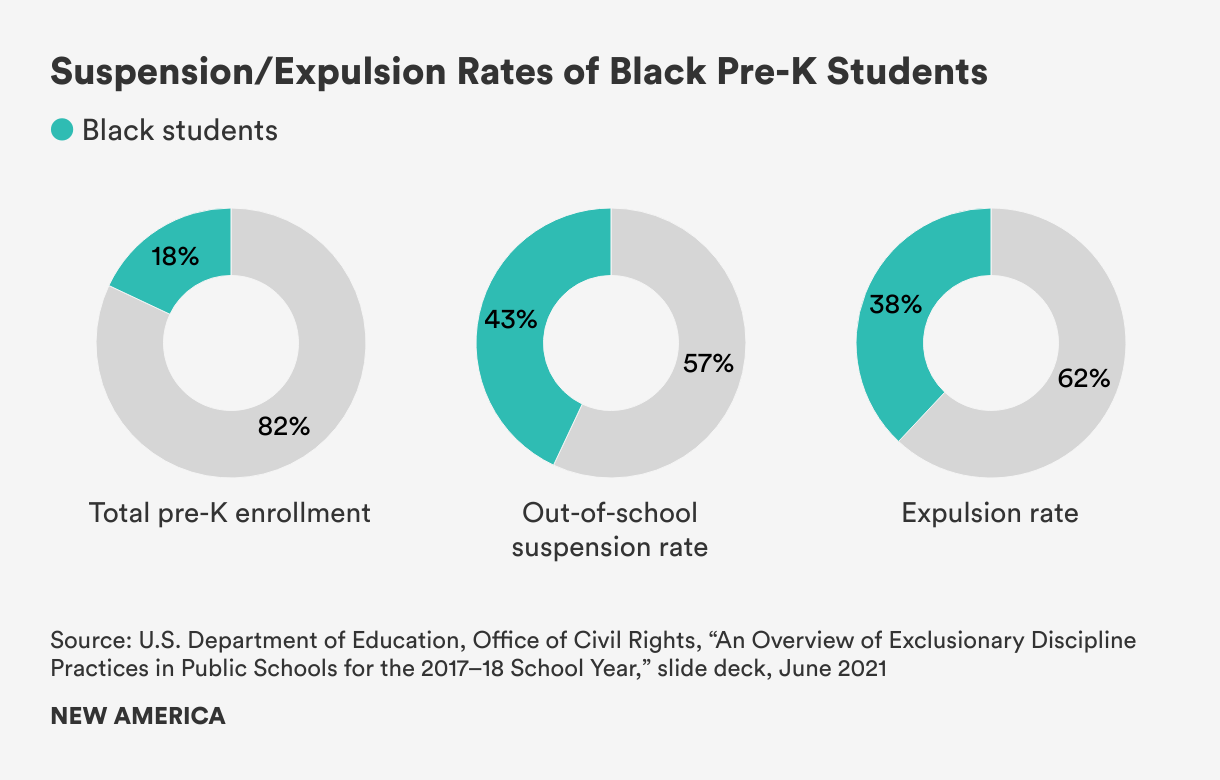
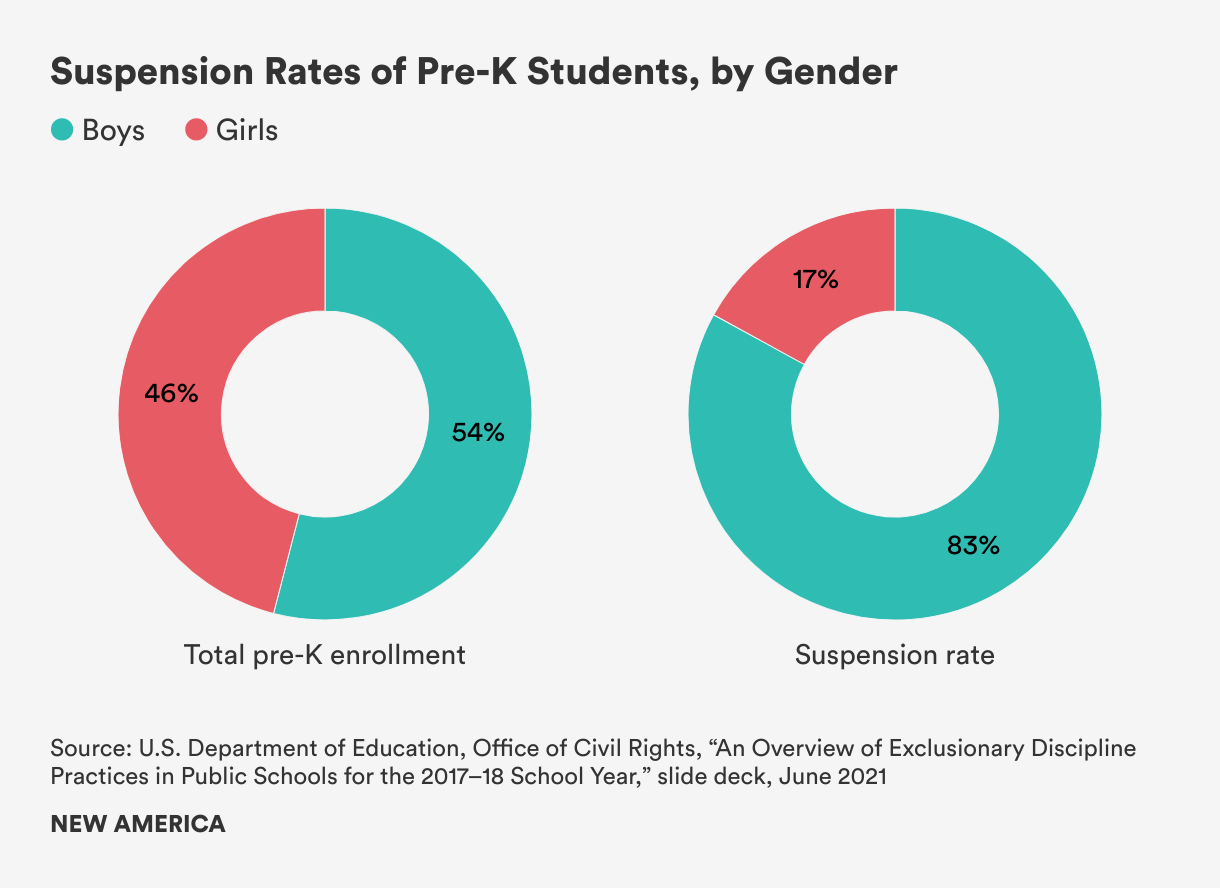
While exclusionary discipline is a problem for all students, it is particularly troubling given the data suggesting disproportionate rates of suspensions and expulsions for young Black children. The 2017–18 Civil Right Data Collection reveals that Black pre-K students are suspended from school at disproportionately high rates. Black children make up 18 percent of total pre-K enrollment, but received 43 percent of out-of-school suspensions and 38 percent of expulsions.7 Black boys in pre-K were both suspended and expelled at a rate more than three times their share of total enrollment. The data also show that boys overall were more likely to be suspended than girls, with boys representing 83 percent of pre-K suspensions despite making up only 54 percent of total pre-K enrollment.8
Significant disparities in disciplinary practices have also been found for children with disabilities. A 2018 analysis found that children ages three to five with disabilities and/or emotional and social challenges make up only 12 percent of early education students but represent 75 percent of suspensions and expulsions. The same analysis found that the odds of being suspended and expelled were 33 times higher for young children with ADHD and 10 times higher for young children with autism compared to their typically developing peers.9 The disparities are even worse when race and disability intersect, as would be the case, for example, for a Black child with a learning disability.10
Excluding Children from ECE Programs Is Ineffective
Decades of research show that exclusionary discipline practices in the early years are ineffective and developmentally inappropriate. Children who are removed from the classroom lose out on valuable learning opportunities. Their emotional well-being may suffer and school might no longer feel like a safe place. Instead, they may feel unwelcome and develop a negative association with school. Exclusion also disrupts the continuity of care, which is important to fostering strong early education experiences.11 Searching for suitable new child care arrangements also creates significant stress for families.
According to a study published in the January issue of The Review of Educational Research, there may be long-term consequences, as “early experiences of exclusion may trigger a cascade of negative interactions with schools, increasing the risk of future exclusions.”12 The authors warn that “the earlier the pattern of exclusion is established, the more likely children are to be expelled in elementary school, resulting in greater losses in cumulative instructional time and more significant achievement gaps separating removed children from their included peers, particularly during critical development periods.”13
Young children are usually removed from the classroom because teachers consider their behavior to be challenging; they are viewed as either too disruptive or dangerous. However, many of the behaviors that teachers associate with being disruptive or dangerous are relatively common in young children. And teachers’ perceptions of what constitutes challenging behavior differ substantially, often depending on their ability to cope with it.14 While program administrators are ultimately responsible for disciplinary decisions, research shows that “educators who are stressed, depressed, or unsatisfied with their job are more likely to request to expel children in their classroom.”15 Opinions around children’s behavior may also be influenced by teachers’ implicit biases. A 2016 study led by Gilliam found that teachers tended to observe Black children, especially Black boys, more closely when they were asked to look for challenging behaviors.16
Efforts to Address Inappropriate School Discipline Practices
Policymakers at the federal and state levels have taken steps to address exclusionary discipline practices in recent years. The 2014 Child Care and Development Block Grant (CCDBG) reauthorization added a requirement for states to report their policies around suspension and expulsion, bringing needed attention to the issue for child care providers.17 CCDBG requires lead agencies to offer information to child care providers about appropriate discipline strategies and social-emotional development. While already common practice in Head Start, the 2016 update to the Head Start Performance Standards specifically banned expulsion and severely limited suspension in programs.18 Under the Obama administration, the U.S. Departments of Health & Human Services and Education also released joint guidance on limiting exclusionary discipline practices in ECE settings.19
More and more states are establishing policies to reduce or eliminate expulsion and suspension for young children. Between 2015 and 2018, members in both Republican and Democratic controlled legislatures introduced 13 bills across 12 states, nine of which passed.20 A 2021 report from the BUILD Initiative and the National Center for Children in Poverty that looked more broadly at state agency regulation, guidance, and legislation found that 29 states have early childhood expulsion or suspension policies in place, with 18 states having fully implemented them.21 There is significant variation across states regarding which programs are covered under the guidance, whether new funding has been provided with the policy changes, and what is required or suggested of programs. Roughly one-third of state policies include specific language about racial equity and equity for children with disabilities.22
But to see meaningful change, policies must get to the root of the problem. They need to acknowledge that part of the reason young children are removed from the classroom is because educators do not have the knowledge, tools, or supports they need to manage certain behaviors and appropriately support children. Educator buy-in is key for successfully implementing changes to discipline approaches, as they are the ones dealing with these issues in the classroom. Without this acknowledgment, programs may continue to exclude children for lack of more appropriate tools and strategies.
Popular Interventions and Approaches to Supporting the Workforce
States have taken different approaches to recommending alternative actions for early childhood programs to use, and research points to several strategies that can be employed to support early educators in handling challenging behaviors and supporting students.23 In this report we focus on the two strategies that have received significant traction: early childhood mental health consultation (ECMHC) and improved training for educators on children’s social-emotional development.
Early Childhood Mental Health Consultation
ECMHC places mental health professionals in early childhood settings and elementary schools to work with educators and families to address challenging behaviors. In a 2021 survey of states, 16 reported that ECMHC is widely available to ECE programs.24 The updated Head Start Program Performance Standards mandate that programs have access to regularly scheduled on-site ECMHC.25 ECMHC is intended to be a preventative measure to improve educator practice and overall program quality. Consultants do not work directly with children, but instead guide teachers and coach them to consider a child’s “contextual factors such as trauma, parenting, cultural expectations and developmental differences.”26
The specifics of ECMHC may look different from one state or locality to the next and may vary among types of programs, according to need. Numerous reports have noted positive outcomes in children as a result of ECMHC interventions, such as decreased behavior problems, especially externalizing behaviors, and improved social and emotional skills.27 There is evidence that ECE programs with regular access to ECMHC are less likely to have expelled a child in the previous year.28
Professional Learning on Children’s Social-Emotional Development
Professional development for teachers and school leaders around implicit bias, culturally responsive teaching, classroom management, and social-emotional development can all be important to strengthening teacher practice and helping them manage student behavior. Professional development on promoting children’s social-emotional growth and addressing challenging behavior is reported to be widely available in more than half of states.29
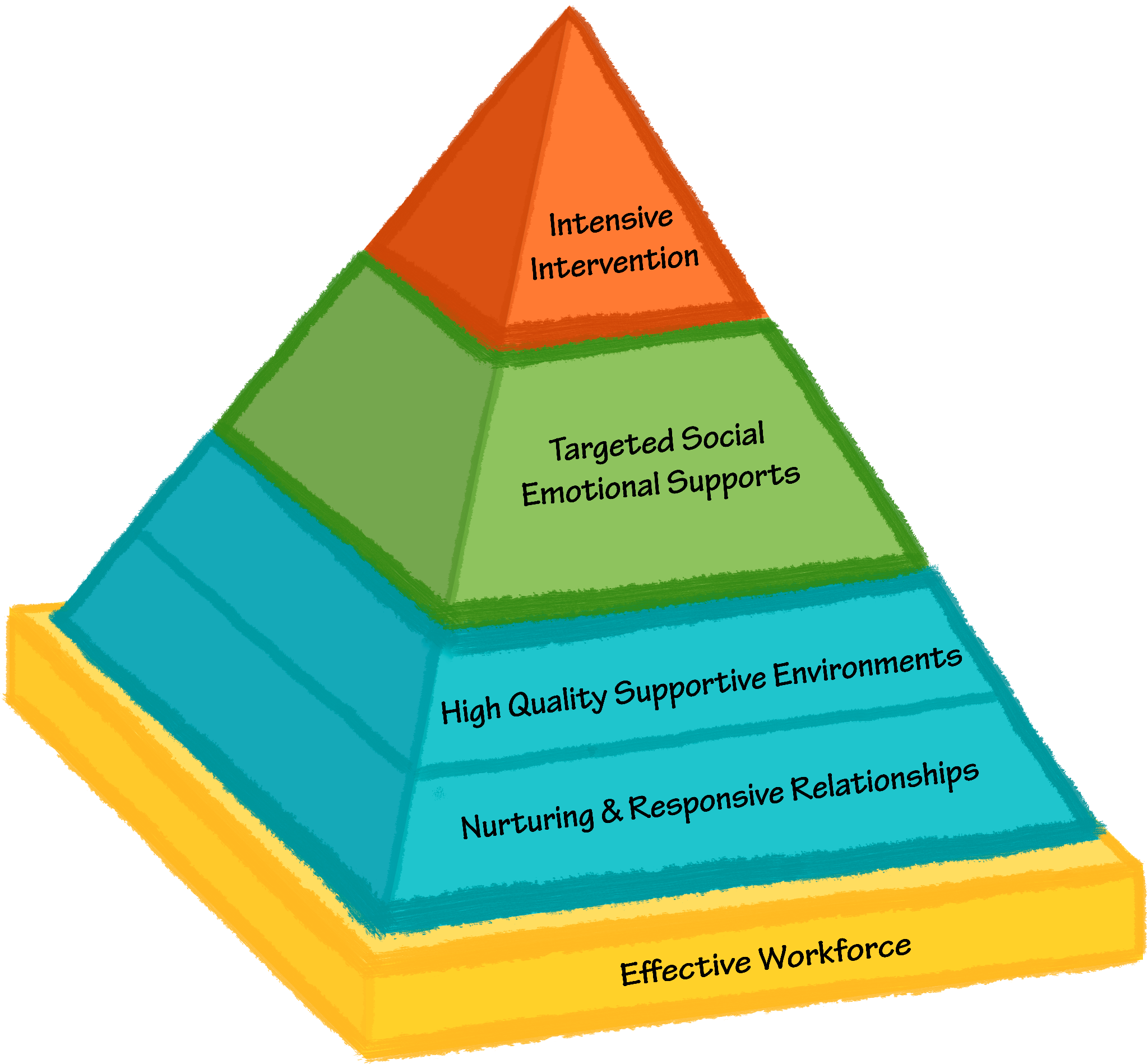
There are multiple professional development models that are designed to equip teachers to build children’s social-emotional skills. The Pyramid Model for Supporting Social Emotional Competence in Infants and Young Children has been associated with lower rates of expulsion.30 When implemented to fidelity, the Pyramid Model is associated with fewer teacher reported problem behaviors.31 It is a tiered system of support for children below the age of six, somewhat similar to positive behavior intervention and support (PBIS) frameworks used in elementary schools.32 The model is designed to provide ECE programs with the guidance necessary to appropriately address challenging behaviors and teach children and families effective strategies for developing healthy social-emotional behaviors, habits, and routines. It includes an extensive training curriculum and ongoing coaching focused on social-emotional development and well-being strategies for individuals working with young children.33 Pyramid Model training, coaching, and tools are reported to be widely available in 15 states.34
Trauma-informed Professional Development
One type of professional development that states and districts are increasingly pursuing is trauma-informed practice. Childhood exposure to trauma is associated with poor academic performance and emotional and social challenges.35 A study looking at the impact of traumatic or adverse events among young children found that the odds of suspension or expulsion increased significantly for each traumatic event they experienced.36 Children experiencing greater numbers of traumatic events displayed less behavioral control and more conflicts with peers and teachers.37
Trauma-informed professional development can lead to more supportive and responsive teacher-child interactions, reducing children’s behavioral issues and improving academic outcomes in later grades.
To learn more about how one district is using a trauma-informed lens, see New America’s recent brief, Incorporating Anti-Racist Principles into Preschool Classrooms. Oakland Unified School District (OUSD) is working to change practices and incorporate anti-racist principles in early learning settings. As one piece of this work, OUSD partners with the city of Oakland Head Start and others to host group trainings, monthly professional learning communities, and coaching in the classroom, designed to build teachers’ knowledge and skills to help children who have experienced trauma. An evaluation by Engage R+D found positive results for this coaching, which led to improvements in OUSD student outcomes, teaching quality, and classroom quality for teachers who participated in the work for three years.38
Citations
- We chose the name Elijah; the educator did not disclose the child’s name when recounting the story.
- In this paper we use “challenging behaviors” to describe classroom actions that might include disruption, like a child consistently not following instructions and refusing to participate in activities, or aggressive or potentially dangerous behaviors, like a child hitting or throwing things. As discussed later in the paper, what educators find to be challenging behaviors varies for multiple reasons.
- We conducted a total of five sessions throughout November with 31 total participants: 15 from Colorado and 16 from Illinois. These virtual sessions lasted for one hour and participants received a $100 gift card as an incentive for participation.
- Walter S. Gilliam, Prekindergarteners Left Behind: Expulsion Rates in State and Prekindergarten Programs, FCD Policy Brief Series no. 3 (New York: Foundation for Child Development, May 2005), source
- Songtian Zeng, Catherine Corr, Courtney O’Grady, and Yiyang Guan, “Adverse Childhood Experiences and Preschool Suspension Expulsion: A Population Study,” Child Abuse and Neglect 97 (November 2019), source
- Katherine M. Zinsser, H. Callie Silver, Elyse R. Shenberger, and Velisha Jackson, “A Systematic Review of Early Childhood Exclusionary Discipline,” Review of Educational Research (2022): 1–43, source
- U.S. Department of Education, Office of Civil Rights, “An Overview of Exclusionary Discipline Practices in Public Schools for the 2017–18 School Year,” slide deck, June 2021, source
- Cristina Novoa and Rasheed Malik, “Suspensions are Not Support,” Center for American Progress, January 17, 2018, source
- U.S. Department of Education, Office of Civil Rights, “An Overview of Exclusionary Discipline Practices in Public Schools for the 2017–18 School Year,” slide deck, June 2021, source
- Mary Benson McMullen, “The Many Benefits of Continuity of Care for Infants, Toddlers, Families and Caregiving Staff,” Young Children 73, no. 3 (July 2018), source
- Zinsser, Silver, Shenberger, and Jackson, “A Systematic Review.”
- Kelsey A. Clayback and Mary Louise Hemmeter, “Exclusionary Discipline Practices in Early Childhood Settings: A Survey of Child Care Directors,” Early Childhood Research Quarterly 55 (2nd quarter 2021): 129–136, source
- Walter S. Gilliam, Angela N. Maupin, Chin R. Reyes, Maria Accavitti, and Frederic Shic, Do Early Educators’ Implicit Biases Regarding Sex and Race Relate to Behavior Expectations and Recommendations of Preschool Expulsions and Suspensions? (New Haven, CT: Yale University Child Study Center, September 2016), source
- U.S. Department of Health & Human Services, Office of Child Care (website), “Expulsion and Suspension Policy Statement,” November 7, 2016, source
- Head Start Early Childhood Learning & Knowledge Center (website), “Head Start Showcase: Suspension and Expulsion Video,” December 2019, source
- U.S. Department of Health & Human Services and U.S. Department of Education, “Policy Statement on the Expulsion and Suspension Policies in Early Childhood Settings, 2016, source
- Alysse Loomis, Annie Davis, Gracelyn Cruden, Christina Padilla, and Yohan Drazen, “Early Childhood Suspension and Expulsion: A Content Analysis of State Legislation,” Early Childhood Education Journal 50, (February 2021): 327–344, source
- Carey McCann, Sheila Smith, Uyen (Sophie) Nguyen, and Maribel R. Granja, States’ Growing Commitment to Preventing Young Children’s Expulsion from Early Care and Educational Programs: Results of a 50 State Survey (Build Initiative & National Center for Children in Poverty, October 2021), source
- McCann, Smith, Nguyen, and Granja, States’ Growing Commitment.
- Loomis, Davis, Cruden, Padilla, and Drazen, “Early Childhood Suspension.”
- McCann, Smith, Nguyen, and Granja, States’ Growing Commitment.
- “Head Start Performance Standards with Mental Health Focus,” Head Start Program Performance Standards, Part 1302, Subpart D, 1034.24, source
- Annie E. Davis, Deborah F. Perry, and Lauren Rabinovitz, “Expulsion Prevention: Framework for the Role of Infant and Early Childhood Mental Health Consultation in Addressing Implicit Biases,” Infant Mental Health Journal 41, no. 3 (February 2020): 327–339, source
- Frances Duran, Kathy Hepburn, Roxanne Kaufmann, Lan Le, Mary Allen, Eileen Brennan, and Beth Green, Early Childhood Mental Health Consultation (Nashville, TN: The Center on the Social and Emotional Foundations for Early Learning at Vanderbilt University, December 2008), source; and A Statewide Infant Early Childhood Mental Health Consultation Report and Three Year Plan, (Santa Fe: New Mexico Early Childhood Education & Care Department, May 2021), source
- Walter S. Gilliam, Prekindergarteners Left Behind: Expulsion Rates in State and Prekindergarten Programs, FCD Policy Brief Series no. 3 (New York: Foundation for Child Development, May 2005), source
- McCann, Smith, Nguyen, and Granja, States’ Growing Commitment.
- Clayback, and Hemmeter, “Exclusionary Discipline Practices.”
- Mary Louise Hemmeter, Patricia A. Snyder, Lise Fox, and James Algina, “Evaluating the Implementation of the Pyramid Model for Promoting Social-Emotional Competence in Early Childhood Classrooms,” Topics In Early Childhood Special Education 36, no. 3 (2016): 133–146, source
- Zinsser, Silver, Shenberger, and Jackson, “A Systematic Review.”
- Taran Schneider (executive director, Healthy Child Care Colorado), interview with authors, October 20, 2021.
- McCann, Smith, Nguyen, and Granja, States’ Growing Commitment.
- Manuel E. Jimenez, Roy Wade Jr., Yong Lin, Lesley M. Morrow, and Nancy E. Reichman, “Adverse Experienced in Early Childhood and Kindergarten Outcomes,” Journal of the American Academy of Pediatrics 137, no. 2, (February 2016), source
- Shannon T. Lipscomb, Bridget Hatfield, Hillary Lewis, Emiko Goka-Dubose, and Caitlyn Abshire, “Adverse Childhood Experiences and Children’s Development in Early Care and Education Programs,” Journal of Applied Developmental Psychology 72 (January–February 2021), source
- Lipscomb, Hatfield, Lewis, Goka-Dubose, and Abshire, “Adverse Childhood Experiences.”
- Key Findings: Oakland Retrospective Study (Engage R+D & the David & Lucile Packard Foundation, January 2019), source
A Look at What’s Happening in Illinois
Effective January 1, 2018, Illinois enacted a law prohibiting the expulsion of children ages birth to five from all state licensed or funded programs.39 The law, Public Act 100-0105, requires early childhood programs to use all available resources to try to retain children and to document the steps they have taken to work with those who exhibit “persistent and serious” challenging behaviors. If the program ultimately deems their efforts unsuccessful and does not feel they can serve the child, providers can work with families to move children to a program that better meets their needs, which the state refers to as a “planned transition.” The law does allow children to be temporarily removed from class when safety is a concern. Programs must also collect and report data on children who have left, whether through expulsion, a planned transition, or parent choice. This must include demographic information of these children.40 The law outlines different methods or resources that a program should use when dealing with challenging behaviors, such as developmental screenings, referrals to early intervention, and early childhood mental health consultation.41
Infant/Early Childhood Mental Health Consultation
“Illinois has been at the vanguard of children’s mental health for a long time,” according to Kate Zinsser, associate professor of psychology at the University of Illinois at Chicago.42 ECMHC has been available in different ECE settings since the early 2000s, and the Illinois Infant/Early Childhood Mental Health Consultation (I/ECMHC) Initiative was created in 2015 to standardize services and establish a cross-systems model, starting with a pilot program in four communities.43 The model for mental health consultation is meant to be flexible and work in a range of early childhood settings.44 An evaluation of the pilot program found that the model prioritizes “relationship-building, reflective practice, and program-focused consultation as the means to build staff skills” so that they can more effectively serve children and families.45
According to Christine Brambila, the I/ECMHC manager in the Governor’s Office of Early Childhood Development, funding mechanism, culture, and leadership all impact the intervention time and intensity.46 A program’s funding stream impacts how it accesses mental health consultants, with state-funded pre-K programs and Head Start programs paying for services through their budgets. Child care providers, including centers, family child care, faith-based programs, and license-exempt care, can access I/ECMHC for free through Caregiver Connections, an organization funded through the Illinois Department of Human Services, according to Jenna Kelly, associate director of Training & Consultation at Caregiver Connections.47 She explained that the process for getting mental health consultation services can “look a little bit different in different parts of the state.” When fully staffed, Caregiver Connections hopes to have 46 mental health consultants statewide.48 A full list of consultants is available in a database that is open to all providers and programs, regardless of funding stream. In the database, mental health consultants can specify which languages they provide services in and what settings they work in.49
The state used its 2019 Preschool Development Grant and federal COVID relief dollars through the Governor’s Emergency Education Relief Fund (GEERF) to further invest in I/ECMHC and expand access.50 In 2020, Illinois transitioned from housing this work in a private entity to embedding it in the Governor’s Office of Early Childhood Development. The state is working to promote professional development, expand the I/ECMHC database, and improve public awareness to encourage uptake of services.51 In 2021, it passed the Infant and Early Childhood Mental Health Consultations Act to increase availability of this service and coordinate it with other supports for children’s social-emotional development. This law increased investment in I/ECMHC by $4.9 million.52
In 2021, Chapin Hall at the University of Chicago released an evaluation of the three-year pilot where researchers found that implementation was effective overall.53 Early childhood providers with access to mental health consultation improved their reflective capacity and some reported decreased staff burnout. Teachers’ perception of behavior as problematic reduced significantly after working with mental health consultants.
Professional Development
Public Act 100-0105 also says that relevant state agencies can support program staff with training, technical support, and professional development. The law specifically mentions supports “to promote social-emotional development and behavioral health, to address challenging behaviors, and to understand trauma and trauma-informed care, cultural competence, family engagement with diverse populations, the impact of implicit bias on adult behavior, and the use of reflective practice techniques.”
Illinois is a Pyramid Model state, but access issues remain for many programs.54 Public pre-K programs have access to Pyramid, but child care providers often have to pay for Pyramid training out of pocket, which can be prohibitively expensive. The 2021 Infant and Early Childhood Mental Health Consultations Act called on the state to increase funding and access to training for the Pyramid Model and similar tiered support systems.55
Understanding the Illinois Early Childhood Landscape
These programs and policies function within Illinois’s complex ECE system. The Illinois State Board of Education Early Childhood Block Grant funds the Prevention Initiative and Preschool for All (PFA). The Prevention Initiative provides child development and family support services for families with children from birth to age three. Children can be served in either center-based programs or family child care homes.
Illinois has two state-funded pre-K programs. PFA, established in 2006, is a mixed-delivery program with priority enrollment for children experiencing at least two risk factors, as determined by the state, such as low income or developmental delays.56 It is a part-time program, offered for 2.5 hours per day, five days per week. The PFA Expansion Program began in 2017 with a federal Preschool Development Grant. The Expansion program prioritizes a higher risk population of students, including children experiencing homelessness, children with IEPs, children from low-income families, and children in foster care. Since Expansion classrooms receive more funding, these classes are expected to meet more benchmarks and provide more wraparound supports. Expansion programs must work with a mental health professional, such as a consultant.57 PFA and PFA Expansion students can be co-located in the same program, just in different classrooms. Approximately 85,000 children participated in public pre-K in Illinois in 2020.58
Almost 30,000 children from birth to age five in Illinois participate in Head Start.59 Families that do not participate in PFA, PFA Expansion, or Head Start may choose to send their children to a range of child care programs or use informal care. Families that meet income eligibility requirements can apply for child care subsidies to attend certain programs.
Implementation and Evaluation of the Law
Researchers at the University of Illinois Chicago have published multiple reports on the law’s implementation based on the results of voluntary surveys and interviews with ECE providers. The first report, released in 2019, found “pervasive misunderstanding of the legislation,” with confusion among administrators regarding the law’s requirements.60 Providers still reported confusion with the law in the 2021 report.61
Comparing survey data from 2018 to 2020 reveals that significantly fewer young children are being expelled now compared to before the law’s passage.62 However, children continue to be excluded from programs in other ways, such as by “planned transitions” into other programs or by parents choosing to withdraw them.63 The survey data revealed different rates of exclusion by program type and disparities based on student demographics. Family child care providers, who often have more difficulty accessing professional development and supports, “excluded proportionally far more children than center-based or school-based programs.”64 School-based programs were the least likely to formally expel children, and children who left school-based programs usually did so because they were encouraged to withdraw.
Nearly all children excluded from programs were boys, and Black children were also overrepresented in expulsions. Children with diagnosed disabilities or individualized learning plans made up 50 percent of those who were transitioned into other programs. Providers reported that children who were excluded were likely to have had multiple adverse childhood experiences, such as food insecurity or parental unemployment. In general, children were most likely to be transitioned to other programs for displaying physically dangerous or aggressive behavior and were most likely to be expelled for non-aggressive disruptive behavior.
Administrators reported a host of steps taken to try to retain a child before ultimately excluding them. These included strategies such as switching classrooms, providing professional development to staff, and adding a behavioral aide to the classroom. Despite efforts to raise awareness about mental health consultation, only 37 percent of respondents utilized this support, and it was usually in response to a specific child's behavior, not as a preventive strategy. Programs that did not utilize mental health consultation either did not feel they needed it or were confused by the program. They also tended to exclude more children than programs that did use consultation, according to Zinsser, the lead researcher on the law’s implementation studies.
It is important to emphasize that these findings are based on voluntary survey data, because there is not, as of 2021, a statewide data system for reporting on exclusionary discipline.65 While the legislation required programs to start reporting relevant data annually in 2020, Zinsser explained that “there is no way for the state to look in one place to figure out what’s going on with discipline across all types of early care and education programs.”66 While the law has sparked some progress, state advocates and government agencies acknowledge that this is an iterative process. Children are still being excluded from programs and parties are using these implementation studies to guide policy and practice decisions. The law intentionally does not punish programs for removing students, but instead aims to support them so that they can retain more children.
Citations
- We chose the name Elijah; the educator did not disclose the child’s name when recounting the story.
- In this paper we use “challenging behaviors” to describe classroom actions that might include disruption, like a child consistently not following instructions and refusing to participate in activities, or aggressive or potentially dangerous behaviors, like a child hitting or throwing things. As discussed later in the paper, what educators find to be challenging behaviors varies for multiple reasons.
- We conducted a total of five sessions throughout November with 31 total participants: 15 from Colorado and 16 from Illinois. These virtual sessions lasted for one hour and participants received a $100 gift card as an incentive for participation.
- Walter S. Gilliam, Prekindergarteners Left Behind: Expulsion Rates in State and Prekindergarten Programs, FCD Policy Brief Series no. 3 (New York: Foundation for Child Development, May 2005), source">source
- Songtian Zeng, Catherine Corr, Courtney O’Grady, and Yiyang Guan, “Adverse Childhood Experiences and Preschool Suspension Expulsion: A Population Study,” Child Abuse and Neglect 97 (November 2019), source">source
- Katherine M. Zinsser, H. Callie Silver, Elyse R. Shenberger, and Velisha Jackson, “A Systematic Review of Early Childhood Exclusionary Discipline,” Review of Educational Research (2022): 1–43, source">source
- U.S. Department of Education, Office of Civil Rights, “An Overview of Exclusionary Discipline Practices in Public Schools for the 2017–18 School Year,” slide deck, June 2021, source">source
- Cristina Novoa and Rasheed Malik, “Suspensions are Not Support,” Center for American Progress, January 17, 2018, source">source
- U.S. Department of Education, Office of Civil Rights, “An Overview of Exclusionary Discipline Practices in Public Schools for the 2017–18 School Year,” slide deck, June 2021, source">source
- Mary Benson McMullen, “The Many Benefits of Continuity of Care for Infants, Toddlers, Families and Caregiving Staff,” Young Children 73, no. 3 (July 2018), source">source
- Zinsser, Silver, Shenberger, and Jackson, “A Systematic Review.”
- Kelsey A. Clayback and Mary Louise Hemmeter, “Exclusionary Discipline Practices in Early Childhood Settings: A Survey of Child Care Directors,” Early Childhood Research Quarterly 55 (2nd quarter 2021): 129–136, source">source
- Walter S. Gilliam, Angela N. Maupin, Chin R. Reyes, Maria Accavitti, and Frederic Shic, Do Early Educators’ Implicit Biases Regarding Sex and Race Relate to Behavior Expectations and Recommendations of Preschool Expulsions and Suspensions? (New Haven, CT: Yale University Child Study Center, September 2016), source">source
- U.S. Department of Health & Human Services, Office of Child Care (website), “Expulsion and Suspension Policy Statement,” November 7, 2016, source">source
- Head Start Early Childhood Learning & Knowledge Center (website), “Head Start Showcase: Suspension and Expulsion Video,” December 2019, source">source
- U.S. Department of Health & Human Services and U.S. Department of Education, “Policy Statement on the Expulsion and Suspension Policies in Early Childhood Settings, 2016, source">source
- Alysse Loomis, Annie Davis, Gracelyn Cruden, Christina Padilla, and Yohan Drazen, “Early Childhood Suspension and Expulsion: A Content Analysis of State Legislation,” Early Childhood Education Journal 50, (February 2021): 327–344, source">source
- Carey McCann, Sheila Smith, Uyen (Sophie) Nguyen, and Maribel R. Granja, States’ Growing Commitment to Preventing Young Children’s Expulsion from Early Care and Educational Programs: Results of a 50 State Survey (Build Initiative & National Center for Children in Poverty, October 2021), source">source
- McCann, Smith, Nguyen, and Granja, States’ Growing Commitment.
- Loomis, Davis, Cruden, Padilla, and Drazen, “Early Childhood Suspension.”
- McCann, Smith, Nguyen, and Granja, States’ Growing Commitment.
- “Head Start Performance Standards with Mental Health Focus,” Head Start Program Performance Standards, Part 1302, Subpart D, 1034.24, source">source
- Annie E. Davis, Deborah F. Perry, and Lauren Rabinovitz, “Expulsion Prevention: Framework for the Role of Infant and Early Childhood Mental Health Consultation in Addressing Implicit Biases,” Infant Mental Health Journal 41, no. 3 (February 2020): 327–339, source">source
- Frances Duran, Kathy Hepburn, Roxanne Kaufmann, Lan Le, Mary Allen, Eileen Brennan, and Beth Green, Early Childhood Mental Health Consultation (Nashville, TN: The Center on the Social and Emotional Foundations for Early Learning at Vanderbilt University, December 2008), source">source; and A Statewide Infant Early Childhood Mental Health Consultation Report and Three Year Plan, (Santa Fe: New Mexico Early Childhood Education & Care Department, May 2021), source">source
- Walter S. Gilliam, Prekindergarteners Left Behind: Expulsion Rates in State and Prekindergarten Programs, FCD Policy Brief Series no. 3 (New York: Foundation for Child Development, May 2005), source">source
- McCann, Smith, Nguyen, and Granja, States’ Growing Commitment.
- Clayback, and Hemmeter, “Exclusionary Discipline Practices.”
- Mary Louise Hemmeter, Patricia A. Snyder, Lise Fox, and James Algina, “Evaluating the Implementation of the Pyramid Model for Promoting Social-Emotional Competence in Early Childhood Classrooms,” Topics In Early Childhood Special Education 36, no. 3 (2016): 133–146, source">source
- Zinsser, Silver, Shenberger, and Jackson, “A Systematic Review.”
- Taran Schneider (executive director, Healthy Child Care Colorado), interview with authors, October 20, 2021.
- McCann, Smith, Nguyen, and Granja, States’ Growing Commitment.
- Manuel E. Jimenez, Roy Wade Jr., Yong Lin, Lesley M. Morrow, and Nancy E. Reichman, “Adverse Experienced in Early Childhood and Kindergarten Outcomes,” Journal of the American Academy of Pediatrics 137, no. 2, (February 2016), source">source
- Shannon T. Lipscomb, Bridget Hatfield, Hillary Lewis, Emiko Goka-Dubose, and Caitlyn Abshire, “Adverse Childhood Experiences and Children’s Development in Early Care and Education Programs,” Journal of Applied Developmental Psychology 72 (January–February 2021), source">source
- Lipscomb, Hatfield, Lewis, Goka-Dubose, and Abshire, “Adverse Childhood Experiences.”
- Key Findings: Oakland Retrospective Study (Engage R+D & the David & Lucile Packard Foundation, January 2019), source">source
- Illinois General Assembly, Public Act 100-0105, AN ACT concerning Children, effective January 1, 2018, source
- Illinois General Assembly, Public Act 100-0105.
- Phone interview with authors, October 15, 2021.
- Governor’s Office of Early Childhood Development (website), Illinois Infant /Early Childhood Mental Health Consultation, 2022, source
- Illinois Model for Infant/Early Childhood Mental Health Consultation (Illinois Mental Health Consultation Initiative & Illinois Children’s Mental Health Partnership, May 2020), source
- Julie Spielberger, Tiffany Burkhardt, Carolyn Winje, Aida Pacheco-Applegate, Elissa Gitlow, Erin Carreon, Lee Ann Huang, Anna Herriott, and Reiko Kakyuama-Villaber, Evaluation of the Illinois Model of Infant and Early Childhood Mental Health Consultation Pilot (Chicago, IL: Chapin Hill at the University of Chicago, February 2021), source
- Interview with authors, October 19, 2021.
- Interview with authors, November 12, 2021.
- Kelly, interview with authors, November 12, 2021.
- Brambila, interview with authors, October 19, 2021.
- Allison Lowe-Fotos, “Solutions for Addressing Infant and Early Childhood Mental Health,” blog post, Start Early, June 3, 2021, source
- Illinois General Assembly, Illinois Compiled Statutes (405 ILCS 47/), Mental Health and Developmental Disabilities (405 ICLS 47/) Infant/Early Childhood Mental Health Consultations Act, effective March 8, 2021, source
- Spielberger, Burkhardt, Winje, Pacheco-Applegate, Gitlow, Carreon, Huang, Herriott, and Kakyuama-Villaber, “Evaluation of the Illinois Model.”
- Allison Lowe-Fotos (policy manager, Start Early) Phone interview with authors, November 10, 2021.
- Illinois Statute (405 ILCS 47/), Mental Health and Developmental Disabilities (405 ICLS 47/) Infant/Early Childhood Mental Health Consultations Act, effective March 8, 2021, source
- Friedman-Krauss, A. H., Barnett, W. S., Garver, K. A., Hodges, K. S., Weisenfeld, G. G. and Gardiner, B. A. The State of Preschool 2020: State Preschool Yearbook, (New Brunswick, NJ: National Institute for Early Education Research, 2021), source
- Illinois State Board of Education, Early Childhood Block Grant 3-5 Compliance Checklist, Preschool for All and Preschool for All Expansion, (2022), source
- Friedman-Krauss, A. H., Barnett, W. S., Garver, K. A., Hodges, K. S., Weisenfeld, G. G. and Gardiner, B. A. The State of Preschool 2020: State Preschool Yearbook, (New Brunswick, NJ: National Institute for Early Education Research, 2021), source
- National Head Start Association, “Illinois: 2022 Head Start and Early Head Start Profile,” source
- Katherine M. Zinsser, H. Callie Silver, Qaswa Hussaini, and Courtney A. Zulauf, Evaluation Report of the Implementation of Illinois Public Act 100-0105: Early Childhood Programs’ Knowledge of and Response to 2018 Expulsion Legislation (Chicago, IL: University of Chicago, 2019), source
- Kate M. Zinsser, H. Callie Silver, and Elyse Shenberger, Evaluating the Implementation of the Illinois Expulsion Law 2017-2020: Findings & Recommendations Three Years Later (Chicago IL: The University of Chicago, 2021), source
- Zinsser, Silver, and Shenberger, Evaluating the Implementation.
- The evaluation discusses confusion among practitioners around the term “planned transition.” The law explains the process as follows: “If the program ultimately cannot meet the behavioral needs of a child, providers must work with the family to identify and transition the child into an alternative, and appropriate, care setting, such that there is no loss of services to the child.” The researchers recommend further state guidance on this process and support from local Child Care Resource and Referral agencies in navigating planned transitions.
- Zinsser, Silver, and Shenberger, Evaluating the Implementation.
- Interview with authors, October 15, 2021.
What Practitioners Are Saying: Themes from Illinois Listening Sessions
Multiple themes arose in our listening sessions with Illinois practitioners.
The law banning expulsion has made programs more intentional and changed practices of some, but it could go further. We heard that using exclusionary discipline practices is often a matter of program culture. Most practitioners said that they did not have experience with suspending or expelling young children before or after the law went into effect. Others felt that programs with a history of engaging in these practices responded to the law in various ways—some changed their practice, others engaged in soft expulsions instead, and others went through the required documentation process just as a formality.
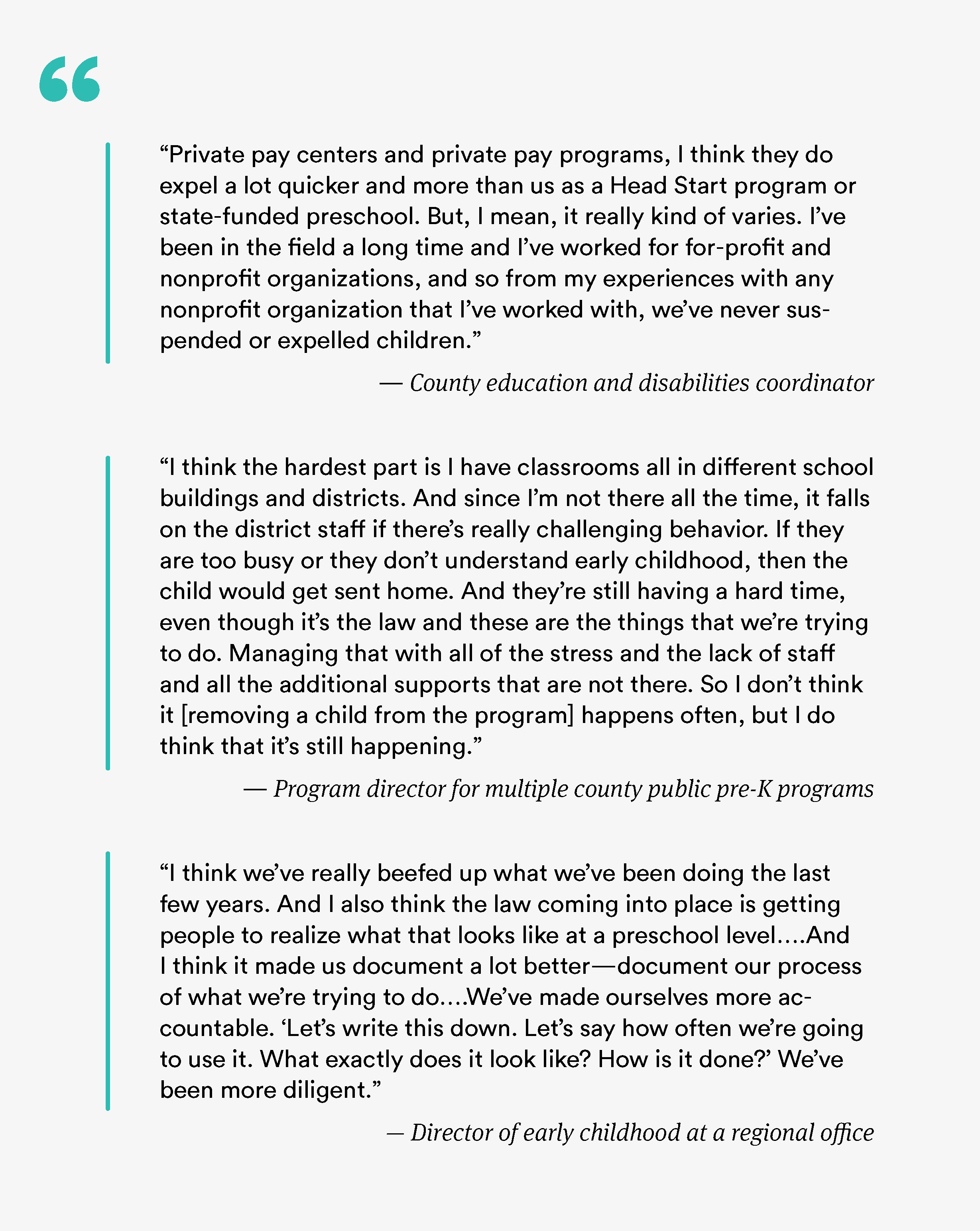
Access to mental health consultation differs across programs and can be more challenging for some. Some ECE programs have in-house mental health consultants, some are part of a consortium that provides support, some access a consultant through their child care resource and referral agency, and others seem to lack access. For programs without a mental health consultant on staff, waiting lists to receive services can be long, making it difficult to address program needs in a timely manner. This is exacerbated by increases in mental health needs due to the pandemic.
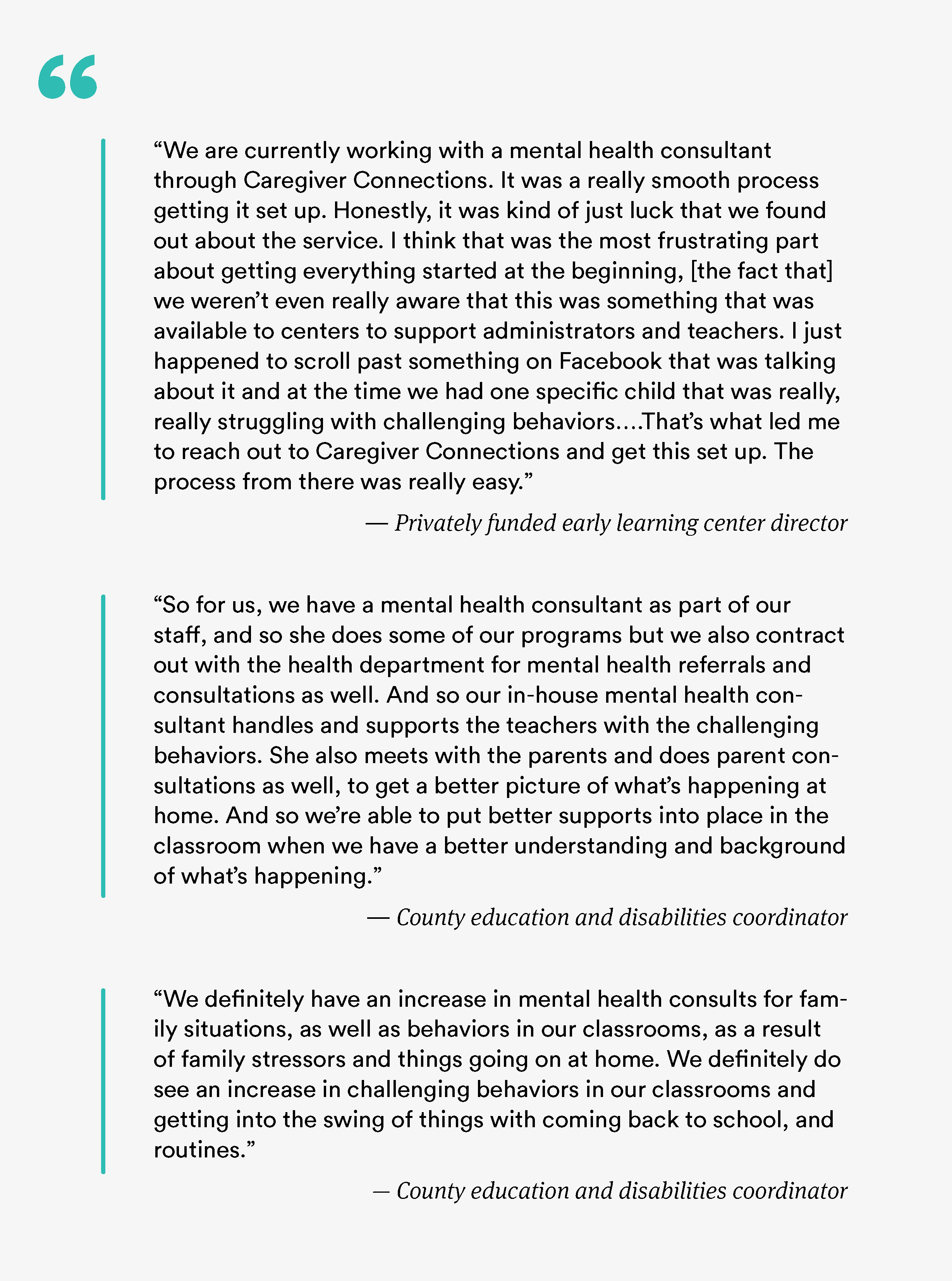
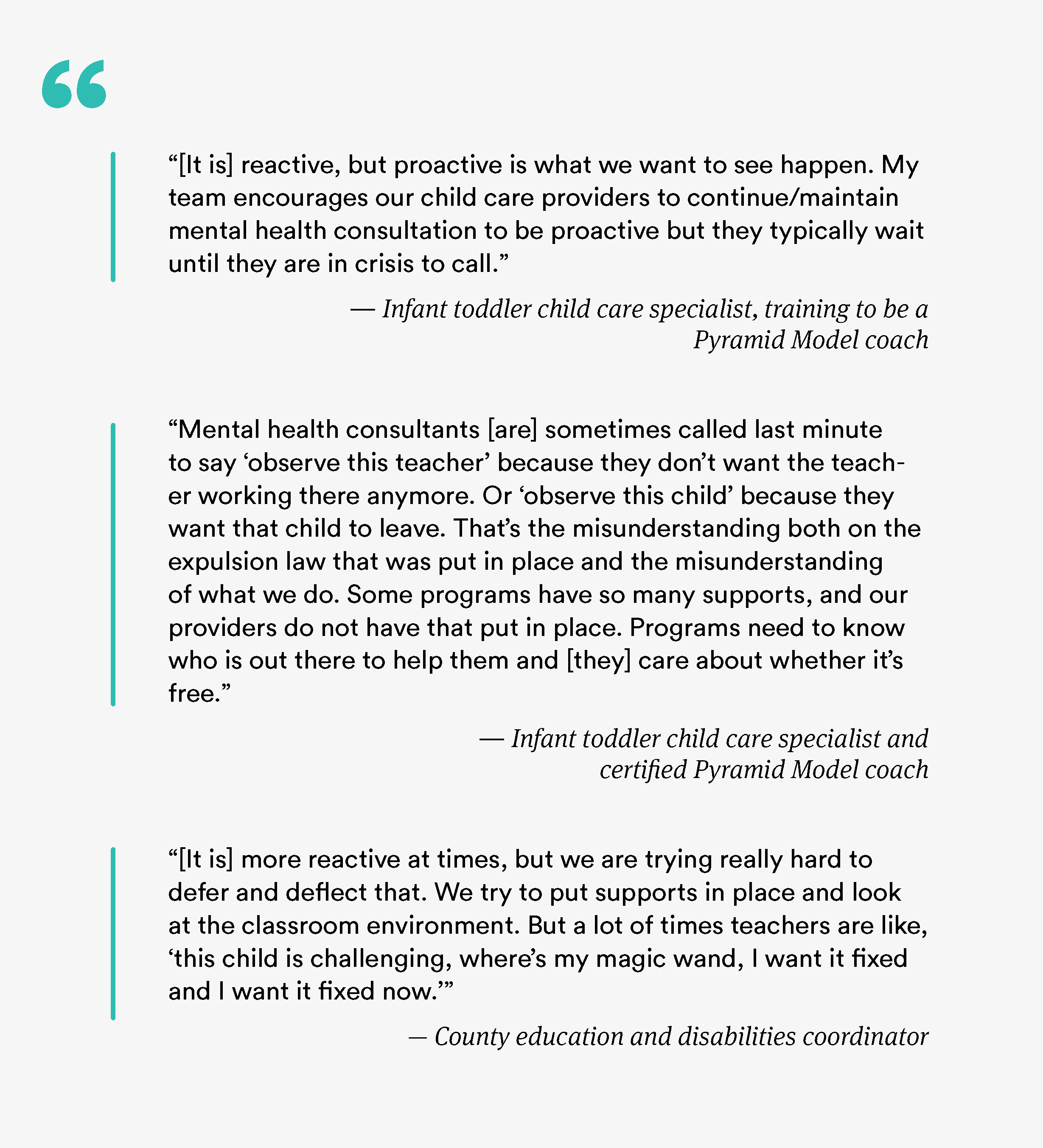
While the Illinois mental health consultation model is meant to be a preventive strategy, it is often used as a reactive strategy. Practitioners also expressed variations in understanding about what constituted mental health consultation.
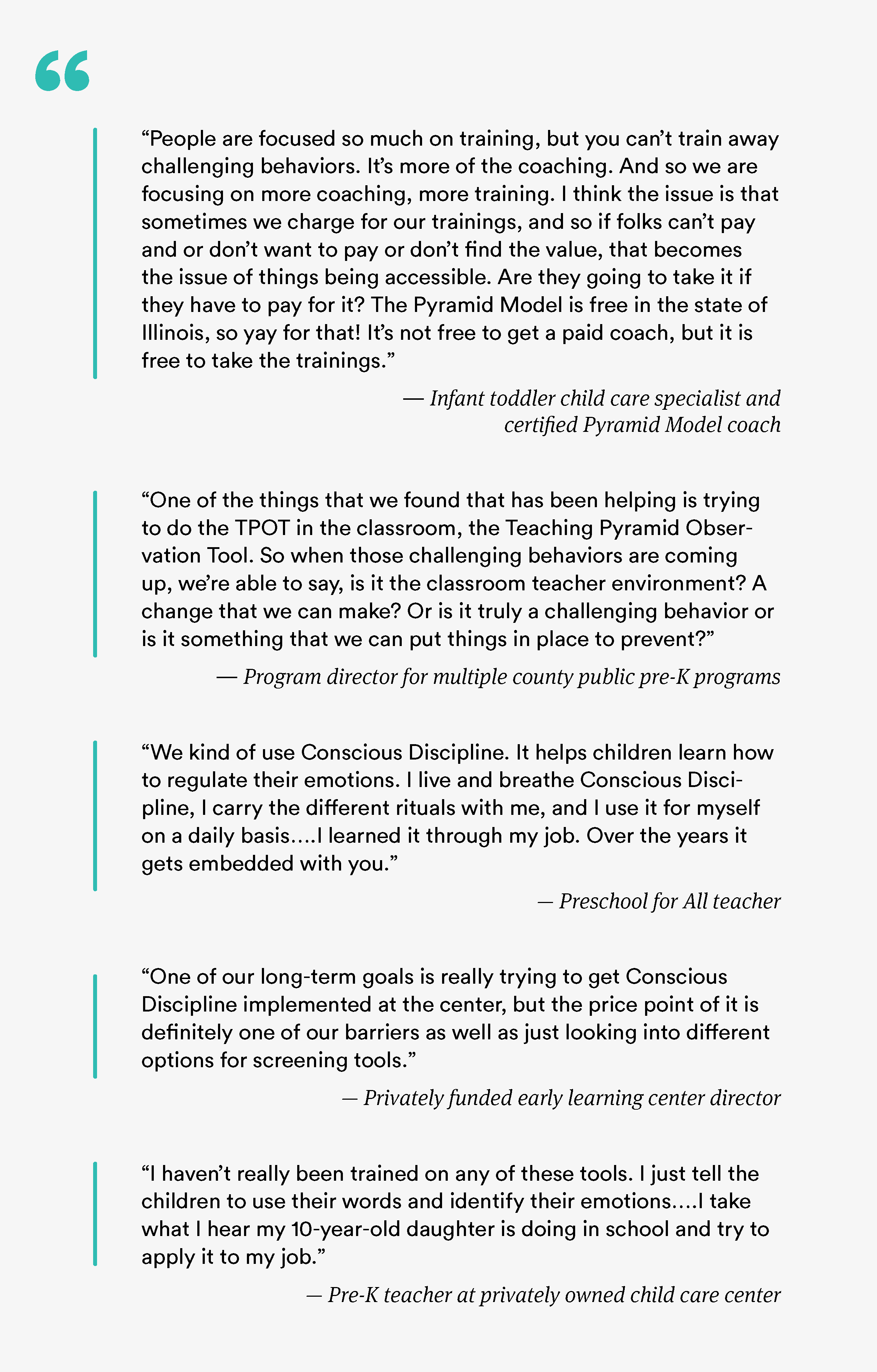
Practitioners found multiple professional development opportunities and resources helpful for dealing with challenging behaviors and supporting children’s social and emotional development. However, there is unequal access to these supports. Professional development tools are often prohibitively expensive for private providers. The tools mentioned favorably in our listening sessions included the Pyramid Model, Playworks training, Conscious Discipline, the Erikson Institute’s Facilitating Attuned Interactions (FAN) training, CHAMPS, and Zone of Regulation.
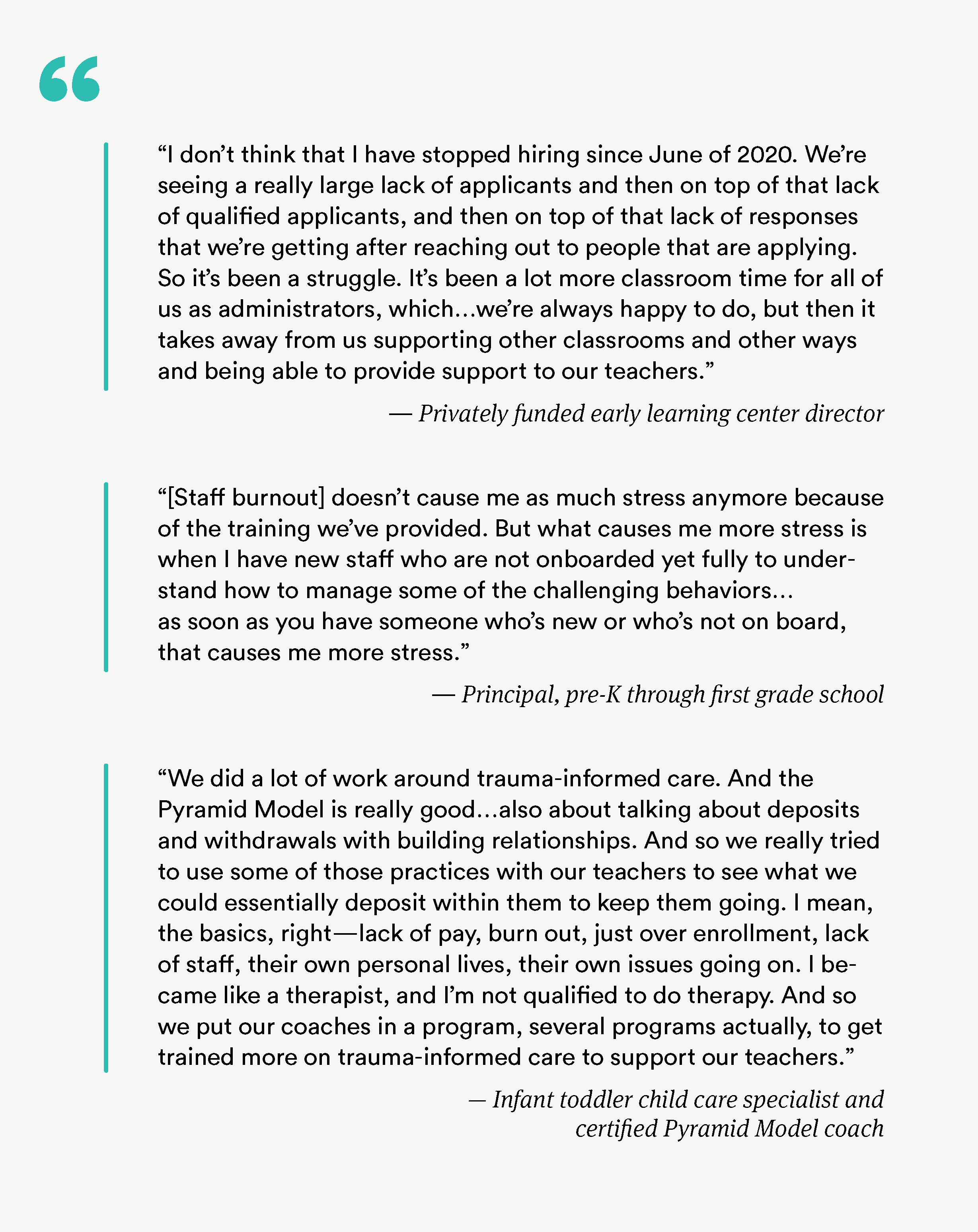
Staffing is a primary challenge for programs. Programs need more support staff or smaller adult-child ratios to handle challenging behaviors. Staffing challenges have been exacerbated by COVID-19.
Classroom teachers lacked familiarity with these topics and expressed confusion. Despite efforts to expand access to ECHMC and Pyramid Model training, most teachers in our focus groups did not have experience with these supports.
While classroom teachers in our listening session had a lot to say about the challenges of teaching during COVID, access to different types of professional development, and the importance of professional peer relationships, they did not say much on suspension and expulsion. They were not familiar with the law banning expulsion and did not see changes in the way programs have handled discipline in recent years. There was confusion among teachers about what constitutes mental health consultation versus other available supports, and they were not clear if they had participated in mental health consultations. Most of the teachers did not have experience using the Pyramid Model. The public pre-K providers had received varied amounts of formal training on social-emotional development, and the one private provider had not received any formal professional development on this topic.
Citations
- We chose the name Elijah; the educator did not disclose the child’s name when recounting the story.
- In this paper we use “challenging behaviors” to describe classroom actions that might include disruption, like a child consistently not following instructions and refusing to participate in activities, or aggressive or potentially dangerous behaviors, like a child hitting or throwing things. As discussed later in the paper, what educators find to be challenging behaviors varies for multiple reasons.
- We conducted a total of five sessions throughout November with 31 total participants: 15 from Colorado and 16 from Illinois. These virtual sessions lasted for one hour and participants received a $100 gift card as an incentive for participation.
- Walter S. Gilliam, Prekindergarteners Left Behind: Expulsion Rates in State and Prekindergarten Programs, FCD Policy Brief Series no. 3 (New York: Foundation for Child Development, May 2005), <a href="source">source">source
- Songtian Zeng, Catherine Corr, Courtney O’Grady, and Yiyang Guan, “Adverse Childhood Experiences and Preschool Suspension Expulsion: A Population Study,” Child Abuse and Neglect 97 (November 2019), <a href="source">source">source
- Katherine M. Zinsser, H. Callie Silver, Elyse R. Shenberger, and Velisha Jackson, “A Systematic Review of Early Childhood Exclusionary Discipline,” Review of Educational Research (2022): 1–43, <a href="source">source">source
- U.S. Department of Education, Office of Civil Rights, “An Overview of Exclusionary Discipline Practices in Public Schools for the 2017–18 School Year,” slide deck, June 2021, <a href="source">source">source
- Cristina Novoa and Rasheed Malik, “Suspensions are Not Support,” Center for American Progress, January 17, 2018, <a href="source">source">source
- U.S. Department of Education, Office of Civil Rights, “An Overview of Exclusionary Discipline Practices in Public Schools for the 2017–18 School Year,” slide deck, June 2021, <a href="source">source">source
- Mary Benson McMullen, “The Many Benefits of Continuity of Care for Infants, Toddlers, Families and Caregiving Staff,” Young Children 73, no. 3 (July 2018), <a href="source">source">source
- Zinsser, Silver, Shenberger, and Jackson, “A Systematic Review.”
- Kelsey A. Clayback and Mary Louise Hemmeter, “Exclusionary Discipline Practices in Early Childhood Settings: A Survey of Child Care Directors,” Early Childhood Research Quarterly 55 (2nd quarter 2021): 129–136, <a href="source">source">source
- Walter S. Gilliam, Angela N. Maupin, Chin R. Reyes, Maria Accavitti, and Frederic Shic, Do Early Educators’ Implicit Biases Regarding Sex and Race Relate to Behavior Expectations and Recommendations of Preschool Expulsions and Suspensions? (New Haven, CT: Yale University Child Study Center, September 2016), <a href="source">source">source
- U.S. Department of Health & Human Services, Office of Child Care (website), “Expulsion and Suspension Policy Statement,” November 7, 2016, <a href="source">source">source
- Head Start Early Childhood Learning & Knowledge Center (website), “Head Start Showcase: Suspension and Expulsion Video,” December 2019, <a href="source">source">source
- U.S. Department of Health & Human Services and U.S. Department of Education, “Policy Statement on the Expulsion and Suspension Policies in Early Childhood Settings, 2016, <a href="source">source">source
- Alysse Loomis, Annie Davis, Gracelyn Cruden, Christina Padilla, and Yohan Drazen, “Early Childhood Suspension and Expulsion: A Content Analysis of State Legislation,” Early Childhood Education Journal 50, (February 2021): 327–344, <a href="source">source">source
- Carey McCann, Sheila Smith, Uyen (Sophie) Nguyen, and Maribel R. Granja, States’ Growing Commitment to Preventing Young Children’s Expulsion from Early Care and Educational Programs: Results of a 50 State Survey (Build Initiative & National Center for Children in Poverty, October 2021), <a href="source">source">source
- McCann, Smith, Nguyen, and Granja, States’ Growing Commitment.
- Loomis, Davis, Cruden, Padilla, and Drazen, “Early Childhood Suspension.”
- McCann, Smith, Nguyen, and Granja, States’ Growing Commitment.
- “Head Start Performance Standards with Mental Health Focus,” Head Start Program Performance Standards, Part 1302, Subpart D, 1034.24, <a href="source">source">source
- Annie E. Davis, Deborah F. Perry, and Lauren Rabinovitz, “Expulsion Prevention: Framework for the Role of Infant and Early Childhood Mental Health Consultation in Addressing Implicit Biases,” Infant Mental Health Journal 41, no. 3 (February 2020): 327–339, <a href="source">source">source
- Frances Duran, Kathy Hepburn, Roxanne Kaufmann, Lan Le, Mary Allen, Eileen Brennan, and Beth Green, Early Childhood Mental Health Consultation (Nashville, TN: The Center on the Social and Emotional Foundations for Early Learning at Vanderbilt University, December 2008), <a href="source">source">source; and A Statewide Infant Early Childhood Mental Health Consultation Report and Three Year Plan, (Santa Fe: New Mexico Early Childhood Education & Care Department, May 2021), <a href="source">source">source
- Walter S. Gilliam, Prekindergarteners Left Behind: Expulsion Rates in State and Prekindergarten Programs, FCD Policy Brief Series no. 3 (New York: Foundation for Child Development, May 2005), <a href="source">source">source
- McCann, Smith, Nguyen, and Granja, States’ Growing Commitment.
- Clayback, and Hemmeter, “Exclusionary Discipline Practices.”
- Mary Louise Hemmeter, Patricia A. Snyder, Lise Fox, and James Algina, “Evaluating the Implementation of the Pyramid Model for Promoting Social-Emotional Competence in Early Childhood Classrooms,” Topics In Early Childhood Special Education 36, no. 3 (2016): 133–146, <a href="source">source">source
- Zinsser, Silver, Shenberger, and Jackson, “A Systematic Review.”
- Taran Schneider (executive director, Healthy Child Care Colorado), interview with authors, October 20, 2021.
- McCann, Smith, Nguyen, and Granja, States’ Growing Commitment.
- Manuel E. Jimenez, Roy Wade Jr., Yong Lin, Lesley M. Morrow, and Nancy E. Reichman, “Adverse Experienced in Early Childhood and Kindergarten Outcomes,” Journal of the American Academy of Pediatrics 137, no. 2, (February 2016), <a href="source">source">source
- Shannon T. Lipscomb, Bridget Hatfield, Hillary Lewis, Emiko Goka-Dubose, and Caitlyn Abshire, “Adverse Childhood Experiences and Children’s Development in Early Care and Education Programs,” Journal of Applied Developmental Psychology 72 (January–February 2021), <a href="source">source">source
- Lipscomb, Hatfield, Lewis, Goka-Dubose, and Abshire, “Adverse Childhood Experiences.”
- Key Findings: Oakland Retrospective Study (Engage R+D & the David & Lucile Packard Foundation, January 2019), <a href="source">source">source
- Illinois General Assembly, Public Act 100-0105, AN ACT concerning Children, effective January 1, 2018, source">source
- Illinois General Assembly, Public Act 100-0105.
- Phone interview with authors, October 15, 2021.
- Governor’s Office of Early Childhood Development (website), Illinois Infant /Early Childhood Mental Health Consultation, 2022, source">source
- Illinois Model for Infant/Early Childhood Mental Health Consultation (Illinois Mental Health Consultation Initiative & Illinois Children’s Mental Health Partnership, May 2020), source">source
- Julie Spielberger, Tiffany Burkhardt, Carolyn Winje, Aida Pacheco-Applegate, Elissa Gitlow, Erin Carreon, Lee Ann Huang, Anna Herriott, and Reiko Kakyuama-Villaber, Evaluation of the Illinois Model of Infant and Early Childhood Mental Health Consultation Pilot (Chicago, IL: Chapin Hill at the University of Chicago, February 2021), source">source
- Interview with authors, October 19, 2021.
- Interview with authors, November 12, 2021.
- Kelly, interview with authors, November 12, 2021.
- Brambila, interview with authors, October 19, 2021.
- Allison Lowe-Fotos, “Solutions for Addressing Infant and Early Childhood Mental Health,” blog post, Start Early, June 3, 2021, source">source
- Illinois General Assembly, Illinois Compiled Statutes (405 ILCS 47/), Mental Health and Developmental Disabilities (405 ICLS 47/) Infant/Early Childhood Mental Health Consultations Act, effective March 8, 2021, source">source
- Spielberger, Burkhardt, Winje, Pacheco-Applegate, Gitlow, Carreon, Huang, Herriott, and Kakyuama-Villaber, “Evaluation of the Illinois Model.”
- Allison Lowe-Fotos (policy manager, Start Early) Phone interview with authors, November 10, 2021.
- Illinois Statute (405 ILCS 47/), Mental Health and Developmental Disabilities (405 ICLS 47/) Infant/Early Childhood Mental Health Consultations Act, effective March 8, 2021, source">source
- Friedman-Krauss, A. H., Barnett, W. S., Garver, K. A., Hodges, K. S., Weisenfeld, G. G. and Gardiner, B. A. The State of Preschool 2020: State Preschool Yearbook, (New Brunswick, NJ: National Institute for Early Education Research, 2021), source">source
- Illinois State Board of Education, Early Childhood Block Grant 3-5 Compliance Checklist, Preschool for All and Preschool for All Expansion, (2022), source">source
- Friedman-Krauss, A. H., Barnett, W. S., Garver, K. A., Hodges, K. S., Weisenfeld, G. G. and Gardiner, B. A. The State of Preschool 2020: State Preschool Yearbook, (New Brunswick, NJ: National Institute for Early Education Research, 2021), source">source
- National Head Start Association, “Illinois: 2022 Head Start and Early Head Start Profile,” source">source
- Katherine M. Zinsser, H. Callie Silver, Qaswa Hussaini, and Courtney A. Zulauf, Evaluation Report of the Implementation of Illinois Public Act 100-0105: Early Childhood Programs’ Knowledge of and Response to 2018 Expulsion Legislation (Chicago, IL: University of Chicago, 2019), source">source
- Kate M. Zinsser, H. Callie Silver, and Elyse Shenberger, Evaluating the Implementation of the Illinois Expulsion Law 2017-2020: Findings & Recommendations Three Years Later (Chicago IL: The University of Chicago, 2021), source">source
- Zinsser, Silver, and Shenberger, Evaluating the Implementation.
- The evaluation discusses confusion among practitioners around the term “planned transition.” The law explains the process as follows: “If the program ultimately cannot meet the behavioral needs of a child, providers must work with the family to identify and transition the child into an alternative, and appropriate, care setting, such that there is no loss of services to the child.” The researchers recommend further state guidance on this process and support from local Child Care Resource and Referral agencies in navigating planned transitions.
- Zinsser, Silver, and Shenberger, Evaluating the Implementation.
- Interview with authors, October 15, 2021.
A Look at What’s Happening in Colorado
In 2006, the Colorado legislature directed funds towards a survey of challenging behaviors and responses to these behaviors in licensed ECE programs across the state. The results of the survey were concerning: young children were removed from programs at a rate three times higher than the national rate of K–12 expulsions and practitioners were mostly using ineffective methods for addressing challenging behavior, such as having parents take their children home or removing children from the program altogether.67 The survey found that rates of removals were much higher for family child care homes than for child care centers, but also found that family child care providers felt that access to mental health consultations made a meaningful difference in their ability to keep children with challenging behaviors in their programs.68
The survey results helped galvanize interest in addressing exclusionary discipline in Colorado’s ECE programs and reducing the frequency of expulsions of young children through evidence-based interventions. Two complementary policy initiatives were launched in an effort to reduce the frequency of exclusionary discipline: increasing provider knowledge of the Pyramid Model and expanding the availability of early childhood mental health consultations.
Understanding the Colorado Early Childhood Landscape
About 337,000 children under the age of five reside in Colorado, 44 percent of whom are children of color.69 In the 2019–20 school year, 98 percent of school districts offered the state-funded Colorado Preschool Program (CPP). CPP serves about 23,000 children, which is approximately a quarter of the state’s four-year-olds. It concentrates on children who come from low-income families or have another statute-defined risk factor, such as being a dual language learner, being in foster care, or being exposed to parental substance abuse.70 CPP also serves about 7,000 three-year-olds who meet a minimum of three family risk factors.71
In 2020, Colorado voters approved a nicotine tax measure to fund 10 hours per week of pre-K for all four-year-olds in the state beginning in the fall of 2023.72 While over three-quarters of CPP participants currently attend pre-K in public school classrooms, that will likely change, since proponents of universal pre-K have repeatedly emphasized their support for a mixed delivery system that includes centers, schools, and homes.73 In 2022, Colorado created a new Department of Early Childhood, a cabinet-level agency that will oversee most of the ECE programs formerly housed in the state’s education and human services departments. The department will be responsible for the launch of universal pre-K in 2023 as well as child care licensing, early childhood mental health, home visiting, and child abuse prevention.74
Colorado’s ECE system faces many of the same staffing shortages and compensation issues as the rest of the nation. When asked to name their top challenge, 70 percent of the state’s child care center directors named finding qualified staff. Lead teachers of children from birth to age four in the state make an average annual salary of below $27,000, with aides and assistants earning even less. The median wage for early educators in the state is $13.79/hour.75
The Pyramid Model
In 2009, the Pyramid Plus Center was launched to expand the evidence-based practices of the Pyramid Model throughout Colorado. The Center launched a training program to certify trainers and coaches in the Pyramid Model during year-long professional development programs and successfully certified 30 trainers and 20 coaches between 2009 and 2011. During the same time span, a multi-agency statewide team worked to create a career ladder linked to Pyramid Model practices and funded four demonstration sites to highlight Pyramid practices. The demonstration sites showed promise for helping address challenging behaviors: they experienced a 60 to 75 percent reduction in the number of children scoring “at risk” on the Ages and Stages Social Emotional Scale from fall to spring of each school year.76 A 2011 follow-up to the original 2006 survey of challenging behaviors in licensed ECE programs found that the rate of removal from a program had substantially decreased and also found a large increase in the teaching of pro-social skills to children with challenging behaviors.77
Early Childhood Mental Health Consultation
The 2006 survey found that family child care providers felt that access to ECMHC made a meaningful difference in their ability to keep children with challenging behaviors in their program. These data spurred an interest in expanding the availability of consultations. An ongoing issue is how to ensure that there are enough mental health consultants in Colorado to meet provider demand. Ideally, ECMHC, which is provided at no cost to licensed providers and state-funded pre-K programs, is used as a proactive strategy rather than a reactive one, so that providers can reach out to consultants prior to needing immediate assistance.78
This ease of access to mental health consultations requires a large supply of mental health professionals, however. In 2018, Colorado was awarded a $5.8 million Preschool Development Grant (PDG B–5) initial grant that required the completion of a statewide birth through age five needs assessment. The subsequent report listed 12 “pressing needs” for the state’s early childhood system and one of these needs was to “expand access to ECMHC.” The report noted that convenient and timely access to consultants continues to be an issue due to growing parent and provider demand, and it recommended exploring remote options to help meet the demand.79 The hope is that remote consultations can help expand access to ECMHCs while the availability of mental health consultants remains limited.80
As of 2019, the Colorado Office of Early Childhood supported 34 full-time consultants across the state, while over 20 additional consultants were supported through other funding sources, such as private foundations.81 For example, in recent years the Buell Foundation has funded projects with the goal of increasing the availability of ECMHCs in rural areas, since most mental health consultants reside in the state’s major urban centers.82 In July 2020, the Colorado legislature passed a bill that codified much of the mental health consultation work already happening throughout the state.83 While the bill did not add additional funding for consultations, it was seen as an important step for ensuring quality control of the ECMHC program as well as the program’s long-term survival.84
A year later, in June 2021, the Behavioral Health Recovery Act, a $114 million omnibus bill, passed the legislature, with $100 million of those funds coming from the federal American Rescue Plan.85 The bill sets aside funding for early childhood mental health services and calls for a third party evaluation of the ECMHC program and its impact on early childhood and program outcomes by August 2026.86 In March 2022, the Colorado Department of Human Services announced that it was using PDG B–5 funds to establish a new statewide ECMHC support line to connect parents and caregivers of young children with mental health consultants via phone at no charge.87
Recent Legislation and Licensing Targeting Exclusionary Discipline
In May 2019, the Colorado legislature passed a bill that would significantly limit suspensions and expulsions for students in state-funded pre-K as well as students in kindergarten through second grade in state-funded school districts and charter schools. Schools can now only suspend or expel students under specified circumstances, such as possessing a weapon or drugs, endangering the health and safety of others, or posing a serious safety threat.88 The bill garnered the support of multiple advocacy organizations, including the American Academy of Pediatrics, Colorado PTA, and both of the state’s major teachers’ unions.89 The bill went into effect for the 2020–21 school year, but there is not yet data available on its impact on rates of exclusionary discipline due to the widespread school closures caused by the COVID-19 pandemic.90
In 2016, the Colorado Department of Human Services updated the licensing standard that governs licensed child care centers and state pre-K providers. The updated licensing rules, which went into effect in December 2021 after public review, require programs to develop written policies and procedures on how decisions are made and what steps are taken prior to suspension or expulsion. The rules require programs to identify and consult with an early childhood mental health consultant prior to suspending or expelling a child or asking a parent to withdraw a child due to behavior issues. Additionally, the updated rules require all center directors and assistant directors to complete a training course about best practices for working with an early childhood mental health consultant.91
Citations
- We chose the name Elijah; the educator did not disclose the child’s name when recounting the story.
- In this paper we use “challenging behaviors” to describe classroom actions that might include disruption, like a child consistently not following instructions and refusing to participate in activities, or aggressive or potentially dangerous behaviors, like a child hitting or throwing things. As discussed later in the paper, what educators find to be challenging behaviors varies for multiple reasons.
- We conducted a total of five sessions throughout November with 31 total participants: 15 from Colorado and 16 from Illinois. These virtual sessions lasted for one hour and participants received a $100 gift card as an incentive for participation.
- Walter S. Gilliam, Prekindergarteners Left Behind: Expulsion Rates in State and Prekindergarten Programs, FCD Policy Brief Series no. 3 (New York: Foundation for Child Development, May 2005), <a href="<a href="source">source">source">source
- Songtian Zeng, Catherine Corr, Courtney O’Grady, and Yiyang Guan, “Adverse Childhood Experiences and Preschool Suspension Expulsion: A Population Study,” Child Abuse and Neglect 97 (November 2019), <a href="<a href="source">source">source">source
- Katherine M. Zinsser, H. Callie Silver, Elyse R. Shenberger, and Velisha Jackson, “A Systematic Review of Early Childhood Exclusionary Discipline,” Review of Educational Research (2022): 1–43, <a href="<a href="source">source">source">source
- U.S. Department of Education, Office of Civil Rights, “An Overview of Exclusionary Discipline Practices in Public Schools for the 2017–18 School Year,” slide deck, June 2021, <a href="<a href="source">source">source">source
- Cristina Novoa and Rasheed Malik, “Suspensions are Not Support,” Center for American Progress, January 17, 2018, <a href="<a href="source">source">source">source
- U.S. Department of Education, Office of Civil Rights, “An Overview of Exclusionary Discipline Practices in Public Schools for the 2017–18 School Year,” slide deck, June 2021, <a href="<a href="source">source">source">source
- Mary Benson McMullen, “The Many Benefits of Continuity of Care for Infants, Toddlers, Families and Caregiving Staff,” Young Children 73, no. 3 (July 2018), <a href="<a href="source">source">source">source
- Zinsser, Silver, Shenberger, and Jackson, “A Systematic Review.”
- Kelsey A. Clayback and Mary Louise Hemmeter, “Exclusionary Discipline Practices in Early Childhood Settings: A Survey of Child Care Directors,” Early Childhood Research Quarterly 55 (2nd quarter 2021): 129–136, <a href="<a href="source">source">source">source
- Walter S. Gilliam, Angela N. Maupin, Chin R. Reyes, Maria Accavitti, and Frederic Shic, Do Early Educators’ Implicit Biases Regarding Sex and Race Relate to Behavior Expectations and Recommendations of Preschool Expulsions and Suspensions? (New Haven, CT: Yale University Child Study Center, September 2016), <a href="<a href="source">source">source">source
- U.S. Department of Health & Human Services, Office of Child Care (website), “Expulsion and Suspension Policy Statement,” November 7, 2016, <a href="<a href="source">source">source">source
- Head Start Early Childhood Learning & Knowledge Center (website), “Head Start Showcase: Suspension and Expulsion Video,” December 2019, <a href="<a href="source">source">source">source
- U.S. Department of Health & Human Services and U.S. Department of Education, “Policy Statement on the Expulsion and Suspension Policies in Early Childhood Settings, 2016, <a href="<a href="source">source">source">source
- Alysse Loomis, Annie Davis, Gracelyn Cruden, Christina Padilla, and Yohan Drazen, “Early Childhood Suspension and Expulsion: A Content Analysis of State Legislation,” Early Childhood Education Journal 50, (February 2021): 327–344, <a href="<a href="source">source">source">source
- Carey McCann, Sheila Smith, Uyen (Sophie) Nguyen, and Maribel R. Granja, States’ Growing Commitment to Preventing Young Children’s Expulsion from Early Care and Educational Programs: Results of a 50 State Survey (Build Initiative & National Center for Children in Poverty, October 2021), <a href="<a href="source">source">source">source
- McCann, Smith, Nguyen, and Granja, States’ Growing Commitment.
- Loomis, Davis, Cruden, Padilla, and Drazen, “Early Childhood Suspension.”
- McCann, Smith, Nguyen, and Granja, States’ Growing Commitment.
- “Head Start Performance Standards with Mental Health Focus,” Head Start Program Performance Standards, Part 1302, Subpart D, 1034.24, <a href="<a href="source">source">source">source
- Annie E. Davis, Deborah F. Perry, and Lauren Rabinovitz, “Expulsion Prevention: Framework for the Role of Infant and Early Childhood Mental Health Consultation in Addressing Implicit Biases,” Infant Mental Health Journal 41, no. 3 (February 2020): 327–339, <a href="<a href="source">source">source">source
- Frances Duran, Kathy Hepburn, Roxanne Kaufmann, Lan Le, Mary Allen, Eileen Brennan, and Beth Green, Early Childhood Mental Health Consultation (Nashville, TN: The Center on the Social and Emotional Foundations for Early Learning at Vanderbilt University, December 2008), <a href="<a href="source">source">source">source; and A Statewide Infant Early Childhood Mental Health Consultation Report and Three Year Plan, (Santa Fe: New Mexico Early Childhood Education & Care Department, May 2021), <a href="<a href="source">source">source">source
- Walter S. Gilliam, Prekindergarteners Left Behind: Expulsion Rates in State and Prekindergarten Programs, FCD Policy Brief Series no. 3 (New York: Foundation for Child Development, May 2005), <a href="<a href="source">source">source">source
- McCann, Smith, Nguyen, and Granja, States’ Growing Commitment.
- Clayback, and Hemmeter, “Exclusionary Discipline Practices.”
- Mary Louise Hemmeter, Patricia A. Snyder, Lise Fox, and James Algina, “Evaluating the Implementation of the Pyramid Model for Promoting Social-Emotional Competence in Early Childhood Classrooms,” Topics In Early Childhood Special Education 36, no. 3 (2016): 133–146, <a href="<a href="source">source">source">source
- Zinsser, Silver, Shenberger, and Jackson, “A Systematic Review.”
- Taran Schneider (executive director, Healthy Child Care Colorado), interview with authors, October 20, 2021.
- McCann, Smith, Nguyen, and Granja, States’ Growing Commitment.
- Manuel E. Jimenez, Roy Wade Jr., Yong Lin, Lesley M. Morrow, and Nancy E. Reichman, “Adverse Experienced in Early Childhood and Kindergarten Outcomes,” Journal of the American Academy of Pediatrics 137, no. 2, (February 2016), <a href="<a href="source">source">source">source
- Shannon T. Lipscomb, Bridget Hatfield, Hillary Lewis, Emiko Goka-Dubose, and Caitlyn Abshire, “Adverse Childhood Experiences and Children’s Development in Early Care and Education Programs,” Journal of Applied Developmental Psychology 72 (January–February 2021), <a href="<a href="source">source">source">source
- Lipscomb, Hatfield, Lewis, Goka-Dubose, and Abshire, “Adverse Childhood Experiences.”
- Key Findings: Oakland Retrospective Study (Engage R+D & the David & Lucile Packard Foundation, January 2019), <a href="<a href="source">source">source">source
- Illinois General Assembly, Public Act 100-0105, AN ACT concerning Children, effective January 1, 2018, <a href="source">source">source
- Illinois General Assembly, Public Act 100-0105.
- Phone interview with authors, October 15, 2021.
- Governor’s Office of Early Childhood Development (website), Illinois Infant /Early Childhood Mental Health Consultation, 2022, <a href="source">source">source
- Illinois Model for Infant/Early Childhood Mental Health Consultation (Illinois Mental Health Consultation Initiative & Illinois Children’s Mental Health Partnership, May 2020), <a href="source">source">source
- Julie Spielberger, Tiffany Burkhardt, Carolyn Winje, Aida Pacheco-Applegate, Elissa Gitlow, Erin Carreon, Lee Ann Huang, Anna Herriott, and Reiko Kakyuama-Villaber, Evaluation of the Illinois Model of Infant and Early Childhood Mental Health Consultation Pilot (Chicago, IL: Chapin Hill at the University of Chicago, February 2021), <a href="source">source">source
- Interview with authors, October 19, 2021.
- Interview with authors, November 12, 2021.
- Kelly, interview with authors, November 12, 2021.
- Brambila, interview with authors, October 19, 2021.
- Allison Lowe-Fotos, “Solutions for Addressing Infant and Early Childhood Mental Health,” blog post, Start Early, June 3, 2021, <a href="source">source">source
- Illinois General Assembly, Illinois Compiled Statutes (405 ILCS 47/), Mental Health and Developmental Disabilities (405 ICLS 47/) Infant/Early Childhood Mental Health Consultations Act, effective March 8, 2021, <a href="source">source">source
- Spielberger, Burkhardt, Winje, Pacheco-Applegate, Gitlow, Carreon, Huang, Herriott, and Kakyuama-Villaber, “Evaluation of the Illinois Model.”
- Allison Lowe-Fotos (policy manager, Start Early) Phone interview with authors, November 10, 2021.
- Illinois Statute (405 ILCS 47/), Mental Health and Developmental Disabilities (405 ICLS 47/) Infant/Early Childhood Mental Health Consultations Act, effective March 8, 2021, <a href="source">source">source
- Friedman-Krauss, A. H., Barnett, W. S., Garver, K. A., Hodges, K. S., Weisenfeld, G. G. and Gardiner, B. A. The State of Preschool 2020: State Preschool Yearbook, (New Brunswick, NJ: National Institute for Early Education Research, 2021), <a href="source">source">source
- Illinois State Board of Education, Early Childhood Block Grant 3-5 Compliance Checklist, Preschool for All and Preschool for All Expansion, (2022), <a href="source">source">source
- Friedman-Krauss, A. H., Barnett, W. S., Garver, K. A., Hodges, K. S., Weisenfeld, G. G. and Gardiner, B. A. The State of Preschool 2020: State Preschool Yearbook, (New Brunswick, NJ: National Institute for Early Education Research, 2021), <a href="source">source">source
- National Head Start Association, “Illinois: 2022 Head Start and Early Head Start Profile,” <a href="source">source">source
- Katherine M. Zinsser, H. Callie Silver, Qaswa Hussaini, and Courtney A. Zulauf, Evaluation Report of the Implementation of Illinois Public Act 100-0105: Early Childhood Programs’ Knowledge of and Response to 2018 Expulsion Legislation (Chicago, IL: University of Chicago, 2019), <a href="source">source">source
- Kate M. Zinsser, H. Callie Silver, and Elyse Shenberger, Evaluating the Implementation of the Illinois Expulsion Law 2017-2020: Findings & Recommendations Three Years Later (Chicago IL: The University of Chicago, 2021), <a href="source">source">source
- Zinsser, Silver, and Shenberger, Evaluating the Implementation.
- The evaluation discusses confusion among practitioners around the term “planned transition.” The law explains the process as follows: “If the program ultimately cannot meet the behavioral needs of a child, providers must work with the family to identify and transition the child into an alternative, and appropriate, care setting, such that there is no loss of services to the child.” The researchers recommend further state guidance on this process and support from local Child Care Resource and Referral agencies in navigating planned transitions.
- Zinsser, Silver, and Shenberger, Evaluating the Implementation.
- Interview with authors, October 15, 2021.
- Megan Vinh, Phillip S. Strain, Sarah Davidon, and Barbara J. Smith, “One State’s Systems Change Efforts to Reduce Child Care Expulsion: Taking the Pyramid Model to Scale,” Topics in Early Childhood Special Education 36, no. 3 (January 2016), source
- Sarah D. Hoover, Lorraine F. Kubicek, Cordelia Robinson Rosenberg, Caludia Zundel, and Steven A. Rosenberg, “Influence of Behavioral Concerns and Early Childhood Expulsions on the Development of Early Childhood Mental Health Consultation in Colorado,” Infant Mental Health Journal 33, no. 3 (May 2012): 246–255, source
- Children’s Defense Fund (website), The State of America’s Children 2020: Child Population Tables, “Table 1: Child Population by Age and Race/Ethnicity, 2018,” source
- Colorado, The State of Preschool 2020—State Preschool Yearbook, National Institute for Early Education Research (2020), source
- Ann Schimke, “Three Things to Know About Colorado’s Plan for Universal Preschool,” Chalkbeat Colorado, December 14, 2021, source
- Ann Schimke, “Proposition EE, Nicotine Tax Measure for Universal Preschool, Cruises to Victory,” Chalkbeat Colorado, November 3, 2020, source
- Schimke, “Three Things to Know.”
- Ann Schimke, “Help Wanted: Leader for Colorado’s Early Childhood Department,” Chalkbeat Colorado, February 17, 2022, source
- Jenny Brundin, “The Workforce Behind The Workforce: Confronting Colorado’s Critical Child Care Staffing Shortage,” CPR News, January 5, 2021, source
- Vinh, Strain, Davidon, and Smith, “One State’s Systems Change Efforts.”
- Taran Scheider (executive director, Healthy Child Care Colorado), interview with authors, October 20, 2021.
- Colorado Shines Brighter: Opportunities for Colorado’s Early Childhood System, The Colorado Birth Through Five Needs Assessment (Colorado Office of Early Childhood and Colorado Health Institute, December 2019), source
- Scheider, interview with authors, October 20, 2021.
- Early Childhood Mental Health Consultation (ECMHC) Hub Feasibility Study Report and Roadmap (Denver, CO: John Snow, June 2019), source
- Laura Carlson (vice president of programs, Buell Foundation), interview with authors, October 28, 2021.
- Colorado General Assembly, House Committee Meeting on Supports for Early Childhood Educator Workforce, HB20-1053: Supports for Early Childhood Educator Workforce, 73rd General Assembly, effective July 8, 2020, source
- Bill Jaeger (vice president of Early Childhood and Policy Initiatives, Colorado Children’s Campaign), interview with authors, October 13, 2021.
- Jeanne Sounldern, “Newly Passed Legislation Increases Support for Mental Health,” Aspen Daily News, July 17, 2021, source
- Colorado Senate Committee Meeting on Behavioral Health Recovery Act, SB21-137: Behavioral Health Recovery Act, 73rd General Assembly, Second Regular Session, effective June 28, 2021, source
- Colorado Department of Human Services (website), “CDHS Announces Early Childhood Mental Health Support Line,” March 2, 2022, source
- Colorado House Committee Meeting on School Discipline for Preschool Through Second Grade, HB19-1194, 73rd General Assembly, Second Regular Session, effective May 13, 2019, source
- Jaeger, interview with authors, October 13, 2021.
- Colorado Draft Legislation, “7.702 Rules Regulating Child Care Centers That Provide Less Than 24-Hour Care,” July 15, 2021, source
What Practitioners Are Saying: Themes from Colorado Listening Sessions
Multiple themes were evident in our listening sessions with Colorado practitioners.
Staff shortages continue to be a major problem in many of the state’s ECE programs, with some staff members leaving for better-paying jobs at public schools. Program administrators consistently mentioned the difficulty of staffing their programs as the issue currently causing them the largest amount of stress. Because the public school system is able to offer higher pay and better benefits, many early education programs lose talented staff members who decide to work in the public school system.
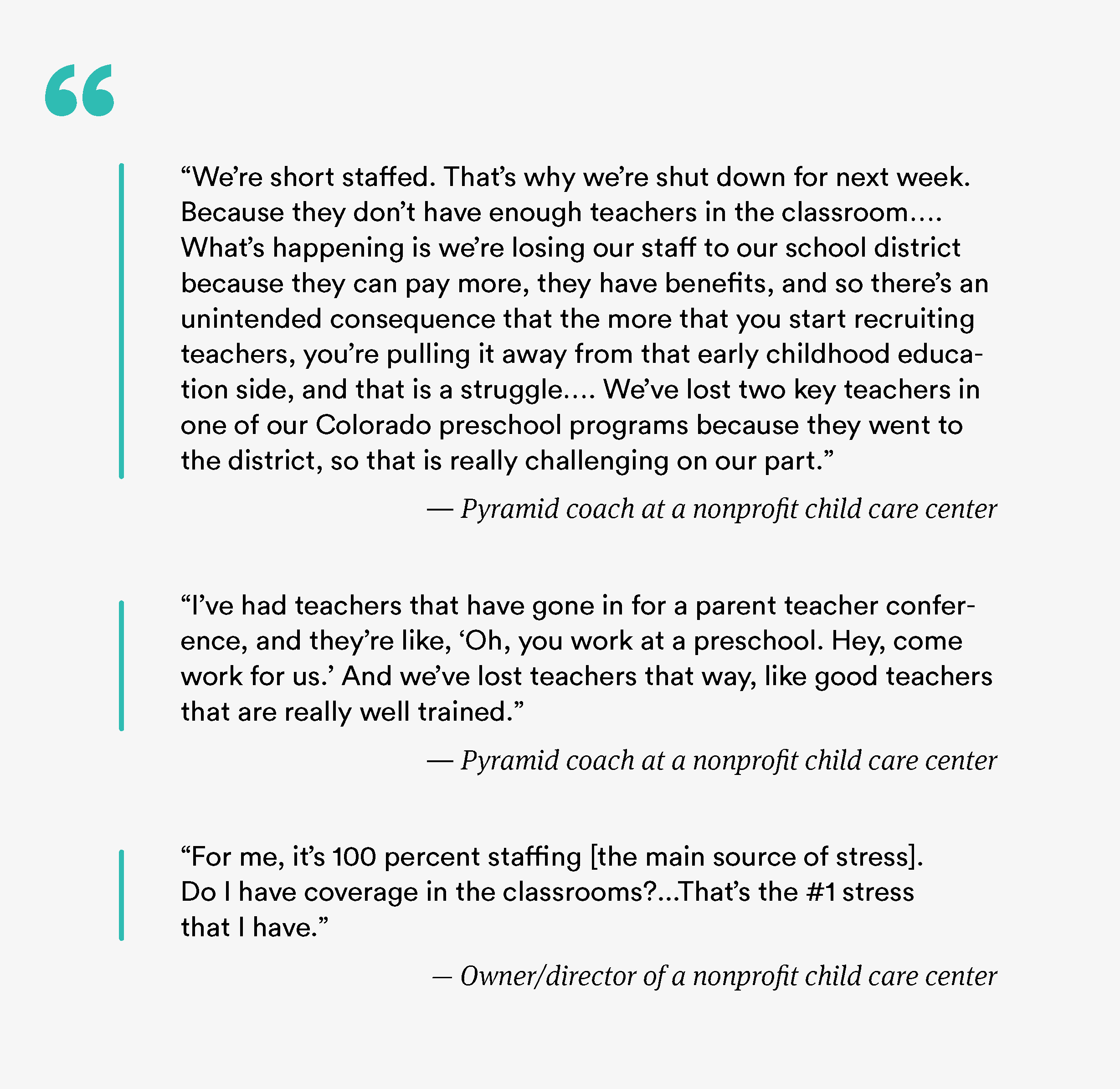
The COVID-19 pandemic has led to higher stress levels for students, teachers, and families. Teachers, administrators, and mental health professionals consistently brought up how stressful the pandemic has been for everyone involved in education.
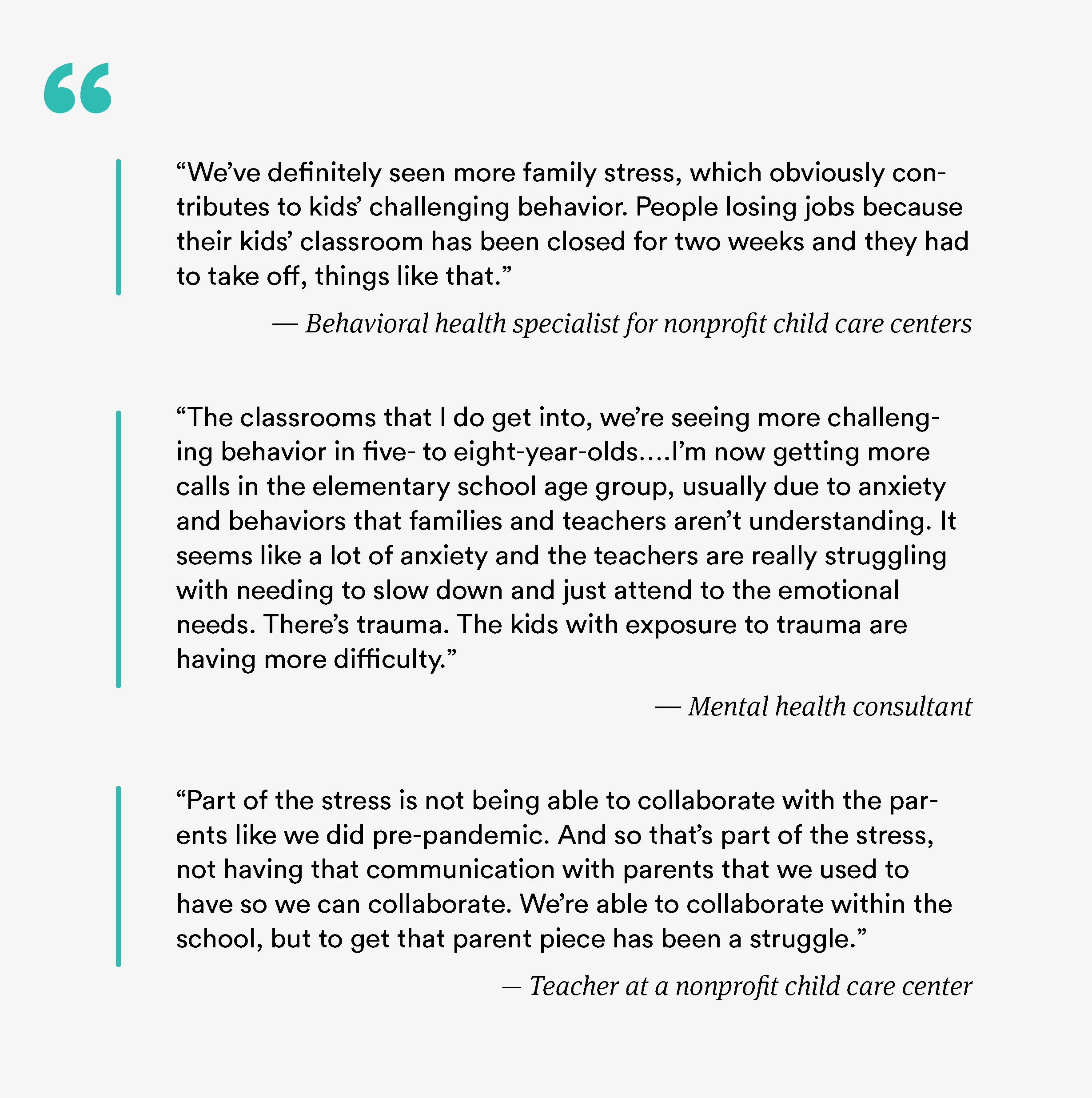
Early childhood mental health consultations are often focused on helping teachers deal with their own stress rather than concentrating on student behavioral challenges. While mental health consultation is always partially focused on helping teachers address their own stress levels, it seems that the pandemic has heightened the focus on improving the mental health of teachers so they are able to effectively model social-emotional skills for their students.
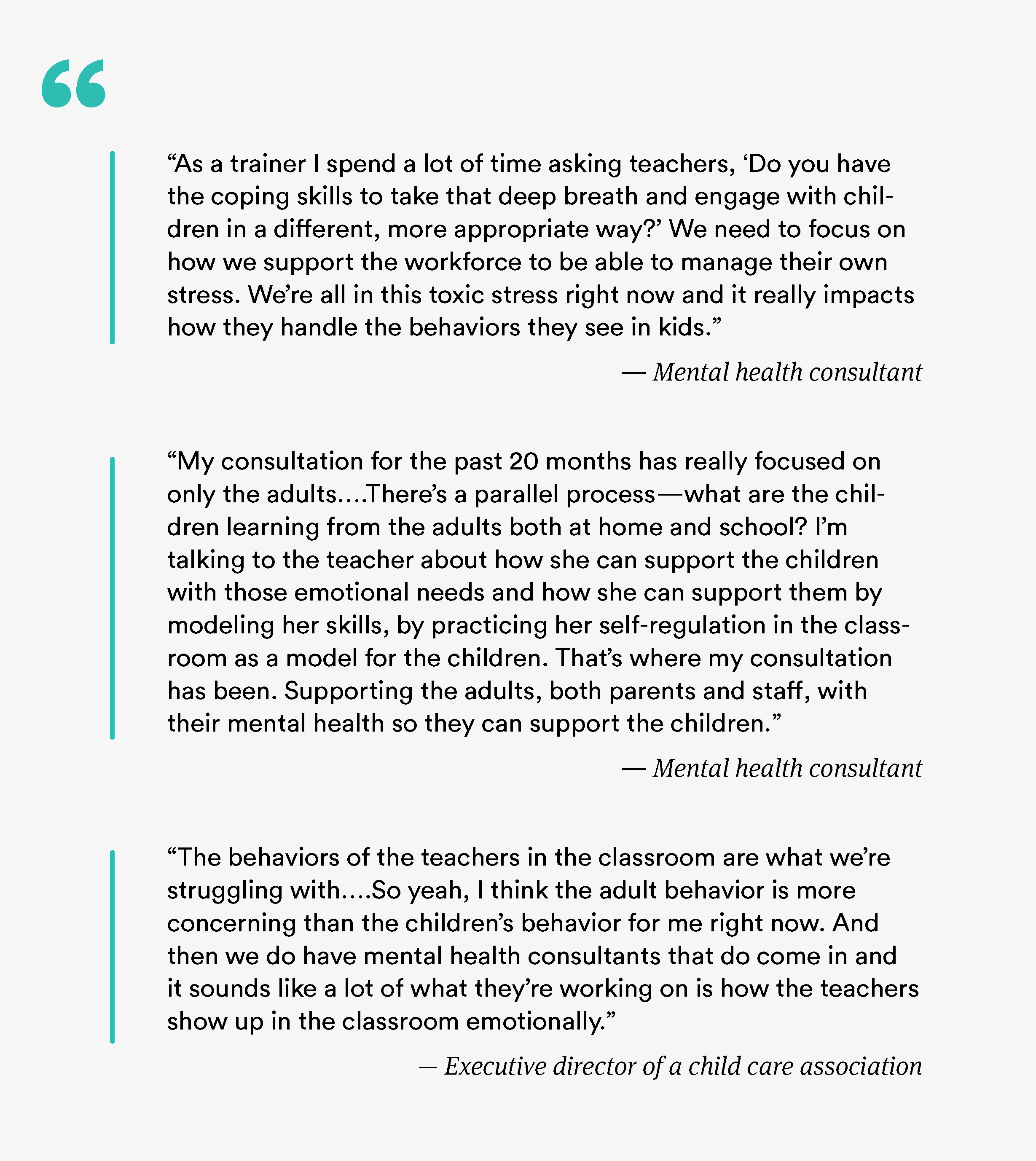
Due to the pandemic, many teachers and administrators had to rely on remote mental health consultations, but this arrangement presented staff with challenges. While teachers and administrators were grateful to be able to access remote consultations during the pandemic, this option was not viewed as being as helpful as traditional, in-person consultations.
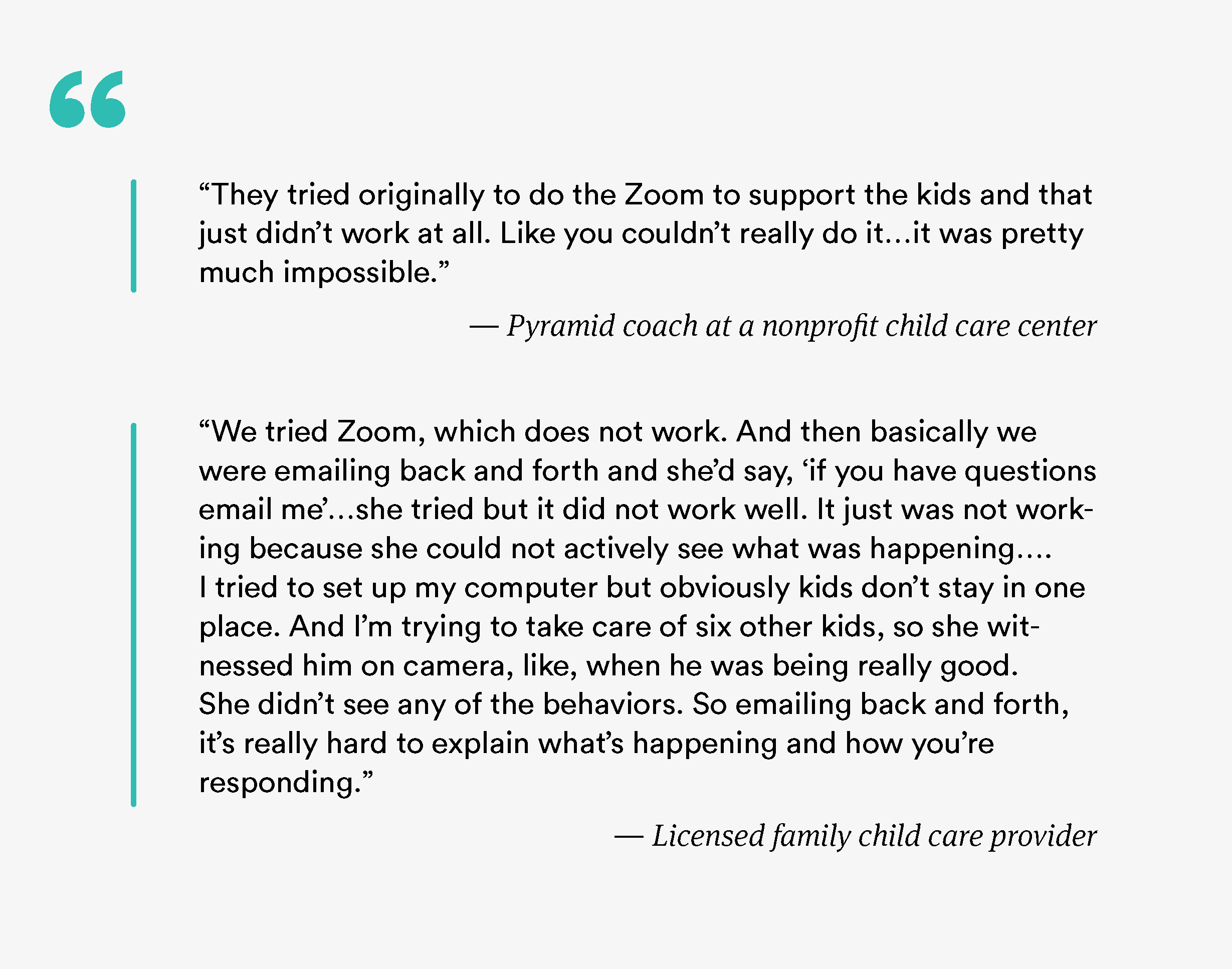
Long wait times to access mental health consultants continue to be an issue. We repeatedly heard that there are not the necessary number of mental health consultants across the state to fill the current demand. Teachers expressed frustration at sometimes having to wait for a month or more to receive assistance from a consultant.
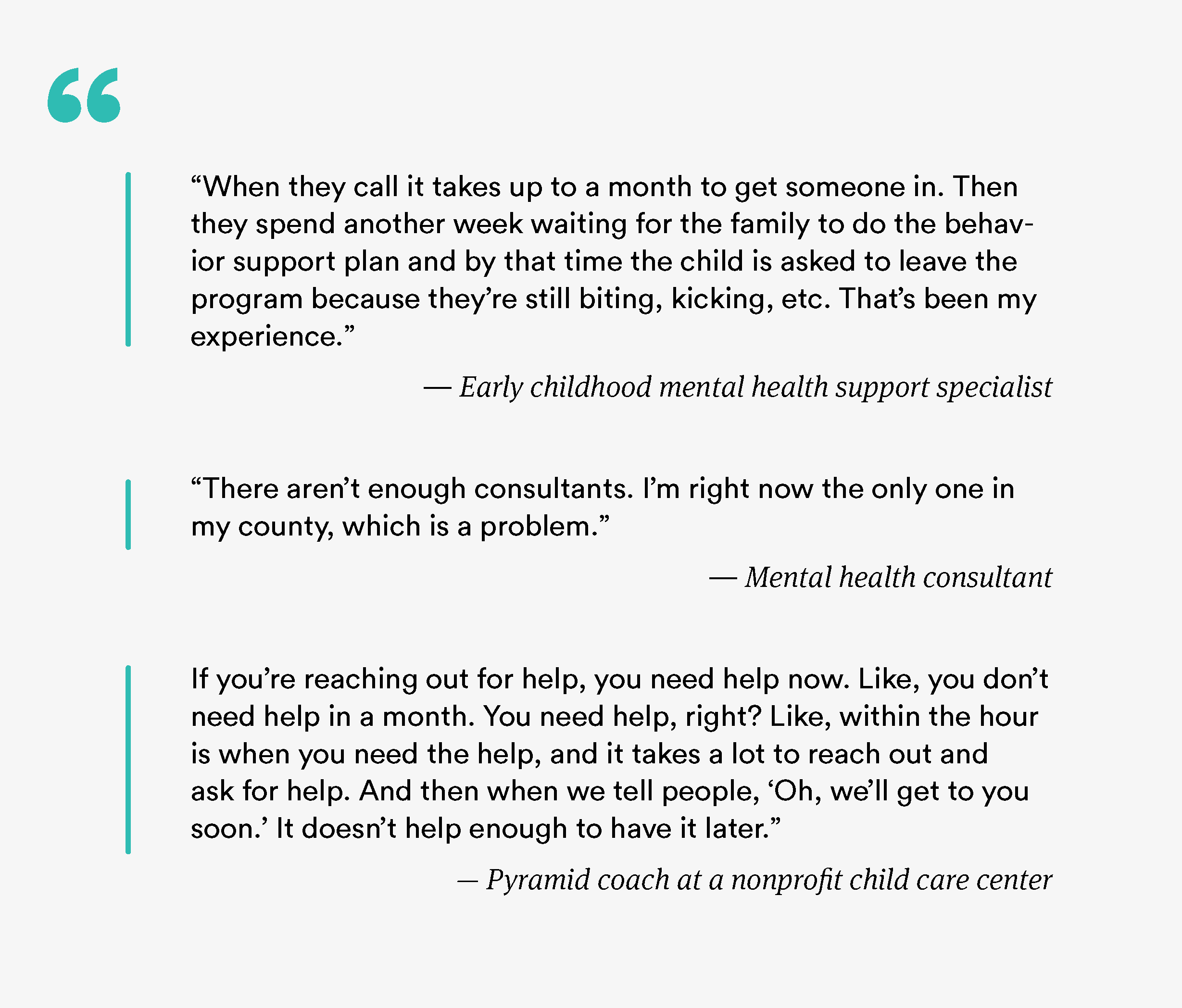
Many programs use mental health consultations at the last moment to “check the box” so they can go ahead and remove a student. Several consultants told us that they often are asked to provide consultations to programs who seem less interested in addressing a child’s challenging behaviors and more interested in having a consultation so they are then free to remove the child from the program.
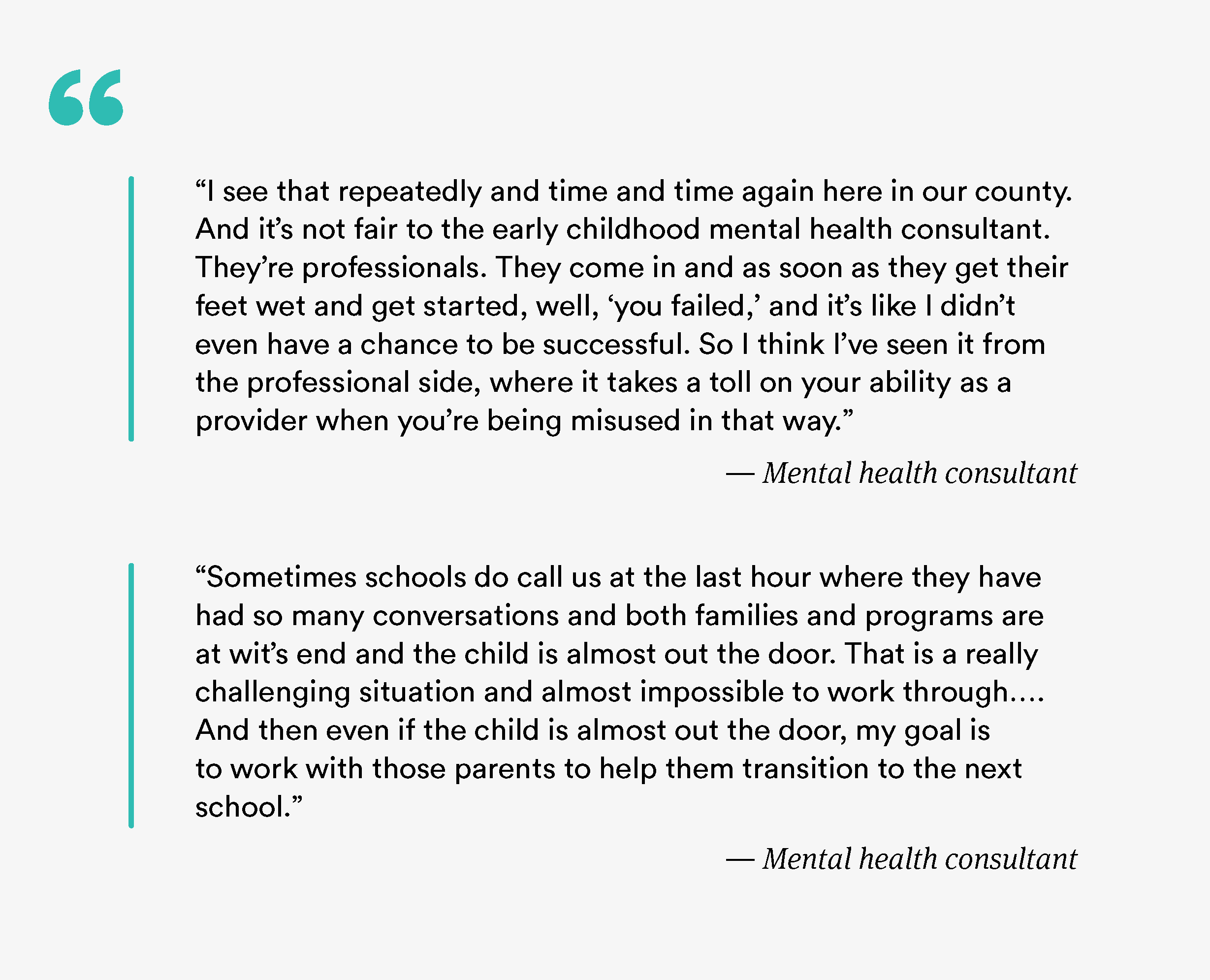
The Pyramid Model has been very helpful for addressing student behavioral challenges, but it requires a long-term commitment combined with ongoing coaching to truly see the benefit. Several teachers and administrators shared that they have had a lot of success in their classroom using the Pyramid Model. They emphasized that successful use of the model does not happen after one training, but requires ongoing professional development and in-person coaching.
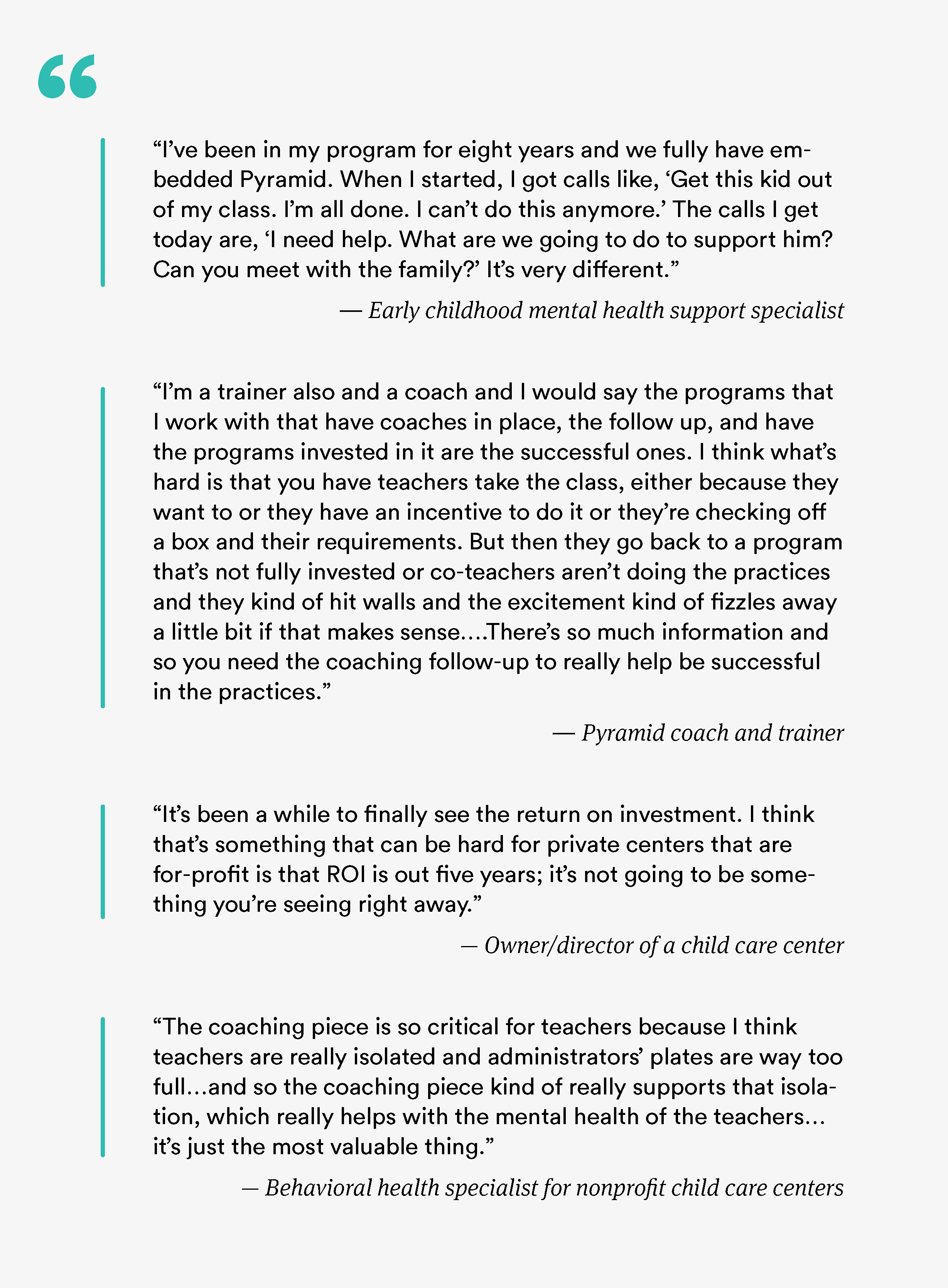
Family child care providers face unique challenges when it comes to addressing student behavioral challenges. For example, those in our listening sessions shared that they have trouble affording Pyramid Model training. Additionally, family child care providers often feel that they sometimes have no choice but to expel students from their classrooms because they do not have enough staff to safely handle students exhibiting violent behaviors.
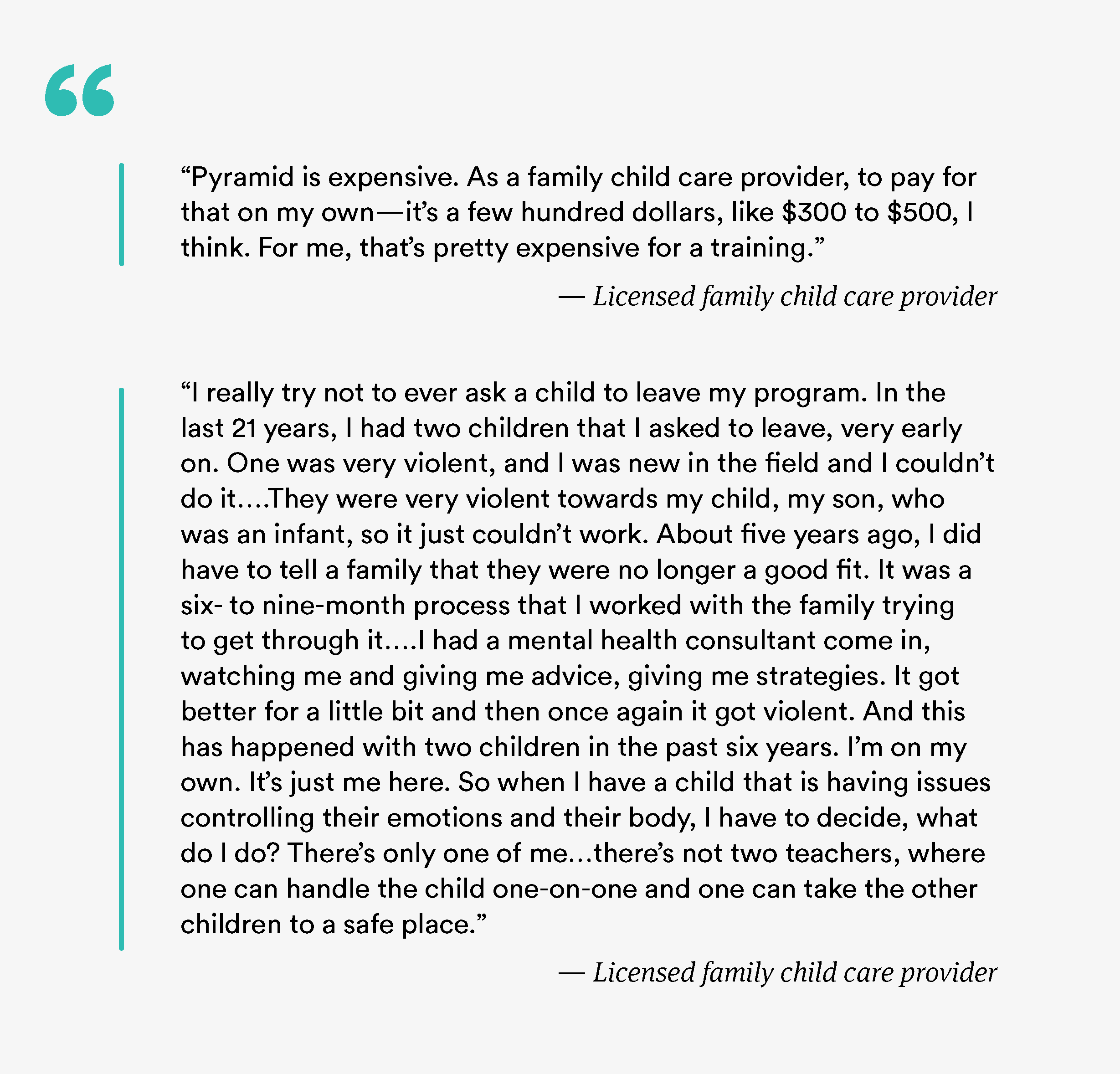
Citations
- We chose the name Elijah; the educator did not disclose the child’s name when recounting the story.
- In this paper we use “challenging behaviors” to describe classroom actions that might include disruption, like a child consistently not following instructions and refusing to participate in activities, or aggressive or potentially dangerous behaviors, like a child hitting or throwing things. As discussed later in the paper, what educators find to be challenging behaviors varies for multiple reasons.
- We conducted a total of five sessions throughout November with 31 total participants: 15 from Colorado and 16 from Illinois. These virtual sessions lasted for one hour and participants received a $100 gift card as an incentive for participation.
- Walter S. Gilliam, Prekindergarteners Left Behind: Expulsion Rates in State and Prekindergarten Programs, FCD Policy Brief Series no. 3 (New York: Foundation for Child Development, May 2005), <a href="<a href="<a href="source">source">source">source">source
- Songtian Zeng, Catherine Corr, Courtney O’Grady, and Yiyang Guan, “Adverse Childhood Experiences and Preschool Suspension Expulsion: A Population Study,” Child Abuse and Neglect 97 (November 2019), <a href="<a href="<a href="source">source">source">source">source
- Katherine M. Zinsser, H. Callie Silver, Elyse R. Shenberger, and Velisha Jackson, “A Systematic Review of Early Childhood Exclusionary Discipline,” Review of Educational Research (2022): 1–43, <a href="<a href="<a href="source">source">source">source">source
- U.S. Department of Education, Office of Civil Rights, “An Overview of Exclusionary Discipline Practices in Public Schools for the 2017–18 School Year,” slide deck, June 2021, <a href="<a href="<a href="source">source">source">source">source
- Cristina Novoa and Rasheed Malik, “Suspensions are Not Support,” Center for American Progress, January 17, 2018, <a href="<a href="<a href="source">source">source">source">source
- U.S. Department of Education, Office of Civil Rights, “An Overview of Exclusionary Discipline Practices in Public Schools for the 2017–18 School Year,” slide deck, June 2021, <a href="<a href="<a href="source">source">source">source">source
- Mary Benson McMullen, “The Many Benefits of Continuity of Care for Infants, Toddlers, Families and Caregiving Staff,” Young Children 73, no. 3 (July 2018), <a href="<a href="<a href="source">source">source">source">source
- Zinsser, Silver, Shenberger, and Jackson, “A Systematic Review.”
- Kelsey A. Clayback and Mary Louise Hemmeter, “Exclusionary Discipline Practices in Early Childhood Settings: A Survey of Child Care Directors,” Early Childhood Research Quarterly 55 (2nd quarter 2021): 129–136, <a href="<a href="<a href="source">source">source">source">source
- Walter S. Gilliam, Angela N. Maupin, Chin R. Reyes, Maria Accavitti, and Frederic Shic, Do Early Educators’ Implicit Biases Regarding Sex and Race Relate to Behavior Expectations and Recommendations of Preschool Expulsions and Suspensions? (New Haven, CT: Yale University Child Study Center, September 2016), <a href="<a href="<a href="source">source">source">source">source
- U.S. Department of Health & Human Services, Office of Child Care (website), “Expulsion and Suspension Policy Statement,” November 7, 2016, <a href="<a href="<a href="source">source">source">source">source
- Head Start Early Childhood Learning & Knowledge Center (website), “Head Start Showcase: Suspension and Expulsion Video,” December 2019, <a href="<a href="<a href="source">source">source">source">source
- U.S. Department of Health & Human Services and U.S. Department of Education, “Policy Statement on the Expulsion and Suspension Policies in Early Childhood Settings, 2016, <a href="<a href="<a href="source">source">source">source">source
- Alysse Loomis, Annie Davis, Gracelyn Cruden, Christina Padilla, and Yohan Drazen, “Early Childhood Suspension and Expulsion: A Content Analysis of State Legislation,” Early Childhood Education Journal 50, (February 2021): 327–344, <a href="<a href="<a href="source">source">source">source">source
- Carey McCann, Sheila Smith, Uyen (Sophie) Nguyen, and Maribel R. Granja, States’ Growing Commitment to Preventing Young Children’s Expulsion from Early Care and Educational Programs: Results of a 50 State Survey (Build Initiative & National Center for Children in Poverty, October 2021), <a href="<a href="<a href="source">source">source">source">source
- McCann, Smith, Nguyen, and Granja, States’ Growing Commitment.
- Loomis, Davis, Cruden, Padilla, and Drazen, “Early Childhood Suspension.”
- McCann, Smith, Nguyen, and Granja, States’ Growing Commitment.
- “Head Start Performance Standards with Mental Health Focus,” Head Start Program Performance Standards, Part 1302, Subpart D, 1034.24, <a href="<a href="<a href="source">source">source">source">source
- Annie E. Davis, Deborah F. Perry, and Lauren Rabinovitz, “Expulsion Prevention: Framework for the Role of Infant and Early Childhood Mental Health Consultation in Addressing Implicit Biases,” Infant Mental Health Journal 41, no. 3 (February 2020): 327–339, <a href="<a href="<a href="source">source">source">source">source
- Frances Duran, Kathy Hepburn, Roxanne Kaufmann, Lan Le, Mary Allen, Eileen Brennan, and Beth Green, Early Childhood Mental Health Consultation (Nashville, TN: The Center on the Social and Emotional Foundations for Early Learning at Vanderbilt University, December 2008), <a href="<a href="<a href="source">source">source">source">source; and A Statewide Infant Early Childhood Mental Health Consultation Report and Three Year Plan, (Santa Fe: New Mexico Early Childhood Education & Care Department, May 2021), <a href="<a href="<a href="source">source">source">source">source
- Walter S. Gilliam, Prekindergarteners Left Behind: Expulsion Rates in State and Prekindergarten Programs, FCD Policy Brief Series no. 3 (New York: Foundation for Child Development, May 2005), <a href="<a href="<a href="source">source">source">source">source
- McCann, Smith, Nguyen, and Granja, States’ Growing Commitment.
- Clayback, and Hemmeter, “Exclusionary Discipline Practices.”
- Mary Louise Hemmeter, Patricia A. Snyder, Lise Fox, and James Algina, “Evaluating the Implementation of the Pyramid Model for Promoting Social-Emotional Competence in Early Childhood Classrooms,” Topics In Early Childhood Special Education 36, no. 3 (2016): 133–146, <a href="<a href="<a href="source">source">source">source">source
- Zinsser, Silver, Shenberger, and Jackson, “A Systematic Review.”
- Taran Schneider (executive director, Healthy Child Care Colorado), interview with authors, October 20, 2021.
- McCann, Smith, Nguyen, and Granja, States’ Growing Commitment.
- Manuel E. Jimenez, Roy Wade Jr., Yong Lin, Lesley M. Morrow, and Nancy E. Reichman, “Adverse Experienced in Early Childhood and Kindergarten Outcomes,” Journal of the American Academy of Pediatrics 137, no. 2, (February 2016), <a href="<a href="<a href="source">source">source">source">source
- Shannon T. Lipscomb, Bridget Hatfield, Hillary Lewis, Emiko Goka-Dubose, and Caitlyn Abshire, “Adverse Childhood Experiences and Children’s Development in Early Care and Education Programs,” Journal of Applied Developmental Psychology 72 (January–February 2021), <a href="<a href="<a href="source">source">source">source">source
- Lipscomb, Hatfield, Lewis, Goka-Dubose, and Abshire, “Adverse Childhood Experiences.”
- Key Findings: Oakland Retrospective Study (Engage R+D & the David & Lucile Packard Foundation, January 2019), <a href="<a href="<a href="source">source">source">source">source
- Illinois General Assembly, Public Act 100-0105, AN ACT concerning Children, effective January 1, 2018, <a href="<a href="source">source">source">source
- Illinois General Assembly, Public Act 100-0105.
- Phone interview with authors, October 15, 2021.
- Governor’s Office of Early Childhood Development (website), Illinois Infant /Early Childhood Mental Health Consultation, 2022, <a href="<a href="source">source">source">source
- Illinois Model for Infant/Early Childhood Mental Health Consultation (Illinois Mental Health Consultation Initiative & Illinois Children’s Mental Health Partnership, May 2020), <a href="<a href="source">source">source">source
- Julie Spielberger, Tiffany Burkhardt, Carolyn Winje, Aida Pacheco-Applegate, Elissa Gitlow, Erin Carreon, Lee Ann Huang, Anna Herriott, and Reiko Kakyuama-Villaber, Evaluation of the Illinois Model of Infant and Early Childhood Mental Health Consultation Pilot (Chicago, IL: Chapin Hill at the University of Chicago, February 2021), <a href="<a href="source">source">source">source
- Interview with authors, October 19, 2021.
- Interview with authors, November 12, 2021.
- Kelly, interview with authors, November 12, 2021.
- Brambila, interview with authors, October 19, 2021.
- Allison Lowe-Fotos, “Solutions for Addressing Infant and Early Childhood Mental Health,” blog post, Start Early, June 3, 2021, <a href="<a href="source">source">source">source
- Illinois General Assembly, Illinois Compiled Statutes (405 ILCS 47/), Mental Health and Developmental Disabilities (405 ICLS 47/) Infant/Early Childhood Mental Health Consultations Act, effective March 8, 2021, <a href="<a href="source">source">source">source
- Spielberger, Burkhardt, Winje, Pacheco-Applegate, Gitlow, Carreon, Huang, Herriott, and Kakyuama-Villaber, “Evaluation of the Illinois Model.”
- Allison Lowe-Fotos (policy manager, Start Early) Phone interview with authors, November 10, 2021.
- Illinois Statute (405 ILCS 47/), Mental Health and Developmental Disabilities (405 ICLS 47/) Infant/Early Childhood Mental Health Consultations Act, effective March 8, 2021, <a href="<a href="source">source">source">source
- Friedman-Krauss, A. H., Barnett, W. S., Garver, K. A., Hodges, K. S., Weisenfeld, G. G. and Gardiner, B. A. The State of Preschool 2020: State Preschool Yearbook, (New Brunswick, NJ: National Institute for Early Education Research, 2021), <a href="<a href="source">source">source">source
- Illinois State Board of Education, Early Childhood Block Grant 3-5 Compliance Checklist, Preschool for All and Preschool for All Expansion, (2022), <a href="<a href="source">source">source">source
- Friedman-Krauss, A. H., Barnett, W. S., Garver, K. A., Hodges, K. S., Weisenfeld, G. G. and Gardiner, B. A. The State of Preschool 2020: State Preschool Yearbook, (New Brunswick, NJ: National Institute for Early Education Research, 2021), <a href="<a href="source">source">source">source
- National Head Start Association, “Illinois: 2022 Head Start and Early Head Start Profile,” <a href="<a href="source">source">source">source
- Katherine M. Zinsser, H. Callie Silver, Qaswa Hussaini, and Courtney A. Zulauf, Evaluation Report of the Implementation of Illinois Public Act 100-0105: Early Childhood Programs’ Knowledge of and Response to 2018 Expulsion Legislation (Chicago, IL: University of Chicago, 2019), <a href="<a href="source">source">source">source
- Kate M. Zinsser, H. Callie Silver, and Elyse Shenberger, Evaluating the Implementation of the Illinois Expulsion Law 2017-2020: Findings & Recommendations Three Years Later (Chicago IL: The University of Chicago, 2021), <a href="<a href="source">source">source">source
- Zinsser, Silver, and Shenberger, Evaluating the Implementation.
- The evaluation discusses confusion among practitioners around the term “planned transition.” The law explains the process as follows: “If the program ultimately cannot meet the behavioral needs of a child, providers must work with the family to identify and transition the child into an alternative, and appropriate, care setting, such that there is no loss of services to the child.” The researchers recommend further state guidance on this process and support from local Child Care Resource and Referral agencies in navigating planned transitions.
- Zinsser, Silver, and Shenberger, Evaluating the Implementation.
- Interview with authors, October 15, 2021.
- Megan Vinh, Phillip S. Strain, Sarah Davidon, and Barbara J. Smith, “One State’s Systems Change Efforts to Reduce Child Care Expulsion: Taking the Pyramid Model to Scale,” Topics in Early Childhood Special Education 36, no. 3 (January 2016), source">source
- Sarah D. Hoover, Lorraine F. Kubicek, Cordelia Robinson Rosenberg, Caludia Zundel, and Steven A. Rosenberg, “Influence of Behavioral Concerns and Early Childhood Expulsions on the Development of Early Childhood Mental Health Consultation in Colorado,” Infant Mental Health Journal 33, no. 3 (May 2012): 246–255, source">source
- Children’s Defense Fund (website), The State of America’s Children 2020: Child Population Tables, “Table 1: Child Population by Age and Race/Ethnicity, 2018,” source">source
- Colorado, The State of Preschool 2020—State Preschool Yearbook, National Institute for Early Education Research (2020), source">source
- Ann Schimke, “Three Things to Know About Colorado’s Plan for Universal Preschool,” Chalkbeat Colorado, December 14, 2021, source">source
- Ann Schimke, “Proposition EE, Nicotine Tax Measure for Universal Preschool, Cruises to Victory,” Chalkbeat Colorado, November 3, 2020, source">source
- Schimke, “Three Things to Know.”
- Ann Schimke, “Help Wanted: Leader for Colorado’s Early Childhood Department,” Chalkbeat Colorado, February 17, 2022, source">source
- Jenny Brundin, “The Workforce Behind The Workforce: Confronting Colorado’s Critical Child Care Staffing Shortage,” CPR News, January 5, 2021, source">source
- Vinh, Strain, Davidon, and Smith, “One State’s Systems Change Efforts.”
- Taran Scheider (executive director, Healthy Child Care Colorado), interview with authors, October 20, 2021.
- Colorado Shines Brighter: Opportunities for Colorado’s Early Childhood System, The Colorado Birth Through Five Needs Assessment (Colorado Office of Early Childhood and Colorado Health Institute, December 2019), source">source
- Scheider, interview with authors, October 20, 2021.
- Early Childhood Mental Health Consultation (ECMHC) Hub Feasibility Study Report and Roadmap (Denver, CO: John Snow, June 2019), source">source
- Laura Carlson (vice president of programs, Buell Foundation), interview with authors, October 28, 2021.
- Colorado General Assembly, House Committee Meeting on Supports for Early Childhood Educator Workforce, HB20-1053: Supports for Early Childhood Educator Workforce, 73rd General Assembly, effective July 8, 2020, source">source
- Bill Jaeger (vice president of Early Childhood and Policy Initiatives, Colorado Children’s Campaign), interview with authors, October 13, 2021.
- Jeanne Sounldern, “Newly Passed Legislation Increases Support for Mental Health,” Aspen Daily News, July 17, 2021, source">source
- Colorado Senate Committee Meeting on Behavioral Health Recovery Act, SB21-137: Behavioral Health Recovery Act, 73rd General Assembly, Second Regular Session, effective June 28, 2021, source">source
- Colorado Department of Human Services (website), “CDHS Announces Early Childhood Mental Health Support Line,” March 2, 2022, source">source
- Colorado House Committee Meeting on School Discipline for Preschool Through Second Grade, HB19-1194, 73rd General Assembly, Second Regular Session, effective May 13, 2019, source">source
- Jaeger, interview with authors, October 13, 2021.
- Colorado Draft Legislation, “7.702 Rules Regulating Child Care Centers That Provide Less Than 24-Hour Care,” July 15, 2021, source">source
Takeaways for Policymakers
Numerous themes were evident in our research and listening sessions with practitioners in Illinois and Colorado. Here are 10 takeaways and recommendations that other states can use as they pursue reform in ECE discipline policies and work to help teachers address challenging behaviors:
- The lack of a uniform, cohesive ECE system within states makes it difficult to efficiently address exclusionary discipline in a way that reaches all children and providers. Young children attend a mix of ECE programs in different settings that are governed by different quality regulations and paid for through distinct funding streams, which results in uneven access to training and support services. One possible solution to this problem is creating a new government entity charged with overseeing all of a state’s ECE programs, such as the Department of Early Childhood just launched in Colorado. As of 2021, eight states had taken such a step.92
- While recruiting and retaining ECE staff has always been difficult due to low compensation and often difficult working conditions, the pandemic has exacerbated the problem. Program administrators in both Colorado and Illinois overwhelmingly named staff shortages as their greatest source of stress. High turnover rates can make it difficult to provide professional development that requires ongoing training and coaching, such as the Pyramid Model. As several administrators described, the poverty-level wages and high stress levels lead many early educators to leave the field entirely or depart for a job in the public school system that provides better compensation. Despite some evidence that reducing teacher stress could lower expulsion rates, none of the 12 state bills related to reducing early childhood exclusionary discipline introduced between 2015 and 2018 mention the need to address teacher stress.93 Because high-quality ECE depends on a high-quality workforce, policies must support the preparation, development, retention, and fair compensation of early educators.
- Private and public programs face different challenges when it comes to appropriately addressing student behavior. Early educators in our listening sessions who worked for large publicly funded programs, such as Head Start and public pre-K, suggested that they had more access to professional development for dealing with student behavior than their peers working for private centers. The private, family child care providers in our listening sessions said that they wanted access to certain professional development topics but had trouble affording the training. Family child care providers are often the sole educator in their setting, making it difficult for them to step away from the classroom for professional development, which is something state policies focused on professional development for early educators should take into account.
- ECMHC is a popular strategy that research shows is effective, but it is not reaching enough programs. Professionals in both Colorado and Illinois expressed the need for more mental health consultants, and this appears to be a national trend. Most states require early childhood mental health consultants to have an advanced degree in an appropriate field such as social work or psychology and experience working with children and their families.94 With limited funding for these positions, it can be difficult to recruit and retain highly qualified staff. Telehealth can lessen the shortage, particularly in rural areas where driving long distances hinders consultants’ ability to reach more programs. However, there are challenges with virtual consultations, such as not being able to observe classrooms in person or demonstrate strategies in a real environment. Because mental health consultation is often used as a reactive strategy and programs request services when they already have a challenge, it is crucial for them to be able to access services in a timely manner.
- States should be diligent in educating practitioners and families on relevant policies and resources. It is not enough for states to simply pass legislation or offer guidance. As heard in our Illinois listening sessions, years later there remains confusion about the details of the policy. States must follow through with outreach and implementation, publicizing policy changes and explaining to providers how to access available supports. It is equally important for parents to understand the policies and know their rights. Parents are often not aware that there are policies in place to help children remain in a program. Parents may not know that providers must employ certain supports before exclusion is considered, or that their children should receive assistance in finding a program that is a better fit, as is the case in Illinois.
- ECE discipline policies should focus on racial equity, and that should be clearly communicated to practitioners. According to a 2021 report, 15 state policies have language with an intentional focus on racial equity.95 Despite evidence on disparities in discipline practices, racial equity issues did not organically emerge in any of the listening sessions. There are multiple possible explanations for why race was not explicitly discussed in these sessions. Practitioners may not have felt comfortable discussing issues of race or bias with peers or with us. They may not be aware of the equity implications of exclusionary discipline, or it may not have been communicated to them that this is an intentional part of the law. The data suggest that doing a better job of reducing exclusionary discipline in ECE will benefit Black children, especially Black boys, the most, and policies should be designed accordingly.
- Accurate data on discipline practices and related policies is essential for successful policy implementation. The lack of data in ECE settings makes it difficult to evaluate whether the law is being implemented successfully. Collecting this data is especially challenging in the early years because the system is disjointed since there are often different governing bodies, funding streams, and regulations guiding different programs. As a study published in the January issue of The Review of Educational Research explains, “unlike K–12 superintendents, ECCE [early childhood] settings do not have access to a full cadre of district personnel to collect, organize, and upload requisite data.”96 A family child care provider might not even have reliable access to a computer or the internet to input data. Accurate statewide data collection is essential to uncovering racial disparities and monitoring the effect of new laws aimed at decreasing the frequency of exclusionary discipline practices.
- The success of the reforms depends on sufficient funding. It is important that any policy changes made by states do not turn into an unfunded mandate. States need to provide adequate funding to ensure that programs are able to update their practices and policies to comply with any new laws or regulations. In both Illinois and Colorado, children are still being excluded from ECE settings, despite the policies and supports that have been put in place. Limited funding is one reason that some programs have difficulty accessing resources in a timely manner. For real change, stable, long-term funding must follow to ensure providers have the resources necessary to update their practices.
- Policymakers should think beyond the classroom to meaningfully support children’s well-being and development. Improving access to programs and supports to meet families’ basic needs like housing, physical and mental health care, and nutrition are important to ensuring that children thrive. These supports can also potentially lessen children’s exposure to trauma. States can look to comprehensive education models like community schools for examples of how to engage families and coordinate with community organizations.97 States can also take steps to ensure that it is easy for families to access the range of services they need, such as by streamlining eligibility requirements and applications.
- Engaging families as partners is instrumental to understanding and supporting children’s behavioral challenges. While children may spend a significant portion of their days in ECE settings, parents continue to be their first and most important teachers. When programs collaborate with parents, students experience a stronger home-to-school connection that can be beneficial. As Gilliam said in a past interview, “one of the things that I’ve never seen is a child expelled from a preschool program where the teacher and parent knew and liked one another.”98 Communication with families can help teachers understand children’s development and also ensure consistency between home and school approaches. Schools can help families learn strategies to support healthy development. School efforts to connect with families are especially important now, after so many have felt less connected to their ECE programs during the pandemic.
Citations
- We chose the name Elijah; the educator did not disclose the child’s name when recounting the story.
- In this paper we use “challenging behaviors” to describe classroom actions that might include disruption, like a child consistently not following instructions and refusing to participate in activities, or aggressive or potentially dangerous behaviors, like a child hitting or throwing things. As discussed later in the paper, what educators find to be challenging behaviors varies for multiple reasons.
- We conducted a total of five sessions throughout November with 31 total participants: 15 from Colorado and 16 from Illinois. These virtual sessions lasted for one hour and participants received a $100 gift card as an incentive for participation.
- Walter S. Gilliam, Prekindergarteners Left Behind: Expulsion Rates in State and Prekindergarten Programs, FCD Policy Brief Series no. 3 (New York: Foundation for Child Development, May 2005), <a href="<a href="<a href="<a href="source">source">source">source">source">source
- Songtian Zeng, Catherine Corr, Courtney O’Grady, and Yiyang Guan, “Adverse Childhood Experiences and Preschool Suspension Expulsion: A Population Study,” Child Abuse and Neglect 97 (November 2019), <a href="<a href="<a href="<a href="source">source">source">source">source">source
- Katherine M. Zinsser, H. Callie Silver, Elyse R. Shenberger, and Velisha Jackson, “A Systematic Review of Early Childhood Exclusionary Discipline,” Review of Educational Research (2022): 1–43, <a href="<a href="<a href="<a href="source">source">source">source">source">source
- U.S. Department of Education, Office of Civil Rights, “An Overview of Exclusionary Discipline Practices in Public Schools for the 2017–18 School Year,” slide deck, June 2021, <a href="<a href="<a href="<a href="source">source">source">source">source">source
- Cristina Novoa and Rasheed Malik, “Suspensions are Not Support,” Center for American Progress, January 17, 2018, <a href="<a href="<a href="<a href="source">source">source">source">source">source
- U.S. Department of Education, Office of Civil Rights, “An Overview of Exclusionary Discipline Practices in Public Schools for the 2017–18 School Year,” slide deck, June 2021, <a href="<a href="<a href="<a href="source">source">source">source">source">source
- Mary Benson McMullen, “The Many Benefits of Continuity of Care for Infants, Toddlers, Families and Caregiving Staff,” Young Children 73, no. 3 (July 2018), <a href="<a href="<a href="<a href="source">source">source">source">source">source
- Zinsser, Silver, Shenberger, and Jackson, “A Systematic Review.”
- Kelsey A. Clayback and Mary Louise Hemmeter, “Exclusionary Discipline Practices in Early Childhood Settings: A Survey of Child Care Directors,” Early Childhood Research Quarterly 55 (2nd quarter 2021): 129–136, <a href="<a href="<a href="<a href="source">source">source">source">source">source
- Walter S. Gilliam, Angela N. Maupin, Chin R. Reyes, Maria Accavitti, and Frederic Shic, Do Early Educators’ Implicit Biases Regarding Sex and Race Relate to Behavior Expectations and Recommendations of Preschool Expulsions and Suspensions? (New Haven, CT: Yale University Child Study Center, September 2016), <a href="<a href="<a href="<a href="source">source">source">source">source">source
- U.S. Department of Health & Human Services, Office of Child Care (website), “Expulsion and Suspension Policy Statement,” November 7, 2016, <a href="<a href="<a href="<a href="source">source">source">source">source">source
- Head Start Early Childhood Learning & Knowledge Center (website), “Head Start Showcase: Suspension and Expulsion Video,” December 2019, <a href="<a href="<a href="<a href="source">source">source">source">source">source
- U.S. Department of Health & Human Services and U.S. Department of Education, “Policy Statement on the Expulsion and Suspension Policies in Early Childhood Settings, 2016, <a href="<a href="<a href="<a href="source">source">source">source">source">source
- Alysse Loomis, Annie Davis, Gracelyn Cruden, Christina Padilla, and Yohan Drazen, “Early Childhood Suspension and Expulsion: A Content Analysis of State Legislation,” Early Childhood Education Journal 50, (February 2021): 327–344, <a href="<a href="<a href="<a href="source">source">source">source">source">source
- Carey McCann, Sheila Smith, Uyen (Sophie) Nguyen, and Maribel R. Granja, States’ Growing Commitment to Preventing Young Children’s Expulsion from Early Care and Educational Programs: Results of a 50 State Survey (Build Initiative & National Center for Children in Poverty, October 2021), <a href="<a href="<a href="<a href="source">source">source">source">source">source
- McCann, Smith, Nguyen, and Granja, States’ Growing Commitment.
- Loomis, Davis, Cruden, Padilla, and Drazen, “Early Childhood Suspension.”
- McCann, Smith, Nguyen, and Granja, States’ Growing Commitment.
- “Head Start Performance Standards with Mental Health Focus,” Head Start Program Performance Standards, Part 1302, Subpart D, 1034.24, <a href="<a href="<a href="<a href="source">source">source">source">source">source
- Annie E. Davis, Deborah F. Perry, and Lauren Rabinovitz, “Expulsion Prevention: Framework for the Role of Infant and Early Childhood Mental Health Consultation in Addressing Implicit Biases,” Infant Mental Health Journal 41, no. 3 (February 2020): 327–339, <a href="<a href="<a href="<a href="source">source">source">source">source">source
- Frances Duran, Kathy Hepburn, Roxanne Kaufmann, Lan Le, Mary Allen, Eileen Brennan, and Beth Green, Early Childhood Mental Health Consultation (Nashville, TN: The Center on the Social and Emotional Foundations for Early Learning at Vanderbilt University, December 2008), <a href="<a href="<a href="<a href="source">source">source">source">source">source; and A Statewide Infant Early Childhood Mental Health Consultation Report and Three Year Plan, (Santa Fe: New Mexico Early Childhood Education & Care Department, May 2021), <a href="<a href="<a href="<a href="source">source">source">source">source">source
- Walter S. Gilliam, Prekindergarteners Left Behind: Expulsion Rates in State and Prekindergarten Programs, FCD Policy Brief Series no. 3 (New York: Foundation for Child Development, May 2005), <a href="<a href="<a href="<a href="source">source">source">source">source">source
- McCann, Smith, Nguyen, and Granja, States’ Growing Commitment.
- Clayback, and Hemmeter, “Exclusionary Discipline Practices.”
- Mary Louise Hemmeter, Patricia A. Snyder, Lise Fox, and James Algina, “Evaluating the Implementation of the Pyramid Model for Promoting Social-Emotional Competence in Early Childhood Classrooms,” Topics In Early Childhood Special Education 36, no. 3 (2016): 133–146, <a href="<a href="<a href="<a href="source">source">source">source">source">source
- Zinsser, Silver, Shenberger, and Jackson, “A Systematic Review.”
- Taran Schneider (executive director, Healthy Child Care Colorado), interview with authors, October 20, 2021.
- McCann, Smith, Nguyen, and Granja, States’ Growing Commitment.
- Manuel E. Jimenez, Roy Wade Jr., Yong Lin, Lesley M. Morrow, and Nancy E. Reichman, “Adverse Experienced in Early Childhood and Kindergarten Outcomes,” Journal of the American Academy of Pediatrics 137, no. 2, (February 2016), <a href="<a href="<a href="<a href="source">source">source">source">source">source
- Shannon T. Lipscomb, Bridget Hatfield, Hillary Lewis, Emiko Goka-Dubose, and Caitlyn Abshire, “Adverse Childhood Experiences and Children’s Development in Early Care and Education Programs,” Journal of Applied Developmental Psychology 72 (January–February 2021), <a href="<a href="<a href="<a href="source">source">source">source">source">source
- Lipscomb, Hatfield, Lewis, Goka-Dubose, and Abshire, “Adverse Childhood Experiences.”
- Key Findings: Oakland Retrospective Study (Engage R+D & the David & Lucile Packard Foundation, January 2019), <a href="<a href="<a href="<a href="source">source">source">source">source">source
- Illinois General Assembly, Public Act 100-0105, AN ACT concerning Children, effective January 1, 2018, <a href="<a href="<a href="source">source">source">source">source
- Illinois General Assembly, Public Act 100-0105.
- Phone interview with authors, October 15, 2021.
- Governor’s Office of Early Childhood Development (website), Illinois Infant /Early Childhood Mental Health Consultation, 2022, <a href="<a href="<a href="source">source">source">source">source
- Illinois Model for Infant/Early Childhood Mental Health Consultation (Illinois Mental Health Consultation Initiative & Illinois Children’s Mental Health Partnership, May 2020), <a href="<a href="<a href="source">source">source">source">source
- Julie Spielberger, Tiffany Burkhardt, Carolyn Winje, Aida Pacheco-Applegate, Elissa Gitlow, Erin Carreon, Lee Ann Huang, Anna Herriott, and Reiko Kakyuama-Villaber, Evaluation of the Illinois Model of Infant and Early Childhood Mental Health Consultation Pilot (Chicago, IL: Chapin Hill at the University of Chicago, February 2021), <a href="<a href="<a href="source">source">source">source">source
- Interview with authors, October 19, 2021.
- Interview with authors, November 12, 2021.
- Kelly, interview with authors, November 12, 2021.
- Brambila, interview with authors, October 19, 2021.
- Allison Lowe-Fotos, “Solutions for Addressing Infant and Early Childhood Mental Health,” blog post, Start Early, June 3, 2021, <a href="<a href="<a href="source">source">source">source">source
- Illinois General Assembly, Illinois Compiled Statutes (405 ILCS 47/), Mental Health and Developmental Disabilities (405 ICLS 47/) Infant/Early Childhood Mental Health Consultations Act, effective March 8, 2021, <a href="<a href="<a href="source">source">source">source">source
- Spielberger, Burkhardt, Winje, Pacheco-Applegate, Gitlow, Carreon, Huang, Herriott, and Kakyuama-Villaber, “Evaluation of the Illinois Model.”
- Allison Lowe-Fotos (policy manager, Start Early) Phone interview with authors, November 10, 2021.
- Illinois Statute (405 ILCS 47/), Mental Health and Developmental Disabilities (405 ICLS 47/) Infant/Early Childhood Mental Health Consultations Act, effective March 8, 2021, <a href="<a href="<a href="source">source">source">source">source
- Friedman-Krauss, A. H., Barnett, W. S., Garver, K. A., Hodges, K. S., Weisenfeld, G. G. and Gardiner, B. A. The State of Preschool 2020: State Preschool Yearbook, (New Brunswick, NJ: National Institute for Early Education Research, 2021), <a href="<a href="<a href="source">source">source">source">source
- Illinois State Board of Education, Early Childhood Block Grant 3-5 Compliance Checklist, Preschool for All and Preschool for All Expansion, (2022), <a href="<a href="<a href="source">source">source">source">source
- Friedman-Krauss, A. H., Barnett, W. S., Garver, K. A., Hodges, K. S., Weisenfeld, G. G. and Gardiner, B. A. The State of Preschool 2020: State Preschool Yearbook, (New Brunswick, NJ: National Institute for Early Education Research, 2021), <a href="<a href="<a href="source">source">source">source">source
- National Head Start Association, “Illinois: 2022 Head Start and Early Head Start Profile,” <a href="<a href="<a href="source">source">source">source">source
- Katherine M. Zinsser, H. Callie Silver, Qaswa Hussaini, and Courtney A. Zulauf, Evaluation Report of the Implementation of Illinois Public Act 100-0105: Early Childhood Programs’ Knowledge of and Response to 2018 Expulsion Legislation (Chicago, IL: University of Chicago, 2019), <a href="<a href="<a href="source">source">source">source">source
- Kate M. Zinsser, H. Callie Silver, and Elyse Shenberger, Evaluating the Implementation of the Illinois Expulsion Law 2017-2020: Findings & Recommendations Three Years Later (Chicago IL: The University of Chicago, 2021), <a href="<a href="<a href="source">source">source">source">source
- Zinsser, Silver, and Shenberger, Evaluating the Implementation.
- The evaluation discusses confusion among practitioners around the term “planned transition.” The law explains the process as follows: “If the program ultimately cannot meet the behavioral needs of a child, providers must work with the family to identify and transition the child into an alternative, and appropriate, care setting, such that there is no loss of services to the child.” The researchers recommend further state guidance on this process and support from local Child Care Resource and Referral agencies in navigating planned transitions.
- Zinsser, Silver, and Shenberger, Evaluating the Implementation.
- Interview with authors, October 15, 2021.
- Megan Vinh, Phillip S. Strain, Sarah Davidon, and Barbara J. Smith, “One State’s Systems Change Efforts to Reduce Child Care Expulsion: Taking the Pyramid Model to Scale,” Topics in Early Childhood Special Education 36, no. 3 (January 2016), <a href="source">source">source
- Sarah D. Hoover, Lorraine F. Kubicek, Cordelia Robinson Rosenberg, Caludia Zundel, and Steven A. Rosenberg, “Influence of Behavioral Concerns and Early Childhood Expulsions on the Development of Early Childhood Mental Health Consultation in Colorado,” Infant Mental Health Journal 33, no. 3 (May 2012): 246–255, <a href="source">source">source
- Children’s Defense Fund (website), The State of America’s Children 2020: Child Population Tables, “Table 1: Child Population by Age and Race/Ethnicity, 2018,” <a href="source">source">source
- Colorado, The State of Preschool 2020—State Preschool Yearbook, National Institute for Early Education Research (2020), <a href="source">source">source
- Ann Schimke, “Three Things to Know About Colorado’s Plan for Universal Preschool,” Chalkbeat Colorado, December 14, 2021, <a href="source">source">source
- Ann Schimke, “Proposition EE, Nicotine Tax Measure for Universal Preschool, Cruises to Victory,” Chalkbeat Colorado, November 3, 2020, <a href="source">source">source
- Schimke, “Three Things to Know.”
- Ann Schimke, “Help Wanted: Leader for Colorado’s Early Childhood Department,” Chalkbeat Colorado, February 17, 2022, <a href="source">source">source
- Jenny Brundin, “The Workforce Behind The Workforce: Confronting Colorado’s Critical Child Care Staffing Shortage,” CPR News, January 5, 2021, <a href="source">source">source
- Vinh, Strain, Davidon, and Smith, “One State’s Systems Change Efforts.”
- Taran Scheider (executive director, Healthy Child Care Colorado), interview with authors, October 20, 2021.
- Colorado Shines Brighter: Opportunities for Colorado’s Early Childhood System, The Colorado Birth Through Five Needs Assessment (Colorado Office of Early Childhood and Colorado Health Institute, December 2019), <a href="source">source">source
- Scheider, interview with authors, October 20, 2021.
- Early Childhood Mental Health Consultation (ECMHC) Hub Feasibility Study Report and Roadmap (Denver, CO: John Snow, June 2019), <a href="source">source">source
- Laura Carlson (vice president of programs, Buell Foundation), interview with authors, October 28, 2021.
- Colorado General Assembly, House Committee Meeting on Supports for Early Childhood Educator Workforce, HB20-1053: Supports for Early Childhood Educator Workforce, 73rd General Assembly, effective July 8, 2020, <a href="source">source">source
- Bill Jaeger (vice president of Early Childhood and Policy Initiatives, Colorado Children’s Campaign), interview with authors, October 13, 2021.
- Jeanne Sounldern, “Newly Passed Legislation Increases Support for Mental Health,” Aspen Daily News, July 17, 2021, <a href="source">source">source
- Colorado Senate Committee Meeting on Behavioral Health Recovery Act, SB21-137: Behavioral Health Recovery Act, 73rd General Assembly, Second Regular Session, effective June 28, 2021, <a href="source">source">source
- Colorado Department of Human Services (website), “CDHS Announces Early Childhood Mental Health Support Line,” March 2, 2022, <a href="source">source">source
- Colorado House Committee Meeting on School Discipline for Preschool Through Second Grade, HB19-1194, 73rd General Assembly, Second Regular Session, effective May 13, 2019, <a href="source">source">source
- Jaeger, interview with authors, October 13, 2021.
- Colorado Draft Legislation, “7.702 Rules Regulating Child Care Centers That Provide Less Than 24-Hour Care,” July 15, 2021, <a href="source">source">source
- Education Commission of the States, “Early Care and Education Governance,” June 2021, source
- Loomis, Davis, Cruden, Padilla, and Drazen, “Early Childhood Suspension.”
- Frances Durran, Kathy Hepburn, Marisa Irvine, Roxane Kaufmann, Bruno Anthony, Neal Horen, and Deborah Perry, What Works? A Study of Effective Early Childhood Mental Health Consultation Programs (Washington, DC: Georgetown University Center for Child and Human Development, 2009), source
- McCann, Smith, Nguyen, and Granja, States’ Growing Commitment.
- Zinsser, Silver, Shenberger, and Jackson, “A Systematic Review.”
- David Jacobson, “A powerful convergence: Community schools and early childhood education,” Phi Delta Kappan, January 24, 2018, source
- Shayna Cook, “Interview: Taking a Look at Pre-K Teachers’ Implicit Biases,” New America, Dec. 19, 2016, source
Conclusion
Excluding children from the classroom is not an effective way to improve their behavior and limits access to ECE, often for those who stand to benefit the most. But addressing inappropriate discipline practices in ECE is about more than banning suspension and expulsion; it is about addressing the underlying reasons these practices are used. As an increasing number of states work to address this issue, it is imperative to provide appropriate support to the workforce. With sufficient supports for programs and educators, exclusion does not need to be a common occurrence.
While this paper focuses on two promising strategies for strengthening the workforce, it is important to acknowledge that ECMHC and targeted professional development to address children’s social-emotional skills do not solve all problems. These supports do not reduce adult-child ratios (a common source of stress for early childhood educators), address funding shortfalls, or ensure children do not face challenges outside of the classroom. There are also other promising professional development models and supports that were not covered in the scope of this report.
There has been significant momentum for ending exclusionary practices in ECE in recent years and more states will likely address this issue as children’s mental health and teacher burnout have both been worsened by the pandemic. As more states tackle this issue on a policy and program level, we should think broadly about how to better support both teachers and students.
Citations
- We chose the name Elijah; the educator did not disclose the child’s name when recounting the story.
- In this paper we use “challenging behaviors” to describe classroom actions that might include disruption, like a child consistently not following instructions and refusing to participate in activities, or aggressive or potentially dangerous behaviors, like a child hitting or throwing things. As discussed later in the paper, what educators find to be challenging behaviors varies for multiple reasons.
- We conducted a total of five sessions throughout November with 31 total participants: 15 from Colorado and 16 from Illinois. These virtual sessions lasted for one hour and participants received a $100 gift card as an incentive for participation.
- Walter S. Gilliam, Prekindergarteners Left Behind: Expulsion Rates in State and Prekindergarten Programs, FCD Policy Brief Series no. 3 (New York: Foundation for Child Development, May 2005), <a href="<a href="<a href="<a href="<a href="source">source">source">source">source">source">source
- Songtian Zeng, Catherine Corr, Courtney O’Grady, and Yiyang Guan, “Adverse Childhood Experiences and Preschool Suspension Expulsion: A Population Study,” Child Abuse and Neglect 97 (November 2019), <a href="<a href="<a href="<a href="<a href="source">source">source">source">source">source">source
- Katherine M. Zinsser, H. Callie Silver, Elyse R. Shenberger, and Velisha Jackson, “A Systematic Review of Early Childhood Exclusionary Discipline,” Review of Educational Research (2022): 1–43, <a href="<a href="<a href="<a href="<a href="source">source">source">source">source">source">source
- U.S. Department of Education, Office of Civil Rights, “An Overview of Exclusionary Discipline Practices in Public Schools for the 2017–18 School Year,” slide deck, June 2021, <a href="<a href="<a href="<a href="<a href="source">source">source">source">source">source">source
- Cristina Novoa and Rasheed Malik, “Suspensions are Not Support,” Center for American Progress, January 17, 2018, <a href="<a href="<a href="<a href="<a href="source">source">source">source">source">source">source
- U.S. Department of Education, Office of Civil Rights, “An Overview of Exclusionary Discipline Practices in Public Schools for the 2017–18 School Year,” slide deck, June 2021, <a href="<a href="<a href="<a href="<a href="source">source">source">source">source">source">source
- Mary Benson McMullen, “The Many Benefits of Continuity of Care for Infants, Toddlers, Families and Caregiving Staff,” Young Children 73, no. 3 (July 2018), <a href="<a href="<a href="<a href="<a href="source">source">source">source">source">source">source
- Zinsser, Silver, Shenberger, and Jackson, “A Systematic Review.”
- Kelsey A. Clayback and Mary Louise Hemmeter, “Exclusionary Discipline Practices in Early Childhood Settings: A Survey of Child Care Directors,” Early Childhood Research Quarterly 55 (2nd quarter 2021): 129–136, <a href="<a href="<a href="<a href="<a href="source">source">source">source">source">source">source
- Walter S. Gilliam, Angela N. Maupin, Chin R. Reyes, Maria Accavitti, and Frederic Shic, Do Early Educators’ Implicit Biases Regarding Sex and Race Relate to Behavior Expectations and Recommendations of Preschool Expulsions and Suspensions? (New Haven, CT: Yale University Child Study Center, September 2016), <a href="<a href="<a href="<a href="<a href="source">source">source">source">source">source">source
- U.S. Department of Health & Human Services, Office of Child Care (website), “Expulsion and Suspension Policy Statement,” November 7, 2016, <a href="<a href="<a href="<a href="<a href="source">source">source">source">source">source">source
- Head Start Early Childhood Learning & Knowledge Center (website), “Head Start Showcase: Suspension and Expulsion Video,” December 2019, <a href="<a href="<a href="<a href="<a href="source">source">source">source">source">source">source
- U.S. Department of Health & Human Services and U.S. Department of Education, “Policy Statement on the Expulsion and Suspension Policies in Early Childhood Settings, 2016, <a href="<a href="<a href="<a href="<a href="source">source">source">source">source">source">source
- Alysse Loomis, Annie Davis, Gracelyn Cruden, Christina Padilla, and Yohan Drazen, “Early Childhood Suspension and Expulsion: A Content Analysis of State Legislation,” Early Childhood Education Journal 50, (February 2021): 327–344, <a href="<a href="<a href="<a href="<a href="source">source">source">source">source">source">source
- Carey McCann, Sheila Smith, Uyen (Sophie) Nguyen, and Maribel R. Granja, States’ Growing Commitment to Preventing Young Children’s Expulsion from Early Care and Educational Programs: Results of a 50 State Survey (Build Initiative & National Center for Children in Poverty, October 2021), <a href="<a href="<a href="<a href="<a href="source">source">source">source">source">source">source
- McCann, Smith, Nguyen, and Granja, States’ Growing Commitment.
- Loomis, Davis, Cruden, Padilla, and Drazen, “Early Childhood Suspension.”
- McCann, Smith, Nguyen, and Granja, States’ Growing Commitment.
- “Head Start Performance Standards with Mental Health Focus,” Head Start Program Performance Standards, Part 1302, Subpart D, 1034.24, <a href="<a href="<a href="<a href="<a href="source">source">source">source">source">source">source
- Annie E. Davis, Deborah F. Perry, and Lauren Rabinovitz, “Expulsion Prevention: Framework for the Role of Infant and Early Childhood Mental Health Consultation in Addressing Implicit Biases,” Infant Mental Health Journal 41, no. 3 (February 2020): 327–339, <a href="<a href="<a href="<a href="<a href="source">source">source">source">source">source">source
- Frances Duran, Kathy Hepburn, Roxanne Kaufmann, Lan Le, Mary Allen, Eileen Brennan, and Beth Green, Early Childhood Mental Health Consultation (Nashville, TN: The Center on the Social and Emotional Foundations for Early Learning at Vanderbilt University, December 2008), <a href="<a href="<a href="<a href="<a href="source">source">source">source">source">source">source; and A Statewide Infant Early Childhood Mental Health Consultation Report and Three Year Plan, (Santa Fe: New Mexico Early Childhood Education & Care Department, May 2021), <a href="<a href="<a href="<a href="<a href="source">source">source">source">source">source">source
- Walter S. Gilliam, Prekindergarteners Left Behind: Expulsion Rates in State and Prekindergarten Programs, FCD Policy Brief Series no. 3 (New York: Foundation for Child Development, May 2005), <a href="<a href="<a href="<a href="<a href="source">source">source">source">source">source">source
- McCann, Smith, Nguyen, and Granja, States’ Growing Commitment.
- Clayback, and Hemmeter, “Exclusionary Discipline Practices.”
- Mary Louise Hemmeter, Patricia A. Snyder, Lise Fox, and James Algina, “Evaluating the Implementation of the Pyramid Model for Promoting Social-Emotional Competence in Early Childhood Classrooms,” Topics In Early Childhood Special Education 36, no. 3 (2016): 133–146, <a href="<a href="<a href="<a href="<a href="source">source">source">source">source">source">source
- Zinsser, Silver, Shenberger, and Jackson, “A Systematic Review.”
- Taran Schneider (executive director, Healthy Child Care Colorado), interview with authors, October 20, 2021.
- McCann, Smith, Nguyen, and Granja, States’ Growing Commitment.
- Manuel E. Jimenez, Roy Wade Jr., Yong Lin, Lesley M. Morrow, and Nancy E. Reichman, “Adverse Experienced in Early Childhood and Kindergarten Outcomes,” Journal of the American Academy of Pediatrics 137, no. 2, (February 2016), <a href="<a href="<a href="<a href="<a href="source">source">source">source">source">source">source
- Shannon T. Lipscomb, Bridget Hatfield, Hillary Lewis, Emiko Goka-Dubose, and Caitlyn Abshire, “Adverse Childhood Experiences and Children’s Development in Early Care and Education Programs,” Journal of Applied Developmental Psychology 72 (January–February 2021), <a href="<a href="<a href="<a href="<a href="source">source">source">source">source">source">source
- Lipscomb, Hatfield, Lewis, Goka-Dubose, and Abshire, “Adverse Childhood Experiences.”
- Key Findings: Oakland Retrospective Study (Engage R+D & the David & Lucile Packard Foundation, January 2019), <a href="<a href="<a href="<a href="<a href="source">source">source">source">source">source">source
- Illinois General Assembly, Public Act 100-0105, AN ACT concerning Children, effective January 1, 2018, <a href="<a href="<a href="<a href="source">source">source">source">source">source
- Illinois General Assembly, Public Act 100-0105.
- Phone interview with authors, October 15, 2021.
- Governor’s Office of Early Childhood Development (website), Illinois Infant /Early Childhood Mental Health Consultation, 2022, <a href="<a href="<a href="<a href="source">source">source">source">source">source
- Illinois Model for Infant/Early Childhood Mental Health Consultation (Illinois Mental Health Consultation Initiative & Illinois Children’s Mental Health Partnership, May 2020), <a href="<a href="<a href="<a href="source">source">source">source">source">source
- Julie Spielberger, Tiffany Burkhardt, Carolyn Winje, Aida Pacheco-Applegate, Elissa Gitlow, Erin Carreon, Lee Ann Huang, Anna Herriott, and Reiko Kakyuama-Villaber, Evaluation of the Illinois Model of Infant and Early Childhood Mental Health Consultation Pilot (Chicago, IL: Chapin Hill at the University of Chicago, February 2021), <a href="<a href="<a href="<a href="source">source">source">source">source">source
- Interview with authors, October 19, 2021.
- Interview with authors, November 12, 2021.
- Kelly, interview with authors, November 12, 2021.
- Brambila, interview with authors, October 19, 2021.
- Allison Lowe-Fotos, “Solutions for Addressing Infant and Early Childhood Mental Health,” blog post, Start Early, June 3, 2021, <a href="<a href="<a href="<a href="source">source">source">source">source">source
- Illinois General Assembly, Illinois Compiled Statutes (405 ILCS 47/), Mental Health and Developmental Disabilities (405 ICLS 47/) Infant/Early Childhood Mental Health Consultations Act, effective March 8, 2021, <a href="<a href="<a href="<a href="source">source">source">source">source">source
- Spielberger, Burkhardt, Winje, Pacheco-Applegate, Gitlow, Carreon, Huang, Herriott, and Kakyuama-Villaber, “Evaluation of the Illinois Model.”
- Allison Lowe-Fotos (policy manager, Start Early) Phone interview with authors, November 10, 2021.
- Illinois Statute (405 ILCS 47/), Mental Health and Developmental Disabilities (405 ICLS 47/) Infant/Early Childhood Mental Health Consultations Act, effective March 8, 2021, <a href="<a href="<a href="<a href="source">source">source">source">source">source
- Friedman-Krauss, A. H., Barnett, W. S., Garver, K. A., Hodges, K. S., Weisenfeld, G. G. and Gardiner, B. A. The State of Preschool 2020: State Preschool Yearbook, (New Brunswick, NJ: National Institute for Early Education Research, 2021), <a href="<a href="<a href="<a href="source">source">source">source">source">source
- Illinois State Board of Education, Early Childhood Block Grant 3-5 Compliance Checklist, Preschool for All and Preschool for All Expansion, (2022), <a href="<a href="<a href="<a href="source">source">source">source">source">source
- Friedman-Krauss, A. H., Barnett, W. S., Garver, K. A., Hodges, K. S., Weisenfeld, G. G. and Gardiner, B. A. The State of Preschool 2020: State Preschool Yearbook, (New Brunswick, NJ: National Institute for Early Education Research, 2021), <a href="<a href="<a href="<a href="source">source">source">source">source">source
- National Head Start Association, “Illinois: 2022 Head Start and Early Head Start Profile,” <a href="<a href="<a href="<a href="source">source">source">source">source">source
- Katherine M. Zinsser, H. Callie Silver, Qaswa Hussaini, and Courtney A. Zulauf, Evaluation Report of the Implementation of Illinois Public Act 100-0105: Early Childhood Programs’ Knowledge of and Response to 2018 Expulsion Legislation (Chicago, IL: University of Chicago, 2019), <a href="<a href="<a href="<a href="source">source">source">source">source">source
- Kate M. Zinsser, H. Callie Silver, and Elyse Shenberger, Evaluating the Implementation of the Illinois Expulsion Law 2017-2020: Findings & Recommendations Three Years Later (Chicago IL: The University of Chicago, 2021), <a href="<a href="<a href="<a href="source">source">source">source">source">source
- Zinsser, Silver, and Shenberger, Evaluating the Implementation.
- The evaluation discusses confusion among practitioners around the term “planned transition.” The law explains the process as follows: “If the program ultimately cannot meet the behavioral needs of a child, providers must work with the family to identify and transition the child into an alternative, and appropriate, care setting, such that there is no loss of services to the child.” The researchers recommend further state guidance on this process and support from local Child Care Resource and Referral agencies in navigating planned transitions.
- Zinsser, Silver, and Shenberger, Evaluating the Implementation.
- Interview with authors, October 15, 2021.
- Megan Vinh, Phillip S. Strain, Sarah Davidon, and Barbara J. Smith, “One State’s Systems Change Efforts to Reduce Child Care Expulsion: Taking the Pyramid Model to Scale,” Topics in Early Childhood Special Education 36, no. 3 (January 2016), <a href="<a href="source">source">source">source
- Sarah D. Hoover, Lorraine F. Kubicek, Cordelia Robinson Rosenberg, Caludia Zundel, and Steven A. Rosenberg, “Influence of Behavioral Concerns and Early Childhood Expulsions on the Development of Early Childhood Mental Health Consultation in Colorado,” Infant Mental Health Journal 33, no. 3 (May 2012): 246–255, <a href="<a href="source">source">source">source
- Children’s Defense Fund (website), The State of America’s Children 2020: Child Population Tables, “Table 1: Child Population by Age and Race/Ethnicity, 2018,” <a href="<a href="source">source">source">source
- Colorado, The State of Preschool 2020—State Preschool Yearbook, National Institute for Early Education Research (2020), <a href="<a href="source">source">source">source
- Ann Schimke, “Three Things to Know About Colorado’s Plan for Universal Preschool,” Chalkbeat Colorado, December 14, 2021, <a href="<a href="source">source">source">source
- Ann Schimke, “Proposition EE, Nicotine Tax Measure for Universal Preschool, Cruises to Victory,” Chalkbeat Colorado, November 3, 2020, <a href="<a href="source">source">source">source
- Schimke, “Three Things to Know.”
- Ann Schimke, “Help Wanted: Leader for Colorado’s Early Childhood Department,” Chalkbeat Colorado, February 17, 2022, <a href="<a href="source">source">source">source
- Jenny Brundin, “The Workforce Behind The Workforce: Confronting Colorado’s Critical Child Care Staffing Shortage,” CPR News, January 5, 2021, <a href="<a href="source">source">source">source
- Vinh, Strain, Davidon, and Smith, “One State’s Systems Change Efforts.”
- Taran Scheider (executive director, Healthy Child Care Colorado), interview with authors, October 20, 2021.
- Colorado Shines Brighter: Opportunities for Colorado’s Early Childhood System, The Colorado Birth Through Five Needs Assessment (Colorado Office of Early Childhood and Colorado Health Institute, December 2019), <a href="<a href="source">source">source">source
- Scheider, interview with authors, October 20, 2021.
- Early Childhood Mental Health Consultation (ECMHC) Hub Feasibility Study Report and Roadmap (Denver, CO: John Snow, June 2019), <a href="<a href="source">source">source">source
- Laura Carlson (vice president of programs, Buell Foundation), interview with authors, October 28, 2021.
- Colorado General Assembly, House Committee Meeting on Supports for Early Childhood Educator Workforce, HB20-1053: Supports for Early Childhood Educator Workforce, 73rd General Assembly, effective July 8, 2020, <a href="<a href="source">source">source">source
- Bill Jaeger (vice president of Early Childhood and Policy Initiatives, Colorado Children’s Campaign), interview with authors, October 13, 2021.
- Jeanne Sounldern, “Newly Passed Legislation Increases Support for Mental Health,” Aspen Daily News, July 17, 2021, <a href="<a href="source">source">source">source
- Colorado Senate Committee Meeting on Behavioral Health Recovery Act, SB21-137: Behavioral Health Recovery Act, 73rd General Assembly, Second Regular Session, effective June 28, 2021, <a href="<a href="source">source">source">source
- Colorado Department of Human Services (website), “CDHS Announces Early Childhood Mental Health Support Line,” March 2, 2022, <a href="<a href="source">source">source">source
- Colorado House Committee Meeting on School Discipline for Preschool Through Second Grade, HB19-1194, 73rd General Assembly, Second Regular Session, effective May 13, 2019, <a href="<a href="source">source">source">source
- Jaeger, interview with authors, October 13, 2021.
- Colorado Draft Legislation, “7.702 Rules Regulating Child Care Centers That Provide Less Than 24-Hour Care,” July 15, 2021, <a href="<a href="source">source">source">source
- Education Commission of the States, “Early Care and Education Governance,” June 2021, source">source
- Loomis, Davis, Cruden, Padilla, and Drazen, “Early Childhood Suspension.”
- Frances Durran, Kathy Hepburn, Marisa Irvine, Roxane Kaufmann, Bruno Anthony, Neal Horen, and Deborah Perry, What Works? A Study of Effective Early Childhood Mental Health Consultation Programs (Washington, DC: Georgetown University Center for Child and Human Development, 2009), source">source
- McCann, Smith, Nguyen, and Granja, States’ Growing Commitment.
- Zinsser, Silver, Shenberger, and Jackson, “A Systematic Review.”
- David Jacobson, “A powerful convergence: Community schools and early childhood education,” Phi Delta Kappan, January 24, 2018, source">source
- Shayna Cook, “Interview: Taking a Look at Pre-K Teachers’ Implicit Biases,” New America, Dec. 19, 2016, source">source