Peter Bergen
Vice President, Global Studies & Fellows, New America; Professor of Practice, Arizona State University; Author, All the Presidents’ Wars
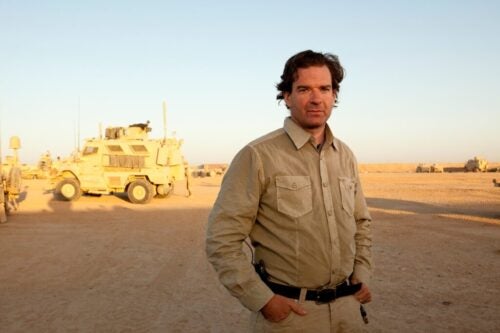
New America Vice President and former Fellow Peter Bergen spoke about Osama bin Laden, al-Qaeda, and his decades of reporting on terrorism for “Three questions” in The Fifth Draft, the Fellows Program’s monthly newsletter. Bergen is a journalist, professor, and author whose work focuses on terrorism, Afghanistan, and U.S. national security.
Your most recent book The Rise and Fall of Osama Bin Laden, is a complex and thorough biography of the former Al-Qaeda leader. Why did you decide to write this book now?
Al-Qaeda’s leader is also one of the few people of whom it can truly be said that he changed the course of history. With the 9/11 attacks, he set the course for U.S. foreign policy for the first two decades of the 21st century and he also changed the course of events in the greater Middle East in all sorts of unexpected ways. Also, in recent years a great deal of information has surfaced to illuminate bin Laden. First, there is the small library of documents found in bin Laden’s Abbottabad compound that were only released in full in late 2017, amounting to some 470,000 files. Secondly, many bin Laden associates have finally shown a willingness to talk. The result is that a decade after his death, it is now possible to appraise him in all the many dimensions of his life: as a family man; as a religious zealot; as a battlefield commander; as a terrorist leader; as a fugitive.
Al-Qaeda’s leader is also one of the few people of whom it can truly be said that he changed the course of history. With the 9/11 attacks, he set the course for US foreign policy for the first two decades of the 21st century and he also changed the course of events in the greater Middle East in all sorts of unexpected ways.
Over your decades as a journalist, you’ve focused on bin Laden, al-Qaeda, the Taliban, and terrorism more broadly. How has your reporting on these topics changed over the past twenty-plus years?
I’m a big believer in the utility of new documents. The Abbottabad files mentioned in the previous answer help explain the life that bin Laden and his family were leading while they were on the run following the 9/11 attacks and they also help illuminate how al-Qaeda and its various affiliates functioned after those attacks. They included a handwritten 228-page bin Laden family journal that recorded the lengthy discussions between bin Laden and his older wives and adult children in the weeks before his death. From these new documents, which amounted to 6,000 pages of useful material, many new insights have emerged about bin Laden and al-Qaeda.
You’ve worn many hats over the years: as a journalist, a professor, and as the Vice President of the New America Fellows program and the Global Studies program. How do these different roles inform each other?
They all build on each other. Take a subject like Afghanistan: I have taught classes about the Afghan wars at three universities. I also reported on those wars as a journalist since 1993, and have edited or written multiple books about Afghanistan and the Taliban. Each of these activities reinforces the others. When I teach I can draw on my own experiences of reporting in Taliban-controlled Afghanistan before 9/11. When I report I can draw on some of the academic literature I’m familiar with including Talibanistan, a book published as a New America project by Oxford University Press in 2014, which still is useful to understand what is happening today in Afghanistan.
Subscribe here to receive next month’s issue of The Fifth Draft.
Vice President, Global Studies & Fellows, New America; Professor of Practice, Arizona State University; Author, All the Presidents’ Wars