Maika Moulite
Senior Social Media Manager
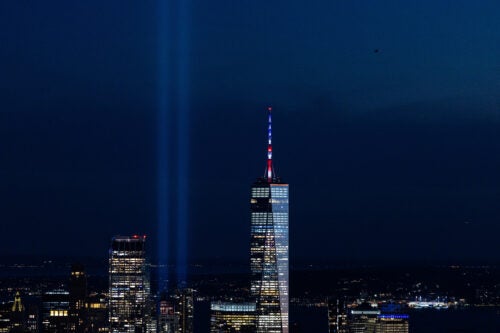
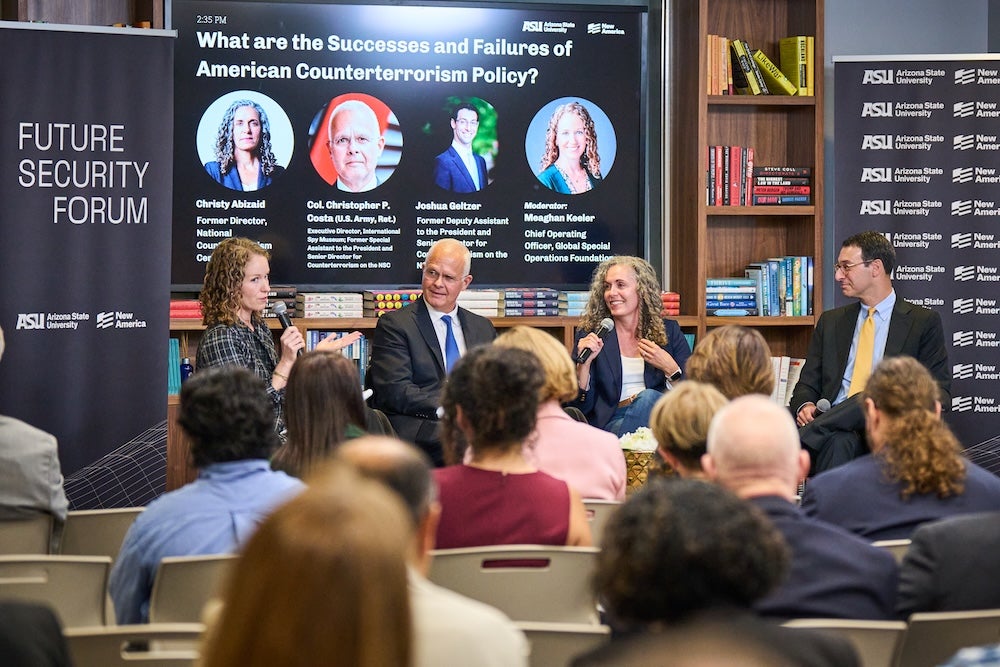
On September 15, Arizona State University (ASU) and New America hosted the 12th Annual Future Security Forum in collaboration with Global SOF Foundation, Security & Defence PLuS, the McCain Institute, and the Small Wars Journal. Twenty-five years after the attacks on September 11, 2001, policymakers, journalists, military leaders, and scholars considered what America’s post-9/11 wars have taught us—and whether those lessons have been applied for the betterment of our global security landscape.
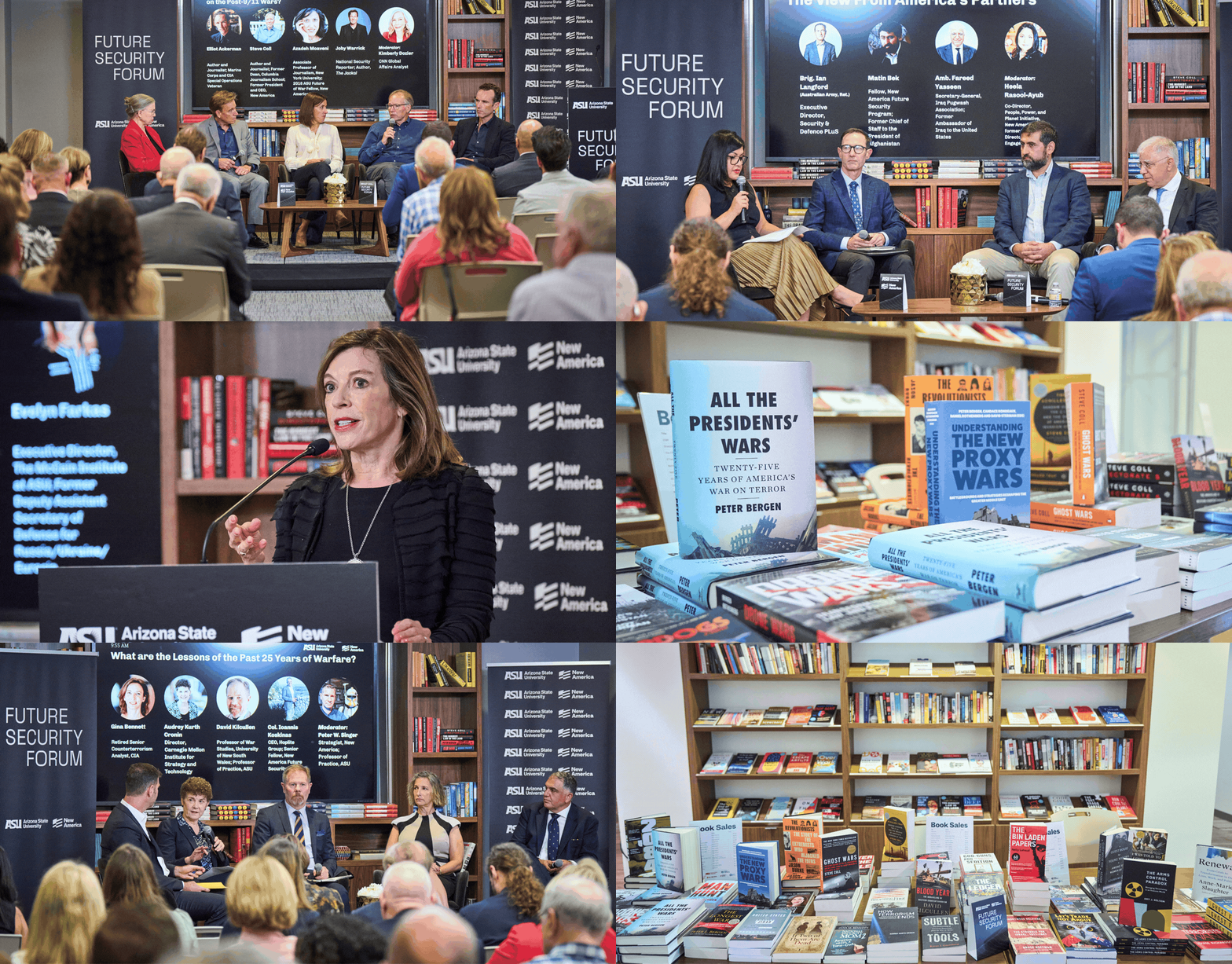
Panels throughout the day unpacked both the successes and failures of America’s counterterrorism efforts. Many of the experts made clear that while there had been tactical success, strategic oversight had come undone. The challenges of navigating U.S. structural bureaucracy created conditions focused on civil–military relations, reinforcing the lack of a political objective immediately following the attacks. Gen. Joseph Votel (Ret.), former commander of U.S. Central Command, described how battlefield wins in Iraq and Afghanistan then expanded into counterinsurgency and nation-building.

What did not go as well was the linkage of our tactical and operational successes on the battlefield to the strategic objectives. Over time, that became a much wider divide, which became really difficult to reconcile.
Dame Louise Richardson, president of the Andrew Carnegie Corporation, traced the failure to how the United States understood its adversary in the first place. Terrorism works, she explained, because it provokes an outsized reaction: “The great genius of terrorism is that the psychological impact is greater than the physical act.”
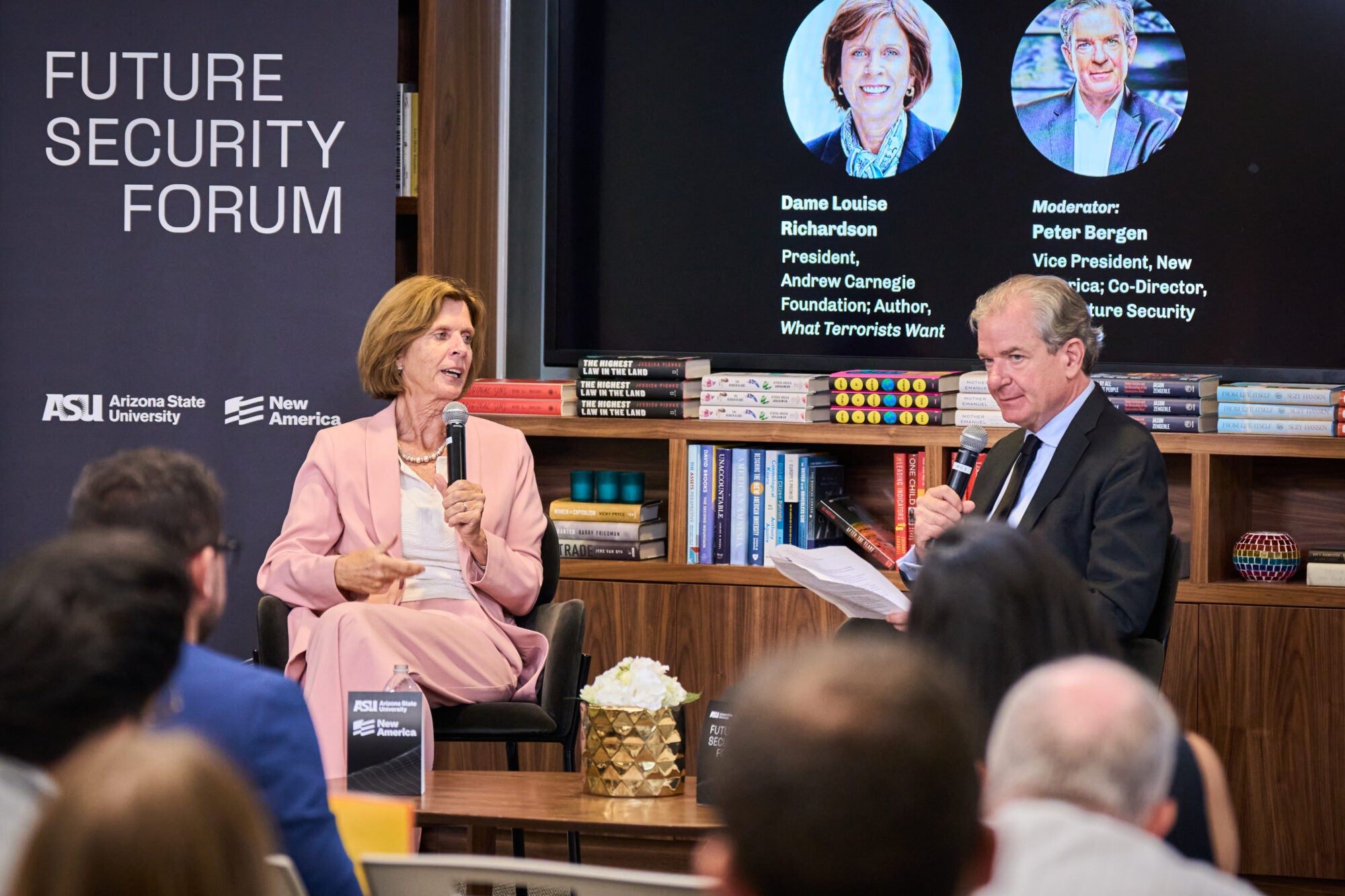
Brig. Ian Langford (Ret.) of Security & Defence PLuS called the American response “strategic hubris,” compounded by an underestimation of history and an overreliance on technology. And, as David Kilcullen argued, no amount of technological advantage compensates for fighting without a clear political end state.

My one lesson from the last 25 years is you can be a superpower, you can have the best technology in history, but if you fight a series of distant wars of choice against adversaries that are fighting close wars of survival, don’t expect to win.
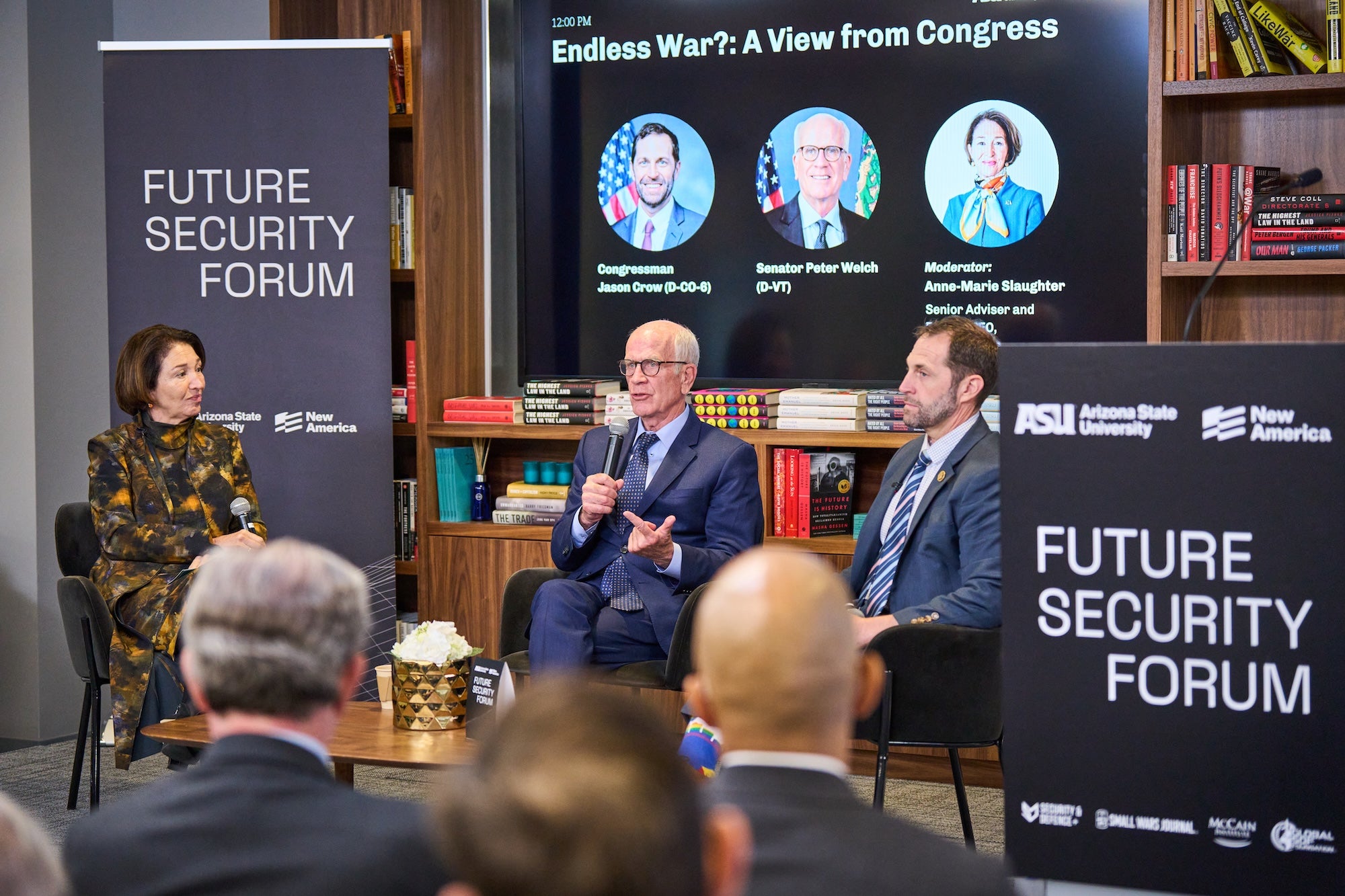
In a session on war powers and the role of Congress, former New America CEO Anne-Marie Slaughter invoked Thomas Jefferson’s 1789 letter to James Madison, which argued that the Constitution placed the power to declare war with the legislature, not the executive. Rep. Jason Crow and Sen. Peter Welch argued that the legislative branch has ceded too much authority over decisions to go to war and that their role is to assess difficult national security situations, even if that means pushing back against their own party.
Though conversations about strategy shaped the Forum’s panels, the day kept returning to the people who lived the consequences of these philosophical discussions. In the panel, “How Should the U.S. Respond to Hostage Taking,” Roger Carstens and Sandrea Hwang discussed the growing sophistication of recovery operations while acknowledging the evolving landscape. Caitlan Coleman, who was held by the Haqqani Network in Afghanistan for five years, described discovering how many people had been working on her case before her release without her knowledge. While support for returning hostages has improved, she noted, the support systems for affected families still lag behind the recovery effort itself.
Investigative reporter, Pulitzer Prize winner, and 2017 ASU Future of War Fellow at New America and former professor of practice at ASU, Azmat Khan, pointed to what she called a “reversion” of civilian harm lessons exemplified by recent conflicts in Gaza, Iran, Lebanon, and Syria. Journalists Steve Coll, Azadeh Moaveni, Joby Warrick, and Elliot Ackerman also described how access, safety, and trust have all narrowed since 2001, making it harder to understand what adversaries and civilians are actually experiencing on the ground.
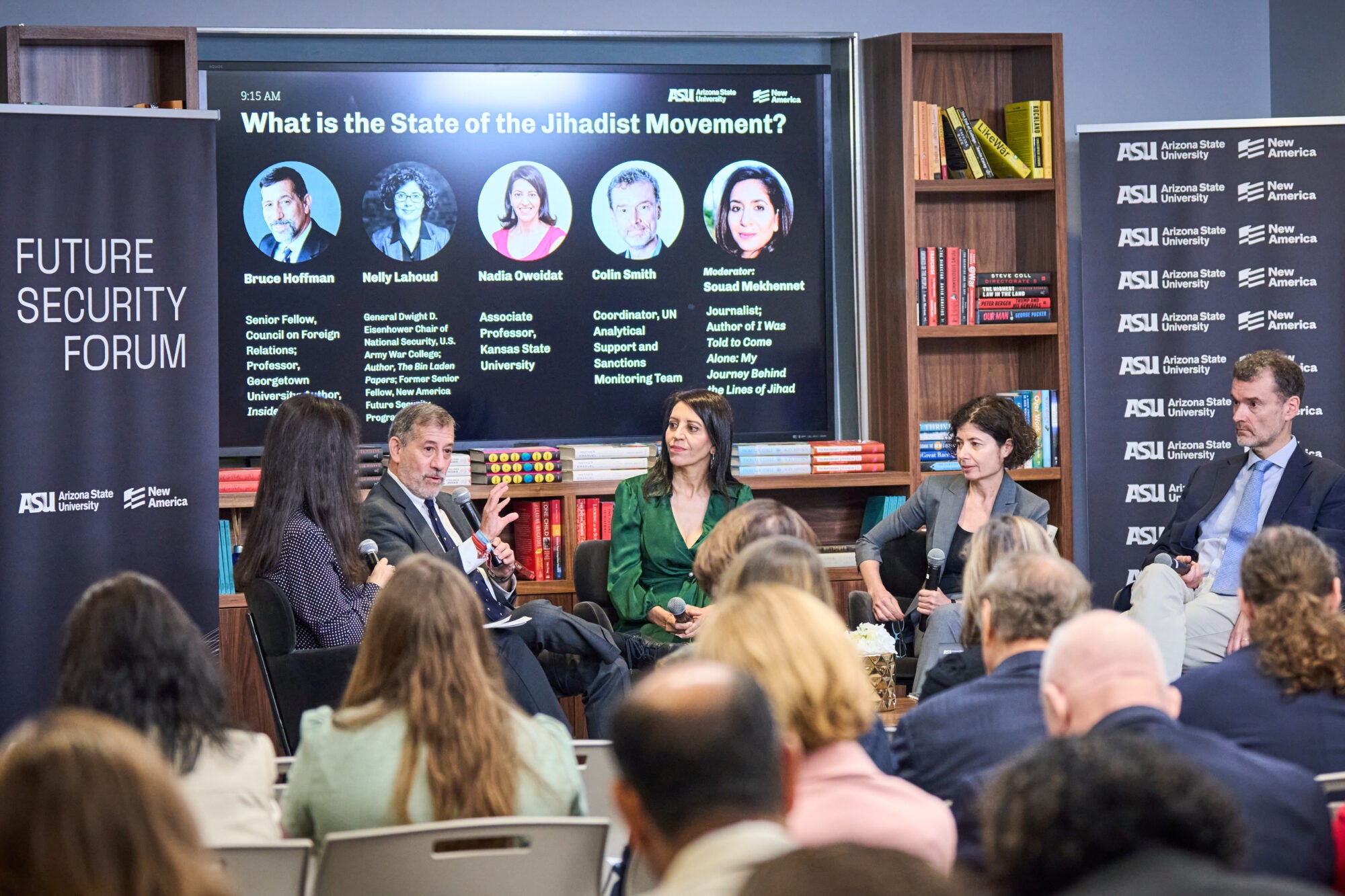
Several panels made clear that the hierarchical organization that the United States built its counterterrorism strategy around in 2001 no longer exists. Bruce Hoffman noted that today’s al-Qaeda is “completely different” from the one that carried out 9/11. Nelly Lahoud, drawing on her research into Bin Laden’s private correspondence conducted in part while a New America fellow, argued that the organization’s inability to announce the current leader of the movement is “fundamentally irreconcilable with al-Qaeda’s Jihadi world view on leadership succession.” Colin Smith of the UN’s sanctions monitoring team pointed to the movement of ransom payments as evidence that the network still plans and operates across borders. Nadia Oweidat added that ideas alone don’t spread without material support, a dynamic she traced over years of field research in the Middle East.
Christy Abizaid, former director of the National Counterterrorism Center, argued that the rise of online radicalization and lone-actor violence has made today’s threat landscape a fundamentally different intelligence problem than the U.S. faced in 2001. Artificial intelligence (AI) now also poses new risks that did not exist 25 years ago. Evelyn Farkas, executive director of The McCain Institute at ASU, considered the potential to regulate the technology in the same way that we regulate nuclear material. Audrey Kurth Cronin made a similar case for bioterrorism, arguing that it should not be framed as a speculative risk, but a predictable one that requires preparation before an attack takes place.
This year’s Future Security Forum highlighted lessons learned that could bolster the counterterrorism efforts of the United States and its allies. Whether those get applied—to AI, bioterrorism, or the next emerging threat—will be the real test of whether the last 25 years were, in Retired Colonel Ioannis Koskinas’s words, learned or merely identified.
Senior Social Media Manager
Communications & Engagement Manager, Security & Defence PLuS (S&D+)