National Security: What We Talk About When We Talk About Gender
Abstract
The following report provides an in-depth look and analysis into policymakers' views on gender inclusivity, awareness of gender theory, the inclusive security agenda and gender-differentiated data, and perceptions of the role of gender in national security policy processes and outcomes.
We asked a range of questions of the policymakers that covered not only the topics listed above, but also examined where gender is present, absent, and siloed as policy is formulated and implemented.
Research conducted by Rebecca Haller and Haller Strategies.
Acknowledgments
We'd like to thank Rebecca Haller, of Haller Strategies, for her work conducting the interviews and her insights on the research. Many thanks to Alexandra Stark for her feedback, and to Maria Elkin, Joanne Zalatoris, Laura Pratt, Brandon Tensley, Audrey Gu, and Alison Yost for their communication and editorial work.
This initiative is supported by the Compton Foundation.
Downloads
Executive Summary
Two years ago, our team asked a groundbreaking question: Was the growing body of social science around how gender affects security outcomes permeating the formal national security policymaking process?
In this new research, we return to that question, but in a very different political and cultural environment. A month after we released our initial findings, Donald Trump shocked much of America—his supporters included—by winning the 2016 presidential election, prompting millions of women to march across the country in protest. A year later, investigative reporting from the New York Times and the New Yorker kickstarted the #MeToo movement, inspiring other women to come forward with their stories of harassment and assault.
Since then, interactions of gender and security have entered the national debate in other ways: The sitting secretary of defense said, almost three years after the opening of all combat positions to women, that “the jury is still out” on how successful they are in those roles, and that “we cannot do something that militarily doesn’t make sense.” Administration officials have reportedly sought to remove the concept of gender from departmental websites and plans, as well as UN documents. Others have apparently developed approaches to remove the entire concept of gender—the socially-constructed way individuals perceive themselves and each other—from U.S. administrative law and replace it with biological sex only. These interviews were held in the run-up to the 2018 midterm elections, where perceptions of how women view politics, including security and insecurity, took center stage.
While we didn’t explicitly ask about discrimination and sexual harassment in the national security and foreign policy apparatus, half our interviewees raised those topics.
In some areas of the study, this second round of research found little to no change: Policymakers are still largely unaware of gender theory, the inclusive security agenda, and gender-differentiated impact data. But we did find stark shifts in tone, body language, confidence and comfort with the subject matter. In 2016, we struggled to recruit female participants. In 2018, we had to turn some away after they’d heard about the research from women who’d already participated. Our female interviewees had more anecdotes to share, while men were more reticent than two years ago. The men we interviewed took more pauses before responding and frequently caveated their responses to acknowledge they know they’ve had different experiences than their female colleagues, going so far as to suggest we ask them. We heard the word “empower” 18 times as often. And while we didn’t explicitly ask about discrimination and sexual harassment in the national security and foreign policy apparatus, half our interviewees raised those topics. In 2016, no one broached them.
What’s more, we saw these shifts across across genders, political views, professional experiences and age. This suggests that these changes were less indicative of the individual participants and more of shifting cultural norms.
By design, we followed the same discussion guide in each interview as we did in 2016 and intentionally did not inquire about nor reference relevant current events of the past two years. The following represent our top seven insights distilled from the latest research and compared, when relevant, to our 2016 findings.
Findings
1) Gender still “doesn’t come up” in the policymaking process.
Respondents—regardless of political leaning and gender—said, “it’s not something people talk about.” This comment often came with an almost apologetic caveat or at least recognition of it being an oversight in the process. Said one male respondent, “People would react strangely to it, frankly. Maybe that’s something that needs to be assessed, maybe it is a good question to be asked and why, or maybe it’s not. People would look at others sideways—it’s not part of regular discourse.” (Read more.)
2) The core social science behind both diversity practices and the gender and security field is still little-known, misunderstood, or contested among national security professionals. Core terminology, including phrases like gender mainstreaming, inclusion, and “women, peace, and security” (WPS), remain unfamiliar and evoke hostile reactions.
“I’m delighted to say I do not know [what gender mainstreaming is],” one respondent told us. “The idea that you could make a policy’s impact on a society without all people on society, that seems insane.”
Both men and women we spoke with agreed with the notion of making the security space more inclusive. Beyond the surface, however, we found significant gender gaps related to how men and women define inclusion. (Read more.)
3) Perceptions of what women’s roles and needs are have shifted—in some cases evolving, and in others, regressing.
In 2016, a significant number of participants offered stereotypes about gender roles and “soft” versus “hard” security in their thinking about what women had to offer in the national security space. We heard less of that this year, with participants across gender and ideological lines speaking much more frequently about the need for women in both peacemaking and peacekeeping roles. At the same time, some repeated old, essentialist arguments about why women, as nurturers, are better equipped and more interested in advocating for peace. (Read more.)
4) Participants were unified in identifying two sources of roadblocks: the Defense Department and leadership (or the lack thereof) within the interagency process. They saw fewer differences between administrations than outsiders viewing through the lens of partisan combat might expect.
Across agencies and administrations, nearly all our interviewees saw most roadblocks to gender inclusivity emanating from one of two sources: the Department of Defense or from interagency rivalries.
Some respondents discounted comparisons across administrations or ideologies. “I don’t see any evidence that the Republican establishment doesn’t take gender into consideration in policy discussions,” one said, adding that “there are exceptions to the rule in every administration.” (Read more.)
5) Policymakers are increasingly open to using more gender-differentiated data in policymaking, but still don’t know what that means exactly, or where to find it.
Gender-differentiated data on the causes and effects of conflict and various security policies is increasingly available, and social science is developing a broadening understanding of its relevance. Examples range from the correlation between conflict and indicators such as bride price or rates of violence, to tracking the movement of female populations as indicators of extremist group planning. While interagency policymakers and influencers became more aware of measurement data’s existence and its value, they remained unaware of what could be measured or how to find such data and metrics.
Impact data is still hard to find. But in a change from 2016, nearly all respondents welcomed the idea of it. (Read more.)
6) Women identify a lack of empowerment as the key barrier to ascendance in the national security field.
“There’s a culture of assumption perpetuated by both men and women that women don’t have a role to play in security and foreign policy,” one female respondent said. Women continued to cite education, training, and unequal caregiving roles—as well as outdated assumptions about those roles—as barriers. (Read more.)
7) Policymakers hesitate to identify gender as a factor that has influenced their working life.
This study found an extreme reticence in women and men, especially younger women, to ever call a gender issue a gender issue professionally.
Several male policymakers shared an inability to either decipher or admit when gender is, or is not, a factor in their own professional settings.
Several men and women ranked the likeliest blame of workplace issues in the following order: personality, age and then gender. (Read more.)
The following report provides an in-depth look and analysis into policymakers' views on gender inclusivity, awareness of gender theory, the inclusive security agenda and gender-differentiated data, and perceptions of the role of gender in national security policy processes and outcomes.
We asked a range of questions of the policymakers that covered not only the topics listed above, but also examined where gender is present, absent, and siloed as policy is formulated and implemented.
About the Gender and Security Project
Within the Political Reform program, we consider how gender interacts with all areas of democracy and governance, with particular attention to the field of national security. Gender-based violence is one of the best predictors of both intra- and inter-state conflict, and gender inclusion is crucial both for brokering peace abroad and negotiating legislation at home. Women remain underrepresented in situation and board rooms, embassies, and on the front lines.
This initiative is supported by the Compton Foundation.
Part 1: Inclusion, Diversity, and Gender Theory
Gender still “doesn’t come up” in the policymaking process.
The social science literature on how gender differences affect policy processes and outcomes—and how policymakers can see through a gender lens to improve outcomes from peace negotiations to counterterrorism—is steadily growing. But those insights are not being applied to American security policy-making. Our research found that policymakers have little or no knowledge of gender theory, lack exposure to research on gender-differentiated policy impacts, and simply do not factor in gender when shaping policies. Strikingly, we found no progress over the results of our original study two years ago.
In fact, respondents—regardless of political leaning and gender—said, “it’s not something people talk about.”
“I mean, look,” a male respondent said. “It doesn’t come up in a lot of policy conversations, rightly or wrongly. ‘What’s the effect of this policy on women?’ It doesn’t get asked. People would react strangely to it, frankly. Maybe that’s something that needs to be assessed, maybe it is a good question to be asked and why, or maybe it’s not. People would look at others sideways—it’s not part of regular discourse.”
Unlike 2016, respondents often added an almost apologetic caveat, or recognition that failure to think about gender was an oversight.
When the 14 participants were asked to list various factors that go into policymaking and implementation, none volunteered gender. However, when pressed, five—two men, three women; one Republican, one Democrat and one Independent—did say yes, it’s a factor. Men were more inclined to say no, even when probed, as were Republicans. Two women said the question of having women at the table is the only way gender comes into play.
The five who did see gender as a factor in policymaking had an important commonality: experience working at the United Nations.
The paradox of the UN’s role came up repeatedly in this study. At the UN, and in many countries’ national security establishments (as well as at NATO), gender inclusion and gender’s influence on policy outcomes have taken on heightened importance in recent years. “Taking gender questions into account when planning an operation could be just as important as considering the weather or the geography,” the Swedish Armed Forces Chief of Operations Jan Thörnqvist said in 2016. “All of that can make an operation more effective.”
We also asked policymakers and influencers about the theory of gender mainstreaming that inspired UN Resolution 1325 (2000), which urges inclusive representation in security efforts, stresses the importance of including women in the prevention and resolution of conflicts, and has created an entire subfield of study and implementation.
“It doesn’t come up in a lot of policy conversations, rightly or wrongly. ‘What’s the effect of this policy on women?’ It doesn’t get asked.”
Core social science is still little-known, misunderstood or contested.
Gender mainstreaming “dilutes the important”
The concept at the core of the UN work is “gender mainstreaming”—the idea that considerations of gender, both who is at the table and how policies affect people of different genders, belong in the policymaking mainstream. Only two of the 14 participants could define the phrase, both of the men who had spent time at the UN. Only one of 12 participants correctly defined the phrase in 2016.
Moreover, the majority, upon hearing the term, did not respond positively. Some suggested that “mainstream dilutes the important,” potentially pushing gender down the priority list.
Others perceived mainstreaming to involve singling women out for special or different treatment. One respondent went as far as to say, “I’m delighted to say I do not know [what gender mainstreaming is]. The idea that you could make a policy’s impact on a society without all people on society, that seems insane.”
Gender considerations have made more inroads in international development, health, and the so-called “soft” side of foreign policy. In 2016, study participants differentiated between “hard” and “soft” security issues, assuming that gender came up on the “soft” side more frequently. This year, however, almost no participants mentioned the hard-vs-soft dichotomy. One woman mentioned when Syria sanctions were being formulated at the National Security Council in 2011 as a case study of how gender does, or does not, factor into national security policymaking. I “don’t want to do an easy one, like poverty or water issues…” she said, before landing on the Syria example.
“How these policies could affect women never came up,” she said. “And you had people of every office there to brainstorm and come up with options and implications. I remember a woman coming in from the UN Women’s office and mentioning several times how we need to ensure women were safe and asking how schools would be affected. It wasn’t weird when I was inside government that we didn’t talk about gender, but it’s weird to think about now. If all comms go down, we didn’t think about the effect on women and schools. That got lumped under UN efforts. For all the UN’s flaws, they’re better at including impacts of policies on women. Funny, considering it’s such a bad place to work as a woman.”
“I’m delighted to say I do not know [what gender mainstreaming is.] The idea that you could make a policy’s impact on a society without all people on society, that seems insane.”
Gender as a synonym for women
The very concept of gender—the state of identifying as male, female, or nonbinary based on social and cultural constructs—is a heated battlefield in polarized U.S. cultural wars. That debate has not soaked through to the national security establishment. None of our interview subjects, from either side of the aisle, took issue with the term “gender.” Obama-era officials spoke with pride about the progress they had made “baking gender into the process.” “I see the progress in the statements coming out [of the] NSC and UN resolutions,” said one. “Gender is increasingly in the lexicon. I don’t know if that ball has been progressing over the last couple years, though. In the past, the U.S. has been the one pushing the agenda, so if current policymakers are not putting emphasis on it, it can erode.”
This same individual asserted that “there will always be a gender office at the UN because you can point to all these resolutions where there’s a section on gender and you can’t argue for closing the office.”
His confidence seemed to reflect a broader acceptance. No one offered support for the reported intent of the Trump administration’s initiative to replace the construct of “gender” with one of biological, determined-at-birth sex, including reported efforts to remove gender from UN documents, most often replacing it with “women.”
Indeed, however, many of our interviewees did treat gender as a synonym for women. Social science and advocacy efforts to stress that gendered lenses uncover particular needs and concerns of all people, not just women, do not seem to be taking root in policymaking. Significant opportunities to improve policy are likely being lost as a result. For example, young men’s inability to achieve the markers of successful manhood seems to be a significant driver of extremist group recruitment. The use of rape as a weapon, a threat and a tool of indoctrination against men or LGBTQ+ individuals, is also a significant feature of some conflicts.
“Women, peace, and security” remains unfamiliar and evokes hostility
Awareness or understanding of the UN initiative’s tagline phrase “women, peace, and security,” or WPS, had only grown slightly over the last two years. Four respondents (two men and two women) knew what the initiative was—as compared to only two women two years ago. These individuals mentioned both UN Resolution 1325 and the Women, Peace, and Security Act of 2017, which codified the UN’s goal of increasing women’s participation in security and peacebuilding into U.S. law, but provided no new resources for its implementation. One man commented on what he saw as the tenuous nature of the project by remarking that he couldn’t define WPS without using the word “tried”—as in, “tried to codify the protection of women in conflict zones.”
Policymakers had an implicit expectation that not every administration might be equally committed to gender concerns, and sought to address this by putting priorities into law:
“Legislation can be such a helpful tool, especially on the back half of an administration. We worked really hard with the Hill to get legislation through, not knowing who would be coming in next. Without that, it may have been lost if it weren’t legislation.”
Another policymaker felt that the machinery of government was making progress in sustaining a focus on gender, saying:
“Increasingly, with capital letters, those words have become not a given, but a sure path to sustainability in women. It’s important to advocate for the role of women and empower them in conflicts, as well as post-conflict. Formalizing it within the multilateral framework—baking it into our process of peacekeeping, but also [into] how USAID engages in post-conflict societies.”
As we found two years ago, most respondents worried that the phrase implied some kind of gender segregation, or even “dangerously [siloing] women off from peace and security.” This year, a woman who did know the phrase commented, “It makes it sound like something that’s not as well-integrated into actual peace and security. You shouldn’t have to call it out. You call it out because people aren’t doing a good enough job pulling it into consideration, but it shouldn’t have to be called out.”
The phrase brought up challenging and negative connotations for those familiar with it and especially for those encountering it for the first time, who interpreted it as an essentialist view of distinctly female roles or qualities related to peacemaking and peacekeeping.
In addition, female respondents tended to default to the idea that the primary gender challenge in the security field was protecting women in conflict—although UNSC 1325 was written, and has been implemented, to focus as much or more on extending agency to, not just protection of, women. Female respondents defaulted to a focus on keeping women safe even as they feared it automatically implies they are the weaker sex.
“Passing measures to protect women in conflict zones does more harm than good,” said one woman. “It’s important to recognize women may be impacted differently than men by a policy and that is fair game. But when it remains as vague as ‘protect women,’ we’re doing women a disservice.”
Perceptions of women’s roles and needs have shifted—in some cases evolving, and in others, regressing
In 2016, a significant number of participants offered traditional stereotypes about gender roles and “soft” versus “hard” security in their thinking about what women had to offer in the national security space. We heard less of that this year, with participants across gender and ideological lines speaking much more frequently about the need for women in both peacemaking and peacekeeping roles. This year, male respondents shared—as a positive—how “useful” and “empathetic” women are in the field. Asked where women have roles, a majority answered through a geographical lens, often exclusively.
“Maybe in some circumstances in AfPak, you’d want a man instead of a woman; some cases you’d want a woman versus a man,” one male respondent said. “Given backgrounds and cultures, sometimes a woman can get more information. Or, in places like Saudi [Arabia], you can’t send a woman in the room.”
Women, rather than focus on how specific, gender-based traits prepare them for specific roles, offered illustrations of how women reframe roadblocks, such as access or cultural norms, to get things done. They offered a range of ideas on how women professionals add value, including both competence-based and cultural arguments.
One woman traveled to the Middle East with Condoleezza Rice after she left office to meet with political leaders. There, “Condi and I would be able meet with the wives of the heads of state. [They] basically predicted the Arab Spring and said what all the moms were doing about it.”
“Condi and I would be able meet with the wives of the heads of state. [They] basically predicted the Arab Spring and said what all the moms were doing about it.”
Another described a meeting in the Gulf:
“Women often notice if no other women are in a meeting and will act on that observation to find the women and get their side of the story, whereas a man may not even notice. And you better believe if the women are not allowed in the meeting, there’s a strong likelihood they have a very different side of the story.”
“Women are the ones we wanted to empower in Afghanistan,” one woman said. “They were almost the litmus test. ‘How are the women doing?,’ we’d ask.”
Another echoed this sentiment, explaining that “the women in Afghan villages were much more willing to speak truth and report the rapes.”
The idea that women respond to different kinds of outreach is not new in the international development and health policy spheres, but it showed up in our security-focused conversations for the first time this year. To encourage more women’s participation in a recent African nation’s election, both in voting and working at the polling sites, a woman described how her team “targeted and made sure we thought about the role women played in election work. For example, we gave soap powder to women (it came from Iran so we had to get permission around sanctions), because women are caregivers and that’s important role they play.” This tactic was less a reflection on women’s skills and more an acknowledgement that in that environment, “women play so many different roles, including nurturers.” Therefore, she argued, “often it’s women in the communities we need to engage with. We should be doing more engagement through conversation.”
While some respondents focused heavily on women’s abilities, others made arguments about women’s supposedly inherent characteristics, a view that social science calls “essentialism.” They suggested that women are more concerned with peace than men because they tend to be nurturing, protective mothers and sisters: “The people with the most stake in peace are the women,” one woman said. “They want to protect their children, they don’t want sons to have to fight.”
Administrative champions and roadblocks, and the fallibility of partisan comparisons
Across agencies and administrations, nearly all our interviewees saw most roadblocks to gender inclusivity emanating from one of two sources: the Department of Defense, or from interagency rivalries.
As one DoD policymaker put it: “The military tends to say, we’re not the diplomatic branch of the U.S. government, we’re the fighting branch. We solve problems by fighting.”
While the defense community was broadly perceived as the lead roadblock, the State Department’s Bureau of Democracy, Human Rights and Labor (DRL) was frequently cited specifically as the first to raise gender in the policymaking process. This difference is visible in the strategic plans initiated for each department by the Trump administration. The State Department makes 18 mentions of “women” and nine of “gender” in its 62-page report. The Defense Department’s for FY 2018-2022 makes no mention of “women” or “gender” in its 38-page report. Four mentions of gender in the 78-page appendix, however, reference a harassment survey. As of October 2018, the USAID page on performance.gov features only Lorem Ipsum filler content.
Respondents also pointed to the outsized role of the National Security Council, which has steadily accumulated policymaking power at Cabinet departments’ defense. In addition, there is a perception that attention to gender needs to be commanded from the heights, rather than bubble up from below. As a result, the role of interagency coordination, and what does or doesn’t get coordinated, becomes important in a way traditional policymaking theories don’t account for. “If the USG mandates us to focus on [gender] more in policymaking, we’ll focus on it more,” one person said. “Politely, I don't think anyone in the military is going to take orders from UN.”
A senior-level policymaker at the NSC shared a 2009 anecdote in which gender played a surprising role in policymaking:
“With any broad development/diplomacy/defense packages we deploy and implement overseas, we have to report to Congress. On Afghanistan policies, there was competition between the White House and State. [State] wrote this report but it was missing any element of gender and female empowerment, which was a very important piece to the new Afghanistan policy—central really. It was about going beyond the numbers to focus on the empowerment of women. The joke is that women will chair the the Commission on Women’s Issues. They want to look beyond it and focus on healthcare and education and other things. We pushed back on State about the report and said it has to include gender. Clinton got upset we’d sent the report back to State and came over to meet with General [James L.] Jones. Once we all discussed the issue, everyone realized they’d let the rivalry get in the way of the policy.”
As UN Resolution 1325 marked its 18th anniversary this October, one respondent weighed in on where we are now versus where we’ve come. “I can’t say empowering women is not an element in current foreign policy, it was just bigger in the Obama days,” he said. “It was ‘not, not one’ in the Bush days. That’s not fair, it was more than ‘not-not.’ It was starting to bubble up then.”
Another, with experience in the current and previous two administrations, was quick to warn of the potential for fallacious comparisons of gender importance in policymaking across administrations or ideologies. “I don’t see any evidence that the Republican establishment doesn’t take gender into consideration in policy discussions,” adding that “there are exceptions to the rule in every administration.”
“I don’t see any evidence that the Republican establishment doesn’t take gender into consideration in policy discussions.”
Measuring impact: policymakers want gender-differentiated data, but don't know where to find it
The 2016 study found that policymakers lacked exposure to research on gender-differentiated policy impacts across the board and struggled to connect gender perspectives with policy outcomes. In 2018, two of the 14 we interviewed spoke in detail about gender-differentiated impacts, and another three acknowledged they did not know what they were, but were certain such measurements existed.
While interagency policymakers and influencers are more aware of measurement data’s existence and its value, they remained unaware of what could be measured or how to find such data and metrics.
However, we found a far less fatalistic view of the potential usefulness of gender-differentiated impact data than in 2016. Impact data is still far from commonplace and hard to find, but nearly all respondents welcomed the idea of it rather than discuss the roadblocks and challenges to such measurements.
“There’ve been gradual improvements on how to measure impacts in peacekeeping,” one respondent said. “Go back to Bosnia [in the ‘90s], it may have come up, but it wasn’t really talked about. In the late 2000s, you knew you needed to measure it but didn’t know how to do it.”
For example, “the easy metric might be how much polling staff are women? We may have that 50 percent metric, which is better than nothing, but we don’t have anything deeper about what roles they played, what influence they had, how it impacted elections, etc.”
Common sources cited when respondents were pushed to think about where they might go to find such metrics included the UN, USAID, and the State Department, as well as think tanks, although no specific ones were named. The problem most commonly-cited with gender-differentiated data was that “it’s varied and not consistent.” This mirrors what we learned in 2016. However, this year, there was more openness to such metrics, rather than simply citing the barriers and difficulties.
While there’s massive room for gender-differentiated outcome measurement improvements across the board in USG, the military and defense communities face the strongest cultural barriers, according to many in this study.
“We still have a long way to go with military, even with the younger generation,” one person said. “There’s such a culture there that has to be overcome.”
“There’s a bit of aversion to talking about these types of issues. Everyone in the military is a bit sensitive right now,” one participant with military and defense experience said. “If you’re the commanding officer, the fastest way to get into trouble is to have issues with sexual harassment or inclusivity; measuring those sorts of things, commands try to avoid it if they don’t have known issues. Which is probably why I’ve never heard of anything like [gender-differentiated outcomes] being measured before.”
“We still have a long way to go with military, even with the younger generation. There’s such a culture there that has to be overcome.”
Another echoed this culture of sensitivity and fear and added a more institutional barrier. “Units rotate in and out. [A] new unit comes in, so it’s hard to institutionalize the learnings that have come over time. Especially when people don’t want to talk about controversial topics in the office.”
Policymakers and influencers we interviewed spoke of wanting to be convinced by the data, but acknowledged how anecdotal evidence becomes a powerful tool. One person said:
“The most persuasive arguments are data-driven. But what can get it on policymakers’ radar is the data paired with the personal stories. In developing worlds, there’s an increasing body of proof: What has and will sway or motivate people in policy society is if you can show data on qualitative improvements in economic growth, as well as the human stories benefitting from those improvements.”
Part 2: Gender Representation
Empowerment and other barriers to inclusivity and inclusive representation.
In 2016 and 2018, all policymakers and influencers we spoke with said that bringing more women into the national security and foreign policy community would lead to improved outcomes. However, the driver behind this assumption seems to have changed. In 2016, we heard a more passive approach: “The door should be open to anyone.” In 2018, policymakers and influencers recognized the need to more actively seek out those with different experiences than them in order to strengthen policies. Opening the door is no longer seen as sufficient.
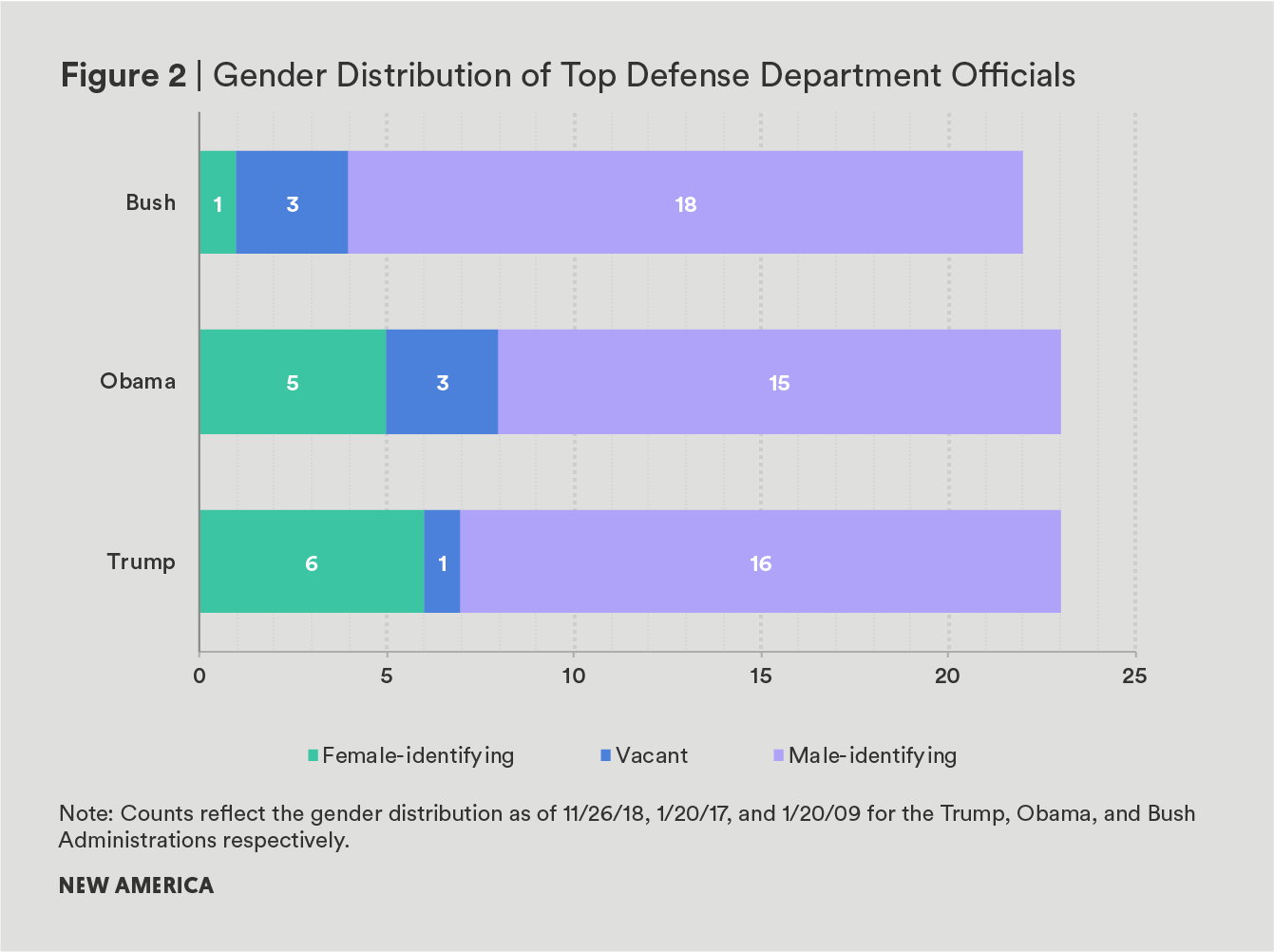
Gender representation differs dramatically between administrations, and among agencies. While comparisons are difficult because so many slots are unfilled, particularly at State, as of November 26, one in thirteen senior positions (Assistant Secretary and above) are permanently filled by women at State, compared to six at DoD. Neither number represents a significant shift from the final Obama years.

On the surface, men and women we spoke with favor making the security space more inclusive than it has been in the past. Below the surface, however, we found significant gender gaps.
“I think it’s already quite inclusive,” one male respondent said. “I’m trying to think how it could be more inclusive.”
When the men we interviewed discuss inclusivity, their approach tended toward the gender-blind: Just don’t consider gender as a factor. It’s all about having the widest possible array of information possible, and making sure roles are open, at least technically, to all.
“I think it’s already quite inclusive,” one male respondent said. “I’m trying to think how it could be more inclusive.”
“I’m much more of a consequentialist. What is getting our best information: man, woman or drone?” one man said.
Another echoed this sentiment by saying, “I’m of the mindset you get the best people, really talented people on the ground and in the room, whether or not they are male or female.”
A third said of women on the ground in conflict situations, “Women are incredibly useful, but I don’t draw a gender distinction. I don’t think, ‘oh, if only we had a woman or a man who could get that information for us.’ It’s whoever can best get the information.”
Notably, male respondents struggled when pressed to articulate a formula for when to turn to a woman for a job versus a man.
Women, however, both saw a need for more attention to diversity and saw the physical representation of different kinds of people as an essential ingredient to achieving diversity of ideas, information and views.
“When demographics don’t represent the demographics of the broader population, there is progress to be made there,” one woman said.
A male peer echoed that sentiment, explaining inclusive representation is “very, very important from image to ability to personally relate to the population you’re protecting. If Group X is 75 percent of the police force, but only has one representative in parliament, I’d say you’re setting yourself up for a coup.”
“By having the broadest set of views and backgrounds in the process from the start, you eliminate, or at least lower, unintended repercussions down the line.”
“The richest, smartest foreign policy seeks a variety of experiences and outlooks, including those affected by the policy,” one woman said. “By having the broadest set of views and backgrounds in the process from the start, you eliminate, or at least lower, unintended repercussions down the line.”
Female respondents were conflicted, wanting to see everyone held responsible for promoting diverse viewpoints, but also recognizing that doesn’t always, or even often, happen: “It’ll always be a woman who chairs the proverbial Committee on Women’s Issues.” Yet all recognized they have unique points of view to bring to the decision-making process—even if it “pisses [them] off [they’re] still seen as providing the ‘female perspective.’”
“Men can’t see the ideas and opportunities women present,” one woman said. “[It’s] not out of malice; they simply haven’t had the same experiences.” Only one male respondent broached the idea that “men can be promoting issues, too.” “People think Latinos push Latino issues and women push women’s issues.”
“In general, women are more mindful of achieving win-win situations and making sure all parties are accounted for even if they aren’t at the table,” a female explained. “Trust me, I do not want men speaking on behalf of my experiences. But I’d love it if they’d think to include a female perspective. That’s what we need, really: leadership.”
Some cited leadership challenges at both national and global levels as barriers. “With the U.S. withdrawing from its leadership roles in some of these spaces, someone needs to take it on,” one respondent said. “The Swedish government has stepped up. We need more Swedish governments.”
In addition to an overall lack of understanding and leadership, respondents also mentioned funding, prioritization, and socialization as barriers to inclusive representation in security.
“Funding cannot be understated,” one person said. “There’s a budget-policy alignment process you have to have for anything we’ve ever implemented. Socialization is also important. For all of these things we’ve had public information campaigns, rollout plans—even if we don’t call it that. That has to continue. It takes years to socialize new concepts.”
While different forms of requiring diversity have gained support in the non-profit and corporate sectors, and some international bodies feel that their experience with gender quotas has been a positive one, attitudes toward quotas in the national security space remains uniformly negative.1 All interviewees felt they harm rather than help gender issues. “If you lay out the job requirements and desire diversity among the best candidates, that’s the better approach,” one person said.
“Trust me, I do not want men speaking on behalf of my experiences. But I’d love it if they’d think to include a female perspective. That’s what we need, really: leadership.”
Key barriers to women’s ascendance in the field
Policymakers agreed having more women at the table was critical to creating more effective policy. This marked a notable increase in male respondents’ perceiving the lack of women in national security and foreign policy as a problem, and stating beliefs that the more diversity around the table—e.g. gender, race, age, experience—the better the policy.
In 2016, most men and women we interviewed cited the influence of older generations, and women’s focus on family, as key reasons for the slowness of women to gain equal status within the national security apparatus. This time, we found male policymakers and influencers far more resistant to offering up their perspectives on such barriers, many suggesting we “ask [their] female colleagues,” and saying they did not feel qualified to answer—a response that never arose in 2016.
Women’s responses have also shifted in the last two years, falling into three buckets of explanations for women’s low representation in policymaking circles. However, all three categories stem from the same root cause: a lack of personal and structural empowerment. Women’s explanations for how that lack of empowerment is felt split along generational lines: Women above 40 more frequently cited a lack of empowerment at the cultural and institutional levels, acknowledging that gender was a factor that shaped their career. In contrast, women below 40 focused more on the personal level, blaming themselves for not applying for the more senior roles that their peers were.
First, women felt that the culture, both in and outside government, still doesn’t tell women they belong: “There’s a culture of assumption perpetuated by both men and women that women don’t have a role to play in security and foreign policy,” one woman said.
Education and training play a big role here, female policymakers and influencers said. Another female respondent said:
“A big systemic issue is there’s just a different system of grooming people for these jobs from the beginning. Are we telling women what their participation in foreign policy roles could look like? Are we showing them all the options like logistical management of special ops and intel analysis and coercive economics? It’s broader than just combat. It’s a decades-long challenge of integrating women to help them acquire the right skills. Promoting STEM could help, but is it enough?”
Once women do enter the broad field, we heard throughout the study that both cultural and institutional forces box women into certain policy areas and out of others. As one woman put it:
“Men are generally trained on conflict, politics, economics, rarely going into healthcare, human rights and children’s issues. Men feel much more comfortable in a very constrained area, so it’s been left with women to oversee anything related to education, women, the elderly, human rights and children. Those are good topics for women, but then the assumption is women are not interested in the other policies. Men have always had a more narrow issue scope and are to blame. Men say, ‘we’ve taken care of those differences now. Women are equally interested in foreign policy and economics.’ That again is trying to push women into this really small box that they inhabit as some kind of norm. I’d argue we need to redefine the norm as the broader spectrum of how policies impact societies, both economically and from a human rights perspective.”
A male policymaker with military and intelligence experience noted that these limiting misperceptions have been perpetuated over decades, and DoD still doesn’t do much to debunk them publicly.
“The majority of jobs in the military can be male or female. There are very limited jobs where having muscles and endurance [to] wear a ruck and walk for weeks through the desert in Afghanistan [is required], but that’s where it becomes very complicated. Given the particular sacrifice those people are making for country, we don’t want to put them in danger. The military is collecting and measuring this stuff now, so we all need to get behind policy changes and be open minded.”
Notably, two years ago numerous respondents volunteered their concerns about women in combat as a response to gender inclusion. This time, we only heard one reference, framed through a more forward-looking lens, which suggested to us that women’s combat roles have gained broad acceptance among national security leaders (contrasting, again, with ideological culture wars).
A few women, including one who ran policy coordination and development for two presidential campaigns, cited the field’s reliance on specific career achievements, or credentialing, as one reason it is so difficult to find females in foreign policy.
“It’s broader than just combat. It’s a decades-long challenge of integrating women to help them acquire the right skills. Promoting STEM could help, but is it enough?”
“Women face enormous issues around getting credentialed in foreign policy,” she said. “I had 200 men working on policy for the campaign, and ten, no, probably more like seven women, and that was very hard to get. How can you develop foreign policy without women at the table representing potential impacts of the policies on women?”
Generations see challenges differently
Notably, women cited struggles of balancing family and children as a professional obstacles less than in 2016. Women 40 and older bemoaned the cultural assumptions that still leave mothers with heavier burdens to shoulder.
“These jobs are often very demanding on time and travel,” one said. “We still have a social-professional demand on people that makes it hard to do it all for women. At daycare for my kids, there’s still the assumption women will be the primary contact and volunteer.”
They also mentioned how much goes into managing a household that all too often falls to the woman in the upper-middle class culture to which national security professionals typically belong or aspire.
“You have to be outstanding at your foreign policy role, as well as at the executive level in managing the household perfectly and the au pair and the housecleaner,” one woman in her mid-40s said. “You make it all happen, it just requires this whole process—and if you’re not really damn good with a Google Doc, you’re toast.”
For women under 40, they agreed that you just make it work, but framed the challenges differently. “Arguably I didn’t face the same issues my mother faced,” one woman in her 40s said. “For me, I didn’t feel like there were significant barriers to achievement.”
The younger set saw the challenge not so much as a lack of opportunities or the barriers to entry—but as having confidence in a difficult environment.
“Speaking internationally on behalf of the United States? I’m very comfortable with that,” one woman said. “But in those DAS [Deputy Assistant Secretary] and AS [Assistant Secretary] jobs, you were always filling in on those meetings for the secretary or undersecretary and sometimes it would be issues I didn’t work with every day. The challenge is the confidence and courage to stand up and speak up at the table.”
“We still have a social-professional demand on people that makes it hard to do it all for women. At daycare for my kids, there’s still the assumption women will be the primary contact and volunteer.”
And several of the younger women offered the same nuance on who, exactly, was helping them move forward: “I’ve had the best male bosses in both administrations I’ve worked,” one said. “They promoted me and I credit them with my career. But it’s the women who are better about asking for my opinion in meetings, encouraging me to speak up. It can be hard when you’ve got two generals at the table who have stars. The other men at the table might not even notice I haven’t spoken up or offered my opinion.”
Policymakers hesitate to identify gender as a factor that has influenced their working life.
For all the talk of empowerment of women in these interviews, this study found an extreme reticence in women and men, especially younger women, to ever call a gender issue a gender issue professionally.
One woman recently left the administration after nearly two decades of service and still grappled with what ultimately pushed her out earlier than planned.
“I’ve worked for great bosses, male and female, in Bush and Obama administrations, and gender was never an issue. Sadly, it’s changed a lot in the last year. With this administration, it was a whole new deal. My new boss came in and he was intolerable. He empowered a man who worked for me over me. Maybe it’s not a gender thing, I don’t know. It’s hard for me to accept that my boss really had an issue with women. Rumors existed from Transition Team and I just can’t believe it. Could have been a personality clash.”
Several male policymakers shared an inability to either decipher or admit when gender is, or is not, a factor in their own professional settings. One said:
“I’ve watched a lot of those power players work and it would be hard for me to say. I worked for [Robert] Gates early in my career then I read in his book he has a disdain for young people. Michèle [Flournoy] respected everyone, it was almost reverse sexism. Samantha [Power] was a bulldog and men would not want to engage she was so relentless … Gender plays a role for sure, [but] I just can’t put age, personality and gender into neat columns.”
Several men and women ranked the likeliest blame of workplace issues in the following order: personality, age and then gender.
When we asked interviewees whether they believed their colleagues shared their views, men were more likely to believe their views of gender to be typical of that of the national security apparatus. But compared to 2016, we heard more men hesitate this year. Several started their response with “I don’t know,” something we didn’t hear a lot of in 2016.
Women, however, didn’t hesitate. Many expressed a core view of the field at odds with the confident talk about empowerment.
“My generation changed over time and we didn’t have a chip on our shoulder,” one woman said. “We were deluded that you could have kids and a family and a career. We thought you could have it all. Nobody told us that gender was an issue. I’m still briefing people as a female? Really? I’m actually more pissed about it now at 50. It just never ends, the inequality. That drives me nuts. I didn’t want to be in a women's group. I didn’t want to be hired because I am a woman. I didn’t fully appreciate it, [but] there was a point where it worked for me to be a woman and I didn’t appreciate all of the obstacles and subtle things we deal with.”
Another woman summed up the sentiments of so many women with whom we spoke about what it means to redefine the norm.
“There have to be pioneers,” she said. “And being a pioneer is horrible.”
“It just never ends, the inequality. I didn’t want to be hired because I am a woman. I didn’t fully appreciate it, [but] there was a point where it worked for me to be a woman and I didn’t appreciate all of the obstacles and subtle things we deal with.”
Citations
- An extensive social science literature documents the experience with quotas globally. See Susan Franceschet, Mona Lena Krook, and Jennifer M. Piscopo, eds., The Impact of Gender Quotas, (New York: Oxford University Press, 2012). Mona Lena Krook, “Gender Quotas, Norms, and Politics” 2 (March 2006): 110-118.
Part 3: Looking Ahead
Opportunities and Recommendations
The disconnect between gender and security policy illuminated in our 2016 research still exists. But policymakers are newly open to changing the status quo, across gender, ideological, and generational divides.
We propose three practices that have application in and out of government, in military and civilian environments, for think tanks, advocacy organizations, philanthropy and journalism—in some case, practices already adopted in the private sector (such as the ban on employee participation in all-male panels adopted by media organizations Bloomberg and the Financial Times.)
1) Model what we want to accomplish through setting best practices, sponsorship and mentorship.
The data are increasingly clear that diversity practices and gender analysis do not get adopted from the bottom up. As General (Ret.) Janet Wolfenbarger, the head of the Defense Advisory Committee on Women in the Services and first American woman to gain four-star rank, told the Halifax Security Forum in November 2018, "in order to make real progress, the change has to be emulated at the senior-most levels within your organization, at which point you can hold accountable all the subordinate levels."
Leaders also need to attend to questions of organizational culture and practice, from promotions to public speaking. Large organizations in the national security space have begun to publish their own diversity statistics. The federal government—or Congress, if the Trump administration is unwilling—should return to the practice begun by the Obama administration of publishing diversity statistics.
Our research highlights the critical role played by mentors in advancing national security careers. Leaders can encourage mentoring for women through formal programming. Research suggests that the most effective mentoring is a sponsorship characterized by a mutually beneficial exchange between a sponsor and a protege: The sponsor looks out for career opportunities for her protege, gives her stretch assignments and promotes her work, and the protege is a dependable asset for her sponsor’s agenda and ideas.
Leaders should encourage, and younger women should seize, opportunities presented by organizations like Foreign Policy Interrupted, the OpEd Project, Women in International Security, or Women of Color Advancing Peace and Security. Those organizations, for their part, could do much more to disseminate international best practices and social science around gender analysis.
2) Build datasets that will allow gender-differentiated assessments, and build policy processes that reward their use.
Policymakers repeatedly said they seek out “all available information and intelligence” in developing policy options and were open to data on gender impacts, yet didn’t know where to look for metrics. Case in point: “The amount that goes into policy options papers, the amount of research, [is] usually turned around in weeks or a week or a day and they have appendices,” one policymaker said. “You pull together anything you can get your hands on.” Gender lens advocates both in and out of government should focus on developing such data, along with training and best practices for using it. Several dynamic repositories of gender-differentiated research and data already exist, from Professor Valerie Hudson’s Womenstats, to CFR’s interactive gender research, or the World Bank’s Women, Business and the Law, just to name a few.
Building the datasets isn’t enough, however. Policymakers and academics have an immense responsibility to teach next generations to seek it out and use it. As New America has found in prior studies, currently that isn’t happening—new cohorts of public policy graduates are emerging just as ignorant of gender theory as their predecessors.
In addition, it’s time to think about building a gender lens into reporting and clearance processes. USAID’s experience in this area during the Obama years should be studied for its relevance to other agencies. If the current interagency policy process is unable to support reform of this kind, individual leaders can make a point of building it into their own clearance processes. Congress, moreover, can make a point of including a requirement for analysis of differential impacts on people of different genders into its many reporting requirements and hearing questions.
3) Rethink jargon. Instead, tell stories and connect them to data.
Data is great, especially when it’s paired with narrative: Research shows that people tend to remember arguments and ideas better when they are integrated into a story—preferably one about a person. Organizations like Peace is Loud and the Fuller Project are doing work to translate gender and security research into compelling narratives. Much remains to be done to shift the way major media organizations tell stories about national security, where narratives are gendered male, and women are all too often either invisible or victims.
Appendix: Methodology and Participant Range of Experiences
About the Research
New America commissioned Haller Strategies to conduct research among U.S. policymakers and influencers to understand national security policymakers’ perceptions around gender. This study is the follow-up to one conducted in summer 2016. .
Haller Strategies leverages a design-thinking approach to qualitative research. Our methods are rooted in ethnography, anthropology and psychology, allowing organizations to gain better insight into what makes people tick. We conducted one-on-one, hour-long, in-depth interviews with 14 highly-targeted national security and foreign policymakers and influencers — parallel but not the same as those interviewed in summer 2016. In 2018, we asked the exact same questions as we did in 2016.
About the Participants
Interviewees had a vast and diverse range of experiences across the national security and foreign policy apparatus. They had held high-ranking posts within the Departments of State, Treasury and Defense; the White House and National Security Council (NSC); the military; the United Nations (UN); the Central Intelligence Agency (CIA) and Congress, as well as private sector and nonprofit organizations. By design, each participant had experience in at least two policymaking organizations within the United States government. We sought diversity in professional experience, political orientation, age and gender.
White House & National Security Council:
Deputy National Security Advisor
Deputy Assistant to the President
Senior Advisor to National Security Advisor
Senior Director, Executive Secretariat
Director, Strategic Planning
Director, Middle East Affairs
Director, Afghanistan and Pakistan
Director, Press & Communication
Director, Syria & Lebanon
Director, Middle East and North Africa
Executive Assistant to the National Security Advisor
Department of Defense:
Deputy Secretary of Defense
Under Secretary of Defense for Policy
Deputy Assistant Secretary, Defense for Russia/Ukraine/Eurasia/W. Balkans
Special Assistant to the Secretary of Defense to the NATO Summit
Special Assistant to the Under Secretary of Defense for Policy
Senior Advisor to Supreme Allied Commander, Europe and Commander, U.S. European Command
Senior Policy Advisor, Office of Secretary of Defense
Senior Policy Advisor, Office of Secretary of Defense
Senior Policy Advisor, Middle East Issues
State Department:
Special Assistant to the Under Secretary for Political Affairs
Special Assistant to the Special Envoy for Middle East Regional Security
Senior Advisor, Strategic Planning & Crisis Communications
Executive Committee member, Public-Private Partnership for Justice Reform in Afghanistan
USAID:
Deputy Assistant, Policy Planning and Learning Bureau
Senior Policy Analyst, Policy Planning and Learning Bureau
Deputy Coordinator for Middle East Transition Response
Senior Program Analyst, Offices of Policy & Strategic Planning and Project Design
Senior Field and Democracy Advisor, Democracy Conflict and Humanitarian Assistance Bureau
Program Officer, Office of Transition Initiatives
Department of Treasury:
Deputy Assistant Secretary, Office of Terrorist Financing and Financial Crimes
Chief of Staff and Senior Advisor to the Under Secretary
Special Advisor to the Deputy Assistant Secretary, Terrorist Financing and Financial Crimes
Senior Advisor, Under Secretary for Terrorism and Financial Intelligence
Senior Advisor, Assistant Secretary for Terrorist Financing and Financial Crimes
Treasury Liaison to U.S. European Command
Spokesperson, Terrorism and Financial Intelligence
Senior Policy Advisor, Treasury
Policy Advisor, Middle East, Terrorist Financing and Financial Crimes
Policy Advisor, Strategic Policy
Senior Advisor, OFAC Director
Assistant Director, Strategic Policy, Terrorist Financing and Financial Crimes
Congress:
Professional Staff Member, Armed Services Committee, House
Rosenthal Fellow, U.S. House of Representatives, Foreign Affairs Committee, Senate
Senior Foreign Policy Advisor, Senate
Military:
Officer, Army
Naval Intelligence Officer
Professor, U.S. Marine Corps. Command and Staff College
More About the Authors

Elena Souris

Elizabeth Weingarten

Heather Hurlburt
Director, New Models of Policy Change