
My File: A Collaborative and Open-Source Approach to Transforming Public Service Delivery
Abstract
As public trust in government reaches historic lows and income inequality rises, seamless access to trustworthy public services is critical. My File is an ambitious digital solution designed to meet this need—a mobile-first, open-source platform for the secure storage and sharing of vital personal documents, such as IDs, social security cards, and birth certificates. It makes it easier for users to decide what documents to share and direct who to share the documents with and for what purpose. Developed through a collaborative, public-interest approach, My File is a scalable, replicable digital public good grounded in human-centered design principles. The solution is customizable for use-case and jurisdiction. Currently, the platform connects New York City families experiencing homelessness to city services.
This report examines My File’s development, implementation, and sustainability—offering key insights, solutions to common product development challenges, and details on the project’s white-labeled codebase. These findings and analysis contribute to the broader discourse on digital public goods. To learn more about the My File code repositories and project documentation, please visit our GitHub.
Acknowledgments
This project is powered by countless individuals and organizations committed to creating impact through public programs. We are grateful for our partnership with the dedicated team of public interest technologists with NYC Opportunity, especially Darnell Sessoms and Haiyan Sui. The work of NYC Opportunity proves that every city and state could benefit from applying evidence and innovation for more efficient and effective government services that serve the public well.
DIGI’s replication team engineer Aleks Fadini is a joy to work with. He took on the challenge of white-labeling My File with enthusiasm, patience, and a deep appreciation for open-source solutions. My File was also strengthened by the expertise and insightful guidance from New America and NYC Opportunity staff and alumni, including Muhammad Asghar, Yuriy Berezskyy, Brandon Cespedes, Lilian Coral, Dahna Goldstein, Neyva Hernandez, Rebecca Ierardo, Pavel Ilin, Farah Khan, Bermet Kydykova, Alexis (Lex) Morant, Wesley Reid, Alberto Rodríguez, Silvana Rodríguez, Jaylene Rubio, Andreen Soley, Emily Tavenner, and Ellen Zeng.
We would like to thank Ford Foundation, Gates Foundation, and the Rockefeller Foundation for their generous support of this work.
Editorial disclosure: The views expressed in this report are solely those of the author(s) and do not reflect the views of New America, its staff, fellows, funders, or board of directors.
Downloads
Introduction: The Case for Change
Collaborating on an open-source digital solution can simplify and streamline critical government services, which makes life easier for both families applying for services and the public servants working tirelessly to deliver for them. Leveraging a relatively straightforward technology solution, such as a dependable document management tool, can significantly enhance the accessibility and efficiency of public services while giving users more agency over their personal information.
There is a demonstrable need for governments to deliver meaningful, trustworthy, and reliable services, especially at a time when public trust in government is near all-time lows and income inequality is rising. Across federal, state, and local levels of government, digital solutions are purchased far more often than they are developed in-house. This leads to proprietary, often-redundant, technologies utilized across government, due to a fundamental misalignment of incentives between the public and private sectors.
There are ways to improve this status quo through human-centered best practices in the delivery of public services. Open-source code is one of them.
Potential for Scale and Replication
Open-source software solutions, sometimes referred to as FOSS (free and open-source software), are powered by a codebase that is freely accessible under an open access license and has more user and implementer benefits than proprietary vendor-led development.
Advantages of open-source solutions include:
- Cost savings.
- Customization to meet specific needs and ensure better alignment with operational requirements.
- Collaboration and community design, use, and management—contributes to security and improvements.
- Not dependent on a single vendor for updates, pricing, or support.
Any software incorporated into operations brings with it responsibilities. Open-source code must be maintained so it doesn’t become cumbersome or obsolete. It may be free, but it needs care.
Open-Source Software for Public Benefit
Reconceptualizing how governments build solutions and provide public services and programs is a critical step to developing better outcomes for communities. Discussions around the feasibility of implementing open-source in government touch on a wide array of topics including cybersecurity, capacity, public procurement, sustainability of digital public goods, cloud computing, open data, and open government policies.
An open-first agenda for public solutions is achievable, and many governments, at all levels, are exploring this model for efficiencies and cost savings. Governments could also use their purchasing power and require solutions to be open by default. Much of today’s technology ecosystem is already powered by open source. Up to 96 percent of codebases include free and open-source software.
Examples of open-source software in the provision of public services in the United States include Code.gov, Simpler.Grants.gov, Login.gov (one account for access to participating government agencies), CiviForm, and the California Open Source Portal.
Among notable examples of open-source software in the administration of public programs outside of the United States: Switzerland requires all government software be open source, modeling a “public money, public code” approach; more than 21 million Ukrainians use the open-source Diia application to access public services; and the Mojaloop Foundation maintains software to build digital financial services.
The concept of digital public goods has been circulating among the tech-for-good community at least since 2017 and has gained some popularity in policymaking circles. Digital public goods can take the form of software, datasets, AI models, standards, or open content that are generally free, adhere to applicable laws and best practices, do no harm, and contribute to sustainable digital development.
The idea of open source has been around far longer, dating to the advent of computer software. The two concepts are very much intertwined, and although there tends to be a divide between implementation models of tech developed in the public interest in the United States and solutions created internationally, we believe momentum is building to close this gap as practitioners can more easily share what is working to create public value irrespective of locality.
About My File
My File is a project of the Digital Impact and Governance Initiative (DIGI) at New America. The platform is designed to help people applying for public services to store, retrieve, and share vital documents in a simple and secure manner. It is an efficient, effective, and accessible provision of public services informed by human-centered research. While the solution accounts for the complexities and realities facing individuals and families seeking access to public programs, it is also a tool to improve access to those services.
The system is open source, and the code repositories and quickstart guide are published to the My File pages on New America’s GitHub.
Key Features
For many people—particularly those experiencing homelessness or other significant disruptions—maintaining personal documents can be challenging. Frequent moves, estrangement from families, or the loss of one’s home make it difficult to access current, organized files. Lacking appropriate identifying documents makes all processes difficult and time-consuming for residents and government workers and is a primary factor for delays in, and even denials of, services.
The basic functionality of My File is simple and straightforward. Users can securely upload, manage, and store encrypted copies of vital documents such as ID cards, Social Security cards, and utility bills—all documents required to access such public services as temporary or permanent housing—with the ability to view, download, or delete them at any time. When applying for services, users can choose to share documents, while program administrators can sort, download, and update the status of documents and applications.
In Action: My File NYC
The system is operational in New York City, where the focus is to better support families in the temporary-to-permanent housing journey. My File NYC is managed by the Mayor’s Office for Economic Opportunity (NYC Opportunity). The NYC Opportunity team partners with agencies to improve the systems of government and make the city’s social service programs more effective, efficient, and responsive. My File NYC is deployed with the Department of Homeless Services for families applying to Prevention Assistance and Temporary Housing (PATH) and is scaling to an additional use case with Housing Preservation and Development (HPD).

Courtesy of NYC Opportunity, used with permission.
The following developments underscore the system’s potential to become an integral part of document management across public services.
- Over 2,100 families completed account creation for My File NYC at PATH.
- Document uploads, shares, and downloads of My File have been consistent through 2024. Families average five documents uploaded and shared.
- PATH staff reported the processing time for family documents by users opting into My File has dropped from roughly 10 minutes to two minutes, offering a solution that is both user friendly and addresses back-end processes.
- Positive feedback from users, both clients and staff, highlights its accessibility, security, and overall usefulness.
- Expansion requests from various city stakeholders reflect a growing recognition of My File NYC’s value, prompting discussions about scaling to serve a broader population.
NYC Opportunity manages the resources crucial to maintaining operations, enhancing features, and supporting future expansion. For more information, see NYC Opportunity’s pilot case study and product page.
An Alternative to the Status Quo
By utilizing user-centered approaches, working in partnership with government, and focusing on open-source reuse, scale, and spread, My File demonstrates an alternative to the status quo:
- Open: A generic My File not specific to New York City is published as a “white-labeled” version that other jurisdictions can use, adapt, or modify. This is true to the vision of open source, unlike proprietary vendor software.
- Prioritizes users: Built with the principles of Human-Centered Government, My File empowers users to give permission to access documents for a specific purpose.
- Accessible: Optimized for web browsers (computers and smartphones), not custom bandwidth-intensive apps that require personal phones and additional steps for users.
- Responsive and iterative: My File leveraged a small pilot to test and learn before pursuing larger-scaled deployments with added direct input from users.
- Community layer: Built as a generalized, customizable “community layer” for any government to use across programs and services, rather than a hard-coded, narrowly designed software for a single use case.
- Built not bought: My File was built by a collaborative multi-stakeholder approach rooted in the fact that technology, although crucial, is only one part of a complete solution. The more traditional model for government digital solutions is vendor-driven.
Building a Secure, Scalable Digital Solution: From Pilot to Expansion
Progress in the public sector is often nonlinear, and political dynamics and bureaucratic constraints can introduce expedited timelines, delays, or obstacles that conflict with proper agile, data-driven, and user-centered development. We share a brief operational narrative as an example in transparency, not as the only way to spark better outcomes in the digital government ecosystem.
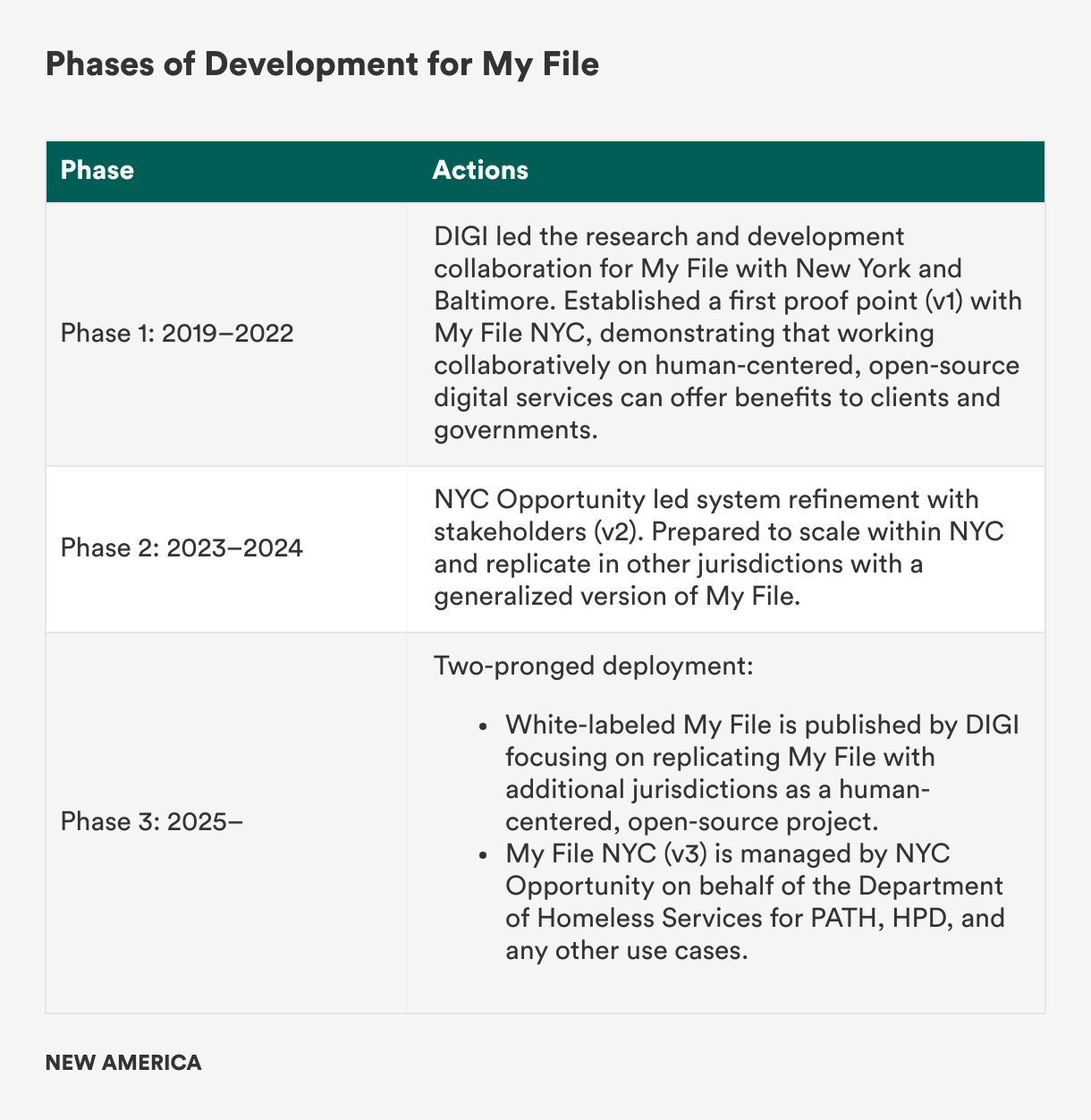
Phase 1: Design and Pilot
Research
DIGI collaborated with NYC Opportunity and the Baltimore Mayor’s Office of Homeless Services to define the scope of a shared challenge, develop an implementation strategy, and build a core codebase for a secure document storage and sharing platform. User research integrating lived experience informed the design of a mobile-first website that allows residents to easily and securely store and share vital documents when applying for public services. Understanding the nuances of the work was critical, leading to close partnerships with city departments that provide public health and human services. Cybersecurity, data governance, and terms of use are also key considerations in the system’s development.
Minimum Viable Product
After an open request for proposals (RFP) for core code development, DIGI selected Two Bulls. The first version of the system, launched in Baltimore under the name “My Digital Data Locker” in 2021, faced challenges due to the COVID-19 pandemic. Each jurisdiction adapted the core code to meet specific needs, with Baltimore opting for a managed service (SaaS) approach while New York City customized the system with internal engineering talent and Blenderbox.
Requirements
Stakeholders identified system requirements, key features, and integration methods that would not disrupt existing operations. NYC Opportunity manages the system in collaboration with the Department of Homeless Services (DHS) and the Prevention Assistance and Temporary Housing (PATH) intake center. The platform is optimized for NYC’s technology services including the centralized public identity management application (NYC.ID). These efforts pave the groundwork for a robust and scalable implementation tailored to the city’s unique needs.
Launch
My File NYC was launched as a limited-scale pilot in partnership with PATH. Families with children seeking temporary housing were given an option to use My File NYC for securely storing and sharing their essential documents. The pilot aimed to serve 500 families while managing a backlog of additional features. The successful deployment provided valuable insights into user behavior and system performance, allowing for further refinements.
Proof of Concept
The first phase validated the proof of concept, showing strong acceptance among both residents and PATH administrators. Despite initial challenges in Baltimore, lessons learned from that deployment contributed to the implementation in New York, where the system has remained live since 2022, highlighting the potential for further growth and accessibility improvements. With a solid foundation, My File NYC is well positioned for continued expansion and enhancement.
Phase 2: Improve, Scale, and Replicate
User-Centric Upgrades
My File NYC was upgraded in 2023, with significant iterations on the code, design, usability, security, and infrastructure to better meet the needs of both clients and staff. As part of the upgrade and in response to feedback from users, the team added 13 human-translated languages going beyond Local Law 30 and shared outreach materials, such as flyers and a looping get started video at PATH to boost user engagement.
Replatforming
In parallel with user-centric enhancements, the NYC team embarked on replatforming efforts with a new data architecture model. The underlying infrastructure is completely rebuilt, making it easier to maintain and scale while introducing agency-based workflows, document checklists, re-upload capabilities, communicating and sharing documents from the city to clients, and other enhanced features.
Scale and Replication
As the system matured and prepared to scale in New York, DIGI prepared for solution replication outside of the city. We developed a white-labeled, open-source version that incorporates its own authentication functionality, independent of the NYC.ID-reliant login system. We also explored replication models that address operational deployment, documentation, contracting, and capacity considerations to ensure effective adoption.
Technical Support
To further strengthen the platform, we added a dedicated engineer to the replication team and hosted a listening tour to gather feedback from external peers and people-first tech organizations. We also sought the technical expertise of a public benefit corporation, Exygy, for an assessment of the quality of the code (on items such as modularity, clarity, documentation, and ease of deployment by a new jurisdiction).
Recognition
The My File NYC pilot was awarded “Best IT Collaboration” at the New York City Technology Forum’s 2023 Best of NYC Awards for the partnership between the DHS PATH Intake Center and the NYC Opportunity team. The system was showcased at BenCon2024. It is also included in the Digital Gov Hub, managed by the Beeck Center for Social Impact + Innovation at Georgetown University and the American Public Human Services Association.
Phase 3: Code Publication and Beyond
Two-Pronged Deployment
- The white-labeled My File code is independent of a jurisdiction or use case and is essential for replication outside of New York. It will need to be customized for deployment by use case. We are focused on replication opportunities with additional jurisdictions interested in human-centered service delivery.
- Based on the success of the deployment in New York across the two phased approach, the project is scaling to an additional housing-related use case. My File NYC (v3) is scaling in New York City and is managed by NYC Opportunity, working in collaboration with the Department of Homeless Services for PATH, Housing Preservation and Development (HPD), and other potential use cases. More information about My File NYC can be found online.
Flexible Application and Focus on Modularity
My File can be customized to meet the needs of future implementers. Tools and services that can be used in a variety of contexts or designed to meet common challenges in administering public programs and services tend to make for more scalable and spreadable digital public goods than software solutions built for narrow use cases.
Code
The solution code and documentation in GitHub is accessible and thorough. It contains the deployment scripts for the My File platform and serves as the central documentation hub. We created a project Wiki with comprehensive information about My File—including how to use it, detailed technical documentation, and guidance on making contributions to the system—and welcome feedback and suggestions for improvements. Additionally, the Wiki has a troubleshooting guide and a roadmap covering future improvements and known limitations.
License
Feel free to use, modify, and distribute the My File code in accordance with the terms of the MIT license.
Replication Outside of New York City
We continue to explore replication models that address operational deployment, documentation, contracting, and capacity considerations to ensure effective adoption. The rest of this report details our findings on these fronts.
Reflections and Recommendations
The My File project’s most essential ingredient is the trust that was nurtured and sustained by project partners. While the journey has certainly not been linear and direct, it demonstrates a bright spot in the delivery of a critical government service, a viable alternative to the status quo of purchasing software from a vendor. Through multi-stakeholder collaboration, mission-driven nonprofit organizations can partner effectively with governments to deliver human-centered, impactful solutions that meet people’s needs.
Lessons Learned: What Went Well
Delivered an Open Solution to a Common Challenge
Every government wrestles with how to effectively, efficiently, and safely improve access to programs and services. We focused on the goal of delivering a mobile-first, open-source solution that improves access to services and strengthens the provision of programs without creating a digital-only environment to meet beneficiaries where they are and provide ease of use and access for all involved. We paid attention to historic blockers in government tech, procurement limitations, legal concerns, and cyber requirements to develop a system that works for the clients and the public servants administering the programs.
Forged Multi-Stakeholder Collaboration in the Public Interest
We worked openly and collaboratively, and we identified other change champions with cross-functional resources, experience, and interest. DIGI serves as a thought partner and a not-for-profit innovation driver with different learning objectives than private sector actors developing closed systems. We could access various subject matter expertise and informed research, including lived experiences. User testing helped us identify process friction early, ensuring that the tool was both accessible and intuitive. Working with NYC Opportunity, a nimble office with the mandate to incubate new interventions driving economic mobility, allowed partners to focus on what they could bring to the table for effective development. This flexibility helped the project to progress faster, cost less, and circumvent delays typical of government procurement processes.
Well-Suited for Philanthropic Support
We started small in scope and designed a pilot that was doable before determining next steps. The collaboration was instrumental in gathering valuable insights and validating the potential for My File to function in a complex public ecosystem. Contractual, political, and organizational constraints sometimes hamper agility in govtech, but the project’s commitment to iterative practices ultimately allowed us to refine the product effectively. Maintaining a clear vision for the goals of the product and access to philanthropic support helped us navigate these challenges and maintain momentum.
Considerations for the Future
There are always things that can be improved when a project is assessed with a retrospective lens. We identified a few decisions that made sense with respect to managing costs, capacity, and resources but now strike us as areas we could have approached differently.
Scalability
Our initial focus was to build for our partner jurisdictions. We did not focus on scalability, which caused some challenges later on.
A critical issue was that v1 was not optimized for scale or replication. As a result, we spent significant time retrofitting v3 of the system into something that can be adapted by other jurisdictions. This effort could have been mitigated if scalability, openness, and flexibility had been prioritized from the outset in addition to focusing on the proof of concept. However, that approach may have required far more resources.
The initial plan was to collaboratively build for both New York City (NYC) and Baltimore. The idea was to deliver core code that each city could customize and use. However, from the start, the two cities had different plans and significantly different needs. NYC requested full control of the code and offered technical talent to manage and customize it. Baltimore preferred more of a vendor-style managed service. These differences made it difficult to deliver a single solution that worked for both. Eventually, the My File solution gained more traction in NYC, and so the solution became built for NYC. This meant that the solution could not directly be spread to other jurisdictions and required abstraction (generalization), for example, of variable names, images, and processes, for another jurisdiction to use it. We addressed this challenge by white-labeling the code.
What’s interesting is that the My File project was able to establish a high degree of trust in both Baltimore and New York by assessing each jurisdiction’s needs and designing a solution to meet those needs while addressing a common goal. That meant that the first proof points were more likely successful because the collaborations met the cities where they were. It’s easy to imagine a world in which we approached Baltimore and New York with a white-labeled version that was not customized for either of them and subsequently gained no traction. Solving for NYC allowed the development of a strong proof point that we can now turn toward scaling, however onerous, and that meant we did not build for scale from the start. On the other hand, if we had started with a generalized solution, we may never have gotten the first proof point.
Interoperability
My File is dependent on an infrastructure platform, which means it is not truly interoperable across all infrastructure stacks without refactoring.
The system is hosted on Amazon Web Services (AWS) cloud services. This has benefits, and it makes sense when developing a proof of concept, but it raises challenges if a city or agency wants to use My File outside of an AWS ecosystem. Ideally, the system wouldn’t have operating dependencies.
Workflow
Due to resourcing constraints, we were not able to use a continuous team to work on My File. This led to a pattern of discontinuities in workflow that posed some challenges.
Ensuring a continuous and iterative development process enhances efficiency and alignment with best practices in building user-centered digital services within government. My File was influenced by the nature of philanthropic funding, which was provided in varying amounts and at different intervals. This made it challenging to sustain a full-time product team (product manager, engineers, user experience, research) through various stages. The COVID-19 pandemic compounded these complexities. Additionally, the mechanics of recruiting and retaining technical talent within government, along with securing continuous full-time funding for such roles, presented further hurdles. Philanthropic funding allowed us to augment development capacity with contractors. This flexibility was helpful for resource conservation and progress, but it also introduced new challenges, including longer timelines.
Code Documentation
We could have documented the code more thoroughly, which would have made the effort to scale and replicate across jurisdictions far more straightforward.
Comprehensive documentation from the beginning is essential for replicating projects like My File NYC in other contexts. Open-source best practices of documenting from the start isn’t always in reach for time- and resource-crunched engineers, as much as we wish it had been.
Potential for Replication
My File’s potential for effective replication needs to be considered alongside potential implementers’ desired use case and existing systems, technical infrastructure, and capacity. But there are clear reasons that it is a strong contender for replication by any city or agency exploring improvements in service delivery.
Customizable Modularity
One of the most important technical takeaways is the undisputable value of modularity. Modular design—especially in elements such as the authentication model and data management—should facilitate troubleshooting and scaling, making the system more flexible for future implementations. We like the “community layer” aspect of the solution. It can work across current systems (which tend to be focused on a single government program or service, run by a single department), making it far easier to customize for different use cases.
Definitive Proof Point
“If you can make it here, you can make it anywhere” is applicable in the civic tech space. The implementation of My File NYC demonstrates the proof of concept is valid by ensuring that residents’ documents were protected with the highest standards of privacy and security. This use case gives additional legitimacy for a potential replication. For some cities or organizations exploring replication, New York’s implementation may feel out of reach given its size and resources. However, the pilot in NYC was small and well-defined, and the solution can aid in different environments regardless of size and internal technical talent. There are ways to customize My File to reflect the realities on the ground, so smaller cities and organizations should not let NYC be a deterrent on that front.
Ease of Deployment and Cloud Infrastructure
My File leverages modern cloud technology, which is ideal for governments modernizing public services. Unlike traditional on-premises systems, cloud solutions follow a pay-as-you-go model, cutting capital costs while dynamically allocating resources based on demand. This flexibility is crucial for services with fluctuating usage. Additionally, cloud platforms obviate the need to maintain physical infrastructure, shifting security, compliance, and updates to specialized providers. By utilizing cloud technology, governments can deploy My File faster, strengthen cybersecurity, and enhance accessibility, all of which strengthen service delivery.
Assessment of Needs, Capabilities, and Outcomes
We recommend starting with an initial assessment that considers specific use cases, internal champions, available resources and constraints, and how the tool supports broader goals. This assessment will provide a foundation for understanding what is feasible. Successful system design, development, implementation, and ongoing support hinge on deep understanding of stakeholder needs, capabilities, and desired outcomes, as well as thorough planning and architecture. Further research and planning will be needed to guide implementation, including costs, timelines, technical setup, testing, training, and clear roles and responsibilities.
Specifically, conditions for success include:
- Identified need and meaningful scope for My File: Know how it can help achieve programmatic goals.
- Commitment to strengthen public services backed by research and design from the partners working to provide those programs: For example, with the NYC deployment, PATH is a supportive and collaborative partner that deeply understands the nuances of accessing and delivering services.
- Capacity and resources for sustainability: This could be in-house or with a trusted vendor. Either way, an internal project team should be empowered to champion the work, related requirements, and manage resources.
Customization for Effective Delivery
Building digital services within the context of an implementer’s specific needs and capabilities necessitates customization for effective delivery of policy and public programs, and adapting a digital public good is one way to do so efficiently. It skips the reinvention of the wheel step, but how to get to that next step isn’t well mapped out for governments, and there are choices.
- The most direct route would be to fork the repository and customize it for a well-defined pilot deployment. If the proof of concept version is successful, the host can continue to customize or scale as needed.
- If multiple jurisdictions band together as a cohort, it may be more effective to maintain a stewarded core code so that all versions benefit from system updates.
- It is conceivable that some sort of nongovernmental entity, such as an academic institution or a nonprofit, could manage, develop, and push the growth of open-source digital public goods, including My File.
- Alternatively, a forward-thinking government entity could do that, too, though it may find offering shared services to be a way around some of the obstacles of digital public goods (e.g., capacity/capability).
- A private sector entity could be an option for the sustainability of some digital public goods. There are many examples of technology companies that operate profitable businesses utilizing open-source projects (e.g., Red Hat/Linux or Google Chrome/Chromium).
Each replication path has pros and cons, depending on the level of control and customization required by a jurisdiction. Forking would be the most independent option and allow for the most flexible reuse. For example, a jurisdiction could take modules of My File without necessarily using the entire system. However, once forking is done, the code is no longer in sync with the main open-source repository and would no longer receive updates from it. Working in a stewarded or community model would require more coordination and fidelity to the main branch of the project but would allow for continued connection for updates and revisions to be done together collaboratively.
Leveraging Open-Source Solutions in Government
Leveraging replicable open-source solutions may take time, but it doesn’t have to be daunting. Stakeholders—whether governments, public IT and program delivery teams, funders, tech providers, the nonprofit civic tech ecosystem—can all be pushing for greater transparency, interoperability, and collaboration through open data and open-source projects. Several key actions could support the use of open source in public administration for better service delivery and innovation.
- Reimagine public procurement to be open, accessible, and competitive.
- Support internal technical and administrative capabilities and capacity. Adopt open data policies for the government and promote data sharing and reuse across agencies while ensuring privacy preservation and security in software initiatives.
- Streamline secure and efficient routes to establish eligibility for services in addition to connecting people directly with those services.
- Identify flexible funding streams. Many civic technology pilots have roared to successful starts but fell into disrepair as funders and the project contributors alike realized that the funding would need to continue to support the project itself as well as the ongoing scale and potential for replication.
- Incentivize trusted multi-stakeholder collaborations. The partnerships that supported My File provided a layer of expertise that supplemented the internal capabilities of Baltimore and New York, helping to bridge gaps in product management, development, and other key areas. Include civil society partners that have a clearer mandate to serve as a trusted sounding board and solution finder that isn’t trying to upsell a solution.
Conclusion: Building Forward
Collaborative and coalition approaches to societal challenges is the ideal. This is best achieved when open solutions and civic groups, political leaders, philanthropies, business leaders, technologists, faith leaders, and unions and workers’ groups, work in concert at the local, state, and national levels to build and implement solutions designed in the public interest. This is an obvious point to those of us who do the work, but it is worth repeating for governments that are accustomed to working directly with for-profit entities. Governments can explore innovative ways of working with third parties, instead of traditional status-quo procurement. Rather than posting a single monolithic request for proposals, governments could invite vendors to work collaboratively on responsive, resilient, and cost-effective solutions to big public sector problems.
The one clear motive for open-source digital public goods and anyone who works on them is better serving the public interest, while private sector vendors must operate in a project-first or product-first orientation. Private sector vendors can work toward the public interest; it is just more complicated for them to do so. Real change is rarely a quick fix. Developing new and sustainable paths for government innovation needs far more attention, research, and effective case studies. It also requires flexible and sustainable funding models that foster contributions from all stakeholders. Open-source software is a route to strengthening public service delivery and addressing some of the obstacles preventing the adoption of systems more responsive to the needs of clients, frontline staff, and administrators.
The My File project demonstrates that working with and for communities can lead to government service delivery that is both efficient and effective. We are thrilled to share the My File codebase and invite the public interest tech community to explore the repositories. DIGI is actively exploring partnerships and collaborations with jurisdictions working toward improving pathways to accessing public services.
More About the Authors

Allison Price