
Table of Contents
Lessons For Local Governance
There are ways to maximize the efficacy across all governance models, and there are lessons that are more specific to particular approaches. Below, we identify broadly applicable principles that can be implemented across any governance archetype and more specific principles for programs led by either school districts, city or county agencies, or independent organizations.
Broadly Applicable Principles
Enlist a champion who can marshal resources for the program.
Implementing a large-scale early childhood education program—particularly on a short timeline—requires an all-of-government approach. The entity managing the program rarely has control over all the necessary functions. If new early childhood centers need permits and licenses, there will likely be a role for city or county health departments, building departments, fire departments, and others. Early childhood programs are unlikely to rise to the top of their list of priorities, not out of malice or any disrespect, but because those agencies are typically capacity-strapped and juggling competing requests. If a mayor, city council member, or county leader can compel those agencies to prioritize early childhood education, it will lead to smoother implementation.
Create genuine avenues for community voice and participation.
As outlined in a prior brief, creating authentic opportunities for community members—especially parents and educators—to inform policymaking is critical to designing programs that meet the needs of the people using them. Depending on the governance structure, the options for involving family and provider voices might look somewhat different. If there is a formal board with oversight responsibilities for the program, parents and providers could be given seats. An advisory board specifically for parents and providers could be another option, so long as the group is truly given visibility and opportunity to influence the program.
Consolidate as much of the funding and decision-making as possible.
In most jurisdictions, a complex process map is necessary to even attempt to understand how all the different early care and education funding streams flow. Often, local executive leaders do not look at the overall picture of early care and education services and supports, defaulting instead to viewing each as a separate program. This fragmented management can negatively impact service delivery because each agency may be operating within its own silo, motivated by different goals and priorities. The agency administering child care funds has, by statute, an orientation toward enabling parents to work, even over prioritizing the developmental needs of children. A public school district will have a natural lean toward looking at early childhood education as an on-ramp for K–12 education. (See the box below for a tale of two Bay Area consolidations.)
Early Childhood Governance in the Bay Area
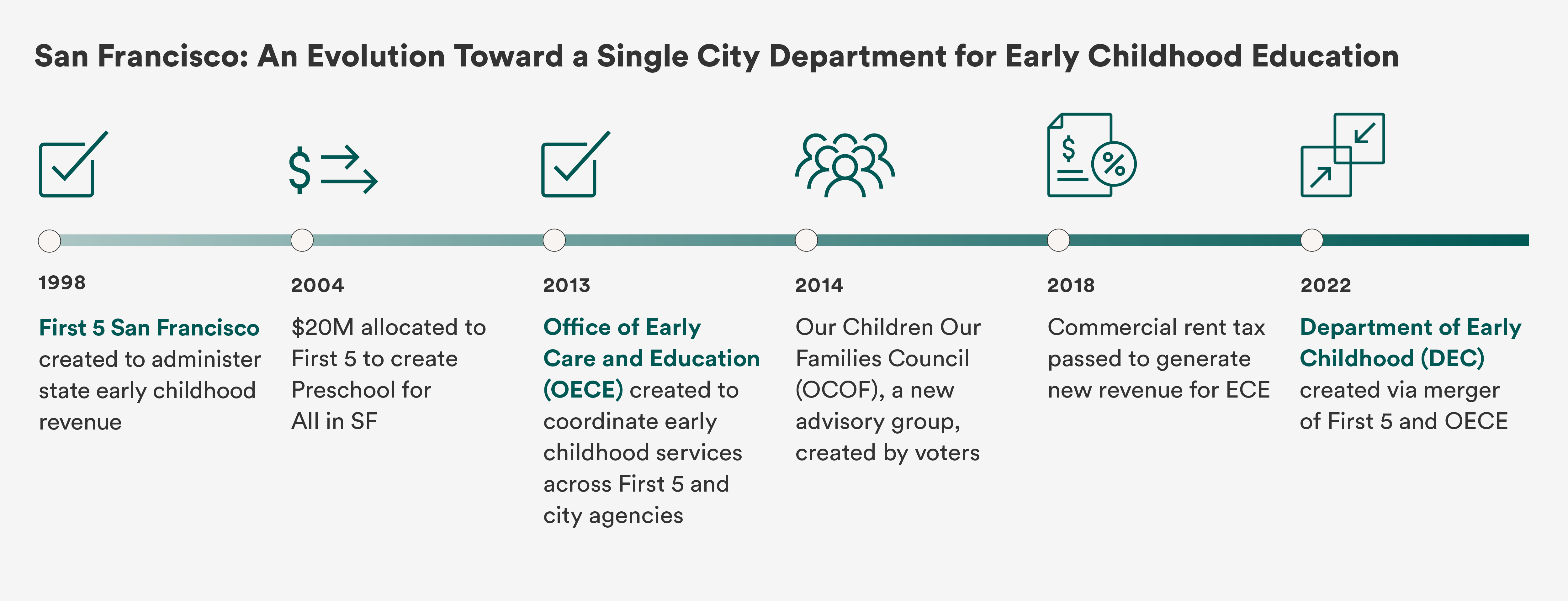
San Francisco’s Department of Early Learning represents the somewhat rare and successful attempt to fully consolidate management of early care and education at the city level. Over 20 years, the city has evolved its governance structure, first by putting systems in place to coordinate across offices, and later, by formally merging them. San Francisco is both a city and a county, which supported this consolidation: The county-level First 5 San Francisco, an entity created by the state to administer revenue for early childhood education, was merged with what had been the city-level Office of Early Care and Education to create the now-unified department.
Just across the San Francisco Bay, there are multiple structures within California’s Alameda County involved in the administration of early childhood education services. Oakland is the largest city within Alameda County, but the county extends well beyond Oakland’s borders. First 5 Alameda, a county commission created under the same state law as First 5 San Francisco, plays a critical role in coordinating services and has driven recent efforts to raise new revenue for publicly funded services. Within Oakland, the mayor’s office and the public school district have been active leaders, and the city of Oakland also raised new revenue in the last several years for early care and education. First 5 Alameda administers both the Children’s Health and Child Care Initiative for Alameda County (Measure C) and the Oakland Children’s Initiative (Measure AA). With oversight of both funding sources and a clear role in countywide system-building, First 5 Alameda is able to drive coordination and collaboration across an otherwise fragmented landscape.
The first step is for local leaders to map out where different services are located and how they are managed. Then, consider where there are opportunities to streamline management to enable greater coordination in service delivery and eliminate redundancies or confusion. That’s easier said than done: Public agencies are typically loath to give up the programs they manage, and state or federal rules may restrict a locality’s ability to move around large grant programs. If—as is the case in most places—it is inevitable that multiple agencies are in charge of different pieces of the early childhood care and education system, someone should be empowered to lead, set priorities, coordinate across agencies, and create some sense of accountability.
Be thoughtful about what can and should be done in-house and where there are meaningful opportunities for partnership.
Administering a mixed-delivery early education program requires a wide range of functions: contracting, payment, enrollment, programmatic and instructional oversight, student support services, data, research and evaluation, and more. Governance does not always have to be synonymous with direct management. In some organizations, it may be feasible to scale up the staff, systems, and infrastructure to manage all functions of a publicly funded early childhood program. In others, it may be too costly or time-consuming; implementation may be more efficient and impactful with the support of outside partners. Within the ECE Implementation Working Group, there are teams running large-scale preschool programs with a staff of fewer than a dozen people and a large roster of contracted partners. There are other teams with dozens or even hundreds of staff members who do everything from the core back-office functions of the organization to the front-line coaching and social work support in early childhood classrooms. Neither model is inherently better. As part of the planning process for any early childhood system, it is important for local leaders to map out all of the functions and services required for their program, to assess where the organization administering the program has the skills and capabilities to run the program (or can build them), and to identify where there may be functions that require outside partners.
Outsourcing some functions, particularly more technical ones, can be a good thing: It can allow the organization running the program to focus on its strengths and to bring experts to the table who know their area of work well. Some program administrators also appreciate the accountability, both actual and perceived, of employing external vendors. There are also some risks to outsourcing core functions, including concerns about who owns and manages sensitive data, where the controls are for key decisions, and questions about accountability to voters and the general public. These risks can be mitigated through careful, strategic management and by making thoughtful choices about which partners to bring on. This question is explored in more detail, specifically as it relates to centralized enrollment systems, in a prior brief in this series.
Principles in Systems Where the School District is Leading
Create the conditions so that everyone feels like they are on the same team.
In mixed-delivery early childhood systems, there is an inherent mismatch between small child care providers and public schools. Public schools are like the Amazon of preschool education: They have scale that child care providers do not, their economic models are less precarious, and they wield more influence and power. When the public school district is the competition, the one making the rules, and the one paying the bills, it can leave smaller child care providers feeling that they are set up for failure.
Districts have taken different strategies to mitigate this dynamic. Some have created formal roles for private providers within their governance structure, giving child care providers more visibility into internal data and a voice in major policy decisions. It can also be important to ask providers what they need to feel more secure, rather than just assuming or deciding on their behalf. This has led some districts to create marketing materials that child care providers can use, and spurred the creation of new shared services models that provide administrative support for all providers, but that may especially benefit smaller operations. In New York City, there is a dedicated team within the Department of Education’s teacher recruitment office focused on identifying and screening teaching candidates for contracted child care centers, and the district hosts hiring fairs specifically for private early childhood centers.
Creating genuine and authentic partnerships requires real investment, and equity has to be more than just a promise. There are systemic policy levers that can also make it clear that equity within the system matters, like investments in teacher salaries to create a more level playing field across contracted child care providers and public schools. In West Virginia, the state’s universal pre-K program is managed by school districts, which are required to contract with private providers for at least 50 percent of slots. Salary decisions are left up to districts, but the state has provided guidance on how they can move toward parity in compensation across schools and contracted programs, and some funding to enable the shifts.
Seek opportunities to meaningfully integrate early childhood and early elementary education.
This can be one of the biggest benefits of a school district-led approach. As there is greater recognition that learning from early childhood through the early elementary years should be treated as a continuum, some districts are reorganizing their work to reflect this. In Chicago, the Office of Early Childhood Education within Chicago Public Schools now has oversight of programming from birth to second grade—a shift from the team’s prior role focused primarily on pre-K. In Boston, the research-backed “Focus on Pre-K” developed by Boston Public Schools has been built out as an aligned pre-K through second-grade curriculum.
Distinguish early childhood education from K–12 where it matters.
When school districts lead early education programs, there is often a concern that three- and four-year-olds will just be treated as mini kindergarteners (and in turn, that kindergarteners will be treated as mini first graders). In reality, the needs of preschoolers are different—instructionally, logistically, and operationally. Districts need to create the systems and processes to communicate differently with early childhood providers and families, and the infrastructure to serve them differently. When the COVID-19 pandemic hit New York City, the Department of Education was able to mobilize supplies and guidance to public schools relatively quickly, but the strategy for pre-K would have to be different than K–12. The Department had to build different distribution systems to get personal protective equipment, or PPE, to the city’s 1000+ contracted child care center partners, who were not linked into the same systems as public schools, while also developing adapted health and safety guidance that was developmentally appropriate for children under five.
Principles in Systems Where a City or County Agency Leads
Make sure people in charge understand the programmatic side of the work.
City and county agencies with contracting experience, systems to manage payment and track key data inputs and outputs, and connections to broader health and human services functions can often be a good fit to manage local early childhood programs. But, it’s less common to find early childhood instructional and programmatic experience within a broader municipal agency that has not managed this type of program before. To ensure a focus on program quality during implementation, it is also critical to ensure these agencies bring in relevant expertise. This could come in the form of new hires in roles with oversight of programmatic decisions, as well as expert advisors, so long as those advisors have sufficient access and influence.
In some cities or counties, there may be an opportunity to create a new department focused on early learning and related topics. This provides a platform to elevate personnel with relevant expertise, and just as critically, ties to the early childhood community. In Allegheny County, Pennsylvania, county leadership launched the Department of Children Initiatives in 2021 to drive a new focus on access to early care and education and afterschool programs. The department’s inaugural director, Becky Mercatoris, had spent her career working in early care and education systems in Pennsylvania and had deep first-hand experience with the relevant policies and funding streams. Her appointment built immediate credibility for the new agency with the local early childhood sector.
Be visible in communities and on the ground.
Programs housed within large government agencies may feel inherently inaccessible to families and providers. Agency leaders can take proactive steps to break down barriers between communities and administrators to ensure that the program feels responsive to community needs, to build public confidence and participation in the program, and to drive authentic two-way communication and feedback. PHLpreK, administered by the City of Philadelphia’s Office of Children and Families, hosts frequent events around the city to build awareness about the program and connect with families, including an annual “citywide play date” in a public park.
Principles in Systems Where an Independent Organization Leads
Independence is good until you need something; put mechanisms in place in advance for clear, ongoing communication.
Independent or quasi-independent organizations may have the flexibility and freedom to operate without some of the red tape that slows government agencies down. However, no organization can do it all, and there will be moments when the city or county government needs to step in. Build systems and relationships in advance so the lines of communication are open well before an emergency strikes, and then keep them open to account for the frequency with which elected or agency leaders might cycle in and out of roles. This could include regularly scheduled conversations between program leaders and local government leaders, proactive relationship-building with local elected officials, and standing committees that include staff from critical city and county agencies.
Leverage your board wisely.
Nonprofit organizations are required by law to have boards. The organizations administering local early childhood programs typically have a specific board structure mandated by law or charter; many have board members appointed by city officials. For example, 10 members of the Denver Preschool Program Board of Directors are appointed by the Mayor and approved by the City Council, and the City Council appoints one of its members to serve on the board. The Cincinnati Preschool Promise Board of Managers is jointly appointed by Promise Forward, a coalition of early education groups; Cincinnati Public Schools; and the United Way of Greater Cincinnati; each of the three organizations can nominate board observers. In San Antonio, the Pre-K 4 SA Board of Directors has 11 members: one appointed by the Mayor and the rest appointed by a member of the City Council; the Mayor’s appointee is the chair.
Across all these organizations, the organizational leader works with the nominating bodies to identify the types of people who would be a good fit for the board. The board can be one opportunity to elevate parents and providers into leadership positions, giving them a greater voice in decision-making. The board can also be a strategic lever to support the program’s sustainability. Pre-K 4 SA has been built on relationships with San Antonio’s business community, which has championed the program; the organization’s board has been one avenue to solidify and strengthen those ties.
The board can also take on activities that the organization values, but may not have the bandwidth to take on in-house. Cincinnati Preschool Promise’s board has a standing communications committee that takes on some of the work to engage community members, bolstering the capacity of the organization to do this work. This allows the organization to gather more comprehensive public input ahead of major decisions.