Joe Posner
New America Fellow, 2023
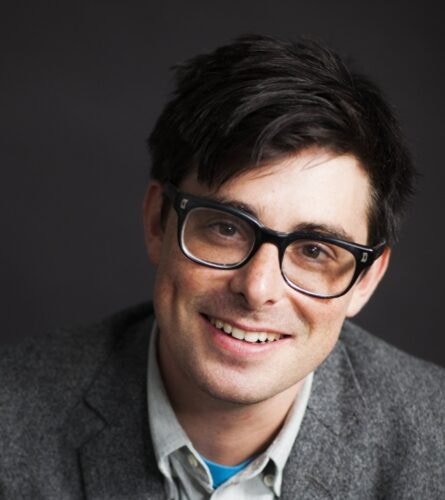
New America 2023 Fellow Joe Posner spoke about his new YouTube channel, Dream On, for “Three questions” in The Fifth Draft, the Fellows Program’s monthly newsletter. Posner is a filmmaker, motion designer, musician, and creative leader. He co-founded Vox Video in 2014, building their award-winning YouTube channel.
Joe, you’ve just launched Dream On, a new YouTube show traveling the country to find the people and places improving economic mobility in America. The premise is that the American Dream isn’t dead, it is just badly covered. What is the news getting wrong?
It’s fundamentally human to slow down on the highway to look at a fiery car crash, and that’s not a wrong impression of U.S. national politics right now. Looking closely at problems rather than away is important work.
But there’s never been more competition for our attention, and conflict content is cheaper and faster to make. I just want to see equal energy going toward what’s going right. Shouldn’t a program 10 times as cost-effective as smaller class sizes spread? Spartanburg, South Carolina transformed its most struggling neighborhood—maybe your city can too.
Back in 2004, Paul Tough and The New York Times Magazine’s coverage of the Harlem Children’s Zone snowballed and inspired projects I’m now covering today. What I saw missing was a YouTube-era magazine to make today’s version of that story. Until now…
But there’s never been more competition for our attention, and conflict content is cheaper and faster to make. I just want to see equal energy going toward what’s going right.
You’re a Vox Video co-founder, used to having a newsroom’s machine around you. Dream On is made differently: in partnership with a university, published straight to your own channel. What does that setup let you do that a place like Vox couldn’t?
First of all, a lot: Harvard’s EdRedesign Lab has this unreal network and access; they are sponsoring fellowships and conducting research around our subject matter. They are an amazing resource on economic mobility projects across the entire country. It means the world they’ve bet on me and my amazing teammates.
But a newsroom can do these things too; I’m wary of treating independence as the answer. YouTube-focused journalists thriving independently are almost all newsroom-made. And community only gets more important outside institutions. I made a video with Brian Eno about why: great work doesn’t come from a genius, it comes from a scenius.
So, I don’t think this is an escape from the newsroom; it’s an opportunity to build a new kind. I’m so grateful to have partners whose mission matches mine, so I can chase evidence-heavy stories—and hopefully, to empower another cohort of creator-journalists who’ll far surpass whatever I do.
Two episodes in, you’re taking on a long list of American problems: housing, healthcare, education. How do you choose where the show goes next?
We go where something is measurably working and there’s a useful lesson. The first five episodes are a kind of pilot season, so we’re looking to cover the range of what it takes to support someone from birth to finding a good job, and how that work crosses these fields.
This week’s episode is a surprising effort in Dallas, where a local nonprofit is helping lead maternal health efforts to fight child poverty from before birth. We’re also working on stories focused on crime and on the job market.
But these are an opening salvo. I’m hoping these five find our core audience—and that they clue us into the narrower, stranger stories we haven’t heard about yet. (Send them to us here!)
Subscribe here to receive next month’s issue of The Fifth Draft.
New America Fellow, 2023