
Introduction
Over the years, New America has shared the stories of educators who took unconventional journeys into the teaching profession. We shared the experience of Liliya Stefoglo, who worked as a multilingual paraeducator for 10 years before her school principal recognized her exceptional instructional skills and supported her in becoming a teacher.1 We described how Yazmin Gil became a kindergarten teacher after spending eight years pursuing her certification at three different schools.2 We also charted the path of Ramiro Acosta, an experienced parent coordinator, who was able to earn a bachelor’s degree and teaching certification only after receiving financial support from his district.3
The successes of Stefoglo, Gil, and Acosta are unfortunately rare, but their challenges are common. One major reason is that far too many pathways into teaching cater to “traditional” candidates—those entering a bachelor’s degree program in education soon after completing high school. These programs expect teacher candidates to enroll in classes full time and commit several months to unpaid student teaching toward the end of their training. But many aspiring teachers—particularly those who are racially, ethnically, and linguistically diverse —are far from traditional: they are caretakers, heads of household, and career switchers. A good number of them come from low-income backgrounds.4
Non-traditional candidates can bring many assets to schools, including cultural competencies, language skills, instructional experience, and commitments to their local community. But getting these gifted candidates into the classroom will require developing teacher preparation pathways that reduce unnecessary barriers and provide comprehensive supports. Fortunately, Stefoglo and Gil’s home state of Washington, along with other states, is investing in Grow Your Own (GYO) programs that offer accessible, affordable, and well-articulated pathways into teaching. This report offers insights into how states are using competitive grants to expand and bolster these programs.
What are Grow Your Own Programs?
GYO programs are supportive pathways into the teaching profession for local candidates who aspire to teach in their communities. A recent nationwide scan by New America confirms that there is no universal model for these programs.5 Whereas some encourage middle and high students to pursue education majors, others help adults with ties to schools (e.g., paraeducators, uncertified school staff, substitutes, and community members) obtain their teaching certification and often a bachelor’s degree, which is required to teach. GYO programs typically involve partnerships between districts and institutions of higher education, both universities and community colleges. Some follow the “2 + 2” model,6 allowing candidates to begin their teacher preparation at community college and complete it a four-year institution. These programs can usher candidates through traditional teacher preparation programs,7 alternative route programs8 based at institutions of higher education (IHEs), or alternative routes not based at IHEs.9 Sponsors can also differ: programs can be initiated by universities, schools, districts, states, or multiple partners. Additionally, GYO programs can adopt elements of teacher residency10 or apprenticeships,11 both of which emphasize clinical experience and mentorship (see: "Varied Elements of GYO Programs" below).
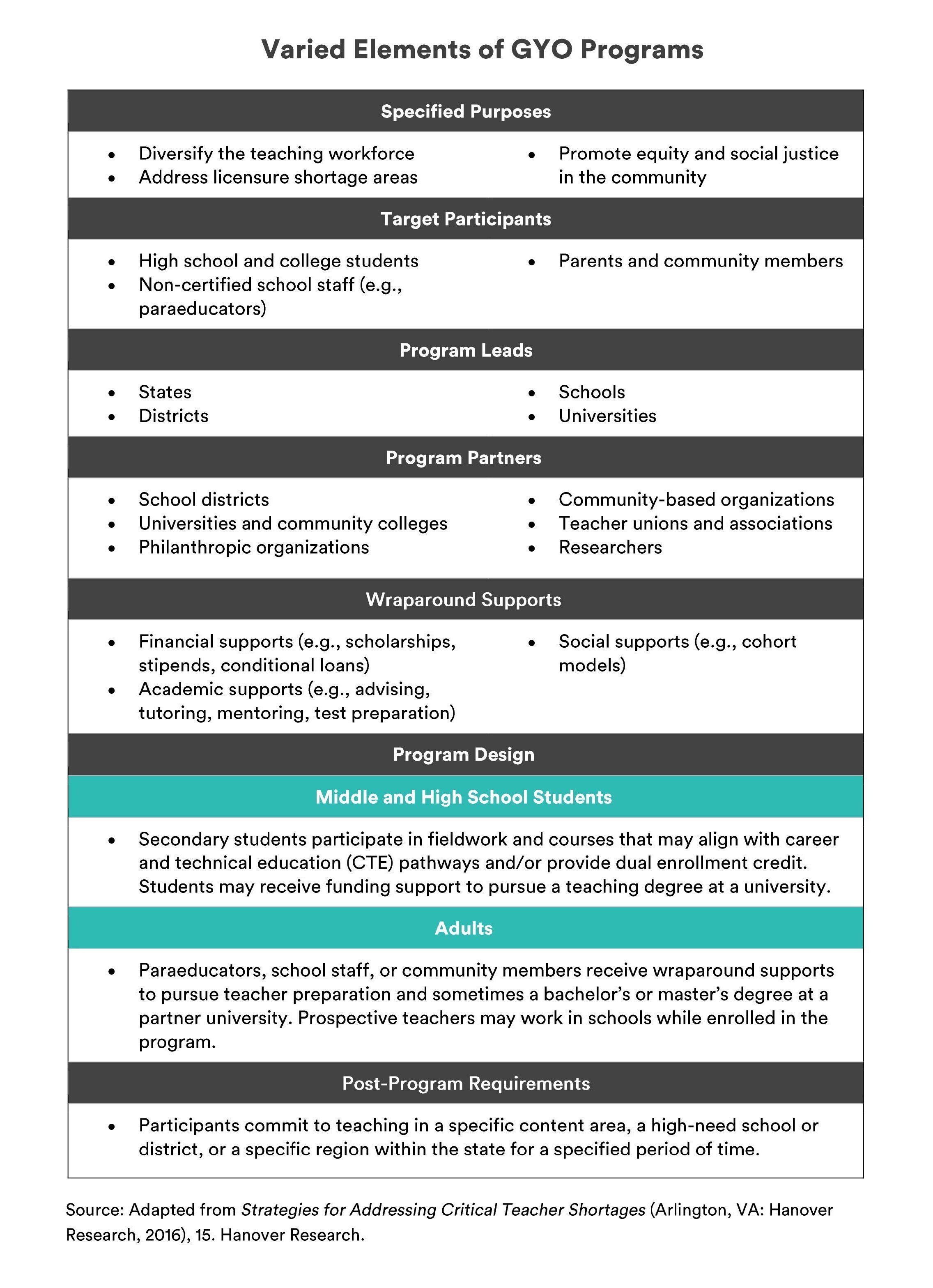
While there is considerable variation in the strategy and design of GYO programs,12 what distinguishes them from other pathways is who they recruit and how they support their candidates. Any program designed to open the door of opportunity to homegrown candidates who may need extensive services and flexibility to earn their teaching credential, and often an undergraduate degree, can be considered a GYO program. A second distinguishing feature is close partnerships between districts and universities that help reduce structural barriers that have historically shut these candidates out of the profession.13
Why Invest in Grow Your Own Programs?
Rather than expend resources to bring teachers from outside of the community into the classroom,14 GYO programs use funds to build local expertise and offer career advancement opportunities to local talent. Indeed, the guiding philosophy of GYO programs is to recruit and prepare teachers from the community for the community. This community-rooted approach yields a range of benefits.
One major contribution is helping schools improve the demographic match between students and teachers.15 While traditional pathways into teaching attract predominately white, female, and monolingual teachers,16 GYO programs recruit from untapped pools of local candidates who reflect student demographics. There are many reasons this is a good idea: racially and ethnically diverse teachers tend to be rated highly by students from all racial and ethnic backgrounds,17 and research has shown that the benefits of same-race teachers include better test scores,18 college-going rates,19 and disciplinary outcomes.20 At the same time, bilingual teachers allow schools to scale up bilingual instructional programs,21 which are uniquely beneficial to English learners.22 When coupled with broader efforts to invest in under-resourced schools and improve working conditions,23 recruiting a more diverse workforce is worth the investment.
GYO programs also have the potential to reduce teacher turnover in hard-to-staff schools, which are often those serving students with the greatest need for teacher talent and stability.24 Local talent recruited by GYO programs often have expertise in high-need school environments and the desire to give back to the community to which they have ties.25 Given this, it makes sense that local candidates may be more effective and more likely to stay in local schools. Although more research is needed to gauge the impact of various types of GYO programs,26 early evidence shows that GYO programs that offer strong financial, academic, and social supports have helped districts recruit candidates from their own ranks who remain in the classroom.27 This not only reduces turnover costs,28 but also ensures that students have access to stable in-school relationships and more experienced teachers.29
Finally, GYO programs show promise for moving the teacher preparation system in a more efficient direction. Historically, there has been little coordination between traditional teacher preparation programs and districts, leading to misalignment between the expertise of the teachers produced and districts’ personnel needs. GYO programs break from this mold by encouraging alignment between educator preparation programs and school districts. When strong coordination exists, GYO programs are able to produce educators who are prepared to teach in the geographical areas, subjects, and grades that typically face shortages. Strong partnerships also benefit teachers, who are able to take advantage of a continuum of supports, more time in schools, and coursework that prepares them to meet district expectations. But the ultimate beneficiary is students, who have teachers who are prepared to meet their academic and socio-emotional needs.
How Should State Leaders Invest in GYO Programs?
While GYO programs are typically established and coordinated at the local level, state decisionmakers can implement competitive grant programs, which provide incentives and policy conditions that bolster programs. Established with the backing of state legislators, state education agencies, local boards of education, and teacher licensing boards, these statewide grant programs are facilitating the development, expansion, and strengthening of GYO programs across the country (see Appendix for an overview).
While existing competitive grant programs differ in their goals, parameters, and requirements, most set criteria that ensure state funds flow to new and existing GYO programs that are well-positioned to institute best practices and deliver desired results. Many programs award priority points to potential grantees who develop clear and carefully constructed budgets, partnership agreements, and goals that align with grant priorities. In some cases, they also give grantees, who typically function in isolation, opportunities to receive technical assistance from state leaders, and learn from other GYO programs in their region or state or state.
To be sure, competitive grant programs have some drawbacks. These programs can unfairly benefit larger districts or universities with grant writers that are better positioned to apply for grant support. Competitive funding that is unpredictable can threaten the sustainability of local programs and, by expanding the recipient pool to new programs, inadvertently dilute funds from existing programs.30 Still, competitive grant programs are helping state leaders promote elements of high-quality GYO programs, such as strong collaboration between stakeholders, sustainable funding models, and data-driven decision-making. Importantly, these grants are also helping states create a more cohesive, statewide GYO strategy.
What are the Elements of High-Quality GYO Programs?
Over several decades, research has provided valuable insights into what constitutes high-quality teacher preparation. While more rigorous studies are needed, we now understand the benefit of certain features of teacher preparation such as the value of hands-on experiences that closely align with teacher preparation curriculum. GYO programs are well-poised to adopt best practices for teacher preparation while maintaining a keen focus on providing the support and flexibility non-traditional, homegrown candidates need to become certified teachers.
In consultation with our Grow Your Own Advisory Group, New America developed a list of policies and practices that can help strengthen GYO programs. Drawn from our two-page publication “Grow Your Own Programs for Bilingual Educators: Essential Policies and Practices,”31 the list below offers seven considerations for developing high-quality programs:
- Recruit candidates who are reflective of and responsive to the local community
- Make programs accessible to candidates with and without a bachelor’s degree
- Provide financial, academic, and social supports
- Provide sustained funding and promote sustainable funding models
- Provide paid, supervised, and coursework-aligned work-based experiences
- Promote collaboration and coordination among GYO partners
- Strengthen data systems to track GYO program impact
While no state currently has all seven recommendations in place, continuing to adopt these practices will help states strengthen their GYO efforts and thereby produce more well-prepared, homegrown teachers. The following sections explain how states are using competitive grant programs to carry out each of these best practices and how other decisionmakers can follow their lead.
Citations
- Kaylan Connally, Amaya Garcia, Shayna Cook, and Conor P. Williams, Teacher Talent Untapped: Multilingual Paraprofessionals Speak About the Barriers to Entering the Profession (Washington, DC: New America, 2017), source
- Amaya Garcia and Shayna Cook, “K–12 Teachers Are Disproportionately White and Monolingual. Here’s One Way That Could Change,” Slate, June 2, 2017, source
- Amaya Garcia, Shayna Cook, Conor P. Williams, and Kaylan Connally, “Multilingual Paraprofessionals Highlight Barriers to Entering the Teaching Profession,” EdCentral (blog), New America, source
- In California, for example, 28 percent of those who participated in the state's GYO initiative said they identified their household annual income range as being either under $10,000, or between $10,000 and $20,000. Forty-four percent indicated they are heads of households, and 43 percent indicated that they are the first in their family to attend college. See California School Paraprofessional Teacher Training Program (Sacramento: California Commission on Teacher Credentialing, 2012), 8.
- Amaya Garcia, Grow Your Own Teachers: A 50-State Scan of Policies and Programs (Washington, DC: New America, July 2020), source
- For an example of this model, see “Profile: Skagit Valley’s Supported Teacher Pathway” in Roxanne Garza, Paving the Way for Latinx Teachers: Recruitment and Preparation to Promote Educator Diversity (Washington, DC: New America, October 2019), 17–28, source
- U.S. Department of Education, Title II, Higher Education Act, Pathways to Teaching, 2016, source
- Dept. of Education, Pathways.
- Dept. of Education, Pathways.
- National Center for Teacher Residencies (website), “The Residency Model,” source
- U.S. Department of Labor (website), Apprenticeship Toolkit FAQ, “What is Apprenticeship?” source
- Garcia, 50-State Scan.
- Angela Valenzuela, "Grow Your Own Educator Programs: A Review of the Literature with an Emphasis on Equity-Based Approaches. Literature Review," Equity Assistance Center Region II, Intercultural Development Research Association (2017): 2–3, source
- For more on how much districts invest to recruit teachers, see Annette Konoske-Graf, Lisette Partelow, and Meg Benner (Washington, DC: Center for American Progress, 2017), source
- For more on how GYO programs can diversify the teaching workforce, see Jenny Muñiz, “Diversifying the Teacher Workforce with ‘GYO Programs,’” EdCentral (blog), New America, February 28, 2018, source
- The State of Racial Diversity in the Educator Workforce (Washington, DC: Department of Education, 2016), source
- Hua-Yu Sebastian Cherng and Peter F. Halpin, "The Importance of Minority Teachers: Student Perceptions of Minority versus White Teachers," Educational Researcher 45, no. 7 (2016): 407–420.
- Seth Gershenson, Cassandra M. D. Hart, Constance A. Lindsay, and Nicholas W. Papageorge, “The Long-Run Impacts of Same-Race Teachers,” IZA Institute of Labor Economics, no. 10630 (2017): 1–70, source
- Gershenson, Hart, Lindsay, and Papageorge, “The Long-Run Impacts.”
- Christopher Redding, "A Teacher Like Me: A Review of the Effect of Student–Teacher Racial/Ethnic Matching on Teacher Perceptions of Students and Student Academic and Behavioral Outcomes,” Review of Educational Research 89, no. 4 (2019): 499–535.
- New America (website), Education Policy, “Instructional Models for ELs,” source
- Jennifer L. Steele, Robert O. Slater, Gema Zamarro, Trey Miller, Jennifer Li, Susan Burkhauser, and Michael Bacon, “Effects of Dual-Language Immersion Programs on Student Achievement: Evidence from Lottery Data,” American Educational Research Journal 54, no. 1S (April 2017): 282S–306S.
- Thomas M. Philip and Anthony L. Brown, We All Want More Teachers of Color, Right? Concerns about the Emergent Consensus (Boulder, CO: National Education Policy Center, 2020), source
- Schools serving low-income students and students of color experience the largest attrition. See Richard M. Ingersoll, “Teacher Turnover and Teacher Shortages: An Organizational Analysis,” American Educational Research Journal 38, no. 3 (2001): 499–534.
- Kam Fui Lau, Evelyn B. Dandy, and Lorrie Hoffman, "The Pathways Program: A Model for Increasing the Number of Teachers of Color," Teacher Education Quarterly 34, no. 4 (2007): 27–40, source
- Conra D. Gist, Margarita Bianco, and Marvin Lynn, “Examining Grow Your Own Programs Across the Teacher Development Continuum: Mining Research on Teachers of Color and Nontraditional Educator Pipelines,” Journal of Teacher Education 70, no. 1 (2019): 13–25, source
- Lau, Dandy, and Hoffman, "Pathways Program.” Additional evidence can be found in Kevin Fortner, David C. Kershaw, Kevin C. Bastian, and Heather Higgins Lynn, “Learning by Doing: The Characteristics, Effectiveness, and Persistence of Teachers Who Were Teaching Assistants First” (paper presented at the 39th annual Association for Education Finance and Policy Conference, March 15, 2014), source
- Replacing one teacher who leaves can cost as much as $20,000 in a large urban district. See Gary Barnes, Edward Crowe, and Benjamin Schaefer, The Cost of Teacher Turnover in Five School Districts: A Pilot Study (Arlington, VA: National Commission on Teaching and America's Future, 2007).
- Matthew Ronfeldt, Susanna Loeb, and James Wyckoff, “How Teacher Turnover Harms Student Achievement,” American Educational Research Journal 50, no. 1 (2013): 4–36.
- To address some of these challenges, leaders can provide application support, offer planning grants, and consider requiring that grant applicants include a high-need district as one of the GYO partners to ensure programs with the greatest need are targeted for support.
- source