
Guaranteed Income and Health Equity
Introduction
Recurring and unconditional cash payment programs—often in the form of guaranteed income (GI) programs—have captured the imagination of local leaders across the country as a potential means of combating some of the most acute problems faced by Americans and their families. In the first half of 2021, there were already 11 pilot programs planned or launched in American cities, with a few dozen other cities indicating interest in exploring cash payment programs.
The aim of direct cash assistance is to provide “the currency of urgency,” according to Mount Vernon, N.Y. Mayor Shawyn Patterson-Howard, in order to help community members pursue or maintain economic and social stability. There is little question that someone cannot maintain stability without access to support for mental and physical health. There is also significant evidence to suggest that the ability to pursue support for good health is heavily influenced by race and income level. So, the question emerges: in what ways is GI a promising tool for democratizing access to mental and physical health?
Measurable health equity outcomes showing improvement in a community’s overall health can serve as a compelling case for how a guaranteed income might positively impact economic equity. It’s important to note that the unconditional character of an inclusive GI program, allowing recipients to use the benefit flexibly on more than just health-oriented activities, has been a key influencer of outcomes. And, cash investments in the community must be paired with community engagement, feedback, and narrative change in order to ensure people retain agency and privacy.
Dr. Stacia West's Perspective
Dr. Stacia West, assistant professor at the University of Tennessee College of Social Work and the co-founder and director of the Center for Guaranteed Income Research, shared her perspective with the authors on guaranteed incomes’ return on investment for health impacts:
“One of the key ways that we are going to drive this policy vehicle is through demonstrating a return on investment in health impacts. So, we can demonstrate a return on investment in the business world and say people are more likely to find full time employment. If you want healthier workers, then you want a guaranteed income. But the argument that will ultimately one day be had on the Hill is, ‘is this a good investment for the country?’ We don't really have that data yet. So those are the questions that we're asking.”
“We know the effects of poverty in the body are expensive. They cause things like cardiovascular disease, pulmonary disease, diabetes. Poverty is one of the worst things that can happen to your health. Is guaranteed income the best solution for it? The only way that we can really bear that out is to have large scale demonstrations, large scale studies, like what we're hosting at CGIR [Center for Guaranteed Income Research] to look at those health outcomes and see over time.”
What is Health Equity?
“Health equity means that everyone has a fair and just opportunity to be healthy. This requires removing obstacles to health such as poverty, discrimination, and their consequences, including powerlessness and lack of access to good jobs with fair pay, quality education and housing, safe environments, and health care.” (Build Healthy Places)
Stakeholder Strategies: The Health Equity Case for Guaranteed Income
Financial resources can impact health in direct and indirect ways, in the near and long-term. Often, health expenses pop up in peripheral ways—a transportation breakdown that keeps someone from a medical appointment, or mounting bills that strain relationships. GI’s main benefit to health outcomes is that it is flexible, able to address any issue that may arise in family care, work, or housing, in a dynamic way that sets it apart from other safety net benefits.
Early reporting from the Stockton Economic Empowerment Demonstration (SEED) experiment suggests that guaranteed income reduced income volatility, which had positive impacts on health, well-being, and agency in goal setting and risk-taking. Multiple SEED program participants also noted they appreciated that SEED’s GI program provided non-invasive support that otherwise can be cumbersome and challenging to navigate for program participants for a variety of reasons. This was particularly true for participants experiencing housing instability or supporting a family member who was formerly incarcerated, as these are instances which can cause disruption or denial of other social safety net supports. This flexibility seems to enable program participants a greater sense of trust in the program and the program creators’ non-judgemental desire for program participants to access increased health and wellness. SEED participants’ comments suggest this increased sense of trust may expand to include an increased sense of generalized trust in societal systems, which is an important factor in individual and collective wellbeing, cohesion, and efficacy. SEED participants also affirmed their increased sense of agency and autonomy, which positively impacts health outcomes and health equity.
Key Health Equity Outcomes from Guaranteed Income
Below is a high-level summary of the health equity outcomes and observations drawn from the Stockton Economic Empowerment Demonstration. Read the Exploring SEED report for more details.
- Improved individual and family mental health outcomes.
- Cash payments reduce income volatility, which reduces stress and anxiety and improves mental health.
- SEED participants expressed gratitude over the agency given and flexibility offered through Stockton’s GI pilot design.
- Reduced income volatility means more schedule stability and time for rest and leisure.
2. Improved relationships and investing time and resources into family members.
- SEED reduced relationship strain, and increased time with family members.
- Spillover effects of income on family and community, where one person receives cash but often spends it on peer networks.
- Cash payments can allow recipients to live closer to and have time to access green spaces and outdoor time in parks improves.
3. Financial stability directly impacts public health through improved job security, as well as the ability to pay off bills and to find safe and stable housing.
- Moving to safer neighborhoods, with more housing options, and fewer lengthy commutes.
- Reducing food insecurity and encouraging more consistent access to healthy food.
- Paying off debt which opens options for investing in other health needs such as medical appointments, check-ups, and medicine.
- Serving as a stepping stone to better/more stable work over the long term.
Addressing Cultural Challenges and Stigma
While early evidence shows the potential benefits of guaranteed income, narratives that stigmatize public assistance impact the perception of government cash payments, and can affect the uptake and popularity of a program like GI. Transparency in data collection, flexibility in benefit design, and community feedback are policy tools to address the growing distrust in government and support the benefits recipients who might anticipate negative treatment from caseworkers or their community.
Delving further into the SEED example, the story bank of interviews used for this analysis illustrates an important facet of how cultural stigma manifests for participants as well as what reflections lead them to interrogate and overcome this stigma. When the Nation reporter Greg Kaufmann asked SEED participants their thoughts on the guaranteed (and not conditional) cash payments SEED provided, many responded in line with what the cultural stigma against poverty would prompt them to say (i.e. that cash payments should be conditional and based on if someone has worked to earn the cash payment through labor market participation or meeting other requirements). However, multiple respondents who reacted with this response initially began to consider their own situation or others they know who have struggled and ultimately spoke to the benefits of SEED’s guaranteed, unconditional approach. One participant speaks directly to this and communicates frustration and confusion about opponents of guaranteed, unconditional cash payments and he critiques the underlying stigma that people are under-resourced due to lack of effort or moral failing:
People are just so negative in this country. Nothing can be good. Anything that comes out that’s helping somebody, it’s just ‘people that are getting help are crack heads. They’re cheating the system, they’re no good, they don’t work.’ That’s the main one, that they don’t work, they’re lazy, they don’t want to do anything with their lives, they’re bums. They don’t believe that people on those programs work, but they need the extra. It’s because they feel, because they have where they’re at, their status, they don’t need it, that nobody else needs it too. – Greg
Another respondent continues about the positives of this program and highlights the choice and freedom enabled by SEED’s guaranteed, unconditional cash payment approach:
[Other social service programs] ask you twenty one questions about this and that, and it has nothing to do with anything. Compared to SEED, they give you the money and they’re basically putting it in your hands to see what you’re going to do with it. You decide whether you’re going to eff it up or you’re going do something good for yourself and accomplish something. I think it’s great because they’re not all up in my business or asking me what am I doing with it. As far as welfare goes, they want to know who’s living at the home, how much you’re spending on this and that, and not everyone keeps up with that kind of stuff. I think it’s good, it has its good and bad. – Falaviena
Another SEED participant acknowledges the risk, yet is ultimately optimistic and hopeful that cash payments provide less harm and more good:
"I think it's risky. There's really no stipulation as to what anybody's going to do, you're in a low-income, poverty city where obviously people do use money for things that wouldn't be intended: drugs, alcohol, etc. And with no real guideline to it, it is a risk…but not to say that these other programs don't have flaws either. I've heard of plenty of people selling their EBT for cash to go and buy drugs, the same things… but ultimately you're still trying to benefit the community and help people out, so anytime you're trying to help people hopefully it's more of a positive than a negative." – Rory
Many of the recipients who participated in the SEED story bank interviews expressed some apprehension or distrust for the SEED funding, at least while they were still learning about the project. They also noted that some residents in the community have stigmatized views about poverty and government assistance programs. These factors influenced why participants emphasized the importance of privacy and agency as positive features of the guaranteed income model.
Community distrust in government stems from local experiences with larger safety net systems that were intentionally designed to make accessing benefits difficult. When systems meant to support people fail them, it is imperative that social stakeholders take action to rebuild trust and partner with communities to build inclusive policies. SEED’s First detailed how public lack of trust in government affected the uptake and implementation of the project. And, 40 percent of the payments loaded to the prepaid debit card that recipients received was withdrawn as cash or moved to another bank account. The participants’ motives to withdraw the cash were partially attributed to rational financial management and partially to a pervasive lack of trust in financial institutions in the community.
Philanthropy, government, employers, and community-based leadership can and should have a role in co-developing and delivering effective outreach and messaging related to public health and safety net benefits. By positively influencing the larger narrative around public benefits access—through coalitions, community events, and intentional storytelling—social stakeholders can work to improve benefit uptake and improve community trust.
Role of Employers
The SEED project control group participants—those who did not receive the $500 monthly—experienced 1.5 times more income volatility than the group that did receive cash allowances. However, both groups still experienced high income volatility: Those who received cash allowances had incomes that fluctuated 46.4 percent monthly, and the control group participants experienced a 67.5 percent monthly income fluctuation. This high income volatility points to a larger concerning trend. Some SEED participants relayed that they had pieced together multiple part-time jobs in order to make ends meet, and others were working exorbitant hours out of financial necessity. And, when employers limit shifts and reduce hours, employees have reduced benefits and fewer opportunities to earn more income.
Questions for Consideration: What role could/should long- and short-term, temporary and gig employers play in incentivizing guaranteed income pilots or policy, for demonstration of corporate social responsibility and/or to preserve productivity? Is there a role for philanthropy to play in incentivizing employer behavior change?
Regulating Eligibility
Participants in the study included residents of Stockton who lived in neighborhoods at or below the city’s median household income. However, the cash allowance recipients had diverse education and career experiences, financial resources, and social networks—with some better-resourced than others. While the cash had an overall positive effect, further research could seek to test targeted versus universal approaches to implementation. Cash allowances could potentially impact participants in different ways, with the potential for cash to have a greater stabilizing impact on more vulnerable individuals.
Some barriers to determining who should receive cash benefits include ideological ones (behavioral conservatism and notions of personal responsibility), implementation issues (funding and political pushback), and the potential for unintended consequences (the idea that GI would make low-wage jobs less appealing or impact the amount of benefits one might receive from another safety net program).
Questions for Consideration: Who should receive cash allowances? If the more vulnerable recipients self-report greater improved health outcomes than those with more resources as a result of the benefit, is this an argument for regulating eligibility?
Passing, Implementing, and Sustaining a Guaranteed Income
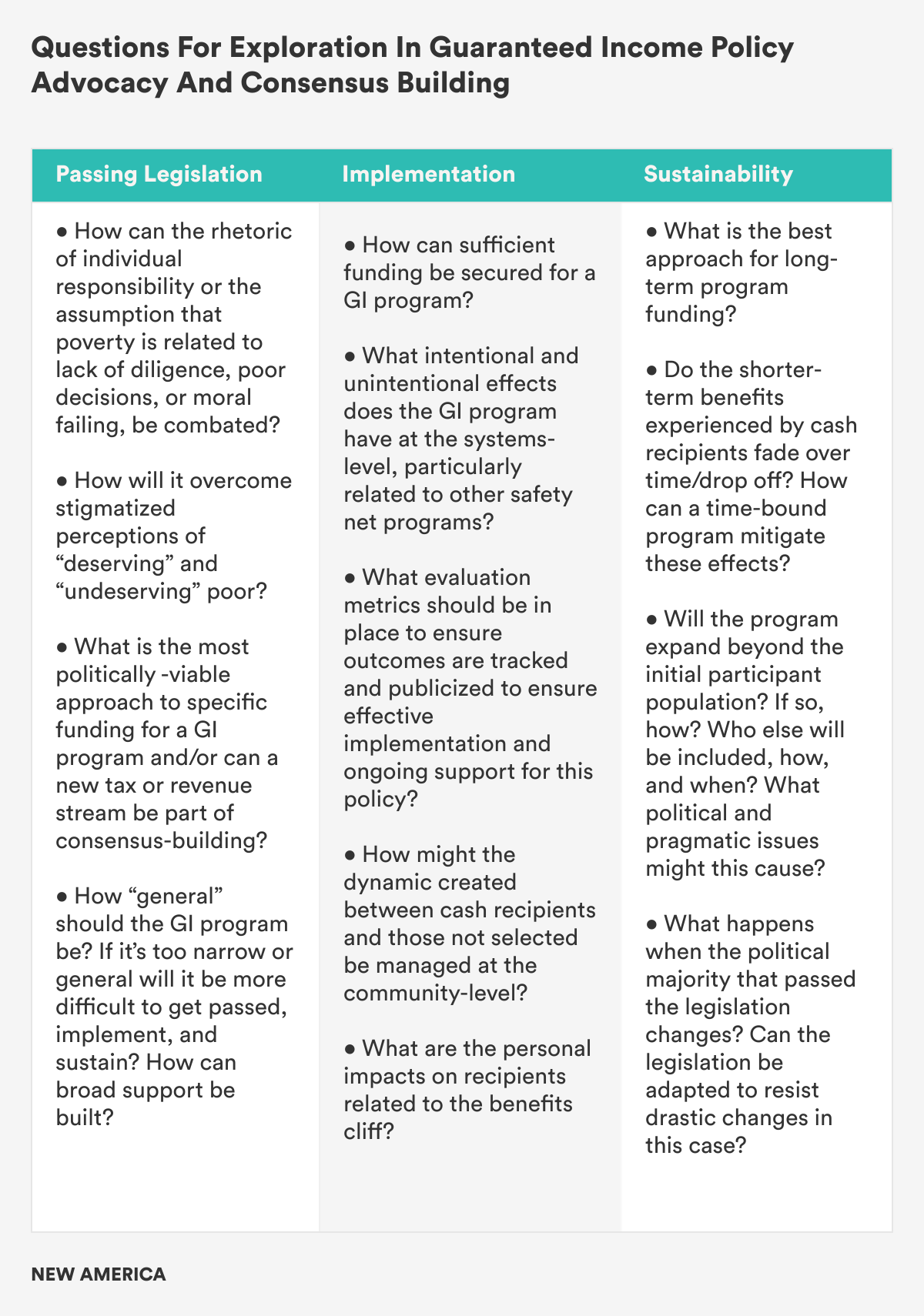
A policy idea, such as GI, requires three steps to achieve the positive aim it seeks to affect. Once conceived, an evidence-based policy must be: 1) passed, 2) implemented, and 3) sustained. Disruption at any stage in this process can hinder the effectiveness and longevity of the policy idea. Each step can present its own complexity and challenges that policymakers must consider as they strategize how to use a policy idea for public benefit. According to Dr. Stacia West, positive health outcomes, particularly for mental health, are a convincing and measurable return on investment that could sway political tides. And, in order to make change at the federal level, guaranteed income pilots must pair qualitative and quantitative data collection to show a more complete view of the impact of guaranteed income on health. Positive health outcomes demonstrate the direct return on investment that cash transfers could have.
The following table highlights some of the roadblocks, in the form of questions, that policymakers and civic leaders must ask themselves in planning advocacy and consensus building around GI in these three critical steps of policy change.
A Few Ways Practitioners Seek to Address These Challenges
On Tuesday, May 25, 2020 New America California convened four mayors from across the United States to discuss their perspectives on, and plans to implement, GI programs at “The Potential of a Guaranteed Income: A Conversation with Four Mayors.” The panelists included Mayor LaToya Cantrell of New Orleans, La.; Mayor Lauren Poe of Gainesville, Fla.; Mayor Libby Schaaf of Oakland, Calif.; and Mayor Siddiqui Sumbul of Cambridge, Mass. Their insights included:
- Schaaf: "We all have committed to not just gathering data on our guaranteed income demonstrations, but also contributing to the narrative. The narrative must change about what causes poverty, it is not lazy people, it is a system that is broken and unjust."
- Cantrell: "So when you do that work [narrative] will evolve. The stories of how you help people, how you can demonstrate that those gaps are actually shrinking, that the disparity gaps are going and whether you have a healthier and more vibrant Community everyone wins from that."
- Poe: “This is an old trope that poor people don't know how to spend their money correctly and that's why they're poor. It’s both classist and racist. We don't ask our senior citizens to report how they use social security, but when we talk about people in poverty we control how they use their money. This is especially true for those returning from incarceration. ‘They’ think they can tell people how to live, but folks know exactly what they need to do to best serve their family”
- Siddiqui: “The momentum is a critical element as we collect data to address decades of economic inequity. Bipartisan support really does give me a lot of hope. COVID has been horrible, but it's also taught us so many lessons and enabled us to be more urgent and not [just] study the problem anymore.”
- Siddiqui: “Cambridge RISE is comprised of local organizations working together to launch the pilot and ensure everyone who can apply for the lottery does. The team is connected to local organizations and the housing authority, and has a strong finger on the pulse of who our constituents trust.”
- Schaaf: “We’re leaning on the trusted messengers and physically going to the places where the people are.”
Two of the mayors stated during the webinar that getting GI adopted at the federal level is their long-term goal for sustainability/long-term impact.
Conclusion
Once a policy is created, it can be used as a tool for societal change through a basic three-step process: enacting, implementing, and sustaining the policy. Historically, support for guaranteed income programs fell along traditional party lines with Democrats wanting increased government sponsored social welfare support and Republicans wanting restricted social welfare programming. The underlying disagreement between this divide is the effectiveness of social welfare programs and the deservedness of recipients. However, the COVID-19 global health pandemic and increased attention paid to racial disproportionalities in income, health, and overall well being spurred an influx of support for general income policies; a recent Stanford study illustrated that 88 percent of liberals supported GI policies, and conservative support of GI policies rose meaningfully from 25 percent before COVID-19 to 45 percent.
The current U.S. safety net works as designed—in a disconnected way that puts the onus of responsibility on the beneficiaries to reach out for help, apply, and know what’s available. This antiquated and racist practice primarily functions to control the narrative of deservedness and reduce the number of people accessing benefits and public services. In order to consider what a revolutionary approach to health equity could look like, stakeholders must interrogate new and innovative approaches that center the needs of people and patch the holes in the current system. Cash assistance has proven benefits on individual, family, and community health, and should be explored and interrogated further as an economically transformative model to improve health.
Acknowledgments
Developed with the generous support of:
Blue Shield of California Foundation
Downloads
More About the Authors

Roselyn Miller Champion
Grant Analyst, City of Portland

Molly G. Martin
Senior Strategist, Executive Office